Mar 5, 2026

You set your alarm. You filled the syringe. You even picked the right injection site. But then you froze. Morning or night? Before breakfast or after dinner? Does it even matter?
It matters more than most guides admit.
Not because tirzepatide absorbs differently at 7 AM versus 9 PM. The pharmacokinetics do not change based on your clock. But the way your body responds to those first few hours after injection, the nausea, the fatigue, the appetite shift, all of that changes dramatically depending on when you press that plunger. And the timing you choose on day one tends to become the timing you stick with for months. Choose poorly, and you are fighting side effects instead of managing them. Choose well, and those same side effects barely register. The difference between a miserable first week and a smooth one often comes down to this single decision, yet most protocols treat injection timing as an afterthought.
This guide breaks down exactly when to inject tirzepatide based on your schedule, your side effect profile, and your goals. Whether you are on your starting dose or deep into weight loss dosing, the right time of day can make your entire protocol easier to sustain. SeekPeptides members consistently report that dialing in injection timing was one of the simplest changes that improved their experience the most.
What the prescribing information actually says
The FDA-approved prescribing information for tirzepatide is clear and deliberately vague at the same time. It states: administer once weekly at any time of day, with or without meals. That is the official guidance. No preferred time. No restrictions around food. No morning-versus-evening recommendation.
This matters because it means the drug itself does not care when you inject it. Tirzepatide is a long-acting peptide with a half-life of approximately five days. It reaches peak plasma concentration somewhere between 8 and 72 hours after injection, and it maintains therapeutic levels throughout the entire week regardless of when you administered it. The dosage determines your blood levels. The timing does not.
But here is what the prescribing information does NOT tell you.
It does not tell you that nausea typically peaks 1 to 3 hours after injection. It does not mention that fatigue often hits within the first 24 hours. It does not explain that your appetite suppression kicks in strongest during the first two days post-injection, which means you can strategically time that suppression to align with your hardest eating days. These practical realities are where injection timing actually becomes important.
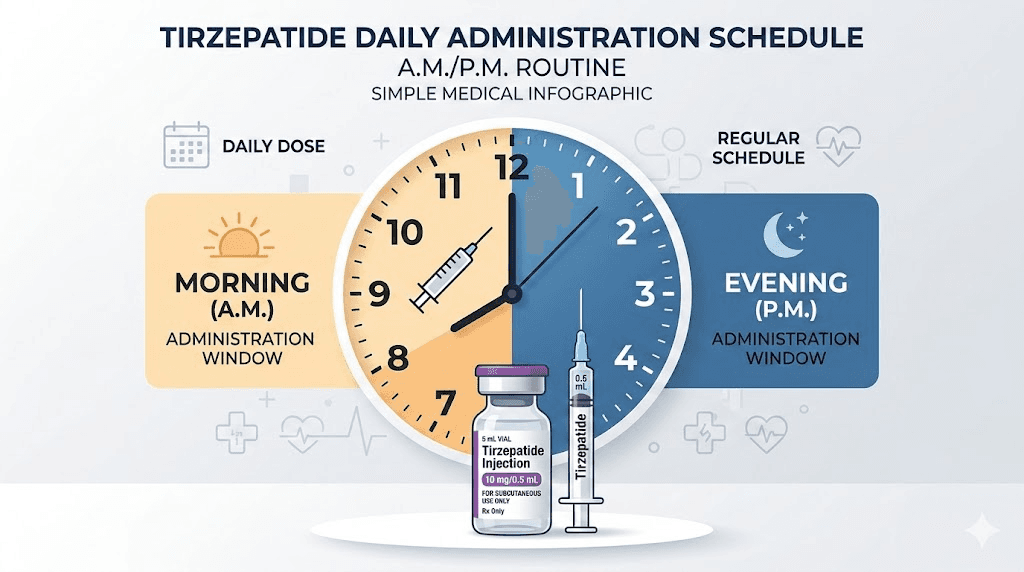
Morning injections: the case for starting your day with tirzepatide
Morning injection is the most popular choice among tirzepatide users, and for good reason. When you inject between 6 AM and 10 AM, you get several practical advantages that make the first 24 hours more manageable.
You can monitor side effects while awake
This is the number one reason clinicians and experienced researchers recommend morning injections, especially during your first few doses. Tirzepatide side effects, particularly gastrointestinal symptoms, tend to appear within the first few hours. If you inject at 7 AM, any nausea peaks around 8 to 10 AM when you are fully awake and can respond appropriately. You can adjust your meals, drink ginger tea, take a walk, or simply ride it out.
Compare that to injecting at 10 PM and waking up at 2 AM with nausea. Not ideal.
If you are on a dose escalation phase, moving from 2.5 mg to 5 mg or higher, the first injection at each new dose is when side effects are most likely to surprise you. Morning timing gives you a full day to assess how your body handles the increase before you need to sleep.
Appetite suppression aligns with your eating window
Tirzepatide works by activating both GIP and GLP-1 receptors, which slow gastric emptying and reduce appetite. This effect is strongest in the first 24 to 48 hours after injection. When you inject in the morning, that peak suppression window covers your daytime eating hours, the exact period when most people struggle with cravings and overeating.
For researchers following a tirzepatide diet plan, morning injection means breakfast and lunch feel effortless. You naturally eat less without white-knuckling through hunger. By dinner, the effect is still strong. This alignment between peak appetite suppression and your most challenging eating periods is one of the biggest practical advantages of morning dosing.
Easier to build a consistent routine
Consistency matters more than timing. The prescribing information emphasizes same day, same time, every week. Morning injection pairs naturally with existing habits. You wake up, inject, go about your day. It becomes part of your routine like brushing your teeth. Evening schedules shift more often. Social events, late dinners, travel, all of these can disrupt a nighttime injection routine. Morning tends to be more stable across most lifestyles.
Who benefits most from morning injection
Morning injection works best for people who experience digestive side effects that they want to manage while awake, people who struggle with daytime eating and want maximum appetite suppression during meals, people with predictable morning routines, and anyone during the first four weeks of a new protocol or dose increase. If you are using a compounded tirzepatide formulation and handling your own injections, morning timing also gives you better light and steadier hands for the injection process itself.
Evening injections: the case for nighttime dosing
Evening injection has its own set of advantages, and for some people, it is clearly the better choice. The data suggests that evening administration reduces nausea and vomiting in up to 20% of patients, likely because they sleep through the worst of the initial gastrointestinal response.
Sleep through the nausea window
If nausea is your primary concern, and for many tirzepatide users it is, evening injection offers a simple solution. Inject at 8 or 9 PM, go to bed at your normal time, and let your body process the initial absorption while you sleep. By morning, the acute nausea window has passed. You wake up feeling the appetite suppression without the accompanying queasiness.
This strategy works particularly well during dose escalation. When you move from lower doses to higher ones, the first injection at the new level often brings the strongest nausea. Sleeping through it eliminates one of the most common complaints about tirzepatide.
No disruption to your workday
Some people experience mild body aches, headaches, or fatigue in the hours following injection. If you work a demanding job where you cannot afford to feel off, evening injection keeps those symptoms out of your professional hours. You deal with any discomfort during downtime rather than during a presentation or client meeting.
This is especially relevant for people in physically demanding jobs. Mild muscle discomfort or injection site tenderness bothers you less when you are headed to bed than when you are headed to the gym or a construction site.
Weekend injection timing strategy
Many researchers split the difference. They inject on Friday evening, giving themselves the entire weekend to process any side effects. This is a popular strategy during the first month of treatment or whenever increasing the dose. By Monday morning, the initial side effect wave has passed, and they head into the work week with nothing but smooth appetite suppression.
Who benefits most from evening injection
Evening injection works best for people who experience significant nausea that they would rather sleep through, people with demanding daytime schedules who cannot afford side effect disruption, people who find their appetite suppression from morning injection wears thin by dinner (evening injection shifts the peak), and anyone who finds the injection process stressful and prefers to do it during relaxed evening hours.
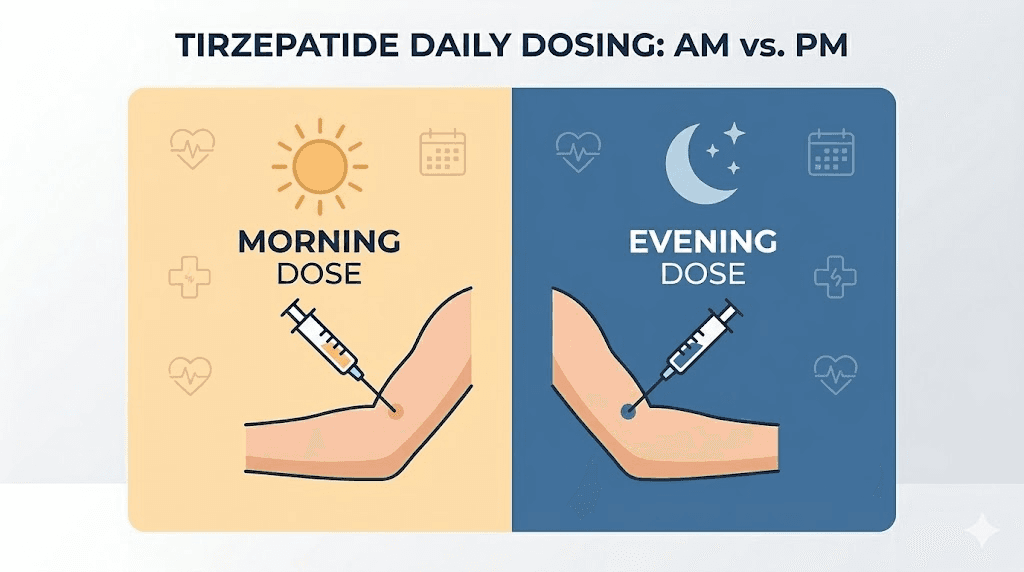
The pharmacokinetics behind injection timing
Understanding how tirzepatide moves through your body explains why timing affects your experience but not your results.
Absorption and peak levels
After subcutaneous injection, tirzepatide absorbs slowly from the injection site into your bloodstream. Peak plasma concentration occurs between 8 and 72 hours, with most people reaching peak levels around 24 to 48 hours post-injection. This wide window means the drug does not spike and crash like a short-acting medication. It builds gradually.
The bioavailability is approximately 80%, meaning your body uses most of what you inject. Because tirzepatide is highly bound to plasma albumin (99%), it stays in circulation for days. The half-life of five days means that after your injection, it takes roughly five days for blood levels to drop by half. This is why weekly dosing works, and why the specific hour you inject matters far less than consistency.
For people using standard dosing protocols, steady-state concentration is typically reached after approximately four weeks of consistent weekly injection. At steady state, your blood levels stay relatively flat throughout the week, with only modest peaks and troughs. This pharmacokinetic profile is what makes tirzepatide so forgiving when it comes to exact injection timing.
Why food does not affect absorption
Because tirzepatide is injected subcutaneously, it bypasses the digestive system entirely. This is fundamentally different from oral tirzepatide formulations, where food timing matters significantly. With injectable tirzepatide, you can inject before meals, after meals, on an empty stomach, or mid-meal. None of it changes how much drug reaches your bloodstream or how quickly it gets there.
This is important because many people assume they need to fast before injection, similar to fasting for blood work. You do not. Eat normally. The injection goes into subcutaneous fat, not your stomach.
The side effect timing window
While the drug itself works the same regardless of timing, your experience of side effects follows a predictable pattern. Most gastrointestinal side effects appear within the first 24 to 72 hours after injection. Nausea specifically tends to peak in the first 1 to 3 hours, then settles into a lower-grade discomfort that can persist for a day or two.
This is why your choice of morning versus evening makes a practical difference. You are essentially choosing when to experience that 1 to 3 hour peak. Morning injection puts it during your waking hours. Evening injection pushes it into your sleep window. Neither approach changes the side effects themselves, just when you feel them.
Day of the week matters more than you think
Most tirzepatide timing discussions focus on morning versus evening. But choosing the right day of the week might be even more important.
The weekend injection strategy
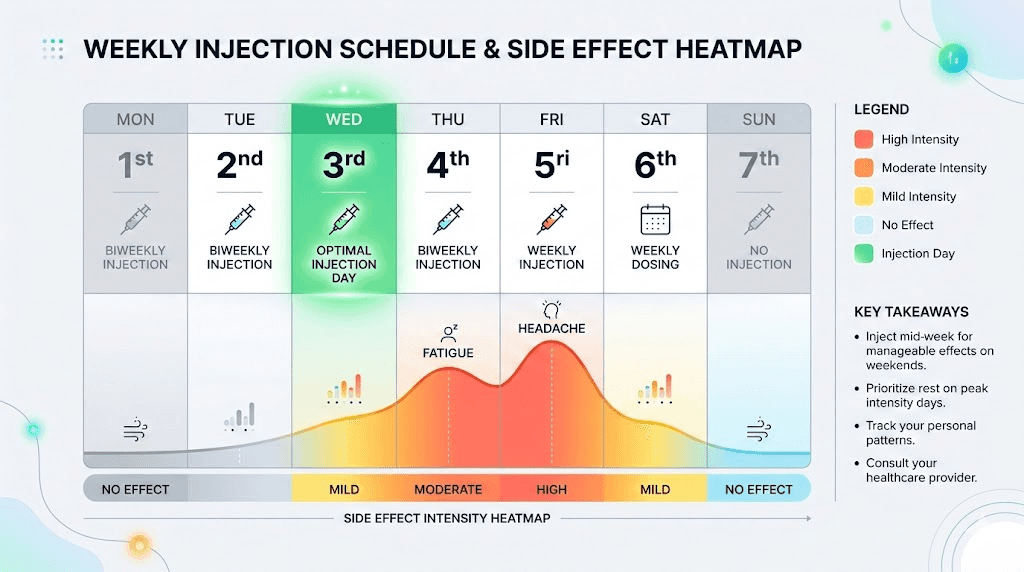
Injecting on Friday evening or Saturday morning gives you the entire weekend to handle any side effects. This is the most popular timing strategy among experienced users, and for good reason. Your first 48 hours post-injection, when side effects are strongest, fall on days when you have the most flexibility. You can rest if you need to. You can eat lighter meals without workplace lunch pressures. You can skip the gym without derailing a rigid weekday schedule.
By Monday, the acute phase has passed. You head into the work week with strong appetite suppression and minimal side effects. This rhythm works well whether you are just starting or well into your protocol.
Aligning injection with your hardest eating days
Think about which days you struggle most with food. For many people, weekends are when discipline breaks down. Social eating, restaurant meals, alcohol, all of these cluster on Saturday and Sunday. If that is your pattern, injecting on Thursday or Friday morning puts your strongest appetite suppression window right over the weekend.
Alternatively, if weekdays are your challenge, say you eat out for lunch with coworkers or stress-eat at your desk, a Sunday or Monday injection peaks your suppression during the work week. Match the timing to your weakness.
For people following specific food guidelines or a structured meal plan, aligning injection day with the start of your meal prep cycle creates a natural rhythm where motivation and biology work together.
Changing your injection day safely
If you need to shift your injection day, the standard guidance is straightforward. You can change the day as long as your last injection was at least three days (72 hours) ago. So if you normally inject on Monday but want to switch to Friday, wait at least 72 hours after your Monday injection, then inject on Friday. Going forward, Friday becomes your new day.
Do not inject early to shift your schedule. Injecting less than 72 hours after your previous dose increases your risk of side effects without providing additional benefit. If you are considering taking it early, understand the minimum spacing requirement first.
How to choose: a decision framework
Stop overthinking this. Use this framework to pick your timing, then commit to it for at least four weeks before reconsidering.
Step 1: identify your primary concern
What bothers you most about tirzepatide? Or if you are just starting, what concerns you most?
If nausea is your biggest concern: Evening injection. Sleep through the peak nausea window. This is backed by data showing up to 20% reduction in nausea severity with evening dosing. Combine with an anti-nausea diet strategy for best results.
If monitoring side effects matters: Morning injection. You stay awake through the initial response window and can adjust your day accordingly. Essential during starting dose phases.
If daytime appetite control is the goal: Morning injection. Peak suppression covers your eating hours. Works well with a structured eating plan.
If work performance is the priority: Evening injection. Keep side effects out of business hours. Sleep through any initial discomfort.
Step 2: consider your schedule
Which time of day is most consistent in your life? If your mornings vary wildly, a 7 AM injection schedule will eventually slip. If your evenings are packed with social commitments, 9 PM injections will get forgotten. Pick the time slot that is most reliably available, week after week.
For people who travel frequently, morning injection tends to be more reliable because hotel mornings are more predictable than hotel evenings. If you cross time zones regularly, stick with the time zone of your home base to keep spacing consistent.
Step 3: test and adjust
Your first four weeks are an experiment. Pick a time based on the framework above, then pay attention to how your body responds. If morning injection makes nausea unbearable during work, switch to evening. If evening injection disrupts your sleep, switch to morning. The beauty of tirzepatide pharmacokinetics is that the drug works the same either way, so you are free to optimize for comfort without sacrificing effectiveness.
Keep a simple log. Note your injection time, any side effects in the first 24 hours, your sleep quality, and your appetite levels the next day. After four weeks, you will have enough data to make an informed permanent decision.
Injection timing by dose level
Your ideal injection time might change as your dose increases. Here is how to think about timing at each stage of your tirzepatide journey.
Starting dose (2.5 mg): prioritize monitoring
At 2.5 mg, side effects are usually mild. This is an initiation dose, not a therapeutic dose, meaning its primary purpose is letting your body adjust. Morning injection is ideal here because you want to observe how your body responds. Most people feel very little at this dose, maybe mild appetite reduction and occasional queasiness. But some people are more sensitive, and morning timing lets you catch any unexpected reactions early.
If your first dose goes smoothly with morning injection, you have a baseline. If it brings noticeable nausea, you have data that suggests evening injection might be better for higher doses.
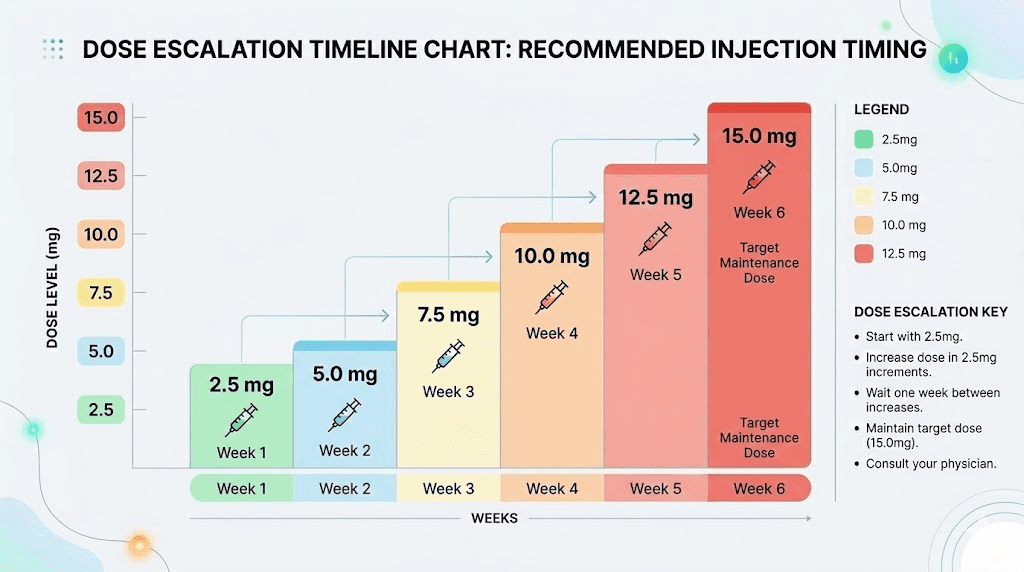
Escalation doses (5 mg to 10 mg): flexibility matters
The escalation phase is where side effects are most noticeable. Each dose increase resets your tolerance to some degree, and 5 mg to 10 mg is when most people feel the biggest jump in gastrointestinal effects.
Consider switching to evening injection during dose increases, even if you normally inject in the morning. Sleep through that first-night nausea peak, then return to morning injection once the new dose stabilizes after two to three weeks. This hybrid approach gives you the monitoring benefits of morning injection at stable doses and the nausea protection of evening injection during transitions.
Some researchers using microdosing protocols find that smaller, more frequent dose increases produce less dramatic side effects, which makes the morning versus evening choice less critical. But standard escalation protocols benefit significantly from strategic timing shifts.
Maintenance dose (10 mg to 15 mg): optimize for lifestyle
Once you reach your maintenance dose and your body has fully adjusted, side effects typically diminish. At this point, choose whatever time fits your lifestyle best. Many people settle into a comfortable morning routine. Others prefer evening for the slight edge it gives in managing residual digestive symptoms.
At maintenance, the focus shifts from managing side effects to optimizing benefits. If you want maximum daytime appetite control, morning wins. If you want the appetite suppression to carry through evening social situations, an afternoon or early evening injection shifts that window later.
Common timing mistakes and how to fix them
Even experienced tirzepatide users make timing errors. Here are the most common ones.
Mistake 1: changing your injection time every week
Some people inject Monday morning one week, Tuesday evening the next, Thursday afternoon the week after. This inconsistency does not affect the drug itself, but it makes side effect patterns unpredictable and harder to manage. It also increases the risk of forgetting a dose entirely.
The fix is simple. Pick a day and time. Write it on your calendar. Set a phone alarm. Treat it like an appointment you cannot cancel. If you need to change, do it once and commit to the new schedule.
Mistake 2: injecting too close to bedtime when starting
Injecting right before bed sounds logical. Sleep through the side effects, right? But if you are new to tirzepatide and have never experienced its side effects, you do not know how your body will react. Some people get significant insomnia from their injection. Others experience dry mouth or nighttime nausea that wakes them repeatedly.
If you want evening injection, start with at least two to three hours before your planned bedtime. This gives you a buffer to assess your initial response before committing to sleep. Once you know how your body reacts, you can adjust the exact time.
Mistake 3: skipping a dose because you missed your window
You normally inject at 8 AM Saturday. It is now 3 PM Saturday and you forgot. What do you do?
Inject now. The exact hour does not matter pharmacologically. A seven-hour delay is irrelevant when the drug has a five-day half-life. The mistake would be skipping the dose entirely because you missed your preferred time. Next week, go back to 8 AM Saturday. One off-schedule injection will not derail your protocol.
That said, if you realize on Sunday or Monday that you missed Saturday entirely, you need to make a judgment call. If it has been less than four days since your last injection, take it as soon as you remember. If it has been more than four days, take it and then pick a new injection day going forward based on when you actually took it. Never double dose to make up for a missed injection.
Mistake 4: not accounting for time zones when traveling
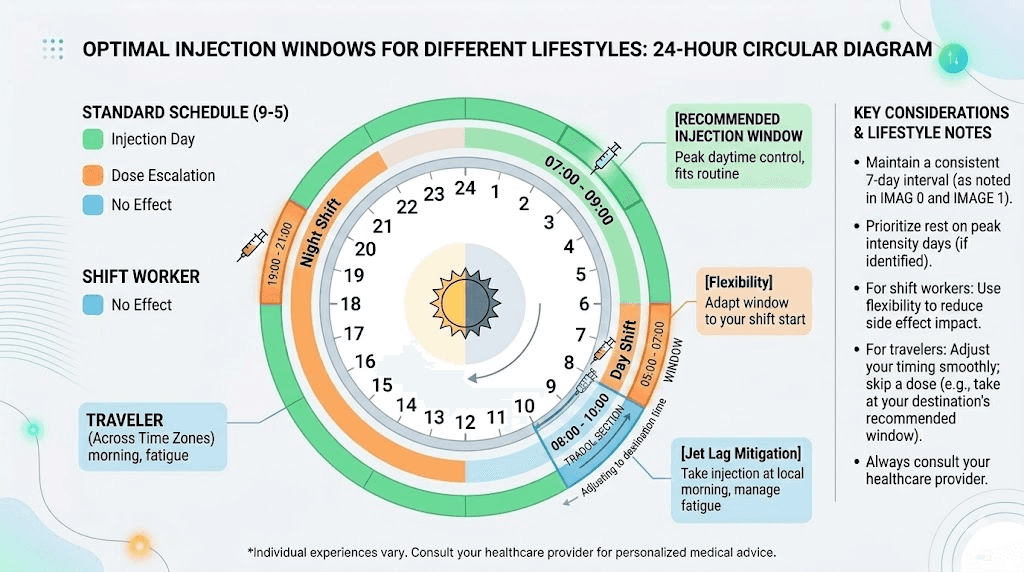
If you travel with tirzepatide, time zone changes can throw off your schedule. A 9 AM injection in New York is a 6 AM injection in Los Angeles and a 2 PM injection in London. For short trips (a week or less), try to inject at your home time zone equivalent. For longer trips, gradually shift to match the local schedule, then shift back when you return.
The key principle is spacing. Maintain at least 72 hours between injections and no more than nine days. Within that window, you have plenty of flexibility to accommodate travel.
Mistake 5: assuming your timing needs to match someone else
Online forums are full of specific timing advice. "I inject at exactly 7:30 AM and it works perfectly." Great for them. Useless for you. Your metabolism, your side effect sensitivity, your schedule, your specific formulation, all of these differ from person to person. What works for a 200-pound man with no nausea sensitivity will not necessarily work for a 140-pound woman who gets queasy easily.
Use other people experiences as data points, not prescriptions. Test your own timing and trust your own body.
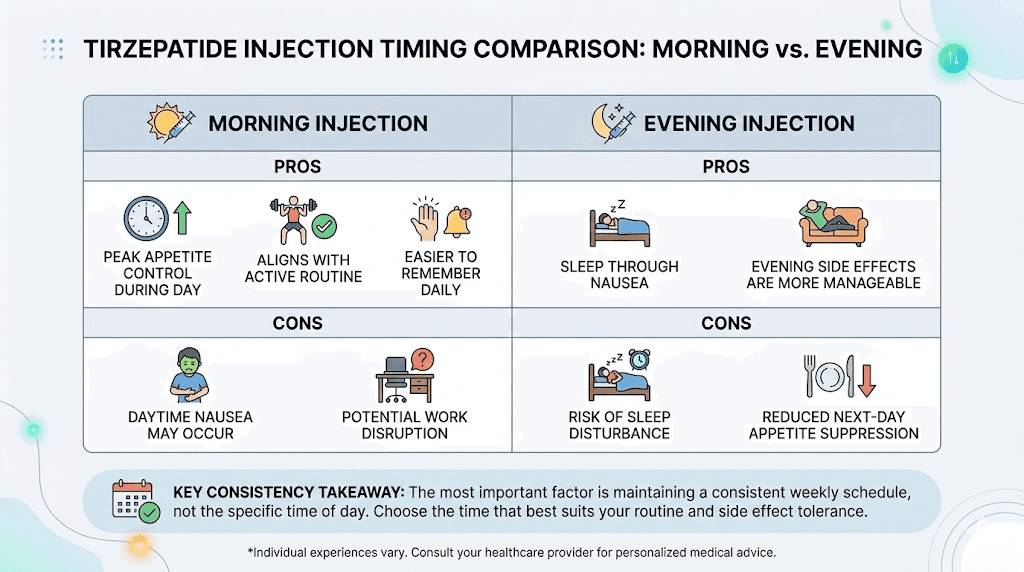
Morning versus evening: the complete comparison
Factor | Morning injection | Evening injection | Winner |
|---|---|---|---|
Nausea management | Feel it during the day, can respond | Sleep through peak nausea window | Evening for severe nausea |
Side effect monitoring | Fully awake to observe reactions | Cannot monitor while asleep | Morning, especially for new doses |
Appetite suppression timing | Peak covers daytime meals | Peak covers evening and next morning | Morning for daytime eaters |
Work disruption | Possible if side effects are strong | Side effects mostly during off-hours | Evening for demanding jobs |
Routine consistency | Mornings are usually predictable | Evenings vary more socially | Morning for most people |
Sleep quality | No injection-related sleep disruption | Possible nausea or insomnia | Morning if sleep is sensitive |
Injection site comfort | No lying on injection site | May lie on tender site while sleeping | Morning slightly |
Remembering the dose | Pairs with morning routine | Risk of forgetting after busy day | Morning for forgetful users |
Looking at this breakdown, morning injection wins more categories. But the categories are not equally weighted. If nausea is your dominant issue, that single evening advantage might outweigh all the morning benefits combined. Choose based on what matters most to you, not which column has more checkmarks.
Injection timing and specific side effects
Different side effects respond differently to timing adjustments. Here is how to use injection timing to manage specific complaints.
Nausea and vomiting
As established, evening injection helps you sleep through peak nausea. But timing alone might not be enough for severe cases. Combine evening injection with these strategies: eat a light, bland meal one to two hours before injecting. Avoid fatty and spicy foods on injection day. Stay hydrated throughout the day before injection. Keep your upper body slightly elevated when sleeping post-injection.
If nausea persists regardless of timing, it may indicate a need for dose splitting or a slower escalation schedule. SeekPeptides provides detailed nausea management protocols for members navigating these adjustments.
Fatigue and tiredness
Tirzepatide fatigue often hits 4 to 12 hours after injection. Morning injectors feel this in the afternoon or evening. Evening injectors feel it during sleep (often reported as sleeping unusually deeply) or the following morning.
If fatigue bothers you during work hours, evening injection is clearly better. The fatigue peak falls during sleep when it barely matters. If you feel groggy the morning after an evening injection, that usually resolves by mid-morning and is far less disruptive than afternoon fatigue crashing your productivity.
For people who also take supplements alongside tirzepatide, timing those around your injection can help buffer fatigue. B12, for example, is often taken in the morning regardless of injection timing to combat any energy dip.
Injection site reactions
If you experience redness or itching at the injection site, morning injection has a slight advantage. You can monitor the site throughout the day and apply treatment if needed. Evening injection means you might not notice a developing reaction until morning, by which point it has had hours to worsen.
Also consider your injection site choice in combination with timing. If you inject in the abdomen and then lie on your stomach to sleep, the pressure can worsen injection site discomfort. If you inject in the thigh and then go for a morning jog, the movement can increase tenderness. Think about what you do in the hours after injection and choose a site that will not be stressed by those activities.
Headaches
Tirzepatide headaches tend to appear 2 to 8 hours post-injection. Morning injectors get them in the afternoon. Evening injectors may wake with them. There is no clear winner here. The better strategy is staying well-hydrated before, during, and after injection, regardless of timing. Dehydration amplifies tirzepatide headaches significantly.
Anxiety and mood changes
Some users report anxiety following injection. If this affects you, evening injection allows the initial hormonal adjustment to happen during sleep. Waking up with mild residual anxiety is usually easier to manage than having it build throughout a stressful workday.
Special situations: timing adjustments for specific contexts
Combining tirzepatide with exercise
Exercise timing relative to injection timing matters for comfort, not effectiveness. Intense exercise within 2 to 4 hours of injection can worsen nausea due to the combination of physical exertion and initial gastrointestinal effects. If you exercise in the morning, inject in the evening. If you exercise in the evening, inject in the morning. Keep the injection and your workout separated by at least four hours.
For people following structured programs that combine diet and exercise, the injection timing becomes part of your weekly planning. Many researchers inject on their rest day, ensuring no exercise-injection conflict at all. You can use the tirzepatide dosage calculator to plan your dosing while simultaneously mapping your exercise schedule around injection days.
Combining tirzepatide with other compounds
If you are using tirzepatide alongside other peptides or supplements, injection timing might need to accommodate multiple compounds. For people using tirzepatide with glycine or B6 formulations, the timing of the tirzepatide injection itself does not change, but you may want to space any additional supplements to avoid compounding gastrointestinal effects.
B12 and glycine blends can sometimes be taken at a different time of day from the tirzepatide injection itself. Morning B12 for energy, evening tirzepatide for nausea management. This separation strategy works well for people who are sensitive to stacking everything at once.
If you are considering adding phentermine or other appetite-related compounds alongside tirzepatide, timing becomes even more important. Phentermine is typically taken in the morning to avoid insomnia, so if you are also injecting tirzepatide in the morning, be aware of additive nausea. Some researchers find that morning phentermine plus evening tirzepatide offers the best balance.
Fasting and intermittent fasting
If you practice intermittent fasting, your eating window creates a natural framework for injection timing. Injecting at the start of your eating window maximizes appetite suppression across the hours when you can eat. Injecting during your fasting window is fine pharmacologically but wastes the peak suppression period on hours when you were not going to eat anyway.
For a common 16:8 fasting schedule with a noon-to-8-PM eating window, injecting around 11 AM or noon puts peak appetite suppression across your entire eating window. This combines the benefits of tirzepatide with the structural discipline of intermittent fasting.
Shift workers and non-traditional schedules
If you work nights, rotating shifts, or irregular hours, the morning-versus-evening framework does not apply the same way. Instead, anchor your injection to your sleep cycle, not the clock. Inject about two hours before your longest sleep period, whatever time that falls on. For a night shift worker who sleeps from 8 AM to 3 PM, injecting around 6 AM mimics the "evening injection" strategy even though it is technically morning.
Consistency matters more than clock time. If your schedule rotates, pick the day of the week with the most predictable schedule and make that your injection day.
What experienced users actually do
Forum posts, community discussions, and clinical feedback reveal some consistent patterns among long-term tirzepatide users.
The Saturday morning crew
The largest group injects Saturday morning between 7 and 10 AM. This gives them the weekend to handle any side effects, puts peak appetite suppression over the weekend (when most people overeat), and creates a predictable weekly routine. Many started with a different day and gravitated to Saturday after the first month.
The Friday evening group
The second most popular timing is Friday evening, typically between 6 and 9 PM. Same logic as Saturday morning: weekend recovery. But with the added benefit of sleeping through the initial nausea peak. By Saturday morning, they wake up with appetite suppression and no queasiness.
The Monday morning minimalists
A smaller but dedicated group injects Monday morning to align appetite suppression with the work week. These tend to be people who have been on tirzepatide long enough that side effects are minimal. They want peak appetite control during the structured eating environment of the work week and are willing to deal with reduced suppression over the less-structured weekend.
The split-dose researchers
Some experienced users following split-dose protocols inject twice weekly at half-dose. For these researchers, timing involves two injection points, typically Monday morning and Thursday evening. This creates more consistent blood levels and often reduces side effects compared to a single larger weekly dose.
The relationship between injection timing and weight loss results
Let us be direct. No study has shown that morning injection produces different weight loss results than evening injection. The clinical trial results were achieved across all timing variations because participants were simply told to inject once weekly at any time.
However, indirect effects matter. If morning injection causes nausea that makes you skip meals, and skipping meals leads to nutrient deficiency and muscle loss, then morning injection indirectly hurt your results. If evening injection causes insomnia that wrecks your sleep, and poor sleep increases cortisol and appetite, then evening injection indirectly hurt your results.
The best timing for weight loss is the timing that produces the fewest side effects for YOU, because fewer side effects means better adherence, and adherence is the single biggest predictor of successful outcomes.
Researchers who are not seeing results should examine their injection timing as one of several factors. If side effects are causing you to skip doses or eat erratically, a simple timing change might remove the barrier. It is one of the easiest adjustments you can make, and it costs nothing.
Creating your injection timing protocol
Here is a step-by-step approach to finding your ideal injection time.
Week 1 to 2: the baseline test
Start with morning injection (between 7 and 9 AM). This gives you maximum information. Note everything: when nausea appears, how long it lasts, when appetite changes, sleep quality that night, energy levels the next day, any injection site reactions. Do this for your first two injections.
Week 3 to 4: the alternative test
Switch to evening injection (between 6 and 8 PM). Same tracking. Note the same variables. After two evening injections, compare your experience. Which timing produced less nausea? Better sleep? More usable appetite suppression? Less work disruption?
Week 5 onward: commit and optimize
Pick the winner and commit to it. Fine-tune the exact time within your chosen window. If morning works better, experiment with 6 AM versus 8 AM. If evening works better, try 7 PM versus 9 PM. Small adjustments within the winning window can further optimize your experience.
SeekPeptides members track these variables through their protocol journals, making it easy to identify patterns and optimize timing based on personal data rather than generic advice.
When to reconsider your timing
Even after you have established a timing protocol, revisit it when you increase your dose (side effects reset, so your timing strategy may need to reset too), when your work or life schedule changes significantly, when seasons change (some people find winter mornings too difficult for injection routines), when you add or remove other medications or supplements, and when you transition from active weight loss to maintenance.
The role of meal timing around injection
While food does not affect tirzepatide absorption, what you eat around injection time can significantly affect your comfort.
Before injection
Eat a light, easily digestible meal one to two hours before injecting. Think plain rice, chicken breast, toast, banana. Avoid heavy, greasy, or spicy foods. An empty stomach combined with tirzepatide often equals more nausea, not less. Having something light in your system provides a buffer.
For people following optimized eating plans (many of the food principles for GLP-1 medications overlap between semaglutide and tirzepatide), pre-injection meals should prioritize lean protein and simple carbohydrates. Fiber-heavy meals before injection can worsen the slow gastric emptying effect.
After injection
For the first four to six hours post-injection, keep meals small and bland. This is not the time for a buffet or a spicy Thai dinner. Simple breakfast options work well for morning injectors. Evening injectors should eat dinner before injecting, then avoid heavy late-night snacking.
Hydration is critical in the hours after injection. Sip water consistently. Dehydration is one of the biggest amplifiers of tirzepatide side effects, particularly headaches and diarrhea. Aim for at least 16 ounces in the two hours following injection.
The next morning
Regardless of when you inject, the morning after injection day is when appetite suppression is typically strongest. Many people make the mistake of forcing themselves to eat a large breakfast because "breakfast is important." Listen to your body. If you are not hungry, eat light. A protein shake or small meal is perfectly adequate when appetite suppression is at its peak.
Tirzepatide injection timing versus semaglutide timing
If you have previously used semaglutide, your timing experience there may or may not transfer to tirzepatide. Both are weekly injections with similar half-lives, but tirzepatide is a dual-agonist (GIP plus GLP-1) while semaglutide is GLP-1 only. This dual mechanism means the side effect profile differs slightly.
Tirzepatide tends to produce less nausea than semaglutide at equivalent therapeutic levels. If you needed evening injection for semaglutide because of nausea, you might be able to switch to morning injection with tirzepatide. Conversely, tirzepatide is more likely to cause diarrhea, which morning injection handles better since you are awake and near a bathroom.
For people switching between the two or comparing them using the conversion chart, do not assume your injection timing preferences will carry over. Treat the switch as a fresh timing experiment, especially for the first two to four weeks. The semaglutide timing guide covers the specific considerations for that medication, and the principles overlap but differ in key details.
Injection timing for compounded versus brand-name tirzepatide
The formulation you use can influence your timing decision, though the active ingredient works the same way in both cases.
Brand-name tirzepatide (Mounjaro, Zepbound)
Pre-filled pens deliver a precise dose with minimal preparation. The convenience factor means injection takes seconds, making it easy to fit into any time slot. Morning injection with a pre-filled pen is as simple as clicking and pressing. No reconstitution, no measuring, no cleanup. This ease of use makes brand-name tirzepatide particularly suited to morning routines where speed matters.
The standard dosing for brand-name tirzepatide follows a fixed escalation schedule. Because the doses are pre-measured, there is zero variability in what you inject, which means your timing experiment results are clean. Any difference you notice between morning and evening injection is genuinely about timing, not dose variation.
Compounded tirzepatide
Compounded formulations require more preparation. You need to reconstitute the peptide, draw the correct amount using a syringe, and handle bacteriostatic water measurements. This process takes 5 to 10 minutes and requires good lighting, steady hands, and a clean workspace.
For compounded tirzepatide, morning injection has a practical edge. You are alert, your hands are steady, and natural light helps you read syringe markings accurately. Evening injection after a long day means you might be tired, less precise, and more likely to rush the process. If you use the dosage calculator to determine your exact draw volume, double-check that number when you are fully awake rather than at the end of a tiring day.
Compounded formulations also come in various concentrations. Syringe dosing varies between a 10 mg vial, a 20 mg/mL formulation, or a 30 mg vial. Getting the concentration wrong because you were bleary-eyed at 11 PM is a real risk. Morning injection virtually eliminates this kind of error.
Lyophilized versus liquid formulations
If you are using lyophilized (freeze-dried) tirzepatide, the reconstitution step adds additional complexity. You need to mix the powder with bacteriostatic water, let it dissolve without shaking, and then draw your dose. This process takes longer and benefits from patience and precision. Morning timing, when you are not rushing to get to bed, gives you the space to handle this correctly.
For pre-mixed liquid compounded tirzepatide, storage becomes the timing consideration. You need to pull the vial from the fridge, let it warm slightly to room temperature (injecting cold solution can sting more), draw your dose, and inject. This takes about 3 to 5 minutes. Factor this prep time into your chosen injection window, especially if your morning routine is already tight.
Tirzepatide timing and hormonal cycles
For women, hormonal fluctuations throughout the month can interact with tirzepatide side effects in ways that make timing more important.
Menstrual cycle considerations
Some women report that tirzepatide side effects are worse during certain phases of their cycle. Tirzepatide can affect your period, and conversely, your hormonal phase can affect how you tolerate tirzepatide. Nausea tends to be worse in the luteal phase (the two weeks before your period), when progesterone is high and the digestive system is already slower.
If you notice a pattern where injection-day nausea is worse at certain times of the month, consider shifting to evening injection during those weeks. The rest of the month, morning injection might work perfectly. This cyclical adjustment sounds complicated, but many women naturally adapt to it once they recognize the pattern.
Pregnancy considerations
While tirzepatide use during pregnancy requires immediate medical guidance, injection timing becomes relevant for women who are planning to conceive. The half-life of five days means the drug stays in your system for weeks after your last injection. Timing your final injection is a medical decision, not a convenience one, but understanding the pharmacokinetics helps you have an informed conversation with your healthcare provider.
Breastfeeding and timing
For women considering tirzepatide while breastfeeding, injection timing relative to feeding schedules is a topic to discuss with your provider. Some practitioners suggest timing injection immediately after a feeding session to maximize the interval before the next feeding, though there is limited data on tirzepatide excretion in breast milk.
The temperature factor: how weather affects injection timing
This rarely gets discussed, but ambient temperature matters for both comfort and drug integrity.
Summer considerations
In hot weather, morning injection has advantages. If you store your tirzepatide in the fridge (as you should, especially with compounded formulations, per our storage guide), pulling the vial out in the cool morning is easier on the peptide than leaving it on a warm bathroom counter all day. The brief time the vial is at room temperature during your morning injection is minimal.
If your house gets very warm during the day and you inject in the evening, the vial has been sitting in ambient heat longer (even in the fridge, frequent door opening warms contents). This is a minor consideration, but for people concerned about heat exposure and refrigerated shelf life, morning injection minimizes unnecessary warming cycles.
Cold injection discomfort
Cold tirzepatide stings more than room-temperature tirzepatide. If you pull the vial straight from the fridge and inject immediately, you might experience more injection site discomfort. Allow the vial to sit for 10 to 15 minutes before injecting. Morning injectors can pull the vial while making coffee. Evening injectors can set it out when they start their bedtime routine.
Building the perfect injection day routine
Beyond just the injection itself, the entire injection day can be optimized. Here is what a well-planned injection day looks like.
Morning injection routine (example)
6:30 AM: Wake up, drink 8 ounces of water immediately.
7:00 AM: Eat a light breakfast. Toast with a small amount of peanut butter, or a banana with plain yogurt. Nothing heavy, nothing fried, nothing spicy. Follow the GLP-1 breakfast guidelines for best results.
7:30 AM: Prepare injection. Pull vial from fridge 10 minutes earlier. Clean injection site with alcohol swab. Inject in the abdomen or thigh, rotating sites each week.
7:35 AM: Continue your morning. Monitor for side effects over the next 2 to 3 hours.
10:00 AM: If nausea has not appeared by now, it likely will not. Proceed with your day normally.
12:00 PM: Eat a moderate lunch. Appetite suppression should be noticeable. Do not force yourself to eat a full meal if you are not hungry. A protein shake or light salad works fine.
6:00 PM: Dinner. Eat normally but listen to your body. Choose foods that agree with tirzepatide.
10:00 PM: Bed. Most people sleep normally after a morning injection. Injection-day side effects, if any, have typically peaked and passed by bedtime.
Evening injection routine (example)
6:00 PM: Eat a light dinner. Same principles as the morning breakfast. Something your stomach handles easily. Avoid the foods that commonly cause problems.
7:30 PM: Pull vial from fridge. Allow 10 to 15 minutes to reach room temperature while you relax.
7:45 PM: Prepare and administer injection. Clean technique, proper site rotation.
8:00 PM: Light activity. Reading, gentle stretching, a short walk. Avoid lying down immediately after injection as this can worsen nausea.
9:30 PM: If mild nausea appears, sip ginger tea or water. Keep crackers nearby.
10:00 PM: Bed. If you feel fine, sleep normally. If mild nausea persists, prop yourself up slightly with an extra pillow.
Next morning: Wake with strong appetite suppression and minimal side effects. The acute window has passed overnight.
Long-term injection timing optimization
Your ideal injection time is not static. It evolves as your body adapts to tirzepatide and as your life circumstances change.
Months 1 to 3: the adaptation period
During the first three months, you are finding your dose, adjusting to side effects, and learning how your body responds. This is when injection timing matters most. Every dose change is an opportunity to reassess your timing. If you start at 2.5 mg with morning injection and it works beautifully, but then move to 7.5 mg and mornings become miserable, switch to evening. Do not suffer through months of poor timing because "morning worked at the beginning."
This adaptation period is also when tracking is most valuable. SeekPeptides members who keep detailed injection journals during these first months make faster, smarter timing decisions than those who wing it.
Months 3 to 6: the optimization period
By month three, most people have settled into a stable dose and know their side effect profile. Now the focus shifts from managing side effects to maximizing benefits. This is when you fine-tune. Maybe morning injection at 7 AM is good, but 8:30 AM is even better because it aligns your appetite suppression with your lunch meeting schedule. Maybe Friday evening injection works, but Saturday at 6 AM is even better because you are always awake at that time but Friday evenings vary.
Small adjustments during this period compound over time. A 15% improvement in appetite suppression timing might not seem like much week to week, but over six months of consistent dialing-in, it adds up to meaningfully better adherence and results.
Months 6 and beyond: the maintenance phase
Long-term tirzepatide users often report that injection timing becomes a non-issue. Side effects have diminished. Appetite suppression is steady and predictable. The injection is a two-minute weekly task that barely registers. At this point, the "best time" is simply whenever you are most likely to remember consistently.
Some long-term users set calendar reminders and forget about timing entirely. Others have incorporated it so deeply into their weekly routine that it is as automatic as taking a daily vitamin. The key insight is that obsessing over timing in month 12 the way you did in month 1 is unnecessary. Trust the stability you have built and keep it simple.
If you are weaning off tirzepatide or transitioning to maintenance, timing matters again briefly. As you reduce your dose, side effects can reappear in a different pattern. The principles remain the same, but pay attention to your body as if you are starting fresh, because at the lower dose, your experience may differ from what you are used to.
Injection timing when switching between GLP-1 medications
If you are transitioning from another medication to tirzepatide, or from tirzepatide to something else, your injection timing needs to reset.
Switching from semaglutide to tirzepatide
This is one of the most common transitions. If you used morning semaglutide timing and it worked well, you might be tempted to keep the same schedule for tirzepatide. You can try it, but do not assume it will work the same way. Tirzepatide has a dual GIP/GLP-1 mechanism that produces different side effect patterns. Some people who tolerated morning semaglutide perfectly find that morning tirzepatide brings more nausea.
When making the switch using the conversion chart, treat your first tirzepatide injection like a completely new experience. Start with morning injection for monitoring purposes, and be prepared to shift to evening if needed. The transition period typically takes two to four weeks before you know your tirzepatide timing preference.
Switching from tirzepatide to retatrutide
For researchers considering the move to retatrutide, timing considerations change again. Retatrutide is a triple agonist (GIP/GLP-1/glucagon), and the glucagon component adds a different energy and metabolism dynamic. Users switching to retatrutide often find that their well-established tirzepatide timing works initially, but needs adjustment within the first few weeks as the glucagon effects manifest differently throughout the day.
The transition timeline from tirzepatide to retatrutide varies. Some researchers notice differences immediately. Others take several weeks to feel the distinct profile. During this adjustment, flexible timing is more important than rigid scheduling.
Coming back to tirzepatide after a break
If you are restarting after a break (the semaglutide article covers similar restart principles), your body has lost some of its adaptation. Your previous timing preference may or may not still apply. Start again at the starting dose and treat timing as a fresh experiment.
Many researchers who took a break and restarted report that their side effect profile shifted. What was previously a well-tolerated morning injection might now cause more nausea than before. This is normal and related to the loss of GLP-1 receptor desensitization that occurs during the break. Give yourself two to three weeks to re-establish your optimal timing.
What the research says about injection timing for GLP-1 medications
While no randomized controlled trial has specifically compared morning versus evening tirzepatide injection, several relevant studies and data points inform the discussion.
The SURMOUNT trials
The landmark SURMOUNT-1 through SURMOUNT-4 trials that led to tirzepatide approval did not control for injection timing. Participants were told to inject once weekly at any time. The impressive weight loss results, up to 22.5% body weight reduction at the highest dose, were achieved across all timing variations. This is the strongest evidence that timing does not affect outcomes at the population level.
However, individual adherence within these trials was closely monitored. Participants who missed doses or varied their timing more than others were noted but not analyzed separately in the primary outcomes. What we can say is that consistent weekly injection, regardless of timing, produced the results.
GLP-1 medication timing data
Data from semaglutide timing studies suggests that patient preference and adherence are the primary drivers of any timing-related outcome differences. The GLP-1 class of medications all share similar pharmacokinetic profiles with long half-lives that make specific timing relatively unimportant from an absorption standpoint.
Post-marketing analysis of tirzepatide adverse events shows that gastrointestinal complaints are most common during dose escalation, with 7,678 nausea reports from 2022 to early 2025. The temporal pattern of these complaints, clustering in the first few days after dose increases, supports the strategy of timing injections to manage side effects during known difficult periods.
Chronobiology and GLP-1 signaling
Emerging research in chronobiology suggests that GLP-1 receptor sensitivity may vary throughout the day, with potentially higher sensitivity during active hours. This is preliminary data, mostly from animal studies, and is not yet actionable for clinical dosing decisions. But it raises the interesting possibility that morning injection might produce slightly stronger initial appetite suppression due to circadian GLP-1 receptor patterns.
Until human trials specifically test this hypothesis, it remains speculative. For now, the practical considerations, managing side effects, aligning with your schedule, maintaining consistency, remain far more important than any theoretical circadian advantage.
Tracking your injection timing: what to monitor
If you are going to experiment with timing, do it properly. Casual guessing leads to months of suboptimal dosing.
The injection timing journal
For the first four to six weeks, track these variables after each injection. The exact time you injected. The injection site you chose. What you ate in the two hours before injection. When nausea first appeared (if it did). The severity on a 1-to-10 scale. When nausea resolved. Sleep quality that night rated 1 to 10. Energy levels the next morning rated 1 to 10. Appetite level at breakfast, lunch, and dinner the next day. Any injection site reactions.
This sounds like a lot. It takes about 60 seconds per entry. And after four weeks, you have 4 data points that tell you exactly when your body handles tirzepatide best. That 60 seconds of daily tracking saves you months of guessing and unnecessary discomfort.
Patterns to look for
After four weeks of morning injection or two weeks of each (morning and evening), look for these patterns. Does nausea consistently last longer with one timing? Does your sleep suffer more with evening injection? Are you hungrier on day three with one timing versus the other? Do you notice more temperature sensitivity or energy changes with morning versus evening? Is your metabolism responding differently based on when you inject?
The answers to these questions are your personal injection timing protocol. No blog, no forum post, no generic recommendation can give you this data. Only your own tracking can.
For people using GLP-1 tracking tools or the peptide calculator to plan their protocols, adding injection timing as a tracked variable creates a complete picture of your optimization journey. Many SeekPeptides members find that tracking timing alongside their weight loss timeline reveals clear correlations they would have otherwise missed.
Frequently asked questions
Does it matter if I inject tirzepatide in the morning or at night?
Pharmacologically, no. Tirzepatide works the same regardless of injection time. The drug reaches identical blood levels whether you inject at 6 AM or 10 PM. However, the timing of side effects like nausea and bloating shifts based on when you inject, so your comfort and daily experience can differ significantly between morning and evening dosing.
Can I change my injection time from morning to evening?
Yes. You can switch freely between morning and evening injection as long as you maintain at least 72 hours between doses. On the week you make the change, you might have a slightly shorter or longer interval, but this does not affect the drug effectiveness. Just commit to the new time going forward for consistency.
Should I inject tirzepatide before or after eating?
Food does not affect tirzepatide absorption since it is a subcutaneous injection. However, having a light meal one to two hours before injection can reduce nausea. Avoid heavy, greasy, or foods that commonly cause issues on injection day. After injection, keep meals small and bland for 4 to 6 hours.
What is the best day of the week to inject tirzepatide?
Friday evening or Saturday morning are the most popular choices because they allow the weekend to absorb any side effects. But the best day is the one you can consistently commit to every week. Choose based on your schedule stability and which days you most need appetite suppression. See our detailed tirzepatide timing guide for more context.
I missed my usual injection time. Should I still take it?
Yes. If you are still within the same day, inject as soon as you remember. If you are a day or two late, still take it and resume your normal schedule the following week. Only skip the dose if more than four days have passed and your next scheduled dose is within three days. Never double dose to compensate.
Does injection time affect how quickly tirzepatide works?
No. How quickly tirzepatide works depends on your dose, your body composition, and your individual response. The time of day you inject does not speed up or slow down the onset of weight loss or appetite suppression.
Can I inject at different times each week?
You can, but consistency helps with remembering your dose and predicting side effects. If your schedule is truly unpredictable, at minimum keep the same day each week and allow the time to flex. The dosage and weekly consistency matter more than the exact hour.
Is afternoon injection a good option?
Afternoon injection (1 to 4 PM) is a viable middle ground. It gives you most of the morning to work uninterrupted, puts the nausea peak in late afternoon or early evening (manageable), and still provides strong overnight appetite suppression. It works well for people who find both morning and evening options impractical.
External resources
Tirzepatide prescribing and dosing information (Mayo Clinic)
Tirzepatide injection: how it works and side effects (Cleveland Clinic)
For researchers serious about optimizing their tirzepatide protocols, SeekPeptides provides the most comprehensive resource available, with evidence-based guides, proven protocols, and a community of thousands who have navigated these exact questions.
In case I do not see you, good afternoon, good evening, and good night. May your injection timing stay consistent, your side effects stay manageable, and your results stay on track.