Feb 10, 2026
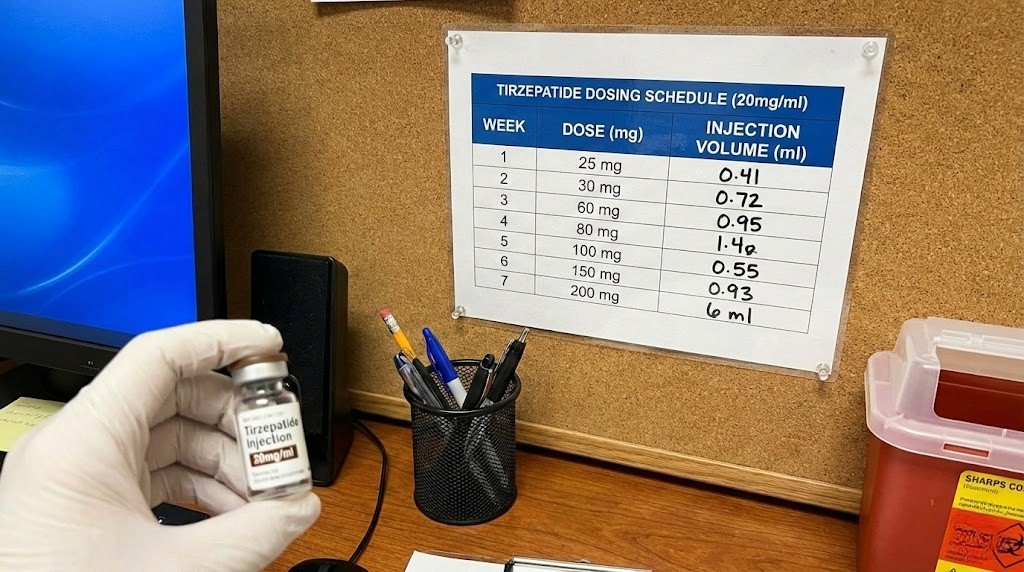
What a 20mg/ml tirzepatide concentration actually means
You are staring at a vial that reads 20mg/ml. The syringe in your hand has markings in units. Your provider said something about 2.5mg to start. And now you are doing math that does not seem to add up. Sound familiar?
This is the exact problem thousands of people face when they receive compounded tirzepatide at the 20mg/ml concentration. The numbers look different from everything they read online. The dosing charts they found were built for 10mg/ml vials or pre-filled pens. And the gap between "what the instructions say" and "what the syringe shows" feels dangerously wide.
Here is the good news. The math is actually simple once someone explains it clearly. A 20mg/ml concentration means that every single milliliter of liquid in your vial contains 20 milligrams of tirzepatide. That is twice as concentrated as a 10mg/ml formulation. So if you previously drew 50 units from a 10mg/ml vial to get 5mg, you now draw only 25 units from a 20mg/ml vial for the exact same dose. Half the volume, same medication amount. The confusion disappears once you understand that one relationship. But there is more to proper dosing than just the conversion math, and this guide covers everything you need to know about using a compounded tirzepatide dosage chart at this specific concentration, from your very first injection through maintenance dosing and beyond.
SeekPeptides built this guide specifically for the 20mg/ml concentration because most resources skip over it entirely. They give you generic charts. They assume you already know how concentrations work. They leave out the practical details that actually matter when you are standing in your kitchen with a syringe and a vial, trying to figure out whether 12.5 units or 25 units is the right draw for your prescribed dose. This guide does not make those assumptions.
The complete 20mg/ml tirzepatide dosing chart
This is the chart you came here for. Every dose from the standard tirzepatide dose chart escalation schedule, converted to the exact number of units you draw from a 20mg/ml vial using a standard insulin syringe.
Full conversion table for 20mg/ml tirzepatide
Prescribed dose (mg) | Units to draw (20mg/ml) | Volume in ml | Units if 10mg/ml | Typical phase |
|---|---|---|---|---|
2.5mg | 12.5 units | 0.125ml | 25 units | Initiation (weeks 1 to 4) |
5mg | 25 units | 0.25ml | 50 units | First maintenance (weeks 5 to 8) |
7.5mg | 37.5 units | 0.375ml | 75 units | Escalation (weeks 9 to 12) |
10mg | 50 units | 0.50ml | 100 units | Intermediate maintenance |
12.5mg | 62.5 units | 0.625ml | 125 units | Higher escalation |
15mg | 75 units | 0.75ml | 150 units | Maximum maintenance |
Save this chart. Screenshot it. Print it and tape it to your fridge. This is the reference you will use every single week.
The formula behind these numbers is straightforward. Take your prescribed dose in milligrams, divide it by 20 (the concentration in mg/ml), and multiply by 100 (to convert ml to units on an insulin syringe). So for a 5mg dose: 5 divided by 20 equals 0.25ml, which equals 25 units. For 10mg: 10 divided by 20 equals 0.50ml, which equals 50 units. Once you see the pattern, you can calculate any dose yourself. But you should always double check against the chart above. A calculation error with a tirzepatide dosage chart in ml can mean accidentally taking double your intended dose.
Why the "units" on your syringe are not medication units
This trips up almost everyone. The word "units" on an insulin syringe refers to volume, not drug potency. An insulin syringe marked to 100 units holds exactly 1ml of liquid. Each "unit" marking equals 0.01ml. When your provider says "draw 25 units," they mean draw to the 25-unit line on your syringe, which happens to be 0.25ml of liquid. They are not talking about 25 units of tirzepatide as a measurement of medication strength. This distinction matters because if you confuse syringe units with medication units, you could easily underdose or overdose. The tirzepatide dosage chart in units exists specifically to bridge this gap between what your provider prescribes in milligrams and what your syringe shows in volume units.
Understanding this relationship between tirzepatide dosing for weight loss in units and milligrams is the single most important safety concept when using compounded formulations.
How the 20mg/ml concentration compares to other formulations
Compounded tirzepatide comes in several concentrations. The most common are 5mg/ml, 10mg/ml, and 20mg/ml. Each requires different volume calculations for the same milligram dose. Getting these mixed up is the number one dosing error people make.
Side-by-side concentration comparison
Dose | 5mg/ml (units) | 10mg/ml (units) | 20mg/ml (units) |
|---|---|---|---|
2.5mg | 50 units | 25 units | 12.5 units |
5mg | 100 units | 50 units | 25 units |
7.5mg | 150 units | 75 units | 37.5 units |
10mg | 200 units | 100 units | 50 units |
12.5mg | 250 units | 125 units | 62.5 units |
15mg | 300 units | 150 units | 75 units |
Look at the 10mg dose row. With a 5mg/ml vial, you need 200 units, which is literally 2ml of liquid and requires a larger syringe. With 10mg/ml, you need 100 units, which is exactly 1ml. With 20mg/ml, you need only 50 units, just half a milliliter. The higher the concentration, the smaller the injection volume. This is actually one of the main advantages of the 20mg/ml formulation.
Smaller injection volumes mean less discomfort at the injection site, less likelihood of lumps forming under the skin, and potentially better absorption. If you have been using a compound tirzepatide dosage chart for a different concentration and are switching to 20mg/ml, the transition requires careful attention. Do not just draw the same number of units you were drawing before. A person who was drawing 50 units from a 10mg/ml vial to get 5mg would accidentally inject 10mg if they drew 50 units from a 20mg/ml vial. That is double the dose. Check your vial label every time.
The standard tirzepatide dose escalation schedule
Tirzepatide follows a gradual escalation protocol. You do not start at your target dose. You build up to it over weeks, giving your body time to adjust. This slow approach reduces side effects and helps you find the dose that works best for your individual response.
The FDA-approved titration schedule
The standard protocol, based on clinical trial data and tirzepatide dosing guidance, follows a clear progression.
Weeks 1 through 4: Start at 2.5mg once weekly. This is not a therapeutic dose for most people. It exists solely to let your digestive system adapt to the medication. Draw 12.5 units from your 20mg/ml vial. Do not increase early even if you feel fine. Your gut needs this adjustment period.
Weeks 5 through 8: Increase to 5mg once weekly. This is the first dose where meaningful appetite suppression begins for many people. Draw 25 units from your 20mg/ml vial. Some people find this dose sufficient and stay here. Others need to continue escalating.
Weeks 9 through 12: Increase to 7.5mg once weekly if needed. Draw 37.5 units. At this dose, most people notice significant appetite reduction. Weight loss typically becomes more consistent. Gastrointestinal side effects may temporarily increase after the bump.
Weeks 13 through 16: Increase to 10mg once weekly if additional response is needed. Draw 50 units. This is a common maintenance dose. The SURMOUNT-1 clinical trial showed participants on 10mg lost an average of 21.4% of their body weight, roughly 49 pounds or 22 kilograms.
Weeks 17 through 20: Increase to 12.5mg once weekly if 10mg is tolerated but additional weight loss is desired. Draw 62.5 units. Not everyone reaches this dose. If 10mg is working well, there is no requirement to go higher.
Weeks 21 and beyond: Maximum dose of 15mg once weekly. Draw 75 units from your 20mg/ml vial. In SURMOUNT-1, participants on 15mg achieved an average weight loss of 22.5%, approximately 52 pounds or 24 kilograms over 72 weeks. This is the ceiling. Going above 15mg weekly is not supported by clinical evidence and increases risk without demonstrated benefit.
The key principle behind this schedule is patience. Each dose increase should happen only after at least 4 weeks at the current level. Some people benefit from staying at each dose for 6 to 8 weeks before increasing, especially if they experience side effects that take time to resolve. Rushing the escalation does not produce faster results. It just produces worse side effects.
Finding your maintenance dose
Not everyone needs 15mg. Not everyone needs 10mg. Your optimal maintenance dose is the lowest dose that produces meaningful, consistent results with tolerable side effects. Some people plateau at 7.5mg and stay there happily. Others need the full 15mg to achieve their goals. The right dose is not the highest dose. It is the dose that works for your body.
How do you know when you have found it? Three signs. First, your appetite is genuinely reduced without feeling sick. Second, you are losing weight at a steady pace, typically 1 to 2 pounds per week. Third, side effects are manageable and not interfering with daily life. If all three boxes are checked, you have likely found your maintenance dose. Stay there. Compare your progress against the broader context of tirzepatide before and after results to gauge whether your response is typical.
How to read your insulin syringe for 20mg/ml tirzepatide
Insulin syringes come in three common sizes. The 30-unit syringe (0.3ml), the 50-unit syringe (0.5ml), and the 100-unit syringe (1ml). With a 20mg/ml concentration, most doses require less than 75 units, so a 100-unit syringe works for the full dosing range. However, smaller syringes offer better precision for lower doses.
Which syringe size to use for each dose
Dose | Units to draw | Best syringe | Why |
|---|---|---|---|
2.5mg | 12.5 units | 30-unit syringe | Finer markings make 12.5 units easier to read |
5mg | 25 units | 30-unit or 50-unit | Clear visibility on either size |
7.5mg | 37.5 units | 50-unit syringe | Half-unit markings help hit 37.5 |
10mg | 50 units | 50-unit or 100-unit | Exact fill on 50-unit syringe |
12.5mg | 62.5 units | 100-unit syringe | Exceeds 50-unit capacity |
15mg | 75 units | 100-unit syringe | Needs larger capacity |
A practical tip: when your dose falls on a half-unit mark like 12.5 or 37.5 or 62.5 units, look for insulin syringes with half-unit markings. These exist specifically for this purpose and make precision much easier. The small extra cost is worth the accuracy. If you can only find syringes with whole-unit markings, draw to the halfway point between the two nearest whole-unit lines. For 12.5 units, that means halfway between 12 and 13.
If you are new to peptide injections or subcutaneous injections in general, the syringe reading process might feel intimidating at first. It becomes second nature within a few weeks. The important thing is to take your time, check twice, and never rush the drawing process.
Reading the syringe correctly
Hold the syringe at eye level with the needle pointing up. The bottom of the black rubber stopper inside the syringe barrel is your measurement line. Not the top of the stopper. Not the middle. The flat bottom edge where it meets the liquid. This is where precision matters. Being off by just a few unit markings at the 20mg/ml concentration can mean a meaningful dose difference.
For context, each unit marking on an insulin syringe represents 0.01ml. At 20mg/ml, each unit marking represents 0.2mg of tirzepatide. So being off by 5 units means being off by 1mg. That might not sound like much, but at the 2.5mg starting dose, 1mg is 40% of your dose. Accuracy matters more than most people realize, which is why resources like the peptide calculator exist to help with these calculations.
How tirzepatide works and why dosing precision matters
Tirzepatide is not a simple appetite suppressant. It is a dual GIP and GLP-1 receptor agonist, meaning it activates two different hormone receptors simultaneously. This dual mechanism is what makes it more effective for weight loss than single-receptor medications. But it also means that dosing precision directly impacts how well these mechanisms function.
The dual agonist mechanism explained
GLP-1, or glucagon-like peptide 1, does several things. It slows gastric emptying so food stays in your stomach longer. It enhances insulin secretion when blood sugar is elevated. It reduces glucagon release from the pancreas. And it signals satiety centers in the brain, telling you that you are full. These are the same pathways targeted by semaglutide, which is a GLP-1 only agonist.
GIP, or glucose-dependent insulinotropic polypeptide, adds a second layer of effects. It enhances fat metabolism by increasing lipoprotein lipase activity in white adipose tissue. It improves energy balance. It promotes the breakdown of stored triglycerides into free fatty acids and glycerol. And research suggests it may also influence central appetite regulation through brain pathways that GLP-1 alone does not reach. The difference between tirzepatide vs semaglutide dosage charts reflects this fundamental difference in mechanism. Tirzepatide achieves greater weight loss at equivalent dose escalation schedules because it is working through two pathways instead of one.
When these two mechanisms work together, the results exceed what either could achieve alone. Co-infusion studies show that simultaneous GIP and GLP-1 receptor activation produces significantly greater insulin response and glucagonostatic response than either hormone administered separately. This synergy is the reason tirzepatide consistently outperforms GLP-1 only medications in head-to-head comparisons.
Why underdosing and overdosing both cause problems
Underdose tirzepatide and you will not achieve the receptor occupancy needed for meaningful appetite suppression. You will feel hungry. You will not lose weight. You will think the medication does not work. Meanwhile, the medication is working exactly as well as the dose you gave it.
Overdose and you overwhelm your GLP-1 receptors, causing severe nausea, vomiting, and diarrhea that can last days. Your body cannot process the excess signal. The gastrointestinal side effects become debilitating rather than manageable. People who accidentally double their dose because of a concentration calculation error often end up in urgent care for dehydration. This is why the exact unit calculation for your dose is not just academic. It is a safety issue.
The 20mg/ml concentration amplifies both risks because the margin of error is smaller. Drawing 5 extra units from a 20mg/ml vial means accidentally taking an extra 1mg. From a 5mg/ml vial, the same 5-unit error would only be 0.25mg. Higher concentration demands higher precision.
Step-by-step injection protocol for 20mg/ml tirzepatide
The injection process itself is straightforward once you know the steps. But details matter. Every step has a reason, and skipping any of them can affect your dose accuracy or injection safety.
Preparing your dose
Step 1: Gather supplies. You need your 20mg/ml tirzepatide vial, an alcohol swab, the correct size insulin syringe, and a sharps container for disposal. Have everything within reach before you start.
Step 2: Check the vial. Look at the liquid inside. It should be clear and colorless. If it looks cloudy, discolored, or has particles floating in it, do not use it. Check the expiration date. Check the concentration printed on the label, confirm it says 20mg/ml. This 10-second check prevents the most dangerous dosing errors. People who have multiple vials of different concentrations in their fridge are especially at risk for grabbing the wrong one. Understanding tirzepatide storage requirements also ensures your medication remains effective.
Step 3: Clean the vial top. Wipe the rubber stopper on top of the vial with an alcohol swab. Let it air dry for a few seconds. This prevents bacteria from being introduced into the vial by the needle.
Step 4: Draw air into the syringe. Pull the plunger back to the same number of units you plan to draw. For a 5mg dose, pull to 25 units of air. This air goes into the vial to replace the liquid you remove, which prevents a vacuum from forming and makes drawing the liquid easier.
Step 5: Inject air and draw medication. Insert the needle through the rubber stopper. Push the air in. Then invert the vial with the syringe still inserted so the vial is upside down and the tip of the needle is submerged in liquid. Slowly pull the plunger back to your target number of units. For a 5mg dose from 20mg/ml, draw to exactly 25 units.
Step 6: Remove air bubbles. With the vial still inverted, tap the syringe barrel gently to move any air bubbles to the top near the needle. Push the plunger slightly to expel the air back into the vial. Then re-draw to your target unit line if the liquid level dropped below it. Air bubbles are not dangerous in a subcutaneous injection, but they do displace medication volume, meaning you would receive slightly less than your intended dose.
Step 7: Remove the syringe. Pull the needle out of the vial. Do not touch the needle. Do not set it down on any surface. Proceed directly to the injection.
Administering the injection
The recommended injection sites are the abdomen (at least 2 inches from the navel), the outer thigh, or the back of the upper arm if someone else is helping you. Rotate your injection site each week. Do not inject in the same spot repeatedly, as this can cause lipodystrophy, a condition where fat tissue under the skin becomes lumpy or indented.
Clean the injection site with an alcohol swab. Let it dry completely. Pinch a fold of skin at the site. Insert the needle at a 45 to 90 degree angle, depending on how much subcutaneous fat is present. Most people use a 90-degree angle. Push the plunger slowly and steadily until all medication is injected. Wait 5 to 10 seconds before withdrawing the needle. This gives the medication time to disperse into the tissue and prevents leakback.
Apply gentle pressure with a cotton ball or gauze if there is any bleeding. Do not rub the site. Dispose of the used syringe in a sharps container. Never recap a needle. Never throw it in regular trash. These protocols apply to any peptide injection, not just tirzepatide.
Managing side effects during dose escalation
Gastrointestinal side effects are the most common challenge with tirzepatide. Nausea. Diarrhea. Constipation. Reduced appetite that crosses the line from helpful into uncomfortable. These side effects are directly related to the dose and the speed of escalation. They are also, for most people, temporary.
The nausea timeline
Most people experience the worst nausea during two specific windows: the first 2 to 3 days after their very first injection, and the first 2 to 3 days after each dose increase. After each escalation, nausea typically peaks on days 1 through 3, improves by days 4 through 5, and largely resolves by the end of the first week at the new dose. If nausea persists beyond 2 weeks at a given dose level, that may signal you have reached your ceiling dose sooner than expected.
Some people breeze through escalation with minimal symptoms. Others feel terrible for the first few days after every increase. Both responses are normal. The medication is not working better or worse based on how nauseous you feel. Side effects and efficacy are related but not identical. Someone with no nausea can lose just as much weight as someone who feels sick for three days after every dose change.
Practical strategies for reducing nausea
Eat smaller, more frequent meals throughout the day instead of three large ones. Tirzepatide slows gastric emptying, meaning food sits in your stomach longer than usual. A large meal on top of a full stomach creates the perfect recipe for nausea. Five small meals work better than three big ones during the adjustment period.
Avoid high-fat and greasy foods, especially during the first few days after a dose increase. Fat takes the longest to digest, and when your stomach is already moving slowly, adding hard-to-digest food makes everything worse.
Stay hydrated. Mild dehydration worsens nausea significantly. Sip water throughout the day rather than drinking large amounts at once. Ginger tea can also help. The evidence for ginger as an anti-nausea agent is actually quite strong, and it works through a different mechanism than the medication-induced nausea, making it a useful complement.
Do not eat right before bed. Lying down with a full stomach when your gastric emptying is already delayed is asking for trouble. Try to finish your last meal at least 3 hours before sleep.
Time your injection strategically. Some people find that injecting in the evening allows them to sleep through the initial nausea wave. Others prefer morning injections so the worst of it passes during daylight hours when they can manage it more actively. Experiment to find what works for you. This is similar to the timing considerations many people weigh when starting any GLP-1 based protocol, whether tirzepatide or semaglutide.
When to slow down your escalation
The 4-week minimum between dose increases is just that, a minimum. You can stay at any dose for longer. If you are experiencing significant side effects at 5mg, there is no reason to jump to 7.5mg at exactly the 4-week mark. Wait another 2 to 4 weeks. Let your body fully adjust. The weight loss continues at the current dose while your system adapts.
Signs you should delay your next escalation: nausea that lasts more than 5 days after injection, vomiting more than once per week, diarrhea that disrupts daily activities, or inability to maintain adequate hydration. These are signals that your body is still adapting to the current dose and is not ready for a higher one. Many people who read about not losing weight on tirzepatide are actually escalating too fast, experiencing debilitating side effects, and then missing doses because they feel too sick to inject.
Some providers recommend an even more conservative approach for people who are particularly sensitive. They might start at half the standard initiation dose, using microdosing tirzepatide at 1.25mg for the first 2 weeks before moving to 2.5mg. With a 20mg/ml vial, 1.25mg is just 6.25 units, a tiny draw that requires careful syringe reading but can dramatically reduce initial side effects for sensitive individuals.
The math behind 20mg/ml conversions
Understanding the conversion formula means you never have to memorize a chart again. The formula works for any concentration, any dose, any syringe. Once you learn it, you are protected against dosing errors for life, not just for tirzepatide but for any peptide dosage calculation you encounter.
The universal concentration formula
Units to draw = (prescribed dose in mg / concentration in mg per ml) x 100
That is it. Three numbers and two operations. Let us walk through every standard dose with the 20mg/ml concentration.
2.5mg dose: 2.5 / 20 = 0.125ml. Multiply by 100 = 12.5 units.
5mg dose: 5 / 20 = 0.25ml. Multiply by 100 = 25 units.
7.5mg dose: 7.5 / 20 = 0.375ml. Multiply by 100 = 37.5 units.
10mg dose: 10 / 20 = 0.5ml. Multiply by 100 = 50 units.
12.5mg dose: 12.5 / 20 = 0.625ml. Multiply by 100 = 62.5 units.
15mg dose: 15 / 20 = 0.75ml. Multiply by 100 = 75 units.
The multiplying by 100 step converts milliliters to units on the insulin syringe. This works because a standard insulin syringe holds 1ml at the 100-unit mark. So 100 units = 1ml. Therefore, 0.25ml = 25 units. The math is clean. No rounding required for any standard tirzepatide dose at the 20mg/ml concentration.
Use this formula to verify any chart, any provider instruction, any pharmacy label. If the numbers do not match when you run them through the formula, something is wrong, and you should clarify before injecting. Tools like the peptide reconstitution calculator can help double-check your math. For tirzepatide specifically, the relationship between milligrams and units changes based on concentration, so always confirm you are using the right conversion for your specific vial.
What if your dose falls between standard increments?
Some providers prescribe non-standard doses. Maybe 3.75mg as an intermediate step between 2.5mg and 5mg. Or 6.25mg between 5mg and 7.5mg. The formula handles these just fine.
3.75mg from 20mg/ml: 3.75 / 20 = 0.1875ml. Multiply by 100 = 18.75 units. Draw to the halfway point between 18 and 19 on your syringe.
6.25mg from 20mg/ml: 6.25 / 20 = 0.3125ml. Multiply by 100 = 31.25 units. Draw to the quarter point between 31 and 32.
These fractional draws are trickier and benefit from a syringe with half-unit markings. If your provider prescribes unusual intermediate doses, ask if a different concentration might make the syringe reading easier. Sometimes a 10mg/ml vial produces cleaner unit numbers for non-standard doses.
How much weight you can expect to lose at each dose level
Clinical trial data provides realistic expectations for what each dose level typically achieves. These numbers come from the SURMOUNT-1 trial, which enrolled over 2,500 adults with obesity or overweight and tracked outcomes for 72 weeks.
Weight loss by dose from SURMOUNT-1
Dose | Average weight loss (%) | Average weight loss (lbs) | Average weight loss (kg) |
|---|---|---|---|
Placebo | 2.4% | ~5 lbs | ~2 kg |
5mg | 16.0% | ~35 lbs | ~16 kg |
10mg | 21.4% | ~49 lbs | ~22 kg |
15mg | 22.5% | ~52 lbs | ~24 kg |
These are averages. Individual results vary widely. Some people lose more. Some lose less. Genetics, starting weight, diet, exercise, sleep quality, stress levels, and metabolic health all influence your personal response. But these numbers provide a realistic baseline for expectations.
Notice something interesting in the data. The jump from placebo to 5mg is massive: 2.4% to 16%. The jump from 5mg to 10mg is significant: 16% to 21.4%. But the jump from 10mg to 15mg is much smaller: 21.4% to 22.5%. This shows diminishing returns at higher doses. For many people, the sweet spot is somewhere between 5mg and 10mg, where they get most of the benefit with fewer side effects. This pattern is worth understanding when you look at how long tirzepatide takes to work at different dose levels.
The weight loss timeline
Weeks 1 through 4 at 2.5mg: Minimal weight loss for most people. Maybe 1 to 3 pounds. Some people lose nothing. This is the adjustment period. Do not panic if the scale does not move.
Weeks 5 through 8 at 5mg: This is where things start happening. Most people notice appetite reduction becoming significant. Weight loss of 4 to 8 pounds during this period is typical. Some experience more.
Weeks 9 through 16 at 7.5mg to 10mg: The acceleration phase. Consistent weight loss of 1 to 2 pounds per week becomes the norm. Total cumulative loss by week 16 often reaches 15 to 25 pounds. Appetite is noticeably different from baseline. Portions feel naturally smaller. Food thoughts decrease. People around you start asking if you have lost weight.
Weeks 17 through 72 and beyond: Continued steady loss that gradually slows. Most of the total weight loss happens in the first 6 to 9 months. After that, the rate tapers as your body approaches a new equilibrium. This does not mean the medication stopped working. It means you are approaching a new stable weight. The appetite suppression timeline follows a similar pattern, becoming strongest in the first few months and then stabilizing.
20mg/ml vial management and storage
A 20mg/ml vial contains a lot of medication in a small package. Proper storage and handling maximize its shelf life and ensure every dose from the vial is as potent as the first.
How many doses per vial
Vial sizes vary by pharmacy, but common sizes for compounded tirzepatide include 2ml and 5ml vials.
2ml vial at 20mg/ml: Total medication = 40mg. At 2.5mg per week, that is 16 weeks of doses. At 5mg per week, 8 weeks. At 10mg per week, 4 weeks. At 15mg per week, just over 2.5 weeks.
5ml vial at 20mg/ml: Total medication = 100mg. At 2.5mg per week, that is 40 weeks. At 5mg per week, 20 weeks. At 10mg per week, 10 weeks. At 15mg per week, approximately 6.5 weeks.
These calculations matter for planning your refills and understanding cost per dose. A single 5ml vial at 20mg/ml can last months at lower doses, which affects storage timeline significantly.
Storage requirements
Compounded tirzepatide should be stored in the refrigerator at 36 to 46 degrees Fahrenheit (2 to 8 degrees Celsius). Do not freeze it. Freezing can damage the peptide structure and reduce potency. Do not leave it at room temperature for extended periods, though brief exposure during the injection process is fine.
Most compounded formulations remain stable for 28 to 90 days after first use when properly refrigerated, depending on the compounding pharmacy preservative system. Your vial label should specify the beyond-use date. Once that date passes, discard the vial even if medication remains. The concern is not just potency loss but potential bacterial contamination from repeated needle insertions through the stopper. These considerations apply broadly to tirzepatide fridge storage and tirzepatide out of fridge scenarios.
Keep the vial in its original box if possible. Light exposure can degrade peptides over time. Store it toward the back of the fridge where temperature is most consistent, not in the door where it fluctuates with opening and closing. These same storage principles apply to any reconstituted peptide, as covered in the comprehensive peptide storage guide.
Switching to 20mg/ml from another concentration
If you have been using tirzepatide at a different concentration and your pharmacy switches you to 20mg/ml, this transition requires careful attention. The medication is the same. The dose in milligrams does not change. But the volume you draw changes dramatically.
Transition safety protocol
From 10mg/ml to 20mg/ml: Cut your unit draw in half. If you were drawing 50 units for 5mg, you now draw 25 units for the same 5mg dose. This is the most common transition and the most dangerous if not caught. Write the new number on a piece of tape and stick it to the vial. Put it on the fridge. Make it impossible to forget.
From 5mg/ml to 20mg/ml: Divide your unit draw by 4. If you were drawing 100 units for 5mg, you now draw 25 units. This is a 4x reduction in volume. The risk of error is even higher than the 10mg/ml transition because the change is more dramatic.
From pre-filled pens (Mounjaro or Zepbound) to 20mg/ml compounded: Pre-filled pens deliver a fixed dose per click, so you never calculated units before. Now you need to learn the entire syringe-drawing process from scratch. Do not assume you can figure it out. Read this guide completely. Practice drawing water first if your provider recommends it. And verify your first few draws with your pharmacist.
Whenever switching concentrations, double-check every injection for the first 4 weeks. Read the vial label. Run the math. Confirm the units. Compare against the chart. These extra 30 seconds prevent the most common and most dangerous dosing error in compounded tirzepatide dosing in units.
Tirzepatide 20mg/ml and combination formulations
Some compounding pharmacies offer tirzepatide combined with other ingredients, most commonly B12 (cyanocobalamin) or niacinamide. The 20mg/ml concentration refers only to the tirzepatide component. The additions do not change your tirzepatide dosing math.
Tirzepatide with B12
B12 is added to some formulations because weight loss can occasionally reduce B12 absorption, and supplementation supports energy levels and neurological function during significant caloric deficit. The tirzepatide with B12 combination is popular for this reason. Your dosing chart remains identical. The B12 is along for the ride at whatever volume you draw for your tirzepatide dose. You do not need to calculate B12 separately.
Tirzepatide with niacinamide
Niacinamide (vitamin B3) is sometimes added because early research suggested it might reduce injection site reactions and potentially enhance peptide stability. The tirzepatide niacinamide combination does not change your unit calculations. Same math. Same chart. Same injection process.
Regardless of what is combined with tirzepatide in the formulation, the concentration listed on the vial for tirzepatide is the only number that matters for dosing purposes. A vial labeled "tirzepatide 20mg/ml with B12" means there are 20mg of tirzepatide per ml, plus whatever amount of B12 the pharmacy added. Your dosing targets tirzepatide, and everything else comes included proportionally.
Common dosing mistakes with 20mg/ml tirzepatide
After analyzing the most frequent questions and errors people report, these are the specific mistakes that happen repeatedly with the 20mg/ml concentration.
Mistake 1: Using your old concentration chart
You switched from 10mg/ml to 20mg/ml but kept following the same chart from your previous vial. You drew 50 units thinking you were getting 5mg, but at 20mg/ml that is actually 10mg. Double your dose. This mistake causes the most severe side effects because the excess is significant enough to trigger intense nausea and vomiting.
Prevention: Every time you open a new vial, read the concentration label. Compare it to the chart you are using. If they do not match, stop and recalculate before drawing anything.
Mistake 2: Confusing mg with units
Your provider says "take 5mg this week." You draw to the 5 line on your insulin syringe, thinking 5 units equals 5mg. It does not. At 20mg/ml, 5 units is only 1mg. You have underdosed by 80%. You will feel nothing. You will think the medication does not work.
Prevention: Always convert milligrams to units before drawing. 5mg at 20mg/ml = 25 units. The conversion chart in this guide exists for exactly this reason. You can also use an online mg to units converter for tirzepatide to double-check.
Mistake 3: Not accounting for half-unit doses
Your prescribed dose requires drawing 12.5 or 37.5 or 62.5 units, but your syringe only has whole-unit markings. You round to the nearest whole number, consistently rounding up or down. Over weeks, this accumulates into meaningful dose deviation.
Prevention: Get insulin syringes with half-unit markings. They cost the same or slightly more but provide the precision you need for a 20mg/ml concentration.
Mistake 4: Air bubbles reducing your dose
You draw what looks like 25 units, but 3 of those units are actually an air bubble trapped in the syringe barrel. You inject 22 units of medication and 3 units of air. The air is harmless in a subcutaneous injection, but you received 4.4mg instead of 5mg. Over time, persistent air bubbles mean you are consistently underdosed.
Prevention: Always tap out air bubbles before injecting. With the vial inverted, tap the syringe barrel until all bubbles rise to the top near the needle, push the air back into the vial, and re-draw to your target units.
Mistake 5: Injecting too fast
You push the plunger quickly to get the injection over with. The medication pools at the injection site instead of dispersing into the subcutaneous tissue. You might see a visible lump or feel a burning sensation. Absorption may be slower or less complete.
Prevention: Inject slowly over 5 to 10 seconds. Count in your head. Wait another 5 to 10 seconds before withdrawing the needle. The patience pays off in better absorption and less injection site discomfort.
How tirzepatide compares to semaglutide at equivalent doses
Many people switch between tirzepatide and semaglutide or consider one versus the other. Understanding how the dosing charts compare helps contextualize what each milligram of medication delivers.
Dose equivalence comparison
Tirzepatide dose | Approximate semaglutide equivalent | Relative potency notes |
|---|---|---|
2.5mg | 0.5mg semaglutide | Initiation dose for both |
5mg | 1.0mg semaglutide | First therapeutic dose |
7.5mg | 1.7mg semaglutide | Intermediate escalation |
10mg | 2.0mg semaglutide | Common maintenance |
12.5 to 15mg | 2.4mg semaglutide | Maximum doses for each |
These equivalences are approximate and based on clinical outcome comparisons rather than direct pharmacological matching. The dual GIP/GLP-1 mechanism of tirzepatide means milligram-for-milligram comparisons are inherently imperfect. But this table gives a useful framework for people considering switching from semaglutide to tirzepatide or trying to understand how the semaglutide to tirzepatide conversion chart works in practice.
In head-to-head data, tirzepatide at 15mg produced roughly 22.5% body weight loss compared to semaglutide at 2.4mg producing roughly 15% body weight loss. That is a 50% greater weight loss for the highest dose of tirzepatide versus the highest dose of semaglutide. The dual agonist mechanism makes a measurable difference.
For a deeper comparison across all dose levels, the full conversion chart between the two medications provides more granular detail.
Missed doses and timing flexibility
Real life does not always cooperate with weekly injection schedules. Travel, illness, scheduling conflicts, and simple forgetfulness all happen. Here is how to handle them without derailing your progress.
The 96-hour rule
If you miss your scheduled injection day, you can still take the dose as long as it has been less than 96 hours (4 days) since your last injection was due. So if you normally inject on Monday morning and forget, you can inject as late as Thursday morning. Then resume your regular Monday schedule the following week.
If more than 96 hours have passed, skip the missed dose entirely. Do not double up. Do not try to make up for it. Simply resume your regular schedule at the next scheduled time with your normal dose. Doubling a missed dose of tirzepatide can cause severe gastrointestinal distress and is never recommended.
Changing your injection day
You can change your weekly injection day as long as there are at least 72 hours (3 days) between doses. If you normally inject on Monday and want to switch to Thursday, simply wait until Thursday for your next injection after your Monday dose. Make sure at least 72 hours have passed. Then Thursday becomes your new weekly injection day going forward.
What about travel?
Traveling with compounded tirzepatide requires a few considerations. Keep the vial in an insulated cooler bag with an ice pack during transport. Do not check it in luggage where it might freeze in the cargo hold. Carry a copy of your prescription in case security questions the syringes. The injectable nature of the medication means TSA or other security agencies may ask about it. A prescription label or letter from your provider resolves this quickly. These are the same considerations covered in general peptide storage guides, but they become especially important for compounded formulations without manufacturer packaging.
When to talk to your provider about dose adjustments
Self-adjusting your tirzepatide dose is never advisable. The escalation schedule should always be guided by a healthcare provider who can evaluate your response, side effects, and overall health. That said, knowing when to request a conversation about adjustment helps you advocate for yourself effectively.
Signs you may need a dose increase
Your appetite has returned to near-baseline levels after initially being suppressed at this dose. Weight loss has plateaued for 4 or more weeks despite consistent diet and exercise. You are tolerating the current dose with minimal side effects. You have been at your current dose for at least 4 weeks. All four of these should be true before asking about an increase. Missing even one of them usually means something else needs to change first.
Signs you may need a dose decrease
Persistent nausea that does not improve after 2 to 3 weeks at a dose. Vomiting more than once per week. Significant fatigue or weakness that interferes with daily activities. Unable to eat enough to meet basic nutritional needs. These symptoms suggest the current dose exceeds what your body can comfortably process. Stepping back to the previous dose is not failure. It is smart dosing. People who understand the nuances of tirzepatide appetite suppression know that more is not always better.
Signs something else might be going on
Rapid heart rate, severe abdominal pain, signs of pancreatitis (intense pain radiating to the back), vision changes, or symptoms of thyroid problems (neck swelling, difficulty swallowing). These are not normal side effects and require immediate medical attention, not dose adjustment. Tirzepatide carries a boxed warning about thyroid C-cell tumors based on animal studies. While human risk has not been established, thyroid symptoms should always be evaluated promptly.
Tracking your progress on 20mg/ml tirzepatide
What gets measured gets managed. Tracking your progress systematically helps you and your provider make informed decisions about dose adjustments, timeline expectations, and when to transition to maintenance.
What to track weekly
Weight: Same time, same conditions, same scale. Morning after using the restroom, before eating or drinking. Weight fluctuates by 2 to 5 pounds daily due to water, food volume, and hormonal shifts. Weekly averages are more useful than daily numbers. Record it but do not obsess over day-to-day changes.
Measurements: Waist circumference, hip circumference, and any other area you are targeting. Take these every 2 weeks. Sometimes the scale stalls while inches continue to come off. This is especially true if you are exercising, as muscle gain can offset fat loss on the scale while measurements still improve.
Side effects: Rate your nausea, energy, appetite, and digestion on a 1 to 10 scale each week. This creates a pattern that helps identify your ideal dose. If nausea was 2/10 at 5mg but 7/10 at 7.5mg with only marginally better appetite suppression, that data helps your provider decide whether the higher dose is worth the side effects.
Injection details: Record the date, time, dose in mg, units drawn, injection site, and any immediate reactions. This log is invaluable if you ever switch pharmacies, change providers, or need to reconstruct your dosing history. SeekPeptides members have access to tracking tools that make this process simple and organized.
Realistic milestones
Month 1: 2 to 5 pounds lost. Appetite changes beginning. Learning the injection routine. This month is about adaptation, not results.
Month 2: 5 to 10 pounds total lost. Noticeable appetite reduction. Side effects settling. Clothing starting to fit differently.
Month 3: 10 to 20 pounds total lost. Consistent weekly loss pattern established. Energy improving. Others starting to notice changes.
Month 6: 25 to 40 pounds total lost for most people. Significant visual changes. Health markers improving, blood pressure, blood sugar, cholesterol, all trending in the right direction.
Month 12: 35 to 55+ pounds total lost on average, depending on dose and starting weight. This is where the clinical trial data starts becoming personally relevant. Your individual numbers may be higher or lower, but this timeframe shows the full potential of the medication. Looking at real tirzepatide results from others at similar starting points can help calibrate expectations.
Understanding your vial label
Compounded vial labels contain critical information that you should know how to read. Unlike pre-filled pens that do not require any calculation, a compounded vial puts the dosing responsibility partially in your hands.
Key information on the label
Concentration: This is the most important number. It should read "20mg/ml" for this guide to apply. If it says anything different, you need a different chart. Do not assume all your vials are the same concentration, especially if you get them from different pharmacies or different batches.
Total volume: How many ml the vial contains. A 2ml vial at 20mg/ml contains 40mg total. A 5ml vial contains 100mg total. This tells you how many weeks the vial will last at your current dose.
Beyond-use date (BUD): The last date the medication should be used. This is NOT the same as an expiration date on a manufactured product. Compounded medications have shorter shelf lives. Respect this date. Using medication past its BUD risks reduced potency and possible contamination. Wondering whether older medication is still usable? The same concerns that apply to questions about peptide expiration apply here.
Storage instructions: Usually "Refrigerate at 36 to 46 degrees F" or the Celsius equivalent. Follow these exactly.
Lot number: Identifies the specific batch. Record this in your tracking log. If you ever experience a quality issue, the lot number helps the pharmacy investigate.
Frequently asked questions
How many units is 2.5mg of tirzepatide at 20mg/ml?
At 20mg/ml concentration, 2.5mg equals 12.5 units on an insulin syringe. The calculation is 2.5 divided by 20, which gives 0.125ml, then multiplied by 100 to convert to syringe units. This is the standard starting dose drawn with a 30-unit syringe for best precision. For more unit-based dosing detail, see the full guide to 2.5mg tirzepatide in units.
Can I use the same dosing chart for 10mg/ml and 20mg/ml tirzepatide?
No. Absolutely not. Using a 10mg/ml chart with a 20mg/ml vial will cause you to draw double your intended dose. Always verify that the concentration on your chart matches the concentration on your vial label. A tirzepatide dosage chart must specify the concentration it is designed for.
What if I cannot draw exactly 12.5 or 37.5 units on my syringe?
Look for insulin syringes with half-unit markings, which allow precise drawing to 0.5-unit increments. If you can only find whole-unit syringes, draw to the halfway point between the two nearest whole-unit lines. For 12.5 units, that is the halfway mark between 12 and 13. Being consistently off by 0.5 units at 20mg/ml means a 0.1mg deviation, which is clinically negligible.
How long does a 20mg/ml vial last?
It depends on your dose and the vial size. A 2ml vial (40mg total) lasts 16 weeks at 2.5mg per week, 8 weeks at 5mg, 4 weeks at 10mg, and about 2.5 weeks at 15mg. A 5ml vial (100mg total) lasts 40 weeks at 2.5mg, 20 weeks at 5mg, 10 weeks at 10mg, and about 6.5 weeks at 15mg. Always check the beyond-use date, which may expire before you use all the medication.
Is 20mg/ml tirzepatide stronger than 10mg/ml?
No. The medication is the same strength. The concentration is higher, meaning the same amount of drug is dissolved in less liquid. A 5mg dose from a 20mg/ml vial is identical to a 5mg dose from a 10mg/ml vial. The only difference is that you draw half the volume. Strength and concentration are different concepts. Concentration affects how much liquid you draw, not how much medication you receive.
Should I switch from semaglutide to tirzepatide?
This depends on your response to semaglutide and your weight loss goals. Tirzepatide produces greater average weight loss than semaglutide in clinical trials, roughly 22.5% versus 15% at maximum doses. However, individual responses vary. Some people do well on semaglutide and see no reason to switch. Others plateau on semaglutide and benefit from the dual-agonist mechanism of tirzepatide. Discuss this with your provider. The transition between the two medications requires careful dose matching to avoid gaps in coverage or accidental overdosing.
What happens if I accidentally take double my dose?
Contact your healthcare provider immediately. Expect significant gastrointestinal symptoms including severe nausea, vomiting, and diarrhea. Stay hydrated. Do not take your next scheduled dose until your provider advises. A double dose is uncomfortable and potentially dangerous, but it is manageable with proper medical guidance. The most important thing is to report it and follow instructions.
Can I microdose tirzepatide at 20mg/ml?
Yes, though it requires extremely precise syringe reading. A 1.25mg microdose at 20mg/ml equals 6.25 units, a very small draw. Half-unit marking syringes are essential for this level of precision. Some providers recommend microdosing as an even gentler start for people who are highly sensitive to GLP-1 medications. The microdosing tirzepatide chart covers sub-standard dosing approaches in detail.
External resources
For researchers serious about optimizing their weight management protocols, SeekPeptides offers the most comprehensive resource available, with evidence-based guides, dosing calculators, detailed protocol libraries, and a community of thousands who have navigated these exact questions.
In case I do not see you, good afternoon, good evening, and good night.