Dec 16, 2025
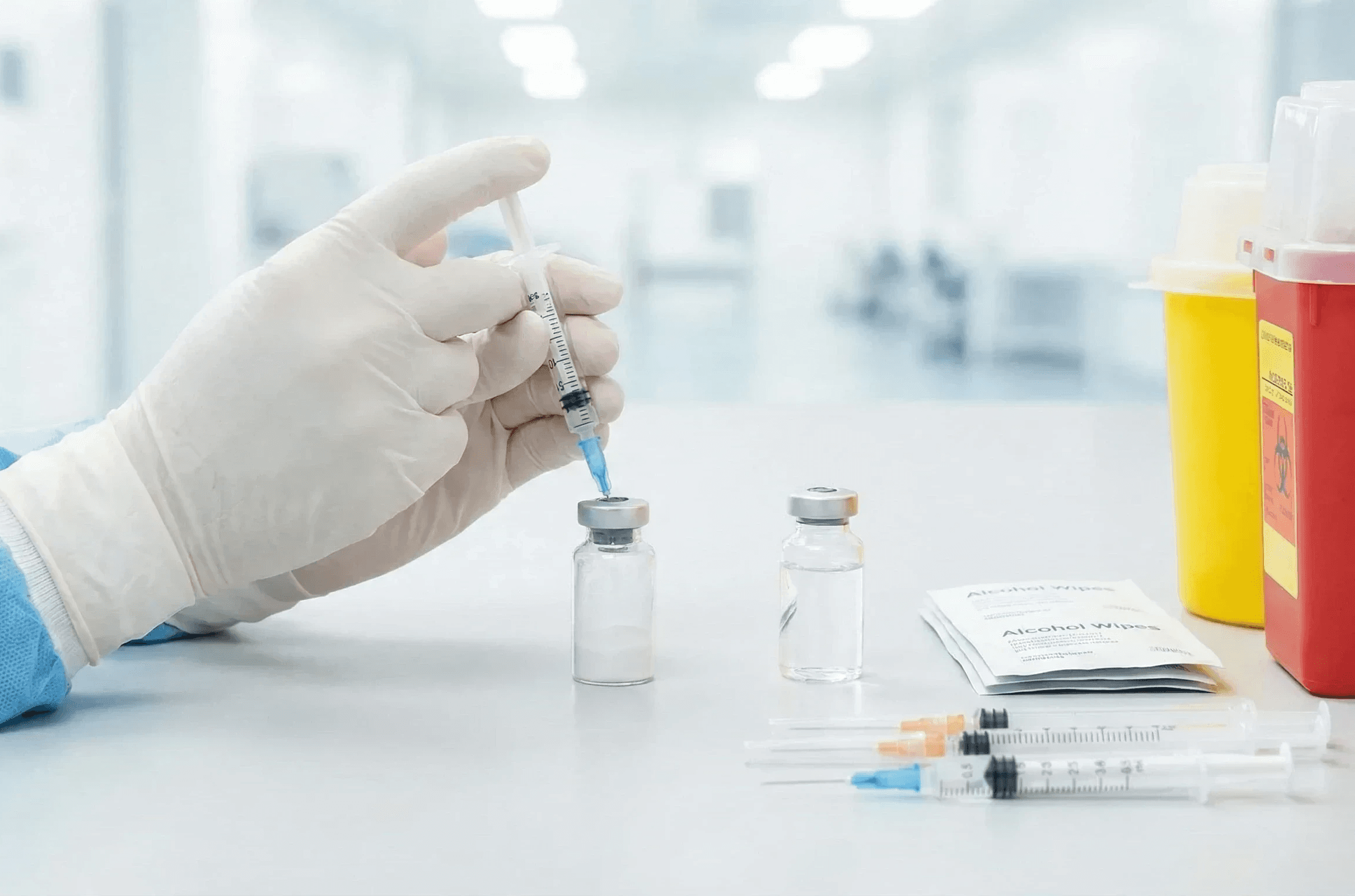
You just got your first peptide vial.
It's a tiny bottle with white powder at the bottom.
No instructions or measurements.
Now what?
You know you need to add water.
But how much?
What kind?
How do you calculate doses afterward?
What if you screw it up?
Five minutes and you'll have injectable peptide ready to use. See how.
What reconstitution means
Reconstitution is mixing peptide powder with liquid to create an injectable solution.
Peptides are shipped as lyophilized powder because it's stable.
The powder can sit at room temperature during shipping without degrading.
Once you add water, the clock starts ticking, peptides in liquid form must be refrigerated and used within weeks.
Think of it like instant coffee.
Powder is stable forever, mix it with water, and you need to drink it relatively soon.
The powder → liquid process is reconstitution.
What you need before starting
Don't try to improvise. Get the right supplies first.
Essential items:
Your peptide vial (the powder)
Bacteriostatic water (BAC water) - NOT regular water
Alcohol prep pads
Insulin syringes (0.3ml or 0.5ml with 31G needle)
Sharps disposal container
Where to get supplies:
Bacteriostatic water: Online peptide vendors, Amazon, medical supply stores
Insulin syringes: Pharmacy (no prescription needed), Amazon, medical supply
Alcohol pads: Any pharmacy or Amazon
Sharps container: Pharmacy or Amazon
Cost for supplies:
Bacteriostatic water: $10-15 per 30ml bottle
Insulin syringes: $15-25 per 100-pack
Alcohol pads: $5-10 per 100-pack
Sharps container: $10-15
Total startup: $40-65. These supplies last for months of peptide use.
Why you must use bacteriostatic water
This is critical. Do not use regular sterile water.
Bacteriostatic water contains:
99.1% sterile water
0.9% benzyl alcohol (preservative)
The benzyl alcohol prevents bacterial growth. This lets reconstituted peptides last 28+ days in the refrigerator.
Regular sterile water:
No preservative
Bacteria can grow after opening
Reconstituted peptides only safe for 24 hours
Must be used same-day
Some peptides (like growth hormone) come with sterile water because you're supposed to use the entire vial immediately. But most peptides are used over weeks, so you need bacteriostatic water.
Never use:
Tap water (bacteria, contaminants)
Distilled water (no preservative)
Saline solution (wrong osmolarity for some peptides)
Only bacteriostatic water. This isn't optional.
How much water to add
The amount of water you add determines your concentration. More water = more dilute. Less water = more concentrated.
Neither is better. It's about convenience.
Standard ratios:
2mg peptide + 2ml water = 1mg/ml (1000mcg/ml)
5mg peptide + 2ml water = 2.5mg/ml (2500mcg/ml)
5mg peptide + 1ml water = 5mg/ml (5000mcg/ml)
10mg peptide + 2ml water = 5mg/ml (5000mcg/ml)
How to choose:
More water (2-3ml per vial):
Easier to measure small doses accurately
Larger injection volumes (0.2-0.3ml)
Lasts longer (more injections per vial)
Less water (1ml per vial):
Higher concentration
Smaller injection volumes (0.05-0.1ml)
Fewer injections per vial
Most people use 2ml of water for 5mg vials. This creates 2500mcg/ml concentration - easy math for calculating doses.
Our peptide reconstitution calculator does all the math for you. Enter your vial size and water amount, get exact concentration and dosing.
Step-by-step reconstitution process
Follow this exactly. No shortcuts.
Step 1: Prepare your workspace
Clean a flat surface. Wipe it down with alcohol or disinfectant.
Wash your hands thoroughly with soap and water. Dry them completely.
Gather all your supplies in one place.
Step 2: Prep the vials
Take your peptide vial and bacteriostatic water vial out of the refrigerator. Let them come to room temperature (10-15 minutes).
Cold liquid injected into cold powder can cause clumping.
Remove the plastic caps from both vials. Don't touch the rubber stoppers with your fingers.
Clean both rubber stoppers with alcohol prep pads. Let them air dry for 30 seconds.
Step 3: Draw bacteriostatic water
Take a new insulin syringe. Make sure the needle cap is on.
Remove the needle cap (keep the cap - you'll need it).
Pull back the plunger to the amount of water you want (usually 2ml = 200 units on insulin syringe).
Insert the needle through the rubber stopper of your bacteriostatic water vial.
Push the plunger down to inject air into the vial (this prevents vacuum).
Flip the vial upside down while keeping needle inserted.
Pull back the plunger to draw the exact amount of water you need.
Remove needle from vial. Recap the needle carefully (push cap onto needle, don't hold cap while pushing needle in).
Step 4: Add water to peptide vial
Hold your peptide vial at a 45-degree angle.
Insert the needle through the rubber stopper.
Critical step: Aim the needle at the side wall of the vial, NOT directly onto the powder.
Slowly inject the water down the side of the glass. Let it trickle down to the powder.
Do not spray water directly onto the powder. This can damage the peptide.
Remove the needle and dispose of the syringe in your sharps container.
Step 5: Dissolve the peptide
Do not shake the vial. Ever.
Let the vial sit undisturbed for 1-2 minutes. The powder will start dissolving on its own.
If some powder remains, gently swirl the vial in a circular motion. Don't shake or invert rapidly.
Within 2-5 minutes, the solution should be completely clear. No visible powder or particles.
If the solution is cloudy or has floating particles after 10 minutes, something went wrong. Do not use it.
Step 6: Store properly
Immediately place the reconstituted peptide in the refrigerator (36-46°F / 2-8°C).
Do not freeze. Freezing destroys peptides.
Label the vial with:
Peptide name
Concentration (mg/ml or mcg/ml)
Date reconstituted
Expiration (28 days from reconstitution)
Use a small piece of masking tape and a permanent marker.
Calculating your dose
Now you have reconstituted peptide. How do you figure out how much to inject?
The formula: Dose needed (mcg) ÷ Concentration (mcg/ml) = Volume to inject (ml)
Example 1: BPC-157
You need: 250mcg
Concentration: 2500mcg/ml (5mg + 2ml water)
Calculation: 250 ÷ 2500 = 0.1ml
Inject 0.1ml (10 units on insulin syringe)
Example 2: Semaglutide
You need: 500mcg (0.5mg)
Concentration: 2500mcg/ml (5mg + 2ml water)
Calculation: 500 ÷ 2500 = 0.2ml
Inject 0.2ml (20 units on insulin syringe)
Example 3: TB-500
You need: 2500mcg (2.5mg)
Concentration: 2500mcg/ml (5mg + 2ml water)
Calculation: 2500 ÷ 2500 = 1ml
Inject 1ml (entire syringe if using 1ml syringes)
Math not your thing?
Our peptide reconstitution calculator calculates injection volumes automatically.
Just enter your vial size, water amount, and desired dose.
Understanding insulin syringe measurements
Insulin syringes measure in units, not ml. This confuses people.
Standard conversions:
100 units = 1ml
50 units = 0.5ml
10 units = 0.1ml
5 units = 0.05ml
Most insulin syringes are marked in 1-unit increments. Each line is 0.01ml.
Common syringe sizes:
0.3ml syringe = holds 30 units max
0.5ml syringe = holds 50 units max
1ml syringe = holds 100 units max
For most peptides, 0.3ml or 0.5ml syringes work perfectly.
Our calculator shows both ml and units, so you never have to do conversion math.
How to draw and inject
You've reconstituted correctly. Now let's use it safely.
Drawing from the vial
Clean the rubber stopper with an alcohol pad before every use.
Pull back the plunger to the amount you need to inject (creates air space).
Insert needle through rubber stopper into the vial.
Push plunger down to inject air into vial (prevents vacuum).
Flip vial upside down while keeping needle inserted.
Pull plunger back to draw your calculated dose.
Check for air bubbles. If present, tap syringe gently and push bubbles back into vial. Draw more liquid to replace the air.
Remove needle from vial. Recap carefully.
Injecting subcutaneously
Clean your injection site with alcohol pad. Let it dry completely (wet skin stings more).
Common injection sites:
Abdomen (easiest, most common)
Front/side of thigh
Back of upper arm
Pinch skin to create a fold.
Insert needle at 45-degree angle into the fat layer. Full depth of needle should go in.
Release the pinched skin.
Slowly inject over 5-10 seconds. Don't rush.
Remove needle at same angle it went in.
Apply light pressure with alcohol pad if needed. Don't rub.
Dispose of needle in sharps container immediately.
Rotating injection sites
Don't inject in the same spot repeatedly. This causes:
Scar tissue buildup
Reduced absorption
Lumps under the skin
Injection site pain
Create a rotation pattern. Example:
Monday: Left abdomen
Tuesday: Right abdomen
Wednesday: Left thigh
Thursday: Right thigh
Friday: Left abdomen (different spot)
Space injections at least 1 inch apart from previous sites.
Storage and shelf life
Proper storage determines how long your peptides remain effective.
Before reconstitution (powder):
Refrigerated: 12-24 months
Room temperature: 6-12 months
Frozen: Not recommended
Most peptide powder is stable at room temperature for shipping but should be refrigerated long-term.
After reconstitution (liquid):
Refrigerated (36-46°F): 28 days maximum
Room temperature: 24 hours maximum
Frozen: Never freeze reconstituted peptides
The 28-day rule applies to bacteriostatic water. Sterile water only lasts 24 hours.
Signs your peptide has degraded:
Solution becomes cloudy
Particles or flakes visible
Color changes (peptides should be clear)
Unusual smell
If you see any of these, discard the vial. Don't risk using degraded peptides.
Common reconstitution mistakes
Let's address what people screw up.
Mistake 1: Shaking the vial
Never shake peptide solutions. This denatures the peptide structure.
The delicate peptide chains can break apart from mechanical stress.
Gently swirl if needed. Be patient and let it dissolve naturally.
Mistake 2: Using wrong water
Bacteriostatic water only. Not sterile water, not saline, not tap water.
This mistake leads to bacterial contamination and wasted peptides.
Mistake 3: Spraying water directly onto powder
Aim for the glass wall, not the powder pile.
Direct spray can damage the peptide. Let water trickle down gently.
Mistake 4: Not letting vials reach room temperature
Cold water into cold powder causes clumping.
Wait 10-15 minutes for both vials to warm to room temperature before mixing.
Mistake 5: Storing at wrong temperature
Reconstituted peptides must be refrigerated.
Room temperature storage destroys them within 24 hours.
Freezing them destroys their structure.
36-46°F in refrigerator. That's it.
Mistake 6: Not sterilizing rubber stoppers
Every single time you insert a needle, wipe the stopper with alcohol first.
Bacteria on the stopper gets pushed into your vial with the needle.
One contaminated vial ruins your entire supply.
Mistake 7: Math errors in dosing
Concentration calculations confuse people.
Always convert mg to mcg (multiply by 1000) before calculating.
Use our peptide reconstitution calculator to eliminate math errors. It handles all conversions automatically.
Multi-dose vial management
Most peptide vials contain multiple doses. Manage them correctly.
Tracking doses remaining:
Let's say you have a 5mg BPC-157 vial reconstituted with 2ml water (2500mcg/ml concentration).
Your dose is 250mcg twice daily.
Math:
Total peptide: 5000mcg (5mg)
Dose per injection: 250mcg
Total doses available: 5000 ÷ 250 = 20 doses
Days the vial lasts: 20 doses ÷ 2 daily = 10 days
Mark on your vial or keep a log. When you have 2-3 doses left, prepare your next vial.
Multi-vial protocols:
For longer protocols, you'll use multiple vials.
Example: 8-week BPC-157 protocol (250mcg twice daily)
Doses needed: 2 per day × 56 days = 112 total doses
Doses per 5mg vial: 20 doses
Vials needed: 112 ÷ 20 = 5.6 vials (buy 6)
Our peptide cost calculator calculates exact vials needed for any protocol length and frequency.
Different peptides, different considerations
Some peptides need special attention.
Growth hormone peptides (Ipamorelin, CJC-1295)
These are fragile. Extra care needed:
Always aim water at glass wall
Never shake, even gently
Use within 21 days (not 28)
Check for cloudiness before each use
Large dose peptides (TB-500, semaglutide)
Higher doses mean faster vial depletion:
Consider larger vial sizes (10mg)
Or use less water for higher concentration
Track remaining doses carefully
Multiple daily dose peptides (BPC-157)
You'll access the vial 2x daily:
Extra important to sterilize stopper each time
Consider single-use reconstitution if doing 3x daily
Watch for contamination signs
Long-acting peptides (Semaglutide, CJC-1295)
One dose per week means vials last longer:
28-day shelf life is plenty
Can use smaller water amounts for more concentrated solution
Less frequent contamination risk
Use our peptide dosage calculator to determine optimal dosing frequency and vial management for any peptide.
Troubleshooting common issues
Problems happen. Here's how to fix them.
Problem: Powder won't dissolve completely
Causes:
Water too cold
Not enough time
Damaged peptide
Solutions:
Let sit for 5-10 minutes undisturbed
Gently swirl (don't shake)
Warm hands around vial (body heat helps)
If still not dissolving after 15 minutes, peptide may be degraded
Problem: Solution is cloudy or has particles
Causes:
Contamination
Degraded peptide
Improper storage before reconstitution
Solutions:
Do not use cloudy solution
Discard the vial
Contact vendor for replacement
Never inject cloudy peptides
Problem: Can't draw liquid from vial
Causes:
Vacuum in vial
Needle blocked
Solutions:
Inject air into vial before drawing (equal amount to what you're withdrawing)
Make sure needle tip is below liquid level
Use fresh needle if current one is blocked
Problem: Injection site reactions
Causes:
Injecting too fast
Not rotating sites
Contaminated peptide
Solutions:
Inject slower (10 seconds minimum)
Rotate sites minimum 1 inch apart
Check for cloudiness before injection
If reactions persist, discard vial
Problem: Uncertain about concentration
Causes:
Forgot to label vial
Added wrong amount of water
Mixed up multiple vials
Solutions:
Always label immediately after reconstitution
Use our peptide reconstitution calculator and write exact concentration on vial
When uncertain, discard and start fresh (better safe than wrong dose)
Reconstitution for specific peptides
Quick reference for common peptides.
BPC-157 (5mg vial)
Water: 2ml bacteriostatic water
Concentration: 2500mcg/ml
Typical dose: 250mcg = 0.1ml (10 units)
Doses per vial: 20 injections
TB-500 (5mg vial)
Water: 2ml bacteriostatic water
Concentration: 2500mcg/ml
Typical dose: 2500mcg = 1ml (100 units)
Doses per vial: 2 injections
Semaglutide (5mg vial)
Water: 2ml bacteriostatic water
Concentration: 2500mcg/ml (2.5mg/ml)
Starting dose: 250mcg = 0.1ml (10 units)
Maximum dose: 2400mcg = 0.96ml (96 units)
Ipamorelin (5mg vial)
Water: 2ml bacteriostatic water
Concentration: 2500mcg/ml
Typical dose: 200mcg = 0.08ml (8 units)
Doses per vial: 25 injections
Safety and sterile technique summary
The fundamentals that keep you safe:
Before reconstitution:
Wash hands thoroughly
Use clean workspace
Check peptide powder appearance (should be white/off-white)
Verify bacteriostatic water (not sterile water)
During reconstitution:
Clean both rubber stoppers with alcohol
Let vials reach room temperature
Inject water slowly down vial wall
Never shake, only gentle swirl
Verify complete dissolution before storing
After reconstitution:
Refrigerate immediately (36-46°F)
Label vial with name, concentration, date
Use within 28 days maximum
Check for cloudiness before each use
For every injection:
Clean rubber stopper with alcohol
Use new sterile syringe every time
Rotate injection sites
Dispose needles in sharps container
Track doses remaining
Follow these rules and you'll never have problems.
The bottom line
Reconstitution seems complicated until you do it once.
Then it's routine. Five minutes from powder to injectable peptide.
The keys:
Bacteriostatic water only
Inject water slowly down the wall
Never shake the vial
Refrigerate after mixing
Use within 28 days
Get the calculations right using our peptide reconstitution calculator.
It eliminates math errors and shows exact injection volumes.
Once you've reconstituted correctly, you're ready to start your protocol with confidence.
The powder in that tiny vial is now medicine.
Use it right.
In case I don’t see you, good afternoon, good evening, and good night. Take care of yourself.