Dec 20, 2025
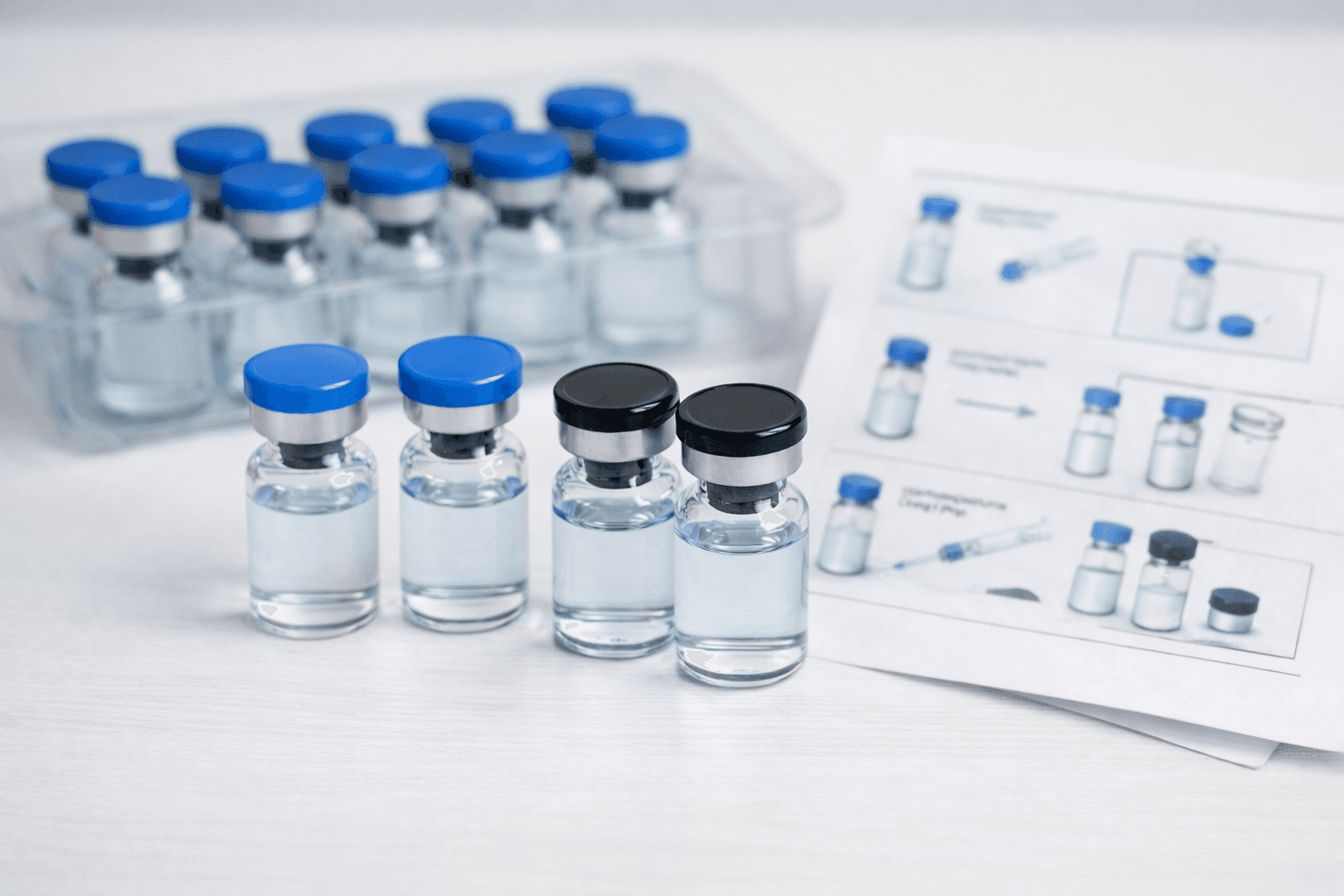
Tirzepatide is dosed differently than semaglutide.
It comes in multiple vial sizes (10mg, 30mg, 40mg) and requires careful titration from 2.5mg weekly to 10-15mg over 16-20 weeks for maximum results.
This guide covers complete tirzepatide dosing - how to dose each vial size, titration schedules, reconstitution for different strengths, what to expect at each dose level, and troubleshooting common issues.
Understanding tirzepatide dosing
Before diving into specific protocols, understanding the basics prevents mistakes.
Why tirzepatide requires titration
You can't start at full dose. Your body needs time to adapt to GLP-1 receptor activation.
Starting too high causes:
Severe nausea and vomiting
Extreme fatigue
Intolerable side effects
Protocol abandonment
Gradual titration:
Minimizes side effects
Allows adaptation
Improves tolerance
Maintains adherence
Standard schedule: Start 2.5mg weekly, increase every 4 weeks until reaching maintenance dose.
Learn more about how peptides work.
Tirzepatide vs semaglutide dosing
Key differences:
Tirzepatide:
Dual agonist (GLP-1 + GIP)
Higher starting dose (2.5mg vs 0.25mg)
Faster titration schedule
Typically higher maintenance dose
Single agonist (GLP-1 only)
Lower starting dose (0.25mg)
Slower titration
Lower maintenance dose
Effectiveness: Tirzepatide produces 15-22% weight loss vs semaglutide's 15-17%. Both excellent options.
Read our complete semaglutide vs tirzepatide comparison.
Common vial sizes
Research peptides come in three main sizes:
10mg vials: Smallest, good for testing tolerance or single dose
30mg vials: Most popular, lasts 3-12 weeks depending on dose
40mg vials: Bulk option, best value for long protocols
Which to buy? Start with 30mg vials. Most versatile for titration schedules.
Calculate exactly what you need with our peptide cost calculator.
Complete titration schedule
Standard protocol for maximum results with minimal side effects.
Week 1-4: Starting dose (2.5mg)
Weekly dose: 2.5mg
Why this dose:
Introduces GLP-1 effect
Minimal side effects
Tests tolerance
Begins appetite suppression
What to expect:
Mild appetite reduction (20-30%)
Slight nausea first few days (30% of users)
Weight loss: 2-4 lbs (mostly water)
Energy may dip initially
Common mistake: Thinking 2.5mg is "too low" and skipping to 5mg. Don't. This foundation dose matters.
Week 5-8: Low therapeutic dose (5mg)
Weekly dose: 5mg (double from 2.5mg)
Why this dose:
First therapeutic dose
Noticeable appetite suppression
Steady weight loss begins
Side effects still manageable
What to expect:
Moderate appetite suppression (40-50%)
Consistent 1-2 lb weekly loss
Nausea reduces (if present initially)
Energy normalizes
Total weight loss so far: 6-10 lbs
Week 9-12: Medium dose (7.5mg)
Weekly dose: 7.5mg
Why this dose:
Increased effectiveness
Strong appetite control
Accelerated fat loss
Still tolerable for most
What to expect:
Strong appetite suppression (60-70%)
1.5-2 lbs weekly loss
Minimal side effects (body adapted)
Improved insulin sensitivity
Total weight loss so far: 12-18 lbs
Week 13-16: High therapeutic dose (10mg)
Weekly dose: 10mg
Why this dose:
Maintenance dose for many users
Maximum appetite suppression
Optimal metabolic effects
Sustainable long-term
What to expect:
Very strong appetite control (70-80%)
Continued 1-2 lb weekly loss
Minimal hunger most days
Excellent insulin control
Total weight loss so far: 18-26 lbs
Week 17-20: Maximum dose (12.5-15mg)
Weekly dose: 12.5mg or 15mg (optional)
Why this dose:
For those who plateau at 10mg
Additional 3-5% weight loss
Maximum therapeutic effect
Not needed by everyone
What to expect:
Maximum suppression (80-90%)
Final 5-10 lbs to goal
Very little hunger
Excellent metabolic health
Total weight loss (20 weeks): 25-35 lbs average
Note: Many people maintain at 10mg. Only increase to 12.5-15mg if weight loss stalls.
Use our semaglutide calculator (works for tirzepatide too).
Dosing 10mg vials
10mg vials are smallest size. Best for single doses or testing.
Reconstitution for 10mg vials
Add 2ml bacteriostatic water to 10mg vial
Concentration: 5,000mcg per ml (5mg/ml)
Why 2ml: Easy math, manageable injection volume.
Supplies needed:
10mg tirzepatide vial
3ml syringe for mixing
Insulin syringes for injecting
Learn how to reconstitute peptides properly.
Dose chart for 10mg vials
With 2ml water (5mg/ml concentration):
Dose | Volume (ml) | Syringe units |
|---|---|---|
2.5mg | 0.5ml | 50 units |
5mg | 1.0ml | 100 units |
7.5mg | 1.5ml | 150 units |
10mg | 2.0ml | 200 units |
Problem with 10mg vials: Only contains one 10mg dose or four 2.5mg doses. Not ideal for long protocols.
Best use: Testing tolerance before buying larger vials.
Supply needed (10mg vials)
For complete 20-week protocol:
Week 1-4 (2.5mg): 1 vial (use 1/4 of vial weekly)
Week 5-8 (5mg): 2 vials
Week 9-12 (7.5mg): 3 vials
Week 13-16 (10mg): 4 vials
Total: 10 vials minimum
Cost: $400-600 for complete protocol (at $40-60 per 10mg vial)
Better option: Use 30mg vials (more economical).
Dosing 30mg vials
30mg vials are most popular. Best value and flexibility.
Reconstitution for 30mg vials
Add 3ml bacteriostatic water to 30mg vial
Concentration: 10,000mcg per ml (10mg/ml)
Why 3ml: Perfect for all dose levels, easy calculations.
Alternative: Add 2ml for stronger concentration (15mg/ml) but larger syringe units needed.
Use our reconstitution calculator for exact measurements.
Dose chart for 30mg vials
With 3ml water (10mg/ml concentration):
Dose | Volume (ml) | Syringe units | Doses per vial |
|---|---|---|---|
2.5mg | 0.25ml | 25 units | 12 doses |
5mg | 0.5ml | 50 units | 6 doses |
7.5mg | 0.75ml | 75 units | 4 doses |
10mg | 1.0ml | 100 units | 3 doses |
12.5mg | 1.25ml | 125 units | 2.4 doses |
15mg | 1.5ml | 150 units | 2 doses |
30mg vial advantages:
Lasts 3-12 weeks depending on dose
Economical ($80-120 vs multiple 10mg vials)
Flexible for any dose level
Standard from most suppliers
Supply needed (30mg vials)
For complete 20-week protocol:
Week 1-4 (2.5mg x 4 doses): 10mg total = 1/3 of vial
Week 5-8 (5mg x 4 doses): 20mg total = 2/3 of vial
First vial lasts 8 weeks
Week 9-12 (7.5mg x 4 doses): 30mg total = 1 vial
Week 13-16 (10mg x 4 doses): 40mg total = 1.33 vials
Week 17-20 (12.5mg x 4 doses): 50mg total = 1.67 vials
Total: 4-5 vials for complete 20-week protocol
Cost: $320-600 for complete protocol (at $80-120 per 30mg vial)
Most economical option for full protocol.
Source from best peptide vendors.
Example weekly schedule (30mg vial)
Week 1: 2.5mg dose
Reconstitute 30mg vial with 3ml water
Monday: Inject 0.25ml (25 units)
Vial contains 29 doses of 2.5mg remaining
Refrigerate, use over next 11 weeks
Week 2-4: Continue 0.25ml weekly
Week 5: Increase to 0.5ml (50 units) for 5mg dose
Week 9: New vial or continue (depending on dose progression)
Dosing 40mg vials
40mg vials are bulk option. Best for long-term use or high doses.
Reconstitution for 40mg vials
Add 4ml bacteriostatic water to 40mg vial
Concentration: 10,000mcg per ml (10mg/ml)
Why 4ml: Matches 30mg vial concentration (10mg/ml), easy consistency.
Alternative: Add 2ml for 20mg/ml concentration (very strong, smaller injection volumes).
Dose chart for 40mg vials
With 4ml water (10mg/ml concentration):
Dose | Volume (ml) | Syringe units | Doses per vial |
|---|---|---|---|
2.5mg | 0.25ml | 25 units | 16 doses |
5mg | 0.5ml | 50 units | 8 doses |
7.5mg | 0.75ml | 75 units | 5.3 doses |
10mg | 1.0ml | 100 units | 4 doses |
12.5mg | 1.25ml | 125 units | 3.2 doses |
15mg | 1.5ml | 150 units | 2.7 doses |
40mg vial advantages:
Lowest cost per mg
Lasts longer (less reconstitution)
Good for maintenance dosing
Bulk discount pricing
Disadvantage: Larger upfront cost, might expire if protocol ends early.
Supply needed (40mg vials)
For complete 20-week protocol:
Week 1-8: 30mg total = 3/4 of first vial
Week 9-16: 70mg total = 1.75 vials
Week 17-20: 50mg total = 1.25 vials
Total: 3-4 vials for complete 20-week protocol
Cost: $360-720 for complete protocol (at $120-180 per 40mg vial)
Best for: People committed to long-term use (6+ months).
Injection technique
Subcutaneous injection once weekly. Same day each week.
Best injection sites
Abdomen (recommended):
2 inches from belly button
Most fat tissue
Easy to reach
Rotate quadrants weekly
Front of thigh: Alternative if abdomen not suitable
Back of upper arm: Requires assistance or flexibility
Injection process
Step 1: Calculate dose using charts above
Step 2: Draw dose into insulin syringe
Step 3: Clean injection site with alcohol swab
Step 4: Pinch skin, insert needle at 45-90 degree angle
Step 5: Inject slowly (5-10 seconds)
Step 6: Withdraw needle, apply pressure
Step 7: Dispose needle in sharps container
Timing: Same day each week (e.g., every Monday morning)
Rotating sites: Prevents tissue damage, improves absorption.
Compare injectable vs oral peptides options.
Managing side effects at each dose
Side effects vary by dose level.
2.5mg dose side effects
Common (30-40% of users):
Mild nausea (first 2-3 days)
Slight fatigue
Reduced appetite
Management:
Eat smaller meals
Avoid greasy foods
Stay hydrated
Ginger for nausea
Duration: Usually resolves within 3-5 days
5mg dose side effects
Common (40-50%):
Moderate nausea (dose day + 1-2 days after)
Constipation
Mild headache
Management:
Anti-nausea medication (Zofran) if needed
Increase fiber and water
Walk after meals
Electrolyte supplementation
7.5-10mg dose side effects
Common (30-40%):
Nausea (body adapted by now, less severe)
Constipation (more common)
Fatigue on injection day
Management:
Miralax or magnesium for constipation
Inject evening instead of morning
Meal timing strategies
Lower fat intake
12.5-15mg dose side effects
Common (20-30%):
Similar to 10mg but slightly more intense
GI slowdown
Occasional reflux
Management:
Smaller, more frequent meals
Avoid late-night eating
Antacids if needed
Consider staying at 10mg if intolerable
Read our peptide safety guide for complete information.
Troubleshooting common dosing issues
Not losing weight at current dose
Wait 4 weeks: Weight loss isn't linear. Plateaus normal.
Check diet: GLP-1 agonists reduce appetite but don't override terrible food choices.
Increase dose: If 4 weeks at same dose with no loss, increase to next level.
Consider stacking: Add other peptides for enhanced results.
Side effects too severe
Reduce dose temporarily: Go back to previous dose for 2 more weeks.
Slow titration: Increase by 1.25mg increments instead of 2.5mg jumps.
Timing strategies: Inject Friday evening so weekend side effects don't affect work.
Medication: Anti-nausea meds, GI support supplements.
Stop if: Severe vomiting, extreme fatigue, signs of pancreatitis (severe abdominal pain).
Calculating doses incorrectly
Use calculators: Don't eyeball measurements.
Double-check math: Concentration × volume = dose.
Mark syringes: Write dose on syringe before injection.
Reconstitution calculator: Use our peptide reconstitution calculator.
Dosage calculator: Use our semaglutide calculator (works for tirzepatide).
Running out mid-protocol
Plan ahead: Order next vials when current vial 70% used.
Shipping delays: Account for 5-10 day delivery.
Backup suppliers: Have 2-3 vetted vendors identified.
Storage: Unopened vials stable for 2+ years, reconstituted stable 28 days.
Read our peptide storage guide.
Alternative titration schedules
Standard schedule works for most people. Alternatives for special cases.
Fast titration (aggressive)
Week 1-2: 2.5mg Week 3-4: 5mg Week 5-6: 7.5mg Week 7-8: 10mg Week 9+: 12.5-15mg
Pros: Reach therapeutic dose faster, quicker results
Cons: Higher side effect risk, lower adherence
Best for: People with prior GLP-1 experience, high tolerance
Slow titration (conservative)
Week 1-6: 2.5mg Week 7-12: 5mg Week 13-18: 7.5mg Week 19-24: 10mg
Pros: Minimal side effects, excellent tolerance
Cons: Slower initial results, longer protocol
Best for: Side effect-sensitive people, first-time users, health conditions
Micro-dosing (very gradual)
Increase by 1mg increments instead of 2.5mg jumps
Example: 2.5mg → 3.5mg → 4.5mg → 5.5mg → etc.
Pros: Almost zero side effects
Cons: Complex dosing calculations, very slow
Best for: Extreme sensitivity, previous GLP-1 intolerance
Maintenance dosing
After reaching goal weight, what's next?
Finding maintenance dose
Most people: 5-10mg weekly maintains weight
Some need: 2.5mg weekly for maintenance
Few require: 12.5-15mg to prevent regain
Process: Reduce dose gradually, monitor weight for 4 weeks at each level.
Maintenance schedule
Month 1-2: Stay at current dose, assess stability
Month 3-4: Reduce by 2.5mg, monitor weight
Month 5-6: Reduce again if weight stable
Long-term: Minimum dose that prevents regain
Coming off tirzepatide
Not recommended: Abruptly stopping often leads to rapid weight regain.
Better approach: Gradual dose reduction over 2-3 months while building sustainable habits.
Success factors:
Established eating habits
Regular exercise routine
Metabolic adaptation complete
Sustainable calorie intake
Reality: Many people stay on low maintenance dose long-term (2.5-5mg weekly).
Cost analysis by vial size
Which vial size offers best value?
Cost per mg comparison
10mg vials at $50 each: $5 per mg
30mg vials at $100 each: $3.33 per mg (33% savings)
40mg vials at $140 each: $3.50 per mg (30% savings)
Winner: 30mg vials offer best value
Total protocol costs
Using 10mg vials (10 vials needed):
10 vials × $50 = $500-600
Using 30mg vials (4-5 vials needed):
5 vials × $100 = $400-500
Using 40mg vials (3-4 vials needed):
4 vials × $140 = $480-560
Winner: 30mg vials most economical for 20-week protocol
Calculate your specific needs with our peptide cost calculator.
Budget strategies
Start small: Test tolerance with one 10mg or 30mg vial before bulk buying.
Bulk discounts: Many vendors offer 10-20% off for 5+ vials.
Compare suppliers: Prices vary $20-40 per vial between suppliers.
Quality matters: Don't choose cheapest option. Third-party testing essential.
Comparing to other weight loss peptides
How tirzepatide stacks up.
Tirzepatide vs semaglutide
Single receptor (GLP-1)
15-17% weight loss average
Lower starting dose (0.25mg)
Slower titration
More established research
Tirzepatide:
Dual receptor (GLP-1 + GIP)
15-22% weight loss average
Higher starting dose (2.5mg)
Faster results
Newer, less long-term data
Winner: Tirzepatide edges out for weight loss effectiveness.
Read our complete semaglutide vs tirzepatide comparison.
Tirzepatide vs peptide stacks
Peptide stacks for weight loss:
Multiple peptides combined
More complex protocols
Different mechanisms (GH release, metabolism)
No appetite suppression
Tirzepatide:
Single peptide
Simple weekly dosing
Direct appetite suppression
Easier to maintain
Winner: Tirzepatide for simplicity and weight loss. Stacks for body composition + performance.
Use our stack calculator to compare options.
Frequently asked questions
Q: Which tirzepatide vial size should I buy?
A: 30mg vials for most people. Best balance of value and flexibility. Start with one vial to test tolerance, then buy 3-4 more for complete protocol.
Q: Can I start at 5mg instead of 2.5mg?
A: Not recommended. Side effects will be severe. Always start at 2.5mg for 4 weeks. The titration schedule exists for good reasons.
Q: How do I dose a 30mg vial for 2.5mg weekly?
A: Add 3ml bacteriostatic water to vial (makes 10mg/ml). Draw 0.25ml (25 units on insulin syringe) weekly. Use our reconstitution calculator.
Q: What if I miss a weekly dose?
A: Take it within 4 days of scheduled dose. If more than 4 days late, skip and resume normal schedule. Don't double up.
Q: How long does tirzepatide work?
A: 5-7 day half-life. Weekly dosing maintains stable blood levels. Effects accumulate over weeks.
Q: Can I increase dose faster than recommended?
A: You can, but side effects will be worse. Most people who rush the titration end up quitting. Slow and steady wins.
Q: Is tirzepatide better than semaglutide?
A: Slightly more effective (15-22% vs 15-17% weight loss). Read our comparison guide.
Q: Where do I buy tirzepatide?
A: Research peptide suppliers with third-party testing. Check our vendor guide for vetted sources.
Q: How much does complete tirzepatide protocol cost?
A: $400-600 for 20-week protocol using 30mg vials. Use our cost calculator.
Q: Do I need to refrigerate tirzepatide?
A: Yes, both before and after reconstitution. Read our storage guide.
The bottom line
Tirzepatide requires careful dosing across multiple vial sizes. 30mg vials offer best value for most protocols.
Standard titration schedule:
Week 1-4: 2.5mg weekly
Week 5-8: 5mg weekly
Week 9-12: 7.5mg weekly
Week 13-16: 10mg weekly
Week 17-20: 12.5-15mg weekly (optional)
Vial recommendations:
10mg vials: Testing tolerance only
30mg vials: Best value, most flexible
40mg vials: Bulk option for long-term use
Complete protocol requires:
4-5x 30mg vials (most economical)
20 weeks minimum
$400-600 total cost
Weekly injections
Success factors:
Follow titration schedule (don't rush)
Source quality peptides from reputable vendors
Manage side effects proactively
Support with diet and exercise
Use our calculators:
Semaglutide calculator (works for tirzepatide)
Start with 2.5mg weekly for 4 weeks. Increase gradually every 4 weeks. Most people maintain at 5-10mg long-term.
Related resources
Semaglutide vs tirzepatide comparison (complete guide)
Best peptides for weight loss (all options)
Semaglutide dosage calculator (similar protocol)
Best peptide stack for weight loss (alternatives)
In case I don’t see you, good afternoon, good evening, and good night. Take care of yourself. Cheers.