Dec 23, 2025
Retatrutide is the peptide everyone's talking about but nobody can seem to find.
It's more powerful than semaglutide. More effective than tirzepatide. Clinical trials show average weight loss of 24% body weight at 48 weeks, numbers that make other GLP-1 agonists look weak.
But here's the problem: retatrutide isn't FDA-approved yet. It's still in phase 3 trials. You can't walk into CVS with a prescription and pick it up.
The companies selling it online range from legitimate research peptide suppliers to outright scammers selling who-knows-what.
So how do you actually buy retatrutide? More importantly, how do you buy it without getting scammed, underdosed, or worse - contaminated product?
This guide covers everything. Where to source retatrutide, how to verify what you're getting is real, what it should cost, how to dose it properly, and what results to expect. You'll learn the difference between legitimate research peptide suppliers and operations you should avoid.
Let's start with what makes retatrutide different from the weight loss peptides you already know about.
What is retatrutide and why is it so effective?
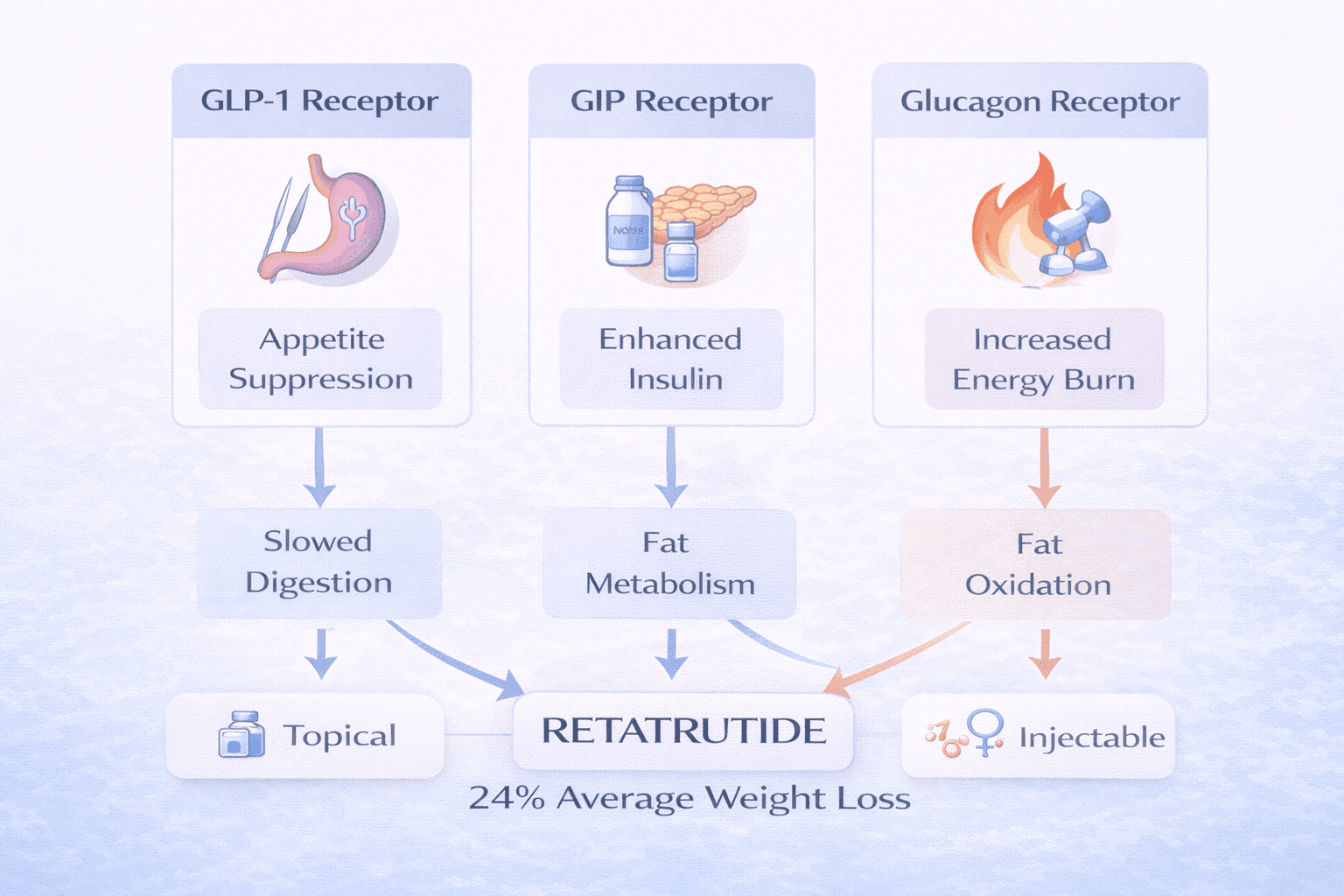
Retatrutide is a triple agonist peptide - meaning it activates three different receptor types simultaneously: GLP-1, GIP, and glucagon receptors.
Compare this to semaglutide (Ozempic, Wegovy) which only activates GLP-1 receptors, or tirzepatide (Mounjaro, Zepbound) which activates GLP-1 and GIP receptors. Retatrutide does everything they do plus more.
Here's what each receptor does:
GLP-1 activation: Slows gastric emptying, suppresses appetite, improves insulin sensitivity. This is why semaglutide works - you feel full longer, eat less, lose weight.
GIP activation: Enhances insulin secretion, reduces glucagon (which normally raises blood sugar), and may directly affect fat metabolism in adipose tissue. This is why tirzepatide outperforms semaglutide.
Glucagon activation: This is retatrutide's unique advantage. Glucagon typically raises blood sugar, but when combined with GLP-1 and GIP activation in specific ratios, it increases energy expenditure and promotes fat burning without causing hyperglycemia. Your body burns more calories at rest.
The triple action creates synergy. You eat less (appetite suppression), absorb and store less (improved insulin sensitivity and fat metabolism), and burn more (increased metabolic rate). The result is weight loss that significantly exceeds dual agonists.
Clinical trial results
Phase 2 trials showed:
24.2% average body weight loss at 48 weeks (highest dose group)
17.5% weight loss in lower dose group
Significant improvements in cardiometabolic markers
Relatively well-tolerated side effect profile
For context, semaglutide achieves about 15% weight loss and tirzepatide achieves about 22% weight loss in comparable timeframes. Retatrutide's 24% puts it in a class by itself.
Phase 3 trials are ongoing. If results hold up, retatrutide will likely receive FDA approval for obesity treatment by 2026-2027.
Why you can't get it through normal channels yet
Retatrutide is still investigational. It's not approved for any medical use. Pharmaceutical companies (Eli Lilly holds the rights) won't sell it outside clinical trials.
This leaves the research peptide market - companies that synthesize and sell peptides for "research purposes only." This market exists in a legal gray area. Technically legal when sold for research, technically illegal if purchased for human use.
That gray area is where you'll find retatrutide right now.
Where to buy retatrutide peptide safely
Finding legitimate sources requires careful vetting. Here's how to approach it:
Understanding the research peptide market
Research peptide companies exist to supply peptides for laboratory and research purposes. They're not pharmaceutical manufacturers. They don't go through FDA approval processes. They synthesize peptides and sell them with the legal disclaimer "for research use only, not for human consumption."
Despite the disclaimers, everyone knows these peptides are being used by humans. The suppliers know it. The buyers know it. The payment processors know it. It's the legal fig leaf that allows this market to exist.
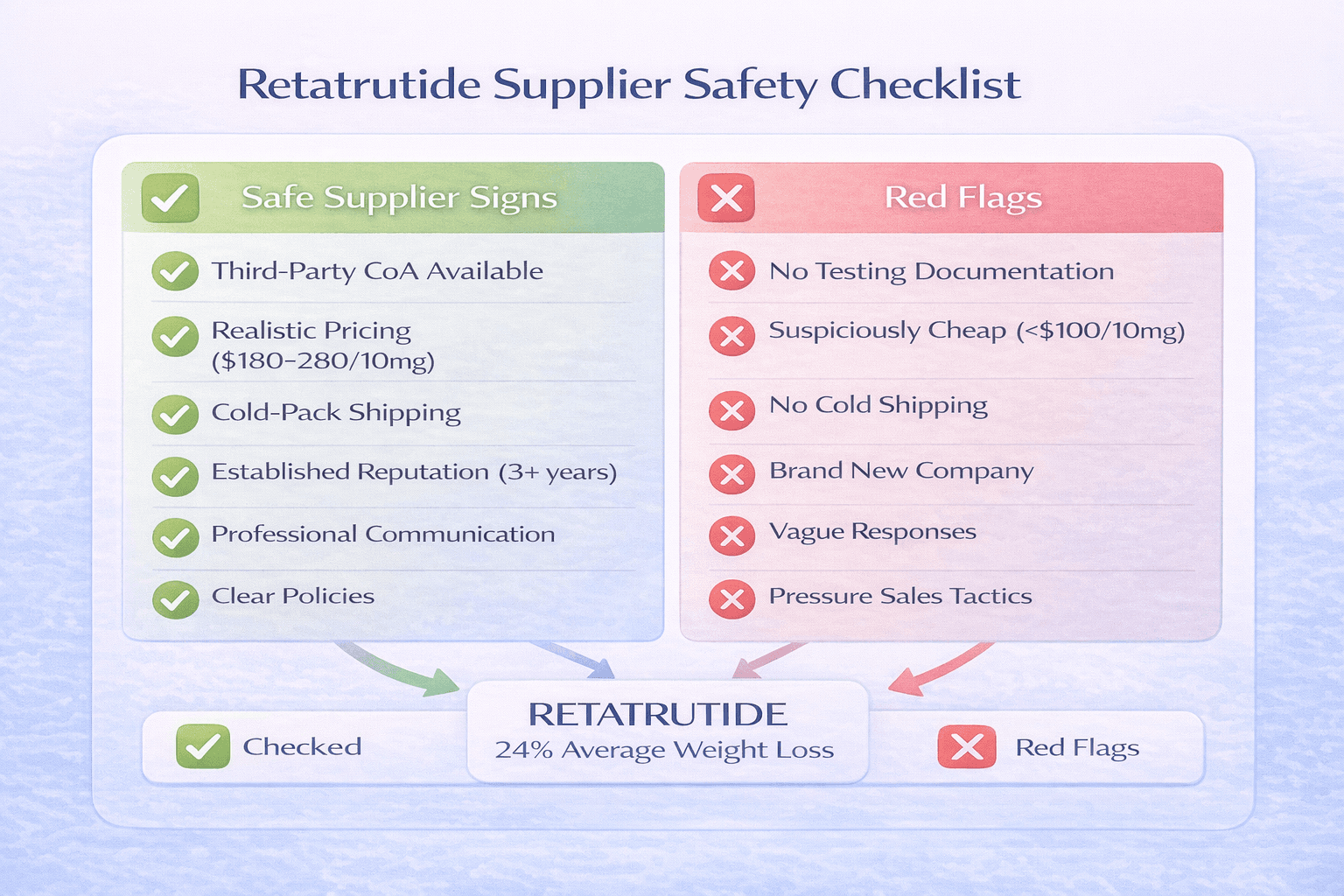
Legitimate research suppliers:
Provide third-party testing documentation
Have been in business for years
Ship proper products consistently
Have verifiable community reputation
Operate transparently with clear policies
Scam operations:
No testing documentation or fake CoAs
Brand new companies with no track record
Suspiciously cheap prices
Poor communication and customer service
Vague about sourcing and manufacturing
Key factors for evaluating suppliers
1. Third-party testing (most important)
Every batch of retatrutide should come with a Certificate of Analysis (CoA) from an independent laboratory. This verifies:
Identity (confirms it's actually retatrutide, not something else)
Purity (percentage of actual peptide vs contaminants)
Concentration (how much retatrutide per vial)
Don't buy from suppliers who can't or won't provide CoAs. Ever. No exceptions.
The CoA should be from a recognized testing lab (Janoshik, Peptide Test, or similar). It should include the specific batch number matching your product. Generic CoAs or "representative testing" mean nothing.
2. Pricing reality check
Retatrutide is expensive to synthesize. If someone's selling it dramatically cheaper than everyone else, they're either:
Underdosing (vial says 10mg, actually contains 5mg)
Selling lower purity product (70% pure instead of 98%+)
Selling fake product (different peptide or no active ingredient)
Running a scam (take your money, ship nothing or garbage)
Current market pricing (as of late 2024):
10mg vial: $180-280
15mg vial: $250-400
Kits (multiple months supply): $800-1,500
If you see 10mg vials for $50, run away. That's not real retatrutide.
3. Shipping and storage
Peptides degrade in heat. Legitimate suppliers ship with cold packs or ice. If your retatrutide arrives warm after sitting in a hot delivery truck, it may be degraded.
Good suppliers:
Use insulated packaging
Include ice packs or gel packs
Ship priority or express to minimize transit time
Provide tracking information
Have policies for addressing heat-damaged shipments
4. Customer service and communication
Try contacting the supplier before ordering. Ask specific questions:
What's the purity of your current retatrutide batch?
Can you provide a recent CoA?
What's your shipping method and timeline?
What's your policy for product issues?
Legitimate suppliers respond professionally with specific answers. Scammers give vague responses or don't respond at all.
5. Payment methods
Credit cards, PayPal, and similar payment processors often don't work with research peptide suppliers due to their terms of service. Many legitimate suppliers use:
Cryptocurrency (Bitcoin, Ethereum, etc.)
Zelle
Cash App
Wire transfer
Sometimes Venmo
Using crypto doesn't mean a supplier is shady. It often means they're established enough to have been kicked off traditional payment processors. Just make sure all the other factors check out.
6. Community reputation
Check Reddit (r/Peptides, r/Mounjaro, weight loss subreddits), Discord servers, and peptide forums. Established suppliers have long histories of verified purchases and experiences. New operations might be legitimate but carry more risk.
Look for:
Multiple verified positive experiences
Detailed reviews discussing actual product effects
How the company handles problems (shipping issues, product concerns)
Warning signs from other users
Red flags that mean "don't buy"
No testing available: If they can't provide CoAs, assume product is fake or contaminated.
Prices too good to be true: Retatrutide isn't cheap. Dramatically low prices mean something's wrong.
Website full of medical claims: Legitimate research suppliers avoid making medical/therapeutic claims. If the site reads like pharmaceutical advertising, it's trying too hard.
Poor website quality: Terrible grammar, broken links, stolen stock photos - these indicate low-effort scam operations.
Pressure tactics: "Limited time offer!" "Almost out of stock!" These are sales tactics, not how legitimate suppliers operate.
No contact information: No physical address, no email, no way to reach them except an order form - huge red flag.
Brand new company: Established suppliers have years of history. New operations might be legitimate but require extra scrutiny.
For more detailed supplier evaluation criteria, see our best peptide vendors guide.
Proper retatrutide dosing protocols
Retatrutide dosing differs from semaglutide and tirzepatide. Here's how to use it safely and effectively:
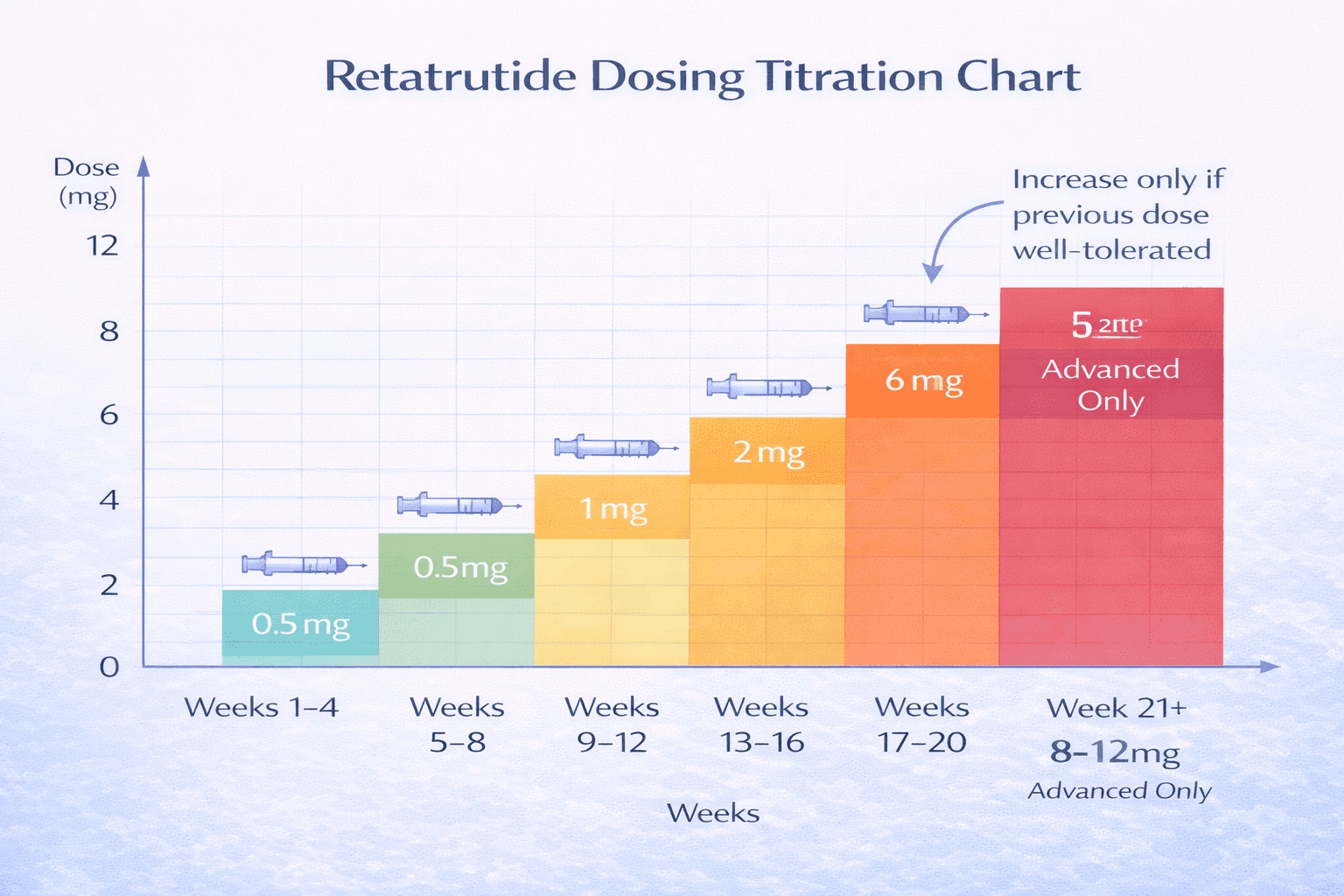
Standard titration protocol
You must start low and increase gradually. Jumping straight to high doses causes severe nausea, vomiting, and potential complications.
Week 1-4: 0.5mg per week
Start here regardless of your weight or goals
This acclimates your system to GLP-1 effects
You'll notice some appetite suppression but minimal side effects
Week 5-8: 1mg per week
Double your dose if 0.5mg was well-tolerated
More significant appetite suppression
Weight loss becomes noticeable
Week 9-12: 2mg per week
Continue titrating upward
This is where substantial results begin
Monitor side effects carefully
Week 13-16: 4mg per week
Therapeutic dose for most people
Strong appetite suppression
Significant weight loss in progress
Week 17-20: 6mg per week (optional)
Only increase if 4mg isn't producing adequate results
Not everyone needs this dose
Side effects increase at higher doses
Week 21+: 8-12mg per week (advanced)
Clinical trials used up to 12mg weekly
Only for those who tolerate lower doses perfectly
Most people don't need to go this high
Injection timing and frequency
Once weekly dosing: Retatrutide has a long half-life (approximately 5-7 days). Once-weekly injection maintains stable blood levels.
Best injection day: Pick a consistent day each week. Many people choose Sunday evening or Monday morning for weekly routine.
Best time of day: Evening injection before bed reduces likelihood of feeling side effects while awake. If nausea occurs, you sleep through the worst of it.
Injection location: Subcutaneous injection in abdomen, thigh, or upper arm. Rotate sites weekly to prevent irritation.
Reconstitution
Retatrutide comes as lyophilized powder requiring reconstitution with bacteriostatic water.
Standard reconstitution ratio: 2ml bacteriostatic water per 10mg vial
This creates 5mg/ml concentration:
0.5mg dose = 0.1ml (10 units on insulin syringe)
1mg dose = 0.2ml (20 units)
2mg dose = 0.4ml (40 units)
4mg dose = 0.8ml (80 units)
For precise calculations with different vial sizes, use our peptide reconstitution calculator.
Storage after reconstitution:
Store in refrigerator (36-46°F)
Protect from light (use original box or wrap in foil)
Use within 28-30 days of reconstitution
Don't freeze
For detailed reconstitution guidance, see our guide on how to reconstitute peptides.
Adjusting based on response
If experiencing significant side effects at current dose:
Don't increase yet
Stay at current dose an additional 2-4 weeks
Only increase when side effects have resolved
If experiencing no side effects and minimal results:
You can increase dose after 3-4 weeks instead of 4-8 weeks
Don't skip titration steps entirely
Monitor response closely
If you miss a dose:
Take it as soon as you remember if within 3 days
If more than 3 days late, skip missed dose and take next scheduled dose
Don't double up doses to "catch up"
Duration of use
Typical cycle: 16-24 weeks to reach goal weight
Maintenance: After reaching goal, either:
Continue at lowest effective maintenance dose (often 2-4mg weekly)
Transition to less frequent dosing (every 10-14 days)
Take a break and reassess if weight begins creeping back
Many people find they need ongoing GLP-1 therapy to maintain weight loss. This isn't "dependency" - it's addressing the biological factors that caused obesity in the first place.
Expected results and timeline
Weight loss with retatrutide follows a predictable pattern, though individual results vary.
Weeks 1-4: Initial response (0.5mg dose)
What's happening: Your body is adapting to GLP-1 receptor activation. Gastric emptying slows. Appetite signals change.
Weight loss: 2-5 pounds. Mostly water weight and reduced food volume in digestive system.
Side effects: Mild nausea possible but usually minimal at this low dose. Some people notice no side effects at all.
What to expect: Food doesn't sound as appealing. You feel satisfied with smaller portions. The constant food thoughts quiet down.
Weeks 5-8: Momentum builds (1mg dose)
What's happening: GLP-1 effects strengthen. Fat oxidation increases. Insulin sensitivity improves.
Weight loss: 5-10 pounds (cumulative 7-15 pounds total). Real fat loss beginning.
Side effects: Nausea more likely, especially days 2-3 after injection. Usually manageable.
What to expect: Appetite suppression becomes more noticeable. Eating large meals feels uncomfortable. Weight drops more consistently.
Weeks 9-12: Significant progress (2mg dose)
What's happening: Triple agonist effects fully engaged. Metabolic rate elevated. Fat burning optimized.
Weight loss: 8-12 pounds this month (cumulative 15-27 pounds). Clothes fit noticeably looser.
Side effects: Nausea, possible constipation, food aversions. Usually peaks around day 2-3 post-injection, then improves.
What to expect: Weight loss becomes obvious to others. Energy often improves. Blood sugar and blood pressure trending lower.
Weeks 13-20: Maximum effect (4-6mg dose)
What's happening: Full therapeutic effect achieved. Body is efficiently burning fat while preserving muscle.
Weight loss: 3-5 pounds per week (12-20 pounds during this period). Total cumulative loss 27-47 pounds.
Side effects: Either you've adapted and feel fine, or side effects remain challenging. If the latter, consider staying at 4mg instead of increasing to 6mg.
What to expect: Major body composition changes. Substantial clothing size reductions. Metabolic markers significantly improved.
Weeks 21-24: Final phase (maintenance dose finding)
What's happening: Approaching goal weight or deciding on maintenance strategy.
Weight loss: Slowing as you approach goal (2-4 pounds per week). Total loss varies widely but 40-60+ pounds is common.
Side effects: Side effects typically stabilize. You've either adapted or found your tolerance limit.
What to expect: Shifting focus from rapid loss to sustainable maintenance. Determining minimum effective dose to maintain results.
Realistic total weight loss expectations
Based on clinical trial data and anecdotal reports:
Starting at obese (BMI 30-35):
20-25% body weight loss over 24 weeks
40-60 pounds for someone starting at 200-240 pounds
Starting at severely obese (BMI 35-40):
22-28% body weight loss
65-85 pounds for someone starting at 280-320 pounds
Starting at morbidly obese (BMI 40+):
20-30% body weight loss
80-120+ pounds for someone starting at 350+ pounds
Results depend on:
Starting weight (heavier people lose more absolute pounds)
Diet quality (protein intake matters for muscle preservation)
Activity level (resistance training preserves muscle during loss)
Metabolic health (insulin resistance slows progress)
Medication adherence (missing doses reduces effectiveness)
Genetics (metabolic rate and fat distribution vary)
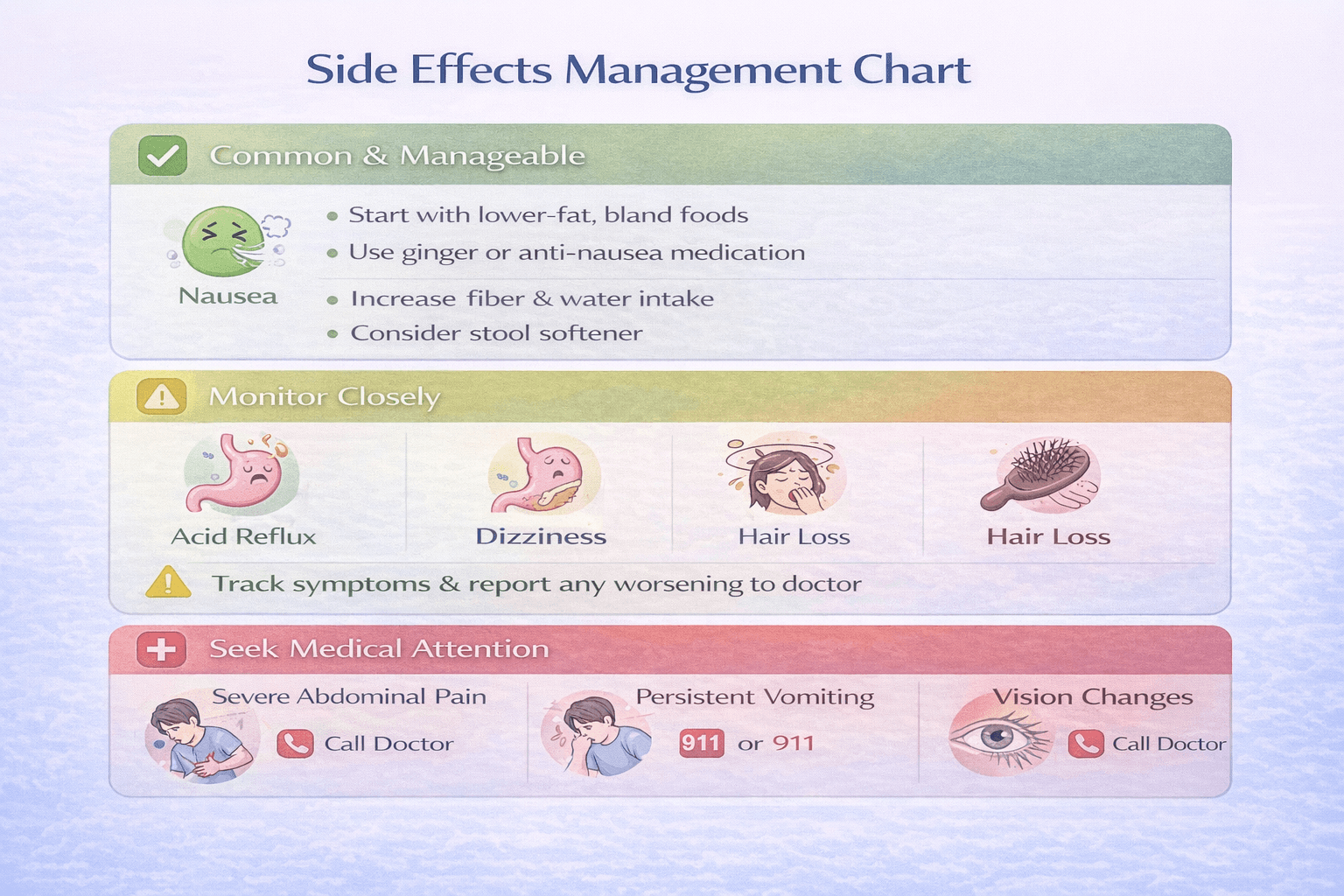
Side effects and how to manage them
Retatrutide side effects are similar to other GLP-1 agonists but potentially more intense due to triple agonist action.
Common side effects (occur in 30-60% of users)
Nausea:
Most common side effect
Typically worst day 1-3 after injection, improves by day 5-7
Usually decreases over time as body adapts
Management:
Eat smaller, more frequent meals
Avoid greasy, spicy, or heavy foods
Ginger tea or ginger supplements help
Anti-nausea medications (ondansetron, meclizine) if severe
Stay hydrated
Constipation:
Slowed gastric emptying affects entire digestive tract
Can become uncomfortable if not addressed
Management:
Increase fiber intake (vegetables, psyllium husk)
Stay well-hydrated (1 gallon water daily)
Magnesium supplements (400-600mg)
Miralax or other gentle laxatives if needed
Regular physical activity
Fatigue:
Low-calorie intake plus metabolic changes cause tiredness
Usually improves after 4-6 weeks
Management:
Ensure adequate protein intake (prevents muscle loss)
Take electrolytes (sodium, potassium, magnesium)
Get sufficient sleep (8+ hours)
Light exercise helps maintain energy
Food aversions:
Specific foods suddenly seem unappealing or repulsive
Meat aversion particularly common
Management:
Focus on foods that still appeal
Ensure adequate protein from various sources
This often resolves after several weeks
Less common but important side effects
Acid reflux/heartburn:
Delayed gastric emptying can increase reflux
Management:
Take antacids (Tums, Pepcid, omeprazole)
Don't eat within 3 hours of bedtime
Sleep with head elevated
Dizziness/lightheadedness:
Often related to low blood sugar or blood pressure changes
Management:
Monitor blood pressure and blood sugar
Stay hydrated
Rise slowly from sitting/lying positions
Gallbladder issues:
Rapid weight loss increases gallstone risk
Management:
Eat some fat with each meal (stimulates gallbladder emptying)
Monitor for severe upper right abdominal pain
Seek medical attention if symptoms develop
Hair loss:
Temporary, related to rapid weight loss and potential nutrient deficiency
Usually resolves 3-6 months after weight stabilizes
Management:
Ensure adequate protein (0.8-1g per pound goal body weight)
Take biotin, zinc, and iron supplements
Use peptides for hair growth (see our peptides for hair growth guide)
Serious side effects requiring medical attention
Severe abdominal pain: Could indicate pancreatitis or gallbladder issues. Seek immediate medical attention.
Persistent vomiting: Dehydration risk. Contact doctor if vomiting more than 3-4 times in 24 hours.
Vision changes: Rare but possible. Report to doctor immediately.
Severe allergic reaction: Rash, swelling, difficulty breathing. Call 911.
Who should not use retatrutide
Absolute contraindications:
Personal or family history of medullary thyroid carcinoma
Multiple endocrine neoplasia syndrome type 2
Pregnancy or breastfeeding
Active pancreatitis
Relative contraindications (use with caution/medical supervision):
History of pancreatitis
Severe gastroparesis
Diabetic retinopathy
Kidney disease
History of eating disorders
For comprehensive peptide safety information, see our peptide safety and risks guide.
Retatrutide vs semaglutide vs tirzepatide
How does retatrutide compare to established weight loss peptides?
Weight loss effectiveness
Retatrutide: 24% average body weight loss at 48 weeks (highest dose)
Tirzepatide: 22% average body weight loss at 72 weeks (highest dose)
Semaglutide: 15% average body weight loss at 68 weeks (highest dose)
Retatrutide wins on pure numbers. The triple agonist mechanism produces more weight loss than dual or single agonists.
Side effect profile
Retatrutide: More intense GI side effects in some users due to triple mechanism. Nausea rates around 40-50% in trials.
Tirzepatide: Moderate side effects. Better tolerated than semaglutide for many users. Nausea around 30-40%.
Semaglutide: Significant GI issues for many users. Nausea rates 40-50%, often severe enough to discontinue.
Winner depends on individual tolerance. Retatrutide isn't necessarily worse than semaglutide despite being more powerful.
Cost (current market)
Retatrutide (research peptide): $200-300/month at therapeutic doses
Tirzepatide (prescription Mounjaro/Zepbound): $1,000+/month without insurance, $25-50/month with good insurance
Semaglutide (prescription Ozempic/Wegovy): $1,000+/month without insurance, $25-50/month with insurance
Tirzepatide (compounded): $300-500/month
Semaglutide (compounded): $200-400/month
Retatrutide through research suppliers is competitive with compounded versions of approved peptides. Prescription brand-name drugs are much more expensive without insurance.
Availability
Retatrutide: Research peptide market only. Requires sourcing from legitimate suppliers.
Tirzepatide: FDA-approved, widely available by prescription. Also available compounded.
Semaglutide: FDA-approved, widely available by prescription. Also available compounded.
Semaglutide and tirzepatide are much easier to obtain legally with medical supervision.
FDA approval status
Retatrutide: Phase 3 trials ongoing. Likely FDA approval 2026-2027 if trials succeed.
Tirzepatide: FDA-approved for diabetes (Mounjaro) and obesity (Zepbound).
Semaglutide: FDA-approved for diabetes (Ozempic) and obesity (Wegovy).
Using retatrutide means using an investigational drug. There's no medical oversight unless you're in a clinical trial.
When to choose each
Choose semaglutide if:
You want FDA-approved, doctor-supervised treatment
Your insurance covers it
You prefer established safety profile
15% weight loss would meet your goals
Choose tirzepatide if:
You want maximum approved efficacy (22% loss)
Insurance covers it or you can afford it
You want medical supervision
You didn't tolerate semaglutide well
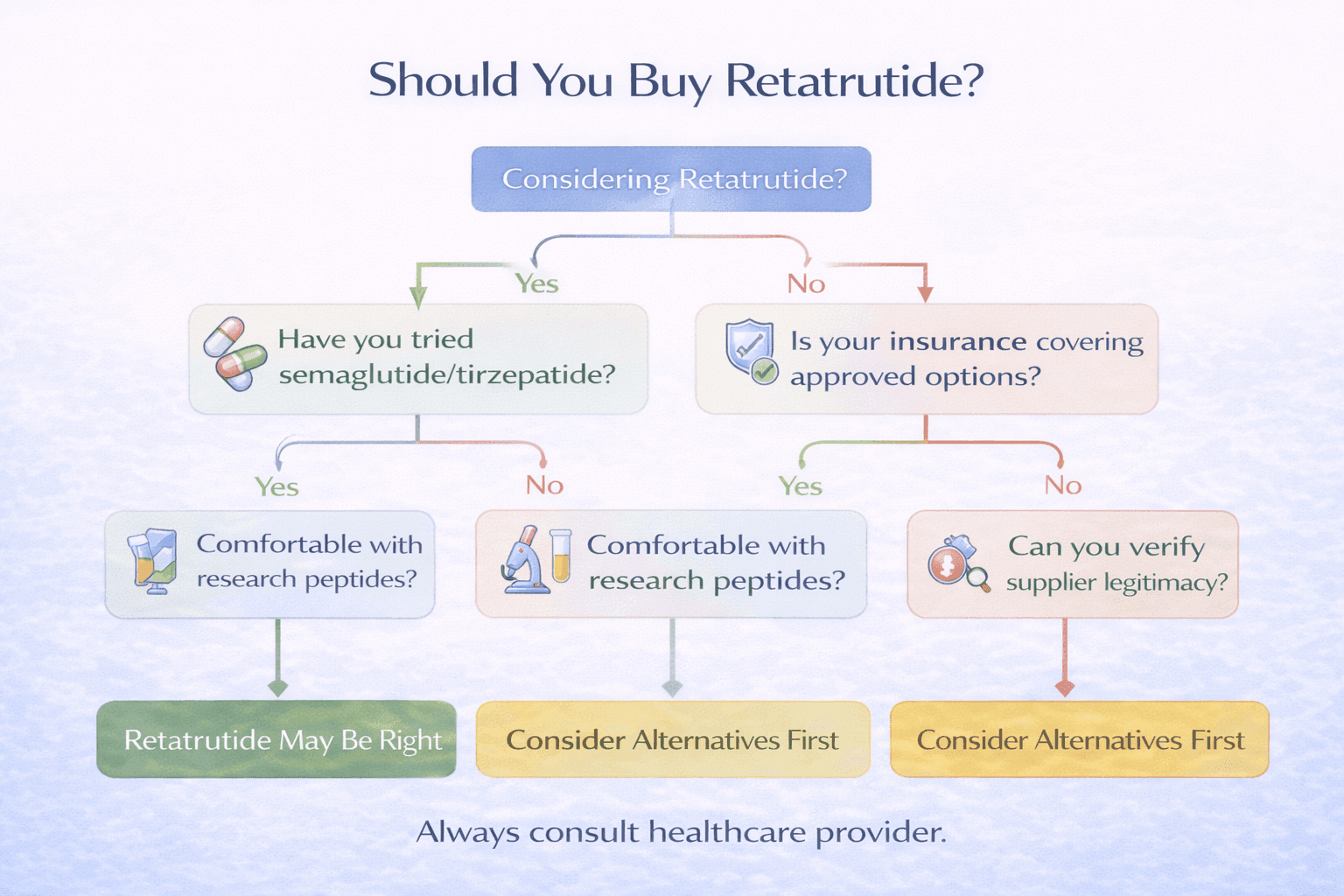
Choose retatrutide if:
You've tried semaglutide/tirzepatide and want more
You're comfortable with research peptides
You don't have insurance coverage for approved options
You're willing to accept investigational status risks
You want maximum possible results
For detailed comparisons, see our semaglutide vs tirzepatide guide and use our semaglutide calculator for dosing guidance.
Stacking retatrutide with other peptides
Retatrutide is powerful enough that most people don't need to stack it. However, specific combinations can address particular goals:
Retatrutide + BPC-157 (for gut health)
If you're experiencing significant GI side effects from retatrutide, BPC-157 can help heal digestive inflammation and improve tolerance.
Protocol:
Retatrutide: Standard titration protocol
BPC-157: 250-500mcg twice daily, subcutaneous injection
BPC-157 won't eliminate nausea but can reduce overall GI discomfort and protect stomach lining. See our BPC-157 guide.
Retatrutide + CJC-1295/Ipamorelin (for muscle preservation)
Rapid weight loss can cause muscle loss. Growth hormone peptides help preserve lean mass during aggressive calorie deficits.
Protocol:
Retatrutide: Standard titration
CJC-1295/Ipamorelin: 200-300mcg before bed
This is advanced. Monitor closely for interactions. Increased appetite from growth hormone peptides may partially counter retatrutide's appetite suppression.
Retatrutide + peptides for loose skin
After significant weight loss, skin laxity becomes an issue. Certain peptides may improve skin elasticity.
Protocol:
Retatrutide: Standard protocol
GHK-Cu: Topical application to areas of concern
Consider: TB-500 cycles for tissue remodeling
This is more theoretical than proven, but some users report improvement.
What NOT to stack
Retatrutide + other GLP-1 agonists: Redundant and increases side effects without additional benefit. Don't combine retatrutide with semaglutide or tirzepatide.
Retatrutide + insulin: Contradictory mechanisms. If diabetic and using insulin, work with endocrinologist to adjust insulin doses as needed.
For comprehensive stacking guidance, see our peptide stacks guide.
The role of SeekPeptides in your retatrutide journey
Using retatrutide effectively requires precision. Reconstitution errors waste expensive peptides. Dosing mistakes cause unnecessary side effects. Poor planning leads to inconsistent results.
SeekPeptides eliminates these problems.
Precise reconstitution: Our peptide reconstitution calculator tells you exactly how much bacteriostatic water to add for your desired concentration. No math errors, no wasted peptides.
Accurate dosing: Our peptide calculator ensures you inject the right amount every time based on your vial concentration and target dose.
Protocol planning: Our cycle planning guide helps you map out your complete titration schedule, track progress, and know when to adjust.
Cost planning: Our peptide cost calculator helps you budget for your full protocol so you're not surprised by total costs.
Evidence-based information: Our comprehensive guides on weight loss peptides provide mechanisms, realistic expectations, and practical protocols without marketing hype.
AI-powered assistance: Get answers to your specific questions about dosing, managing side effects, combining peptides, and troubleshooting issues.
You don't have to figure out retatrutide through expensive trial and error. Use the tools thousands of successful peptide users rely on.
Final thoughts
Retatrutide represents the cutting edge of peptide-based weight loss.
The 24% average weight loss exceeds anything else available, and the triple agonist mechanism makes biological sense.
But it's not approved yet.
Buying it means navigating the research peptide market, accepting investigational status, and taking responsibility for your own use.
If you go this route, do it right. Source from legitimate suppliers with third-party testing. Start low and titrate slowly. Monitor for side effects. Track your progress. Stay committed to proper nutrition and exercise.
Retatrutide is powerful, but it's not magic.
You still need to eat appropriately (high protein, adequate nutrients), move regularly, manage stress, and sleep enough. The peptide makes the calorie deficit tolerable and maximizes fat loss, but it doesn't override basic biology.
For people who've tried other GLP-1 agonists and want more results, or who need the most aggressive weight loss option available, retatrutide delivers. Just buy it safely, use it properly, and give it time to work.
Related resources
In case I don’t see you, good afternoon, good evening, and good night. Take care of yourself.