Jan 21, 2026
The question hits everyone eventually. You've researched the peptides. You understand the mechanisms. You know which protocols might help your goals.
Then you start looking at prices and wonder if peptide therapy fits your budget at all.
Here's the reality. Peptide therapy costs range from $150 to over $2,000 per month depending on what you're using, where you're getting it, and how you structure your protocol. That's a massive range. And most of the information online either oversimplifies the pricing or tries to sell you something without explaining what you're actually paying for.
This guide breaks down peptide therapy costs with the specificity you need to make informed decisions.
We'll cover what different peptides actually cost, why prices vary so dramatically between sources, where the hidden fees hide, and how to get legitimate peptide therapy without destroying your finances. Whether you're considering BPC-157 for healing, CJC-1295 for growth hormone optimization, or weight loss peptides like semaglutide, you'll find the pricing information you need here.
Understanding peptide therapy pricing
Peptide therapy costs confuse people because there's no standard pricing model. Unlike prescription medications with set retail prices, peptide therapy involves multiple cost components that vary wildly depending on your approach.
The three cost models
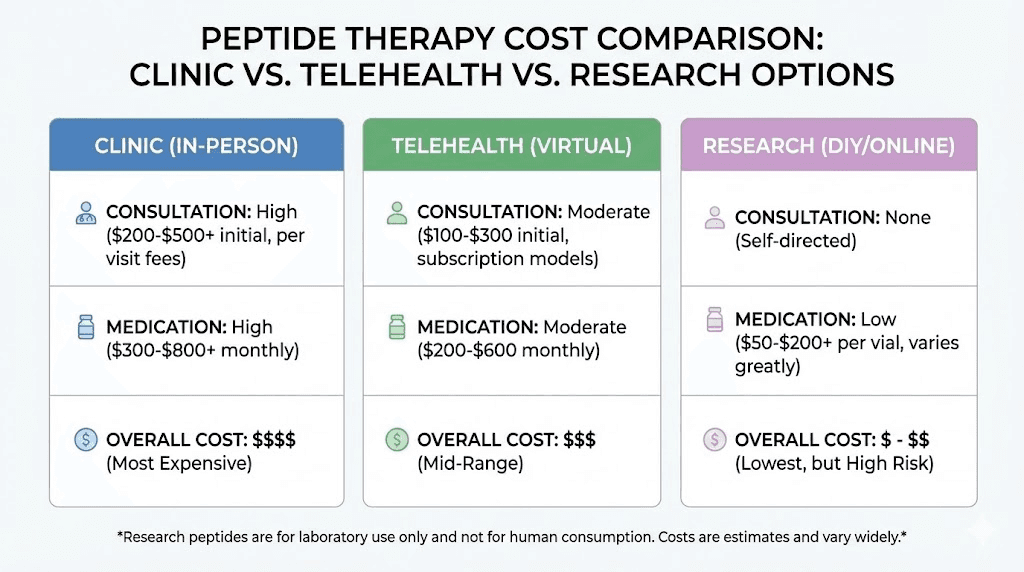
Clinical peptide therapy involves working with a licensed provider who prescribes peptides compounded by a regulated pharmacy. You pay for consultations, the peptides themselves, supplies, and ongoing monitoring. This is the most expensive route but offers the highest quality assurance and medical oversight.
Telehealth peptide therapy connects you with physicians remotely. You still get prescriptions filled through compounding pharmacies, but lower overhead means lower prices. Most telehealth providers charge $100 to $150 less per month than brick-and-mortar clinics for comparable treatments.
Research peptide self-administration involves sourcing peptides labeled "for research purposes only" and using them without medical supervision. Prices are significantly lower, but so is quality control, and you assume all legal and health risks. We'll discuss this option honestly, including why many experienced researchers eventually move toward supervised therapy despite the cost difference.
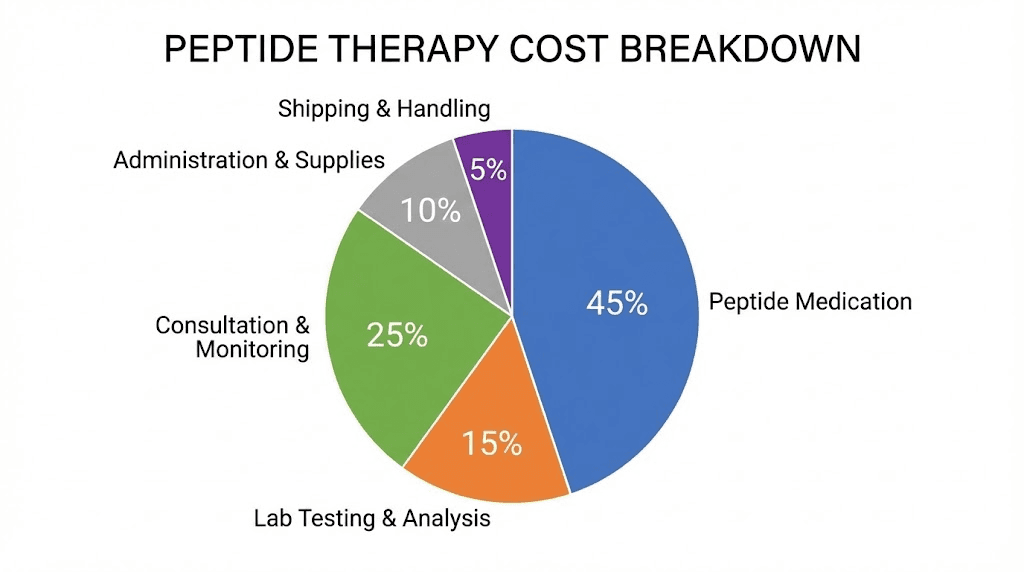
What you're actually paying for
Understanding cost components helps you evaluate whether you're getting fair pricing.
The peptide itself represents only a portion of clinical therapy costs. Raw peptide ingredients are relatively inexpensive. A 5mg vial of BPC-157 might cost a compounding pharmacy $5-15 to produce. The markup covers pharmacy overhead, quality testing, sterile compounding facilities, and regulatory compliance.
Medical consultation fees typically range from $100 to $300 for initial evaluations. Some clinics include consultations in their therapy packages while others charge separately. Follow-up appointments usually cost less than initial consultations.
Laboratory testing adds costs that many people don't anticipate. Responsible peptide therapy often requires baseline bloodwork and periodic monitoring. Expect $200-500 for comprehensive panels, though some telehealth providers include basic labs in their pricing.
Supplies include syringes, alcohol swabs, bacteriostatic water, and sharps containers. Clinical programs typically include these. Self-administering researchers need to budget $20-50 monthly for quality supplies.
Shipping for temperature-sensitive peptides requires cold chain logistics. Overnight shipping with ice packs adds $20-50 per shipment depending on distance and provider.
Cost by peptide category
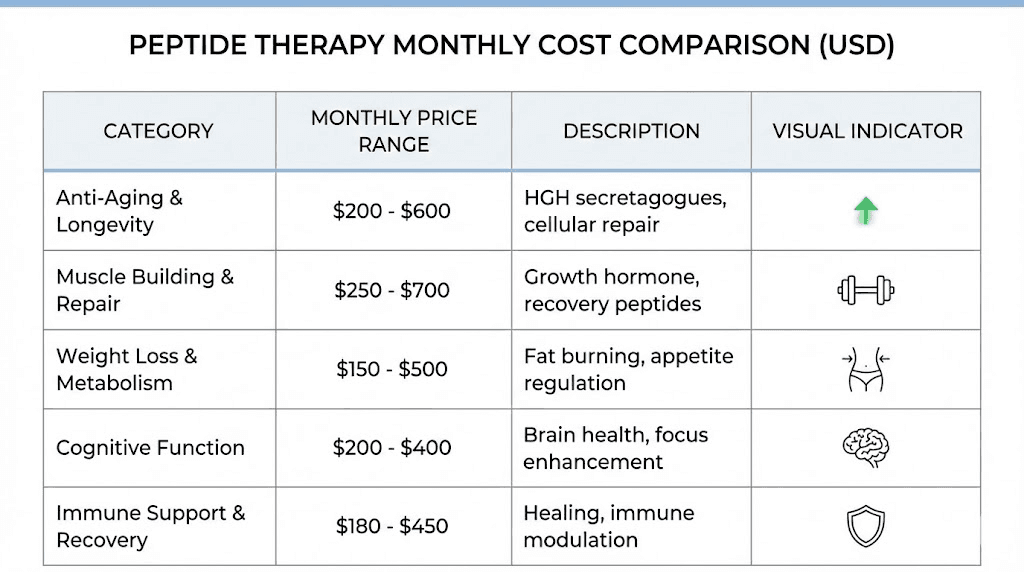
Different peptides serve different purposes, and pricing varies accordingly. Here's what to expect across major categories.
Healing and recovery peptides
Peptides targeting tissue repair and injury recovery represent some of the most popular applications. BPC-157 and TB-500 lead this category.
BPC-157 clinical pricing:
Single month supply: $350-495
Two-month supply: $550-700
Typical protocol duration: 4-8 weeks
Total protocol cost: $350-700
TB-500 clinical pricing:
Monthly supply: $300-450
Loading phase (4 weeks): $300-400
Maintenance phase: $150-250 monthly
BPC-157 + TB-500 combination ("Wolverine Stack"):
Clinical programs: $439-600 for 4-6 week protocols
Includes both peptides plus supplies
The BPC-157 and TB-500 stacking guide covers protocols in detail. For budget planning, expect $400-700 for a complete healing-focused protocol.
Research peptide pricing for these compounds runs significantly lower. A 5mg BPC-157 vial from research suppliers costs $30-70, meaning a basic 8-week protocol might cost $150-250 in peptides alone. However, this comes without quality verification, sterility guarantees, or medical guidance.
Growth hormone peptides
Peptides that stimulate natural growth hormone production represent a large category with varied pricing.
CJC-1295/Ipamorelin combination:
Entry-level telehealth: $249-399 monthly
Premium clinical programs: $500-675 monthly
Typical treatment duration: 3-6 months
This combination is popular for its growth hormone benefits without the risks of direct HGH administration. The Ipamorelin vs CJC-1295 comparison explains how these peptides work together.
Sermorelin offers another growth hormone releasing option:
Budget telehealth: $99-175 monthly
Standard programs: $175-250 monthly
Premium clinical: $300-400 monthly
Sermorelin typically costs less than CJC-1295/Ipamorelin combinations while offering similar mechanisms. It's often recommended for researchers on tighter budgets who want anti-aging benefits.
Individual peptide pricing (clinical):
Ipamorelin (5mg vial): $120-180
CJC-1295 no DAC (5mg vial): $150-200
CJC-1295 with DAC (2mg vial): $175-250
Weight loss peptides
GLP-1 receptor agonists dominate this category, with pricing that varies dramatically based on source.
Semaglutide (Ozempic/Wegovy):
Brand name retail: $936-1,349 monthly
Compounded semaglutide: $300-500 monthly
Budget telehealth programs: $199-350 monthly
Tirzepatide (Mounjaro/Zepbound):
Brand name retail: $1,023-1,200 monthly
Compounded tirzepatide: $400-600 monthly
The semaglutide vs tirzepatide comparison covers effectiveness differences. Tirzepatide produces greater average weight loss (20.2% vs 13.7% body weight at 15 months), which affects cost-effectiveness calculations.
Cost per percentage of body weight lost:
Tirzepatide: $683 per 1% reduction
Semaglutide: $1,351 per 1% reduction
Despite higher monthly costs, tirzepatide may offer better value for aggressive weight loss goals. The semaglutide dosage calculator helps determine your specific needs.
Other weight loss peptides like AOD-9604 cost $150-300 monthly through clinical programs, offering a more affordable alternative though with less dramatic results than GLP-1 agonists.
Anti-aging and skin health peptides
GHK-Cu (copper peptides) pricing varies by delivery method:
Injectable GHK-Cu: $150-300 per treatment session
Topical serums: $50-150 per month
Combined therapy programs: $300-500 monthly
The "GLOW Mix" combination (BPC-157 + TB-500 + GHK-Cu) runs approximately $439 through clinical programs. This combination targets skin tightening, wound healing, and overall tissue regeneration.
Epitalon for telomere support:
Clinical programs: $300-500 per cycle
Typical cycling: 10-20 day protocols repeated quarterly
Performance and recovery peptides
For athletic performance and recovery:
MOTS-c (mitochondrial peptide):
Clinical programs: $400-600 monthly
Often combined with other performance peptides
Research grade: $200-400 monthly
Limited clinical availability
Sexual health peptides
Clinical programs: $200-400 monthly
Per-dose pricing: $25-50 per use
Used as-needed rather than daily
Clinic vs telehealth vs self-sourcing costs
Your sourcing choice dramatically affects both cost and quality. Understanding the trade-offs helps you make informed decisions.
Traditional clinic costs
Brick-and-mortar clinics offering peptide therapy typically charge premium prices reflecting their overhead and in-person service model.
Initial consultation: $200-400
Monthly therapy costs: $400-800 depending on peptides
Follow-up appointments: $100-200 each
Lab work: Often additional, $200-500
Traditional clinics work best for people who value face-to-face interaction with physicians, need complex multi-peptide protocols, or have health conditions requiring close monitoring. The higher cost includes more comprehensive care.
Many researchers start at clinics like those offering peptide therapy in Phoenix, Austin, or Miami for initial evaluation, then transition to telehealth for ongoing management once protocols are established.
Telehealth costs
Online peptide clinics have emerged as the most popular option, combining legitimate medical oversight with significantly lower pricing.
Initial consultation: $0-100 (many offer free consultations)
Monthly therapy costs: $175-400 depending on peptides
Follow-up appointments: Often included or $25-50
Lab work: Sometimes included, otherwise $150-300
The savings come from eliminated clinic overhead. Without expensive real estate, large support staffs, and in-person infrastructure, telehealth providers pass savings to patients while maintaining proper medical protocols.
Quality telehealth providers still require:
Medical history review
Video consultations with licensed physicians
Prescriptions filled through licensed compounding pharmacies
Ongoing monitoring and protocol adjustments
The peptide therapy near me guide covers how to find reputable providers.
Research peptide costs
Peptides sold as research chemicals for laboratory use cost significantly less than clinical peptides. However, this comparison requires honest discussion of what you're getting and not getting.
Typical research peptide pricing:
BPC-157 5mg: $30-70
TB-500 5mg: $40-80
CJC-1295 no DAC 5mg: $35-70
Ipamorelin 5mg: $30-60
An 8-week healing protocol using BPC-157 might cost $100-200 in research peptides versus $400-700 through clinical programs. The price difference is substantial.
What research peptides don't include:
Quality verification (no mandatory testing)
Sterility guarantees
Accurate labeling verification
Medical guidance
Legal protection
Research peptides are explicitly labeled "not for human consumption." They're produced without pharmaceutical-grade standards, and quality varies enormously between suppliers. Contamination, incorrect concentrations, and degraded peptides represent real risks.
People have experienced infections, allergic reactions, and hospitalizations from contaminated research peptides. The money saved becomes irrelevant when you're dealing with health complications.
The peptide testing labs guide explains how to verify peptide quality if you choose this route.
Compounding pharmacy vs research peptides
This distinction deserves deeper examination because it represents the core quality-cost trade-off in peptide therapy.
Compounding pharmacy standards
Licensed compounding pharmacies operate under Section 503A or 503B of the Federal Food, Drug, and Cosmetic Act. This means:
Facility requirements:
State board of pharmacy inspection and licensing
USP <795> and <797> compliant clean rooms
Documented quality control processes
Batch testing and records
Ingredient sourcing:
Raw materials from FDA-registered facilities
Pharmaceutical-grade ingredients (not research or food grade)
Certificate of analysis for each ingredient lot
Product testing:
Sterility testing
Endotoxin testing
Potency verification
Particulate matter testing
When you receive peptides from a compounding pharmacy, you know what you're getting. The concentration matches the label. The product is sterile. Contamination has been tested for and excluded.
Research chemical standards
Research peptides operate in a different regulatory framework entirely. The "for research purposes only" designation means:
No manufacturing requirements:
No clean room requirements
No mandatory testing
No batch records
No recall systems
Quality varies enormously:
Some suppliers provide high-quality products
Others sell underdosed, contaminated, or degraded peptides
No way to know without independent testing
Third-party testing through services like Janoshik can verify research peptide quality, but adds cost and doesn't guarantee sterility since testing typically occurs on samples rather than the specific vial you'll use.
The regulatory landscape
The FDA has increased scrutiny on peptide compounding. Some peptides that were previously compoundable no longer qualify under current regulations. The peptide regulation news tracks these ongoing changes.
For researchers concerned about regulatory compliance, clinical peptide therapy through licensed providers offers clear legal standing. Research peptide self-administration exists in a gray area that creates uncertainty.
Hidden costs to anticipate
The advertised price for peptide therapy rarely represents your total cost. Budget for these additional expenses.
Initial testing and consultation
Responsible peptide therapy starts with baseline assessment. Initial bloodwork typically includes:
Complete metabolic panel: $50-150
Complete blood count: $30-75
Hormone panel (testosterone, IGF-1, thyroid): $150-300
Additional markers depending on peptides: $100-200
Total initial testing cost: $200-500
Some telehealth providers include basic labs in their pricing. Others require you to obtain labs independently or through their partner laboratories at additional cost.
Ongoing monitoring
Depending on your protocol, periodic bloodwork confirms peptides are working as expected and not causing adverse effects.
For growth hormone peptides like CJC-1295 and Ipamorelin, monitoring typically includes IGF-1 levels every 3-6 months.
For weight loss peptides, metabolic markers and A1C testing may be recommended quarterly.
Budget $150-300 per monitoring panel, with frequency depending on your specific protocol.
Supplies
Clinical programs usually include necessary supplies. If you need to source separately:
Insulin syringes (100 count): $15-25
Alcohol swabs (200 count): $5-10
Bacteriostatic water (30mL): $10-20
Sharps container: $5-15
Monthly supply cost: $20-50 if sourcing independently.
Shipping
Peptides require temperature-controlled shipping. Cold chain logistics add:
Overnight shipping: $25-50 per shipment
Ice packs and insulated packaging: Usually included
Signature requirement: Sometimes additional
Some providers include shipping in their pricing. Others charge per shipment. Monthly programs typically ship monthly or quarterly depending on peptide stability.
Protocol adjustments
Initial protocols sometimes need adjustment. Follow-up consultations to modify dosing or address side effects may incur additional fees depending on your provider's pricing structure.
Insurance coverage realities
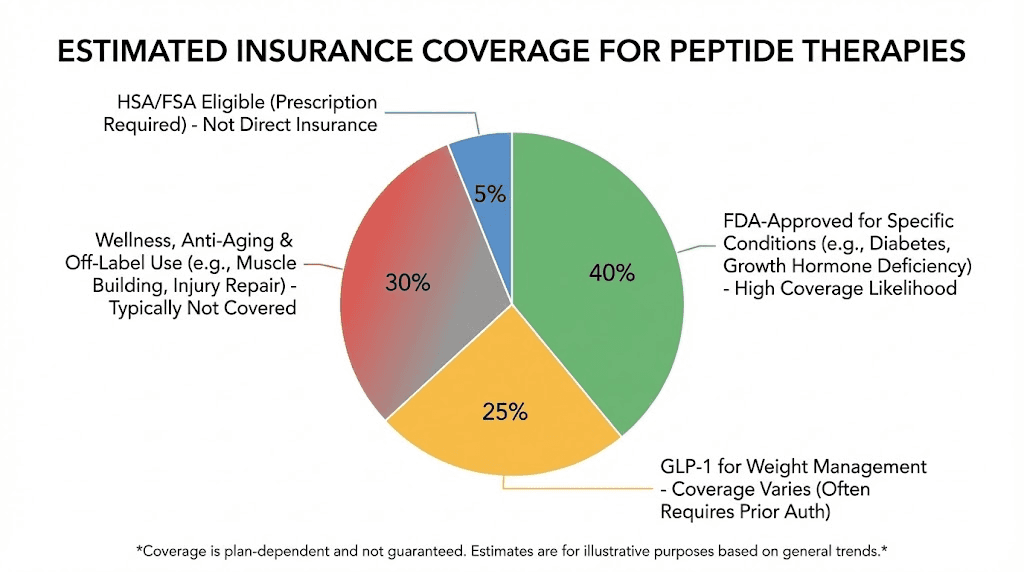
Most peptide therapy is not covered by insurance. Understanding this upfront prevents frustration and helps with financial planning.
What insurance typically covers
FDA-approved peptides for approved indications:
Semaglutide (Ozempic) for type 2 diabetes: Often covered
Semaglutide (Wegovy) for obesity: Sometimes covered with restrictions
Tirzepatide (Mounjaro) for type 2 diabetes: Often covered
Tirzepatide (Zepbound) for obesity: Limited coverage
What coverage looks like:
Prior authorization typically required
Documentation of failed dietary interventions
BMI thresholds for weight loss indications
Co-pays still substantial ($100-500 monthly)
What insurance doesn't cover
The vast majority of peptide therapy falls outside insurance coverage:
Compounded peptides (BPC-157, TB-500, most growth hormone peptides)
Anti-aging applications even for FDA-approved drugs
Performance enhancement uses
Off-label applications
These costs are entirely out-of-pocket for most patients.
HSA and FSA options
Health Savings Accounts and Flexible Spending Accounts may cover peptide therapy when prescribed by a licensed physician for legitimate medical conditions. This provides tax-advantaged payment for otherwise out-of-pocket expenses.
Requirements vary, but documented medical necessity typically enables HSA/FSA use for:
Growth hormone deficiency treatment
Metabolic disorder management
Injury recovery under medical supervision
Consult your benefits administrator for specific coverage rules.
Strategies to reduce peptide therapy costs
Smart approaches can significantly reduce costs without compromising safety or effectiveness.
Choose telehealth over brick-and-mortar clinics
Telehealth providers typically charge $100-200 less monthly than traditional clinics for equivalent therapy. The care quality doesn't suffer because you're still working with licensed physicians and receiving peptides from regulated pharmacies.
The savings add up quickly. Over a 6-month protocol, telehealth might save $600-1,200 compared to in-person clinics.
Opt for multi-month supplies
Many providers offer discounts for longer commitments:
Monthly subscriptions: Full price
Quarterly plans: 10-15% savings
6-month commitments: 15-25% savings
If you're confident in your protocol, longer commitments reduce per-month costs and shipping frequency.
Use combination protocols strategically
Some peptide combinations provide synergistic benefits at lower total cost than running each peptide separately. The peptide stacking guide covers effective combinations.
For example, the BPC-157/TB-500 combination often costs less than running separate protocols for each peptide while providing enhanced healing benefits.
Consider cycling strategies
Many peptides don't require continuous use. Strategic cycling reduces annual costs while maintaining benefits.
Growth hormone peptides: 12-16 weeks on, 4 weeks off
Healing peptides: Use as needed for specific injuries rather than continuous maintenance
Anti-aging peptides: Periodic cycles (e.g., quarterly) rather than constant use
The peptide cycling guide explains optimal approaches for different peptide categories.
Leverage the cost calculator
The SeekPeptides peptide cost calculator helps you estimate protocol expenses before committing. Input your planned peptides, dosages, and duration to see projected costs and compare options.
Start with single peptides
Complex multi-peptide stacks cost more and increase complexity. Starting with a single peptide matching your primary goal lets you:
Assess individual response
Reduce initial investment
Add peptides strategically based on results
If injury healing is your goal, start with BPC-157 alone before considering TB-500 addition. If growth hormone optimization is the target, CJC-1295/Ipamorelin is often sufficient without layering additional compounds.
Don't sacrifice quality for savings
This bears repeating. The cheapest peptides available aren't worth the risk. Research peptides that cost 70% less than pharmacy compounds may be contaminated, underdosed, or degraded. Medical complications from low-quality peptides cost far more than the savings.
SeekPeptides members access vetted provider recommendations and quality verification resources that help find legitimate savings without quality compromise.
Cost-effectiveness by goal
Different goals have different cost-effectiveness profiles. Understanding these helps prioritize spending.
Injury recovery
Cost range: $400-700 for a complete protocol
Duration: 4-8 weeks typically
Cost-effectiveness: High
Healing peptides like BPC-157 represent some of the best value in peptide therapy. A single protocol often accelerates recovery significantly, with no need for ongoing use once healing is complete.
Compare this to:
Physical therapy sessions: $100-200 each, often 12+ sessions needed
Surgery costs: $5,000-50,000 depending on procedure
Lost productivity from prolonged injury: Potentially substantial
For many injuries, a $500 peptide protocol that speeds recovery provides excellent return on investment.
Weight loss
Cost range: $200-1,000+ monthly
Duration: Ongoing, often 6-12+ months
Cost-effectiveness: Variable
Weight loss peptide cost-effectiveness depends heavily on results achieved and alternatives available.
If semaglutide or tirzepatide produce significant weight loss that you maintain, the health benefits (reduced diabetes risk, improved cardiovascular health, better mobility) provide substantial long-term value.
If you're already successful with diet and exercise, adding expensive weight loss peptides may offer marginal benefit for high cost.
The best peptide for fat loss guide helps match peptide choice to specific weight loss goals and budgets.
Growth hormone optimization
Cost range: $250-675 monthly
Duration: Cycling protocols, ongoing
Cost-effectiveness: Moderate to high
Growth hormone peptides offer multiple benefits (improved sleep, recovery, body composition, skin quality) that compound over time. For researchers in their 30s and beyond experiencing age-related GH decline, these peptides often provide noticeable quality-of-life improvements.
Cost-effectiveness improves with:
Age (older individuals see more dramatic relative improvement)
Baseline deficiency (those with lower starting GH benefit more)
Consistent training and nutrition (peptides amplify rather than replace fundamentals)
Anti-aging and skin health
Cost range: $150-500 monthly
Duration: Ongoing or cyclical
Cost-effectiveness: Subjective
Value depends on how much you prioritize appearance and skin quality. GHK-Cu and similar peptides produce measurable improvements in skin thickness, hydration, and elasticity, but whether that justifies ongoing expense is personal.
Compare to:
High-end skincare products: $100-500 monthly
Cosmetic procedures: $500-5,000+ per treatment
Laser treatments: $200-1,000 per session
Peptide therapy often compares favorably to other anti-aging interventions on a per-result basis.
Budget planning for peptide therapy
Practical budgeting helps ensure you can sustain peptide therapy long enough to see results without financial strain.
Entry-level budget ($200-350/month)
What you can access:
Budget telehealth sermorelin programs
Single healing peptide protocols (BPC-157)
Compounded semaglutide through value-focused providers
Basic growth hormone support
This budget works for researchers with specific, focused goals who can commit to one primary peptide or a basic combination.
Standard budget ($400-600/month)
What you can access:
CJC-1295/Ipamorelin combinations
Multi-peptide healing stacks
Mid-tier weight loss programs
Combination protocols with medical oversight
Most researchers find this range covers comprehensive single-goal protocols or basic multi-peptide approaches.
Premium budget ($700-1,500+/month)
What you can access:
Complex multi-peptide stacks
Premium clinic services with enhanced monitoring
Brand-name weight loss medications
Comprehensive anti-aging protocols
Higher budgets enable more aggressive protocols and premium service levels.
Sample annual budgets
Healing-focused protocol (8 weeks):
Initial consultation: $100
BPC-157/TB-500 stack: $500
Supplies: $30
Follow-up: $50
Total: $680
Growth hormone optimization (16 weeks on, then cycling):
Initial consultation and labs: $350
CJC-1295/Ipamorelin 4 months: $1,200
Supplies: $100
Monitoring labs: $200
Total first cycle: $1,850
Annual with cycling: $3,500-4,500
Weight loss (12-month program):
Initial consultation and labs: $300
Compounded semaglutide 12 months: $3,600-6,000
Quarterly monitoring: $400
Follow-ups: $200
Total: $4,500-7,000
Questions to ask before committing
Before signing up for any peptide therapy program, get clear answers to these questions.
About pricing
What's included in the monthly fee?
Are consultations included or additional?
Is lab work included or separate?
What are shipping costs?
Are there discounts for longer commitments?
What's the cancellation policy?
About quality
Which compounding pharmacy fills prescriptions?
Is the pharmacy 503A or 503B licensed?
Can you provide certificates of analysis?
What quality testing does the pharmacy perform?
About care
How often will I have physician consultations?
What monitoring is included?
Who do I contact with questions or concerns?
What's the response time for urgent issues?
Reputable providers answer these questions directly. Vague responses or reluctance to discuss quality sources are red flags.
Frequently asked questions
How much does peptide therapy cost per month?
Monthly costs typically range from $150 to $2,000 depending on which peptides you use, the number of peptides in your protocol, and whether you use telehealth or in-person clinics. Single-peptide protocols through budget telehealth providers start around $150-250 monthly, while complex multi-peptide stacks through premium clinics can exceed $1,000 monthly.
Is peptide therapy covered by insurance?
Most peptide therapy is not covered by insurance. FDA-approved peptides like semaglutide and tirzepatide may be covered when prescribed for approved indications (diabetes, obesity), but compounded peptides, off-label uses, and anti-aging applications are typically out-of-pocket expenses. HSA and FSA accounts may cover physician-prescribed peptide therapy for documented medical conditions.
Why is there such a big price difference between providers?
Price variation reflects differences in overhead (brick-and-mortar clinics vs telehealth), included services (labs, consultations, supplies), peptide quality (compounding pharmacy standards vary), and profit margins. Lower prices don't always mean lower quality, but extremely low prices should prompt questions about sourcing and quality control.
Are research peptides safe to use?
Research peptides carry significant risks. They're produced without pharmaceutical-grade quality standards, testing requirements, or sterility guarantees. Contamination, incorrect dosing, and degradation are real possibilities. People have experienced serious complications from contaminated research peptides. The savings rarely justify the health risks for most researchers.
What's the cheapest effective peptide therapy?
Budget-friendly options with documented effectiveness include sermorelin through telehealth ($99-175/month) for growth hormone support, and single-peptide healing protocols like BPC-157 through value-focused providers ($200-350 for complete protocols). The peptide cost calculator helps compare options.
How can I save money on peptide therapy without sacrificing quality?
Use telehealth providers instead of brick-and-mortar clinics, commit to multi-month plans for discounts, start with single peptides before adding complexity, cycle peptides appropriately rather than continuous use, and verify you're paying for legitimate compounded peptides rather than premium pricing without justification. Never sacrifice quality for savings by using unverified research chemicals.
How long do I need to budget for peptide therapy?
Duration varies by goal. Healing protocols typically run 4-8 weeks. Growth hormone optimization often involves 12-16 week cycles with breaks. Weight loss programs may run 6-12+ months. Anti-aging protocols are often ongoing or cyclical. Budget for at least 3 months to assess results, as most peptides require 8-12 weeks for noticeable effects.
Do peptide therapy costs include everything I need?
Not always. Ask specifically about consultation fees, lab work, supplies (syringes, bacteriostatic water), shipping, and follow-up appointments. All-inclusive pricing simplifies budgeting but may cost more than à la carte options if you don't need every service. Get itemized cost breakdowns before committing.
For researchers serious about optimizing their peptide protocols while managing costs effectively, SeekPeptides provides comprehensive resources including the cost calculator, vetted provider recommendations, and a community of experienced researchers who've navigated these exact financial decisions.
In case I don't see you, good afternoon, good evening, and good night. May your budgets stay sustainable, your peptides stay pharmaceutical-grade, and your protocols stay cost-effective.