Feb 24, 2026
You are spending $399 a month on Willow tirzepatide. Maybe more. And you are not entirely sure what you are getting for that money, whether the price will climb as your dose increases, or whether another provider could deliver the same medication for less. That uncertainty is expensive. Not just financially, but in the mental energy it drains from a process that should be straightforward.
Here is the reality. Willow charges between $399 and $524 per month for compounded tirzepatide, depending on the concentration your prescriber recommends. That monthly fee covers the medication itself, physician consultations, shipping, and ongoing support. No hidden membership charges. No separate consultation fees. But that base number does not tell the whole story, because dose escalation changes the math significantly over a six-month or twelve-month treatment window.
This guide breaks down every dollar. From starting doses to maximum concentrations, from sublingual drops versus injections, from Willow versus Shed versus Empower versus brand-name Zepbound. You will find six-month cost projections, hidden fees most reviews overlook, and strategies for reducing your total spend without compromising results. Whether you are considering Willow for the first time or evaluating whether to stay, the numbers here will give you clarity.
What Willow charges for tirzepatide
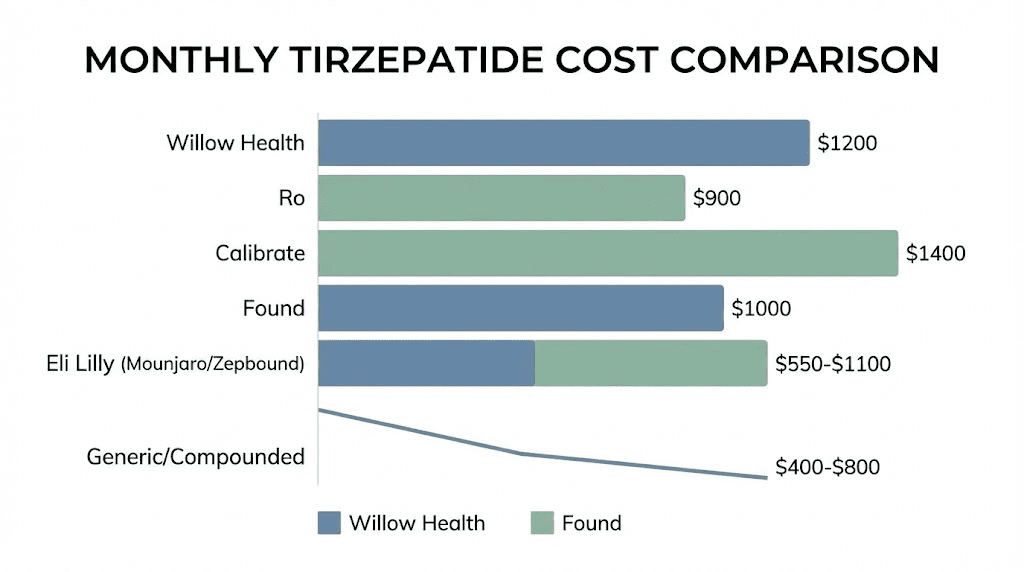
Willow operates on a flat monthly subscription model. You pay one price, and that price includes everything. No separate line items for the physician visit. No shipping surcharge. No surprise fees when your prescription gets filled. That simplicity is one of the reasons people choose Willow over providers with more complicated billing structures.
But the price is not actually flat across all doses.
At lower concentrations, the standard dose tirzepatide through Willow costs $399 per month. This covers the 2.5mg and 5mg concentrations that most patients start with during the initial titration phase. The medication arrives via FedEx 2-day shipping, usually within five to seven business days of your prescription being processed.
Move up to 10mg or 12.5mg concentrations, and the monthly cost jumps to $499. Reach the 15mg concentration, the highest dose most providers offer, and you are looking at $524 per month. These increases reflect the higher raw material cost of producing greater concentrations of the active peptide at the compounding pharmacy level.
For a complete breakdown of what each dose looks like in practice, the tirzepatide dosing guide covers the clinical rationale behind each titration step.
What the monthly fee includes
Understanding exactly what $399 to $524 buys you matters. Here is the complete list:
Compounded tirzepatide medication (one month supply)
Board-certified physician consultations (initial and ongoing)
Unlimited same-day messaging with your prescribing doctor
Free FedEx 2-day shipping
Injection supplies (syringes, alcohol swabs)
Personalized formulation (may include B12 or L-Carnitine based on individual needs)
Detailed injection instructions (written and video)
FSA receipts and medical necessity letters upon request
One thing that is not included: anti-nausea medication. If you experience gastrointestinal side effects, which many people do during the first few weeks, Willow offers ondansetron (generic Zofran) as an add-on for $30 per month. This is optional, and many patients find they do not need it after the initial adjustment period.
The physician messaging feature deserves attention. Unlike providers that charge per consultation or limit follow-up visits, Willow allows unlimited messaging with your prescribing physician. Need a dose adjustment? Send a message. Experiencing muscle pain or headaches? Message your doctor directly. No appointment scheduling. No extra fees. Response times typically fall within 24 hours, though some users report longer waits on weekends.
How Willow compounded tirzepatide differs from brand-name versions
This is critical to understand before evaluating cost. Willow does not dispense Mounjaro or Zepbound. Those brand-name products, manufactured by Eli Lilly, carry list prices exceeding $1,000 per month. What Willow provides is a compounded version of tirzepatide, prepared by licensed compounding pharmacies that source the active ingredient and formulate it according to physician specifications.
Compounded medications are not FDA-approved products. They have not undergone the same clinical trials as Mounjaro or Zepbound. They are legal when prescribed by a licensed physician and prepared by a licensed pharmacy, but they are fundamentally different products from a regulatory standpoint. This distinction matters when evaluating whether the lower price point represents genuine savings or a different category of product entirely.
The compounding process does allow for personalization. Willow formulations may include additional compounds like vitamin B12, glycine, or L-Carnitine based on what the prescribing physician determines will benefit the individual patient. These additions can support energy levels and metabolic function during weight loss, though the clinical evidence for these specific combinations in compounded tirzepatide formulations remains limited.
Willow tirzepatide cost by dose level
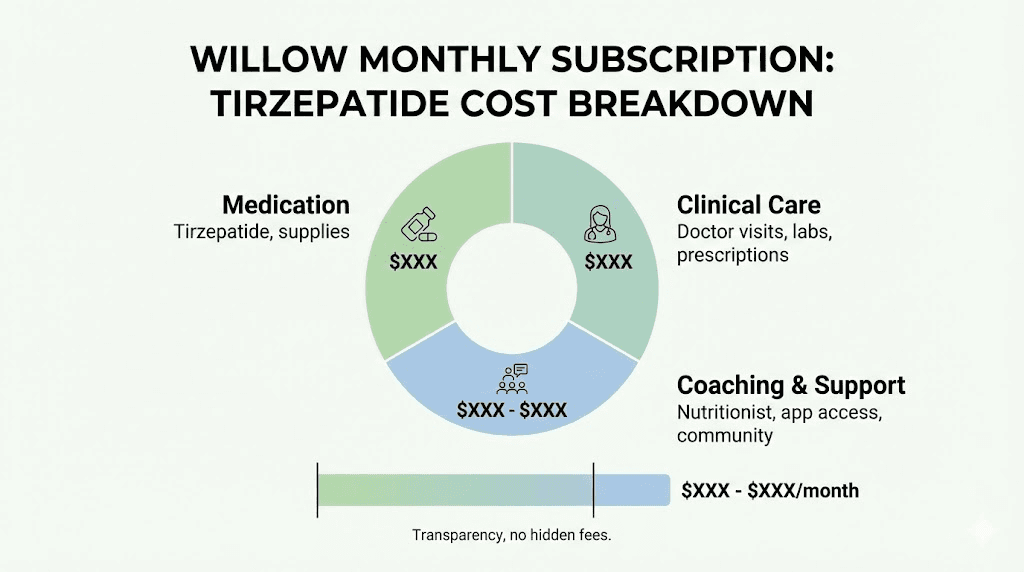
Dose escalation is where the real cost picture emerges. Nobody stays at 2.5mg forever. The entire tirzepatide dosing protocol is designed around gradual increases, with most patients titrating upward every four to eight weeks based on response and tolerability.
Here is what each tier costs at Willow:
Dose | Monthly Cost | Typical Duration at This Dose | Cumulative Spend |
|---|---|---|---|
2.5mg (starting) | $399 | 4 weeks | $399 |
5mg | $399 | 4-8 weeks | $798-$1,197 |
7.5mg | $399 | 4-8 weeks | $1,197-$1,995 |
10mg | $499 | 4-8 weeks | $1,696-$2,494 |
12.5mg | $499 | 4-8 weeks | $2,195-$2,993 |
15mg | $524 | Ongoing maintenance | $2,719+ (6 months) |
The jump from $399 to $499 at the 10mg level catches some people off guard. You might start Willow at $399, feel good about the price, and then find yourself paying $100 more per month three months into treatment. This is not a hidden fee exactly, but it is a detail that many reviews gloss over.
Starting dose costs (2.5mg to 7.5mg)
Most patients spend their first two to three months at the $399 tier. The standard starting dose is 2.5mg administered once weekly via subcutaneous injection. After four weeks, the physician typically increases to 5mg if the patient tolerates the medication well.
At 5mg, many patients begin experiencing meaningful appetite suppression. Food noise quiets. Portions shrink naturally. The timeline for appetite suppression varies, but most users report noticeable changes within the first two to four weeks of treatment.
Some physicians move patients to 7.5mg next, still within the $399 pricing tier. This intermediate dose provides stronger effects while keeping the monthly cost unchanged. For patients who respond well at 7.5mg, this can be a sweet spot, offering meaningful results without the price increase that comes with higher concentrations.
Three months at the starting tier: $1,197 total.
Mid-range dose costs (10mg to 12.5mg)
Here is where the pricing shifts. The 10mg and 12.5mg concentrations cost $499 per month, a $100 increase from the starting tier. For patients who need higher doses to achieve their weight loss goals, this jump is unavoidable.
Clinical research on tirzepatide shows a clear dose-response relationship. Higher doses generally produce greater weight loss, with studies demonstrating that tirzepatide users on 10mg and above can achieve 20% or more body weight reduction over the course of treatment. The question becomes whether the additional $100 per month delivers proportionally better results.
For many patients, it does. The jump from 7.5mg to 10mg often breaks through plateaus that the lower doses could not overcome. If you find yourself wondering about why tirzepatide stopped working at a lower dose, the mid-range concentrations frequently restore progress.
Two months at the mid-range tier: $998 additional.
Maximum dose costs (15mg)
The 15mg concentration represents both the highest efficacy and the highest price point at $524 per month. Not every patient needs this dose. Some achieve their goals at 10mg or 12.5mg and never progress further. Others require the maximum concentration to maintain appetite suppression and continue losing weight.
At $524 monthly, the 15mg tier costs $125 more than the starting dose. Over a year at this concentration, you would spend $6,288. That is a significant investment, and it is worth evaluating whether the expected weight loss results at this dose justify the premium.
Understanding your exact dosage in units helps you verify that you are receiving the correct concentration. Dosing errors are rare with compounded formulations, but knowing what to expect when you draw up your injection adds an important layer of confidence.
Six-month and twelve-month cost projections
Nobody budgets for one month of tirzepatide. Weight loss treatment is a multi-month commitment, and understanding the full financial picture prevents surprises. Here are realistic projections based on standard titration schedules.
Realistic six-month budget
A typical six-month tirzepatide journey through Willow follows this pattern:
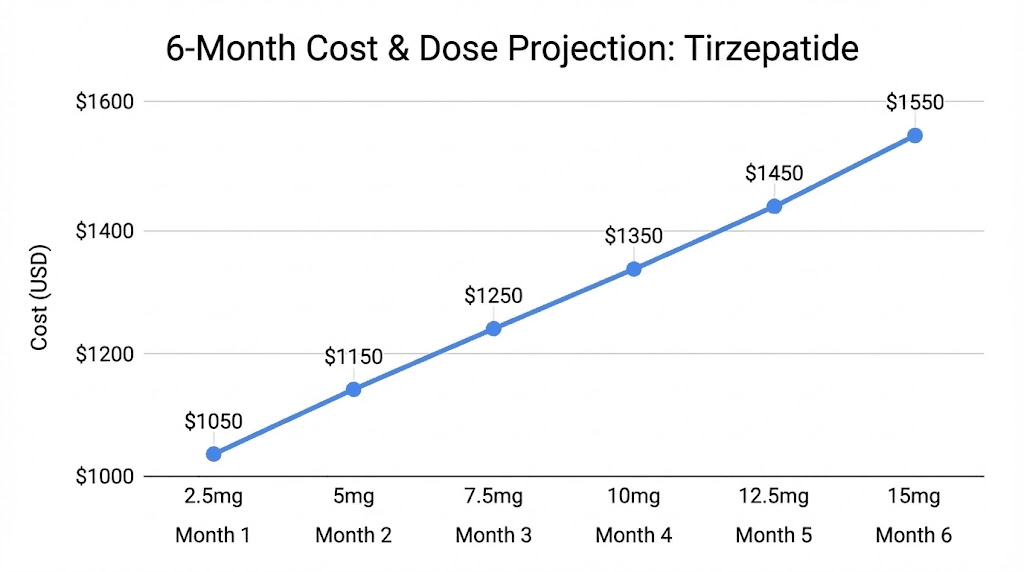
Month 1: 2.5mg at $399
Month 2: 5mg at $399
Month 3: 7.5mg at $399
Month 4: 10mg at $499
Month 5: 12.5mg at $499
Month 6: 15mg at $524
Six-month total: $2,719
That averages to $453.17 per month when you account for the dose escalation. This is the number that matters for budgeting, not the $399 starting price. If your physician recommends a slower titration schedule, spending more time at each dose, your six-month total could be lower. If you respond well at 7.5mg and stay there, your six-month cost drops to $2,394.
Compare this to brand-name Zepbound or Mounjaro, which would cost approximately $6,480 to $6,516 for the same six months at list price. Even with Eli Lilly direct savings programs, brand-name tirzepatide runs approximately $2,994 for six months. Willow is cheaper, but not by as much as the headline $399 price suggests once dose escalation is factored in.
Full year cost estimates
For patients who need twelve months of treatment:
Scenario | 12-Month Cost | Average Monthly |
|---|---|---|
Stay at 7.5mg or below | $4,788 | $399 |
Standard escalation to 15mg | $5,567 | $464 |
Rapid escalation, maintenance at 15mg | $5,843 | $487 |
The $399 headline price only holds for a full year if you never exceed the 7.5mg dose. Once you cross into the $499 and $524 tiers, which most patients eventually do, the annual cost climbs meaningfully. Budget for the mid-range scenario ($5,567) and you will not be caught off guard.
For context, the affordable tirzepatide guide covers additional strategies for managing the long-term cost of treatment across multiple providers.
Dose escalation timeline and cost impact
How quickly you move through dose tiers directly affects your total spend. Faster escalation means reaching the higher-priced tiers sooner. Slower escalation keeps you in the $399 tier longer.
There is a case for patience. Some physicians advocate spending eight weeks at each dose rather than four, giving the body more time to respond before increasing. This approach has a double benefit: potentially better tolerability with fewer gastrointestinal side effects, and a lower average monthly cost over the course of treatment.
The microdosing approach takes this even further. Some patients use lower doses more frequently or split their weekly dose into smaller administrations. While this requires more injections per week, it can maintain appetite suppression at lower total doses, potentially keeping you in the $399 pricing tier for longer.
Discuss the timeline with your prescribing physician at Willow. They can adjust the escalation schedule based on your response, goals, and budget considerations. The unlimited messaging feature makes these conversations easy to initiate without scheduling a formal appointment.
Willow tirzepatide drops versus injection pricing
Willow offers tirzepatide in two formats: the standard weekly subcutaneous injection and sublingual drops administered daily. The pricing structure for each format differs, and the choice between them affects both your monthly cost and your experience with the medication.
Sublingual drops cost
The tirzepatide sublingual drops are priced at $399 per month, the same base price as the injectable version at starting doses. The drops are administered daily rather than weekly, placed under the tongue where they dissolve and absorb directly into the bloodstream through the rich vascular network beneath the tongue.
Daily administration changes the experience significantly. Instead of one injection per week, you take drops every day. Some patients prefer this consistency. Others find the daily routine more burdensome than a single weekly injection. The oral versus injection comparison covers the full spectrum of advantages and disadvantages for each format.
One consideration for cost-conscious patients: sublingual drops may provide more consistent blood levels of the medication throughout the week. This steady-state delivery could potentially allow lower total doses to achieve similar effects, though the clinical evidence comparing sublingual and injectable compounded tirzepatide remains limited at this stage.
Injectable cost
The injectable format follows the tiered pricing structure described earlier: $399 for starting doses, $499 for 10mg to 12.5mg, and $524 for 15mg. Injections are self-administered once weekly using the supplies included in your monthly shipment.
For patients unfamiliar with self-injection, Willow provides both written and video instructions. The needles used are small gauge, similar to what you would use for an insulin injection. Most patients report minimal discomfort after the first few administrations. For guidance on technique, the injection guide walks through the process step by step.
Injectable tirzepatide has a longer track record in clinical research. The SURMOUNT and SURPASS trial data that demonstrated tirzepatide effectiveness was generated using injectable formulations, which gives some patients additional confidence in this format even when the specific product is compounded rather than brand-name.
Which format offers better value
At the same base price ($399), the value comparison between drops and injections comes down to bioavailability and convenience rather than cost. Sublingual administration typically achieves lower bioavailability than subcutaneous injection, meaning a higher nominal dose in drops may be needed to match the effects of a lower injectable dose.
If you can tolerate injections, the injectable format likely delivers more consistent and predictable dosing. If needle aversion is a barrier to starting or continuing treatment, the drops offer a viable alternative at the same price point. The tablets versus injections guide provides additional context on absorption differences and effectiveness comparisons across delivery methods.
Consider also the orally dissolving tablet format offered by some competitors. Each delivery method has distinct advantages, and the best choice depends on your individual preferences, tolerability, and budget constraints.
Willow tirzepatide versus semaglutide cost
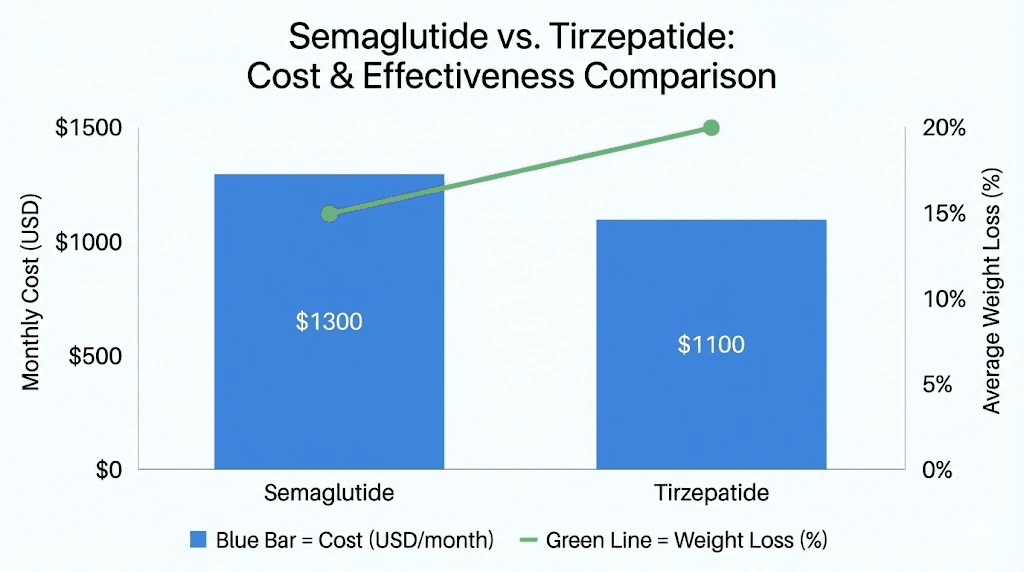
Willow offers both tirzepatide and compounded semaglutide, and the price difference between them is the first decision most new patients face. Understanding what that $100 monthly gap buys you is essential for making an informed choice.
Price difference
The numbers are straightforward:
Medication | Starting Price | Maximum Price | 6-Month Average |
|---|---|---|---|
Compounded semaglutide | $299/month | $299/month (flat) | $299/month |
Compounded tirzepatide | $399/month | $524/month | $453/month |
Semaglutide at Willow costs $299 per month regardless of dose. No escalation tiers. No price jumps. That flat pricing structure is a genuine advantage for budget planning. Over six months, semaglutide costs $1,794 total, compared to $2,719 for tirzepatide. That is a $925 difference, enough to cover nearly two and a half additional months of semaglutide treatment.
Effectiveness difference
The price gap exists because tirzepatide and semaglutide work differently. Semaglutide is a GLP-1 receptor agonist only. Tirzepatide is a dual GLP-1 and GIP receptor agonist, targeting two metabolic pathways instead of one.
In clinical trials, tirzepatide consistently outperformed semaglutide for weight loss. Average body weight reduction with tirzepatide reached 22.5%, compared to 16.9% with semaglutide. That difference, roughly five percentage points, translates to meaningful additional weight loss for most patients.
For a 200-pound individual, the difference looks like this: semaglutide might help you lose 33.8 pounds, while tirzepatide might help you lose 45 pounds. Eleven additional pounds of weight loss for $925 more over six months. Whether that ratio makes sense depends entirely on your goals and financial situation.
The side effect profiles also differ between the two medications, and this can affect cost indirectly. If one medication causes fewer side effects for you personally, you are less likely to need the $30 per month anti-nausea add-on, less likely to miss work due to discomfort, and more likely to complete the full treatment course.
Cost per pound lost
This is the metric that matters most for value-conscious patients. Using clinical trial averages for a six-month treatment course:
Metric | Semaglutide | Tirzepatide |
|---|---|---|
6-month cost | $1,794 | $2,719 |
Average weight loss (%) | 16.9% | 22.5% |
Weight loss (200 lb person) | 33.8 lbs | 45 lbs |
Cost per pound lost | $53.08 | $60.42 |
Semaglutide actually offers a lower cost per pound lost at $53.08 versus $60.42 for tirzepatide. However, this analysis assumes average outcomes. Individual results vary enormously. Some patients respond dramatically better to tirzepatide than semaglutide, making the cost per pound calculation much more favorable. Others respond equally well to both, in which case semaglutide offers better value.
If you are uncertain which medication to choose, starting with semaglutide at the lower price point is a reasonable strategy. If results plateau, switching to tirzepatide is always an option. The conversion chart helps physicians determine the appropriate tirzepatide starting dose for patients transitioning from semaglutide.
Willow versus competitor tirzepatide pricing
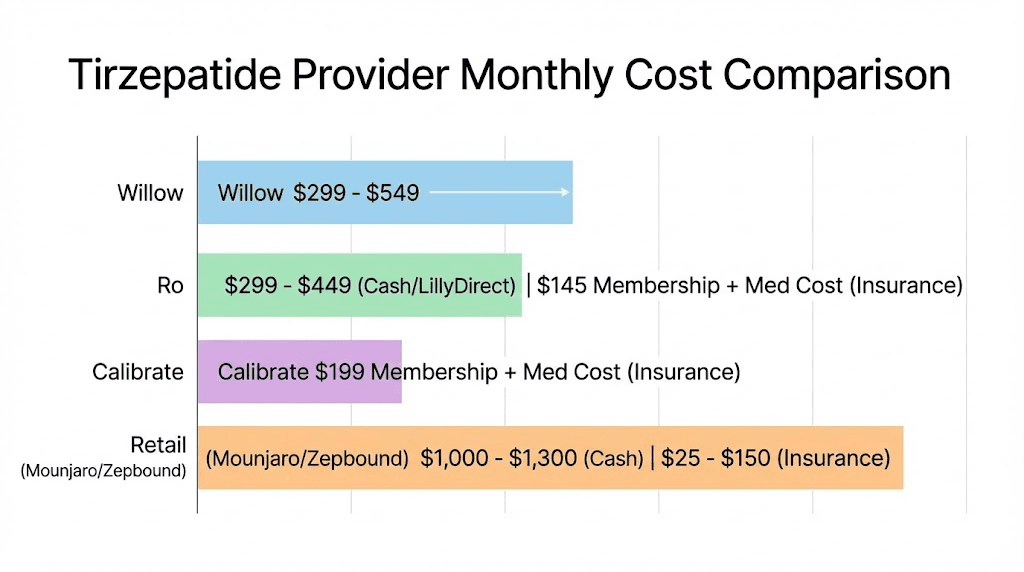
Willow is not the only telehealth provider offering compounded tirzepatide, and it is not the cheapest. Understanding where Willow falls in the competitive landscape helps you determine whether the service delivers adequate value for the price or whether switching providers could save you meaningful money each month.
Complete competitor comparison table
Provider | Starting Price | Max Price | Includes | Notable Features |
|---|---|---|---|---|
Willow | $399/mo | $524/mo | Medication, shipping, messaging, consultations | Drops + injection options, HSA/FSA |
$297/mo | $399/mo | Medication, coaching, guarantee | Weight-loss guarantee, 2-month minimum | |
$279/mo | $399/mo | Medication, basic coaching | Lower starting price, coaching included | |
~$349/mo | Varies | Medication, physician oversight | Established pharmacy reputation | |
Ro Body | $349/mo + $145 membership | $499+/mo | Medication, behavioral coaching | Insurance for Rx, structured program |
Brand Zepbound | $499/mo (savings) | $1,086/mo (list) | FDA-approved medication | Brand name, clinical trial data |
The landscape is crowded and competitive. Willow sits in the middle of the pack on price, neither the cheapest nor the most expensive for compounded tirzepatide.
Willow versus Shed
Shed starts at $297 per month for lower-dose compounded tirzepatide, making it approximately $100 cheaper than Willow at the entry level. Shed also includes personalized coaching and offers a weight-loss guarantee, both features that Willow does not match.
The trade-off: Shed requires a two-month minimum commitment. Willow allows cancellation at any time. For patients who are unsure whether they want to continue treatment beyond the first month, that flexibility has monetary value. But for patients committed to at least two months of treatment, which describes virtually everyone starting tirzepatide, Shed savings of $200+ over those first two months are real and tangible.
Shed also tends to have strong support infrastructure. The coaching component addresses dietary planning and behavioral strategies that complement the medication, potentially improving outcomes beyond what the drug alone provides.
Willow versus MEDVi
MEDVi offers an even lower starting price at $279 for the first month, though the regular price increases to $399, matching Willow. The initial savings of $120 in month one is appealing, but the long-term cost trajectory is similar.
MEDVi includes basic coaching and nutrition education, which Willow does not offer. For patients who want guidance on what to eat while on tirzepatide or need help developing a structured meal plan, that included coaching adds value that Willow charges nothing for but also does not provide.
Willow versus Empower pharmacy
Empower pharmacy is one of the most established names in compounded tirzepatide. Their pricing typically starts around $349 per month, placing them $50 below Willow at the entry level. Empower has a strong reputation for pharmaceutical quality and consistency, which matters when you are injecting a compounded medication weekly.
The difference: Empower typically works through partner telehealth platforms rather than providing direct-to-consumer service the way Willow does. This means the total cost may include both the medication and a separate platform fee, which can bring the all-in price closer to or above Willow depending on the telehealth partner you choose. The Empower dosage guide details their specific formulations and concentration options.
Willow versus brand-name Zepbound
The comparison most people want. Zepbound, Eli Lilly brand-name tirzepatide approved specifically for weight loss, carries a list price of $1,086.37 for a 28-day supply. With the manufacturer self-pay savings program, the cost drops to $499 per month for the first fill at 7.5mg or 10mg doses.
At $399 to $524 for compounded versus $499 to $1,086 for brand-name, Willow is cheaper. But the savings narrow considerably at higher doses, where Willow charges $524 and the Zepbound savings program charges $499. At that point, the brand-name product is actually less expensive than Willow compounded, and it carries the benefit of FDA approval and clinical trial data supporting its specific formulation.
The manufacturer savings programs have eligibility requirements and do not apply to patients with insurance coverage for the medication. Check current program terms before assuming brand-name pricing. For patients whose insurance covers Zepbound, the out-of-pocket cost could be significantly lower than any compounded option.
Additional providers worth comparing
The telehealth GLP-1 market includes dozens of competitors. Other providers to research include Strive pharmacy, Priority Meds, Lavender Sky, Orderly Meds, ProRx, BPI Labs, and Southend pharmacy. Each offers slightly different pricing, formulations, and service levels. The cheap compounded tirzepatide guide compares the most budget-friendly options across the market.
For patients interested in broader GLP-1 provider analysis, the Willow comprehensive review covers the full service experience beyond just pricing, including onboarding, support quality, and medication consistency.
Hidden costs and fees to watch for
The $399 per month headline price is real. But several additional costs can push your actual monthly spend higher. Knowing about them in advance prevents budget surprises and helps you plan accurately.
Anti-nausea medication add-on
Ondansetron, the generic form of Zofran, costs $30 per month as an optional add-on through Willow. This medication treats nausea, which is one of the most common side effects during the early weeks of tirzepatide treatment.
Not everyone needs it. But if you do, that $30 monthly adds up to $180 over six months. Some patients only need anti-nausea support during the first month or two as their body adjusts, while others need it throughout the dose escalation process, particularly when stepping up to higher concentrations.
Managing gastrointestinal side effects without ondansetron is possible for some patients. Dietary adjustments, meal timing, and targeted supplementation can reduce nausea without the additional medication cost. The foods to avoid on tirzepatide guide identifies dietary triggers that commonly worsen gastrointestinal symptoms.
Dose escalation price increases
This is the biggest hidden cost. The $399 starting price becomes $499 at 10mg and $524 at 15mg. Over a twelve-month treatment course, these escalation costs add $1,000 to $1,500 beyond what you would pay if the price stayed flat.
Some providers, like Willow semaglutide program, offer flat pricing regardless of dose. If predictable monthly costs are a priority for you, semaglutide at $299 per month flat might be worth considering over tirzepatide, even if the effectiveness data slightly favors tirzepatide. The semaglutide effectiveness timeline shows what to expect from the lower-cost alternative.
Cancellation and refund policies
Willow does not charge cancellation fees. You can cancel at any time by contacting the Patient Care Team via chat or email. If you cancel before your prescription is sent to the pharmacy, you receive a full refund within five to ten business days.
The catch: you need to submit cancellation requests at least two business days before your next processing date. Miss that window, and your next month charge processes before the cancellation takes effect. This is not a hidden fee per se, but it does mean a poorly timed cancellation could cost you an extra month of treatment.
Once the pharmacy processes your prescription and ships the medication, refunds are not available for that cycle. This is standard across virtually all telehealth GLP-1 providers and reflects the perishable nature of compounded medications that require refrigerated storage.
State availability limitations
Willow currently operates in 34 states. If you live outside their service area, you cannot access the program at all. If you move to a state they do not serve, you would need to switch providers mid-treatment. That transition has costs: potentially lost medication during the switch, a new patient evaluation fee at another provider, and possible gaps in treatment that could affect your weight loss trajectory.
Check the current list of covered states before committing. As of the most recent data, Willow serves Arizona, California, Colorado, Connecticut, Florida, Georgia, Hawaii, Idaho, Illinois, Indiana, Iowa, Kentucky, Maine, Maryland, Massachusetts, Michigan, Minnesota, Missouri, Montana, Nebraska, Nevada, New Hampshire, New Jersey, New York, North Carolina, Ohio, Oklahoma, Oregon, Pennsylvania, South Carolina, Tennessee, Texas, Virginia, Washington, and Wisconsin.
How to save money on Willow tirzepatide
The monthly cost is what it is. But several strategies can reduce your total spend over the course of treatment without compromising the effectiveness of your protocol.
Use HSA or FSA accounts
Willow tirzepatide qualifies for Health Savings Account and Flexible Spending Account payments. If your employer offers an FSA or you have an HSA through a high-deductible health plan, using these accounts effectively gives you a discount equal to your marginal tax rate.
For someone in the 24% federal tax bracket with an additional 6% state income tax, paying $399 per month through an HSA or FSA saves $119.70 per month in taxes. That reduces the effective cost to $279.30, suddenly making Willow more competitive with even the cheapest compounded tirzepatide providers on the market.
Willow provides FSA receipts and medical necessity letters upon request, making the reimbursement process straightforward. If you have access to these accounts, using them for tirzepatide is one of the most impactful savings strategies available.
Optimize your titration timeline
Rushing to higher doses costs more money. Every month you spend in the $399 tier instead of the $499 or $524 tier saves you $100 or $125. If extending your time at 7.5mg by four additional weeks is clinically appropriate and your physician agrees, that patience saves real money.
The compounded tirzepatide dosage calculator can help you and your physician determine the optimal dose for your body weight and goals. Some patients find that a lower dose combined with strategic dietary changes produces results comparable to a higher dose alone.
This is not about underdosing for the sake of saving money. It is about ensuring you are on the minimum effective dose, which is better medical practice anyway. Every dose escalation should be driven by clinical need, not arbitrary protocol timelines.
Consider microdosing strategies
Microdosing tirzepatide involves using smaller doses more frequently rather than standard weekly injections. Some patients and physicians find that splitting a lower total weekly dose into two or three smaller administrations maintains appetite suppression with fewer side effects and a lower overall dose requirement.
If microdosing allows you to achieve your goals at 7.5mg instead of 10mg, you save $100 per month. Over six months, that adds up to $600 in savings. The microdose schedule guide outlines common splitting protocols and their rationale.
Discuss this approach with your Willow physician before implementing it. Microdosing is not appropriate for every patient, and splitting doses changes the pharmacokinetic profile of the medication in ways that require medical oversight.
Explore payment timing options
For patients who find the monthly cost challenging, Afterpay and similar payment splitting services can spread the cost of each monthly payment over multiple installments. This does not reduce the total cost, but it can make the cash flow more manageable for patients with tight budgets.
Some patients also time their treatment strategically, starting during months when they have additional income from bonuses or tax refunds and planning to reach higher-cost dose tiers when their budget can best absorb the increase.
Is Willow tirzepatide worth the cost
Value is not just about price. It is about what you get for what you spend. Willow competes in a crowded market, and whether it represents good value depends on what you prioritize.
Value analysis
The case for Willow:
All-inclusive pricing with no hidden membership or consultation fees. Unlimited physician messaging that other providers charge separately for. Multiple medication formats, including both injectable and sublingual options. Same-day prescribing when eligible. HSA and FSA eligibility. Straightforward cancellation with no penalties.
The case against Willow:
Higher base price than several competitors. Dose escalation pricing that increases costs over time. Limited to 34 states. No FDA-approved brand-name options. Mixed customer service reviews, with some users reporting slow responses and inconsistent weekend availability. No structured coaching or nutritional guidance included. Trustpilot reviews show a significant percentage of one-star ratings, suggesting that while many patients have positive experiences, a substantial minority encounters problems.
Willow earns a 3 out of 5 rating from independent review sites, with strong marks for onboarding simplicity and pricing transparency, but lower marks for support quality and medication options limited to compounded formulations.
Who benefits most from Willow
Willow is the best fit for patients who:
Want a simple, all-inclusive monthly subscription with no surprise fees
Prefer asynchronous communication (messaging) over phone or video appointments
Are comfortable with compounded rather than brand-name medications
Value the option to choose between injectable and sublingual formats
Have HSA or FSA accounts that can offset the cost
Live in one of the 34 states where Willow operates
Willow is less ideal for patients who need intensive support, structured coaching, brand-name medications, or access from all 50 states. If you fall into that second category, exploring providers like Shed (for coaching) or pursuing brand-name Zepbound through insurance may better serve your needs.
When to consider alternatives
Consider switching from or choosing a provider other than Willow if:
You need maximum savings. Providers like MEDVi ($279 first month) and Shed ($297 per month) offer lower entry points. For patients on tight budgets, that $100+ monthly difference compounds significantly over a treatment course lasting six to twelve months.
You want coaching and nutritional support. Willow is medication-only. No dietary guidance. No behavioral coaching. No meal planning support. If you want a more comprehensive program that addresses the lifestyle factors that complement medication, providers with integrated coaching deliver more value per dollar.
You are approaching the 15mg dose. At $524 per month, Willow 15mg compounded tirzepatide costs more than the Zepbound savings program at $499 per month for an FDA-approved product. If you are going to spend over $500 monthly, the brand-name option may offer better value given its regulatory standing and clinical data.
Your state is not covered. If Willow does not serve your state, the decision is made for you. The cheap compounded tirzepatide guide lists alternatives with broader geographic coverage.
For patients exploring all available options, understanding general peptide pricing provides broader context for evaluating whether any individual provider offers fair value. The peptide cost calculator helps estimate costs across different medications and providers.
SeekPeptides members access detailed provider comparisons, real user experiences, and cost optimization strategies that go beyond what any single review can cover. For patients who want to make the most informed decision possible about their GLP-1 treatment investment, the platform offers comprehensive resources that connect the dots between cost, quality, and outcomes.
Managing long-term costs on tirzepatide
Weight loss medication is not a short-term expense. Most patients use tirzepatide for six months minimum, with many continuing for twelve months or longer to reach and maintain their target weight. Managing costs over that extended timeline requires thinking beyond the monthly subscription price.
Building a realistic treatment budget
Start with the realistic six-month average of $453 per month through Willow, not the $399 starting price. This accounts for the inevitable dose escalation most patients experience. For a twelve-month budget, plan on $464 per month average, allowing for several months at the higher-priced tiers.
Factor in potential add-on costs. Anti-nausea medication at $30 per month during the first two to three months adds $60 to $90. The recommended supplements, including probiotics, fiber, and specific vitamins that support GLP-1 treatment, may run another $30 to $50 per month depending on what you choose.
Then subtract the savings. Many tirzepatide patients report spending 10% or more less on groceries because reduced appetite leads to smaller portions and fewer meals. For a household spending $800 per month on food, that represents $80 per month in offset savings. Factor that in, and the net cost of treatment drops meaningfully.
Maximizing results to minimize treatment duration
The fastest way to reduce total treatment cost is to achieve your goals sooner. Every month you shave off your treatment timeline saves $399 to $524. Several strategies can accelerate results:
Following an optimized diet plan while on tirzepatide amplifies the appetite suppression the medication provides. Patients who pair medication with structured nutrition consistently outperform those who rely on appetite suppression alone.
Regular physical activity, even moderate walking, enhances the metabolic effects of tirzepatide and supports metabolic rate during weight loss. The combination of medication, diet, and exercise produces results faster than any single intervention.
Adequate sleep matters more than most people realize. Poor sleep undermines appetite regulation, and tirzepatide-related insomnia, when it occurs, can create a cycle where sleep deprivation blunts the medication effectiveness. Addressing sleep quality proactively helps you get more out of every dose.
Consistency with injection timing also matters. Taking your weekly dose at the same time each week maintains stable blood levels and consistent appetite suppression. The best time to take your GLP-1 injection depends on your schedule and when side effects are most manageable for your lifestyle.
Planning for maintenance after reaching your goal
What happens after you hit your target weight? This is a cost consideration that many patients overlook during their initial treatment planning. Research on GLP-1 discontinuation shows that most patients regain a significant portion of lost weight after stopping the medication, which means many patients need some form of ongoing treatment, often at a lower dose, to maintain results.
Maintenance dosing is typically lower than the maximum dose reached during active weight loss. If your maintenance dose falls at 5mg or 7.5mg, you stay in the $399 pricing tier. This makes the long-term maintenance cost more manageable than the peak treatment cost, though it remains a significant ongoing expense.
Some patients transition from tirzepatide to semaglutide for maintenance, taking advantage of the lower $299 per month price point while still receiving appetite suppression support. The switching guide covers how to make this transition safely and what dose equivalencies to expect.
Willow tirzepatide storage and handling cost considerations
Compounded tirzepatide requires proper storage, and mishandling the medication effectively wastes the money you spent on it. Every vial that degrades due to improper temperature management is $399 or more thrown away.
Tirzepatide must be refrigerated at 36 to 46 degrees Fahrenheit. Leaving a vial out at room temperature for extended periods degrades the peptide, reducing potency and potentially wasting an entire month supply. The room temperature tolerance guide explains how long the medication can safely remain unrefrigerated before efficacy suffers.
When your Willow shipment arrives, check the packaging. Medications should arrive cold, with ice packs or insulated packaging intact. If the medication feels warm or the cold packs have fully melted, contact Willow immediately. They will arrange replacement shipments for medications compromised during transit, but you need to flag the issue promptly.
Understanding how long tirzepatide lasts in the fridge and recognizing signs of degradation, like cloudiness or discoloration, protects your investment. The tirzepatide expiration guide covers shelf life and stability factors that every patient should understand.
Travel presents additional storage challenges. If you plan to be away from home, you need a travel cooler or insulated bag to maintain the cold chain. The cost is minimal, usually $15 to $30 for a quality insulated medication travel case, but the consequences of not having one during a trip can mean wasting an entire vial of medication.
Understanding the compounded tirzepatide market and pricing trends
Tirzepatide pricing through telehealth providers like Willow does not exist in a vacuum. Market forces, regulatory changes, and supply dynamics all influence what you pay. Understanding these factors helps you anticipate future cost changes and make strategic decisions about when and how to pursue treatment.
Why compounded tirzepatide costs what it does
The raw tirzepatide peptide represents a significant portion of the compounding cost. Unlike simpler compounded medications where the active ingredient is inexpensive, tirzepatide synthesis is complex and the raw material commands premium pricing. This explains why compounded tirzepatide costs $300 to $500 per month while other compounded medications might cost $30 to $50.
On top of raw material costs, providers like Willow add physician services, platform infrastructure, customer support, and shipping. These operational costs represent a meaningful portion of the monthly subscription price. When evaluating whether $399 is fair, remember that the medication itself might account for 50% to 60% of that total, with the rest covering the service and infrastructure.
Providers with lower prices often achieve savings through operational efficiency rather than lower medication quality. They might have leaner customer support teams, simpler platforms, or more efficient pharmacy partnerships. Understanding this helps frame the price differences between providers: you are often paying for different service levels rather than different medication quality.
The regulatory landscape and its impact on pricing
The legal landscape around compounded tirzepatide continues to evolve. FDA regulations regarding compounded versions of commercially available drugs create uncertainty in the market. Changes in regulatory enforcement could affect availability and pricing, potentially making compounded options more expensive or less accessible in the future.
For patients considering whether to start treatment now versus waiting, this regulatory uncertainty cuts both ways. Prices could decrease as more providers enter the market and competition intensifies. Or they could increase if regulatory tightening reduces the number of pharmacies willing to compound tirzepatide. For a broader perspective on compounded medication access, the grey market tirzepatide guide examines the regulatory landscape in detail.
Market trends affecting future pricing
Several trends are worth watching:
New GLP-1 receptor agonists entering the market, including orforglipron, survodutide, and retatrutide, will increase competition and could put downward pressure on tirzepatide pricing across both brand-name and compounded channels.
The emergence of oral GLP-1 formulations, including oral tirzepatide and oral semaglutide, expands the market and introduces new price competition from providers offering needle-free alternatives.
Telehealth competition continues intensifying. With dozens of providers now offering compounded tirzepatide, price competition drives monthly costs downward over time. Providers like Willow will need to either lower prices or differentiate on service quality to maintain market share.
For researchers and patients serious about navigating this complex landscape, SeekPeptides provides continuously updated provider comparisons, pricing analyses, and community insights from thousands of members who share real-world experiences with different GLP-1 providers and protocols.
Comparing the total cost of ownership across treatment approaches
Monthly subscription price is one lens. Total cost of ownership over a complete treatment cycle provides a clearer picture. Different approaches to peptide-based weight loss carry very different total price tags.
Approach | Monthly Cost | 6-Month Total | 12-Month Total | Notes |
|---|---|---|---|---|
Willow tirzepatide | $399-$524 | $2,719 | $5,567 | Compounded, tiered pricing |
Willow semaglutide | $299 | $1,794 | $3,588 | Compounded, flat pricing |
Brand Zepbound (savings) | $499 | $2,994 | $5,988 | FDA-approved, limited eligibility |
Brand Zepbound (list) | $1,086 | $6,516 | $13,032 | FDA-approved, full price |
Competitor compounded | $279-$399 | $1,674-$2,394 | $3,348-$4,788 | Varies by provider |
When viewed across a full treatment cycle, the differences become substantial. Choosing Willow tirzepatide over Willow semaglutide costs an additional $1,979 over twelve months. Choosing Willow over a budget competitor could cost $1,000 to $2,000 more annually. These are real dollars that compound over time.
At the same time, the most effective medication for your body produces the best results in the shortest time, which can actually reduce total cost by shortening the treatment duration. If tirzepatide helps you reach your goal weight two months sooner than semaglutide would, those two saved months at $299 each ($598) partially offset the higher monthly cost.
Use the peptide cost calculator to model different scenarios based on your expected treatment duration, dose progression, and provider choice. The semaglutide versus tirzepatide comparison page provides additional context for choosing between these two medications from both an effectiveness and cost perspective.
Real patient cost experiences with Willow
Review data provides insight into what actual patients spend and whether they consider the investment worthwhile. Understanding the range of experiences helps set realistic expectations.
Satisfied patients frequently cite the simplicity of one monthly charge that covers everything. No surprise fees. No separate consultation charges. One payment, one shipment, ongoing messaging support. For patients coming from traditional healthcare settings where each visit, each lab test, and each follow-up generates a separate bill, the subscription model feels refreshing.
The most common positive feedback centers on weight loss results relative to cost. Patients who lose 20 or more pounds over two to three months typically express satisfaction with the value, even at the $399 to $499 price points. When treatment works as intended, the cost feels justified against the health benefits and the reduced spending on food.
Dissatisfied patients most commonly cite shipping delays that effectively reduce their medication supply, slow customer service responses when issues arise, and concerns about the legitimacy of compounded formulations. A notable percentage of negative reviews mention paying $399 or more without receiving timely shipments, which represents the worst possible outcome: paying the full price while receiving interrupted treatment.
The mixed review profile, strong on ConsumerAffairs but weaker on Trustpilot, suggests that experience quality varies significantly. For a deeper analysis of patient feedback, the comprehensive Willow review breaks down the full spectrum of user experiences beyond just pricing.
If you do experience issues with Willow, understanding your options helps. Knowing the storage requirements helps you determine whether a delayed shipment has compromised your medication. Understanding the dosing flexibility around injection timing helps you manage gaps between shipments without losing treatment momentum.
Making the final cost decision
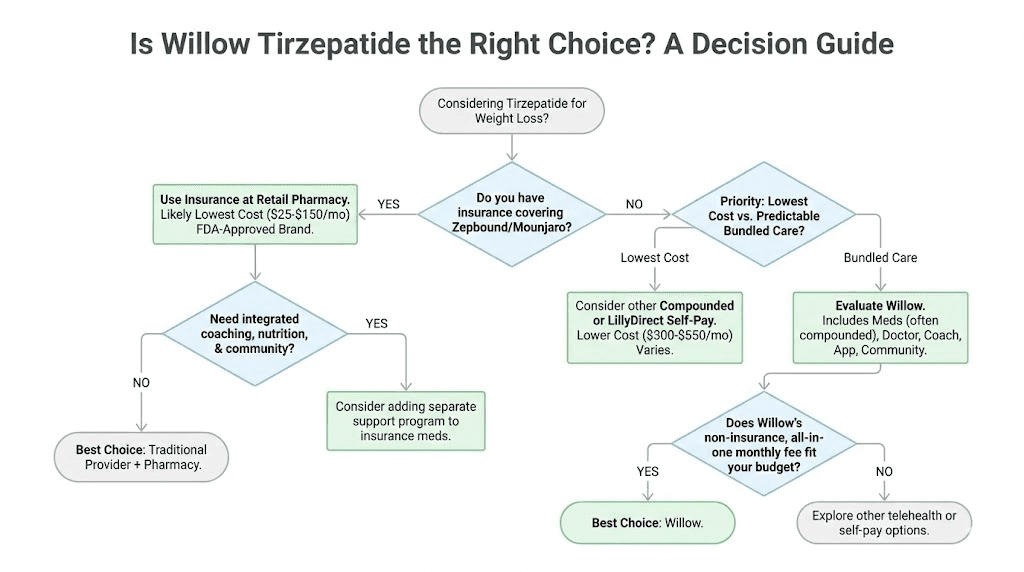
At the end of this analysis, the decision about Willow tirzepatide cost comes down to your specific situation. There is no universal answer. The right choice depends on your budget, your state of residence, your comfort with compounded medications, and what level of support you need alongside the medication itself.
If budget is your primary concern, Willow is not the cheapest option. Competitors offer lower starting prices, and some maintain lower pricing across higher dose tiers. The cheap compounded tirzepatide guide identifies the most cost-effective alternatives.
If simplicity is your priority, Willow delivers. One price, everything included, easy cancellation. For patients who want a clean, straightforward experience without comparing line items and add-on fees, the all-inclusive model has genuine appeal.
If you have HSA or FSA access, Willow becomes significantly more competitive. The tax savings on $399 to $524 monthly payments can reduce effective costs below what nominally cheaper providers charge when paid with after-tax dollars.
If you are approaching higher dose tiers, compare carefully. At the 15mg level, brand-name Zepbound through the manufacturer savings program actually undercuts Willow compounded, and you get an FDA-approved product. That comparison alone makes the decision straightforward for patients who qualify for the savings program.
Whatever you choose, understanding the full cost picture, from dose escalation to potential add-ons to long-term maintenance, empowers you to make a decision based on reality rather than headline pricing. The numbers in this guide give you that foundation.
For researchers committed to making informed decisions about their GLP-1 treatment, SeekPeptides offers the most comprehensive resource available. Evidence-based guides, real-world community experiences, detailed provider analyses, and cost optimization tools help you navigate the complex landscape of weight loss medication with clarity and confidence.
Frequently asked questions
How much does Willow tirzepatide cost per month?
Willow tirzepatide starts at $399 per month for doses up to 7.5mg. The price increases to $499 per month at 10mg and 12.5mg concentrations, and $524 per month at the 15mg maximum dose. These prices include medication, physician consultations, unlimited messaging, and free 2-day shipping.
Does Willow tirzepatide price change when your dose increases?
Yes. Willow uses tiered pricing based on concentration. Standard doses (2.5mg to 7.5mg) cost $399 per month. Higher concentrations cost $499 (10mg to 12.5mg) or $524 (15mg). Most patients experience at least one price increase during treatment as their physician titrates to higher doses for better results. See the complete dosing guide for typical escalation timelines.
Is Willow tirzepatide cheaper than Zepbound?
At lower doses, yes. Willow at $399 per month is significantly cheaper than Zepbound list price of $1,086. However, with Eli Lilly savings program at $499 per month, the gap narrows. At the 15mg dose, Willow at $524 actually costs more than the Zepbound savings program price. For a detailed medication comparison, see the tirzepatide versus semaglutide guide.
Does Willow accept insurance for tirzepatide?
No. Willow does not accept insurance. All payments are self-pay. However, Willow does accept HSA and FSA payments, which provide tax advantages that effectively reduce the cost. They also provide medical necessity letters upon request, which may be helpful for HSA and FSA reimbursement documentation.
Can you cancel Willow tirzepatide at any time?
Yes. There is no minimum commitment. Contact the Patient Care Team at least two business days before your next processing date to avoid being charged for the following cycle. If you cancel before the prescription goes to the pharmacy, you receive a full refund within five to ten business days.
What is the total six-month cost of Willow tirzepatide?
Following standard dose escalation from 2.5mg to 15mg over six months, the total cost is approximately $2,719. This averages to $453 per month when dose escalation pricing is factored in. Patients who stay at lower doses longer will spend less. The dosage calculator helps estimate costs based on your specific protocol.
Is Willow tirzepatide available in all states?
No. Willow currently operates in 34 states. Notable states not covered include Alaska, Alabama, Arkansas, Delaware, Kansas, Louisiana, Mississippi, New Mexico, North Dakota, Rhode Island, South Dakota, Utah, Vermont, West Virginia, and Wyoming. Check the Willow website for the most current state availability list.
Does Willow charge extra for tirzepatide drops versus injections?
Both formats start at the same $399 per month base price. The tirzepatide drops are administered daily under the tongue, while injections are given once weekly. Choose based on preference for administration method rather than price, as the cost is equivalent at baseline doses.
External resources
Centers for Medicare and Medicaid Services - Drug Pricing Information
National Association of Boards of Pharmacy - Compounding Pharmacy Verification
In case I do not see you, good afternoon, good evening, and good night. May your budget stay manageable, your doses stay effective, and your results stay consistent.