Feb 21, 2026
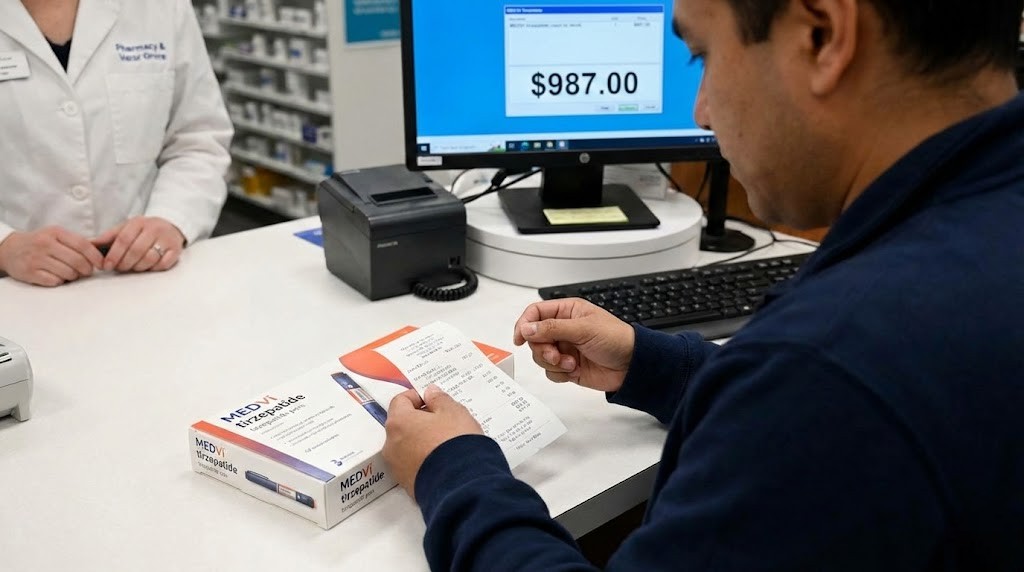
The average person searching for compounded tirzepatide will visit six different telehealth platforms before choosing one. Six. And across those six platforms, the pricing they encounter will range from $99 to $699 per month for what is supposedly the same active ingredient. That gap is staggering. It means someone could pay seven times more than another person for a nearly identical medication delivered through nearly identical telehealth models. MEDVi sits in the middle of that range, advertising compounded tirzepatide starting at $279 for the first month with ongoing refills climbing to $399 or even $499 depending on dose requirements and formulation choices.
But a starting price tells you almost nothing. What matters is the total cost over six months, twelve months, or however long your treatment lasts. What matters is what that monthly number actually includes, what it does not include, and whether the medication you receive justifies the price tag. And with the FDA tightening restrictions on compounded GLP-1 medications throughout the past year, the question of whether any platform can continue offering compounded tirzepatide at all looms large over every purchasing decision.
SeekPeptides tracks these platforms because our members navigate this exact decision every week. The pricing confusion is real. The regulatory uncertainty is real. And the financial commitment of six to twelve months of tirzepatide treatment is significant enough that getting the wrong answer can cost you thousands of dollars. This guide breaks down every cost, hidden fee, comparison point, and regulatory factor you need to evaluate MEDVi tirzepatide pricing clearly and confidently.
What MEDVi actually charges for tirzepatide
MEDVi operates as a doctor-led telehealth platform specializing in GLP-1 weight loss medications. They offer both compounded tirzepatide and compounded semaglutide, with tirzepatide positioned as their premium option. The pricing structure is straightforward on the surface but gets more complex once you account for dose escalation, formulation choices, and treatment duration.
Here are the numbers.
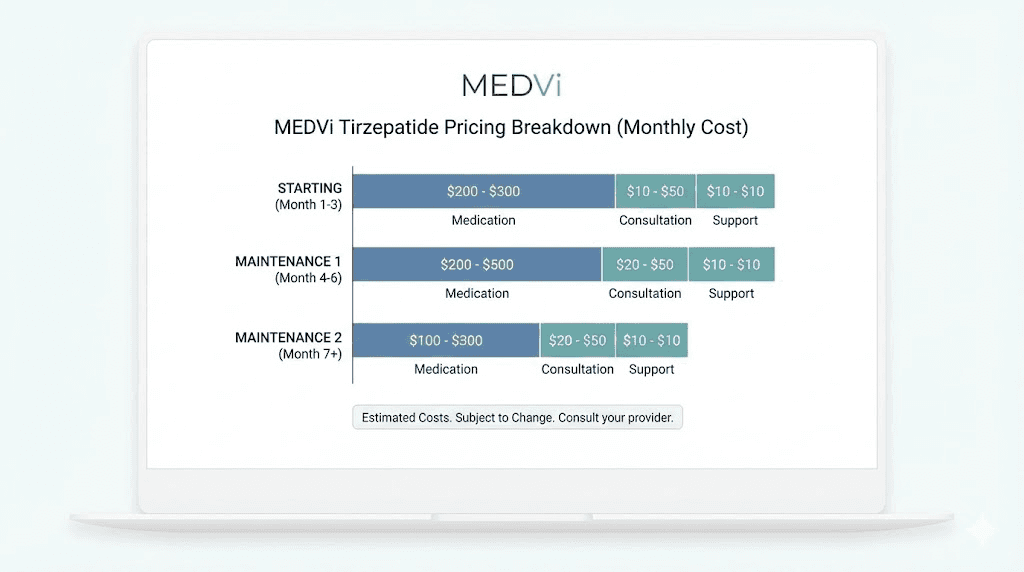
The first month of compounded tirzepatide injections through MEDVi costs $279. That introductory rate covers the initial physician evaluation, your treatment plan, a metabolic report, the medication itself, and shipping with cold packs. It is an all-inclusive price. No separate consultation fee. No hidden membership charge. No surprise add-ons at checkout.
After that first month, the price increases. Monthly refills for compounded tirzepatide injections run between $399 and $499 depending on your dose level. MEDVi uses a tiered pricing model where costs increase as your dose escalates through the standard tirzepatide titration schedule. Starting doses cost less. Maintenance doses at 10mg or 15mg weekly cost more. This is different from platforms that use flat-rate pricing regardless of dose, and it means your total cost rises over time as your treatment progresses.
MEDVi also offers compounded tirzepatide in tablet form. The starting price for tablets is $279 per month, matching the injectable introductory rate. Tablet refill pricing requires direct confirmation with MEDVi customer service, as it may differ from injectable refill costs depending on current availability and compounding pharmacy pricing.
Annual cost projections
A realistic annual cost estimate for MEDVi tirzepatide treatment falls between $4,500 and $5,500. That accounts for the lower introductory month, the gradual dose escalation through the standard dose chart, and the higher maintenance dose pricing that kicks in around month three or four.
Break it down month by month and the picture becomes clearer:
Month 1: $279 (introductory rate at 2.5mg)
Months 2 to 3: $399/month (dose escalation through 5mg to 7.5mg)
Months 4 to 6: $449 to $499/month (maintenance doses at 10mg to 15mg)
Months 7 to 12: $449 to $499/month (ongoing maintenance)
Over twelve months, that totals approximately $5,100 to $5,700. Over two years, you are looking at $10,000 to $11,500. These are significant numbers. They deserve careful consideration before you commit, especially when cheaper alternatives exist and the regulatory landscape continues shifting beneath every compounding platform.
What the monthly fee includes
MEDVi bundles several services into their monthly rate. Understanding what you get helps you compare apples to apples with competing platforms that may unbundle these services and charge separately.
Your monthly fee covers ongoing provider access with unlimited messaging. You can ask questions about side effects, dosing concerns, or treatment adjustments without paying per-message fees. It covers regular progress check-ins where your provider reviews your response and adjusts your protocol. It covers dose adjustments as you titrate through the standard schedule. And it covers shipping with cold packs, which matters for a temperature-sensitive medication that requires refrigeration.
Lab testing is included when medically necessary. That phrase matters. "When medically necessary" means the provider decides whether labs are warranted based on your clinical presentation. It does not mean you get routine comprehensive metabolic panels included in your monthly fee. If you want baseline labs before starting treatment, which is a wise idea, you may need to arrange and pay for those separately through your primary care provider or a direct-to-consumer lab service.
MEDVi does not charge a separate membership fee. They do not charge a separate consultation fee beyond the bundled monthly rate. They do not require insurance. The entire model operates on a cash-pay basis, which simplifies billing but means you cannot submit claims to your insurance company for reimbursement. HSA and FSA payments are accepted, providing a tax-advantaged way to pay if your account has sufficient funds.
MEDVi tirzepatide vs brand-name tirzepatide pricing
Context matters enormously when evaluating any compounded medication price. Without understanding what the brand-name alternative costs, the compounded price exists in a vacuum. So here is the comparison that drives every purchasing decision in this space.
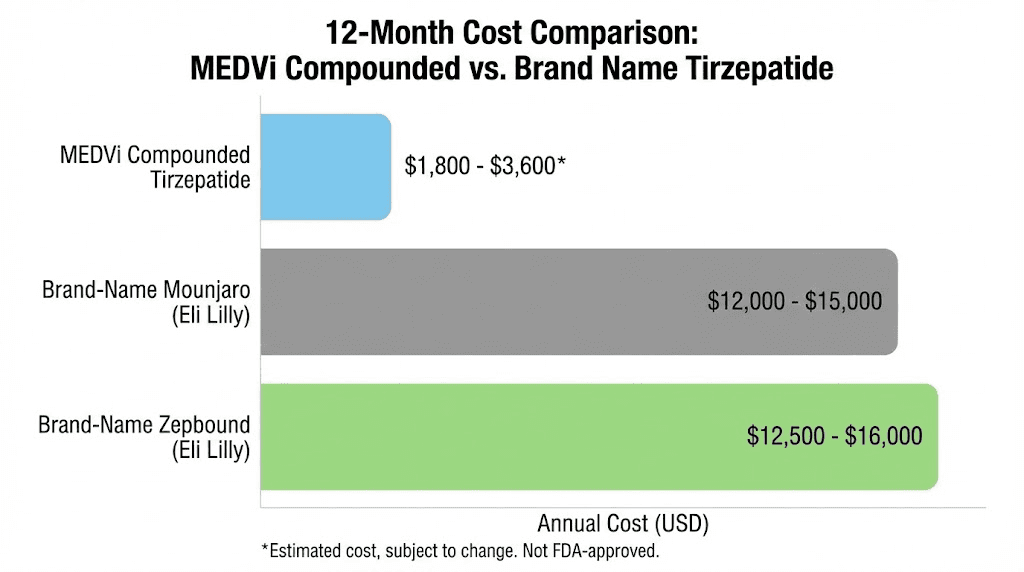
Brand-name tirzepatide comes in two FDA-approved formulations. Mounjaro, manufactured by Eli Lilly, carries a list price of approximately $1,080 per month. Zepbound, also from Eli Lilly and specifically approved for weight management, costs approximately $1,060 per month. Through the Eli Lilly direct portal (LillyDirect), some patients access Zepbound at approximately $499 per month, though availability and eligibility criteria apply.
At MEDVi pricing of $399 to $499 per month for maintenance doses, you save roughly $560 to $680 per month compared to full list-price Mounjaro. That is a 40 to 60 percent cost reduction. Over twelve months, the savings total $6,700 to $8,200. Over two years, $13,400 to $16,400. Those numbers explain why compounded tirzepatide platforms attract millions of patients despite the regulatory concerns.
But here is the catch. Brand-name tirzepatide through insurance can cost as little as $25 to $150 per month with a good plan. If your insurance covers GLP-1 medications for weight loss, the brand-name option may actually be cheaper than MEDVi compounded tirzepatide. Always check your insurance benefits before assuming compounded is the more affordable route. The assumption that compounded equals cheaper only holds when you do not have insurance coverage for the brand alternative.
Cost comparison table
Option | Monthly cost | Annual cost | FDA approved | Insurance eligible |
|---|---|---|---|---|
Mounjaro (brand) | $1,080 | $12,960 | Yes | Yes |
Zepbound (brand) | $1,060 | $12,720 | Yes | Yes |
LillyDirect (brand) | $499 | $5,988 | Yes | No |
MEDVi (compounded) | $279 to $499 | $4,500 to $5,700 | No | No |
Insurance copay (brand) | $25 to $150 | $300 to $1,800 | Yes | Yes |
The table makes the reality clear. MEDVi compounded tirzepatide is substantially cheaper than brand-name list pricing. But it is more expensive than brand tirzepatide through insurance, and it is comparable to the LillyDirect program. Your best financial move depends entirely on your insurance situation.
How MEDVi compares to other compounded tirzepatide platforms
MEDVi does not exist in isolation. The compounded tirzepatide market has grown explosively, and a dozen or more telehealth platforms now compete for the same patients. Pricing varies dramatically. Service quality varies even more. Understanding where MEDVi falls in this landscape helps you determine whether their pricing represents good value or whether alternatives deserve consideration.
Platform-by-platform comparison
Platform | First month | Ongoing monthly | Pricing model | Trustpilot rating |
|---|---|---|---|---|
MEDVi | $279 | $399 to $499 | Tiered by dose | 4.9/5 (29,100+) |
Direct Meds | $397 | $397 | Flat rate | 4.6/5 (7,000+) |
TrimRx | $349 | $349 | Flat rate | Varies |
Henry Meds | $349 | $349 | Flat rate | Varies |
Join Josie | $399 | $399 | Flat rate | Varies |
Several patterns emerge from this comparison. MEDVi offers the lowest entry point at $279 for the first month. That matters for patients testing the waters who want to minimize their initial financial commitment. However, MEDVi ongoing costs of $399 to $499 place them at or above most competitors who use flat-rate pricing regardless of dose level.
The tiered pricing model is the critical distinction. Platforms like Direct Meds and TrimRx charge the same monthly rate whether you are on 2.5mg or 15mg. MEDVi charges more as your dose increases. For patients who reach and maintain higher doses, which is most patients after the first few months, MEDVi may end up costing $50 to $150 more per month than flat-rate competitors.
Over twelve months, that difference adds up. A flat-rate platform at $349 per month costs $4,188 annually. MEDVi at an average of $440 per month (accounting for the lower introductory rate and dose escalation) costs $5,280 annually. The $1,092 annual difference is real money. Whether MEDVi service quality justifies that premium is the question every prospective patient needs to answer.
Where MEDVi wins on value
Review volume and ratings tell a story. MEDVi Trustpilot rating of 4.9 out of 5 based on over 29,100 reviews is exceptional. For comparison, most telehealth platforms in this space hover between 3.5 and 4.5. That kind of review volume at that rating level suggests consistently positive patient experiences. Patients repeatedly praise MEDVi clinical staff for being knowledgeable, responsive, and genuinely attentive to individual concerns.
The 24/7 messaging support is another differentiator. Not all platforms offer round-the-clock provider access. When you are experiencing gastrointestinal side effects at 2 AM, having the ability to message your care team and get a response matters. That accessibility carries real value, even if it is hard to quantify in dollars.
MEDVi also includes lab testing when medically indicated, which some competitors charge extra for. And their five-month money-back guarantee, while limited by specific conditions, provides a safety net that not all platforms offer.
Where MEDVi loses on value
The tiered pricing model is the primary disadvantage. Patients on maintenance doses pay a premium compared to flat-rate platforms. The $499 per month ceiling for higher doses pushes MEDVi toward the expensive end of the compounded tirzepatide market.
Processing times represent another weakness. Multiple reviews describe shipment timelines of seven to fourteen days from order to delivery. Some competitors manage five to seven day turnaround consistently. For a medication that requires consistent weekly dosing, delays create gaps in your treatment schedule that can affect results and trigger rebound appetite.
And the cash-pay-only model, while simplifying billing, means you cannot apply insurance benefits. For patients with employer-sponsored health plans that cover GLP-1 medications, MEDVi pricing is objectively worse than going through their insurance. There is no way around that math.
Understanding MEDVi tirzepatide formulations
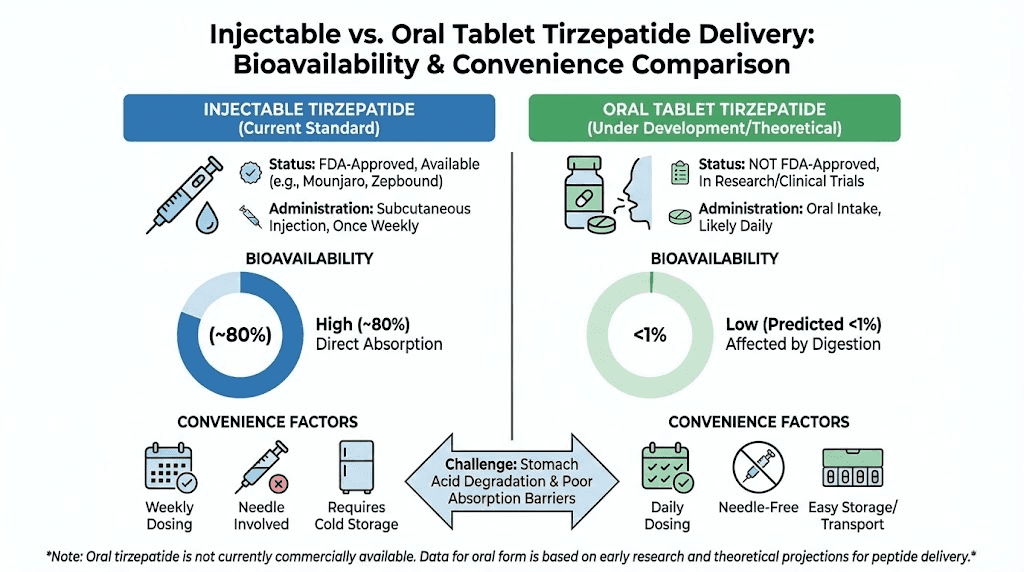
MEDVi offers compounded tirzepatide in two forms: injectable and tablet. The choice between them affects your experience, your results, and potentially your cost. Understanding the differences requires knowing how each formulation works at a pharmacological level.
Injectable tirzepatide from MEDVi
Injectable compounded tirzepatide follows the same subcutaneous administration route as brand-name Mounjaro and Zepbound. You inject once weekly into the abdomen, thigh, or upper arm using an insulin syringe. The injection itself takes seconds. The preparation, drawing the correct dose from a vial, requires precision and basic understanding of tirzepatide dosage in units.
Bioavailability for subcutaneous tirzepatide is high. The medication enters your system efficiently because it bypasses the digestive tract entirely. This means your prescribed dose is essentially your effective dose. No worrying about absorption variables. No wondering whether stomach acid degraded half the medication before it reached your bloodstream.
The injectable form requires proper storage. Compounded tirzepatide vials must be refrigerated and protected from light. You need supplies: insulin syringes, alcohol swabs, and a sharps container. MEDVi shipping includes cold packs, but you must refrigerate the medication promptly upon delivery. Temperature excursions during shipping can compromise potency, which is why understanding temperature stability matters.
If the medication arrives as a lyophilized powder rather than a pre-mixed solution, you will need to reconstitute it with bacteriostatic water before use. This adds a step but is straightforward with proper instructions. MEDVi provides reconstitution guidance, and our reconstitution calculator can verify your calculations.
Tablet tirzepatide from MEDVi
The tablet option eliminates needles entirely. No injections. No syringes. No reconstitution. You take a pill. That simplicity appeals to a substantial segment of patients who cannot or will not self-inject.
But simplicity comes with trade-offs. The pharmacology of oral versus injectable tirzepatide differs in important ways. Oral delivery exposes the medication to stomach acid and first-pass liver metabolism, both of which can reduce the amount of active ingredient that reaches your bloodstream. Compounded oral tirzepatide formulations use various delivery technologies to mitigate these challenges, but the bioavailability data for compounded tablets is not as robust as the data for injectable formulations.
Does that mean tablets do not work? No. Many MEDVi patients on tablet formulations report meaningful appetite suppression and weight loss. But if you want the highest confidence in medication delivery and the most established pharmacological profile, injectable remains the stronger choice based on current evidence.
The tablet pricing at MEDVi starts at $279 per month, matching the injectable introductory rate. Whether tablet refill costs match or differ from injectable refill costs should be confirmed directly with MEDVi before committing to a formulation choice.
The MEDVi sign-up process and what to expect
Understanding the process from first click to first dose helps you evaluate whether MEDVi operational model meets your expectations. Here is exactly what happens.
Step 1: online health assessment
You start by completing a health questionnaire on the MEDVi website. This takes approximately five minutes. The form collects your medical history, current medications, weight loss goals, any contraindications, and relevant health markers. It is not a casual survey. The questions are designed to identify patients who should not take tirzepatide, including those with a personal or family history of medullary thyroid carcinoma, a history of pancreatitis, or active gallbladder disease.
Step 2: clinician review
A licensed healthcare provider reviews your intake form. MEDVi positions itself as a doctor-led program, which means your case is evaluated by a physician or nurse practitioner rather than processed through an automated approval algorithm. The provider determines whether you are a suitable candidate for tirzepatide based on your health profile and stated goals.
If approved, the provider creates your treatment plan, selects your starting dose (typically 2.5mg weekly), and writes a prescription. If declined, you should receive an explanation of why tirzepatide is not appropriate for your situation.
Step 3: payment and pharmacy processing
Once approved, your payment processes and the prescription routes to a partner compounding pharmacy. MEDVi works with licensed compounding pharmacies, including Belmar Pharma Solutions, to prepare medications. The pharmacy compounds your tirzepatide to the prescribed specifications, packages it with cold packs, and ships it to your door.
This step is where delays can occur. Multiple customer reviews describe pharmacy processing times of three to five business days, followed by two-day shipping. Total timeline from payment to delivery: seven to fourteen days. If you are starting a new treatment and eager to begin, that wait can feel long. Plan accordingly and do not expect same-week delivery.
Step 4: treatment and ongoing support
Once your medication arrives, you begin treatment following your provider prescribed schedule. MEDVi offers 24/7 messaging support for questions about side effects, injection technique, or dosing concerns. Regular check-ins allow your provider to assess your response and adjust your protocol as needed.
Dose titration follows the standard schedule. Most patients increase their dose every four weeks, moving from 2.5mg through 5mg, 7.5mg, 10mg, and potentially up to 15mg depending on response and tolerance. Each dose increase may trigger a price increase under MEDVi tiered model, so factor that into your financial planning.
MEDVi refund and cancellation policy explained
The refund policy is where many telehealth platforms reveal their true priorities. MEDVi policy contains important details that every prospective patient should understand before committing money.
The money-back guarantee
MEDVi advertises a money-back guarantee tied to weight loss outcomes. The specific terms require at least five months of participation with documented weight loss failure before a refund becomes eligible. That is a significant commitment. Five months at $399 to $499 per month means you are spending $2,000 to $2,500 before the guarantee becomes applicable.
A 25 percent consultation fee may be deducted from any refund. That deduction reduces the actual refund amount meaningfully. On five months of treatment at $450 per month ($2,250 total), a 25 percent deduction removes $562, leaving a refund of approximately $1,688. Better than nothing. But far from a full refund.
Monthly cancellation rules
Routine cancellations operate differently from the money-back guarantee. The critical window is before the pharmacy processes your order for each billing cycle. Once the pharmacy begins compounding your medication, that month payment is generally non-refundable. MEDVi requires 72-hour notice before your billing date to cancel without being charged for the upcoming month.
This means you need to track your billing cycle carefully. Missing the 72-hour window by even a day could result in being charged for an additional month of medication you do not want. Set calendar reminders. Document your cancellation request in writing. Save the confirmation.
Lessons from customer complaints
Trustpilot and consumer review sites show a small but consistent pattern of complaints about the cancellation process. Some customers describe difficulty reaching the right department. Others report being encouraged to continue rather than cancel. A few describe billing charges appearing after they believed they had successfully cancelled.
These complaints represent a minority of MEDVi customer base. The platform 4.9 out of 5 rating across 29,100+ reviews makes that clear. But the complaints exist, and if you are investing $400 to $500 per month in a medical treatment, you deserve a frictionless cancellation process when you decide to stop. Document everything. Keep email confirmations. Note dates and names.
MEDVi customer reviews and real results
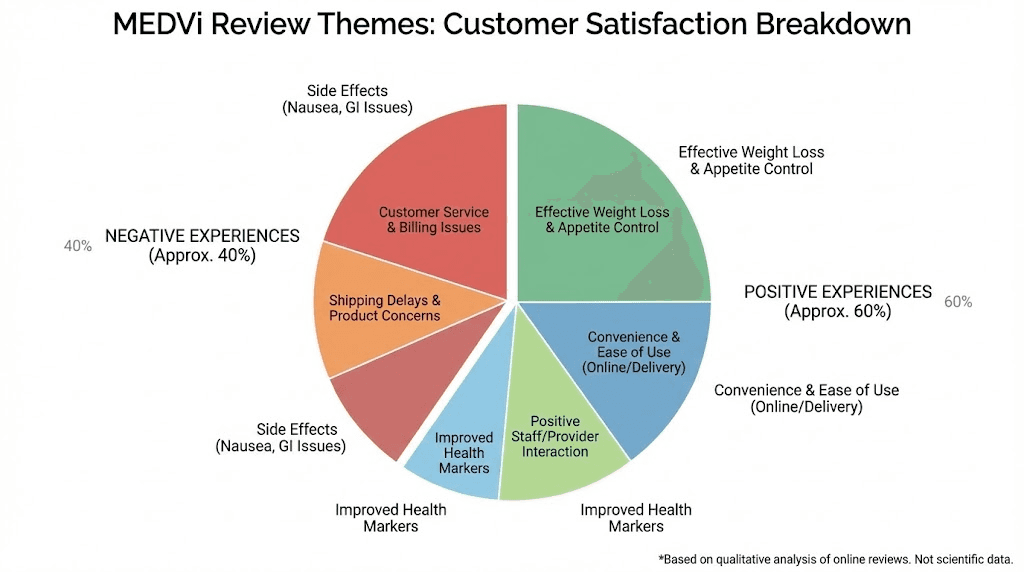
Numbers on a pricing page tell you what a service costs. Reviews tell you what a service delivers. MEDVi review profile is among the strongest in the compounded GLP-1 space, but understanding both the praise and the complaints gives you a complete picture.
What patients love about MEDVi
The Trustpilot rating of 4.9 out of 5 based on over 29,100 reviews is remarkable. Very few healthcare services achieve that rating at that volume. The positive reviews consistently highlight several themes.
Clinical staff quality stands out. Patients describe nurse practitioners who listen, ask thorough questions, and provide personalized guidance rather than one-size-fits-all protocols. Multiple reviews mention specific staff members by name, which suggests genuine relationship-building rather than transactional interactions.
Weight loss results are frequently reported. MEDVi claims patients lose an average of 15 to 20 percent of body weight. Individual reviews corroborate meaningful losses: 20 pounds in two months, 35 pounds in four months, fitting into clothes they had not worn in years. These are self-reported figures, not independently verified clinical data. But the volume and consistency of positive outcomes suggests the medication and support structure are working for most patients.
The 24/7 support access receives consistent praise. Patients value being able to reach their care team at any time, especially during the early weeks when side effects are most common and questions are most urgent. This around-the-clock accessibility distinguishes MEDVi from competitors who limit support to business hours.
What patients complain about
No platform with 29,000+ reviews is complaint-free. MEDVi negative reviews, while representing a small percentage, cluster around predictable themes.
Shipping delays appear most frequently. Some patients report medications arriving one to two weeks after expected delivery dates. For a weekly injection, a two-week delay means missing doses, which can disrupt your titration schedule and potentially trigger the return of appetite that tirzepatide had been suppressing. If you are considering MEDVi, plan for potential shipping delays by reordering before your current supply runs out rather than waiting until you are on your last dose.
First shipment temperature concerns surface in several reviews. One customer reported their initial shipment arriving warm rather than cold. For a medication that requires refrigeration, this raises legitimate potency questions. MEDVi ships with cold packs, but transit times, weather conditions, and doorstep exposure can all compromise temperature control. If your medication arrives warm, contact MEDVi immediately and do not use it until you confirm its safety.
Price increases after the first month catch some patients off guard. The jump from $279 to $399 or $499 is clearly stated in MEDVi pricing structure, but patients who focus on the introductory price may not fully internalize what the ongoing cost will be. This is not deceptive. It is standard tiered pricing. But it creates sticker shock for patients who budgeted based on the first month number.
Patient portal friction appears in a handful of reviews. Some patients describe a learning curve with the digital interface, particularly around the refill process. Technology hiccups happen with any platform, but when the technology stands between you and your medication, even minor friction feels significant.
The regulatory elephant in the room: can MEDVi still offer compounded tirzepatide?
This section matters more than pricing, more than reviews, and more than any comparison table. The regulatory status of compounded tirzepatide has changed dramatically, and every patient considering any compounded GLP-1 platform needs to understand the current landscape.
What happened with the FDA
In December 2024, the FDA determined that the tirzepatide shortage was over. Eli Lilly confirmed that manufacturing capacity could meet demand for both Mounjaro and Zepbound across all dose strengths. That determination triggered a chain of regulatory consequences that transformed the compounded tirzepatide market.
During the shortage period, compounding pharmacies operated with broader authority to prepare copies of commercially available medications under FDA drug shortage provisions. Once the shortage ended, that authority narrowed significantly. The FDA set transition periods: 503A compounding pharmacies could continue compounding tirzepatide through specified deadlines, and 503B outsourcing facilities had slightly longer windows. Those transition periods have expired.
As of the current regulatory framework, compounding tirzepatide is generally restricted to rare, patient-specific cases where an FDA-approved product cannot be used. The standard justification requires a documented medical need, such as a verified allergy to an inactive ingredient in the brand-name formulation, that makes the FDA-approved version unsuitable for that specific patient. Compounding for general weight loss, cost savings, or patient preference does not meet the legal criteria.
What this means for MEDVi
MEDVi continues to offer compounded tirzepatide as of the time of this writing. Multiple telehealth platforms continue operating in this space despite the regulatory changes. The gap between the letter of the law and enforcement action creates a gray area that platforms continue to occupy.
But this gray area carries risk. For MEDVi. And for you as a patient.
If the FDA escalates enforcement against compounding pharmacies or telehealth platforms offering broadly compounded tirzepatide, your supply could be interrupted with little warning. You might be mid-treatment at 10mg weekly, experiencing excellent results, and suddenly unable to obtain your next refill. Transitioning to brand-name tirzepatide at that point means navigating insurance approvals, finding a prescribing provider, and potentially paying significantly more per month. The disruption to your treatment continuity could set you back weeks or months. Understanding current peptide regulation developments helps you stay ahead of these changes.
MEDVi also offers brand-name options at premium pricing, which provides a potential pathway if compounded formulations become unavailable. But brand-name pricing through MEDVi reportedly reaches $1,999 per month, which is significantly higher than obtaining brand tirzepatide through other channels. That premium pricing for brand-name options is worth questioning if you ever need to transition.
Protecting yourself regardless of platform
If you choose MEDVi or any compounded tirzepatide platform, take these steps to protect yourself against regulatory disruption:
First, establish a relationship with a primary care provider or endocrinologist who can prescribe brand-name tirzepatide if needed. Having a backup prescriber already in place means you do not start from scratch if your compounded supply disappears.
Second, check your insurance coverage for brand-name GLP-1 medications now, before you need it. Understanding your coverage, copay, and prior authorization requirements ahead of time eliminates delays when you need them most.
Third, do not stockpile compounded medication beyond what you can use within the recommended shelf life. Expired or degraded medication provides no benefit and may carry risk.
Fourth, stay informed about FDA actions. The regulatory landscape in this space changes frequently. What is available today may not be available next month.
MEDVi tirzepatide versus MEDVi semaglutide: which costs less?
MEDVi offers both compounded tirzepatide and compounded semaglutide. The pricing difference between them is substantial, and understanding whether the tirzepatide premium is worth paying requires knowing what each medication offers.
Pricing comparison within MEDVi
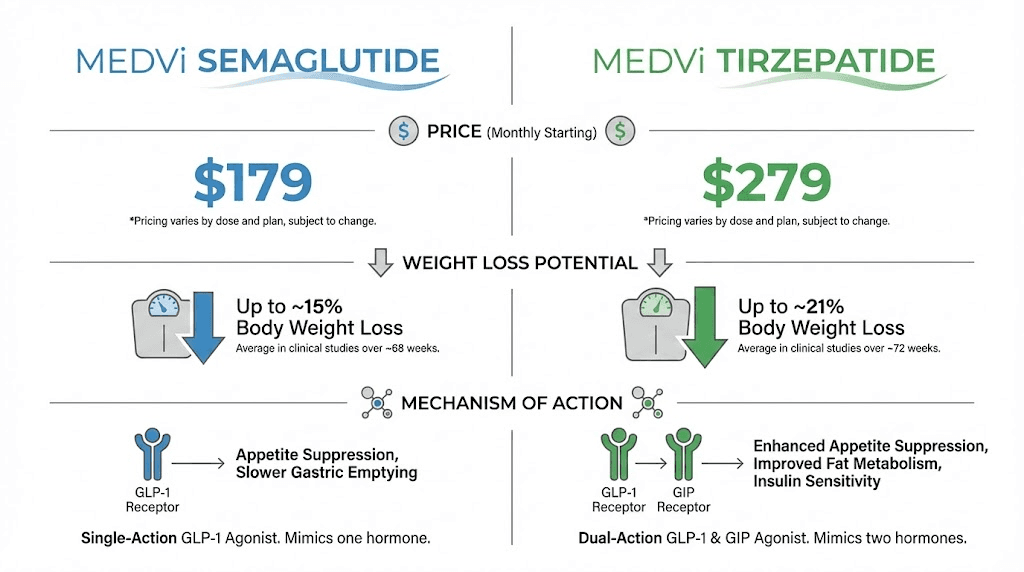
MEDVi compounded semaglutide starts at $179 for the first month. Ongoing refills cost $299 per month, which MEDVi advertises as a locked rate that does not increase with dose escalation. Compare that to tirzepatide starting at $279 with ongoing costs of $399 to $499.
The annual cost difference is significant:
Semaglutide through MEDVi: $179 + (11 x $299) = $3,468 annually
Tirzepatide through MEDVi: $279 + (11 x $449 average) = $5,218 annually
Tirzepatide costs approximately $1,750 more per year through MEDVi. Over two years, that premium exceeds $3,500. The question is whether tirzepatide clinical advantages justify that additional expense.
Clinical differences that affect your decision
Tirzepatide is a dual GIP/GLP-1 receptor agonist. It activates two metabolic pathways rather than the single GLP-1 pathway that semaglutide targets. Clinical trial data from the SURMOUNT and SURPASS programs showed tirzepatide producing average weight loss of 20 to 25 percent of body weight at the highest doses, compared to 15 to 17 percent for semaglutide at comparable doses.
That 5 to 8 percentage point difference translates to real pounds. For a 220-pound person, 20 percent loss means 44 pounds. Seventeen percent means 37.4 pounds. The additional 6.6 pounds may or may not matter to you depending on your goals. For some patients, tirzepatide results justify the premium. For others, semaglutide achieves sufficient results at a lower cost.
Some patients tolerate one medication better than the other. If semaglutide causes intolerable gastrointestinal symptoms that tirzepatide does not, or vice versa, tolerability may drive your choice regardless of cost. You cannot put a price on completing your treatment versus abandoning it due to side effects.
If cost is the primary factor, start with semaglutide through MEDVi. If you do not achieve adequate results after three to four months, discuss transitioning to tirzepatide with your provider. Using a conversion chart can help guide the dosing transition. This stepped approach saves money upfront while preserving tirzepatide as an escalation option.
Saving money on MEDVi tirzepatide
Every dollar counts over a year-long treatment. Here are practical strategies for reducing your total cost if you choose MEDVi.
Use HSA or FSA funds
Health Savings Account and Flexible Spending Account funds are pre-tax dollars. Depending on your tax bracket, paying with HSA or FSA effectively reduces your cost by 20 to 37 percent. On a $450 monthly bill, that represents $90 to $166 in effective savings per month, or $1,080 to $1,998 annually. This is the single most impactful cost reduction strategy available.
Start at the minimum effective dose
MEDVi tiered pricing means lower doses cost less. Starting at 2.5mg and titrating slowly does more than manage side effects. It keeps you at lower price tiers longer. If 5mg or 7.5mg provides adequate appetite suppression and weight loss, staying at that dose rather than pushing to 10mg or 15mg saves money every month.
Discuss this approach with your provider. Not every patient needs the maximum dose. Your optimal dose is the lowest dose that produces meaningful, sustained results. Using a dosage calculator helps you and your provider find that sweet spot.
Consider the tablet formulation
If tablet and injectable pricing differs (confirm with MEDVi directly), the tablet option may offer savings. You trade potentially lower bioavailability for lower cost and greater convenience. For patients whose primary goal is appetite suppression and moderate weight loss rather than maximum pharmacological potency, tablets may deliver adequate results at a lower price point.
Time your start strategically
If you have an FSA that resets annually, timing your start to maximize FSA coverage across the calendar year can matter. Starting in January means twelve months of FSA-eligible expenses. Starting in November means only two months of coverage before the reset.
Compare before committing
Get pricing quotes from two or three platforms before choosing MEDVi. Pricing changes frequently in this market. A platform that was expensive three months ago may have reduced rates. A platform that was cheap may have raised prices. Current pricing is the only pricing that matters.
What makes tirzepatide worth the cost (or not)
Paying $4,500 to $5,700 per year for any medication demands honest evaluation of whether the investment produces returns that justify the expense. Here is how to think about the value calculation.
The health economics argument
Obesity costs the average person $1,861 per year in excess medical expenses according to CDC data. That includes higher healthcare premiums, more frequent doctor visits, more medications, and higher rates of chronic conditions like type 2 diabetes, hypertension, and cardiovascular disease. A person with BMI over 40 faces even higher excess costs.
If tirzepatide treatment moves you from obese to normal weight, the $4,500 to $5,700 annual cost partially offsets itself through reduced healthcare spending. Not entirely. But the gap narrows when you account for fewer medications, fewer doctor visits, and lower insurance premiums over time.
The SURMOUNT trials showed tirzepatide producing statistically significant improvements in blood pressure, blood sugar control, and triglyceride levels alongside weight loss. Those metabolic improvements carry real financial value in reduced future healthcare costs, even if that value is difficult to quantify precisely for any individual patient.
The quality of life argument
Weight loss improves sleep quality. It reduces joint pain. It increases energy. It improves mobility. It reduces symptoms of depression and anxiety. It improves sexual function. It extends lifespan. These outcomes resist easy dollarization, but ask anyone who has lost 40 or 50 pounds whether they would pay $5,000 per year to maintain those improvements and most would not hesitate.
The question is whether the weight loss is sustainable. If you lose 50 pounds on tirzepatide and regain 35 of them within a year of stopping, the long-term value diminishes substantially. Tirzepatide works while you take it. The challenge is maintaining results after treatment ends, which requires the lifestyle, nutrition, and exercise habits you build during treatment. Following a structured tirzepatide diet plan and understanding which foods to avoid increases your chances of maintaining results long-term.
When tirzepatide is not worth the cost
Tirzepatide is not worth the cost if you are not losing weight on it. Non-response happens. Some patients do not experience meaningful appetite suppression or weight loss even at higher doses. If you have been on tirzepatide for three months, reached an adequate dose, and see minimal results, continuing to spend $400 to $500 per month is throwing money away.
It is not worth the cost if you can get brand-name tirzepatide through insurance for less. Do the math. If your copay for Zepbound is $150 per month, MEDVi at $450 per month costs three times as much for a non-FDA-approved product. That makes no financial or medical sense.
It is not worth the cost if you are not simultaneously building sustainable habits. Tirzepatide without lifestyle change is a temporary band-aid at premium prices. The medication creates a window of opportunity. You have to do the work inside that window by establishing nutrition patterns, exercise routines, and behavioral strategies that persist after treatment ends.
MEDVi pharmacy partners and medication quality
The quality of compounded medication depends entirely on the compounding pharmacy. Understanding who prepares your medication and how they ensure quality is essential for any patient considering compounded tirzepatide from any platform.
Who compounds MEDVi medications?
MEDVi partners with licensed US-based compounding pharmacies. Belmar Pharma Solutions has been specifically identified as one of their pharmacy partners. MEDVi clinical network includes partnerships with Beluga Health, OpenLoop Health, and CareValidate for the healthcare provider side of operations.
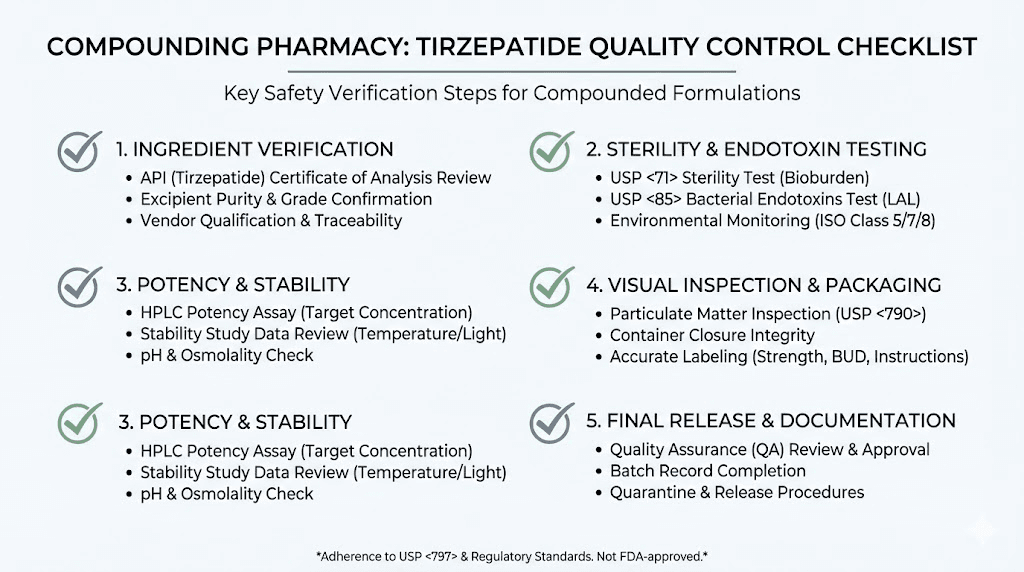
Knowing your pharmacy matters. You can verify a compounding pharmacy licensing status through your state board of pharmacy. You can check whether they have received any FDA warning letters or enforcement actions. You can ask about their quality control procedures, including potency testing, sterility testing, and endotoxin testing. A pharmacy that cannot answer these questions or refuses to provide this information is not one you want preparing medication you inject into your body.
Compounded medication quality considerations
The FDA does not review compounded medications for safety, effectiveness, or quality before they reach patients. That single fact carries enormous weight. It does not mean compounded medications are unsafe. It means the safety assurance system differs fundamentally from what FDA-approved medications undergo.
Reputable compounding pharmacies maintain strict quality control protocols. They test for potency (is the medication at the correct concentration?), sterility (is it free from microbial contamination?), and endotoxins (is it free from bacterial toxins?). They follow United States Pharmacopeia (USP) standards for compounding. They maintain clean room environments appropriate for sterile compounding.
The FDA has received more than 215 reports of adverse events related to compounded tirzepatide. Many trace to dosing errors caused by concentration confusion between compounded and brand-name formulations. Others involve quality issues at specific compounding pharmacies. These reports represent a fraction of total patients using compounded tirzepatide, but they demonstrate that the risk is not theoretical.
Before your first dose of compounded tirzepatide from MEDVi or any platform, verify the concentration in milligrams per milliliter. Calculate your dose carefully using a peptide calculator. Double-check your math. Have your provider confirm. And inspect every vial visually before use, checking for particulate matter, discoloration, or cloudiness that could indicate contamination or degradation.
Managing side effects on MEDVi tirzepatide
Side effects are part of tirzepatide treatment regardless of the source. Understanding what to expect and how to manage common issues maximizes your chances of completing treatment successfully rather than abandoning it due to discomfort.
The most common side effects
Gastrointestinal symptoms dominate. Nausea affects roughly 25 to 30 percent of tirzepatide users, particularly during the first few weeks and after dose increases. Diarrhea, constipation, and decreased appetite (which is both a side effect and the intended mechanism) round out the most common complaints.
Less common but notable side effects include headaches, fatigue, body aches, anxiety, insomnia, and joint pain. These typically resolve as your body adjusts to the medication, but they can be disruptive during the first one to two weeks at each new dose level.
Practical management strategies
For nausea: Eat smaller, more frequent meals. Avoid greasy, fried, and heavy foods. Ginger tea or ginger supplements can help. Some patients find that taking their injection in the evening and sleeping through the peak nausea window works well. If nausea is severe, ask your MEDVi provider about anti-nausea medication.
For constipation: Increase fiber intake gradually. Hydrate aggressively. Consider magnesium citrate supplementation. Walking or light exercise stimulates gut motility. If constipation persists, see our detailed constipation management guide.
For fatigue: Ensure adequate protein intake. Fatigue on GLP-1 medications often stems from inadequate nutrition rather than the medication itself. Your appetite drops, you eat less, and if that means less protein and fewer calories than your body needs for basic function, fatigue follows. B12 supplementation may help, especially with compounded formulations that do not include B12. See our guide on the best supplements to take with tirzepatide.
For hair thinning: Rapid weight loss triggers telogen effluvium in some patients. This is a temporary shedding phase caused by the caloric deficit and weight change, not by tirzepatide directly. Adequate protein, biotin, zinc, and iron support help minimize shedding. Hair typically regrows within six to twelve months. Read our complete guide on GLP-1 and hair loss for detailed management strategies.
When to contact your MEDVi provider
Most side effects are manageable at home. But certain symptoms require prompt medical attention:
Severe, persistent abdominal pain that radiates to your back could indicate pancreatitis. Contact your provider immediately or go to an emergency room.
Signs of allergic reaction, including facial swelling, throat tightness, difficulty breathing, or severe rash, require emergency medical attention.
Persistent vomiting that prevents you from keeping fluids down for more than 24 hours risks dehydration and electrolyte imbalances. Seek medical care.
Any lump or swelling in your neck, difficulty swallowing, or persistent hoarseness could indicate thyroid changes. Report these to your provider promptly.
Maximizing your results on MEDVi tirzepatide
Tirzepatide is not a magic solution. It is a powerful tool that works best when combined with strategic nutrition, exercise, and behavioral changes. Here is how to get the most value from your investment.
Nutrition priorities during treatment
Protein is non-negotiable. Aim for 0.7 to 1.0 grams per pound of body weight daily. When your appetite drops dramatically, protein is usually the first macronutrient to suffer. Without adequate protein, you lose muscle along with fat. That hurts your metabolism, your strength, and your long-term outcomes. Following a structured eating plan while on tirzepatide helps ensure you meet nutritional targets even as overall intake decreases.
Hydration matters more than usual. Tirzepatide gastrointestinal effects can cause fluid loss. Aim for at least 64 ounces of water daily. More if you are active or experiencing GI symptoms.
Micronutrients deserve attention. Reduced food intake means reduced micronutrient intake. A quality multivitamin, B12, vitamin D, and electrolytes cover the most common gaps. Some patients benefit from glycine supplementation or B12 specifically formulated compounds.
Exercise strategy
Resistance training two to three times per week preserves lean mass during weight loss. This is the single most important exercise recommendation. Compound movements (squats, deadlifts, rows, presses) stimulate the most muscle tissue per exercise. Progressive overload, gradually increasing weight or volume, ensures continued adaptation.
Daily walking of 7,000 to 10,000 steps supports cardiovascular health and accelerates fat loss without requiring gym time. Walking is sustainable, low-impact, and additive to any resistance training program.
Tracking and accountability
Weigh yourself weekly, not daily. Daily weight fluctuates by two to five pounds based on water, sodium, and digestion. Weekly averages smooth out the noise and reveal your true trajectory.
Take body measurements monthly. Waist circumference, hip circumference, and how clothing fits tell stories that the scale misses. You can be losing inches while the scale stalls if body composition is shifting from fat to muscle.
Track your food for at least the first four to six weeks. Not forever. Just long enough to understand how your eating patterns change on tirzepatide and whether you are meeting protein and calorie targets. Apps make this straightforward.
Is MEDVi tirzepatide right for you? A decision framework
After absorbing all the pricing data, competitor comparisons, regulatory context, and real patient experiences, here is a framework for deciding whether MEDVi tirzepatide deserves your money.
Choose MEDVi tirzepatide if:
You value clinical support quality and are willing to pay a premium for 24/7 provider access, high Trustpilot ratings, and a doctor-led program. MEDVi clinical reputation is genuinely strong.
You do not have insurance coverage for brand-name GLP-1 medications and the cash-pay model works for your budget at $399 to $499 per month ongoing.
You prefer starting with a lower introductory price ($279) to test the platform before committing to higher ongoing costs.
You want the option to switch between tirzepatide and semaglutide within the same platform if one medication does not work for you.
Consider alternatives if:
Cost is your primary concern and you want flat-rate pricing that does not increase with dose escalation. Several competitors offer compounded tirzepatide at $349 to $399 per month flat regardless of dose level.
You have insurance that covers brand-name tirzepatide. The insurance copay will almost certainly be lower than MEDVi cash-pay pricing for a product that carries full FDA approval.
Shipping speed matters to you. MEDVi seven to fourteen day delivery timeline is slower than some competitors. If treatment continuity is a high priority, faster shipping platforms may be worth evaluating.
You are concerned about the regulatory future of compounded tirzepatide. All compounding platforms face the same regulatory uncertainty, but if you want to avoid that risk entirely, brand-name tirzepatide through a traditional prescriber eliminates it.
Questions to ask MEDVi before enrolling
Call MEDVi at (323) 690-1564 or email help@medvi.org with these questions before committing:
What is the exact monthly cost for each dose level of compounded tirzepatide? Get the full titration price schedule in writing.
Which compounding pharmacy will prepare my medication? Verify their licensing independently.
What is the typical timeline from order to delivery for refills?
What exactly triggers the money-back guarantee and what gets deducted?
What happens to my treatment if the FDA restricts compounded tirzepatide further?
Can I cancel at any time without penalty as long as I provide 72-hour notice?
Do tablet and injectable formulations cost the same at each dose level?
Get the answers in writing. Save them. Reference them if disputes arise later.
For researchers and health-focused individuals navigating these complex decisions, SeekPeptides provides evidence-based guides, dosage calculators, and a community of experienced researchers who understand the nuances of GLP-1 protocols. Making informed choices about peptide-based weight management requires reliable, unbiased information, and that is exactly what SeekPeptides was built to deliver.
Frequently asked questions
How much does MEDVi tirzepatide cost per month?
MEDVi charges $279 for the first month of compounded tirzepatide injections. Ongoing monthly refills range from $399 to $499 depending on your dose level, with higher doses costing more under their tiered pricing model. Tablet formulations start at $279 monthly, with refill pricing varying by dose.
Is MEDVi tirzepatide FDA-approved?
No. MEDVi offers compounded tirzepatide, which is not FDA-approved. Compounded medications contain the same active ingredient as brand-name products but are prepared by compounding pharmacies under a different regulatory framework. FDA-approved tirzepatide is available as Mounjaro and Zepbound from Eli Lilly. Learn more about the differences in our compounded tirzepatide guide.
Can I use insurance for MEDVi tirzepatide?
No. MEDVi operates on a cash-pay model only. They do not accept insurance or submit claims on your behalf. However, they do accept HSA and FSA payments, which provide tax-advantaged savings that can reduce your effective cost by 20 to 37 percent depending on your tax bracket.
How does MEDVi tirzepatide pricing compare to Mounjaro?
Brand-name Mounjaro costs approximately $1,080 per month at list price. MEDVi compounded tirzepatide at $399 to $499 monthly represents a 40 to 60 percent cost reduction. However, brand-name tirzepatide through insurance can cost as little as $25 to $150 per month, potentially making it cheaper than MEDVi compounded option.
Does MEDVi offer a money-back guarantee for tirzepatide?
MEDVi advertises a money-back guarantee, but it requires at least five months of participation with documented weight loss failure. A 25 percent consultation fee may be deducted from refunds. Routine cancellations require 72-hour notice before your billing date to avoid being charged for the next month.
Which compounding pharmacy does MEDVi use?
MEDVi partners with licensed US-based compounding pharmacies, including Belmar Pharma Solutions. You can and should request the specific pharmacy name and verify their licensing through your state board of pharmacy before starting treatment.
Should I choose tirzepatide or semaglutide from MEDVi?
Tirzepatide costs approximately $1,750 more per year than semaglutide through MEDVi. Clinical data shows tirzepatide produces slightly greater average weight loss (20 to 25 percent versus 15 to 17 percent). If budget is tight, starting with semaglutide and escalating to tirzepatide if needed is a cost-effective approach. Read our tirzepatide versus semaglutide comparison for a detailed analysis.
How long does MEDVi tirzepatide take to ship?
The total timeline from order to delivery is typically seven to fourteen days. This includes clinician review, pharmacy processing (three to five business days), and shipping (two days). Some patients report longer delays. Plan to reorder before your current supply runs out to avoid treatment gaps.
External resources
In case I do not see you, good afternoon, good evening, and good night. May your doses stay accurate, your providers stay responsive, and your investment stay worthwhile.