Feb 10, 2026
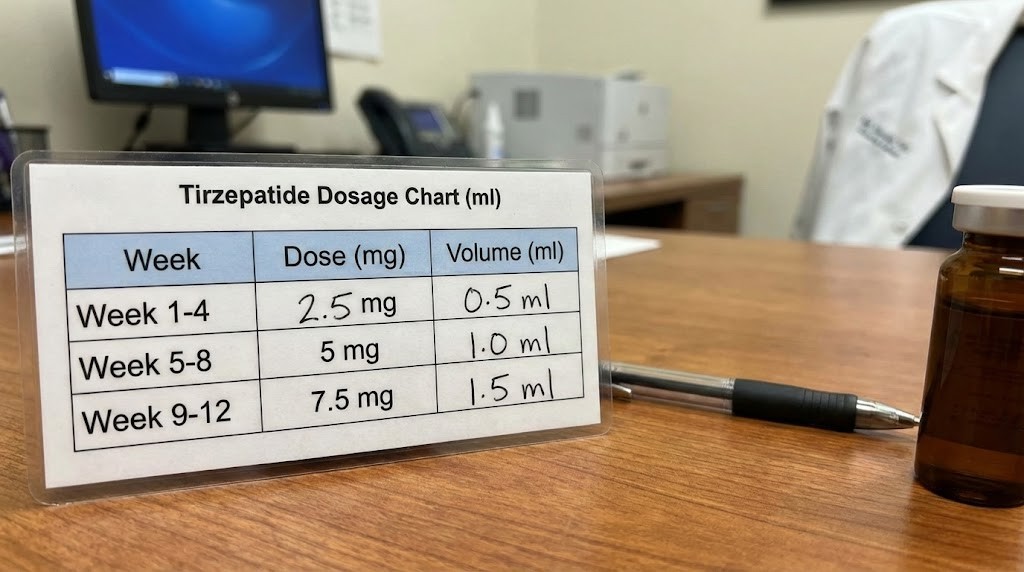
You are wasting tirzepatide. Not because your peptide is bad. Not because your protocol is wrong. Because you are drawing the wrong amount of liquid from your vial, and every incorrect draw costs you money, results, and time you cannot get back. The difference between drawing 0.25 ml and 0.30 ml might look trivial on a syringe. It is not trivial. At a 10 mg/ml concentration, that 0.05 ml difference means you just took 0.5 mg more than your target dose. Over four weeks, those small errors compound into a significantly different protocol than what you intended.
This is why a tirzepatide dosage chart measured in milliliters matters more than most people realize. Milligrams tell you what dose you want. But milliliters tell you what to actually draw into your syringe. And the ml you need changes completely depending on your vial concentration. A 2.5 mg dose from a 5 mg/ml vial requires 0.50 ml. That same 2.5 mg dose from a 20 mg/ml vial requires only 0.125 ml. Get those numbers confused, and you have quadrupled your intended dose. That is not a rounding error. That is a serious problem.
This guide gives you every conversion you will ever need. Every concentration. Every dose level. Every syringe type. Complete charts you can reference before every single injection, because guessing has no place in peptide research. SeekPeptides members already know that precision separates good outcomes from wasted effort, and this article will show you exactly how to achieve that precision with tirzepatide dosing in milliliters.
Why milliliters matter more than milligrams for tirzepatide dosing
Every tirzepatide protocol starts with a target dose in milligrams. Your provider says 2.5 mg per week. Or 5 mg. Or 7.5 mg. Clear enough. But milligrams describe the amount of active compound you want in your body. They do not tell you how much liquid to draw from the vial. That translation from milligrams to milliliters is where most dosing errors happen, and it is where this guide will save you from costly mistakes.
The critical variable is concentration. Your vial label states how many milligrams of tirzepatide are dissolved in each milliliter of solution. Common concentrations include 5 mg/ml, 10 mg/ml, and 20 mg/ml. Some compounding pharmacies produce 15 mg/ml or even 30 mg/ml concentrations. Each concentration requires a completely different volume to achieve the same milligram dose.
Here is the fundamental formula that governs every conversion in this guide:
Volume to draw (ml) = Desired dose (mg) / Concentration (mg/ml)
Simple math. But critical math. If you want 5 mg from a 10 mg/ml vial, you draw 0.50 ml. If you want 5 mg from a 20 mg/ml vial, you draw 0.25 ml. Same dose, completely different syringe volumes. Getting this wrong means you are either underdosing (wasting time and money waiting for results that will not come) or overdosing (increasing side effect risk unnecessarily). Neither outcome is acceptable when you understand how straightforward the math actually is.
For a deeper understanding of tirzepatide dosing fundamentals, including the clinical rationale behind each dose tier, that guide covers the pharmacological background. This article focuses specifically on the milliliter conversions you need at the syringe.
The concentration problem with compounded tirzepatide
Brand-name tirzepatide (Mounjaro, Zepbound) comes in pre-filled pens. You click the dose, inject, done. No math required. But compounded tirzepatide arrives as either lyophilized powder requiring reconstitution or as a pre-mixed liquid in a multi-dose vial. Either way, you are responsible for drawing the correct volume.
The problem intensifies because compounding pharmacies do not use a single standard concentration. One pharmacy sends you a 10 mg/ml vial. Another sends 20 mg/ml. A third might compound at 5 mg/ml or 15 mg/ml. If you switch pharmacies, or even switch between batches from the same pharmacy, the concentration can change. Your dose stays the same in milligrams. But the milliliters you draw change completely.
This is not a minor inconvenience. It is the single most common source of dosing errors with compounded GLP-1 peptides. People memorize "I draw to the 25 unit mark" without understanding that 25 units from a 10 mg/ml vial delivers a very different dose than 25 units from a 20 mg/ml vial. Every time your concentration changes, your ml calculation must change too.
Reading your vial label correctly
Before touching a syringe, read your vial label. You need three pieces of information:
Total content: How many milligrams of tirzepatide are in the entire vial (for example, 30 mg, 50 mg, or 60 mg total).
Concentration: How many milligrams per milliliter (for example, 10 mg/ml or 20 mg/ml). This is the number you plug into the conversion formula.
Total volume: How many milliliters of liquid the vial contains (for example, 3 ml total). This tells you how many doses the vial holds.
If your vial label says "60 mg / 3 ml" you can calculate the concentration yourself: 60 mg divided by 3 ml equals 20 mg/ml. Some labels state the concentration directly. Others require this simple division. Either way, confirm the concentration before every new vial, because it determines everything that follows. Proper peptide dosing always starts with confirming what is actually in your vial.
Complete tirzepatide dosage chart in ml: 5 mg/ml concentration
The 5 mg/ml concentration is less common but still produced by some compounding pharmacies. It requires larger injection volumes, which some users actually prefer because drawing a bigger volume is easier to measure accurately on a standard syringe. The tradeoff is a slightly larger injection, which can mean marginally more discomfort at the injection site.
Here is every standard tirzepatide dose converted to milliliters for a 5 mg/ml concentration:
Dose (mg) | Volume to draw (ml) | Insulin syringe units (U-100) | Doses per 30 mg vial |
|---|---|---|---|
1.0 mg | 0.20 ml | 20 units | 30 doses |
1.25 mg | 0.25 ml | 25 units | 24 doses |
2.0 mg | 0.40 ml | 40 units | 15 doses |
2.5 mg | 0.50 ml | 50 units | 12 doses |
3.75 mg | 0.75 ml | 75 units | 8 doses |
5.0 mg | 1.00 ml | 100 units | 6 doses |
7.5 mg | 1.50 ml | N/A (exceeds 1 ml syringe) | 4 doses |
10.0 mg | 2.00 ml | N/A (exceeds 1 ml syringe) | 3 doses |
Notice something important in this chart. At 5 mg/ml concentration, doses above 5 mg require more than 1 ml of liquid. A standard U-100 insulin syringe holds exactly 1 ml (100 units). So if you need 7.5 mg or 10 mg from a 5 mg/ml vial, you cannot use a regular insulin syringe. You would need a 3 ml syringe with ml markings, or you would need to split the dose into two separate draws. This is one practical reason why higher concentrations (10 mg/ml and 20 mg/ml) are more popular for tirzepatide.
For microdosing tirzepatide, a 5 mg/ml concentration actually works well. Small doses like 1.0 mg or 1.25 mg translate to 0.20 ml or 0.25 ml, which are easy to measure precisely. The lower concentration gives you more room on the syringe barrel for accurate measurement. If precision at low doses is your priority, 5 mg/ml has a genuine advantage over higher concentrations.
Complete tirzepatide dosage chart in ml: 10 mg/ml concentration
The 10 mg/ml concentration is arguably the most common concentration from compounding pharmacies. It offers a solid balance between manageable injection volumes and reasonable syringe accuracy. Most standard doses fall within the easy-to-read range of a U-100 insulin syringe.
Dose (mg) | Volume to draw (ml) | Insulin syringe units (U-100) | Doses per 30 mg vial |
|---|---|---|---|
1.0 mg | 0.10 ml | 10 units | 30 doses |
1.25 mg | 0.125 ml | 12.5 units | 24 doses |
2.0 mg | 0.20 ml | 20 units | 15 doses |
2.5 mg | 0.25 ml | 25 units | 12 doses |
3.75 mg | 0.375 ml | 37.5 units | 8 doses |
5.0 mg | 0.50 ml | 50 units | 6 doses |
7.5 mg | 0.75 ml | 75 units | 4 doses |
10.0 mg | 1.00 ml | 100 units | 3 doses |
12.5 mg | 1.25 ml | N/A (exceeds 1 ml syringe) | 2.4 doses |
15.0 mg | 1.50 ml | N/A (exceeds 1 ml syringe) | 2 doses |
At 10 mg/ml, the sweet spot for most users falls between 2.5 mg (0.25 ml) and 10 mg (1.00 ml). These volumes align perfectly with standard insulin syringe markings. You can read them clearly, draw them accurately, and inject them comfortably.
The challenge comes at higher doses. At 12.5 mg you need 1.25 ml, and at 15 mg you need 1.50 ml. Both exceed the capacity of a 1 ml insulin syringe. If your protocol calls for doses above 10 mg and your vial is 10 mg/ml, you either need a larger syringe or a higher concentration vial. Many users at the higher end of the tirzepatide dose chart switch to 20 mg/ml vials specifically to keep injection volumes manageable.
One detail that trips people up: the 1.25 mg and 3.75 mg doses fall on half-unit marks. On a standard 1 ml insulin syringe with unit markings, 12.5 units sits between the 12 and 13 unit lines. This is not impossible to measure, but it requires careful attention. If your syringe does not have half-unit markings, consider rounding to the nearest full unit or using a syringe with finer graduations. The peptide calculator can help you verify these conversions against your specific vial concentration.
Complete tirzepatide dosage chart in ml: 20 mg/ml concentration
The 20 mg/ml concentration is increasingly popular because it keeps injection volumes small even at higher doses. This matters for comfort, because less liquid means less pressure at the injection site. It also matters for accuracy at high doses, because you can fit the entire dose within a 1 ml syringe up to 20 mg.
Dose (mg) | Volume to draw (ml) | Insulin syringe units (U-100) | Doses per 60 mg vial |
|---|---|---|---|
1.0 mg | 0.05 ml | 5 units | 60 doses |
1.25 mg | 0.0625 ml | 6.25 units | 48 doses |
2.0 mg | 0.10 ml | 10 units | 30 doses |
2.5 mg | 0.125 ml | 12.5 units | 24 doses |
5.0 mg | 0.25 ml | 25 units | 12 doses |
7.5 mg | 0.375 ml | 37.5 units | 8 doses |
10.0 mg | 0.50 ml | 50 units | 6 doses |
12.5 mg | 0.625 ml | 62.5 units | 4.8 doses |
15.0 mg | 0.75 ml | 75 units | 4 doses |
This is the concentration where everything fits neatly into a standard insulin syringe. Even the maximum 15 mg dose only requires 0.75 ml, or 75 units. No need for oversized syringes. No need to split doses across two draws. Clean, simple, contained.
But here is the tradeoff you need to understand. At 20 mg/ml, small measurement errors have bigger consequences. Drawing 5 extra units (0.05 ml) on a syringe means you just took an extra 1.0 mg of tirzepatide. At 10 mg/ml, that same 5-unit error only adds 0.5 mg. At 5 mg/ml, it adds just 0.25 mg. Higher concentrations amplify measurement mistakes.
This is why syringe selection matters enormously with 20 mg/ml tirzepatide. A 0.3 ml (30-unit) syringe has finer graduation marks than a 1 ml (100-unit) syringe. For low doses like 2.5 mg (12.5 units) from a 20 mg/ml vial, a 0.3 ml syringe gives you much better precision than a full 1 ml syringe where those same 12.5 units occupy a tiny sliver of the barrel. Choosing the right syringe is part of choosing the right dose, and your tirzepatide dosage in units depends entirely on this precision.
Why 20 mg/ml is popular for maintenance doses
Once you reach your maintenance dose (typically 5 mg, 7.5 mg, 10 mg, or 15 mg weekly), you want the process to be as straightforward as possible. At 20 mg/ml concentration, a 10 mg maintenance dose is just 0.50 ml, which is exactly half a standard insulin syringe. Easy to draw. Easy to confirm visually. Easy to repeat week after week without second-guessing your measurement.
Contrast that with 10 mg from a 5 mg/ml vial: 2.0 ml. That is two full insulin syringes, or one large 3 ml syringe. More liquid, more injection discomfort, more room for measurement error, and you go through vials twice as fast. For long-term maintenance, 20 mg/ml is the practical choice most researchers settle on. Understanding tirzepatide dosing for weight loss in units alongside milliliters gives you complete confidence at every step.
Side-by-side concentration comparison: same dose, different volumes
This is the chart you should tape to your refrigerator. It shows the exact same tirzepatide dose in milligrams, but how the milliliter volume changes across three common concentrations. One glance tells you everything you need to know about why concentration matters.
Dose (mg) | 5 mg/ml (ml) | 10 mg/ml (ml) | 20 mg/ml (ml) |
|---|---|---|---|
1.0 mg | 0.20 ml | 0.10 ml | 0.05 ml |
2.5 mg | 0.50 ml | 0.25 ml | 0.125 ml |
5.0 mg | 1.00 ml | 0.50 ml | 0.25 ml |
7.5 mg | 1.50 ml | 0.75 ml | 0.375 ml |
10.0 mg | 2.00 ml | 1.00 ml | 0.50 ml |
12.5 mg | 2.50 ml | 1.25 ml | 0.625 ml |
15.0 mg | 3.00 ml | 1.50 ml | 0.75 ml |
See the pattern? Every time you double the concentration, you halve the volume. This relationship is linear and predictable. But it also means that switching from a 10 mg/ml vial to a 20 mg/ml vial without adjusting your syringe draw gives you exactly double your intended dose. This is the number one mistake people make when they receive a new batch at a different concentration, and it is entirely preventable with a simple label check.
For researchers who also work with semaglutide at different concentrations, the same principle applies. The math is identical. Only the numbers change. Learn the formula once, apply it to every peptide you will ever use.
How to convert tirzepatide ml to insulin syringe units
Most people using compounded tirzepatide inject with U-100 insulin syringes. These syringes are marked in "units" rather than milliliters, which creates an additional conversion step that confuses a lot of people. But the conversion is straightforward once you understand the relationship.
On a U-100 insulin syringe:
100 units = 1.0 ml
That is it. That is the entire conversion. Every 10 units equals 0.10 ml. Every 1 unit equals 0.01 ml. The "units" on an insulin syringe are just a different way of measuring volume. They have nothing to do with the concentration of your tirzepatide. They are purely a volume measurement.
So the full conversion chain looks like this:
Step 1: Volume (ml) = Dose (mg) / Concentration (mg/ml)
Step 2: Syringe units = Volume (ml) x 100
Example: You want 5 mg from a 10 mg/ml vial.
Step 1: 5 mg / 10 mg/ml = 0.50 ml
Step 2: 0.50 ml x 100 = 50 units
Draw to the 50 unit mark on your insulin syringe. Done. If you have ever used the peptide reconstitution calculator on SeekPeptides, you have seen this math automated. But understanding it yourself means you can verify any calculator output and catch errors before they reach your syringe.
Common unit conversions for quick reference
Milliliters (ml) | Insulin syringe units |
|---|---|
0.05 ml | 5 units |
0.10 ml | 10 units |
0.125 ml | 12.5 units |
0.20 ml | 20 units |
0.25 ml | 25 units |
0.30 ml | 30 units |
0.375 ml | 37.5 units |
0.50 ml | 50 units |
0.625 ml | 62.5 units |
0.75 ml | 75 units |
1.00 ml | 100 units |
Notice that some conversions land on half-unit marks (12.5, 37.5, 62.5 units). Most insulin syringes have markings at every 2 units, meaning you can estimate the midpoint between two lines. For doses requiring half-unit precision, a 0.3 ml or 0.5 ml syringe with finer graduations gives you better accuracy than a full 1 ml syringe. Understanding how many units equal 2.5 mg of tirzepatide depends entirely on your concentration, which is why memorizing unit counts without knowing your concentration is dangerous.
Choosing the right syringe size
This is a detail most dosing guides skip, but it directly affects your accuracy.
1 ml (100 unit) insulin syringe: Best for doses requiring 0.30 ml or more. The graduations are spaced far enough apart to read clearly. Ideal for 10 mg/ml vials at standard doses (2.5 mg to 10 mg).
0.5 ml (50 unit) insulin syringe: Better for doses under 0.50 ml. The finer graduation marks make small volumes easier to read. Good for 20 mg/ml vials at moderate doses (2.5 mg to 10 mg).
0.3 ml (30 unit) insulin syringe: Best for very small volumes under 0.30 ml. Essential for microdosing protocols or high-concentration vials where tiny volume differences matter. If you are working with 20 mg/ml and dosing below 5 mg, this is your syringe.
The rule of thumb: use the smallest syringe that fits your dose volume. Smaller syringes have finer markings, which means better accuracy. Drawing 12.5 units on a 30-unit syringe is far more precise than drawing 12.5 units on a 100-unit syringe where those markings are compressed into a tiny space. For anyone following general peptide dosage chart guidelines, syringe selection is a universal principle that applies to every injectable compound.
Tirzepatide reconstitution and ml: when you start with powder
If your tirzepatide arrives as lyophilized (freeze-dried) powder, you need to reconstitute it before drawing any dose. The amount of bacteriostatic water you add directly determines your concentration, which then determines how many milliliters you draw for each dose. You control the concentration. That is both a freedom and a responsibility.
Reconstitution math: choosing your concentration
The formula is simple:
Concentration (mg/ml) = Total peptide (mg) / Volume of water added (ml)
So if you have a 30 mg vial and add 3 ml of bacteriostatic water, your concentration is 30/3 = 10 mg/ml. Add 6 ml instead, and your concentration is 30/6 = 5 mg/ml. Add 1.5 ml, and you get 30/1.5 = 20 mg/ml.
Here is a reconstitution chart for common vial sizes:
Vial size | Water added | Resulting concentration |
|---|---|---|
10 mg | 1.0 ml | 10 mg/ml |
10 mg | 2.0 ml | 5 mg/ml |
10 mg | 0.5 ml | 20 mg/ml |
30 mg | 3.0 ml | 10 mg/ml |
30 mg | 1.5 ml | 20 mg/ml |
30 mg | 6.0 ml | 5 mg/ml |
50 mg | 5.0 ml | 10 mg/ml |
50 mg | 2.5 ml | 20 mg/ml |
60 mg | 3.0 ml | 20 mg/ml |
60 mg | 6.0 ml | 10 mg/ml |
Which concentration should you choose? It depends on your dose level and your syringe. If you are in the early titration phase at 2.5 mg per week, a 5 mg/ml or 10 mg/ml concentration gives you a comfortable draw volume. If you are on a maintenance dose of 10 mg or 15 mg per week, 20 mg/ml keeps the volume small and the syringe comfortable. There is no universally "best" concentration. There is only the concentration that matches your dose and your syringe.
For step-by-step reconstitution instructions including proper technique for adding water without damaging the peptide, the complete guide to reconstituting tirzepatide covers every detail. And if you work with other peptides, the principles in mixing peptides with bacteriostatic water apply universally.
Reconstitution tips that affect your ml accuracy
How you reconstitute affects the accuracy of every dose you draw afterward. These details matter.
Measure your water precisely. If you intend to add 3.0 ml of bacteriostatic water but actually add 3.2 ml, your concentration is not 10 mg/ml. It is 9.375 mg/ml. Every dose you draw from that vial will be slightly less than intended. Use a syringe (not an eyedropper) to measure your bacteriostatic water. A 3 ml syringe with 0.1 ml graduations gives you the precision you need.
Account for dead space in the syringe. When you draw bacteriostatic water and inject it into the vial, a small amount of water stays in the needle hub. This "dead space" is typically 0.02 to 0.08 ml depending on the needle. For a 3 ml reconstitution, this is negligible. For a 0.5 ml reconstitution, it can shift your concentration by 4 to 16 percent. At very low reconstitution volumes, either use a low dead space syringe or account for this in your calculations.
Do not shake the vial. Tirzepatide is a delicate molecule. Aggressive shaking can cause foaming and protein degradation, which reduces the actual active content below what the label states. Gently swirl or roll the vial until the powder dissolves completely. Patience here protects your investment. Proper peptide storage after reconstitution is equally important for maintaining potency over the life of the vial.
The standard tirzepatide titration schedule in ml
Tirzepatide follows a gradual dose escalation schedule. You start low and increase every four weeks to minimize side effects, particularly nausea, which is the most commonly reported gastrointestinal response. The clinical protocol used in the SURMOUNT trials starts at 2.5 mg per week and increases in 2.5 mg increments, with 15 mg as the maximum weekly dose.
Here is the complete titration schedule with ml volumes for each common concentration:
Phase | Weeks | Dose | 5 mg/ml | 10 mg/ml | 20 mg/ml |
|---|---|---|---|---|---|
Starting | 1-4 | 2.5 mg | 0.50 ml | 0.25 ml | 0.125 ml |
Titration 1 | 5-8 | 5.0 mg | 1.00 ml | 0.50 ml | 0.25 ml |
Titration 2 | 9-12 | 7.5 mg | 1.50 ml | 0.75 ml | 0.375 ml |
Titration 3 | 13-16 | 10.0 mg | 2.00 ml | 1.00 ml | 0.50 ml |
Titration 4 | 17-20 | 12.5 mg | 2.50 ml | 1.25 ml | 0.625 ml |
Maximum | 21+ | 15.0 mg | 3.00 ml | 1.50 ml | 0.75 ml |
The SURMOUNT-1 clinical trial demonstrated significant outcomes with this titration approach. Participants receiving 15 mg weekly achieved an average body weight reduction of 22.5% over 72 weeks. The 10 mg group saw 21.4% reduction, and the 5 mg group saw 16.0% reduction. These results established tirzepatide as one of the most effective peptides for weight loss studied to date.
Not everyone needs to reach 15 mg. Many people find their optimal response at 5 mg, 7.5 mg, or 10 mg. The purpose of titration is to find the lowest effective dose that produces results without intolerable side effects. If 7.5 mg is working and you feel good, there is no clinical mandate to keep escalating. Work with your healthcare provider to determine the dose that balances efficacy with tolerability for your specific situation.
Why the four-week minimum between increases matters
Four weeks is not an arbitrary number. Tirzepatide takes approximately three to four weeks to reach steady-state blood levels at any given dose. Increasing before steady state means you do not actually know whether the current dose is sufficient. You might be escalating past a dose that would have worked perfectly if you had given it enough time.
Additionally, gastrointestinal side effects are most pronounced during the first two weeks at a new dose and typically improve by weeks three and four. Rushing through titration means stacking the side effect peaks from multiple dose increases, which increases the likelihood of nausea, anxiety, and other unwanted responses that might have resolved with patience.
If you are experiencing significant nausea at a current dose, the answer is usually to stay at that dose for an additional four weeks rather than either decreasing or increasing. Your body adapts. Tolerance develops. And that adaptation period directly influences your long-term outcomes. Understanding how fast tirzepatide works helps set realistic expectations for each phase of the titration.
Microdosing tirzepatide: ml conversions for sub-clinical doses
Microdosing tirzepatide has gained traction as a strategy for people who want gradual appetite modulation without the more intense side effects associated with standard clinical doses. Typical microdoses range from 0.5 mg to 2.0 mg per week, well below the standard starting dose of 2.5 mg.
Microdose (mg) | 5 mg/ml (ml) | 10 mg/ml (ml) | 20 mg/ml (ml) |
|---|---|---|---|
0.25 mg | 0.05 ml | 0.025 ml | 0.0125 ml |
0.5 mg | 0.10 ml | 0.05 ml | 0.025 ml |
0.75 mg | 0.15 ml | 0.075 ml | 0.0375 ml |
1.0 mg | 0.20 ml | 0.10 ml | 0.05 ml |
1.25 mg | 0.25 ml | 0.125 ml | 0.0625 ml |
1.5 mg | 0.30 ml | 0.15 ml | 0.075 ml |
2.0 mg | 0.40 ml | 0.20 ml | 0.10 ml |
Look at those 20 mg/ml column numbers. A 0.5 mg microdose from a 20 mg/ml vial requires just 0.025 ml, which is 2.5 units on an insulin syringe. That is an incredibly tiny volume. Even with a 0.3 ml syringe, measuring 2.5 units accurately is difficult. For microdosing, lower concentrations are almost always better. A 5 mg/ml vial gives you 0.10 ml for a 0.5 mg dose, ten units on a syringe, which is far easier to measure with confidence.
This is the practical guidance most microdosing tirzepatide charts leave out. They give you the conversion math but do not tell you that certain concentration-dose combinations are nearly impossible to measure accurately with standard equipment. If you are microdosing, reconstitute to a lower concentration. Your precision will improve dramatically, and precision is the entire point of microdosing.
Switching concentrations: the ml adjustment you cannot skip
This scenario happens constantly. You have been using a 10 mg/ml vial. You reorder. The new vial arrives at 20 mg/ml. You reach for your syringe and draw to the same mark you always do.
Stop.
If you were drawing 50 units (0.50 ml) for a 5 mg dose from a 10 mg/ml vial, and you draw 50 units from a 20 mg/ml vial, you just injected 10 mg. Double your intended dose. This is not a hypothetical scenario. This happens to real people, and the consequences range from intensified nausea and gastrointestinal distress to potentially dangerous side effects from an unexpected dose doubling.
The safe procedure when receiving any new vial:
1. Read the label. Find the concentration in mg/ml.
2. Recalculate your volume. Use the formula: dose (mg) / concentration (mg/ml) = volume (ml).
3. Convert to syringe units. Volume (ml) x 100 = units.
4. Confirm against the charts in this guide. Cross-reference your calculation with the appropriate concentration table above.
5. Draw carefully and double-check before injecting.
Write the concentration on the vial cap or base with a marker if you store multiple vials. Create a simple note on your phone or posted next to your supplies: "Current vial: 20 mg/ml. My dose: 5 mg = 0.25 ml = 25 units." Update this note every time you start a new vial. It takes ten seconds and prevents the most dangerous dosing error in compounded peptide use. If you are comparing tirzepatide with other GLP-1 options, the tirzepatide vs semaglutide dosage chart helps you understand how concentration math applies across different peptides.
How many doses are in your vial? Calculating vial life in ml
Knowing how many doses your vial contains prevents two problems: running out unexpectedly mid-week and letting reconstituted tirzepatide sit too long past its stability window. Once reconstituted with bacteriostatic water, tirzepatide typically maintains stability for approximately 28 days when refrigerated. Beyond that, potency degrades and sterility becomes a concern.
The vial life formula:
Number of doses = Total vial volume (ml) / Volume per dose (ml)
Or equivalently:
Number of doses = Total peptide (mg) / Dose per injection (mg)
Here is a practical reference showing how long common vial sizes last at different weekly doses:
Vial total | Weekly dose | Doses in vial | Weeks of supply | Within 28-day window? |
|---|---|---|---|---|
10 mg | 2.5 mg | 4 | 4 weeks | Yes |
10 mg | 5.0 mg | 2 | 2 weeks | Yes |
30 mg | 2.5 mg | 12 | 12 weeks | No (exceeds 28 days) |
30 mg | 5.0 mg | 6 | 6 weeks | No (exceeds 28 days) |
30 mg | 10.0 mg | 3 | 3 weeks | Yes |
30 mg | 15.0 mg | 2 | 2 weeks | Yes |
60 mg | 10.0 mg | 6 | 6 weeks | No (exceeds 28 days) |
60 mg | 15.0 mg | 4 | 4 weeks | Yes |
See the problem? Larger vials at lower doses can exceed the 28-day stability window. A 30 mg vial at 2.5 mg per week gives you 12 weeks of supply, but the peptide is only reliably stable for 4 weeks after reconstitution. After that, you are injecting degraded product. You still feel the syringe go in. You still see liquid leave the vial. But the tirzepatide molecules are breaking down, and your results will taper off without you understanding why.
Solutions include using smaller vials matched to your dose level, splitting a large vial into smaller sterile vials after reconstitution, or starting with a higher dose that uses the vial within 28 days. Proper tirzepatide refrigerator storage maximizes your window but cannot extend it indefinitely. And understanding how long tirzepatide can be out of the fridge prevents accidental degradation from temperature excursions.
Tirzepatide dosage chart in ml for specific compounding pharmacy formats
Different pharmacies send tirzepatide in different configurations. Here are the most common formats with their ml conversions pre-calculated.
10 mg vial (common for starting doses)
This is often the first vial new users receive. It contains enough for four weeks at the 2.5 mg starting dose, aligning perfectly with the first titration phase.
Reconstitution | Concentration | 2.5 mg dose | 5 mg dose | Total doses at 2.5 mg |
|---|---|---|---|---|
1.0 ml water | 10 mg/ml | 0.25 ml | 0.50 ml | 4 doses |
2.0 ml water | 5 mg/ml | 0.50 ml | 1.00 ml | 4 doses |
0.5 ml water | 20 mg/ml | 0.125 ml | 0.25 ml | 4 doses |
30 mg vial (most common multi-dose format)
The 30 mg vial is the workhorse of compounded tirzepatide. It holds enough for multiple weeks at moderate doses and is the most cost-effective format per milligram for most users.
Reconstitution | Concentration | 2.5 mg | 5 mg | 7.5 mg | 10 mg |
|---|---|---|---|---|---|
3.0 ml water | 10 mg/ml | 0.25 ml | 0.50 ml | 0.75 ml | 1.00 ml |
1.5 ml water | 20 mg/ml | 0.125 ml | 0.25 ml | 0.375 ml | 0.50 ml |
6.0 ml water | 5 mg/ml | 0.50 ml | 1.00 ml | 1.50 ml | 2.00 ml |
60 mg vial (high-dose or bulk format)
The 60 mg vial is designed for users on higher maintenance doses who want fewer reorder cycles. At 15 mg per week, a single vial lasts exactly four weeks.
Reconstitution | Concentration | 10 mg | 12.5 mg | 15 mg | Weeks at 15 mg |
|---|---|---|---|---|---|
3.0 ml water | 20 mg/ml | 0.50 ml | 0.625 ml | 0.75 ml | 4 weeks |
6.0 ml water | 10 mg/ml | 1.00 ml | 1.25 ml | 1.50 ml | 4 weeks |
Notice how the 60 mg vial at 20 mg/ml and 15 mg weekly gives you exactly four doses (four weeks), each at 0.75 ml. Clean math, no waste, and well within the 28-day stability window. This is the optimal configuration for high-dose maintenance. For more vial-specific guidance, the compounded tirzepatide dosage chart explores pharmacy-specific considerations in more detail.
Troubleshooting common ml measurement problems
Even with perfect charts and correct calculations, practical measurement challenges arise. Here are the problems people actually encounter and how to solve them.
Air bubbles affecting your volume
Air bubbles in the syringe displace liquid, making your drawn volume appear correct when it is actually less than intended. A bubble sitting in the middle of your liquid column means you are injecting air plus less-than-intended tirzepatide.
Fix: After drawing your dose, hold the syringe needle-up and tap the barrel to float bubbles to the top. Push the plunger gently until the bubbles are expelled and a tiny drop of liquid appears at the needle tip. Then recheck your volume against the syringe markings. You may need to draw slightly more to reach your target after expelling the air. This is standard technique for any peptide injection and applies to every injectable compound.
Drawing from a nearly empty vial
As your vial empties, the remaining liquid pools at the bottom and around the rubber stopper. Tilting the vial and positioning the needle tip in the deepest point helps access this remaining volume. Some liquid will always be irretrievable, trapped in the space between the stopper and the glass. This is called "overfill" or "dead volume" and most manufacturers account for it by adding slightly more liquid than the labeled amount.
However, do not assume you can always get extra doses from the overfill. The amount varies between vials and manufacturers. Treat the labeled content as your maximum usable amount and consider any extra as a bonus rather than part of your planned protocol.
Difficulty reading syringe markings at small volumes
If you are trying to draw 5 units (0.05 ml) from a 1 ml syringe, the markings are compressed so tightly that accurate measurement becomes genuinely difficult. Two solutions work.
First, switch to a smaller syringe. A 0.3 ml syringe spreads those 5 units across more physical space on the barrel, making the markings easier to read.
Second, reconstitute to a lower concentration so your dose volume is larger. If 5 units from a 20 mg/ml vial is too small to read, reconstitute your next vial to 10 mg/ml instead. Your 1 mg dose becomes 10 units instead of 5. The trade is a larger injection volume but much easier measurement. This is why understanding the relationship between peptide dosage calculations and practical measurement tools matters as much as the raw conversion math.
Inconsistent results between doses
If your results seem inconsistent from week to week despite following the same protocol, measurement variation is often the culprit. Small errors compound over time. A 5 to 10 percent variation in draw volume means your actual dose fluctuates by the same percentage. At 10 mg, that is plus or minus 0.5 to 1.0 mg per injection.
Standardize your measurement process. Use the same syringe type every time. Draw in the same light conditions. Double-check before injecting. And consider whether your concentration is matched to a draw volume that your syringe can measure accurately. Consistency in technique produces consistency in results. If fluctuating outcomes are an issue, check whether the root cause is not losing weight on tirzepatide due to measurement inconsistency rather than the compound itself.
Tirzepatide ml dosing compared with brand-name pen doses
Understanding how compounded tirzepatide ml doses correspond to brand-name pen doses (Mounjaro and Zepbound) helps you contextualize your protocol against the clinical trial data.
Brand-name tirzepatide pens deliver fixed doses in fixed volumes. The pen does all the measurement internally. You select your dose, press the button, and the pen injects exactly 0.5 ml regardless of the dose. The concentration inside the pen cartridge varies by dose level:
Brand pen dose | Volume per injection | Internal concentration |
|---|---|---|
2.5 mg | 0.5 ml | 5 mg/ml |
5.0 mg | 0.5 ml | 10 mg/ml |
7.5 mg | 0.5 ml | 15 mg/ml |
10.0 mg | 0.5 ml | 20 mg/ml |
12.5 mg | 0.5 ml | 25 mg/ml |
15.0 mg | 0.5 ml | 30 mg/ml |
This is clever engineering. Every injection is the same volume (0.5 ml), which means the injection experience feels identical regardless of dose level. The concentration changes, not the volume. Compounded tirzepatide, by contrast, usually has a fixed concentration and a variable volume. Different approach, same end result: a specific number of milligrams entering your body each week.
The clinical outcomes from SURMOUNT trials apply to the milligram doses, not the milliliter volumes. Whether you get 10 mg from a brand pen (0.5 ml at 20 mg/ml internal concentration) or from a compounded vial (1.0 ml at 10 mg/ml, or 0.5 ml at 20 mg/ml), the pharmacological effect should be equivalent. The active molecule is the same. Only the delivery mechanism differs. For a broader comparison of semaglutide versus tirzepatide, including dosing equivalency, that guide covers the clinical data side by side.
Tirzepatide ml dosage adjustments for special situations
Splitting weekly doses into twice-weekly injections
Some people split their weekly tirzepatide dose into two smaller injections, typically to reduce gastrointestinal side effects. The ml math is straightforward: take your weekly ml volume and divide by two.
Weekly dose | Each injection (mg) | 10 mg/ml per injection (ml) | 20 mg/ml per injection (ml) |
|---|---|---|---|
5.0 mg | 2.5 mg x 2 | 0.25 ml | 0.125 ml |
7.5 mg | 3.75 mg x 2 | 0.375 ml | 0.1875 ml |
10.0 mg | 5.0 mg x 2 | 0.50 ml | 0.25 ml |
15.0 mg | 7.5 mg x 2 | 0.75 ml | 0.375 ml |
Notice that 7.5 mg split into two injections creates a 3.75 mg per injection dose. At 20 mg/ml, that is 0.1875 ml, or about 18.75 units. This is a challenging volume to measure precisely. If you plan to split doses, factor measurement precision into your concentration choice. A 10 mg/ml vial gives you 0.375 ml (37.5 units) per injection for a split 7.5 mg dose, which is much easier to read on a syringe.
Adjusting ml when tapering down
Some protocols involve tapering down from a higher dose rather than staying at the same level indefinitely. If you are reducing from 10 mg to 7.5 mg to 5 mg over successive months, your ml draw decreases at each step. Here is what that looks like:
Taper phase | Dose | 10 mg/ml (ml) | 20 mg/ml (ml) |
|---|---|---|---|
Current | 10 mg | 1.00 ml | 0.50 ml |
Step down 1 | 7.5 mg | 0.75 ml | 0.375 ml |
Step down 2 | 5.0 mg | 0.50 ml | 0.25 ml |
Step down 3 | 2.5 mg | 0.25 ml | 0.125 ml |
Each step reduces your volume by 0.25 ml (at 10 mg/ml) or 0.125 ml (at 20 mg/ml). Predictable, easy to track, easy to implement. The key is making each reduction intentionally, not accidentally drawing less because your vial is running low or your syringe hand was less precise that morning. For guidance on managing transitions between tirzepatide and semaglutide during tapering, that comparison covers equivalent doses across both peptides.
Storing tirzepatide and how storage affects your ml accuracy
Storage does not change the milliliters you draw, but it can change what those milliliters contain. Degraded tirzepatide means your 5 mg draw might only deliver 3 mg or 4 mg of active compound. The volume looks right. The syringe reads correctly. But the molecules inside have broken down, and your results suffer.
Proper storage rules for reconstituted tirzepatide:
Temperature: Refrigerate between 36 to 46 degrees Fahrenheit (2 to 8 degrees Celsius). Do not freeze. Do not leave at room temperature for extended periods. Brief temperature excursions (under two hours) during transport are generally acceptable, but consistent room temperature storage degrades the peptide faster than the 28-day window suggests.
Light: Keep the vial in its box or wrapped in foil. Tirzepatide, like most peptides, is sensitive to light exposure. Extended light can accelerate degradation.
Duration: Use reconstituted tirzepatide within 28 days. Mark the reconstitution date on the vial with a permanent marker. If day 28 passes and you still have liquid remaining, discard it. The cost of a partial vial is far less than the cost of injecting degraded product that does nothing.
For powder (unreconstituted) tirzepatide, storage requirements are less strict but still important. Room temperature storage is acceptable for peptide powder, though refrigeration extends stability. Once you add bacteriostatic water, the 28-day clock starts immediately. Managing storage properly is part of the overall peptide storage protocol that protects your investment in both money and results.
Safety considerations for tirzepatide ml dosing
Accurate ml measurement is ultimately a safety issue. Underdosing wastes money and time. Overdosing risks increased side effects that can range from uncomfortable to medically concerning.
What happens if you draw too much
A single accidental overdose of tirzepatide is unlikely to cause serious harm in most healthy individuals, but it will amplify side effects. Expect more intense nausea, potential vomiting, diarrhea, and reduced appetite beyond what is comfortable. These effects typically resolve within 48 to 72 hours as the excess drug is metabolized.
However, repeated overdosing due to consistent measurement errors is more concerning. Chronically taking 7.5 mg when you think you are taking 5 mg means you are on a different pharmacological trajectory than intended. Your side effect profile, weight loss rate, and metabolic adaptations all shift. You are no longer following the protocol you think you are following, and any adjustments your provider makes are based on incorrect assumptions about your actual dose.
What happens if you draw too little
Consistent underdosing produces underwhelming results. You might conclude that tirzepatide "does not work for me" when the reality is that you never reached a therapeutic dose. This leads to unnecessary dose escalations, switching to different medications, or abandoning treatment altogether, all because the syringe draw was off by 10 to 20 percent.
This is why the conversion charts in this guide exist. Use them. Verify your math every time you start a new vial. And if your results seem inconsistent with what clinical trials show for your dose level, measurement accuracy should be the first thing you investigate, not the last. The peptide safety and risks guide covers broader safety considerations beyond dosing accuracy.
When to consult a healthcare provider about dosing
Always consult a healthcare provider before starting or adjusting any tirzepatide protocol. The charts in this guide are reference tools for accuracy, not prescriptive medical advice. Specific situations where provider consultation is essential include:
Switching between vial concentrations. Your provider can verify your recalculated dose.
Experiencing unexpected side effects. Could indicate an inadvertent dose change.
Not seeing expected results after 8 or more weeks. May indicate measurement issues or other factors affecting response.
Combining tirzepatide with other medications or peptides. Drug interactions can affect how tirzepatide works and may require dose adjustments. If you are considering combining with other peptides, understand how many peptides you can take at once safely.
Using tirzepatide alongside cagrilintide or other peptide stacks. These combinations require careful dose coordination.
Quick reference: the five numbers you need to know
After reading this entire guide, the daily practice comes down to knowing five numbers before every injection:
1. Your prescribed dose in milligrams. (Example: 5 mg)
2. Your vial concentration in mg/ml. (Example: 10 mg/ml)
3. Your draw volume in milliliters. (Example: 0.50 ml)
4. Your draw volume in syringe units. (Example: 50 units)
5. Your syringe size. (Example: 1 ml / 100 unit insulin syringe)
If you can state all five numbers without hesitation, you are dosing correctly. If any of those numbers are uncertain, stop and recalculate before touching a syringe. The SeekPeptides peptide calculator can verify your math in seconds, but building the habit of knowing these five numbers yourself means you never depend on a tool that might not be available when you need it.
SeekPeptides members get access to comprehensive dosing protocols, interactive calculators, and expert-reviewed guides that take the guesswork out of every aspect of peptide research. Whether you are calculating ml conversions for tirzepatide or building a complete peptide dosing protocol, the platform provides the tools and community support that turn accurate measurement into reliable results.
Frequently asked questions
How many ml is 2.5 mg of tirzepatide?
It depends on your vial concentration. At 5 mg/ml, 2.5 mg equals 0.50 ml. At 10 mg/ml, 2.5 mg equals 0.25 ml. At 20 mg/ml, 2.5 mg equals 0.125 ml. Always divide your dose (mg) by your concentration (mg/ml) to get the correct volume. The peptide calculator can verify this for any concentration.
How many ml is 5 mg of tirzepatide?
At 5 mg/ml concentration: 1.00 ml. At 10 mg/ml: 0.50 ml. At 20 mg/ml: 0.25 ml. Use the formula dose (mg) / concentration (mg/ml) = volume (ml) for any combination. Always check your tirzepatide dose chart against your specific vial label.
How do I convert tirzepatide ml to insulin syringe units?
Multiply your ml volume by 100. So 0.25 ml = 25 units, 0.50 ml = 50 units, 0.75 ml = 75 units, and 1.00 ml = 100 units. This conversion applies to all U-100 insulin syringes regardless of their total capacity (0.3 ml, 0.5 ml, or 1.0 ml syringes).
What concentration of tirzepatide is best?
No single concentration is universally best. For microdosing and low doses (under 2.5 mg), 5 mg/ml gives easier measurement. For standard doses (2.5 to 10 mg), 10 mg/ml offers good balance. For high maintenance doses (10 to 15 mg), 20 mg/ml keeps volumes small and comfortable. Match your concentration to your dose level and syringe type.
Can I change the concentration of my tirzepatide by adding more water?
Only if you start with lyophilized powder. Once reconstituted, adding more water to change the concentration is technically possible but not recommended. It introduces contamination risk and makes the total volume calculation less precise. Choose your concentration at reconstitution and commit to it for that vial.
How long does reconstituted tirzepatide last?
Approximately 28 days when stored in the refrigerator at 36 to 46 degrees Fahrenheit. After 28 days, potency decreases and bacterial contamination risk increases. Mark the reconstitution date on every vial and discard unused portions after the 28-day window. See the tirzepatide refrigerator storage guide for detailed stability data.
What if my syringe does not have fine enough markings for my dose?
Switch to a smaller syringe. A 0.3 ml (30 unit) syringe has finer graduations than a 1 ml (100 unit) syringe. Alternatively, reconstitute to a lower concentration so your dose volume is larger and easier to measure. Both approaches improve precision without changing your actual dose in milligrams.
Is compounded tirzepatide the same as Mounjaro or Zepbound?
Compounded tirzepatide contains the same active molecule but is not FDA-approved. It is produced by compounding pharmacies rather than Eli Lilly. The active ingredient is identical, but compounded versions lack the large-scale clinical trial data, standardized manufacturing processes, and regulatory oversight that brand-name products undergo. Discuss the differences with your healthcare provider to determine which option is appropriate for your situation. The compounded tirzepatide guide covers cost and access considerations.
External resources
SURMOUNT-1 clinical trial results (New England Journal of Medicine)
NIH National Institute of Diabetes and Digestive and Kidney Diseases
In case I do not see you, good afternoon, good evening, and good night. May your concentrations stay accurate, your syringes stay precise, and your results stay consistent.