Dec 14, 2025
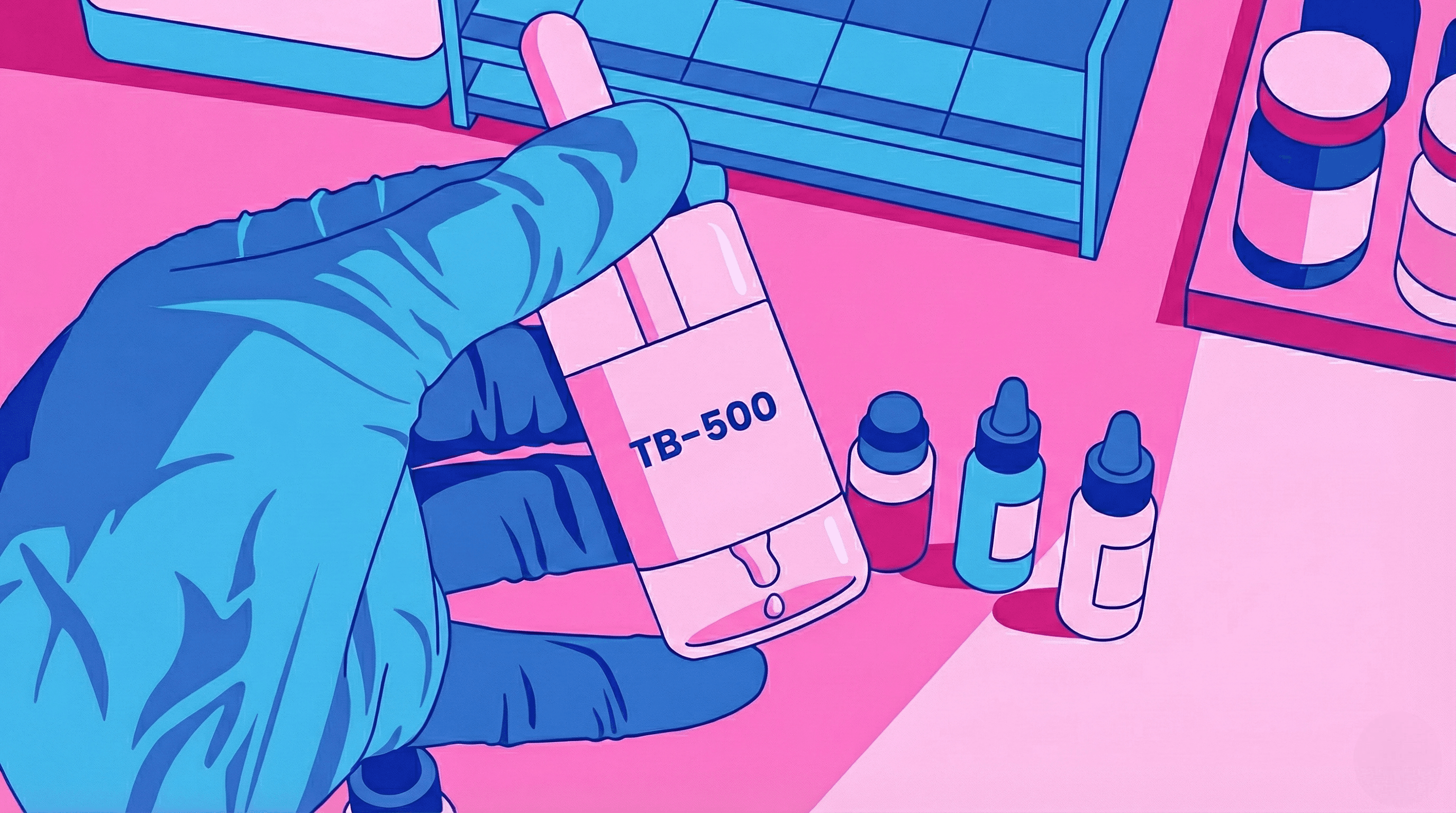
TB-500 is the other peptide everyone talks about alongside BPC-157. If you're researching healing peptides, you've probably seen them mentioned together. But TB-500 works differently.
And it has its own research, its own protocols, and its own use cases.
This guide covers everything. What TB-500 actually is. How it works in the body. What the research shows. Dosing protocols. Side effects. And how it compares to BPC-157.
No forum drama. No bro-science. Just what you need to know.
What is TB-500?
TB-500 is a synthetic version of a naturally occurring peptide called thymosin beta-4. Your body already produces thymosin beta-4. It's found in nearly all human cells.
The natural version plays a key role in tissue repair, cell migration, and blood vessel formation. When you get injured, thymosin beta-4 levels increase at the injury site. It's part of your body's built-in healing system.
TB-500 is a fragment of the full thymosin beta-4 protein. Researchers isolated the active region responsible for most of the healing effects. That fragment is what people use.
The peptide has been studied since the 1970s. It was originally investigated for wound healing and cardiac repair. More recently, it gained popularity in the biohacking and athletic communities for injury recovery.
Like BPC-157, TB-500 is not FDA approved for human use. It exists in the same regulatory gray area.
How does TB-500 work?
TB-500 works through several mechanisms that promote healing and reduce inflammation.
Cell migration. TB-500 promotes the migration of cells to injury sites. This includes endothelial cells, keratinocytes, and other cells involved in tissue repair. Faster cell migration means faster healing.
Actin regulation. The peptide interacts with actin, a protein that forms the structural framework of cells. By regulating actin, TB-500 helps cells move, divide, and organize during repair processes.
Angiogenesis. TB-500 promotes the formation of new blood vessels. More blood vessels mean better oxygen and nutrient delivery to damaged tissue. This is especially important for injuries with poor blood supply.
Anti-inflammatory effects. Studies show TB-500 reduces inflammation.
It appears to modulate inflammatory pathways and decrease swelling at injury sites.
Reduced scar formation. Some research suggests TB-500 can improve wound healing quality.
Wounds may heal with less scarring compared to untreated injuries.
The combination of these effects makes TB-500 particularly useful for soft tissue injuries, muscle damage, and conditions where inflammation is a problem.
What does the research say?
TB-500 has substantial research behind it. Most studies focus on wound healing, cardiac repair, and tissue regeneration.
Wound healing
Multiple studies show TB-500 accelerates wound healing. A study published in the Annals of the New York Academy of Sciences found thymosin beta-4 significantly improved wound closure rates.
The peptide appears to work on multiple wound types. Burns, cuts, and surgical wounds all showed improvement in animal studies. Healing was faster and tissue quality was better.
Muscle repair
TB-500 shows promise for muscle injuries. Animal studies demonstrate faster recovery from muscle damage when treated with the peptide.
One mechanism involves satellite cells. These are muscle stem cells that activate after injury. TB-500 appears to support satellite cell function and muscle fiber regeneration.
Athletes and bodybuilders often use TB-500 for this reason. Strains, tears, and exercise-induced damage may recover faster.
Heart tissue repair
Some of the most interesting TB-500 research involves cardiac repair. Studies in mice showed the peptide could help repair heart tissue after heart attacks.
Research published in PNAS found thymosin beta-4 promoted cardiac cell migration and survival. Damaged hearts showed improved function after treatment.
This research is still early. But it suggests TB-500 may have applications beyond simple injury recovery.
Hair growth
An unexpected finding: TB-500 may promote hair growth. Some studies show it stimulates hair follicle stem cells.
This has led some people to use it for hair loss. The evidence is limited, but anecdotal reports exist of improved hair growth during TB-500 use.
Corneal healing
TB-500 has been studied for eye injuries. It appears to promote corneal healing after damage. Some veterinary products use thymosin beta-4 for this purpose.
TB-500 dosing protocols
Like other research peptides, TB-500 has no official dosing guidelines. Protocols come from research, clinical observations, and community experience.
Standard dosing
Most protocols use these ranges:
Loading phase: 4-8 mg per week for 4-6 weeks
Maintenance phase: 2-4 mg per week ongoing
The loading phase uses higher doses to build up levels in the body. Once healing is underway, people often reduce to a maintenance dose.
Injection frequency
TB-500 has a longer half-life than BPC-157. Most people inject 2-3 times per week rather than daily.
Common schedules:
2.5 mg twice per week (5 mg total)
2 mg three times per week (6 mg total)
Some people do once-weekly injections of the full dose. Both approaches appear in practice.
Injection method
TB-500 is typically injected subcutaneously. Unlike BPC-157, most people don't inject near the injury site. The peptide is systemic and travels throughout the body.
Common injection sites:
Abdominal fat
Thigh
Upper arm
Rotate sites to avoid irritation.
Reconstitution
TB-500 comes as a lyophilized powder. Reconstitute with bacteriostatic water.
A typical approach:
5 mg vial of TB-500
Add 1 ml of bacteriostatic water
This gives 5 mg per ml
A 2.5 mg dose would be 0.5 ml
Store in the refrigerator after mixing. Use within 3-4 weeks.
TB-500 for specific conditions
For muscle injuries
This is one of the primary uses. TB-500 may help with:
Muscle strains
Partial tears
Post-exercise damage
Chronic muscle tightness
Typical protocol: 4-6 mg per week during loading, then 2-4 mg per week for maintenance. Run until healed.
For tendon and ligament injuries
TB-500 works for connective tissue, though BPC-157 may have more research support here. Some people use both together for serious tendon issues.
Common approach: Stack with BPC-157. Use TB-500 at 4-6 mg weekly alongside BPC-157 at 250-500 mcg daily.
For general recovery
Some athletes use TB-500 during intense training periods to support recovery. The anti-inflammatory and tissue repair effects may help manage accumulated damage.
Protocol varies. Some use it continuously at low doses. Others cycle it during heavy training blocks.
For hair loss
Some people experiment with TB-500 for hair. The research is thin, but the mechanism makes some sense.
If trying this, typical doses are similar to injury protocols. Results, if any, take months to appear.
Side effects and safety
TB-500 appears well-tolerated in research studies. Most people report minimal side effects.
Commonly reported effects
Headache (usually temporary)
Nausea
Fatigue
Injection site irritation
Head rush or lightheadedness
These tend to be mild and often decrease with continued use.
Potential concerns
Cancer risk. Like BPC-157, TB-500 promotes cell growth and blood vessel formation. The theoretical concern is that it could support tumor growth. No research shows TB-500 causes cancer. But people with active cancer or high cancer risk often avoid it.
Quality issues. The same quality control problems affect TB-500 as other research peptides. Reports indicate many peptide products are contaminated or mislabeled. Source quality matters.
Limited human data.
Most research is in animals. Long-term human safety data doesn't exist.
Drug interactions.
TB-500 affects multiple biological systems. It could potentially interact with medications. Consult a doctor if you're on other drugs.
Who should avoid it
People with active cancer
Pregnant or breastfeeding women
Those with serious medical conditions (without doctor supervision)
Anyone uncomfortable with using unapproved compounds
TB-500 vs BPC-157
People constantly compare these two. Here's how they differ.
Origins
TB-500: Derived from thymosin beta-4, found throughout the body BPC-157: Derived from gastric juice protein
Mechanisms
TB-500: Works primarily through actin regulation, cell migration, angiogenesis BPC-157: Works through growth factors, nitric oxide system, multiple pathways
Dosing
TB-500: Higher doses (mg range), 2-3x weekly injections BPC-157: Lower doses (mcg range), daily injections or oral
Strengths
TB-500: May be better for muscle injuries, systemic inflammation, hair growth BPC-157: May be better for tendons, gut issues, localized injuries
Oral use
TB-500: Not stable orally, must inject BPC-157: Stable orally, can take by mouth
Stacking
Many people use both together. The theory is they work through different pathways and complement each other.
Common stack:
TB-500: 2-2.5 mg twice weekly
BPC-157: 250-500 mcg daily
This is one of the most popular peptide combinations for injury recovery.
Legal status
TB-500 has the same legal status as BPC-157 in most places.
In the United States, it's not FDA approved. It can be sold as a "research chemical" but not for human consumption.
The peptide is banned by WADA (World Anti-Doping Agency) and most sports organizations. Athletes subject to drug testing should avoid it.
Regulatory enforcement is evolving. The FDA has increased scrutiny on peptides, though political pressure may shift priorities.
Check your local laws. Regulations vary by country.
Is TB-500 worth trying?
No medical advice here. But some considerations.
It might make sense if:
You have muscle or soft tissue injuries not responding to other treatments
You understand the risks of using an unapproved compound
You can find a quality source
You're not subject to drug testing
You've done your research
It probably doesn't make sense if:
Your injury will heal on its own
You have serious health conditions
You're a tested athlete
You can't verify source quality
You're not comfortable with uncertainty
Many people report positive results. The research is promising. But it's not proven in humans to the standard of approved medications.
TB-500 is a synthetic peptide based on thymosin beta-4.
It promotes healing through cell migration, blood vessel formation, and anti-inflammatory effects.
Research shows benefits for wound healing, muscle repair, and potentially cardiac tissue. Most studies are in animals, with limited human data.
Dosing typically involves a loading phase of 4-6 mg weekly, then maintenance at 2-4 mg weekly.
Most people inject 2-3 times per week.
Side effects are generally mild.
Main concerns are quality control and lack of long-term safety data.
TB-500 is often stacked with BPC-157.
The two peptides work through different mechanisms and may complement each other.
If you're considering it, research thoroughly.
Find a reputable source. Start conservative. Pay attention to your body's response.
That's the reality of peptides right now.
Promising research, regulatory gray area, and people making informed decisions for themselves.
In case I don’t see you, good afternoon, good evening, and good night.