Feb 11, 2026
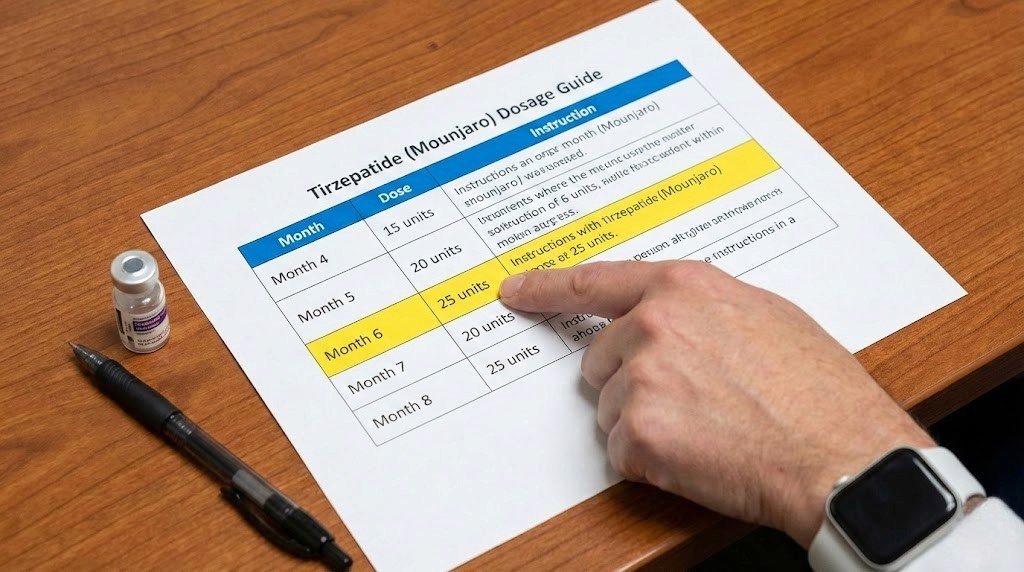
You drew up 25 units on your insulin syringe. Now you are staring at it. Is that the right dose? How many milligrams is this, exactly? And why does every compounding pharmacy seem to give you a different answer?
These are the questions that keep tirzepatide users awake the night before their injection. The math should be simple. It is not.
Here is the problem. Tirzepatide comes in different concentrations depending on whether you are using brand-name Mounjaro, Zepbound, or a compounded formulation from a pharmacy. Twenty-five units on an insulin syringe always means 0.25 mL of liquid. That part never changes. But the milligrams of tirzepatide dissolved in that liquid? That depends entirely on the concentration of your specific vial. At a 10 mg/mL concentration, 25 units delivers exactly 2.5 mg. At 20 mg/mL, those same 25 units deliver 5 mg. Double the dose from the exact same syringe marking. Get this wrong, and you are either underdosing (wasting time and money) or overdosing (inviting side effects that could have been avoided). This guide breaks down every concentration, every conversion, and every scenario so you never second-guess your dose again. Whether you are brand new to tirzepatide or switching pharmacies mid-protocol, SeekPeptides built this reference to be the only tirzepatide dosage chart in units you will ever need.
Understanding what 25 units actually means on a syringe
Before we do any math, let us get one thing straight. Units on an insulin syringe are a volume measurement. Not a dose measurement. Not a potency measurement. Volume.
One hundred units equals 1 mL. That is the universal standard for U-100 insulin syringes, which are the type used for virtually all subcutaneous peptide injections. So when you draw up to the 25-unit line, you are pulling exactly 0.25 mL of liquid into the syringe. Every time. Regardless of what is dissolved in that liquid.
This matters because tirzepatide is not insulin. Insulin has a standardized concentration (U-100 means 100 units of insulin per mL). Tirzepatide does not follow that convention. Compounding pharmacies produce tirzepatide at concentrations like 5 mg/mL, 10 mg/mL, 15 mg/mL, 20 mg/mL, and even 30 mg/mL. The concentration printed on your vial determines how many milligrams of active tirzepatide sit inside those 25 units of liquid.
Think of it like this. You have a shot glass. It always holds the same volume. But filling it with water versus filling it with espresso gives you a very different experience. Same volume, different potency. The syringe is your shot glass. The concentration is what you filled it with.
The universal conversion formula
Every tirzepatide dose conversion follows one formula. Learn it once and you can calculate any dose at any concentration for the rest of your life.
Dose (mg) = Concentration (mg/mL) x Volume (mL)
Since 25 units = 0.25 mL, the formula becomes:
Dose (mg) = Concentration (mg/mL) x 0.25
That is it. The entire mystery of "how many mg is 25 units" collapses into one multiplication problem. But because different vials have different concentrations, the answer changes. A lot. And getting it wrong is not a minor inconvenience. It is a dosing error that affects your results, your side effects, and your safety.
If math is not your strength, our peptide calculator handles the conversion instantly. Plug in your reconstitution details and it tells you exactly how many units to draw.
25 units of tirzepatide at every common concentration
Here is the complete breakdown. Every concentration you are likely to encounter, with the exact milligram dose that 25 units delivers.
Concentration: 5 mg/mL
5 mg/mL x 0.25 mL = 1.25 mg
This is below the standard starting dose. You would rarely see this concentration in clinical practice, but some compounding pharmacies produce it for patients who need ultra-low doses or are doing a slow titration. At this concentration, 25 units gives you roughly half of the typical starting dose of 2.5 mg. Some clinicians use this for patients transitioning from semaglutide to tirzepatide who want an even gentler start.
Concentration: 10 mg/mL
10 mg/mL x 0.25 mL = 2.5 mg
This is the most common compounded concentration and the one most people encounter. At 10 mg/mL, 25 units delivers exactly 2.5 mg, which matches the FDA-recommended starting dose for both Mounjaro (for type 2 diabetes) and Zepbound (for weight management). If your provider tells you to "start with 25 units" and your vial reads 10 mg/mL, you are on the standard starting protocol. This concentration makes the math clean and the dosage chart in mL easy to follow.
Concentration: 15 mg/mL
15 mg/mL x 0.25 mL = 3.75 mg
This falls between standard dose tiers. The FDA-approved doses jump from 2.5 mg to 5 mg, so 3.75 mg is an off-label intermediate step. Some clinicians prescribe this concentration specifically for patients who tolerate 2.5 mg well but experience significant side effects when jumping straight to 5 mg. It serves as a bridge dose. If your vial is 15 mg/mL and your provider says "draw 25 units," understand that you are getting more than the starting dose but less than the second tier.
Concentration: 20 mg/mL
20 mg/mL x 0.25 mL = 5 mg
Twenty-five units at this concentration delivers the second-tier dose. This is a maintenance dose, not a starting dose. If you are new to tirzepatide and your vial reads 20 mg/mL, drawing 25 units would skip the entire 2.5 mg initiation phase. That matters. The titration schedule exists for a reason. Your body needs time to adjust to GLP-1 receptor agonism. Skipping the initiation dose dramatically increases the risk of nausea, vomiting, and diarrhea. At 20 mg/mL, you would need just 12.5 units (0.125 mL) to get the standard 2.5 mg starting dose.
Concentration: 30 mg/mL
30 mg/mL x 0.25 mL = 7.5 mg
This is a high-concentration formulation. Twenty-five units delivers 7.5 mg, which is the third dose tier in the standard tirzepatide escalation protocol. You should never draw 25 units from a 30 mg/mL vial as a starting dose. At this concentration, the starting dose of 2.5 mg requires only about 8.3 units (0.083 mL). Small-volume syringes like the 0.3 mL (30-unit) insulin syringe become essential for accurate measurement at these low volumes.
Quick reference table: 25 units across all concentrations
Vial concentration | 25 units delivers | Dose tier | Notes |
|---|---|---|---|
5 mg/mL | 1.25 mg | Below starting | Sub-therapeutic for most, used for ultra-slow titration |
10 mg/mL | 2.5 mg | Starting dose | Most common compounded concentration |
15 mg/mL | 3.75 mg | Between tiers | Off-label bridge dose between 2.5 and 5 mg |
20 mg/mL | 5.0 mg | Second tier | Maintenance dose, not for starting |
30 mg/mL | 7.5 mg | Third tier | Never a starting dose, requires careful measurement |
This table should be your first stop every time you receive a new vial. Check the concentration. Run the math. Confirm with your provider. The peptide reconstitution calculator at SeekPeptides makes this process instant if you prefer automated conversions.
The complete tirzepatide titration schedule in units
Understanding 25 units is just the beginning. Tirzepatide follows a structured dose escalation that increases every four weeks. The pace is deliberate. Your gastrointestinal system needs time to adapt to the slowed gastric emptying that tirzepatide produces. Rush through the titration and you will spend your first month fighting nausea instead of seeing results.
Here is the complete titration schedule at the most common 10 mg/mL concentration, since this is the one where 25 units = 2.5 mg.
Standard titration at 10 mg/mL
Weeks | Dose (mg) | Units to draw | Volume (mL) | Purpose |
|---|---|---|---|---|
1-4 | 2.5 mg | 25 units | 0.25 mL | Initiation (let body adjust) |
5-8 | 5.0 mg | 50 units | 0.50 mL | First therapeutic dose |
9-12 | 7.5 mg | 75 units | 0.75 mL | Escalation (if tolerated) |
13-16 | 10.0 mg | 100 units | 1.00 mL | Higher therapeutic dose |
17-20 | 12.5 mg | 125 units | 1.25 mL | Advanced dose (requires 1 mL+ syringe) |
21+ | 15.0 mg | 150 units | 1.50 mL | Maximum approved dose |
Notice something important at the higher doses. Once you pass 100 units (1 mL), a standard 1 mL insulin syringe cannot hold the full dose. You will need a larger syringe or you will need to split the injection into two draws. This is one reason many clinics prefer higher concentrations like 20 mg/mL for patients who will eventually need larger doses.
Standard titration at 20 mg/mL
For those with 20 mg/mL vials, the same dose schedule requires half the units:
Weeks | Dose (mg) | Units to draw | Volume (mL) |
|---|---|---|---|
1-4 | 2.5 mg | 12.5 units | 0.125 mL |
5-8 | 5.0 mg | 25 units | 0.25 mL |
9-12 | 7.5 mg | 37.5 units | 0.375 mL |
13-16 | 10.0 mg | 50 units | 0.50 mL |
17-20 | 12.5 mg | 62.5 units | 0.625 mL |
21+ | 15.0 mg | 75 units | 0.75 mL |
See the difference? At 20 mg/mL, even the maximum 15 mg dose fits comfortably in a 1 mL syringe. No splitting injections required. But the starting dose becomes just 12.5 units, which is a tiny volume. Precision matters more than ever at these small draws. A 30-unit (0.3 mL) syringe gives you the finest graduation marks for these small volumes.
Both concentration charts follow the same milligram progression. The FDA-approved escalation does not change based on your vial. Only the units you draw change. Your provider sets the milligram dose. You calculate the units based on your vial concentration.
Why 25 units is the perfect starting point at 10 mg/mL
At 10 mg/mL, the 2.5 mg starting dose falls at exactly 25 units. Clean number. Easy to read on the syringe. No fractions, no squinting between graduation marks. This is not a coincidence. Compounding pharmacies formulate at 10 mg/mL precisely because it creates user-friendly syringe markings that align with the standard tirzepatide dosing tiers.
Every dose in the escalation lands on a clean, easy-to-read line: 25, 50, 75, 100. Compare that to 20 mg/mL, where the starting dose is 12.5 units (a half-mark between 12 and 13 on most syringes). Readable? Yes. As easy? No.
How to convert any tirzepatide dose between mg and units
You will need this skill repeatedly throughout your tirzepatide protocol. Providers prescribe in milligrams. Syringes measure in units. The translation between them depends on your vial. Here is how to go both directions.
Converting mg to units (your provider told you the mg dose)
Formula: Units = (Desired mg / Concentration mg/mL) x 100
Example: Your provider prescribes 5 mg. Your vial is 10 mg/mL.
Units = (5 / 10) x 100 = 50 units
Another example: Your provider prescribes 7.5 mg. Your vial is 20 mg/mL.
Units = (7.5 / 20) x 100 = 37.5 units
Converting units to mg (you know what you drew up but want to verify the mg dose)
Formula: mg = (Units / 100) x Concentration mg/mL
Example: You drew 25 units. Your vial is 10 mg/mL.
mg = (25 / 100) x 10 = 2.5 mg
Another example: You drew 25 units. Your vial is 20 mg/mL.
mg = (25 / 100) x 20 = 5.0 mg
Same number of units. Double the dose. This is exactly why you must check your vial concentration every single time.
Complete conversion table: all standard doses across all concentrations
This is the master reference table. Bookmark it. Screenshot it. Print it out. Whatever keeps it accessible when you are standing at your injection station with a syringe in one hand and your vial in the other.
Desired dose (mg) | Units at 5 mg/mL | Units at 10 mg/mL | Units at 15 mg/mL | Units at 20 mg/mL | Units at 30 mg/mL |
|---|---|---|---|---|---|
2.5 mg | 50 units | 25 units | 16.7 units | 12.5 units | 8.3 units |
5.0 mg | 100 units | 50 units | 33.3 units | 25 units | 16.7 units |
7.5 mg | 150 units | 75 units | 50 units | 37.5 units | 25 units |
10 mg | 200 units | 100 units | 66.7 units | 50 units | 33.3 units |
12.5 mg | 250 units | 125 units | 83.3 units | 62.5 units | 41.7 units |
15 mg | 300 units | 150 units | 100 units | 75 units | 50 units |
Several things become clear from this table. At 5 mg/mL, even moderate doses require huge volumes that exceed standard syringe capacity. At 30 mg/mL, starting doses require such tiny volumes that measurement precision becomes the primary challenge. The sweet spot for most users lands at 10 mg/mL or 20 mg/mL, where the unit measurements align with readable syringe markings across the full dose range.
Our peptide calculator handles these conversions automatically if you prefer not to do the math manually. Enter your vial concentration and desired dose, and it returns the exact units to draw.
Why concentration matters more than most people realize
The single biggest dosing mistake with compounded tirzepatide is assuming all vials are the same. They are not. And the consequences of that assumption range from wasted product to dangerous overdoses.
The pharmacy switch scenario
Consider this situation, which happens more often than you might think. You have been using a 10 mg/mL vial from Pharmacy A. Your dose is 5 mg, so you draw 50 units each week. Simple. Consistent. Working well.
Then Pharmacy A runs out of stock. Your provider switches you to Pharmacy B, which compounds at 20 mg/mL. If you draw the same 50 units out of habit, you are now injecting 10 mg instead of 5 mg. That is double your dose. Overnight. Without intending to.
The gastrointestinal consequences of an unintentional dose doubling are severe. We are talking about persistent nausea, vomiting, diarrhea, and potentially dehydration. The compounded tirzepatide dosing chart exists specifically to prevent this scenario.
How to verify your concentration every time
Three steps. Do them every time you receive a new vial.
Step 1: Read the label. Find the mg/mL notation. It should be clearly printed. If it is not, call the pharmacy before using the vial.
Step 2: Cross-reference with your prescription. Your provider should have noted the concentration they are prescribing. If your prescription says "tirzepatide 10 mg/mL" and your vial says "20 mg/mL," contact your provider before injecting.
Step 3: Recalculate your units. Even if you have been on the same milligram dose for months, a concentration change means a unit change. Use the formula or the calculator every time.
This is not paranoia. This is basic medication safety. Pharmacies change concentrations without always clearly communicating the switch. Compounded medications are not standardized like brand-name drugs. The responsibility for verifying your dose falls partially on you.
Brand-name vs compounded: concentration differences
Brand-name tirzepatide (Mounjaro and Zepbound) comes in pre-filled pens with fixed doses. You do not need to calculate units because the pen delivers a pre-measured amount. The pens contain specific concentrations designed for their labeled dose:
2.5 mg pen: delivers 2.5 mg per injection (0.5 mL at 5 mg/mL)
5 mg pen: delivers 5 mg per injection (0.5 mL at 10 mg/mL)
7.5 mg pen: delivers 7.5 mg per injection (0.5 mL at 15 mg/mL)
10 mg pen: delivers 10 mg per injection (0.5 mL at 20 mg/mL)
12.5 mg pen: delivers 12.5 mg per injection (0.5 mL at 25 mg/mL)
15 mg pen: delivers 15 mg per injection (0.5 mL at 30 mg/mL)
Compounded tirzepatide, by contrast, comes in multi-dose vials that require manual drawing with a syringe. The concentration is set by the compounding pharmacy, and it does not necessarily match any of the brand-name concentrations above. This is why the conversion chart is essential for anyone using compounded formulations.
Choosing the right syringe for 25 units
Not all insulin syringes are created equal. The syringe you choose directly affects how accurately you can measure your dose, especially at the 25-unit volume that is so critical for tirzepatide initiation.
The three insulin syringe sizes
0.3 mL (30-unit) syringe: This is the precision instrument. With markings at every single unit, you can read 25 units with absolute clarity. There is no guessing, no estimating between lines. For the 2.5 mg starting dose at 10 mg/mL, this is the ideal syringe. It is also the best choice when using higher concentrations (20 or 30 mg/mL) that require small-volume draws for lower doses. If you are drawing 12.5 units for a 2.5 mg dose from a 20 mg/mL vial, the 30-unit syringe gives you the graduation precision to hit that half-unit mark.
0.5 mL (50-unit) syringe: Markings typically fall at every unit or every two units depending on the manufacturer. Still accurate for 25 units, and it gives you more room to scale up through the titration. This syringe covers doses up to 50 units comfortably, which means it works through the 5 mg dose at 10 mg/mL. A solid middle-ground choice for the first two to three months of treatment.
1 mL (100-unit) syringe: The largest standard insulin syringe. Markings are typically at every two units. At 25 units, you can still measure accurately, but the graduation marks are farther apart and it is easier to make a 2-unit error. The 1 mL syringe becomes necessary once your dose exceeds 50 units (the 5 mg dose at 10 mg/mL, or the 10 mg dose at 20 mg/mL). For the higher doses in the protocol, this is your only option unless you switch to a tuberculin syringe.
Which syringe for which concentration?
Concentration | Starting dose (2.5 mg) volume | Best syringe | Why |
|---|---|---|---|
5 mg/mL | 50 units (0.5 mL) | 0.5 mL or 1 mL | 50 units is at the limit of a 0.5 mL syringe |
10 mg/mL | 25 units (0.25 mL) | 0.3 mL | Perfect precision at this volume |
15 mg/mL | 16.7 units (0.167 mL) | 0.3 mL | Small volume needs fine graduations |
20 mg/mL | 12.5 units (0.125 mL) | 0.3 mL | Very small volume, precision critical |
30 mg/mL | 8.3 units (0.083 mL) | 0.3 mL | Extremely small volume, finest syringe essential |
The pattern is clear. Higher concentrations require smaller syringes for accurate starting doses. If your pharmacy gives you a 1 mL syringe with a 20 mg/mL vial, consider purchasing 0.3 mL syringes separately. The cost is minimal (a few dollars for a box of 100), and the accuracy improvement is significant.
Reading the syringe correctly
Hold the syringe at eye level. Tilt it slightly so the plunger sits flat against the barrel. The measurement reads from the top edge of the plunger rubber stopper, not the bottom. This matters at every volume, but especially at 25 units where a one-unit error represents a 4% dose deviation.
If you see an air bubble between the liquid and the plunger, that bubble is taking up space that should contain medication. Tap the syringe gently with the needle pointing up, allow the bubble to rise to the top, then push the plunger slowly until the bubble exits and liquid appears at the needle tip. Now check your volume again. The peptide injection guide covers this technique in detail.
Step-by-step injection protocol for 25 units of tirzepatide
Drawing up and injecting 25 units follows a specific sequence. Skipping steps increases the risk of contamination, inaccurate dosing, or injection site complications. Here is the complete protocol from start to finish.
Before you begin: gather your supplies
You will need your tirzepatide vial, an appropriately sized insulin syringe (0.3 mL recommended for 25 units), alcohol swabs, a sharps container, and a clean, flat surface. Wash your hands thoroughly with soap and water. Dry them completely. Moisture on your hands can introduce bacteria to the vial or injection site.
Step 1: Inspect the vial
Look at the liquid through the vial. It should be clear, colorless to slightly yellow, and free of particles. If you see cloudiness, floating particles, or discoloration, do not use the vial. Contact your pharmacy for a replacement. Check the expiration date. Check the storage conditions. If the vial has been out of the refrigerator for extended periods, it may have degraded.
Step 2: Clean the vial top
Wipe the rubber stopper on top of the vial with a fresh alcohol swab. Use a firm, circular motion. Allow the alcohol to air dry for 10 to 15 seconds. Do not blow on it or wipe it with a tissue. The evaporation process itself is part of the sterilization.
Step 3: Prepare the syringe
Remove the syringe from its sterile packaging. Pull back the plunger to the 25-unit mark, filling the syringe with air. This air injection into the vial equalizes pressure and makes drawing the liquid easier. Without this step, the vacuum inside the vial makes it difficult to pull liquid smoothly.
Step 4: Inject air and draw medication
Insert the needle through the center of the rubber stopper. Push the plunger to inject the air into the vial. With the needle still in the vial, invert the vial so the needle tip sits below the liquid surface. Slowly pull the plunger back to the 25-unit mark. Pull past it slightly, then push back to exactly 25 units. This technique helps eliminate small air bubbles.
Step 5: Remove air bubbles
With the needle still in the inverted vial, check for air bubbles. If you see any, tap the syringe barrel gently to move the bubbles upward toward the needle. Push them back into the vial. Then redraw to the 25-unit mark. Repeat until the syringe is bubble-free at exactly 25 units.
Step 6: Choose and clean the injection site
Tirzepatide is injected subcutaneously. The recommended injection sites are the abdomen (at least 2 inches from the navel), the front of the thigh (upper third), or the back of the upper arm. Rotate sites with each injection. Clean the chosen site with a fresh alcohol swab and allow it to dry.
Step 7: Inject
Pinch a fold of skin at the injection site. Insert the needle at a 90-degree angle (or 45 degrees if you have very little subcutaneous tissue). Push the plunger slowly and steadily until the syringe is empty. Hold the needle in place for 5 to 10 seconds to allow the medication to disperse under the skin. Release the skin fold. Withdraw the needle in a smooth, straight motion.
Step 8: Dispose and record
Place the used syringe directly into a sharps container. Do not recap the needle. Record the date, time, dose (25 units / 2.5 mg at 10 mg/mL, or whatever your specific dose calculates to), and injection site. This log becomes invaluable for tracking your response timeline and for communicating with your provider about dose adjustments.
If you notice redness, swelling, or hardness at the injection site that persists beyond 24 hours, note it and report it to your provider at your next visit. Mild redness lasting a few hours is normal. The common side effects section below covers what to expect in more detail.
What to expect at the 2.5 mg starting dose
The 2.5 mg starting dose (25 units at 10 mg/mL) is an initiation dose. It is not designed to produce dramatic weight loss or blood sugar changes. Its purpose is to let your body acclimate to tirzepatide before the therapeutic doses begin.
Weight loss expectations at 2.5 mg
Most clinical data on tirzepatide weight loss comes from the SURMOUNT trial program. In SURMOUNT-1, the landmark 72-week trial, participants on tirzepatide achieved average weight reductions of 16.0% on 5 mg, 21.4% on 10 mg, and 22.5% on 15 mg. The 2.5 mg dose was used only as an initiation step and was not studied as a maintenance dose.
That said, many users do report some appetite suppression and modest weight loss even during the 2.5 mg initiation phase. One to three pounds over the first four weeks is common, though not guaranteed. The real results begin when you escalate to the therapeutic doses of 5 mg and above.
Do not get discouraged if the scale barely moves during weeks one through four. The initiation phase is doing important work even when you cannot see it. Your GLP-1 and GIP receptors are being activated. Your gastric emptying is beginning to slow. Your appetite signaling pathways are recalibrating. These changes build the foundation for the significant weight loss that typically follows at higher doses.
Appetite and hunger changes
Most people notice reduced appetite within the first one to two weeks at 2.5 mg. The effect is subtle at first. You might realize you forgot to eat lunch. Or that you pushed away from dinner feeling satisfied after half your usual portion. These are early signs that tirzepatide is working as intended.
Some people feel almost nothing at 2.5 mg. That is also normal. The dual GIP and GLP-1 mechanism requires time to reach its full effect. Patience during the initiation phase pays off with better tolerability during dose escalation.
Common side effects during initiation
Gastrointestinal side effects are the hallmark of GLP-1 receptor agonists. At 2.5 mg, they tend to be mild. But they exist, and knowing what to expect prevents unnecessary panic.
Nausea: The most commonly reported side effect. Affects up to 20% of tirzepatide users across all doses. At 2.5 mg, the nausea is typically mild and intermittent, occurring most often in the 24 to 48 hours after injection. Eating smaller, more frequent meals helps. Avoiding greasy, heavy foods during this window reduces symptoms significantly. Ginger tea and peppermint are traditional remedies that many users find effective.
Diarrhea: Reported in about 16% of users across all doses. Tirzepatide alters intestinal motility, which can reduce the time available for water absorption in the colon. The result is looser stools, particularly in the first few weeks. Staying hydrated is critical. If diarrhea persists beyond the first two weeks at a given dose, contact your provider.
Decreased appetite: This is technically the desired effect, but at 2.5 mg it can feel unusual if you are not expecting it. Some people describe it as a complete absence of hunger signals rather than active suppression. Food simply does not cross their mind. This normalizes as you adapt.
Injection site reactions: Mild redness, itching, or a small bump at the injection site affects a minority of users. Rotating injection sites with each dose minimizes this. If you consistently get reactions in one area, avoid that area and rotate to a different injection zone.
Fatigue: Some users report feeling more tired than usual during the first week or two. This typically resolves as the body adjusts. If fatigue persists beyond the first month, discuss it with your provider, as it may relate to reduced caloric intake rather than the medication itself.
Managing side effects during the 2.5 mg phase
The strategies are straightforward. Eat smaller meals, five to six per day instead of three large ones. Prioritize protein and fiber, which are slower to digest and less likely to trigger nausea than simple carbohydrates and fats. Drink plenty of water throughout the day, but avoid drinking large volumes at once. Stay hydrated with consistent sipping rather than guzzling.
Avoid alcohol during the first few weeks, as it compounds the gastrointestinal effects. Carbonated beverages can also worsen bloating and nausea in some people. If nausea is significant, your provider may prescribe ondansetron (Zofran) as an antiemetic to use on an as-needed basis.
The most important management strategy? Time. Your body adapts. The GI side effects that feel overwhelming in week one often fade to nothing by week three. Slow titration gives your gut time to adjust to the slowed gastric emptying, which is why the protocol starts at 2.5 mg and stays there for a full four weeks before increasing.
When your provider changes your dose from 25 units
The 25-unit starting dose at 10 mg/mL is temporary. After four weeks, your provider will likely increase your dose to 5 mg (50 units at 10 mg/mL). This is where the therapeutic action begins in earnest.
Moving from 25 units to 50 units
Doubling your units from 25 to 50 doubles your dose from 2.5 mg to 5 mg. This is the first real therapeutic dose. In the SURMOUNT-1 trial, the 5 mg dose produced an average weight loss of 16% over 72 weeks. That is roughly 35 pounds for someone starting at 220 pounds.
The jump from 2.5 to 5 mg is when most people feel the full force of tirzepatide for the first time. Appetite suppression intensifies. GI side effects may temporarily worsen before settling down. This is normal and expected. The four weeks you spent at 2.5 mg were preparation for this moment.
If the jump to 50 units causes intolerable side effects, some providers will add an intermediate step. At 10 mg/mL, you could do 37.5 units (3.75 mg) for two weeks before moving to the full 50 units. This is off-label and provider-dependent, but it is a common clinical practice that works well for sensitive patients.
The full escalation path from 25 units
Your provider will continue increasing the dose every four weeks (or longer, if side effects require a slower pace) until you reach a maintenance dose that balances effectiveness with tolerability. Not everyone needs to go to 15 mg. Many people find their optimal dose at 5 mg, 7.5 mg, or 10 mg. The dosage chart in units guides this entire process.
The SURMOUNT-1 data provides a helpful reference for setting expectations at each dose level:
Dose | Units at 10 mg/mL | Average weight loss (72 weeks) | Participants losing 5%+ bodyweight |
|---|---|---|---|
2.5 mg | 25 units | Initiation only (not studied) | Initiation only |
5 mg | 50 units | 16.0% (~35 lbs at 220 lbs) | 89% |
10 mg | 100 units | 21.4% (~47 lbs at 220 lbs) | 96% |
15 mg | 150 units | 22.5% (~50 lbs at 220 lbs) | 96% |
Notice that the weight loss difference between 10 mg and 15 mg is relatively small (21.4% vs 22.5%), while the side effect burden typically increases. This is why many providers keep patients at 10 mg if they are responding well rather than pushing to the maximum. Higher is not always better. The best dose is the lowest one that produces the results you need with tolerable side effects.
Special scenarios: 25 units when switching pharmacies or formulations
Switching pharmacies is one of the most dangerous transitions in a tirzepatide protocol. Different pharmacies compound at different concentrations. What was 25 units at one pharmacy may deliver a completely different dose at the next.
Scenario 1: Switching from 10 mg/mL to 20 mg/mL
You were drawing 50 units (5 mg) from a 10 mg/mL vial. Your new pharmacy sends a 20 mg/mL vial. If you draw the same 50 units, you now get 10 mg instead of 5 mg. Your correct draw is 25 units from the new vial.
This is the most common switch scenario, and it produces the most confusion. The number of units you draw gets cut in half, even though your milligram dose stays the same. Confirm with your provider. Then confirm again. The dose conversion chart principles apply here.
Scenario 2: Switching from 20 mg/mL to 10 mg/mL
The reverse situation. You were drawing 25 units (5 mg) from a 20 mg/mL vial. Your new pharmacy sends 10 mg/mL. To maintain the same 5 mg dose, you now need 50 units. The volume doubles. If you stick with 25 units out of habit, you get only 2.5 mg. Half your intended dose.
Underdosing is less immediately dangerous than overdosing, but it wastes your medication and stalls your progress. You might wonder why the medication "stopped working" when the real problem is a concentration change you did not account for.
Scenario 3: Switching from brand-name to compounded
You were using a Mounjaro or Zepbound pen that delivered a pre-measured dose. Now you are transitioning to a compounded tirzepatide vial. This is the biggest transition because you are going from zero math (the pen does it for you) to full calculation responsibility.
Ask your provider to write out the exact units to draw based on the compounded vial concentration. Verify the math yourself using the formula above. The first injection from a compounded vial should be treated with extra caution. Double-check everything.
Scenario 4: Switching from semaglutide to tirzepatide
If you are transitioning from semaglutide to tirzepatide, the dose conversion is not a simple 1:1 ratio. These are different medications with different mechanisms (tirzepatide is a dual GIP/GLP-1 agonist while semaglutide targets GLP-1 only) and different potency profiles. Most providers will start you at the 2.5 mg tirzepatide initiation dose (25 units at 10 mg/mL) regardless of what semaglutide dose you were on, then titrate up based on your response.
Some providers with extensive experience may start higher if you were on a significant semaglutide dose and want to avoid a period of reduced efficacy during the transition. This is an individualized clinical decision. The semaglutide to tirzepatide conversion chart provides general guidance, but your provider makes the final call.
Microdosing tirzepatide: using less than 25 units
Not everyone starts at 25 units. A growing segment of clinicians and patients use microdosing protocols that begin below the standard 2.5 mg starting dose. The goal? Even gentler initiation with even fewer side effects.
Why microdose?
Some populations benefit from starting below 2.5 mg. People who are highly sensitive to GI medications. Older adults with slower metabolisms. Those who had severe reactions to GLP-1 agonists in the past. Anyone who is anxious about starting a new injectable medication and wants the most conservative possible approach.
At 10 mg/mL concentration, common microdose starting points include:
10 units (1.0 mg): Roughly 40% of the standard starting dose. Barely perceptible GI effects in most people.
15 units (1.5 mg): About 60% of the standard starting dose. Some appetite reduction, minimal nausea.
20 units (2.0 mg): Close to the standard starting dose. A reasonable compromise for people who want a slightly gentler start without going extremely low.
Microdosing extends the initiation phase. Instead of four weeks at 2.5 mg before escalating, you might spend two weeks at 1.0 mg, two weeks at 1.5 mg, two weeks at 2.0 mg, and then four weeks at 2.5 mg before moving to 5 mg. The timeline is longer, but the side effect experience is markedly smoother.
Microdosing conversion table at 10 mg/mL
Units | mL | mg at 10 mg/mL | Compared to standard start |
|---|---|---|---|
5 units | 0.05 mL | 0.5 mg | 20% of standard |
10 units | 0.10 mL | 1.0 mg | 40% of standard |
12.5 units | 0.125 mL | 1.25 mg | 50% of standard |
15 units | 0.15 mL | 1.5 mg | 60% of standard |
20 units | 0.20 mL | 2.0 mg | 80% of standard |
25 units | 0.25 mL | 2.5 mg | 100% (standard start) |
For microdosing, the 0.3 mL (30-unit) syringe is essential. The volumes are so small that a 1 mL syringe cannot provide the precision you need. At 5 units, you are measuring 0.05 mL. Even a 2-unit measurement error at that volume represents a 40% dose deviation. Use the finest syringe available.
Storing your tirzepatide vial after drawing 25 units
Compounded tirzepatide is a multi-dose vial. After you draw your 25 units, the remaining medication stays in the vial for future injections. Proper storage between uses is essential for maintaining potency and sterility.
Refrigeration requirements
Store the vial upright in the refrigerator at 36-46 degrees Fahrenheit (2-8 degrees Celsius). Do not freeze. Freezing can cause the protein to denature, rendering it ineffective. Do not store in the refrigerator door where temperature fluctuates with opening and closing. The back of a shelf is the most temperature-stable location.
How long does compounded tirzepatide last in the fridge? Most compounding pharmacies assign a beyond-use date (BUD) of 28 to 90 days, depending on their stability testing. Check the label on your vial for the specific BUD. Using the medication after this date is not recommended, as potency may have degraded. The tirzepatide storage guide covers this in detail.
Room temperature stability
If your vial is left out of the fridge temporarily (during travel, shipping delays, or while drawing your dose), tirzepatide is generally stable at room temperature (up to 86 degrees Fahrenheit / 30 degrees Celsius) for limited periods. The exact duration depends on the compounding pharmacy formulation and whether preservatives are included. Most formulations tolerate 30 to 60 minutes at room temperature without issues. Extended room temperature exposure beyond what the pharmacy specifies should prompt a call to the pharmacy to confirm the vial is still usable.
Vial integrity between uses
After drawing your dose, remove the needle promptly from the rubber stopper. Leaving a needle in the stopper between uses creates a pathway for bacteria and allows air exchange that can degrade the medication. Wipe the rubber stopper with an alcohol swab after withdrawing the needle. Return the vial to the refrigerator immediately.
Do not shake the vial vigorously. Tirzepatide is a peptide, and aggressive shaking can cause protein aggregation (clumping). Gentle swirling is acceptable if you need to mix a settled solution, but most properly compounded tirzepatide should remain uniform in solution without agitation.
Comparing 25 units of tirzepatide to semaglutide doses
Many people considering tirzepatide have experience with semaglutide (Ozempic, Wegovy, or compounded formulations). The natural question is: how does 25 units of tirzepatide compare to my semaglutide dose?
The honest answer is that a direct comparison is complicated.
Different mechanisms, different potency
Semaglutide is a GLP-1 receptor agonist. Tirzepatide is a dual GIP and GLP-1 receptor agonist. The dual mechanism means tirzepatide activates two separate metabolic pathways, which produces different (and in clinical trials, greater) weight loss at comparable dose levels. You cannot simply say "25 units of tirzepatide equals X units of semaglutide" because the medications work differently.
What we can say is this: 2.5 mg of tirzepatide (25 units at 10 mg/mL) is the initiation dose, comparable in purpose (not potency) to 0.25 mg of semaglutide. Both are starting doses designed for tolerance building, not therapeutic effect. The tirzepatide vs semaglutide dosage chart provides a more detailed comparison across the full dose ranges.
Clinical trial comparison
The SURMOUNT-5 trial directly compared tirzepatide to semaglutide for weight loss. After 72 weeks, tirzepatide 15 mg produced greater average weight loss (20.2%) than semaglutide 2.4 mg (13.7%). The difference was statistically significant and clinically meaningful.
At the starting doses, both medications produce minimal weight loss because both are in their initiation phases. The comparison becomes relevant once you reach maintenance doses, at which point tirzepatide has consistently outperformed semaglutide in head-to-head trials.
Switching scenario: starting tirzepatide at 25 units after semaglutide
If you are switching from semaglutide to tirzepatide, your provider will typically start you at 2.5 mg (25 units at 10 mg/mL) regardless of what semaglutide dose you were on. Yes, even if you were on 2.4 mg of semaglutide. The rationale is straightforward: tirzepatide is a different medication with a different side effect profile, and your body needs to adjust to the dual agonism.
Some providers modify this approach for patients who were stable on high-dose semaglutide, potentially starting at 5 mg tirzepatide instead of 2.5 mg. But this is a clinical judgment call, not a standard recommendation. If your provider starts you at 25 units, trust the process. The switching guide covers every scenario.
Calculating how long a vial lasts at 25 units per week
This is a practical question that affects both your budget and your pharmacy refill timing. How many weeks of treatment does one vial provide?
The math
Vial doses = Total vial volume (mL) x 100 / Units per dose
For a standard 2 mL vial at 10 mg/mL (total content: 20 mg tirzepatide):
Doses = 2 x 100 / 25 = 8 doses (8 weeks of treatment at 2.5 mg/week)
For a standard 5 mL vial at 10 mg/mL (total content: 50 mg tirzepatide):
Doses = 5 x 100 / 25 = 20 doses (20 weeks of treatment at 2.5 mg/week)
Vial duration at different doses (10 mg/mL, 5 mL vial)
Dose (mg) | Units per injection | mL per injection | Doses per 5 mL vial | Weeks of treatment |
|---|---|---|---|---|
2.5 mg | 25 units | 0.25 mL | 20 | 20 weeks |
5.0 mg | 50 units | 0.50 mL | 10 | 10 weeks |
7.5 mg | 75 units | 0.75 mL | 6 (with remainder) | ~6.7 weeks |
10.0 mg | 100 units | 1.00 mL | 5 | 5 weeks |
12.5 mg | 125 units | 1.25 mL | 4 | 4 weeks |
15.0 mg | 150 units | 1.50 mL | 3 (with remainder) | ~3.3 weeks |
The pattern reveals an important cost consideration. At the starting dose of 25 units, a single 5 mL vial lasts nearly five months. At the maximum dose of 150 units, that same vial lasts barely three weeks. This is why higher doses cost significantly more per month. The medication itself may be the same price per vial, but you go through vials much faster.
For budgeting purposes, check whether your compounding pharmacy offers different vial sizes. Some offer 2 mL, 3 mL, 5 mL, and even 10 mL vials. The peptide cost calculator can help you determine the most cost-effective option based on your anticipated dose trajectory.
Common mistakes with 25 units of tirzepatide
After analyzing thousands of user reports and clinical consultations, certain errors appear repeatedly. Knowing them in advance lets you avoid them entirely.
Mistake 1: Confusing units with milligrams
A user reads that the starting dose is "2.5 mg" and draws up to the 2.5 mark on their syringe. But the 2.5 mark on an insulin syringe means 2.5 units, not 2.5 mg. That is 0.025 mL. One tenth of the intended dose. They inject effectively nothing, wonder why the medication does not work, and blame the pharmacy or the compound.
Always convert mg to units using the formula before drawing. Or use the calculator. Never assume the syringe markings correspond to milligrams.
Mistake 2: Not checking the concentration on a new vial
Already covered above, but it bears repeating. Every new vial is a potential concentration change. Every concentration change requires a recalculation. No exceptions. Even if you have been ordering from the same pharmacy for months. Pharmacies change formulations. Shipments get mixed up. Labels get obscured.
Mistake 3: Using the wrong syringe
Drawing 12.5 units from a 20 mg/mL vial using a 1 mL syringe is like measuring a teaspoon with a bucket. The graduation marks on a 1 mL syringe are too widely spaced for accurate small-volume measurement. Use the right injection equipment for your concentration. When in doubt, go smaller.
Mistake 4: Injecting air bubbles
Air bubbles in a subcutaneous injection are not medically dangerous (unlike intravenous injections), but they do reduce your dose. If 3 units of air occupy your 25-unit syringe, you are only injecting 22 units of medication. That is an 12% underdose. Over weeks, those small losses add up. Take the extra 30 seconds to remove bubbles completely.
Mistake 5: Skipping the 2.5 mg initiation
Impatience kills tolerability. Users who start at 5 mg or higher without spending four weeks at 2.5 mg report significantly more severe GI side effects. The initiation phase is not a suggestion. It is a critical step in the protocol that prepares your gastrointestinal system for the therapeutic doses. Skip it, and you may end up unable to tolerate the medication at all, which is a worse outcome than spending four extra weeks at a sub-therapeutic dose.
Mistake 6: Drawing from the same spot on the vial stopper
Each needle insertion through the rubber stopper creates a tiny puncture. If you consistently insert through the same spot, the stopper develops a hole that compromises the vial seal. Rotate your puncture position slightly with each draw. The center of the stopper is fine for the first few uses, but move slightly off-center for subsequent draws. This maintains sterility across the full life of the multi-dose vial.
Advanced dosing strategies around the 25-unit mark
SeekPeptides members frequently ask about optimization strategies that go beyond the standard titration protocol. While these are clinical decisions that require provider oversight, understanding the options helps you have more informed conversations.
Split dosing: 12.5 units twice per week instead of 25 units once
Some clinicians experiment with splitting the weekly dose into two smaller injections. Instead of 25 units (2.5 mg) once per week, you would inject 12.5 units (1.25 mg) every 3 to 4 days. The total weekly dose remains the same.
The theoretical advantage is more stable blood levels throughout the week. Tirzepatide has a half-life of approximately 5 days, which means levels peak within 24 to 72 hours after injection and gradually decline. By splitting the dose, you reduce the peak-to-trough fluctuation, which may reduce side effects for some people.
The evidence for split dosing is limited and anecdotal. It is not part of the FDA-approved protocol. But it is a strategy that some experienced clinicians employ for patients who struggle with end-of-week symptom return or who experience intense peak-dose side effects.
Slow titration: adding 5 units per step instead of doubling
Instead of jumping from 25 units to 50 units (the standard 2.5 mg to 5 mg escalation), some providers increase by just 5 units at a time: 25, 30, 35, 40, 45, 50. Each step represents a 0.5 mg increment. This ultra-slow titration extends the escalation phase from 4 weeks to 24 weeks, but it virtually eliminates the side effect spikes that accompany larger dose jumps.
This approach is particularly useful for patients who are extremely sensitive to GI medications or who have a history of severe nausea with other GLP-1 agonists. The tradeoff is obvious: slower results. But for patients who would otherwise discontinue the medication due to side effects, slow titration keeps them on treatment long enough to reach effective doses.
Dose cycling: varying between doses
Another uncommon but discussed strategy involves alternating between doses. For example, one week at 25 units and the next at 37.5 units, averaging 31.25 units (approximately 3.1 mg) per week. This is sometimes used as a bridge approach when a patient tolerates 2.5 mg easily but reacts poorly to 5 mg.
All of these strategies require provider supervision and should not be self-initiated. They represent the kind of individualized approaches that experienced clinicians develop based on patient response patterns. SeekPeptides members access detailed protocol optimization resources and community discussions about these approaches.
Using our calculators to verify your 25-unit dose
Math errors happen. Even to careful people. Especially at 6 AM before coffee when you are trying to draw your weekly injection. This is why SeekPeptides built a suite of free tools that eliminate the guesswork.
The peptide calculator
The general peptide calculator accepts your vial concentration and desired dose in milligrams, then outputs the exact units to draw. It also shows the volume in mL for users who prefer tuberculin syringes over insulin syringes. Enter "10" for concentration, "2.5" for desired dose, and it returns "25 units (0.25 mL)." Confirmation in seconds.
The reconstitution calculator
If you are working with lyophilized (freeze-dried) tirzepatide that requires reconstitution with bacteriostatic water, the reconstitution calculator determines the resulting concentration based on how much water you add. This is critical because the concentration you create during reconstitution determines how many units equal your desired dose.
For example, adding 1 mL of bacteriostatic water to a 10 mg vial creates a 10 mg/mL solution. Adding 2 mL creates a 5 mg/mL solution. Same vial, different concentrations, different units per dose. The calculator handles this math instantly.
The cost calculator
The cost calculator helps you understand the per-dose and per-week cost at different dose levels. At 25 units (2.5 mg) per week, your cost per injection is the lowest it will ever be. As you titrate up, cost increases proportionally. Planning for this helps avoid surprises when your pharmacy bill increases with each dose escalation.
Tirzepatide dosing chart for weight loss specifically
While the dose escalation schedule is the same whether you are using tirzepatide for weight loss (Zepbound) or type 2 diabetes (Mounjaro), the weight loss context introduces additional considerations around the dosing for weight loss specifically.
When to escalate vs when to hold
The standard protocol increases dose every four weeks. But for weight loss, many providers use a response-based approach instead. If you are losing weight at a satisfactory rate on 5 mg (50 units at 10 mg/mL), there may be no reason to escalate to 7.5 mg. Why increase side effect risk when the current dose is working?
A common guideline: if you are losing at least 1% of body weight per month at your current dose, consider staying at that dose. If weight loss has stalled for four or more weeks despite consistent medication use, dietary compliance, and physical activity, then escalation may be warranted.
The weight loss plateau and dose response
Weight loss on tirzepatide is not linear. Most people experience rapid early loss followed by a gradual slowing. This is not the medication failing. It is your body adapting to its new metabolic set point. Increasing the dose may reignite weight loss, or it may not. At some point, you reach a dose where the side effect burden exceeds the additional weight loss benefit.
This is why the 25-unit starting dose matters even for weight loss. It sets the foundation for a structured, patient approach. Rushing through the titration to reach "the weight loss dose" often backfires. Slow and steady wins this race.
Combining tirzepatide with lifestyle changes
Tirzepatide is not a standalone solution. The best outcomes in clinical trials occurred in participants who combined the medication with reduced caloric intake and increased physical activity. At 25 units (2.5 mg), the appetite suppression may be subtle, but it provides an opportunity to build better eating habits before the stronger doses amplify those habits.
Protein intake becomes especially important on tirzepatide. The reduced appetite can lead to inadequate protein consumption, which accelerates muscle loss alongside fat loss. Aim for 0.7 to 1.0 grams of protein per pound of body weight daily, even during the initiation phase. The weight loss peptide guide covers nutritional strategies in more depth.
Understanding the dual GIP/GLP-1 mechanism behind tirzepatide
Knowing what happens in your body after injecting 25 units helps you understand why the titration schedule exists, why certain side effects occur, and why tirzepatide outperforms single-mechanism alternatives.
GLP-1 receptor agonism
The GLP-1 (glucagon-like peptide-1) component does several things simultaneously. It slows gastric emptying, which means food stays in your stomach longer and you feel full faster. It reduces glucagon secretion, lowering blood sugar after meals. It enhances insulin secretion in response to food (glucose-dependent, so it does not cause hypoglycemia on its own). And it acts on appetite centers in the brain to reduce hunger signals.
This is the mechanism shared with semaglutide. The GI side effects (nausea, vomiting, diarrhea) are primarily driven by the GLP-1 mediated slowing of gastric emptying. Your stomach is not emptying as quickly as your brain expects, creating a mismatch that manifests as nausea.
GIP receptor agonism
The GIP (glucose-dependent insulinotropic polypeptide) component is what sets tirzepatide apart. GIP agonism enhances insulin secretion, improves insulin sensitivity, and appears to influence fat metabolism directly. In clinical trials, the dual mechanism produced greater weight loss and better glycemic control than GLP-1 agonism alone.
At the 2.5 mg starting dose, both receptor systems are being activated at a low level. This dual activation is why even the initiation dose produces some measurable metabolic effects, and why the body needs time to adjust before dose escalation.
Why titration from 25 units matters biochemically
GLP-1 receptors in the gut undergo a process called tachyphylaxis, a gradual reduction in response with repeated exposure. By starting low at 25 units and increasing gradually, you allow your GI receptors to partially desensitize before you hit them with a larger dose. This is the biochemical reason behind the four-week minimum at each dose step.
Skip this process, and your gut receptors face a sudden, high-level activation they are not prepared for. The result is more intense and more prolonged nausea, vomiting, and diarrhea. The titration is not arbitrary. It is based on receptor biology.
Tirzepatide with B12 and other combination formulations
Many compounding pharmacies now offer tirzepatide combined with B12 (cyanocobalamin), L-carnitine, niacinamide, or other adjunctive compounds. If your vial contains a combination formulation, the tirzepatide dosing chart still applies the same way. The 25-unit measurement refers to the tirzepatide concentration, not the total ingredients.
Tirzepatide plus B12
The tirzepatide with B12 formulation is one of the most popular combination compounds. B12 supplementation addresses two concerns: the potential for B12 depletion with long-term GLP-1 agonist use, and the general energy-boosting effects of B12 that can counterbalance the fatigue some users experience.
A typical combination vial might read "tirzepatide 10 mg/mL with cyanocobalamin 0.5 mg/mL." The tirzepatide dosing remains identical. Twenty-five units still delivers 2.5 mg of tirzepatide plus a proportional amount of B12. The B12 does not alter the tirzepatide calculation.
Tirzepatide plus niacinamide
The tirzepatide with niacinamide combination targets metabolic health from multiple angles. Niacinamide (vitamin B3) supports cellular energy metabolism and may complement the metabolic effects of tirzepatide. The dosing approach is the same: focus on the tirzepatide concentration for your unit calculation.
Key rule for combination vials
Always calculate your units based on the tirzepatide concentration, not the total active ingredients. The adjunctive compounds are formulated proportionally so that the correct tirzepatide dose automatically delivers the intended amount of everything else.
Frequently asked questions
How many mg is 25 units of tirzepatide?
It depends on your vial concentration. At 10 mg/mL (the most common compounded concentration), 25 units equals 2.5 mg. At 20 mg/mL, 25 units equals 5 mg. At 5 mg/mL, 25 units equals 1.25 mg. Always check your vial label for the concentration before converting units to milligrams. The formula is: mg = (units / 100) x concentration. Use our peptide calculator for instant conversion.
Is 25 units the right starting dose for tirzepatide?
At 10 mg/mL concentration, 25 units delivers 2.5 mg, which is the FDA-recommended starting dose for both Zepbound (weight loss) and Mounjaro (type 2 diabetes). However, if your vial is a different concentration, 25 units may deliver more or less than 2.5 mg. Always verify your specific vial concentration with your provider before assuming 25 units is correct for you.
Can I use a regular syringe instead of an insulin syringe for 25 units?
You can use a tuberculin syringe, which measures in mL instead of units. Twenty-five units equals 0.25 mL, so you would draw to the 0.25 mL mark. Do not use larger syringes (3 mL, 5 mL, 10 mL) because their graduation marks are too coarse for accurate small-volume measurement. Insulin syringes and tuberculin syringes are the only types with sufficient precision for tirzepatide dosing.
How long should I stay at 25 units before increasing?
The FDA-recommended minimum is four weeks at the 2.5 mg starting dose before escalation. Some providers extend this to six or eight weeks for patients with sensitive GI systems. You should not increase faster than every four weeks. If you are tolerating 25 units well and experiencing acceptable weight loss or glycemic control, your provider may recommend staying at this dose longer before escalating.
What happens if I accidentally inject more than 25 units?
An overdose of tirzepatide is primarily a GI concern. Expect more severe nausea, vomiting, or diarrhea than usual. Stay hydrated. If you experience persistent vomiting that prevents you from keeping fluids down, contact your provider or visit urgent care. There is no antidote for tirzepatide overdose, so treatment is supportive. Prevent this by double-checking your syringe reading before every injection.
Can I take 25 units of tirzepatide every other week instead of weekly?
Every-other-week dosing is not part of the standard protocol and was not studied in clinical trials. Tirzepatide has a half-life of approximately 5 days, which means blood levels drop significantly by day 10. An every-other-week schedule would result in inconsistent blood levels and likely reduced effectiveness. If cost is a concern, discuss options with your provider rather than modifying the dosing frequency on your own.
Does the time of day matter when injecting 25 units?
Tirzepatide can be injected at any time of day, with or without food. The most important thing is consistency. Pick a day of the week and a general time, then stick with it. Many people prefer morning injections so that any acute side effects (nausea, appetite changes) occur during waking hours when they can be managed. But there is no pharmacological reason to prefer one time over another.
What if my provider says to draw 25 units but my pharmacy label says a different dose?
Stop. Do not inject. Contact your provider to reconcile the discrepancy. This usually happens when the pharmacy changed concentrations without clear communication. Your provider prescribed a milligram dose. The units are calculated from that dose and the vial concentration. If any part of the equation changed, the units must be recalculated. Never guess.
External resources
For researchers serious about optimizing their tirzepatide protocols, SeekPeptides offers the most comprehensive resource available, with evidence-based dosing guides, personalized protocol builders, and a community of thousands who have navigated these exact questions.
In case I do not see you, good afternoon, good evening, and good night. May your calculations stay accurate, your concentrations stay verified, and your titration stay patient.