Feb 10, 2026
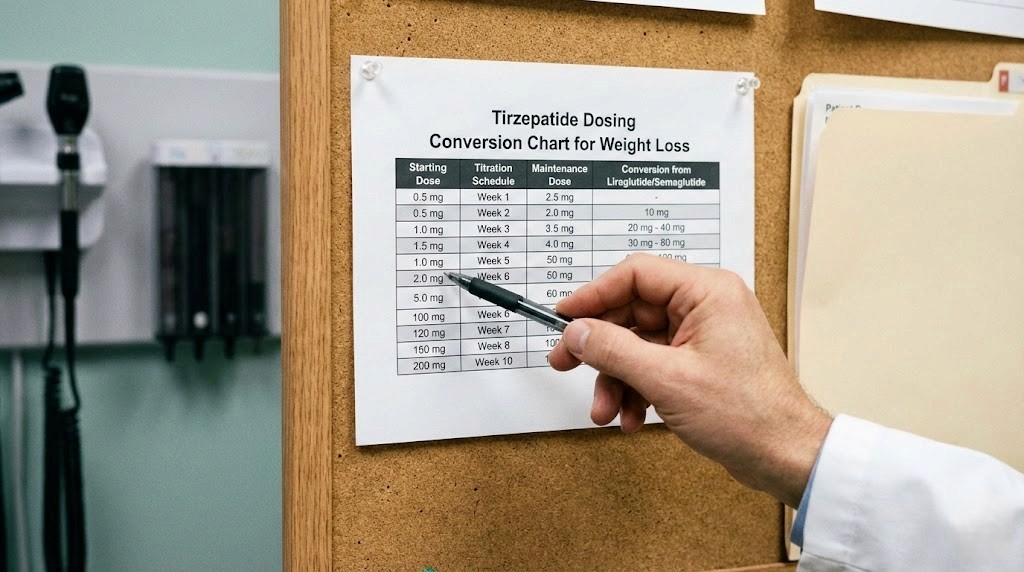
Fifty units from one vial gives you 5 mg. Fifty units from another vial gives you 7.5 mg. Same syringe. Same markings. Completely different doses. That is the conversion problem nobody warned you about when you started tirzepatide dosing for weight loss, and it is exactly why you need a proper conversion chart before drawing another injection.
The confusion runs deeper than most people realize. Compounded tirzepatide arrives in concentrations ranging from 5 mg/mL to 60 mg/mL, depending on which pharmacy filled your prescription. Brand name Zepbound comes in fixed-dose pens that eliminate the math entirely. But the moment you switch to a compounded vial and an insulin syringe, you enter a world where a single miscalculation means underdosing by half or overdosing by double. Neither outcome is something you want when tirzepatide is working on your metabolism around the clock.
This guide lays out every conversion you will ever need. Every concentration. Every dose level. Every syringe type. You will find complete charts for tirzepatide dosing in milliliters, in units, and in milligrams, organized by vial concentration so you can look up your exact prescription and know precisely how much to draw. Beyond the numbers, you will understand the dose escalation schedule, how to manage side effects at each step, what the clinical trial data actually shows about weight loss at each dose, and how to troubleshoot common problems that derail progress. SeekPeptides built this resource because accurate dosing is the foundation of safe, effective peptide use, and getting the conversion wrong is the fastest way to sabotage your results.
Understanding tirzepatide units, milligrams, and milliliters
Before touching a syringe, you need to understand three measurements that interact with each other. Milligrams describe the amount of active tirzepatide. Milliliters describe the volume of liquid. Units describe the markings on your insulin syringe. The relationship between these three depends entirely on one variable: the concentration of your vial.
Here is the core formula. Memorize it.
Volume in mL = dose in mg / concentration in mg per mL
Then convert to syringe units:
Syringe units = volume in mL x 100
So if your vial reads 10 mg/mL and your prescribed dose is 5 mg, you calculate 5 divided by 10, which gives you 0.5 mL, which equals 50 units on an insulin syringe. Simple enough for one concentration. But the confusion multiplies when your pharmacy changes concentrations between refills, or when you switch from one compounding pharmacy to another.
A U-100 insulin syringe always has 100 units per milliliter. That never changes. What changes is how many milligrams of tirzepatide sit inside each unit. At a 10 mg/mL concentration, each unit contains 0.1 mg. At a 20 mg/mL concentration, each unit contains 0.2 mg. At a 60 mg/mL concentration, each unit contains 0.6 mg. The syringe looks identical every time. The dose inside each unit line is completely different.
This is where people make dangerous mistakes. They remember drawing 50 units last month and assume 50 units is still the right amount when a new vial arrives at a different concentration. Understanding tirzepatide dosing in units means understanding that units are never absolute. They only mean something relative to the concentration printed on your vial.
Brand name formulations like Zepbound and Mounjaro sidestep this entirely with pre-filled pens. You select your dose, click the pen, and the mechanism delivers the correct amount. No math. No conversions. No room for error. But pre-filled pens cost significantly more, which is why millions of people use compounded tirzepatide from vials instead. The tradeoff is clear: lower cost requires more responsibility on your part.
Complete conversion chart: 5 mg/mL concentration
This is a lower concentration sometimes used for starting doses and microdosing protocols. You will draw larger volumes compared to higher concentrations, which can actually make precise measurement easier with standard insulin syringes.
5 mg/mL tirzepatide conversion chart:
Dose (mg) | Volume (mL) | Insulin syringe units | Phase |
|---|---|---|---|
1.25 mg | 0.25 mL | 25 units | Microdose |
2.5 mg | 0.50 mL | 50 units | Starter |
5.0 mg | 1.00 mL | 100 units | Maintenance |
At 5 mg/mL, a standard 1 mL syringe maxes out at only 5 mg per injection. This concentration works well for initial dose escalation but becomes impractical at higher maintenance doses because you would need multiple injections per week to reach 10 mg or 15 mg. Most prescribers switch patients to a higher concentration once they move past the starter phase.
One advantage of this concentration is precision at low doses. Drawing 25 units for 1.25 mg is straightforward on any insulin syringe, with clear markings and plenty of space between dose lines. If you are following a tirzepatide microdosing chart, this concentration makes smaller doses much easier to measure accurately.
Complete conversion chart: 10 mg/mL concentration
This is one of the most common concentrations from compounding pharmacies. It offers a good balance between injectable volume and dosing flexibility across the full tirzepatide dose range.
10 mg/mL tirzepatide conversion chart:
Dose (mg) | Volume (mL) | Insulin syringe units | Phase |
|---|---|---|---|
1.25 mg | 0.125 mL | 12.5 units | Microdose |
2.5 mg | 0.25 mL | 25 units | Starter |
5.0 mg | 0.50 mL | 50 units | Maintenance |
7.5 mg | 0.75 mL | 75 units | Escalation |
10.0 mg | 1.00 mL | 100 units | Maintenance |
Notice that 12.5 units falls between the markings on most syringes. A 0.3 mL (30-unit) syringe has finer gradations and makes this measurement more reliable than a 1 mL syringe where the markings are spaced further apart. For any dose requiring half-unit precision, use the smallest syringe that can accommodate your volume.
At 10 mg/mL, you can comfortably reach 10 mg in a single injection (1 mL). Anything above 10 mg requires either a partial second injection or switching to a higher concentration. Most people who stabilize at 10 mg weekly find this concentration ideal, with volumes that are easy to measure and inject comfortably.
This concentration also makes the standard dose escalation math clean and intuitive. Each 2.5 mg step equals exactly 25 units. Going from 2.5 mg (25 units) to 5 mg (50 units) to 7.5 mg (75 units) follows a simple pattern that reduces the chance of calculation errors during titration.
Complete conversion chart: 20 mg/mL concentration
Higher concentration means smaller volumes per dose. This is convenient for higher maintenance doses but demands more precision at lower doses because the spacing between unit lines represents larger jumps in milligrams.
20 mg/mL tirzepatide conversion chart:
Dose (mg) | Volume (mL) | Insulin syringe units | Phase |
|---|---|---|---|
2.5 mg | 0.125 mL | 12.5 units | Starter |
5.0 mg | 0.25 mL | 25 units | Maintenance |
7.5 mg | 0.375 mL | 37.5 units | Escalation |
10.0 mg | 0.50 mL | 50 units | Maintenance |
12.5 mg | 0.625 mL | 62.5 units | Escalation |
15.0 mg | 0.75 mL | 75 units | Max dose |
Now every dose from starter to maximum fits within a single 1 mL syringe. That is the primary advantage of 20 mg/mL. You never need to split injections. The tradeoff is that low doses become harder to measure precisely. Drawing 12.5 units for the 2.5 mg starter dose on a 1 mL syringe requires estimating the halfway point between the 10 and 15 unit marks.
Use a 0.3 mL (30-unit) syringe for doses of 5 mg and below at this concentration. The finer markings give you the precision you need during the critical compounded tirzepatide dose escalation period when accuracy matters most for managing side effects and establishing your baseline response.
For maintenance doses of 10 mg or above, a 0.5 mL or 1 mL syringe works fine. The volumes are large enough that the markings align with standard dose levels, making measurement straightforward.
Complete conversion chart: 30 mg/mL concentration
Some compounding pharmacies offer this higher concentration for patients on moderate to high maintenance doses. It significantly reduces injection volume but leaves almost no room for error at lower doses.
30 mg/mL tirzepatide conversion chart:
Dose (mg) | Volume (mL) | Insulin syringe units | Phase |
|---|---|---|---|
2.5 mg | 0.083 mL | 8.3 units | Starter |
5.0 mg | 0.167 mL | 16.7 units | Maintenance |
7.5 mg | 0.25 mL | 25 units | Escalation |
10.0 mg | 0.333 mL | 33.3 units | Maintenance |
12.5 mg | 0.417 mL | 41.7 units | Escalation |
15.0 mg | 0.50 mL | 50 units | Max dose |
The decimal unit values make this concentration challenging for precise dosing at the starter level. Drawing exactly 8.3 units is nearly impossible on a standard insulin syringe, even with a 0.3 mL model. Many prescribers avoid this concentration for dose initiation and reserve it for patients already stabilized at 7.5 mg or above.
If your pharmacy does provide 30 mg/mL for your starting dose, discuss with your prescriber whether rounding to 8 units (2.4 mg) or 9 units (2.7 mg) is acceptable. The clinical difference between 2.4 mg and 2.7 mg is minimal at the starter dose level, but you should never round without medical guidance.
Complete conversion chart: 60 mg/mL concentration
The highest concentration commonly available from compounding pharmacies. This is exclusively for high-dose maintenance and makes higher-concentration tirzepatide dosing extremely compact. A full 15 mg dose requires only 25 units.
60 mg/mL tirzepatide conversion chart:
Dose (mg) | Volume (mL) | Insulin syringe units | Phase |
|---|---|---|---|
5.0 mg | 0.083 mL | 8.3 units | Maintenance |
7.5 mg | 0.125 mL | 12.5 units | Escalation |
10.0 mg | 0.167 mL | 16.7 units | Maintenance |
12.5 mg | 0.208 mL | 20.8 units | Escalation |
15.0 mg | 0.25 mL | 25 units | Max dose |
At this concentration, tiny measurement errors create large dose swings. One extra unit above 25 (drawing to 26 instead of 25) adds 0.6 mg to your dose. At a 10 mg/mL concentration, one extra unit only adds 0.1 mg. That six-fold difference in sensitivity means 60 mg/mL vials demand extreme precision and should only be used by people comfortable with their tirzepatide reconstitution and drawing technique.
A 0.3 mL syringe is strongly recommended at this concentration. Better yet, a 0.5 mL syringe with 0.01 mL gradations (if available) provides the finest control. Never use a 1 mL syringe with 60 mg/mL tirzepatide, because the markings are too far apart to distinguish between doses that differ by several milligrams.
The standard dose escalation schedule for weight loss
The FDA approved tirzepatide (under the brand names Zepbound and Mounjaro) with a specific titration schedule designed to minimize gastrointestinal side effects while building toward therapeutic doses. Understanding this schedule is essential because the conversion charts above only help if you know which dose you should be targeting at each phase of treatment.
FDA-approved tirzepatide dose escalation schedule:
Weeks | Weekly dose | Purpose |
|---|---|---|
Weeks 1 to 4 | 2.5 mg | Initiation (not therapeutic) |
Weeks 5 to 8 | 5.0 mg | First maintenance dose |
Weeks 9 to 12 | 7.5 mg (optional) | Escalation if needed |
Weeks 13 to 16 | 10.0 mg (optional) | Higher maintenance |
Weeks 17 to 20 | 12.5 mg (optional) | Escalation if needed |
Week 21 onward | 15.0 mg (optional) | Maximum dose |
Several important points about this schedule. First, the 2.5 mg starting dose is not therapeutic. It is purely for acclimation. Your body needs time to adjust to the GLP-1 and GIP receptor activation that tirzepatide triggers. Jumping straight to 5 mg or higher dramatically increases nausea, vomiting, and diarrhea risk.
Second, not everyone needs to reach 15 mg. The SURMOUNT-1 clinical trial showed that participants on just 5 mg lost an average of 15% of their body weight over 72 weeks. Those on 10 mg lost 19.5%. Those on 15 mg lost 20.9%. The difference between 10 mg and 15 mg was less than 2 percentage points of additional weight loss, which for many people does not justify the increased side effect burden. Find the lowest dose that produces consistent weight loss, and stay there.
Third, the four-week intervals exist for a reason. Tirzepatide has a half-life of approximately five days, meaning it takes about 25 days (five half-lives) to reach steady-state levels at any given dose. Increasing before four weeks means you are escalating before your body has fully adjusted to the current dose, which leads to stacking side effects.
Your prescriber may modify this schedule based on your individual response. Some people stay at 5 mg for eight weeks or longer. Others move through the escalation more quickly because they tolerate each step well. The schedule above represents the minimum recommended time at each level, not a rigid requirement to increase every four weeks.
Weight loss results by dose level: what the clinical data shows
Numbers matter. Vague promises about weight loss do not help you make informed decisions about dose escalation. The SURMOUNT clinical trial program is the largest body of evidence for tirzepatide weight loss, and the results are specific enough to set realistic expectations at each dose level.
SURMOUNT-1 results at 72 weeks
This landmark trial published in the New England Journal of Medicine enrolled 2,539 adults with obesity (BMI 30 or higher) or overweight (BMI 27 or higher) with at least one weight-related complication. None of the participants had diabetes. The results were stratified by dose.
Average body weight reduction:
5 mg weekly: 16.0% reduction (approximately 35 pounds for a 220-pound person)
10 mg weekly: 21.4% reduction (approximately 47 pounds)
15 mg weekly: 22.5% reduction (approximately 50 pounds)
Placebo: 2.4% reduction
Percentage of participants achieving clinically significant weight loss:
5% or more weight loss: 85% at 5 mg, 89% at 10 mg, 91% at 15 mg
10% or more weight loss: 69% at 5 mg, 78% at 10 mg, 84% at 15 mg
20% or more weight loss: 32% at 5 mg, 49% at 10 mg, 57% at 15 mg
Look at those numbers carefully. Moving from 5 mg to 10 mg produces a meaningful jump in average weight loss, from 16% to 21.4%. But moving from 10 mg to 15 mg adds only about 1 percentage point more average loss. The benefit curve flattens considerably at the top end.
This has practical implications for your conversion chart. If you are debating whether to increase from 10 mg to 12.5 mg or 15 mg, the additional weight loss is statistically modest. The primary reason to increase is if weight loss has plateaued or you are not losing weight on tirzepatide at your current dose. Understanding how long tirzepatide takes to work helps set proper expectations before making dose changes.
Timeline of weight loss
Weight loss with tirzepatide is not linear. It follows a predictable curve.
Weeks 1 to 4 (2.5 mg): Minimal weight loss, typically 1 to 3 pounds. Appetite suppression begins but is subtle. This phase is about tolerance, not results.
Weeks 5 to 12 (5 mg): Weight loss accelerates. Most people lose 5 to 10 pounds during this phase. Appetite suppression becomes noticeable, and food noise decreases significantly.
Weeks 13 to 24 (5 to 10 mg): The steepest weight loss typically occurs during this window. Monthly losses of 4 to 8 pounds are common. This is when the conversion chart becomes most critical because dose increases mean recalculating your syringe units.
Weeks 25 to 52 (maintenance dose): Weight loss continues but slows. Monthly losses of 2 to 4 pounds. Most people reach their maintenance dose during this period and stabilize.
Weeks 52 to 72 (long-term): Further incremental weight loss. The SURMOUNT-1 data shows continued, though modest, reductions even beyond one year. This is also where the maintenance question becomes important, because the duration of GLP-1 agonist therapy directly impacts long-term outcomes.
A critical finding from post-hoc analysis: 90% of participants who had lost less than 5% at week 12 still achieved clinically meaningful weight loss by week 72. Early non-response does not predict long-term failure. If you are in the first three months and feeling discouraged, the data says keep going.
Syringe selection guide for accurate tirzepatide dosing
The syringe you choose is just as important as the conversion math. Using the wrong syringe for your concentration and dose level introduces measurement errors that compound over weeks and months of treatment.
U-100 insulin syringe types
0.3 mL (30-unit) syringe: Best for doses requiring high precision. The unit markings are spaced further apart, making it easier to draw exactly the right amount. Use this syringe when your calculated volume is 0.3 mL or less. Ideal for higher concentrations (20 mg/mL and above) at lower doses.
0.5 mL (50-unit) syringe: Good middle ground. Suitable for most doses at 10 mg/mL and 20 mg/mL concentrations. The markings provide reasonable precision without the limitation of a tiny maximum volume.
1.0 mL (100-unit) syringe: Best for larger volumes. Use when your calculated volume exceeds 0.5 mL, typically at lower concentrations (5 mg/mL or 10 mg/mL) or higher doses. Precision decreases at small volumes because the unit markings are closer together.
Matching syringe to concentration and dose
Concentration | Dose range | Recommended syringe |
|---|---|---|
5 mg/mL | 1.25 to 2.5 mg | 0.5 mL or 1.0 mL |
5 mg/mL | 5 mg | 1.0 mL only |
10 mg/mL | 2.5 to 5 mg | 0.5 mL |
10 mg/mL | 7.5 to 10 mg | 1.0 mL |
20 mg/mL | 2.5 to 5 mg | 0.3 mL |
20 mg/mL | 7.5 to 15 mg | 0.5 mL or 1.0 mL |
30 mg/mL | 5 to 10 mg | 0.3 mL or 0.5 mL |
30 mg/mL | 12.5 to 15 mg | 0.5 mL |
60 mg/mL | All doses | 0.3 mL only |
One practical tip that experienced peptide users swear by: buy your syringes in bulk and keep multiple sizes on hand. Your syringe needs will change as your dose changes throughout the escalation schedule. Having the right syringe available prevents the temptation to use an oversized syringe for a small dose, which is where measurement errors creep in.
How to reconstitute lyophilized tirzepatide
If your compounding pharmacy provides tirzepatide as a lyophilized (freeze-dried) powder rather than a pre-mixed solution, you will need to reconstitute it yourself. The amount of bacteriostatic water you add determines your concentration, which determines every conversion in your chart.
Reconstitution math
Concentration = total mg in vial / volume of water added
For a 10 mg vial:
Add 1 mL of bacteriostatic water = 10 mg/mL concentration
Add 2 mL of bacteriostatic water = 5 mg/mL concentration
Add 0.5 mL of bacteriostatic water = 20 mg/mL concentration
For a 30 mg vial:
Add 1 mL = 30 mg/mL concentration
Add 1.5 mL = 20 mg/mL concentration
Add 3 mL = 10 mg/mL concentration
Your prescriber or pharmacist should specify the exact volume to add. Do not choose a concentration on your own. The amount of water affects not only dosing math but also stability, injection comfort, and shelf life. If you need a refresher on the basics, our tirzepatide reconstitution chart covers the process in detail.
Step-by-step reconstitution process
Wash hands thoroughly. Clean the vial stopper with an alcohol swab. Draw the prescribed volume of bacteriostatic water into a sterile syringe.
Insert the needle through the rubber stopper at a slight angle. Inject the water slowly, letting it run down the inner wall of the vial. Do not spray it directly onto the powder. Direct force can damage the peptide structure and reduce potency.
Remove the needle. Gently swirl the vial between your fingers. Do not shake it. Shaking creates bubbles, denatures the peptide, and gives you inaccurate draws because air pockets displace liquid in the syringe. Swirl until the powder is fully dissolved and the solution is clear. This typically takes two to five minutes.
Store the reconstituted vial in the refrigerator at 36 to 46 degrees Fahrenheit (2 to 8 degrees Celsius). Never freeze it. Reconstituted tirzepatide with bacteriostatic water typically remains stable for 28 to 30 days when refrigerated. After that period, potency degrades. Check how long tirzepatide lasts in the fridge for your specific formulation, as different pharmacies may have different stability data.
Label the vial with the date of reconstitution, the concentration, and the amount of water added. This prevents confusion if you have multiple vials at different stages. If your tirzepatide ever needs to be out of the fridge temporarily, know the limits on how long compounded tirzepatide can be unrefrigerated.
Conversion chart when switching from semaglutide to tirzepatide
Many people move from semaglutide to tirzepatide seeking greater weight loss. There is no direct milligram-to-milligram conversion between the two because they work through different receptor pathways. Semaglutide is a pure GLP-1 agonist. Tirzepatide is a dual GIP and GLP-1 agonist. The dosing scales are completely independent.
That said, clinical practice has established general switching guidelines. If you have been searching for a semaglutide to tirzepatide dose conversion chart, here is what most prescribers recommend.
General switching guidelines:
Current semaglutide dose | Recommended tirzepatide starting dose | Notes |
|---|---|---|
0.25 to 0.5 mg | 2.5 mg | Standard initiation |
1.0 mg | 2.5 to 5.0 mg | Can sometimes skip 2.5 mg |
1.7 mg | 5.0 mg | Start at first maintenance |
2.4 mg | 5.0 mg | Still start at 5 mg |
Notice that even people on the maximum semaglutide dose (2.4 mg) typically start tirzepatide at 5 mg, not at a higher dose. Tirzepatide activates a different receptor profile, and your body needs to adapt to the GIP agonism regardless of your GLP-1 experience. Jumping to 10 mg or 15 mg based on semaglutide tolerance would likely cause severe gastrointestinal symptoms.
The timing of the switch matters too. Finish your last semaglutide injection and wait one full week before your first tirzepatide injection. Both medications have half-lives of approximately five days, so a week gap ensures you are not stacking two GLP-1 agonists simultaneously. Never take semaglutide and tirzepatide at the same time.
For a detailed walkthrough of the entire transition process, including switching from semaglutide to tirzepatide dosage chart with timeline and monitoring recommendations, our dedicated guide covers everything. If you are coming from the other direction, we also have resources on switching from tirzepatide to semaglutide and the complete semaglutide to tirzepatide conversion chart.
Tirzepatide versus semaglutide: dose-for-dose comparison
Understanding how these two medications compare helps you contextualize the conversion charts for tirzepatide dosing. If you are choosing between them, or if you are on one and considering a switch, the head-to-head data is illuminating.
Weight loss comparison at equivalent time points:
Metric | Tirzepatide (5 to 15 mg) | Semaglutide (2.4 mg) |
|---|---|---|
Average weight loss at 72 weeks | 16 to 22.5% | 14.9% |
Participants losing 5% or more | 85 to 91% | 84% |
Participants losing 10% or more | 69 to 84% | 69% |
Participants losing 20% or more | 32 to 57% | 32% |
Real-world data from the SURPASS trials (for diabetes) showed tirzepatide at 15 mg produced 2.4 kg greater weight loss than semaglutide 1 mg at 40 weeks. An adjusted indirect treatment comparison found that tirzepatide 10 mg and 15 mg produced significantly more weight loss than semaglutide 2 mg, with differences of approximately 3.15 kg to 5.15 kg.
For those on semaglutide who want equivalent conversion charts and dosing references, we maintain comprehensive guides for semaglutide 5 mg/mL dosage charts, semaglutide mixing charts, and semaglutide syringe dosage conversion charts.
Managing side effects during dose escalation
The conversion chart tells you how much to draw. This section tells you what to expect at each level and how to handle the most common challenges that make people abandon treatment prematurely.
Side effects by dose level
Gastrointestinal symptoms are the most common side effects of tirzepatide, and they correlate directly with dose increases. The SURMOUNT trials documented these rates.
Nausea: Reported by 24 to 33% of participants across all dose groups. Most common during the first two weeks at any new dose level. Severity ranges from mild queasiness to significant discomfort. For most people it resolves within 7 to 14 days at each dose level.
Diarrhea: Affects 18 to 25% of participants. More common at higher doses. Often intermittent rather than constant. Usually resolves faster than nausea as the body adjusts.
Constipation: Reported by 11 to 17% of participants. Can persist longer than nausea or diarrhea. Fatigue may also accompany the gastrointestinal effects during escalation.
Decreased appetite: This is technically a therapeutic effect, not a side effect, but it can feel extreme during the first few weeks at a new dose. Many people report having no interest in food at all, which while effective for weight loss can lead to nutritional deficiencies if not managed properly.
Practical strategies for each dose transition
Eat smaller meals. Full-sized portions that were fine before tirzepatide will now trigger nausea. Cut portion sizes in half. You can always eat more later if you are still hungry, but overfilling a stomach with delayed gastric emptying is the fastest path to misery.
Avoid high-fat and fried foods. Fat slows gastric emptying further. Combined with tirzepatide already delaying stomach emptying, fatty meals can sit in your stomach for hours, causing bloating, nausea, and reflux.
Do not drink fluids with meals. Wait 30 to 60 minutes before and after eating. Liquids add volume to an already slow-emptying stomach. Hydrate between meals instead.
Stay upright after eating. Do not lie down for at least 30 minutes after meals. Gravity helps gastric emptying, and lying down promotes reflux.
Consider anti-nausea medication. Ondansetron (Zofran) is commonly prescribed alongside tirzepatide for dose transitions. Over-the-counter options like ginger supplements, ginger tea, or peppermint can provide mild relief.
Slow the escalation if needed. Nothing in the FDA schedule forces you to increase every four weeks. If you are still experiencing significant nausea at week 4 of a new dose, staying at that dose for an additional 2 to 4 weeks is perfectly reasonable. Discuss this with your prescriber. The safety of peptide protocols always comes before speed of dose escalation.
Microdosing tirzepatide: conversion charts for lower doses
A growing number of prescribers and patients are exploring tirzepatide microdosing, using doses below the standard 2.5 mg starting point. While not FDA-approved at these levels, compounded formulations make sub-therapeutic dosing possible. For a complete reference, see our dedicated microdosing tirzepatide chart.
Microdose conversion chart (10 mg/mL concentration):
Dose (mg) | Volume (mL) | Insulin syringe units | Use case |
|---|---|---|---|
0.5 mg | 0.05 mL | 5 units | Ultra-low start |
0.75 mg | 0.075 mL | 7.5 units | Sensitive individuals |
1.0 mg | 0.10 mL | 10 units | Conservative start |
1.25 mg | 0.125 mL | 12.5 units | Half-standard starter |
1.5 mg | 0.15 mL | 15 units | Gradual build |
2.0 mg | 0.20 mL | 20 units | Near-standard |
Important context: no clinical trials have studied tirzepatide at these doses for weight loss. The evidence base for microdosing is anecdotal and observational. The FDA has not evaluated safety or efficacy at sub-2.5 mg levels. However, some prescribers use microdosing for patients who are highly sensitive to GLP-1 agonists, have had severe side effects at standard starting doses, or want to test tolerance before committing to a full protocol.
The Cleveland Clinic and other medical institutions have noted that ultra-low doses may not activate GLP-1 and GIP receptors sufficiently to produce meaningful appetite suppression or metabolic effects. Results at microdoses are inconsistent and unpredictable. If your prescriber recommends microdosing, approach it as a tolerance-building strategy rather than an effective weight loss protocol, and plan to escalate to standard doses once tolerance is established.
Compounded versus brand name tirzepatide: what changes in the conversion
The conversion math differs fundamentally between compounded and brand name tirzepatide, and understanding these differences prevents a category of errors that trips up people who switch between the two.
Brand name (Zepbound, Mounjaro)
Pre-filled pens with fixed doses: 2.5 mg, 5 mg, 7.5 mg, 10 mg, 12.5 mg, and 15 mg. No conversion needed. No syringes. No vials. You select the dose prescribed, click the pen to your skin, press the button, and the full dose is delivered. The pen handles everything.
The tradeoff is cost. Brand name tirzepatide pens can run $1,000 or more per month without insurance. With insurance covering Zepbound, copays vary widely. The simplicity has a price, but for people who are anxious about dosing math or prone to measurement errors, the pen format eliminates risk.
Compounded tirzepatide
Multi-dose vials at varying concentrations. Requires you to calculate the correct volume, select the right syringe, and draw to the precise unit marking. Significantly more affordable, often $100 to $400 per month depending on pharmacy and dose level.
The risks are real. A study of self-administered injectable medications found that 10 to 20% of patients made at least one dosing error over a 12-month period. Most errors were drawing too much or too little, usually because of confusion about units versus milliliters or changes in vial concentration. The conversion charts in this guide exist specifically to prevent those errors.
If you are using compounded tirzepatide, create a personal dosing card. Write down your vial concentration, your current dose in milligrams, the corresponding units, and the syringe size you use. Tape it to the inside of your refrigerator door or wherever you store your vials. Refer to it every single time you draw a dose, even after months of practice. Routine breeds complacency, and complacency breeds errors.
SeekPeptides members access detailed protocol builders and dosing calculators that eliminate the manual math entirely. Input your vial concentration and prescribed dose, and the calculator tells you exactly how many units to draw. For people managing multiple peptides or complex protocols, this kind of automated verification is worth its weight in gold.
Common conversion mistakes and how to avoid them
Knowing what goes wrong helps you stay right. These are the most frequent errors people make when using tirzepatide conversion charts, along with the specific fix for each one.
Mistake 1: using the old concentration with a new vial
Your pharmacy sends a 10 mg/mL vial for three months, then switches to 20 mg/mL because of supply changes. You keep drawing 50 units out of habit. At 10 mg/mL, 50 units equals 5 mg. At 20 mg/mL, 50 units equals 10 mg. You just doubled your dose without realizing it.
Fix: Every time you open a new vial, check the concentration on the label. Recalculate your units from scratch. Never assume a refill matches the previous vial.
Mistake 2: confusing TB syringes with insulin syringes
TB (tuberculin) syringes and insulin syringes look almost identical but have different calibrations. A 1 mL TB syringe is marked in 0.01 mL increments. A 1 mL insulin syringe is marked in units. Drawing to the same visual mark on each syringe delivers different volumes.
Fix: Always use U-100 insulin syringes (typically with orange caps) for tirzepatide dosing. If you have TB syringes, convert your dose to milliliters instead of units and draw accordingly. Better yet, only stock one syringe type to eliminate confusion.
Mistake 3: forgetting to account for reconstitution water volume
If you reconstitute a 10 mg vial with 2 mL of water instead of 1 mL, your concentration drops from 10 mg/mL to 5 mg/mL. Every draw at the old conversion delivers half the intended dose. This mistake can go unnoticed for weeks because half-doses still produce some effect, just less than expected.
Fix: Label every reconstituted vial with the exact volume of water added and the resulting concentration. Double-check against your prescriber instructions before your first draw. If you need guidance on the mixing process itself, our bacteriostatic water guide walks through the calculations.
Mistake 4: rounding aggressively at high concentrations
At 60 mg/mL, one unit equals 0.6 mg. Rounding from 25 units to 26 units adds 0.6 mg to your dose, which is nearly a 2.5% increase at the 15 mg level. Over weeks of rounding in one direction, you accumulate a meaningful deviation from your prescribed dose.
Fix: Use the smallest syringe available for your dose volume. A 0.3 mL syringe has clearer markings and makes it easier to draw exactly to the line rather than estimating between marks.
Mistake 5: changing injection schedule without adjusting dose
Some people split their weekly dose into two injections, three or four days apart, to reduce side effects. This is a valid strategy, but it requires recalculating each injection. If your weekly dose is 10 mg and you split it into two, each injection is 5 mg, not 10 mg. Obvious in theory, but people forget under the stress of managing a new protocol.
Fix: If splitting doses, write out the new per-injection dose and the corresponding units before your first split injection. Keep this card alongside your standard dosing reference.
Special conversion scenarios
Not every dosing situation follows the standard weekly schedule. Here are conversion charts for less common but important scenarios.
Split dosing (twice weekly)
Some prescribers recommend splitting the weekly dose for patients with severe GI side effects. Here is what that looks like at a 10 mg/mL concentration.
Weekly dose | Split dose (each injection) | Volume per injection | Units per injection |
|---|---|---|---|
5 mg | 2.5 mg x 2 | 0.25 mL | 25 units |
7.5 mg | 3.75 mg x 2 | 0.375 mL | 37.5 units |
10 mg | 5 mg x 2 | 0.50 mL | 50 units |
15 mg | 7.5 mg x 2 | 0.75 mL | 75 units |
Dose reduction after reaching goal weight
Once you reach your target weight, many prescribers reduce the dose rather than stopping abruptly. The SURMOUNT-4 trial showed that discontinuing tirzepatide after 36 weeks of treatment led to significant weight regain, with participants regaining about half of the weight they had lost. Stepping down gradually is the evidence-based approach.
Common step-down protocol (10 mg/mL concentration):
Phase | Dose | Units | Duration |
|---|---|---|---|
Active loss | 10 to 15 mg | 100 to 150 units (split if needed) | Until goal reached |
Step-down 1 | 7.5 mg | 75 units | 4 to 8 weeks |
Step-down 2 | 5.0 mg | 50 units | 4 to 8 weeks |
Maintenance | 2.5 to 5.0 mg | 25 to 50 units | Ongoing |
Monitor weight closely during step-down. If you regain more than 3 to 5 pounds at a lower dose, discuss moving back up with your prescriber. The goal is finding the minimum effective maintenance dose, the lowest dose that prevents significant regain while minimizing cost and side effect burden.
How to use the conversion formula for any concentration
Every chart in this article was built using the same two-step formula. Learning the formula means you can calculate conversions for any concentration, including ones not covered here.
Step 1: Calculate volume
Volume (mL) = dose (mg) / concentration (mg per mL)
Step 2: Convert to syringe units
Units = volume (mL) x 100
Example: Your vial is 15 mg/mL and your prescribed dose is 7.5 mg.
Volume = 7.5 / 15 = 0.5 mL
Units = 0.5 x 100 = 50 units
You would draw to the 50-unit mark on your insulin syringe.
Another example: Your vial is 40 mg/mL and your prescribed dose is 12.5 mg.
Volume = 12.5 / 40 = 0.3125 mL
Units = 0.3125 x 100 = 31.25 units
You would draw to approximately the 31-unit mark. With a 0.3 mL (30-unit) syringe, this dose would exceed capacity, so you would need at least a 0.5 mL syringe. These kinds of practical considerations are exactly why doing the math before you prepare your injection prevents waste, errors, and frustration.
The SeekPeptides reconstitution calculator handles these calculations automatically. Input your vial size, water volume, and desired dose, and it returns the exact units to draw. No math. No risk of miscalculation. Just accurate dosing every time. For calculating peptide dosages across any compound, our tools take the guesswork out of the process.
Tirzepatide dosing with B12 and other compounded combinations
Many compounding pharmacies add vitamin B12 (cyanocobalamin or methylcobalamin) to tirzepatide formulations. This combination addresses the potential for B12 deficiency that can develop with long-term GLP-1 agonist use because reduced food intake means reduced vitamin absorption. For a complete guide, see our resource on tirzepatide with B12.
The conversion math does not change when B12 is added. The tirzepatide concentration remains the determining factor. If your vial says 10 mg/mL tirzepatide with 1 mg/mL B12, you still calculate your tirzepatide dose exactly the same way. The B12 comes along for the ride at whatever volume you draw.
However, be aware that some pharmacies adjust the total volume or concentration when adding B12 or other compounds like niacinamide. Always verify the tirzepatide concentration specifically, not just the total compound concentration. A label might read 10 mg/mL tirzepatide + 1 mg/mL B12 in a 2 mL vial, or it might read the total active compound concentration differently. Read carefully.
When to increase your dose and when to stay
The conversion charts become relevant again every time you consider a dose change. Here is a framework for deciding when to move up, when to stay, and when to actually decrease.
Signals that you should increase
Weight loss has plateaued for 4 or more weeks. A true plateau means no change in weight despite consistent diet and exercise habits. Temporary stalls of 1 to 2 weeks are normal and do not require dose changes. Wait for a genuine four-week plateau before discussing escalation.
Appetite suppression has decreased noticeably. If food noise returns, portion sizes creep up, and cravings intensify despite consistent dosing, your body may have partially adapted to the current dose level.
You have completed the minimum four weeks at your current dose. Never increase before four weeks. Ideally, stay at a dose for six to eight weeks before escalating to fully assess its effect.
Signals that you should stay at your current dose
You are still losing weight consistently. Even slow weight loss of 1 to 2 pounds per month is progress. Increasing dose to accelerate loss that is already happening adds side effects without proportional benefit.
Side effects from the last increase have not fully resolved. If you are still experiencing nausea, diarrhea, or significant appetite changes from your most recent dose increase, do not compound those effects with another increase.
You are within 10 pounds of your goal weight. Lower doses are often sufficient for the final stretch and for maintenance. Escalating to 15 mg when you only need to lose 10 more pounds puts you in a position where the step-down later is steeper and more likely to cause rebound weight gain.
Signals to consider decreasing
Severe persistent side effects. If nausea, vomiting, or diarrhea continue beyond 4 weeks at a dose level, stepping back to the previous dose is safer than pushing through. You can always try the higher dose again after a longer adaptation period.
Weight loss is faster than 2 pounds per week consistently. Rapid weight loss increases the risk of gallstones, muscle loss, and nutritional deficiencies. Slowing the rate by reducing the dose may produce healthier, more sustainable results.
You have reached your goal weight. Maintenance dosing is typically lower than active weight loss dosing. Begin the step-down protocol discussed earlier once you reach your target.
Injection technique and its impact on dosing accuracy
Even perfect conversion math fails if the injection technique introduces errors. Here are the technique factors that affect how much tirzepatide actually enters your body.
Air bubbles in the syringe. A small air bubble at the top of the syringe displaces liquid, meaning you draw less than intended. Tap the syringe barrel with your finger to float bubbles to the top, then push the plunger slightly to expel them. Re-check your unit level after removing bubbles, because the liquid line drops slightly.
Dead space in the needle. The hub of the needle holds a small volume of liquid that does not get injected. With insulin syringes using fixed (non-detachable) needles, this dead space is minimal, around 0.003 mL or less. With detachable needles, dead space can reach 0.07 mL, which at high concentrations represents a meaningful dose loss. Always use fixed-needle insulin syringes for tirzepatide.
Injection depth. Tirzepatide is a subcutaneous injection, meaning it goes into the fat layer beneath the skin. Injecting too deep (intramuscular) changes the absorption rate and peak concentration. Too shallow (intradermal) can cause localized reactions and poor absorption. A 45-degree angle with a short (5/16 inch or 8 mm) needle hits the subcutaneous layer reliably for most body compositions.
Injection site rotation. Rotating between abdomen, upper arm, and thigh prevents lipodystrophy (fat tissue changes) at frequently used sites. Lipodystrophy can alter absorption rates, making the same dose less predictable over time. Check our complete peptide injection guide for detailed site rotation protocols.
Tracking your doses and results
A conversion chart is only useful if you track what you actually inject and what happens afterward. Create a simple log with these columns.
Date. Dose (mg). Units drawn. Vial concentration. Injection site. Weight. Side effects. Notes.
This log serves several purposes. First, it catches dosing errors early. If you see unexpected weight changes or side effects, reviewing your log often reveals a calculation mistake or concentration change you missed. Second, it shows your prescriber exactly what you have been doing, which helps them make better dose adjustment decisions. Third, it creates a personal history that helps you predict how your body responds to each dose level.
SeekPeptides members get access to built-in progress tracking tools, protocol management features, and community support from thousands of researchers navigating these same questions. The combination of accurate conversion charts, proper tracking, and expert guidance is what separates people who get consistent results from those who struggle with inconsistent dosing and stalled progress.
Frequently asked questions
How many units is 2.5 mg of tirzepatide?
It depends entirely on your vial concentration. At 10 mg/mL, 2.5 mg equals 25 units. At 20 mg/mL, 2.5 mg equals 12.5 units. At 30 mg/mL, 2.5 mg equals approximately 8.3 units. Always check your specific vial concentration before drawing. For a complete reference, see our guide on how many units is 2.5 mg of tirzepatide.
How many units is 5 mg of tirzepatide?
At 10 mg/mL, 5 mg equals 50 units. At 20 mg/mL, 5 mg equals 25 units. At 60 mg/mL, 5 mg equals approximately 8.3 units. The concentration on your vial label determines the conversion. We cover this in detail in our 5 mg tirzepatide unit conversion article.
How do I convert mg to units for tirzepatide?
Use the two-step formula. First, divide your dose (mg) by your vial concentration (mg/mL) to get the volume in milliliters. Then multiply by 100 to get insulin syringe units. Example: 7.5 mg at 20 mg/mL = 0.375 mL = 37.5 units. Use our peptide calculator to verify your math automatically.
Is 50 units the same as 5 mg of tirzepatide?
Only if your vial concentration is 10 mg/mL. At that concentration, 50 units = 0.5 mL = 5 mg. But 50 units from a 20 mg/mL vial equals 10 mg, and 50 units from a 30 mg/mL vial equals 15 mg. The concentration changes everything. Our unit to mg conversion guide and 40 unit conversion reference break this down further.
What concentration should I choose for compounded tirzepatide?
Your prescriber determines the concentration based on your dose needs. For starting doses (2.5 to 5 mg), 10 mg/mL provides the best measurement accuracy. For maintenance doses (7.5 to 15 mg), 20 mg/mL or higher reduces injection volume. The compound tirzepatide dosing chart shows all options.
Can I use the same syringe for different tirzepatide concentrations?
You can use the same type of syringe, but you must recalculate the number of units for each concentration. A 0.3 mL insulin syringe works with any concentration, but the unit markings mean different milligrams depending on what is in your vial.
How fast does tirzepatide work for weight loss?
Most people notice appetite suppression within the first 1 to 2 weeks. Visible weight loss typically begins at weeks 4 to 6, after moving to the 5 mg maintenance dose. Significant weight loss accumulates over months. The SURMOUNT-1 trial showed average losses of 16 to 22.5% body weight over 72 weeks. Read our detailed breakdown on how fast tirzepatide works for week-by-week expectations.
What happens if I draw too many units by mistake?
If you realize before injecting, simply dispose of the syringe and prepare a new one with the correct amount. If you have already injected a higher dose than prescribed, contact your prescriber. The main risk is intensified gastrointestinal side effects (nausea, vomiting, diarrhea). Significant overdoses may require medical attention. Never try to compensate by skipping your next dose without medical guidance.
Should I switch from semaglutide to tirzepatide?
Tirzepatide generally produces greater weight loss than semaglutide at equivalent time points. The SURMOUNT trials showed 16 to 22.5% body weight reduction with tirzepatide versus approximately 14.9% with semaglutide 2.4 mg. However, individual responses vary. Some people respond better to semaglutide, and the side effect profiles differ slightly. Our semaglutide versus tirzepatide comparison provides a thorough head-to-head analysis to help you decide.
Quick reference: universal conversion table
This master table covers all standard doses across the five most common compounded concentrations. Bookmark this section or screenshot it for quick reference during your injections.
Dose (mg) | 5 mg/mL (units) | 10 mg/mL (units) | 20 mg/mL (units) | 30 mg/mL (units) | 60 mg/mL (units) |
|---|---|---|---|---|---|
1.25 | 25 | 12.5 | 6.25 | 4.2 | 2.1 |
2.5 | 50 | 25 | 12.5 | 8.3 | 4.2 |
5.0 | 100 | 50 | 25 | 16.7 | 8.3 |
7.5 | N/A* | 75 | 37.5 | 25 | 12.5 |
10.0 | N/A* | 100 | 50 | 33.3 | 16.7 |
12.5 | N/A* | N/A* | 62.5 | 41.7 | 20.8 |
15.0 | N/A* | N/A* | 75 | 50 | 25 |
*N/A means the dose exceeds what a standard 1 mL insulin syringe can deliver at that concentration in a single draw.
Print this table. Laminate it. Keep it wherever you prepare your injections. No matter how many times you have done the conversion, having a physical reference eliminates the chance of a mental math error when you are tired, distracted, or rushed.
External resources
For researchers serious about optimizing their peptide protocols, SeekPeptides offers the most comprehensive resource available, with evidence-based guides, proven protocols, dosing calculators, and a community of thousands who have navigated these exact questions.
In case I do not see you, good afternoon, good evening, and good night. May your conversions stay accurate, your doses stay consistent, and your results stay on track.