Feb 10, 2026
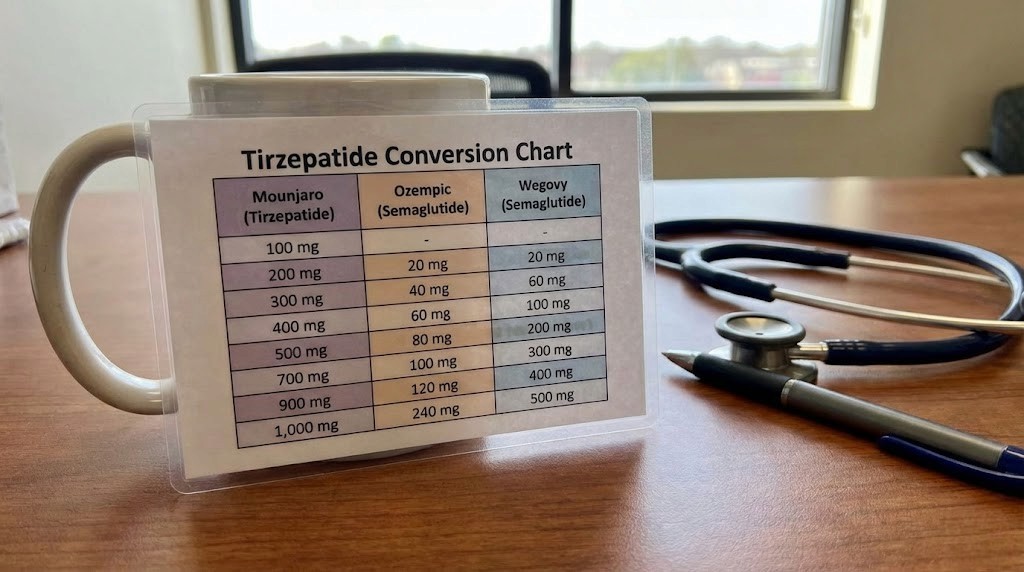
Your provider said 5mg weekly. The vial reads 10mg/mL. The syringe measures in units. And somewhere between those three numbers, you need to figure out exactly how much liquid to draw into that tiny barrel without overdosing, underdosing, or wasting medication that costs more per milliliter than most people spend on groceries in a week.
This is the problem. Tirzepatide does not come in a one-size-fits-all format. Brand name pens like Mounjaro and Zepbound deliver pre-measured doses. Click, inject, done. But compounded tirzepatide arrives in multi-dose vials with concentrations that vary from pharmacy to pharmacy. One vial might contain 5mg/mL. The next might contain 20mg/mL. Same medication. Completely different math. And getting that math wrong means the difference between effective treatment and a frustrating plateau, or worse, side effects that knock you out for days.
The confusion runs deeper than most people realize. Milligrams describe how much active medication you need. Milliliters describe the volume of liquid in the syringe. Units are the markings printed on that syringe. Three measurement systems, all describing the same injection, none of them interchangeable without knowing your specific vial concentration. A tirzepatide conversion chart bridges these three numbers so you can draw precisely what your provider prescribed.
This guide covers every concentration you will encounter, from compounded formulations at 5mg/mL through high-concentration 30mg/mL vials. It explains the conversion formula once, then applies it across every scenario. It breaks down the differences between insulin syringes and tuberculin syringes, because using the wrong type is one of the most dangerous mistakes in self-administered peptide dosing. And it gives you the exact numbers for every standard dose at every common concentration, so you never have to guess.
SeekPeptides built this resource because the existing conversion charts scattered across the internet cover one concentration, maybe two. They leave out the edge cases. They skip the explanation of why the math works the way it does. And they almost never address what happens when your pharmacy switches your concentration mid-protocol. This guide fills every gap.
The conversion formula that governs everything
Every single conversion in this guide comes from one formula. Learn it once and you can calculate any dose at any concentration without a chart at all.
Volume (mL) = Dose (mg) / Concentration (mg/mL)
That is it. Divide what you need by what you have. The result tells you how much liquid to draw.
But most syringes do not measure in milliliters. They measure in units. So you need one more step. On a standard U-100 insulin syringe, 100 units equals 1 mL. That means:
Units = mL x 100
Combine both steps and you get the complete conversion:
Units = (Dose in mg / Concentration in mg/mL) x 100
Here is how that works in practice. Your provider prescribes 5mg of tirzepatide weekly. Your vial concentration is 10mg/mL.
Step 1: 5mg / 10mg/mL = 0.5 mL
Step 2: 0.5 mL x 100 = 50 units
You draw 50 units on your insulin syringe. That delivers exactly 5mg of tirzepatide.
Now change the concentration to 20mg/mL. Same 5mg dose.
Step 1: 5mg / 20mg/mL = 0.25 mL
Step 2: 0.25 mL x 100 = 25 units
Half the liquid. Same amount of medication. This is why concentration matters so much. Get it wrong and you either inject twice what you intended or half.
The formula never changes. The concentration on your vial label is the only variable. Every chart in this guide is just this formula applied to different numbers. If you memorize the formula, you can verify any chart, any calculator, any instruction sheet your pharmacy hands you. Understanding peptide dosage calculations starts with this exact principle.
Tirzepatide conversion chart at 5mg/mL concentration
The 5mg/mL concentration is the most dilute formulation commonly available from compounding pharmacies. It requires the largest injection volumes, which makes it ideal for lower doses where precision matters but becomes impractical at higher doses.
Complete 5mg/mL conversion table
Dose (mg) | Volume (mL) | Insulin Syringe (units) |
|---|---|---|
1.0mg | 0.20 mL | 20 units |
1.5mg | 0.30 mL | 30 units |
2.0mg | 0.40 mL | 40 units |
2.5mg | 0.50 mL | 50 units |
3.0mg | 0.60 mL | 60 units |
3.5mg | 0.70 mL | 70 units |
4.0mg | 0.80 mL | 80 units |
5.0mg | 1.00 mL | 100 units |
7.5mg | 1.50 mL | 150 units (requires 2 injections) |
10.0mg | 2.00 mL | 200 units (requires 2 injections) |
At 5mg/mL, you hit the 1 mL syringe limit at just 5mg. Anything above that dose requires splitting across two injections or switching to a higher concentration vial. This is a real consideration for people on the standard titration schedule who will eventually reach 10mg or 15mg doses.
The advantage of 5mg/mL is granularity. Each unit on the syringe represents just 0.05mg of tirzepatide. That makes microdosing protocols significantly easier. If your provider wants you at 1.25mg (a common starting microdose), you draw exactly 25 units. Clean, precise, no rounding.
Most people using 5mg/mL vials are either in the early stages of titration, following a microdosing approach, or working with a pharmacy that standardizes at this concentration for the initial prescription phase.
Tirzepatide conversion chart at 10mg/mL concentration
The 10mg/mL concentration is the most commonly prescribed compounded tirzepatide strength. It balances precision with practicality across the entire FDA dose range of 2.5mg to 15mg.
Complete 10mg/mL conversion table
Dose (mg) | Volume (mL) | Insulin Syringe (units) |
|---|---|---|
1.0mg | 0.10 mL | 10 units |
2.0mg | 0.20 mL | 20 units |
2.5mg | 0.25 mL | 25 units |
3.0mg | 0.30 mL | 30 units |
5.0mg | 0.50 mL | 50 units |
7.5mg | 0.75 mL | 75 units |
10.0mg | 1.00 mL | 100 units |
12.5mg | 1.25 mL | 125 units (requires 2 injections) |
15.0mg | 1.50 mL | 150 units (requires 2 injections) |
This concentration handles most of the standard tirzepatide dose range within a single injection. The 2.5mg starting dose needs just 25 units. The 10mg dose fills a full 1 mL syringe at exactly 100 units. Only the two highest standard doses, 12.5mg and 15mg, exceed a single syringe capacity.
At 10mg/mL, each unit on the syringe equals 0.1mg of tirzepatide. That level of precision is adequate for standard dosing but less ideal for the fine adjustments used in microdosing protocols where fractions of a milligram matter.
One pattern worth understanding: the relationship between the dose number and the unit count is simple at this concentration. A 5mg dose is 50 units. A 7.5mg dose is 75 units. Multiply the dose in milligrams by 10, and you get your units. That mental shortcut eliminates the need for a chart entirely for 10mg/mL vials.
If your pharmacy dispenses 10mg/mL, use a peptide dosage calculator to double-check your conversions until the mental math becomes automatic. Most dosing errors happen in the first two weeks of a new concentration.
Tirzepatide conversion chart at 15mg/mL concentration
The 15mg/mL concentration sits between the workhorse 10mg/mL and the high-concentration 20mg/mL formulations. Some compounding pharmacies prefer this strength because it keeps every dose through 15mg within a single injection.
Complete 15mg/mL conversion table
Dose (mg) | Volume (mL) | Insulin Syringe (units) |
|---|---|---|
2.5mg | 0.167 mL | 16.7 units |
5.0mg | 0.333 mL | 33.3 units |
7.5mg | 0.500 mL | 50 units |
10.0mg | 0.667 mL | 66.7 units |
12.5mg | 0.833 mL | 83.3 units |
15.0mg | 1.000 mL | 100 units |
Notice the problem immediately. Most doses at this concentration produce fractional units. Drawing 16.7 units on a syringe graduated in whole numbers requires approximation. That rounding introduces small dosing errors at every injection.
Practically, 16.7 units rounds to 17 units (delivering 2.55mg instead of 2.5mg). That 0.05mg difference is clinically insignificant at the starting dose. But at 10mg, the fractional 66.7 units rounds to either 66 or 67 units, delivering 9.9mg or 10.05mg respectively. Still minor.
The real advantage of 15mg/mL shows at the maximum dose. The entire 15mg dose fits in exactly 100 units, one full syringe, no splitting required. For people titrated up to the maximum maintenance dose, this concentration eliminates the two-injection hassle that 10mg/mL vials create.
If your pharmacy uses 15mg/mL, ask whether they provide a concentration-specific dosing chart in units. The fractional values make mental math harder, and precision matters more than convenience when you are measuring medication.
Tirzepatide conversion chart at 20mg/mL concentration
The 20mg/mL concentration is designed for people on moderate to high doses who want small injection volumes. It is the second most common compounded concentration after 10mg/mL.
Complete 20mg/mL conversion table
Dose (mg) | Volume (mL) | Insulin Syringe (units) |
|---|---|---|
2.5mg | 0.125 mL | 12.5 units |
5.0mg | 0.250 mL | 25 units |
7.5mg | 0.375 mL | 37.5 units |
10.0mg | 0.500 mL | 50 units |
12.5mg | 0.625 mL | 62.5 units |
15.0mg | 0.750 mL | 75 units |
Every standard dose fits in a single syringe with room to spare. The 15mg maximum dose needs only 75 units, leaving a quarter of the syringe empty. That is the main selling point of this concentration.
The tradeoff is precision. Each unit now represents 0.2mg of tirzepatide, double the 0.1mg-per-unit resolution of the 10mg/mL formulation. At the starting dose, 12.5 units sits exactly between two syringe markings on a standard insulin syringe. Some people solve this by using a 0.3 mL (30-unit) syringe instead, where the markings are spaced further apart and half-unit precision is easier to achieve visually.
If your concentration just changed from 10mg/mL to 20mg/mL, the critical point is this: you draw half the units for the same dose. If you were drawing 50 units at 10mg/mL for a 5mg dose, you now draw 25 units at 20mg/mL for that same 5mg dose. Drawing 50 units of the new vial delivers 10mg, double your intended dose. This mistake sends people to urgent care with severe nausea, vomiting, and dehydration.
The complete 20mg/mL dosing chart on our site covers additional intermediate doses and includes the specific unit calculations for 2.5mg that trip up people switching concentrations.
Tirzepatide conversion chart at 30mg/mL concentration
The 30mg/mL concentration is the highest strength commonly available from compounding pharmacies. It packs the maximum medication into the minimum volume.
Complete 30mg/mL conversion table
Dose (mg) | Volume (mL) | Insulin Syringe (units) |
|---|---|---|
2.5mg | 0.083 mL | 8.3 units |
5.0mg | 0.167 mL | 16.7 units |
7.5mg | 0.250 mL | 25 units |
10.0mg | 0.333 mL | 33.3 units |
12.5mg | 0.417 mL | 41.7 units |
15.0mg | 0.500 mL | 50 units |
The entire maximum dose fits in half a syringe. That is remarkably compact. But the precision challenges are real. At the starting 2.5mg dose, you need 8.3 units. That is roughly between the 8 and 9 unit marks. Drawing 8 units delivers 2.4mg. Drawing 9 units delivers 2.7mg. Neither matches the prescribed 2.5mg.
For this reason, 30mg/mL concentrations are typically prescribed for people already titrated to higher doses where the fractional units represent a smaller percentage of the total dose. At 15mg (50 units), precision is straightforward. At 2.5mg (8.3 units), precision is challenging without specialized syringes.
Anyone using a 30mg/mL vial at lower doses should consider a 0.3 mL syringe with half-unit markings. These smaller syringes provide better graduation for tiny volumes and reduce the margin of error significantly. SeekPeptides members frequently discuss optimal syringe selection for high-concentration vials in the community forums, and the consensus is clear: smaller syringes produce more accurate doses at this concentration.
Insulin syringe versus tuberculin syringe conversion
This is where people make the most dangerous mistakes. Two syringe types look similar. Both have barrels, plungers, and graduated markings. But they measure completely different things.
The critical difference
An insulin syringe (U-100) measures in units. 100 units equals 1 mL. The markings read 10, 20, 30, all the way to 100 (or 30 for small syringes). These are the syringes most commonly used for tirzepatide injections.
A tuberculin syringe measures in milliliters. The markings read 0.1, 0.2, 0.3, up to 1.0 mL. These syringes have no concept of units. They measure pure volume.
The math relationship: 1 mL on a tuberculin syringe equals 100 units on an insulin syringe. So 0.5 mL equals 50 units. And 0.25 mL equals 25 units.
The danger of mixing them up
Your chart says draw 25 units for a 2.5mg dose at 10mg/mL. You grab a tuberculin syringe by mistake and draw to the 0.25 mark (which you think is 25 units). That delivers exactly 2.5mg. You got lucky because the numbers happened to align.
But if your chart says draw 50 units and you draw to 0.5 on a tuberculin syringe, you also get the right dose. So far so good. The real problem hits when someone confuses the two systems. If a chart is calibrated for tuberculin syringes (showing mL) and someone reads it with an insulin syringe (in units), the numbers may not align, especially with rounding differences at odd concentrations.
The safest approach: know which syringe type your chart references. Every chart in this guide uses insulin syringe units (U-100). If you use a tuberculin syringe, use the mL column instead.
Syringe comparison at a glance
Feature | Insulin Syringe (U-100) | Tuberculin Syringe |
|---|---|---|
Measures in | Units (IU) | Milliliters (mL) |
100 units equals | 1 mL | N/A |
Common sizes | 0.3 mL (30u), 0.5 mL (50u), 1 mL (100u) | 1 mL |
Best for | Standard tirzepatide dosing | Precise small volumes |
Needle gauge | 28-31 gauge | 25-27 gauge |
Needle length | Short (8mm, 12.7mm) | Varies (16mm common) |
For subcutaneous tirzepatide injections, insulin syringes with 29-31 gauge needles are the standard recommendation. The shorter needle length reaches subcutaneous tissue without risk of intramuscular injection, and the finer gauge reduces injection site discomfort. Our peptide reconstitution calculator can help you verify volumes regardless of syringe type.
Converting between different vial concentrations
Pharmacies change concentrations. Insurance changes pharmacies. Compounding formularies change quarterly. At some point during your tirzepatide protocol, your vial concentration will change. When it does, the units you draw must change proportionally.
The golden rule of concentration switching
When concentration doubles, units get halved. When concentration halves, units get doubled.
That is the entire principle. Here it is applied practically:
Switching from | Switching to | Unit adjustment |
|---|---|---|
5mg/mL | 10mg/mL | Halve your units |
10mg/mL | 20mg/mL | Halve your units |
10mg/mL | 5mg/mL | Double your units |
20mg/mL | 10mg/mL | Double your units |
10mg/mL | 30mg/mL | Divide units by 3 |
15mg/mL | 20mg/mL | Multiply by 0.75 |
The math behind every row in that table is the same formula from the beginning of this guide, just applied to two different concentrations. But this shortcut table helps when you are standing in your bathroom at 7am with a new vial and a half-asleep brain.
The most dangerous mistake when switching
You have been injecting 50 units from your 10mg/mL vial for weeks. That gives you 5mg per injection. Your pharmacy sends a 20mg/mL vial this month. You draw 50 units out of habit.
You just injected 10mg. Double your intended dose.
The symptoms hit within hours. Severe nausea. Vomiting. Diarrhea. Possible dehydration requiring medical attention. This is not hypothetical. This is the single most reported dosing error with compounded tirzepatide.
Prevent it with one simple habit: every new vial, check the concentration label before drawing. Write your units for the current concentration on a sticky note and put it on the vial. When the concentration changes, the sticky note changes.
For a detailed walkthrough of this specific transition, our compound tirzepatide dosage chart includes step-by-step switching protocols. And our compound tirzepatide dosing guide covers the practical side of managing pharmacy-initiated concentration changes.
Complete cross-concentration quick reference
This is the master chart. One table covering every standard dose at every common concentration. Print it. Save it on your phone. Reference it every injection until the math becomes automatic.
All concentrations, all doses, one table
Dose (mg) | 5mg/mL (units) | 10mg/mL (units) | 15mg/mL (units) | 20mg/mL (units) | 30mg/mL (units) |
|---|---|---|---|---|---|
1.0mg | 20 | 10 | 6.7 | 5 | 3.3 |
2.0mg | 40 | 20 | 13.3 | 10 | 6.7 |
2.5mg | 50 | 25 | 16.7 | 12.5 | 8.3 |
3.0mg | 60 | 30 | 20 | 15 | 10 |
5.0mg | 100 | 50 | 33.3 | 25 | 16.7 |
7.5mg | 150* | 75 | 50 | 37.5 | 25 |
10.0mg | 200* | 100 | 66.7 | 50 | 33.3 |
12.5mg | 250* | 125* | 83.3 | 62.5 | 41.7 |
15.0mg | 300* | 150* | 100 | 75 | 50 |
*Exceeds 100 units, requires split injection across two syringes
This table eliminates the need for separate charts. Find your dose on the left, find your concentration across the top, and read the intersection. That number goes on your syringe.
Notice how the numbers shift dramatically between concentrations. A 10mg dose requires 200 units at 5mg/mL (two full syringes) but only 33.3 units at 30mg/mL (barely a third of one syringe). Same medication. Same therapeutic effect. Vastly different injection volumes. That is why your vial concentration label is the most important number in your entire dosing protocol.
Keep this chart next to wherever you store your tirzepatide vials and reference it until the conversions become second nature. SeekPeptides members access printable versions of this chart alongside our interactive dosage calculators that perform these conversions automatically.
The FDA-approved tirzepatide dose escalation schedule
Before getting deeper into conversion specifics, you need to understand the standard dosing trajectory. Every tirzepatide protocol follows the same basic pattern, whether you are on brand-name Mounjaro, brand-name Zepbound, or compounded formulations.
Standard titration schedule
Phase | Dose | Duration | Purpose |
|---|---|---|---|
Starting | 2.5mg weekly | 4 weeks minimum | Assess tolerance, minimize GI side effects |
Increase 1 | 5.0mg weekly | 4 weeks minimum | First therapeutic dose |
Increase 2 | 7.5mg weekly | 4 weeks minimum | Intermediate dose |
Increase 3 | 10.0mg weekly | 4 weeks minimum | Higher therapeutic dose |
Increase 4 | 12.5mg weekly | 4 weeks minimum | Advanced dose |
Maximum | 15.0mg weekly | Maintenance | Maximum approved dose |
Each increase happens at minimum four-week intervals, though many providers extend to six or eight weeks per step depending on tolerability. The 2.5mg starting dose is not considered therapeutic for weight loss. It exists solely to let your gastrointestinal system adapt to the medication. Skipping it or shortening it dramatically increases the risk of severe nausea.
Clinical data from the SURMOUNT-1 trial published in the New England Journal of Medicine demonstrated dose-dependent weight loss: 16% average body weight reduction at 5mg, 21.4% at 10mg, and 22.5% at 15mg over 72 weeks. That means the difference between 5mg and 15mg maintenance doses is roughly 6.5 additional percentage points of weight loss, a meaningful but not enormous gap that should factor into conversations with your provider about target dose.
The titration schedule determines which conversions matter to you right now. If you just started, you only need the 2.5mg row. But understanding where the protocol goes helps you anticipate concentration changes, syringe upgrades, and the practical logistics of higher doses before you reach them.
For a deeper look at how this schedule connects to real-world outcomes, our tirzepatide before and after results guide correlates dose levels with documented user experiences. And our tirzepatide timeline guide maps expected milestones against the titration phases.
Tirzepatide to semaglutide dose conversion
This is the question that brings more confusion than any other conversion in the GLP-1 space. People switching between tirzepatide and semaglutide need to know how the doses compare. But the honest answer is: no direct equivalency exists.
Why direct conversion is impossible
Tirzepatide is a dual GIP/GLP-1 receptor agonist. Semaglutide targets only GLP-1. They work through different mechanisms, have different pharmacokinetics, and achieve different clinical outcomes at their respective dose ranges. Comparing 5mg of tirzepatide to 0.5mg of semaglutide is like comparing 5mg of ibuprofen to 5mg of acetaminophen. Same unit, different drug, different effect.
That said, clinical guidance exists for transitioning between the two.
Approximate clinical equivalence (not direct conversion)
Semaglutide Dose | Tirzepatide Starting Dose When Switching | Notes |
|---|---|---|
0.25mg | 2.5mg | Both are starting doses |
0.5mg | 2.5mg | Start tirzepatide at lowest dose |
1.0mg | 2.5mg | Still start at 2.5mg |
1.7mg | 2.5mg | Still start at 2.5mg |
2.4mg (maximum) | 2.5mg | Always restart titration |
The pattern is unmistakable. Regardless of your semaglutide dose, clinical protocols universally recommend starting tirzepatide at 2.5mg. No exceptions.
This catches people off guard. Someone on 2.4mg semaglutide (the maximum weight loss dose) might expect to start tirzepatide at 10mg or higher. But tirzepatide dual receptor activation makes it significantly more potent milligram-for-milligram, and skipping the titration process risks severe gastrointestinal side effects even in people who tolerated high-dose semaglutide without issues.
Our semaglutide to tirzepatide dose conversion chart goes deeper into the clinical reasoning. The switching from semaglutide to tirzepatide dosage chart includes week-by-week titration protocols. And our comprehensive conversion guide addresses the timing nuances of when to take your last semaglutide dose relative to your first tirzepatide injection.
Conversely, if you are switching from tirzepatide to semaglutide, the approach differs because semaglutide is the less potent medication. Most providers start at a semaglutide dose that approximates the therapeutic level rather than restarting from scratch. But that conversation belongs with your prescriber, not a chart.
How to read your tirzepatide vial label
The vial label contains three pieces of information that determine your conversion math. Missing any one of them leads to errors.
The three critical numbers
1. Concentration (mg/mL)
This is the most important number. It tells you how much tirzepatide is dissolved in each milliliter of liquid. A 10mg/mL vial contains 10 milligrams of tirzepatide per milliliter of solution. This number plugs directly into the conversion formula as the divisor.
2. Total content (mg)
This tells you the total amount of tirzepatide in the entire vial. A vial labeled 50mg/5mL contains 50 total milligrams across 5 milliliters of liquid. The concentration is 10mg/mL (50 divided by 5). Some labels show both numbers. Others show only one, requiring you to calculate the other.
3. Total volume (mL)
This tells you how much total liquid is in the vial. Combined with total content, it confirms the concentration. A 50mg vial with 5mL of liquid is 10mg/mL. A 50mg vial with 2.5mL of liquid is 20mg/mL. Same total medication, different concentration, completely different unit calculations.
Common label formats you will encounter
Label reads | Concentration is | How to calculate |
|---|---|---|
Tirzepatide 10mg/mL, 5mL vial | 10mg/mL | Stated directly |
Tirzepatide 50mg/5mL | 10mg/mL | 50 / 5 = 10 |
Tirzepatide 100mg/5mL | 20mg/mL | 100 / 5 = 20 |
Tirzepatide 30mg/mL, 2mL vial | 30mg/mL | Stated directly |
Always verify the concentration before your first draw from any new vial. If the label confuses you, call your compounding pharmacy and confirm. This is not a question to be embarrassed about. Pharmacists answer it dozens of times per day. Getting clarity before injecting is always the right call.
Understanding your vial label connects directly to tirzepatide reconstitution if you work with lyophilized (powder) forms rather than pre-mixed solutions. In that case, the concentration depends entirely on how much bacteriostatic water you add during reconstitution, a variable you control.
Choosing the right syringe size for your dose
Syringe selection affects dosing accuracy more than most people realize. A 1 mL (100-unit) syringe measures a 10-unit dose with the plunger barely moved from the top. A 0.3 mL (30-unit) syringe measures the same 10-unit dose with the plunger a third of the way down the barrel. The second option is objectively more accurate because you can see the graduation marks more clearly.
Syringe size recommendations by dose volume
Units to draw | Recommended syringe | Why |
|---|---|---|
1-30 units | 0.3 mL (30-unit) | Maximum precision for small volumes |
30-50 units | 0.5 mL (50-unit) | Good precision, adequate capacity |
50-100 units | 1.0 mL (100-unit) | Full range for standard doses |
Over 100 units | Two syringes | Split the dose across two injections |
The 0.3 mL syringe deserves special attention. At high concentrations like 20mg/mL or 30mg/mL, your starting dose of 2.5mg requires only 12.5 or 8.3 units respectively. On a 100-unit syringe, those amounts are nearly invisible. On a 30-unit syringe, they are clearly visible and easy to measure precisely.
Many tirzepatide dosing guides recommend the 0.3 mL syringe as the default for anyone on a concentration above 10mg/mL. The cost difference is negligible, typically a few dollars per box of 100, and the accuracy improvement is meaningful.
For detailed syringe selection guidance specific to tirzepatide at various concentrations, our site covers matching syringe capacity to your specific dose and vial combination. And if you handle other peptides alongside tirzepatide, our general peptide dosage chart applies the same syringe selection principles across all injectable compounds.
Microdosing tirzepatide: conversion chart for sub-clinical doses
Not everyone follows the standard titration. Some providers prescribe sub-2.5mg doses for patients who are especially sensitive to GLP-1 receptor agonists, have a history of severe GI side effects, or are transitioning from another medication and need an ultra-gradual introduction.
Microdosing conversion table (10mg/mL concentration)
Microdose (mg) | Volume (mL) | Insulin Syringe (units) |
|---|---|---|
0.5mg | 0.05 mL | 5 units |
0.75mg | 0.075 mL | 7.5 units |
1.0mg | 0.10 mL | 10 units |
1.25mg | 0.125 mL | 12.5 units |
1.5mg | 0.15 mL | 15 units |
1.75mg | 0.175 mL | 17.5 units |
2.0mg | 0.20 mL | 20 units |
At these tiny volumes, syringe precision becomes paramount. A 0.3 mL syringe with half-unit markings is non-negotiable. A standard 1 mL syringe cannot reliably measure 5 units. The margin of error at that volume is massive relative to the intended dose.
The comprehensive microdosing tirzepatide chart explores why sub-therapeutic dosing strategies exist, how providers structure the extended titration, and what results to expect at these lower levels. It is one of the most referenced resources for people who cannot tolerate the standard 2.5mg starting dose.
Microdosing at the 5mg/mL concentration produces more manageable syringe volumes. The same 0.5mg dose requires 10 units instead of 5, which is easier to measure accurately. If precision matters and your provider supports it, requesting the lower concentration for the microdosing phase eliminates one source of dosing error.
What happens when you get the conversion wrong
Dosing errors with tirzepatide are not abstract risks. They produce concrete, immediate, and sometimes serious consequences. Understanding what goes wrong and why motivates the precision this guide demands.
Overdosing scenarios
Drawing too many units for your concentration delivers more medication than intended. The most common cause is concentration confusion, injecting the same number of units after switching to a higher concentration vial.
Symptoms of tirzepatide overdose include severe nausea within 2-4 hours, vomiting that may persist 12-24 hours, diarrhea, abdominal cramping, dehydration, and in some cases, hypoglycemia if combined with other diabetes medications. The severity scales with how much the dose exceeded the intended amount.
A double dose (10mg instead of 5mg, for example) typically produces 24-48 hours of significant GI distress. Most people recover at home with aggressive hydration, electrolyte replacement, and anti-nausea medication. A triple or quadruple dose may require emergency medical attention, IV fluids, and monitoring.
Underdosing scenarios
Drawing too few units delivers less medication than prescribed. This is less immediately dangerous but undermines the entire purpose of treatment. Chronic underdosing produces plateau in weight loss, return of appetite, frustration, and often the false conclusion that tirzepatide does not work.
The insidious part of underdosing is that it looks like treatment failure. Someone drawing 25 units from a 20mg/mL vial thinking they are getting 5mg is actually getting 5mg, which is correct. But someone drawing 25 units from a 10mg/mL vial thinking they are getting 5mg is actually getting only 2.5mg. They may spend months wondering why their results lag behind expectations.
Both scenarios are prevented by the same habit: checking the concentration on every vial before every injection and verifying the math before drawing. Our troubleshooting guide for tirzepatide lists conversion errors as the first thing to check when results stall unexpectedly.
Tirzepatide with B12: conversion adjustments
Many compounding pharmacies add cyanocobalamin (vitamin B12) to tirzepatide formulations. This combination is popular because B12 supplementation may help offset fatigue that some people experience during caloric restriction on GLP-1 medications.
Does B12 change the conversion math?
No. The B12 is dissolved in the same solution. The tirzepatide concentration listed on the label already accounts for the total solution volume. If your vial reads "tirzepatide 10mg/mL with cyanocobalamin 1mg/mL," the 10mg/mL is the tirzepatide concentration. Use it exactly as you would a tirzepatide-only vial.
The B12 does not dilute the tirzepatide. It does not change the volume per dose. It does not require separate calculations. It is simply an additional ingredient dissolved in the carrier solution.
Our tirzepatide with B12 guide covers the clinical rationale, potential benefits, and common formulation details. The semaglutide B12 dosage chart applies the same principle if you encounter B12-enhanced semaglutide formulations. And the compounded semaglutide with B12 chart provides conversion tables for the semaglutide side of combined formulations.
Tirzepatide niacinamide formulations
Another common compounding addition is niacinamide (a form of vitamin B3). The same conversion principle applies: the tirzepatide concentration on the label already accounts for all ingredients in solution. No adjustment needed.
Our tirzepatide niacinamide guide explains why pharmacies include this additive and what, if any, clinical effect it produces. The conversion math remains identical to standard tirzepatide formulations at the same concentration.
Pharmacy-specific conversion charts
Different compounding pharmacies standardize at different concentrations. Knowing your pharmacy default helps anticipate which chart to reference.
Common pharmacy concentration patterns
Pharmacy type | Typical concentration | Notes |
|---|---|---|
Large compounders (Empower, Hallandale) | 10mg/mL, 20mg/mL | Standardized high-volume production |
Local compounders | 5mg/mL, 10mg/mL | Varies widely by pharmacy |
Telehealth providers | 10mg/mL | Most common default |
Specialty pharmacies | 15mg/mL, 30mg/mL | Higher concentrations for advanced users |
For pharmacy-specific dosing details, our Empower tirzepatide dosing chart breaks down that pharmacy exact formulations and unit calculations. The compounded tirzepatide cost guide compares pricing across pharmacies alongside their typical concentrations.
Regardless of pharmacy, the conversion formula never changes. Only the concentration input differs. If you understand the math, you can use tirzepatide from any pharmacy in the world without confusion.
Step-by-step injection day protocol
Theory matters. But what matters more is the sequence of actions on injection day. Here is the practical protocol that eliminates conversion errors.
Before you draw
1. Remove the vial from refrigerated storage and let it warm for 5-10 minutes. Cold medication stings more.
2. Read the vial label. Confirm the concentration. Say the concentration out loud. This sounds ridiculous and it prevents the most common error.
3. Calculate your units using the formula or look them up in the appropriate chart above. Write the number down if you are new to this concentration.
4. Select the correct syringe size for your dose volume (see syringe size chart above).
Drawing the medication
5. Clean the vial stopper with an alcohol swab. Let it dry for 10 seconds.
6. Draw air into the syringe equal to the volume you intend to withdraw. This prevents creating a vacuum in the vial that makes drawing difficult.
7. Insert the needle through the stopper center. Inject the air.
8. Invert the vial with the needle still inserted. Draw slowly to your target number of units.
9. Check for air bubbles. Flick the syringe barrel gently. Expel any air back into the vial. Redraw to target volume if needed.
10. Verify the number of units one final time before removing the needle from the vial.
Administering the injection
11. Choose your injection site: abdomen (avoiding 2 inches around the navel), upper thigh, or back of the upper arm.
12. Rotate sites with each injection. Do not inject into the same spot consecutively.
13. Clean the injection site with alcohol. Let it dry completely.
14. Pinch the skin gently. Insert the needle at a 90-degree angle for subcutaneous delivery.
15. Inject slowly over 5-10 seconds.
16. Release the pinch. Remove the needle. Apply gentle pressure with a cotton ball or gauze. Do not rub.
This protocol applies whether you are on day 1 of a 2.5mg starting dose or month 6 of a 15mg maintenance dose. The conversion math changes. The injection technique stays the same. Our reconstitution guide covers the additional steps needed if you start with lyophilized powder instead of pre-mixed solution. And our peptide storage guide addresses the temperature management that affects medication potency before you ever touch the syringe.
Troubleshooting common conversion problems
Even with charts and formulas, real-world dosing produces questions that the math alone does not answer.
My units do not land on a whole number. What do I do?
Round to the nearest half-unit on a syringe with half-unit markings. On a standard syringe without half-unit markings, round to the nearest whole unit. At standard therapeutic doses (5mg and above), the difference between rounding up and down is clinically insignificant. At microdoses below 2.5mg, use a 0.3 mL syringe with half-unit markings to minimize rounding error.
I drew slightly more or less than intended. Is that okay?
A variance of 1-2 units at standard concentrations means a difference of 0.1-0.2mg at 10mg/mL. That amount does not meaningfully change the medication effect. Do not waste medication by discarding and redrawing unless the variance exceeds 5 units.
My pharmacy changed my concentration without telling me. What now?
This happens more often than it should. Before your next injection, recalculate your units using the new concentration and the conversion formula. If you are unsure about the math, call your pharmacy or provider. Do not inject the old number of units from the new vial.
Can I mix two partial vials of different concentrations?
No. Never combine liquid from two vials of different concentrations. The resulting mixture has an unknown concentration that makes accurate dosing impossible. Use each vial separately until empty, then start the next one.
My vial has less liquid than expected. Is it still the right concentration?
The concentration does not change as you use the vial. If a 10mg/mL vial started with 5 mL and now has 2 mL remaining, it is still 10mg/mL. The concentration is a property of the solution itself, not the total volume in the vial. Draw your normal units as long as enough liquid remains. If the remaining liquid is less than your dose volume, use what is available and draw the remainder from a new vial.
For more complex troubleshooting scenarios, our guide to weight loss plateaus on tirzepatide covers dosing verification as part of a comprehensive diagnostic checklist. The tirzepatide side effects guide helps distinguish between dosing errors and expected medication effects. And our tirzepatide and anxiety guide addresses the psychological stress that conversion confusion creates.
Brand-name versus compounded: conversion differences
Brand-name tirzepatide (Mounjaro for diabetes, Zepbound for weight loss) ships in pre-filled pens that deliver fixed doses. No conversion needed. Click the pen, inject, done.
Compounded tirzepatide ships in multi-dose vials that require the conversions this entire guide describes. Same active ingredient. Completely different user experience.
Why compounded tirzepatide requires conversion charts
Brand-name pens contain a single dose of medication in a pre-measured delivery device. The manufacturer handles all the concentration-to-volume math. You never see the concentration number because you never need it.
Compounded vials contain multiple doses in a single container. You extract each dose using a syringe and your own calculations. The pharmacy tells you the concentration. You do the conversion. Any error in that conversion is your error.
When conversion charts matter most
Starting compounded tirzepatide for the first time
Switching pharmacies (concentration may change)
Receiving a new batch (same pharmacy, different concentration)
Titrating up to a new dose
Switching from brand-name pens to compounded vials
Using a different syringe type than usual
Each of these transitions demands rechecking the math. The oral tirzepatide guide covers the emerging non-injectable formats that may eventually eliminate conversion charts altogether, but for now, vials and syringes remain the compounded standard.
Converting tirzepatide for split dosing protocols
Some providers prescribe twice-weekly injections instead of once-weekly. The weekly total stays the same, but each injection delivers half the dose. This approach can reduce appetite suppression fluctuations and minimize peak-dose side effects.
Split dose conversion at 10mg/mL
Weekly dose (mg) | Per-injection dose (mg) | Per-injection units | Injections per week |
|---|---|---|---|
5.0mg | 2.5mg | 25 units | 2 |
7.5mg | 3.75mg | 37.5 units | 2 |
10.0mg | 5.0mg | 50 units | 2 |
12.5mg | 6.25mg | 62.5 units | 2 |
15.0mg | 7.5mg | 75 units | 2 |
Notice that splitting doses produces some fractional units (37.5, 62.5). These half-unit values are easily measured on syringes with half-unit markings. Use a 0.5 mL syringe for doses under 50 units and a 1.0 mL syringe for doses above.
The conversion math for split dosing is the same formula applied to half the weekly dose. Nothing changes about the concentration relationship. You are simply running the formula with a smaller mg input.
For more on split dosing rationale, our tirzepatide efficacy timeline discusses how splitting affects onset patterns. The unit-based dosage chart includes both standard and split dosing calculations across all concentrations.
Conversion chart for Empower Pharmacy formulations
Empower Pharmacy is one of the largest compounders dispensing tirzepatide. Their formulations typically include niacinamide and come in specific concentration formats that differ from generic compounded tirzepatide.
Common Empower concentrations
Empower commonly compounds tirzepatide at 8mg/mL and 17mg/mL with niacinamide. These non-standard concentrations require their own conversion tables.
Empower 8mg/mL conversion table
Dose (mg) | Volume (mL) | Insulin Syringe (units) |
|---|---|---|
2.5mg | 0.3125 mL | 31.25 units |
5.0mg | 0.625 mL | 62.5 units |
7.5mg | 0.9375 mL | 93.75 units |
10.0mg | 1.25 mL | 125 units (requires 2 injections) |
Empower 17mg/mL conversion table
Dose (mg) | Volume (mL) | Insulin Syringe (units) |
|---|---|---|
2.5mg | 0.147 mL | 14.7 units |
5.0mg | 0.294 mL | 29.4 units |
7.5mg | 0.441 mL | 44.1 units |
10.0mg | 0.588 mL | 58.8 units |
12.5mg | 0.735 mL | 73.5 units |
15.0mg | 0.882 mL | 88.2 units |
These odd concentrations produce messy unit numbers. Empower typically provides its own dosing cards with their shipments, but verifying against the formula is still essential. The numbers above match the formula exactly: dose divided by concentration, multiplied by 100.
Our dedicated Empower tirzepatide dosing chart includes additional intermediate doses, rounding guidance, and pharmacy-specific syringe recommendations. If your provider uses a different major compounder, the same formula applies; only the concentration number changes.
Reconstitution and concentration: when you control the math
Some tirzepatide arrives as lyophilized (freeze-dried) powder that you reconstitute with bacteriostatic water. In this scenario, you determine the final concentration based on how much water you add.
Reconstitution concentration table for a 10mg vial
Water added (mL) | Resulting concentration | Units for 2.5mg dose |
|---|---|---|
0.5 mL | 20mg/mL | 12.5 units |
1.0 mL | 10mg/mL | 25 units |
2.0 mL | 5mg/mL | 50 units |
The formula stays the same. The only difference is that you set the concentration by choosing the reconstitution volume. More water means lower concentration, which means more units per dose but finer measurement precision. Less water means higher concentration, fewer units, but coarser measurement.
Our tirzepatide reconstitution chart provides comprehensive tables for every vial size. The peptide reconstitution calculator automates the math, letting you enter your vial content and desired concentration to get the exact water volume. And the step-by-step reconstitution guide walks through the physical process of adding water to powder without damaging the peptide.
For related reconstitution topics, our semaglutide reconstitution chart and semaglutide mixing chart apply identical principles to the other major GLP-1 medication. The general peptide reconstitution guide covers the technique that applies across all lyophilized peptides.
How vial size affects your dosing logistics
Beyond concentration, vial size determines how many doses you can extract before needing a refill. This is practical logistics, not conversion math, but it directly affects how often you reorder and how much medication you waste.
Doses per vial at common sizes and concentrations
Vial size | Concentration | Total content | Doses at 5mg/week | Doses at 10mg/week |
|---|---|---|---|---|
2 mL | 10mg/mL | 20mg total | 4 weeks | 2 weeks |
5 mL | 10mg/mL | 50mg total | 10 weeks | 5 weeks |
2 mL | 20mg/mL | 40mg total | 8 weeks | 4 weeks |
5 mL | 20mg/mL | 100mg total | 20 weeks | 10 weeks |
2 mL | 30mg/mL | 60mg total | 12 weeks | 6 weeks |
Larger vials mean fewer pharmacy orders but also require longer refrigerated storage. Most compounded tirzepatide solutions remain stable for 28-60 days after first puncture, depending on the pharmacy formulation and storage conditions. If a 5 mL vial at your dose will last longer than the stability window, request smaller vials or check the beyond-use date on the label.
Storing tirzepatide correctly to preserve concentration accuracy
Improper storage can degrade the active ingredient, effectively reducing the concentration below what the label states. If your 10mg/mL vial degrades to 8mg/mL due to heat exposure, every dose you draw based on the 10mg/mL label delivers less medication than intended.
Storage requirements
Refrigerate at 2-8 degrees Celsius (36-46 degrees Fahrenheit)
Protect from light, especially direct sunlight
Do not freeze
After first puncture, note the date and discard after the beyond-use date (typically 28-60 days)
Brief room temperature excursions (under 30 minutes for injection prep) do not affect potency
Our tirzepatide refrigeration guide covers the science behind storage requirements. The out-of-fridge stability guide addresses travel scenarios and temperature excursion limits. And the fridge storage duration guide explains how long opened vials maintain full potency.
Correct storage preserves the accuracy of every conversion chart in this guide. The math only works if the concentration on the label matches the actual concentration in the vial. Proper storage ensures it does.
Understanding tirzepatide dose-response for informed conversion decisions
Knowing the conversion math is only half the picture. Understanding what each dose level actually does helps you appreciate why precision matters.
Clinical outcomes by dose level
The SURMOUNT-1 clinical trial, published in the New England Journal of Medicine, enrolled 2,539 adults with obesity or overweight. Results at 72 weeks showed clear dose-dependent outcomes.
At 5mg weekly, participants lost an average of 16% of their body weight, roughly 35 pounds (16 kg) for an average participant. At 10mg weekly, the average weight loss was 21.4%, approximately 49 pounds (22 kg). At 15mg weekly, participants lost 22.5% on average, about 52 pounds (24 kg).
The gap between 10mg and 15mg (about 1 percentage point) is notably smaller than the gap between 5mg and 10mg (about 5 percentage points). This suggests that for many people, the most significant clinical benefit comes from reaching 10mg rather than pushing to the maximum. That observation has implications for conversion accuracy: the precision difference between underdosing at 4.5mg versus hitting 5mg exactly may matter more at lower doses than the difference between 14mg and 15mg at higher doses.
For complete clinical context, our tirzepatide efficacy timeline maps results against treatment duration. The men before and after tirzepatide guide shows gender-specific outcomes. And the dosing for weight loss in units guide connects these clinical outcomes to the practical unit calculations that deliver them.
When to use a dose calculator instead of a chart
Charts work beautifully for standard doses at common concentrations. But real-world dosing sometimes falls outside those neat rows and columns.
Scenarios where calculators beat charts
Unusual concentrations (8mg/mL, 12mg/mL, 17mg/mL)
Microdoses not included in standard charts (1.25mg, 1.75mg)
Split-dose protocols with non-standard weekly totals
Reconstitution planning where you choose the concentration
Verifying pharmacy-provided dosing instructions
Our peptide dosage calculator handles all of these scenarios. Enter your vial concentration, desired dose, and syringe type, and it returns the exact units. No formula memorization required. No chart lookup needed. Just input and answer.
But understanding the formula behind the calculator matters. Calculators can have bugs. Inputs can be entered incorrectly. The person who understands the formula catches errors that the person who blindly trusts the tool does not. Use the calculator for convenience. Know the formula for safety.
Related tools on SeekPeptides include the reconstitution calculator for lyophilized preparations, the peptide cost calculator for comparing concentration costs, and the semaglutide dosage calculator for the other major GLP-1 medication.
Side effects related to dosing accuracy
Many tirzepatide side effects correlate directly with dose accuracy. Understanding this connection makes the conversion chart not just a mathematical tool but a practical guide for managing your treatment experience.
Dose-related side effects
Side effect | Relationship to dose | Conversion relevance |
|---|---|---|
Nausea | Increases with dose | Accidental overdose intensifies significantly |
Vomiting | Peaks during dose increases | Precise titration reduces risk |
Diarrhea | More common at higher doses | Gradual increases require accurate stepping |
Fatigue | Mild dose correlation | Underdosing may increase if caloric deficit not optimized |
Appetite suppression | Directly dose-dependent | Underdosing reduces primary mechanism |
Injection site reactions | Volume-dependent | Higher concentrations mean less volume, fewer reactions |
The practical takeaway: accurate conversions produce predictable side effects. Inaccurate conversions produce unpredictable ones. If your nausea spikes dramatically one week with no dose change, check your conversion math before assuming the medication is causing problems.
Our tirzepatide fatigue guide, anxiety guide, and appetite suppression timeline all reference dosing accuracy as a variable affecting outcomes. The peptide safety guide provides broader context on how precision across all injectable compounds reduces adverse events.
Frequently asked questions
How many units is 2.5mg of tirzepatide?
It depends on your vial concentration. At 10mg/mL, 2.5mg equals 25 units. At 20mg/mL, it equals 12.5 units. At 5mg/mL, it equals 50 units. Always check the concentration on your vial label before calculating. Our complete guide to 2.5mg unit calculations covers every concentration scenario.
How many mg is 20 units of tirzepatide?
At 10mg/mL, 20 units contains 2mg. At 20mg/mL, 20 units contains 4mg. At 5mg/mL, 20 units contains 1mg. The formula is: mg = (units / 100) x concentration. Our 20 units conversion guide provides the complete breakdown.
How many mg is 40 units of tirzepatide?
At 10mg/mL, 40 units delivers 4mg. At 20mg/mL, 40 units delivers 8mg. At 5mg/mL, 40 units delivers 2mg. The concentration on your specific vial determines the answer. See our 40 units calculation guide for detailed tables.
How many units is 5mg of tirzepatide?
At 10mg/mL, 5mg equals 50 units. At 20mg/mL, 5mg equals 25 units. At 5mg/mL, 5mg equals 100 units (a full 1 mL syringe). Our 5mg unit conversion guide includes all concentration scenarios with syringe selection recommendations.
Can I use the same conversion chart for Mounjaro and compounded tirzepatide?
Mounjaro comes in pre-filled pens that do not require conversion. Compounded tirzepatide requires the charts in this guide. If you switch from Mounjaro to compounded, you need to know your new vial concentration and use the appropriate conversion table. The active ingredient is the same but the delivery method is completely different.
What if my pharmacy gives me a different concentration than last time?
Recalculate your units before your next injection. Use the cross-concentration reference table in this guide or run the formula: units = (dose in mg / concentration in mg/mL) x 100. Do not inject the same number of units from a different concentration vial.
Is 0.5 mL the same as 50 units?
On a U-100 insulin syringe, yes. 0.5 mL equals 50 units. On a tuberculin syringe marked in mL only, 0.5 mL is 0.5 mL, and there are no unit markings. The numeric equivalence only applies when using an insulin syringe where 100 units equals 1 mL.
How do I handle tirzepatide with B12 conversions?
The same way as regular tirzepatide. The B12 is dissolved in the same solution and does not change the tirzepatide concentration listed on the label. Use the labeled tirzepatide concentration for all conversion calculations. The tirzepatide with B12 guide confirms this principle with detailed examples.
External resources
For researchers serious about optimizing their peptide protocols, SeekPeptides offers the most comprehensive resource available, with evidence-based guides, proven protocols, personalized dosage calculators, and a community of thousands who have navigated these exact conversion questions.
In case I do not see you, good afternoon, good evening, and good night.