Mar 5, 2026

You picked a day. Maybe Monday. Maybe Thursday. You injected, went about your week, and then spent the next 48 hours dealing with nausea during your busiest workdays. Sound familiar? Choosing the wrong injection day does not ruin your tirzepatide results, but it can make the entire experience unnecessarily miserable. And when discomfort stacks on top of a demanding schedule, compliance starts to slip. Missed doses follow. Progress stalls.
The thing is, there is no pharmacologically superior day to inject tirzepatide. Tuesday is not better than Saturday from a molecular standpoint. The peptide does not care about your calendar. But your body does. Your routine does. Your ability to manage side effects absolutely depends on when you choose to inject relative to your work, social life, exercise schedule, and sleep patterns.
This guide breaks down everything you need to consider when selecting your weekly injection day, from the pharmacokinetics that make any day technically equivalent, to the practical lifestyle factors that make certain days dramatically better for certain people. You will learn how to evaluate your own schedule, when and how to safely change your injection day, what to do about missed doses, and how experienced researchers optimize their timing for the best possible experience on tirzepatide.
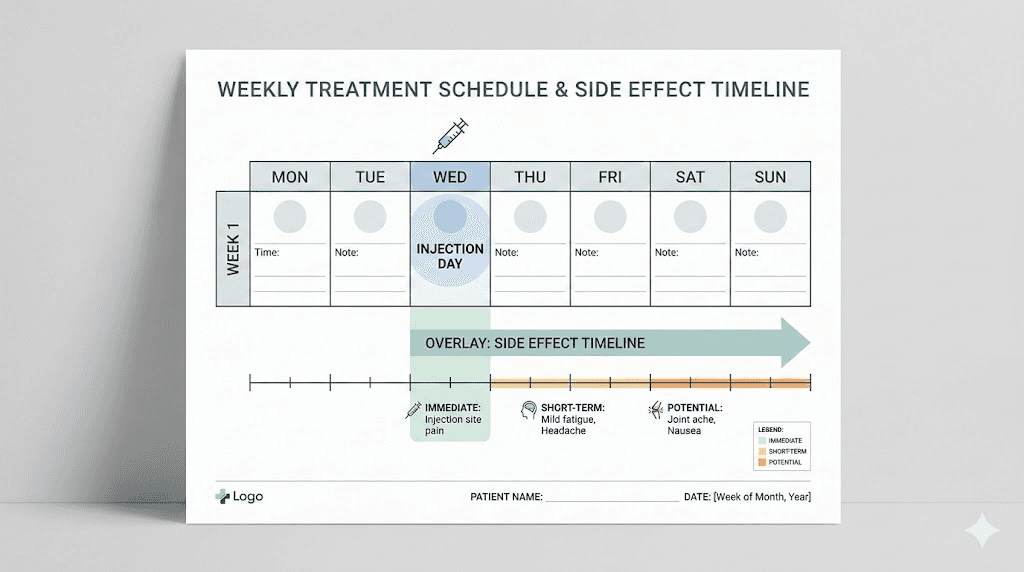
Why the day you choose technically does not matter
Tirzepatide has a half-life of approximately five days. That is long. Remarkably long, actually, compared to most injectable peptides. This extended half-life is precisely why tirzepatide works as a once-weekly injection rather than requiring daily administration like some GLP-1 protocols.
After subcutaneous injection, tirzepatide reaches peak plasma concentration somewhere between 8 and 72 hours. The wide window exists because absorption rates vary based on injection site, subcutaneous fat thickness, blood flow, and individual physiology. Once absorbed, the peptide maintains therapeutic levels throughout the entire seven-day dosing interval. Steady-state concentrations, where the amount entering your system roughly equals the amount being eliminated, are typically achieved after four consecutive weekly doses.
What does this mean practically? It means your body maintains a relatively stable concentration of tirzepatide from day one through day seven of each dosing cycle. The dip before your next injection is modest compared to peptides with shorter half-lives. Whether you inject on Monday morning or Friday evening, the pharmacokinetic profile stays the same. The duration of action does not shift based on which calendar day you choose.
Population pharmacokinetic studies have confirmed that demographics do not meaningfully alter this picture either. Age, gender, race, ethnicity, and body weight do not create clinically relevant differences in how tirzepatide behaves once injected. The drug works the same way regardless of these factors. This is one of the cleaner pharmacokinetic profiles you will find among GLP-1 receptor agonists.
So from a pure science perspective, every day of the week is equally effective. No day produces better weight loss. No day enhances appetite suppression. No day reduces gastrointestinal side effects. The peptide molecule does not know what day it is.
But you do. And that is where the real decision-making begins.
Why certain days work better in practice
If every day is pharmacologically identical, why does injection day matter at all? Because side effects have timing patterns. And those patterns interact with your life in ways that can either be manageable or genuinely disruptive.
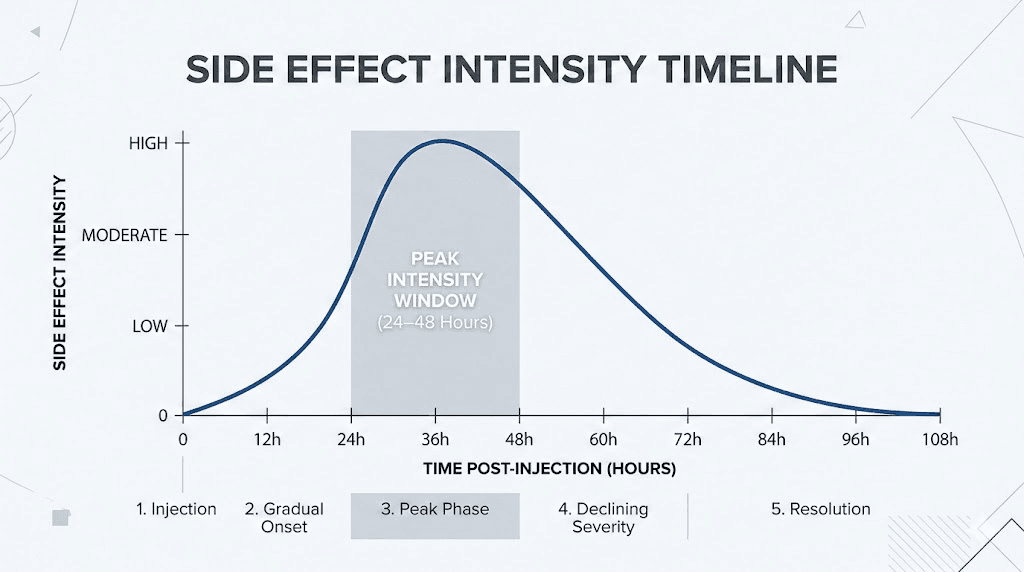
Most people experience their strongest side effects within the first 24 to 48 hours after injection. Nausea typically peaks on injection day and the following day. Gastrointestinal symptoms like bloating, reduced appetite, and digestive changes tend to follow a similar window. Fatigue can appear within 12 to 36 hours of injection. These effects are most pronounced during dose escalation, when your body is adjusting to each new 2.5 mg increase, but many researchers report some degree of post-injection side effects even at maintenance doses.
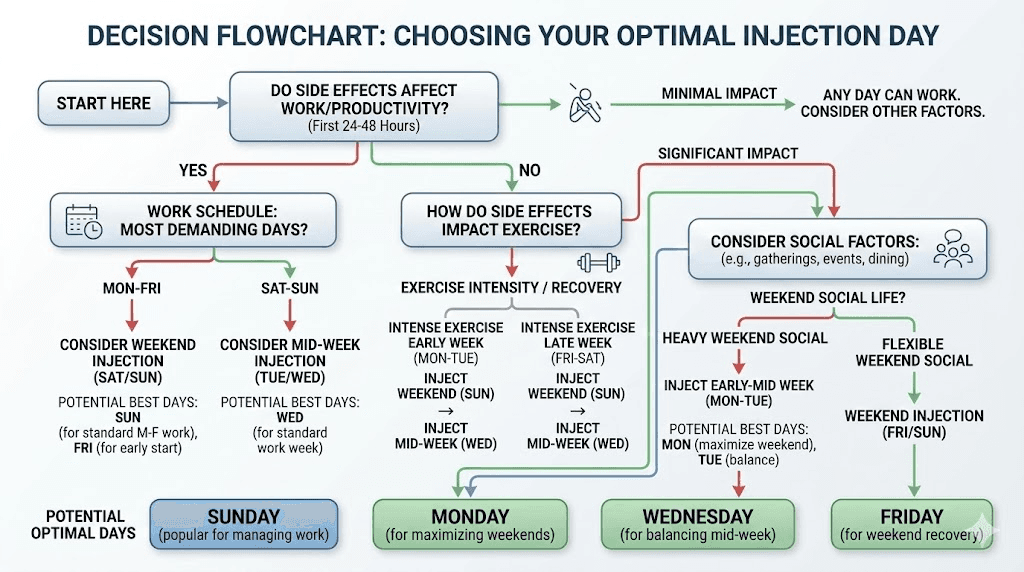
The strategy is simple. Align your injection day so that the 24 to 48 hour side effect window falls during a time when you can rest, eat lightly, stay hydrated, and generally take it easy. For most people with a traditional Monday through Friday work schedule, this means injecting on a weekend.
The weekend injection advantage
Injecting on Friday evening or Saturday morning has become the most popular approach among experienced tirzepatide users, and the logic is straightforward. If side effects hit hardest in the first two days, those two days fall on Saturday and Sunday. You can sleep in. You can eat small meals. You can skip social eating obligations. You can rest on the couch without worrying about a presentation at 2 PM.
By Monday morning, most acute side effects have subsided. You return to work feeling relatively normal, with your appetite suppression still firmly in place but the nausea and fatigue largely resolved. This pattern is especially valuable during the first few weeks at each new dose level, when side effects tend to be most intense.
Friday evening injections specifically offer an additional benefit. Many people find that injecting before bed allows them to sleep through the initial onset of side effects. They wake up Saturday morning with reduced appetite and perhaps mild nausea, but they have skipped the worst of the acute onset period entirely. Compare this to injecting Monday morning and spending Monday afternoon and Tuesday fighting through nausea at your desk.
When weekday injections make more sense
Weekend injection is not universally best. Some people have busier weekends than weekdays. If you work in hospitality, healthcare, retail, or any field with weekend shifts, your recovery window looks completely different. A Tuesday or Wednesday injection might give you the quiet Thursday and Friday recovery period you need before your busy weekend begins.
Consider these scenarios where weekday injection works better:
Weekend social eating: If your weekends revolve around dinners out, brunches, or family meals, injecting on a day that puts peak appetite suppression and potential nausea on quieter weekdays might actually be preferable
Weekend athletics: Serious athletes who train hard on weekends may want to avoid the fatigue and body aches that sometimes follow injection. A Monday injection means peak side effects hit Tuesday and Wednesday, leaving weekends clear for training
Weekend travel: Frequent weekend travelers may prefer a midweek injection to avoid carrying tirzepatide while traveling and dealing with injection logistics away from home
Childcare: Parents with young children on weekends may actually find weekdays easier for managing side effects, since children may be at school or daycare
The key insight is to think backwards from your side effects. When are the 48 hours you can most afford to feel suboptimal? That determines your ideal injection day.
How to evaluate your personal schedule
Choosing the best injection day requires honest assessment of your weekly rhythm. Not your ideal week. Your actual week, with all its imperfections and obligations. Here is a systematic approach.
Map your energy demands
Take a typical week and rate each day on a scale of one to five for how much physical and mental energy you need. Days with important meetings, heavy workouts, social obligations, or high-stakes tasks score higher. Days where you can work from home, have lighter schedules, or can genuinely rest score lower.
Your injection day should place the 24 to 48 hour side effect window on your lowest-scoring days. If Wednesday and Thursday are consistently your lightest days, a Tuesday injection might be ideal. If Saturday and Sunday are genuinely restful for you, Friday works.
Consider your eating patterns
Tirzepatide dramatically reduces appetite. For many people, this is the entire point. But the appetite suppression peaks around the same time as other side effects, in the first 24 to 72 hours. If you have important meals, whether professional dinners, family gatherings, or social events, on certain days of the week, you may want to avoid injecting 24 to 48 hours before them.
Conversely, if your biggest dietary challenge is weekend snacking or social eating, timing your injection so that peak appetite suppression coincides with those temptation windows can work in your favor. Some researchers deliberately inject Thursday so that Friday and Saturday appetite is at its lowest, helping them navigate weekend eating situations more easily.
For detailed guidance on what to eat while on tirzepatide, including managing meals during peak side effect windows, our complete dietary guide covers the specifics.
Factor in your exercise routine
Training while experiencing peak tirzepatide side effects is not dangerous, but it is often unpleasant. Nausea plus heavy squats is nobody's idea of a good time. Muscle aches that sometimes accompany injection can compound exercise-induced soreness. Fatigue reduces workout quality and intensity.
Most active researchers find that placing their injection two to three days before their hardest training sessions gives the best results. If you do your most intense sessions on Saturday, injecting Wednesday gives your body time to clear the acute side effects before you need peak performance. Calculate your own timing using the peptide calculator to ensure your dosing stays accurate regardless of which day you choose.
Think about sleep quality
Some people experience sleep disruption in the first night or two after injection. If quality sleep is essential for specific days, like before a big presentation or an early flight, avoid injecting the evening before those days. Researchers who struggle with post-injection insomnia often do best injecting on Friday or Saturday evening, when a disrupted night has minimal consequences.
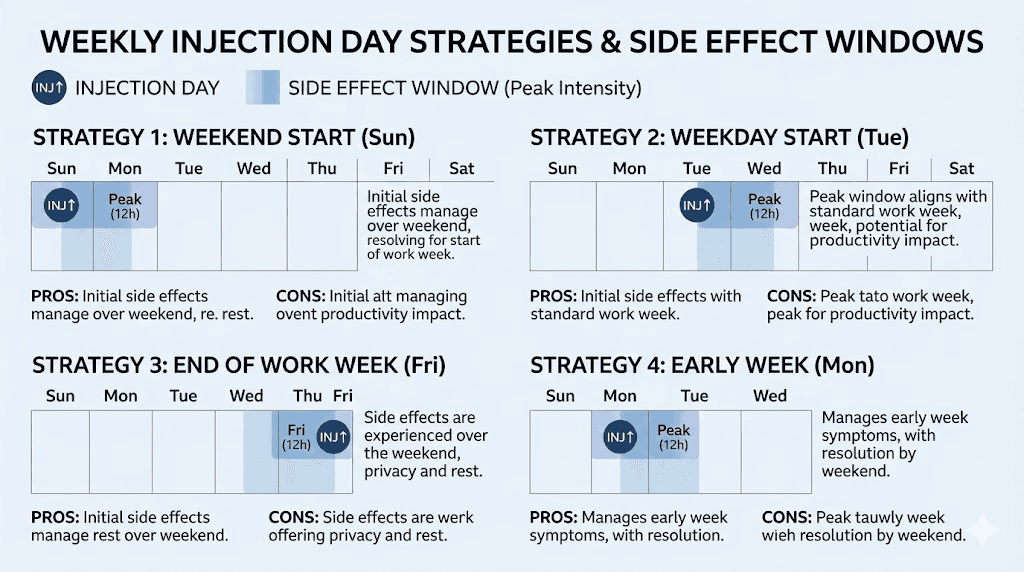
The most popular injection day strategies
Based on community data and clinical experience, several injection day strategies have emerged as particularly effective. Each serves a different lifestyle pattern.
Strategy 1: The Friday night protocol
Inject: Friday evening, typically after dinner
Best for: People with standard Monday to Friday work schedules
Why it works: You sleep through initial onset. Saturday and Sunday serve as your recovery window. By Monday, acute effects have passed. Your strongest appetite suppression conveniently overlaps with the weekend, when many people struggle most with food choices.
Watch out for: If you have active weekend plans, dinners out, or weekend travel, this timing puts your worst side effect window right in the middle of your social life. Also not ideal if weekends are your primary exercise days and you train hard.
Strategy 2: The Saturday morning protocol
Inject: Saturday morning, typically after a light breakfast
Best for: People who want their full Saturday but need Sunday as a recovery day
Why it works: Saturday afternoon side effects are usually mild. Sunday becomes the primary recovery day, when nausea and fatigue peak. Monday arrival at work coincides with the tail end of side effects. This approach gives you most of Saturday before effects kick in.
Watch out for: Sunday plans become harder to maintain. If you have regular Sunday commitments, whether religious, social, or athletic, this timing may not work. Your injection timing within the day also matters here.
Strategy 3: The midweek reset
Inject: Wednesday evening
Best for: People with active weekends who need peak performance Saturday and Sunday
Why it works: Thursday and Friday absorb the worst side effects. By Saturday morning, you are through the acute window. Your weekends remain fully available for activities, exercise, socializing, and eating normally. This is popular among athletes and people with packed weekend schedules.
Watch out for: Thursday and Friday at work may be compromised, especially during dose escalation. If end-of-week deadlines or Friday social events are regular features of your life, this creates conflict.
Strategy 4: The Sunday evening protocol
Inject: Sunday evening before bed
Best for: People who want to sleep through onset and have lighter Monday schedules
Why it works: You sleep through the initial absorption period. Monday and Tuesday absorb the bulk of side effects, which works if those are your lighter workdays. By Wednesday, you are back to full energy. Peak appetite suppression early in the week helps maintain dietary discipline during workdays.
Watch out for: If Mondays are your heaviest workdays with meetings and deadlines, this is a poor choice. Starting the work week with nausea and fatigue is demoralizing. Also problematic if you tend to forget Sunday evening routines.
How side effects change across the dosing schedule
Your ideal injection day may change as you move through the tirzepatide dose escalation schedule. Understanding how side effects evolve across different dose levels helps you plan proactively rather than reactively.
Starting dose (2.5 mg): weeks 1 through 4
The initial 2.5 mg dose is a titration dose, not a therapeutic dose. Its primary purpose is letting your body adjust to the medication. Side effects at this level are typically mild. Many people report little to no nausea, minimal appetite changes, and only slight fatigue. At this dose level, injection day matters least because there is less to manage.
However, this is the perfect time to establish your preferred injection day. Choose the day that fits your long-term schedule, not just your current one. Building the habit at 2.5 mg, when consequences of poor timing are minimal, sets you up for success at higher doses where timing becomes more important.
First escalation (5 mg): weeks 5 through 8
The jump from 2.5 mg to 5 mg is where many researchers first encounter meaningful side effects. Nausea appears or intensifies. Appetite suppression becomes more pronounced. Fatigue may increase. This is the dose where your injection day choice starts to genuinely matter.
If you chose a weekday injection at 2.5 mg and now find yourself nauseated at work after escalating to 5 mg, this is a natural point to reconsider. The starting dose approach often needs adjustment as you escalate.
Subsequent escalations (7.5 mg, 10 mg, 12.5 mg, 15 mg)
Each 2.5 mg increase potentially brings a new wave of side effects as your body adjusts to the higher dose. These adjustment periods typically last one to three weeks before your body acclimates. During dose escalation weeks, your injection day strategy becomes most critical.
Some experienced researchers actually switch their injection day temporarily during escalation weeks. They might normally inject Wednesday but switch to Friday for the first two weeks at a new dose, giving themselves the weekend recovery window for the adjustment period. Once side effects stabilize at the new dose, they switch back to their preferred day.
This is perfectly safe as long as you maintain the minimum 72-hour gap between injections when switching days. More on the mechanics of day switching below.
Maintenance dose: long-term patterns
Once you have been at your maintenance dose for several weeks, side effects typically diminish significantly. Some researchers report almost no side effects at steady state. Others maintain mild but predictable patterns, perhaps slight nausea on injection day and the day after, with no other notable effects.
At maintenance, your injection day becomes less about managing side effects and more about consistency and convenience. The day that is easiest to remember and most stable in your weekly routine becomes the best day. Simplicity wins over strategy when side effects are minimal.
Changing your injection day safely
Life changes. Schedules shift. You might start a new job, change your workout routine, or simply realize your current injection day is not working. Changing your injection day is completely fine, but there are specific rules to follow.
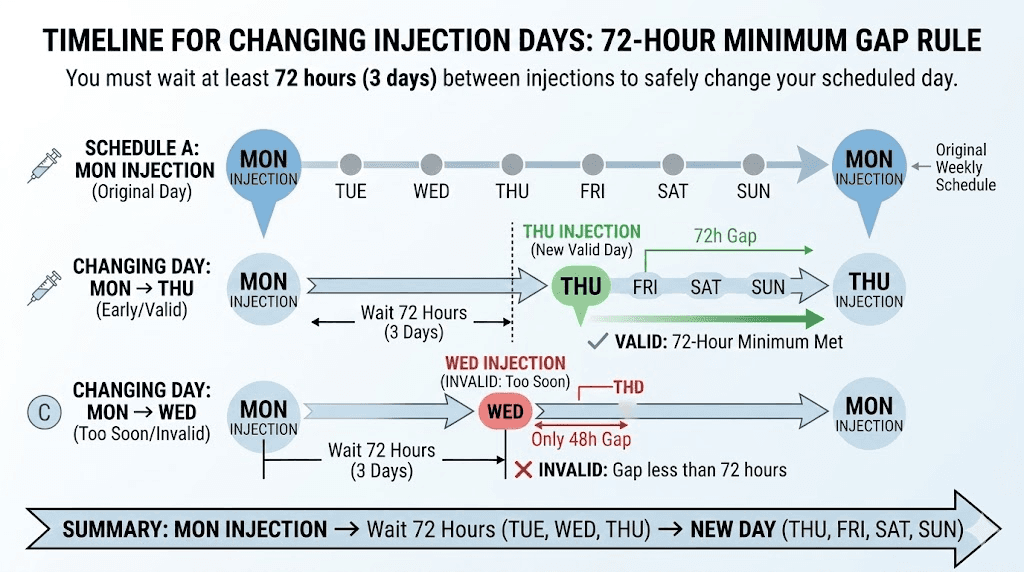
The 72-hour rule
The FDA prescribing information is clear on this point. You may change your weekly dosing day as long as the time between your last dose and your new dose is at least three days, which equals 72 hours. This minimum gap prevents you from effectively doubling up on doses, which would increase side effect risk and could temporarily push your blood concentration above the intended range.
Practical example: if you inject every Wednesday at 6 PM and want to switch to Saturday morning, you would simply skip your Wednesday injection and instead inject Saturday morning. From Wednesday 6 PM to Saturday 8 AM is approximately 62 hours, which is less than 72 hours. So in this case you would need to wait until Saturday evening or Sunday morning to safely make the switch.
Count the hours carefully. The difference between 70 hours and 74 hours might feel trivial, but the 72-hour minimum exists for a reason. If in doubt, add an extra day.
Switching from later in the week to earlier
Switching from a later day to an earlier day requires more planning because it means shortening the gap between doses. If you inject Friday and want to switch to Monday, doing so the very next week would create only a three-day gap. While this meets the 72-hour minimum (assuming you inject Friday morning and Monday evening), it leaves very little margin.
The safer approach is to skip a full week and then inject on your new day. Using the same example: inject Friday as normal, skip the following Friday, and then inject Monday. This creates a 10-day gap between doses, which is longer than ideal but much safer than cutting it close. You may notice slightly reduced appetite suppression during the extended gap, but one week of suboptimal levels will not meaningfully affect your long-term results.
For guidance on early dosing and related timing questions, our guide on taking tirzepatide a day early covers the key considerations.
Switching from earlier in the week to later
This direction is easier. If you inject Monday and want to switch to Thursday, you simply skip Monday and inject Thursday instead. Monday to Thursday is approximately 72 to 96 hours depending on injection times, which comfortably exceeds the minimum gap. You may feel some appetite return during the extra days without medication, but the transition is otherwise smooth.
What about splitting doses
Some researchers have experimented with splitting their tirzepatide dose across two weekly injections to reduce side effects. While this approach is not in standard protocols, it is worth understanding if you are considering it. The principle is that two smaller doses may produce more stable blood levels and fewer peak-related side effects. However, this changes the pharmacokinetic profile and should be discussed with a healthcare provider before attempting.
What to do when you miss your injection day
Missed doses happen. Travel disrupts routines. Refrigerators malfunction. Life gets chaotic. Knowing how to handle a missed dose prevents panic and keeps your protocol on track.
Within 96 hours: inject as soon as possible
If you realize you missed your scheduled injection and fewer than four days (96 hours) have passed, simply inject as soon as you can. Then resume your regular schedule the following week. If the delayed dose is only one or two days late, you can either return to your original day next week or adopt the day you actually injected as your new regular day.
For example, if you normally inject Wednesday but forgot until Friday, inject Friday. The following week, either go back to Wednesday (maintaining the 72-hour minimum between Friday and Wednesday, which is five days) or switch to Friday permanently if that works better for your schedule.
More than 96 hours: skip and resume
If more than four days have passed since your missed dose, the FDA recommends skipping that dose entirely and resuming your regular schedule the following week. This means you will go approximately two weeks between doses. You will likely notice some appetite returning and possibly some weight fluctuation during this period, but it will not undo your progress.
Do not double up. Taking two doses close together to make up for a missed dose significantly increases the risk of severe gastrointestinal side effects and potentially dangerous blood sugar drops in diabetic patients. One missed dose is a minor setback. A double dose is a genuine safety concern.
Preventing missed doses
The best missed dose is the one that never happens. Several strategies help:
Phone alarms: Set a weekly recurring alarm for your injection time. Not just the day, the specific time
Habit stacking: Link your injection to an existing weekly ritual. Sunday meal prep? Inject right before. Friday movie night? Inject when you sit down
Visual reminders: Keep your tirzepatide in the refrigerator where you will see it during your regular routine
Accountability: Tell someone your injection day. Having another person who knows your schedule adds a layer of reminder support
Tracking apps: Use a medication tracking app or even a simple calendar check-off system
Consistency is the single most important factor in tirzepatide outcomes. More than dose optimization, more than injection technique, more than dietary changes. Just showing up every week on the same day creates the foundation for everything else.
Special circumstances that affect day selection
Beyond the basic work schedule considerations, several special circumstances deserve attention when choosing your injection day.
Travel weeks
If you travel frequently, you need a strategy for injection weeks that overlap with trips. The main considerations are maintaining cold chain storage while traveling, finding a private and clean space for injection, and timing the injection so side effects do not hit during flights or important travel days.
Regular travelers often choose a day that gives them maximum flexibility. A midweek injection means you can adjust by a day or two in either direction without violating the 72-hour rule, giving you room to accommodate shifting travel schedules. If you always travel on specific days, simply choose an injection day that avoids the 48-hour post-injection window overlapping with your travel.
Shift workers
Rotating shift work creates unique challenges for weekly injection timing. Your definition of morning and evening changes week to week. Your eating schedule shifts. Your sleep patterns are already disrupted.
For shift workers, the best approach is picking a consistent day based on your rotation cycle rather than trying to match a fixed day of the week. If your rotation repeats every two weeks, you might inject on the first day of your off-stretch each cycle. The key is consistency within your personal pattern, even if that pattern does not align with a standard calendar.
Shift workers often benefit from subcutaneous injection in the abdomen since it can be done quickly and discreetly compared to other injection sites, making it easier to maintain consistency even during demanding shifts.
Social drinkers
Alcohol and tirzepatide interact in ways that affect day selection. Many researchers report dramatically increased alcohol sensitivity on tirzepatide. One drink can feel like three. Drinking while on tirzepatide can also intensify nausea and gastrointestinal effects.
If you drink socially on weekends, injecting Friday or Saturday means peak tirzepatide effects coincide with your drinking window. This can lead to severe nausea, worse hangovers, and potentially dangerous blood sugar fluctuations. A midweek injection that places your lowest tirzepatide blood levels on weekend evenings may be the smarter choice if eliminating alcohol is not something you are ready to do.
Fasting protocols
Researchers who practice intermittent fasting or other fasting protocols need to consider how tirzepatide appetite suppression interacts with their fasting window. Peak appetite suppression in the first 48 hours after injection can make eating enough during feeding windows genuinely difficult. If you fast on certain days, timing your injection so that peak suppression does not overlap with your feeding window helps ensure adequate nutrition.
This intersection of tirzepatide dietary planning and injection timing deserves careful thought. Extreme caloric restriction combined with peak medication effects can lead to excessive muscle loss, nutritional deficiencies, and metabolic slowdown that undermines your goals.
Menstrual cycle considerations
Tirzepatide can affect menstrual cycles, and conversely, different phases of the menstrual cycle can influence how you experience tirzepatide side effects. Some researchers report worse nausea during the luteal phase (the two weeks before menstruation), when progesterone is already causing gastrointestinal symptoms.
While you cannot perfectly sync a weekly injection with a monthly cycle, being aware of this interaction helps with planning. During weeks when your cycle already makes you prone to nausea and fatigue, you might be more aggressive with side effect management strategies, eat even more carefully, and schedule lighter activities for the 48 hours after injection.
Morning versus evening injection on your chosen day
Once you pick the right day, you still need to choose a time. This is a separate but related decision that affects your experience. We have a complete guide on the best time to take your tirzepatide shot, but here is the summary as it relates to day selection.
Morning injection benefits
Injecting in the morning means side effects develop during waking hours. You can actively manage them by adjusting meals, staying hydrated, and resting when needed. You also have all day to monitor for any unusual reactions. If you have chosen a day when you are home anyway, morning injection gives you maximum awake time to manage symptoms.
Evening injection benefits
Evening injection, particularly right before bed, allows you to sleep through the initial onset period. Many researchers swear by this approach, reporting that they fall asleep feeling fine and wake up with manageable appetite suppression and mild or no nausea. This works especially well for people who experience their worst symptoms in the first four to eight hours after injection.
The tradeoff is that evening injection sometimes causes sleep disruption. If you find that post-injection insomnia is a problem, morning injection may be the better choice regardless of the sleep-through-symptoms advantage.
The practical answer
Most experienced tirzepatide users settle on evening injection on their chosen day. The sleep-through-onset advantage is significant for most people, and the minority who experience insomnia can simply switch to morning injection. Start with evening injection and adjust if sleep becomes a problem.
How your injection day relates to your compounded tirzepatide
If you are using compounded tirzepatide, your injection day choice intersects with practical considerations around reconstitution and storage. Compounded tirzepatide requires reconstitution with bacteriostatic water and has a limited shelf life once mixed.
Choosing a consistent injection day helps you plan reconstitution schedules efficiently. If you always inject Friday, you always reconstitute Friday morning or Thursday evening. This predictability reduces waste and ensures you are always injecting fresh, properly stored peptide.
Tirzepatide stability in the fridge is another consideration. If you reconstitute a multi-dose vial, picking a consistent day means you know exactly how long the vial has been reconstituted when you draw each dose. Irregular injection days make it harder to track storage duration and can lead to using peptide that has been reconstituted longer than recommended.
For those using syringe-based dosing, maintaining the same day also means your drawing and injection technique stays sharp through regular practice. Weekly repetition at the same time on the same day builds procedural memory that reduces errors.
Optimizing your injection day for maximum weight loss
While no injection day produces superior pharmacological weight loss, strategic day selection can support behavioral factors that enhance results. This is about psychology and habit, not pharmacology.
Aligning appetite suppression with temptation
Identify the days when you are most likely to overeat. For many people, these are weekends. For others, it might be Monday comfort eating after returning to a stressful job, or Wednesday happy hour. Whatever your pattern, you can time your injection so that peak appetite suppression coincides with your highest temptation period.
Peak appetite suppression typically occurs 24 to 72 hours after injection. If Saturday is your overeating day, injecting Wednesday or Thursday places maximum appetite control right when you need it most. If Monday is your weak point, a Saturday injection puts peak suppression on Monday.
Supporting meal prep routines
Many successful tirzepatide meal plans incorporate weekly meal prep. If you prep on Sundays, injecting Friday or Saturday means your appetite is naturally reduced during your prep day, which may actually help you make better food choices and prepare more appropriate portions.
The timing also means that the meals you prep on Sunday, when appetite is low, are portioned for a low-appetite week. This creates natural caloric control without requiring intense willpower or strict counting.
Managing the end-of-week appetite return
Some researchers notice a slight increase in appetite toward the end of their weekly dosing cycle, around days five through seven after injection. This is the tirzepatide trough, when blood levels are at their weekly lowest. If this pattern applies to you, knowing which days fall in your trough helps you plan accordingly.
You can pre-prepare high-protein, high-fiber snacks for trough days. You can schedule your most diet-supportive meals for those days. You can plan activities that keep you busy and away from the kitchen. Small behavioral adjustments during trough days can meaningfully improve weekly caloric control.
If the end-of-week appetite return is significant, strategies for managing persistent hunger on tirzepatide may help you bridge the gap.
Common mistakes when choosing injection day
Having helped thousands of researchers navigate their first tirzepatide dose and beyond, SeekPeptides has identified several recurring mistakes in injection day selection.
Mistake 1: Choosing based on convenience alone
Picking the day you will remember to inject is important, but it should not be the only factor. The most memorable day might also be your busiest day. A Monday injection is easy to remember because it starts the week, but if Mondays are your most demanding workdays, you are setting yourself up for misery during dose escalation.
Balance memorability with side effect management. A slightly less obvious day that gives you a better recovery window is almost always worth the minor inconvenience of setting a phone alarm.
Mistake 2: Not adjusting during dose escalation
The day that works perfectly at 2.5 mg may be terrible at 10 mg. Side effects often intensify significantly at higher doses, and a Tuesday injection that caused zero problems at low doses might wreck your Wednesday meetings at therapeutic doses. Be willing to reassess your injection day at each escalation point.
Mistake 3: Changing days too frequently
While changing your injection day is allowed, doing it repeatedly disrupts the consistency that supports both compliance and steady-state blood levels. Every day change requires navigating the 72-hour rule, and frequent changes create gaps where blood levels dip below optimal. Pick a day, commit to it for at least four to six weeks, and only change if there is a genuine reason.
Mistake 4: Ignoring the 72-hour rule
Some researchers, eager to switch days, inject too close together. A Saturday to Monday switch with only 48 hours between doses is not safe. The 72-hour minimum is a safety guideline, not a suggestion. Violating it risks elevated side effects and potentially unsafe drug concentrations.
Mistake 5: Panicking over a missed dose
A single missed dose is not a crisis. The 96-hour catch-up window gives you significant flexibility. What turns a minor scheduling hiccup into a real problem is the panic response: doubling up, changing days impulsively, or skipping additional doses out of frustration. Follow the simple missed dose protocol described earlier and move on.
How injection day interacts with other medications
If you take other medications alongside tirzepatide, injection day selection gains an additional layer of complexity. Tirzepatide slows gastric emptying, which can affect the absorption of oral medications taken around the same time.
Oral medications and gastric emptying
The delayed gastric emptying caused by tirzepatide is most pronounced in the first 24 to 48 hours after injection. If you take oral medications that require consistent absorption, such as thyroid medications, certain antibiotics, or oral contraceptives, you may want to take extra care with timing on injection day and the day after.
This does not mean you need to change your injection day specifically to accommodate other medications. But it does mean you should be aware that oral medication absorption may be slightly different on injection day versus other days. Researchers who take metformin alongside tirzepatide or phentermine with tirzepatide should discuss timing with their healthcare provider.
Supplement timing
The supplements commonly taken alongside tirzepatide, including B12, electrolytes, and digestive enzymes, are generally unaffected by injection day selection. However, some researchers find that taking supplements on injection day causes additional gastrointestinal irritation when the stomach is already sensitized. A simple fix is shifting supplement intake to day three or four of your weekly cycle, when gastrointestinal sensitivity has resolved.
Building your long-term injection day strategy
The best injection day is not something you set once and forget. It is a component of your broader tirzepatide optimization strategy that evolves as your circumstances change.
Phase 1: Establishment (weeks 1 through 4)
During your first month at the starting dose, choose a day based on your best guess about schedule compatibility. If unsure, default to Friday evening. Use these low-dose weeks to observe how your body responds to the weekly cycle. Take notes on which days you feel best and worst post-injection.
Phase 2: Refinement (weeks 5 through 12)
As you escalate through 5 mg and 7.5 mg, your side effect profile becomes clearer. This is when most researchers make their one significant day adjustment, if needed. By now you know whether your body produces strong or mild post-injection effects, and you can match your day choice accordingly.
SeekPeptides members often document their side effect patterns during this phase, using the compound dosage chart alongside personal tracking to optimize both dose and timing simultaneously.
Phase 3: Optimization (weeks 13 and beyond)
At maintenance dose with stabilized side effects, your injection day becomes primarily about consistency and lifestyle fit. Minor adjustments are fine, but the foundation should be solid. Most researchers find that by this phase, their injection day feels as natural as any other weekly routine, requiring no special planning or management.
Phase 4: Transition and beyond
If you eventually wean off tirzepatide, the injection day you chose during active treatment becomes irrelevant. But the habits you built around it, regular scheduling, consistent routine, accountability systems, transfer directly into whatever maintenance protocol you adopt. The discipline of showing up on the same day every week teaches consistency that serves you long after the injections stop.
Frequently asked questions
Can I take tirzepatide on different days each week?
Technically yes, as long as you maintain at least 72 hours between doses. However, inconsistent timing makes it harder to maintain steady-state blood levels and increases the risk of missed doses. Choosing one day and sticking to it produces the most consistent results and simplifies your routine. If you need to shift your day, do it once and commit to the new schedule.
Is it better to inject tirzepatide on an empty or full stomach?
Tirzepatide is injected subcutaneously, not taken orally, so stomach contents do not affect absorption. However, some researchers report less post-injection nausea when they inject after a light meal rather than on a completely empty stomach. Experiment with both approaches and see what works for your body. For detailed meal guidance, see our guide on foods to avoid while on tirzepatide.
What happens if I inject two days early?
Injecting two days early (five days after your last dose) is generally safe since it exceeds the 72-hour minimum gap. You may experience slightly more intense side effects because your blood levels have not dropped as much as they would after a full seven days. If you find yourself frequently injecting early, our guide on taking tirzepatide a day early covers this in detail.
Does injection day affect how much weight I lose?
No. Injection day does not influence the pharmacological weight loss effects of tirzepatide. The peptide works identically regardless of which day you inject. However, choosing a day that minimizes side effect disruption to your diet and exercise routine can indirectly support better results through improved compliance and behavioral consistency.
Should I change my injection day if I switch from semaglutide to tirzepatide?
Not necessarily. If your semaglutide injection day worked well for your schedule, there is no pharmacological reason to change it when switching between GLP-1 medications. However, tirzepatide tends to produce different side effect patterns than semaglutide, so be prepared to reassess during your first few weeks if the side effect timing does not match what you experienced before.
Can I inject tirzepatide on the same day I exercise?
Yes, but consider the timing within the day. If you typically experience nausea or fatigue post-injection, avoid injecting immediately before an intense workout. Injecting after your workout or in the evening after a morning exercise session is often the better approach. Light exercise on injection day is generally fine and may actually help with mild body aches and fatigue.
My tirzepatide is not working anymore. Could injection day be the cause?
Injection day does not cause tirzepatide to stop working. If you are experiencing a plateau, the causes are typically related to dose, diet, metabolic adaptation, or other factors covered in our guide on tirzepatide not working anymore. That said, if inconsistent injection timing has led to missed doses or irregular blood levels, improving consistency could help.
Is there a best day for people who work night shifts?
Night shift workers should choose their injection day based on their sleep schedule rather than the calendar. Inject before your longest sleep period so you can rest through initial side effects. If your longest sleep block follows your last night shift of the week, that is likely your best injection time. Consistency relative to your sleep cycle matters more than the actual day of the week.
External resources
For researchers serious about optimizing every aspect of their peptide protocols, SeekPeptides provides comprehensive dosing guides, calculation tools, and a community of thousands who have navigated these exact questions. From choosing your injection day to building complete dose escalation protocols, members access everything needed to make informed, confident decisions about their research.
In case I do not see you, good afternoon, good evening, and good night. May your injection days stay consistent, your side effects stay manageable, and your weekly routine stay effortless.