Feb 10, 2026
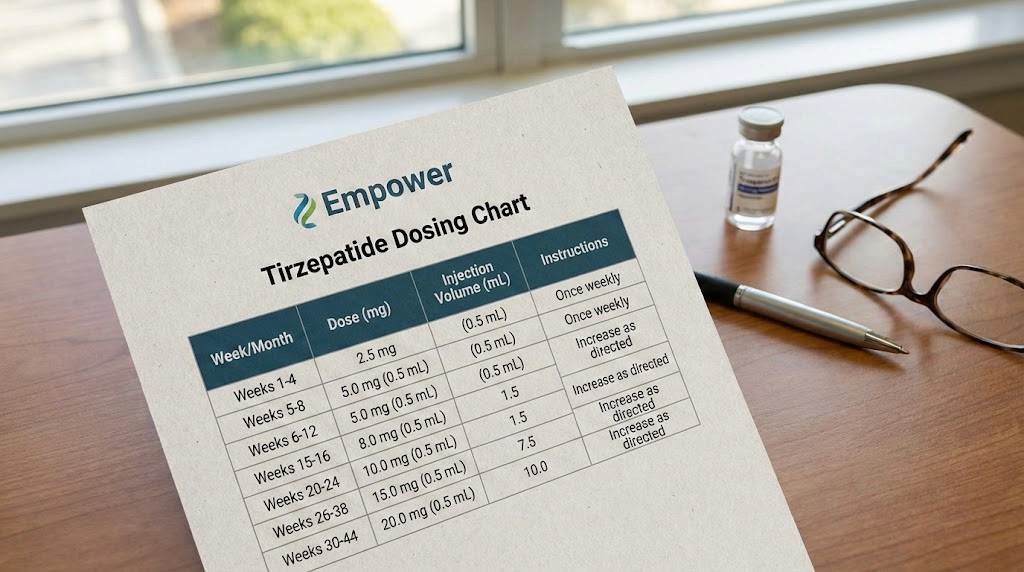
You have the vial in your hand. Empower Pharmacy, tirzepatide/niacinamide, 17mg/mL printed on the label. Your provider said 2.5mg weekly. But the syringe in front of you measures in units, not milligrams. And the math between what your doctor prescribed and what you actually draw into that syringe? That is where most people get lost.
This is not a small problem. Drawing 15 units when you should draw 14.7 units means you are injecting 2.55mg instead of 2.5mg. At low doses, that margin barely matters. But at higher doses, the gap between intended and actual widens fast. At 10mg on a 17mg/mL vial, you need 58.8 units. Round to 59 and you are at 10.03mg. Round to 60 and you hit 10.2mg. These fractions compound over months of weekly injections, and they can mean the difference between manageable side effects and spending two days on the couch with nausea that makes you question the entire protocol.
Empower Pharmacy compounds tirzepatide in multiple vial strengths. The two most common are 8mg/mL and 17mg/mL, each combined with 2mg/mL niacinamide. Different concentrations require completely different unit calculations for the same milligram dose. A person switching from the 8mg/mL vial to the 17mg/mL vial who draws the same number of units would inject more than double their intended dose. That is not a hypothetical. It happens, and it sends people to urgent care with severe gastrointestinal distress.
This guide provides the exact dosing chart for every Empower Pharmacy tirzepatide vial currently available. You will find unit-by-unit calculations for each standard dose from 2.5mg through 15mg, complete titration schedules, syringe reading instructions, and a troubleshooting section for the issues that actually come up when people use these vials in practice. SeekPeptides members have been navigating these calculations since Empower first released their compounded tirzepatide formulations, and the dosing confusion we have seen is exactly why this chart needed to exist. Every number here has been verified against the concentration math. No rounding errors. No guesswork.
How Empower Pharmacy tirzepatide vials work
Empower Pharmacy is a 503A compounding pharmacy based in Houston, Texas. They compound tirzepatide with niacinamide in injectable form, creating formulations that differ significantly from the brand-name products Mounjaro and Zepbound. Understanding how these vials work is the foundation for accurate dosing.
Vial concentrations available
Empower currently offers tirzepatide/niacinamide injection in three primary configurations:
8mg/mL tirzepatide with 2mg/mL niacinamide in 2.5mL vials (20mg total tirzepatide per vial)
17mg/mL tirzepatide with 2mg/mL niacinamide in 2mL vials (34mg total tirzepatide per vial)
17mg/mL tirzepatide with 2mg/mL niacinamide in 4mL vials (68mg total tirzepatide per vial)
The concentration is the critical number. It tells you how many milligrams of tirzepatide exist in every single milliliter of liquid in that vial. When your provider prescribes a dose in milligrams, the concentration is what bridges the gap between that prescription and the units you draw on your syringe.
Why concentration matters more than vial size
Two vials can look almost identical on a shelf and contain wildly different concentrations. The 8mg/mL vial and the 17mg/mL vial might both be small glass containers with rubber stoppers. But the liquid inside them is fundamentally different.
Think of it like coffee. A single shot of espresso and a full mug of drip coffee both contain caffeine. But the concentration per sip is completely different. Drinking the espresso at the same speed you drink drip coffee would overwhelm your system. The same principle applies to these vials.
With the 8mg/mL vial, drawing 31.3 units gives you 2.5mg of tirzepatide. With the 17mg/mL vial, that same 2.5mg requires only 14.7 units. Draw 31 units from the 17mg/mL vial and you have just injected 5.27mg, more than double your intended dose. This is the single most dangerous mistake in compounded tirzepatide dosing, and it happens when people switch vials without recalculating.
The dosing formula you need to memorize
Every chart in this guide reduces to one calculation. Learn it and you can verify any number on any chart, from any pharmacy, for any concentration.
Units to draw = (Desired dose in mg / Concentration in mg per mL) x 100
That is it. Three numbers. One division. One multiplication. The result is the exact number of units to draw on a U-100 insulin syringe.
Breaking down the formula
Start with your prescribed dose. Say it is 5mg.
Divide by your vial concentration. If you have the 17mg/mL vial, that is 5 / 17 = 0.294mL.
Multiply by 100 to convert milliliters to syringe units. So 0.294 x 100 = 29.4 units.
You would draw to the 29 unit mark on your syringe, with the meniscus sitting just barely below the 30 mark. That gives you approximately 4.93mg. Close enough to 5mg that it makes no clinical difference.
For the 8mg/mL vial at the same 5mg dose: 5 / 8 = 0.625mL. Multiply by 100 = 62.5 units. You draw to the halfway point between the 62 and 63 unit marks.
See the difference? Same dose, same medication, but the 8mg/mL vial requires more than twice the volume. This is why you absolutely must know your vial concentration before drawing anything. The dosage calculator tools at SeekPeptides automate this math, but understanding the formula means you can always verify your calculations manually.
Why U-100 insulin syringes
A U-100 syringe has 100 unit markings across 1mL of total volume. Each unit mark represents 0.01mL. These syringes exist in multiple sizes:
0.3mL syringes (30 units total, with half-unit markings for precision)
0.5mL syringes (50 units total, with single-unit markings)
1mL syringes (100 units total, with two-unit markings)
For tirzepatide dosing in units, the 0.5mL syringe works best for the 17mg/mL vial at doses up to about 8.5mg (50 units). Beyond that, or for all doses on the 8mg/mL vial, you will need the 1mL syringe. The smaller syringe gives you finer markings and more precise measurements, so use the smallest syringe that fits your dose volume.
Complete dosing chart for the 8mg/mL vial
This chart covers the Empower Pharmacy tirzepatide/niacinamide 8mg/mL vial (2.5mL total volume, 20mg total tirzepatide per vial). Every calculation uses the formula above.
Prescribed Dose | mL to Draw | Syringe Units | Nearest Practical Unit | Actual mg at Practical Unit |
|---|---|---|---|---|
2.5mg | 0.3125mL | 31.25 units | 31 units | 2.48mg |
5.0mg | 0.625mL | 62.5 units | 62 or 63 units | 4.96mg or 5.04mg |
7.5mg | 0.9375mL | 93.75 units | 94 units | 7.52mg |
10.0mg | 1.25mL | 125 units | Not possible with single 1mL syringe | Split into two draws |
12.5mg | 1.5625mL | 156.25 units | Not possible with single 1mL syringe | Split into two draws |
15.0mg | 1.875mL | 187.5 units | Not possible with single 1mL syringe | Split into two draws |
Important notes about the 8mg/mL vial
Notice that any dose above 8mg on the 8mg/mL vial requires more than 1mL of liquid. A standard insulin syringe only holds 1mL. This means higher doses require splitting the injection into two separate draws or using a larger non-insulin syringe. Most providers prescribe the 8mg/mL vial for patients in the early titration phase (2.5mg to 7.5mg) and then switch to the 17mg/mL vial when doses increase beyond that range.
The 2.5mL vial at 8mg/mL contains 20mg total. At the starting dose of 2.5mg weekly, one vial lasts 8 weeks. At 5mg weekly, it lasts 4 weeks. At 7.5mg weekly, it lasts approximately 2.67 weeks, meaning you will need to start a new vial partway through a week.
For compound tirzepatide dosage calculations, always count how many doses a vial provides before your refill arrives. Running out mid-week means a missed dose, which can restart side effects when you resume.
Complete dosing chart for the 17mg/mL vial
This is the more commonly prescribed Empower formulation for patients who have titrated past the initial doses. The higher concentration means smaller injection volumes, which most people prefer.
Prescribed Dose | mL to Draw | Syringe Units | Nearest Practical Unit | Actual mg at Practical Unit |
|---|---|---|---|---|
2.5mg | 0.147mL | 14.7 units | 15 units | 2.55mg |
5.0mg | 0.294mL | 29.4 units | 29 units | 4.93mg |
7.5mg | 0.441mL | 44.1 units | 44 units | 7.48mg |
10.0mg | 0.588mL | 58.8 units | 59 units | 10.03mg |
12.5mg | 0.735mL | 73.5 units | 73 or 74 units | 12.41mg or 12.58mg |
15.0mg | 0.882mL | 88.2 units | 88 units | 14.96mg |
Why the 17mg/mL vial is preferred at higher doses
Every dose from 2.5mg through 15mg fits within a single 1mL syringe draw. No splitting. No complicated two-injection protocols. The maximum dose of 15mg requires just 88 units, leaving room in the syringe for any small adjustments your provider might prescribe.
The 2mL vial at 17mg/mL contains 34mg total. At 2.5mg weekly, that is approximately 13.6 weeks from a single vial. At 10mg weekly, 3.4 weeks. At 15mg weekly, 2.27 weeks. The 4mL vial doubles everything, containing 68mg total and lasting about 4.5 weeks even at the maximum 15mg dose.
For researchers comparing these numbers to tirzepatide dosage in mL, the milliliter column in the chart above provides direct reference. But always think in syringe units when actually drawing your dose. Milliliters are useful for understanding. Units are what you measure.
Precision at each dose level
At 2.5mg, you draw approximately 15 units. The difference between 14 and 15 units on a 17mg/mL vial is 0.17mg. Clinically insignificant. You have flexibility here.
At 7.5mg, you need 44 units. The gap between 43 and 45 units translates to 0.34mg total range. Still manageable. Most providers consider anything within 0.5mg of the target dose to be acceptable.
At 15mg, you need 88 units. Now each unit represents 0.17mg, and being off by 2-3 units means a variance of 0.34 to 0.51mg. For a 15mg dose, that is a 2-3% deviation. Negligible.
The practical takeaway? Do not obsess over hitting the exact fractional unit. Get within one unit of the calculated number and you are fine. The peptide calculator can verify these numbers for any concentration you encounter.
The standard titration schedule
Tirzepatide follows a structured dose escalation protocol regardless of whether you use brand-name Mounjaro, Zepbound, or Empower compounded formulations. The titration exists for one reason: your gastrointestinal system needs time to adjust to GLP-1 and GIP receptor activation. Skip the titration and you will almost certainly experience severe nausea, vomiting, or both.
FDA-approved titration timeline
Phase | Weeks | Weekly Dose | Units (8mg/mL) | Units (17mg/mL) |
|---|---|---|---|---|
Start | Weeks 1-4 | 2.5mg | 31 units | 15 units |
Escalation 1 | Weeks 5-8 | 5.0mg | 63 units | 29 units |
Escalation 2 | Weeks 9-12 | 7.5mg | 94 units | 44 units |
Escalation 3 | Weeks 13-16 | 10.0mg | Two draws needed | 59 units |
Escalation 4 | Weeks 17-20 | 12.5mg | Two draws needed | 74 units |
Maximum | Week 21+ | 15.0mg | Two draws needed | 88 units |
Each dose increase happens after a minimum of four weeks at the current dose. Four weeks is the floor, not the target. Many providers keep patients at a dose for six or eight weeks if tirzepatide is working well at that level. There is no prize for reaching 15mg faster. The goal is finding the lowest effective dose, not the highest tolerable one.
Why most people stay at 7.5mg or 10mg
Clinical data from the SURPASS trials showed that tirzepatide at 5mg produced A1C reductions of 1.87% and weight loss of approximately 7kg over 40 weeks. The 10mg dose achieved 2.07% A1C reduction and 7.8kg weight loss. The 15mg dose reached 2.37% reduction and 9.5kg loss.
The differences between 10mg and 15mg are real but modest compared to the jump from 5mg to 10mg. Meanwhile, side effects increase substantially at higher doses. This is why experienced clinicians often target the 7.5mg to 10mg range as the sweet spot where meaningful results meet manageable side effects.
For compounded tirzepatide from Empower specifically, providers have more flexibility with dosing than brand-name pens allow. Mounjaro comes in fixed-dose pens. Compounded vials let you draw any amount within the concentration range. Some providers prescribe intermediate doses like 3.75mg or 6.25mg that do not exist in the brand-name product line. This precision is one of the genuine advantages of compounded tirzepatide dosing.
How to read your syringe correctly
The number one dosing error with compounded tirzepatide is not a math mistake. It is a syringe reading mistake. People calculate the correct number of units, then draw the wrong amount because they misread the markings on their syringe.
Understanding syringe markings
A 1mL U-100 insulin syringe typically has major markings at every 10 units (10, 20, 30, up to 100) and minor markings at every 2 units. That means the small lines between 10 and 20 represent 12, 14, 16, and 18 units. There is no line at 11, 13, 15, 17, or 19 on most 1mL syringes.
If your prescribed dose works out to an odd number of units (like 29 units for 5mg on the 17mg/mL vial), you need to draw to just below the 30 line. The plunger tip should sit approximately halfway between the 28 and 30 markings.
A 0.5mL syringe has markings at every single unit, making odd numbers easy to hit. This is why the smaller syringe is preferred whenever your dose volume allows it.
Reading the meniscus
Liquid in a syringe forms a slight curve at the surface called a meniscus. Always read your dose at the flat bottom of the meniscus, not the curved edges that creep up the syringe walls. Reading at the top of the curve adds roughly 0.5 to 1 unit of extra volume, which translates to 0.04 to 0.17mg of extra tirzepatide depending on your vial concentration.
Air bubbles and accuracy
Small air bubbles in the syringe displace liquid and reduce your actual dose. A 3-unit air bubble in a 29-unit draw means you are only injecting 26 units of medication. That is a 10% underdose.
Remove bubbles by tapping the syringe firmly with your finger while holding it needle-up. The bubbles rise to the top. Push the plunger slightly to expel the air, then re-draw to your target unit line. This step takes ten seconds and prevents consistent underdosing that undermines your entire protocol.
If you have been not losing weight on tirzepatide, air bubbles causing systematic underdosing is one of the first things to check. It is a surprisingly common issue that rarely gets discussed.
Comparing Empower to brand-name tirzepatide
Empower Pharmacy compounded tirzepatide and brand-name Mounjaro or Zepbound contain the same active molecule. But the delivery systems, formulations, and dosing mechanics differ in ways that matter for daily use.
Key differences
Factor | Empower Compounded | Brand-Name (Mounjaro/Zepbound) |
|---|---|---|
Delivery | Multi-dose vial + syringe | Single-dose autoinjector pen |
Concentration | 8mg/mL or 17mg/mL | Varies by pen (different per dose) |
Dose flexibility | Any mg amount within range | Fixed doses: 2.5, 5, 7.5, 10, 12.5, 15mg |
Added ingredients | Niacinamide (B3 vitamin) | None beyond standard excipients |
FDA approval status | Not FDA-approved (503A compound) | FDA-approved |
Dose measurement | Manual syringe drawing in units | Pre-measured, no calculation needed |
Storage | Refrigerate 2-8C, use within BUD | Refrigerate, 21 days at room temp |
The niacinamide addition
Empower adds 2mg/mL of niacinamide (vitamin B3) to their tirzepatide formulation. Niacinamide serves as a stabilizer that may help maintain the peptide structure during storage. Some providers also believe it offers mild metabolic benefits, though the 2mg/mL dose is relatively small compared to standalone niacinamide supplements.
The addition does not change how you calculate tirzepatide dosing. Your dose is determined entirely by the tirzepatide concentration (8mg/mL or 17mg/mL). The niacinamide comes along for the ride at whatever volume you draw. For a deeper look at this combination, the tirzepatide niacinamide guide covers the rationale and research behind the pairing.
Why dose flexibility matters
Brand-name pens come in six fixed doses. You cannot inject 3mg or 6mg or 11mg with a Mounjaro pen. Compounded vials from Empower let you inject any amount your provider prescribes, down to fractions of a milligram.
This flexibility becomes valuable in three scenarios. First, when side effects at a standard dose are too strong but the next step down is not effective enough, an intermediate dose solves the problem. Second, when a patient wants to microdose tirzepatide, compounded vials make sub-2.5mg doses possible. Third, when transitioning between doses, some providers prescribe graduated increases (like 2.5 to 3.75 to 5mg over six weeks) rather than the standard four-week jump.
The semaglutide versus tirzepatide comparison page covers how these dosing approaches differ between the two most popular GLP-1 medications.
Managing side effects during dose escalation
Gastrointestinal side effects are the most common reason people struggle with tirzepatide. Clinical trials reported nausea in approximately 20% of participants, with most episodes occurring during dose escalation periods. The side effects tend to be mild to moderate and decrease over time at each dose level. But knowing that does not make the nausea feel any better when you are in the middle of it.
What causes the GI effects
Tirzepatide is a dual GLP-1 and GIP receptor agonist. GLP-1 activation slows gastric emptying, meaning food stays in your stomach longer than it normally would. This delayed emptying is actually part of the mechanism that reduces appetite and promotes weight loss. But it also causes nausea, bloating, and sometimes vomiting, especially when your body first encounters the medication or when the dose increases.
The GIP component helps moderate some of these effects compared to GLP-1-only medications like semaglutide. This is why some patients who could not tolerate semaglutide find tirzepatide more manageable. But the GI effects still occur, particularly during the first two weeks of each new dose level.
Practical strategies that actually work
Eat smaller meals. This is the single most effective strategy. Your stomach empties more slowly on tirzepatide. If you fill it to normal capacity, that food sits there longer, creating pressure and nausea. Reducing portion sizes by 30-40% and eating more frequently (4-5 small meals versus 3 large ones) gives your slowed digestion time to process without overwhelming the system.
Avoid high-fat foods for the first two weeks after each increase. Fat takes the longest to digest. Combined with tirzepatide delayed gastric emptying, a fatty meal can sit in your stomach for hours, causing prolonged nausea. Lean proteins, complex carbohydrates, and vegetables move through faster.
Do not drink large amounts of liquid with meals. Liquid mixed with food in a slow-emptying stomach creates a heavy, sloshing sensation that triggers nausea. Drink water 30 to 60 minutes before eating or 60 minutes after. Stay hydrated throughout the day, just separate it from meals.
Take your injection in the evening. Many people find that injecting before bed lets them sleep through the worst of any initial nausea. By morning, the acute GI response has often passed. This is not universal, but it works for enough people that it is worth trying.
Ginger for nausea. Ginger tea, ginger chews, or ginger capsules have genuine anti-nausea properties backed by research. Keep ginger chews on hand for the first week after each dose increase. They will not eliminate nausea entirely, but they take the edge off.
If nausea persists beyond two weeks at a given dose, talk to your provider about stepping back down for an additional four weeks before trying again. The goal is steady progress, not suffering through side effects. Some patients need six to eight weeks at each dose level instead of the standard four.
For people switching from semaglutide to tirzepatide, the GI adjustment period may be shorter since your body already has experience with GLP-1 receptor activation. But the GIP component is new, so expect some adjustment regardless.
Step-by-step injection guide for Empower vials
Drawing from a multi-dose vial is more involved than clicking a brand-name pen. But once you have done it three or four times, the process becomes routine. Here is the complete procedure.
What you need
Your Empower tirzepatide/niacinamide vial
A U-100 insulin syringe (0.5mL or 1mL depending on dose volume)
Alcohol swabs
A sharps container for disposal
The process
Step 1: Verify your vial. Check the label. Confirm the concentration (8mg/mL or 17mg/mL). Check the expiration date and beyond-use date. If the liquid is cloudy, discolored, or contains particles, do not use it.
Step 2: Calculate your dose. Use the charts above or the formula (dose in mg / concentration in mg per mL x 100 = units). Double-check. Then check one more time. Getting this number wrong means everything else goes wrong too. The reconstitution calculator can help verify your math.
Step 3: Clean the vial stopper. Wipe the rubber stopper of the vial with an alcohol swab. Let it dry for 10 seconds. Do not blow on it to speed drying.
Step 4: Draw air. Pull the syringe plunger back to your target unit mark, filling the syringe with air. This step is important for multi-dose vials because it equalizes the pressure inside the vial, making it easier to draw liquid.
Step 5: Inject air into the vial. Insert the needle through the rubber stopper and push the air in. Keep the needle in the vial.
Step 6: Invert and draw. Turn the vial upside down so the liquid covers the needle tip. Pull the plunger slowly past your target mark by a few units.
Step 7: Remove bubbles. Tap the syringe to move any air bubbles to the top. Push the plunger gently to expel the air and excess liquid until the plunger sits exactly at your target unit mark.
Step 8: Prepare your injection site. Clean the area with an alcohol swab. The recommended sites are the abdomen (at least 2 inches from the navel), the front of the outer thigh, or the back of the upper arm. Rotate sites each week to prevent lipodystrophy.
Step 9: Inject. Pinch the skin at your chosen site. Insert the needle at a 90-degree angle. Push the plunger slowly and steadily. Hold for 5-10 seconds after the plunger is fully depressed. Remove the needle and release the skin pinch.
Step 10: Dispose. Place the used syringe immediately in a sharps container. Never recap needles. Never reuse syringes.
For detailed guidance on how to reconstitute tirzepatide and the full injection process, the complete reconstitution guide covers additional nuances.
Storage requirements for Empower tirzepatide vials
Compounded tirzepatide requires careful storage. The medication is a peptide, and peptides degrade when exposed to heat, light, or temperature fluctuations. Poor storage does not just reduce effectiveness. It can make the medication completely inactive while still looking perfectly normal in the vial.
Temperature rules
Store your vial in the refrigerator at 2 to 8 degrees Celsius (36 to 46 degrees Fahrenheit). Place it in the main body of the refrigerator, not on the door. The door experiences temperature swings every time you open the fridge, and those fluctuations accelerate peptide degradation.
Never freeze tirzepatide. Freezing damages the peptide molecular structure irreversibly. A vial that has frozen, even briefly, should be discarded regardless of how it looks afterward.
The medication can tolerate room temperature (below 30 degrees Celsius or 86 degrees Fahrenheit) for limited periods, typically up to 21 days based on brand-name data. Compounded vials may have shorter room temperature stability depending on the specific formulation. Check your vial label or ask Empower directly for the beyond-use date parameters.
Beyond-use dates
Every compounded medication has a beyond-use date (BUD) printed on the label. This is different from an expiration date. The BUD tells you the last day the pharmacy guarantees the medication meets its labeled potency. For compounded tirzepatide, the BUD typically falls 28 to 90 days from the compounding date, depending on stability testing.
Once you puncture the rubber stopper with a needle, you introduce a potential contamination pathway. Most pharmacies recommend using a punctured vial within 28 days, even if the original BUD extends further. If tirzepatide refrigeration storage is maintained properly, the vial should remain stable throughout this period.
For practical information on shelf life, the guide on how long tirzepatide lasts in the fridge covers the details. And for situations where refrigeration is interrupted, how long compounded tirzepatide can be out of the fridge provides specific guidance on temperature tolerance windows.
Switching between Empower vial concentrations
This is the scenario that causes the most dangerous dosing errors. You have been using the 8mg/mL vial for your initial titration. Your dose increases to 10mg and your provider switches you to the 17mg/mL vial. The number of units you draw changes dramatically.
The critical math
At 7.5mg on the 8mg/mL vial, you were drawing 94 units.
At 10mg on the 17mg/mL vial, you draw 59 units.
If you mistakenly draw 94 units from the 17mg/mL vial (because that is what you are used to drawing), you inject 15.98mg. That is more than double your intended dose and above the maximum recommended dose of 15mg.
Every vial switch requires recalculating from scratch. Do not rely on muscle memory. Do not eyeball it. Run the formula, check the chart, and confirm the number before you draw. Write it on a piece of paper and tape it to your bathroom mirror if you need to.
Transition protocol
When switching vials, follow this process:
1. Confirm your new vial concentration by reading the label twice.
2. Calculate your dose using the new concentration: (Dose mg / New concentration mg per mL) x 100 = New units.
3. Compare to your old units. The number should be different. If it is the same, something is wrong, recheck.
4. Optionally, verify with the peptide calculator or ask your provider to confirm the conversion.
5. Label your new vial with your dose in units using a piece of medical tape. Example: "10mg = 59 units."
This transition process is similar to what people experience when converting from semaglutide to tirzepatide, where different concentrations and medications make manual verification essential.
Empower tirzepatide ODT (orally disintegrating tablet)
Beyond the injectable formulation, Empower Pharmacy has also offered tirzepatide as an orally disintegrating tablet (ODT). This formulation dissolves on the tongue within 30 to 60 seconds, providing a needle-free alternative for patients who cannot or prefer not to self-inject.
How the ODT works
The tablet is placed directly on the tongue and allowed to dissolve completely. During dissolution, patients should avoid swallowing excess saliva to allow for buccal and sublingual absorption. After the tablet fully dissolves, normal swallowing resumes.
The ODT follows the same titration schedule as the injectable form, starting at 2.5mg weekly and increasing in 2.5mg increments every four weeks. However, oral bioavailability of peptides is generally lower than subcutaneous injection, which means the effective dose reaching your bloodstream may differ between the two routes. Your provider accounts for this when prescribing.
For people interested in non-injectable peptide delivery, the oral tirzepatide guide covers the full landscape of oral formulations, absorption considerations, and how they compare to injectables. The broader topic of sublingual peptide delivery explains why some peptides work well through oral mucosa absorption while others require injection.
Important regulatory note
The FDA removed tirzepatide from the drug shortage list, which restricts 503A compounding pharmacies from producing copies of commercially available tirzepatide. This regulatory change may affect the availability of compounded tirzepatide products, including ODT formulations. Always verify current availability with Empower Pharmacy and your prescribing provider.
Dosing for specific goals
Tirzepatide serves multiple clinical purposes, and the optimal dose range differs depending on the primary goal. Your provider determines the target dose, but understanding the rationale helps you participate in that decision.
Weight loss dosing
The SURMOUNT-1 trial studied tirzepatide specifically for weight management in patients without diabetes. Participants who received 15mg weekly lost an average of 22.5% of their body weight over 72 weeks. The 10mg group lost 21.4%. The 5mg group lost 16.0%.
These numbers are remarkable, but they represent averages across large populations. Individual results vary based on genetics, diet, activity level, starting weight, and adherence. Some patients achieve their tirzepatide weight loss goals at 7.5mg. Others need the full 15mg. The tirzepatide dosing for weight loss conversion chart provides additional context on expected outcomes at each dose level.
Diabetes management dosing
The SURPASS trials focused on type 2 diabetes outcomes. At 5mg, A1C reductions averaged 1.87%. At 10mg, 2.07%. At 15mg, 2.37%. The 2.5mg starting dose is not a therapeutic dose for diabetes management. It exists solely as a tolerability step.
Most patients with type 2 diabetes find clinically meaningful glucose control at 5mg to 10mg weekly. The decision to increase beyond 10mg depends on A1C trajectory, individual response, and side effect tolerance.
Maintenance dosing
Once you reach your goals (whether weight loss target or A1C target), the question becomes whether to maintain your current dose, reduce to a lower maintenance dose, or eventually discontinue. Research consistently shows that stopping tirzepatide entirely results in weight regain and A1C increases within months. Most long-term protocols involve either maintaining the effective dose or finding the lowest dose that preserves results.
Some providers experiment with reduced-frequency dosing (every 10-14 days instead of weekly) as a maintenance strategy. This approach uses less medication while potentially maintaining some GLP-1/GIP receptor activation. However, this is off-label and not supported by clinical trial data. Discuss any dosing modifications with your prescriber.
For those considering this approach, the appetite suppression timeline helps set expectations for what happens as you adjust maintenance dosing.
Common dosing mistakes and how to avoid them
After helping thousands of members navigate tirzepatide dosing, SeekPeptides has identified the mistakes that come up repeatedly. Knowing these in advance prevents most of the problems people encounter.
Mistake 1: Using the wrong concentration in calculations
You get a new vial. You calculate your dose based on the old vial concentration. This happens most often when switching from 8mg/mL to 17mg/mL. Always read the label first. Always.
Mistake 2: Confusing units and milligrams
Units are a volume measurement (1 unit = 0.01mL). Milligrams are a mass measurement. They are not interchangeable. When your provider says "take 5mg," they do not mean 5 units. For the 17mg/mL vial, 5mg equals 29 units. For the 8mg/mL vial, 5mg equals 63 units. The units to milligrams conversion for tirzepatide guide walks through this calculation in detail.
Mistake 3: Skipping dose levels
Jumping from 2.5mg directly to 7.5mg, or from 5mg to 10mg, dramatically increases the risk of severe side effects. Each escalation step exists because GLP-1 receptor desensitization requires gradual exposure. Your body needs the intermediate dose to build tolerance. Skipping steps saves four weeks and potentially costs you two weeks of debilitating nausea. Not worth it.
Mistake 4: Not removing air bubbles
Every air bubble in your syringe is medication you are not getting. A consistent 5% underdose from air bubbles means at 10mg you are actually receiving 9.5mg. Over months, this systematic underdosing can explain why results plateau earlier than expected.
Mistake 5: Injecting too quickly
Pushing the plunger in one fast motion deposits a bolus of medication in a small tissue area. This can cause localized irritation, increased injection site pain, and potentially altered absorption kinetics. Push slowly over 5-10 seconds and hold for 5 seconds before withdrawing.
Mistake 6: Not rotating injection sites
Injecting in the same spot every week causes lipodystrophy, where the subcutaneous tissue hardens or develops dips. Hardened tissue absorbs medication poorly, leading to inconsistent dosing. Rotate between at least four sites: left abdomen, right abdomen, left thigh, right thigh. Some people add the backs of the upper arms with help from a partner.
For a comprehensive list of injection considerations, the tirzepatide before and after results page includes dosing protocol details from people who have completed full titration cycles.
Vial usage math: making your supply last
Running out of tirzepatide mid-cycle is more than an inconvenience. Interrupting GLP-1 therapy can trigger rebound hunger, blood sugar fluctuations, and a restart of side effects when you resume. Planning your vial usage prevents these gaps.
How many weeks per vial
Vial | Total mg | At 2.5mg/week | At 5mg/week | At 7.5mg/week | At 10mg/week | At 15mg/week |
|---|---|---|---|---|---|---|
8mg/mL, 2.5mL | 20mg | 8 weeks | 4 weeks | 2.7 weeks | 2 weeks | 1.3 weeks |
17mg/mL, 2mL | 34mg | 13.6 weeks | 6.8 weeks | 4.5 weeks | 3.4 weeks | 2.3 weeks |
17mg/mL, 4mL | 68mg | 27.2 weeks | 13.6 weeks | 9.1 weeks | 6.8 weeks | 4.5 weeks |
Overfill and dead space
Most compounding pharmacies slightly overfill vials to account for the small amount of liquid that remains in the vial and needle hub after the last draw (called dead space). Empower typically provides a small overfill, so you may get one or two extra doses from a vial beyond the calculated number. However, do not count on this overfill for your supply planning. Treat the labeled amount as the guaranteed total.
Timing your refills
Order your next vial when you have approximately 2-3 weeks of medication remaining. Compounding pharmacies require processing time, shipping adds days, and weather-related delays (especially in summer when heat can damage peptides in transit) are common. Building a buffer prevents the frantic scramble of running out before your refill arrives.
The compounded tirzepatide cost guide discusses pricing factors that affect refill planning, including quantity discounts on larger vials.
When to contact your provider about dosing
Self-managing your tirzepatide protocol within the prescribed parameters is fine. But certain situations require immediate provider contact. Do not try to troubleshoot these on your own.
Contact your provider if:
You accidentally injected the wrong dose. If you injected significantly more than prescribed (especially double or more), contact your provider immediately. Higher-than-intended doses increase the risk of severe nausea, vomiting, and potentially dangerous hypoglycemia in patients with diabetes. Your provider may recommend monitoring, dietary adjustments, or in rare cases, medical evaluation.
Side effects persist beyond two weeks at any dose level. Most GI side effects resolve within 7-14 days of starting a new dose. If nausea, vomiting, or diarrhea continues beyond that window, the dose may need adjustment. Your provider might extend the current dose period, prescribe anti-nausea medication, or reduce the dose.
You experience symptoms of pancreatitis. Severe, persistent abdominal pain that radiates to the back, especially accompanied by vomiting, requires urgent medical evaluation. Pancreatitis is a rare but serious potential side effect of all GLP-1 receptor agonists.
You develop signs of an allergic reaction. Swelling at the injection site that spreads, difficulty breathing, rapid heartbeat, or widespread rash are medical emergencies. Call emergency services.
Your blood sugar drops below 70mg/dL. Tirzepatide alone rarely causes hypoglycemia, but combined with insulin or sulfonylureas, low blood sugar becomes a real risk. Symptoms include shakiness, sweating, confusion, and rapid heartbeat. Treat with fast-acting glucose and contact your provider about dose adjustment.
You want to change your dose. Never adjust your tirzepatide dose without provider approval. Even small changes (going from 10mg to 11mg, for example) should be discussed first. Your provider considers factors you may not be aware of, including medication interactions, lab values, and overall treatment trajectory.
Understanding whether tirzepatide causes anxiety and tirzepatide fatigue effects helps distinguish expected adjustment symptoms from situations that warrant medical attention.
Comparing Empower to other compounding pharmacies
Empower is one of several 503A compounding pharmacies that have offered tirzepatide. Understanding how they compare helps you evaluate what you are getting.
Concentration differences
Different pharmacies use different concentrations. Where Empower offers 8mg/mL and 17mg/mL, other pharmacies may compound at 10mg/mL, 20mg/mL, or other concentrations. This means a dosing chart from one pharmacy does not apply to vials from another. Always calculate based on YOUR vial concentration, not a generic chart you found online.
Formulation differences
Some pharmacies add niacinamide (like Empower). Others add B12. Some use plain tirzepatide with no additions. For those using tirzepatide with B12, the added vitamin does not change the tirzepatide dosing calculations, similar to how Empower niacinamide does not affect the tirzepatide math.
The Lavender Sky tirzepatide guide covers another popular pharmacy option for those comparing providers.
Quality considerations
Empower Pharmacy holds PCAB (Pharmacy Compounding Accreditation Board) accreditation, which represents a voluntary quality standard above the FDA minimum requirements for 503A pharmacies. Look for similar accreditations when evaluating any compounding pharmacy. Quality testing, potency verification, and sterility testing are the non-negotiable standards that separate trustworthy pharmacies from questionable ones.
Tirzepatide dosing math for specific Empower vial scenarios
Sometimes the real-world scenarios do not fit neatly into a standard chart. Here are calculations for situations Empower vial users actually encounter.
Scenario 1: You are prescribed 3.75mg (an intermediate dose)
On 8mg/mL vial: 3.75 / 8 x 100 = 46.9 units. Draw to 47 units (actual dose: 3.76mg).
On 17mg/mL vial: 3.75 / 17 x 100 = 22.1 units. Draw to 22 units (actual dose: 3.74mg).
Scenario 2: You are prescribed 6.25mg
On 8mg/mL vial: 6.25 / 8 x 100 = 78.1 units. Draw to 78 units (actual dose: 6.24mg).
On 17mg/mL vial: 6.25 / 17 x 100 = 36.8 units. Draw to 37 units (actual dose: 6.29mg).
Scenario 3: Your provider wants you to microdose at 1.25mg
On 8mg/mL vial: 1.25 / 8 x 100 = 15.6 units. Draw to 16 units (actual dose: 1.28mg).
On 17mg/mL vial: 1.25 / 17 x 100 = 7.4 units. Draw to 7 units (actual dose: 1.19mg).
At these very low volumes, the 0.3mL syringe with half-unit markings becomes essential. On a 1mL syringe, 7 units falls between the minor markings and is nearly impossible to measure accurately. The smaller syringe gives you visible marks at every half-unit, making 7 or 7.5 units a clear, readable draw.
For more on sub-standard dosing approaches, the microdosing tirzepatide chart provides comprehensive protocols and rationale for lower-dose strategies.
Scenario 4: Splitting a 10mg dose on the 8mg/mL vial
The 8mg/mL vial requires 125 units (1.25mL) for a 10mg dose. That exceeds a 1mL syringe. You have two options:
Option A: Two draws from the same syringe. Draw 63 units (5.04mg), inject. Draw 62 units (4.96mg), inject at a different site. Total: 125 units, approximately 10mg. This requires two injections per week.
Option B: Use a non-insulin syringe. A 3mL syringe with 0.01mL markings can hold the full 1.25mL in one draw. However, these larger syringes have thicker needles and less precise markings. Most providers simply switch patients to the 17mg/mL vial at this point.
Understanding Empower tirzepatide and the regulatory landscape
The availability of compounded tirzepatide has changed significantly. Understanding the current regulatory situation helps you plan your treatment continuity.
The FDA shortage list connection
503A compounding pharmacies were permitted to compound tirzepatide because the brand-name products (Mounjaro and Zepbound) were on the FDA drug shortage list. While a drug remains on the shortage list, qualified pharmacies can compound copies to help meet patient demand. When the FDA determines the shortage has resolved, compounding of that specific drug faces additional restrictions.
The FDA removed tirzepatide from the shortage list, which has led to legal challenges and evolving guidance about whether pharmacies like Empower can continue compounding tirzepatide. The situation remains fluid, and patients should stay in close communication with both their pharmacy and their prescribing provider about availability.
What this means for your dosing
If compounded tirzepatide becomes unavailable, patients may transition to brand-name products. The dosing is the same in milligrams (2.5mg, 5mg, 7.5mg, etc.), but the delivery method switches from vial-and-syringe to pre-filled pens. No more unit calculations. No more syringe drawing. The pens deliver a pre-measured dose with a button click.
If you transition from compounded to brand-name, continue at your current dose level. Do not restart from 2.5mg unless your provider specifically instructs otherwise. The medication molecule is the same. Only the delivery format changes.
For those exploring alternatives, the semaglutide versus tirzepatide comparison helps evaluate options, and understanding the broader landscape of peptide regulation news keeps you informed about changes that could affect your protocol.
Advanced dosing considerations
Once you are comfortable with the basic charts and calculations, these nuances help optimize your protocol further.
Injection timing consistency
Tirzepatide is a once-weekly medication. The clinical trials administered it on the same day each week. While occasional schedule variations (injecting a day early or late) are generally tolerable, consistent timing maintains steady drug levels and minimizes the peaks and valleys that contribute to side effects.
Choose a day and time that you can maintain consistently. Many people choose weekend mornings or Friday evenings. Whatever works with your schedule, stick with it. Tirzepatide half-life is approximately 5 days, so a 24-hour delay once in a while will not significantly disrupt your protocol. But chronic inconsistency (injecting every 5 days one week, every 9 days the next) produces variable drug levels that both reduce efficacy and increase side effect unpredictability.
Food and alcohol interactions
There are no absolute contraindications between tirzepatide and food or alcohol. However, delayed gastric emptying means both food and alcohol stay in your system longer than usual. One glass of wine may hit harder and last longer. A rich meal may cause more discomfort than it did before tirzepatide.
Practical guidance: eat lightly on injection day. Avoid alcohol for 24-48 hours after injection when side effects are most likely. These are not medical rules, just wisdom from people who learned through uncomfortable experience.
Exercise timing around injections
Intense exercise immediately after injection is not dangerous, but it can increase injection site discomfort and may slightly alter absorption rates. Most people find that injecting in the evening and exercising the following morning works well. The medication has distributed from the injection site by then, and you avoid any localized discomfort during activity.
For athletes and fitness-focused individuals using tirzepatide alongside other protocols, understanding peptides for weight loss and muscle gain provides context on how to structure a comprehensive approach.
Elderly patient considerations
Patients 65 and older do not require automatic dose adjustments based on age alone. However, older patients may benefit from slower titration (extending each dose level to 6-8 weeks instead of 4), lower maximum target doses, and more frequent monitoring. The increased prevalence of polypharmacy in elderly patients means more potential interactions to consider.
Tracking your progress on Empower tirzepatide
Data drives decisions. Without tracking, you are guessing at what is working and what needs adjustment.
What to track weekly
Weight. Same day, same time, same conditions (morning, after using the bathroom, before eating). Weekly fluctuations of 1-3 pounds are normal and meaningless. Look at the 4-week trend instead of individual data points.
Injection details. Date, time, dose in units, injection site used, any injection site reactions. This log helps your provider make informed decisions and helps you identify patterns.
Side effects. Rate GI symptoms daily for the first week after each dose increase on a 0-10 scale. Note what you ate and when. This data reveals which foods trigger symptoms and how quickly your body adjusts to each dose level.
Appetite changes. Track hunger levels and food satisfaction on a simple 1-5 scale. These subjective measures help identify whether the medication is working as expected or whether a dose adjustment might help.
Energy and mood. Brief daily notes catch patterns that emerge over weeks. Some people experience fatigue during the first days after injection. Others feel energized. Knowing your personal pattern helps plan important activities around injection timing.
SeekPeptides members access progress tracking tools designed specifically for peptide protocols, including weight trends, side effect logging, and dose history visualization. Having all this data in one place makes provider consultations more productive and dose adjustments more precise.
When results plateau
Weight loss often stalls after 8-12 weeks at any given dose, even while consistently losing weight before the plateau. This does not necessarily mean your dose needs to increase. Plateaus are a normal part of the weight loss process as your body adjusts to its new energy balance.
Before requesting a dose increase, try: adjusting your dietary macros (more protein often breaks plateaus), increasing physical activity modestly, improving sleep quality, and managing stress. If the plateau persists beyond 4 weeks after addressing these factors, then a dose escalation conversation with your provider is appropriate.
The article on how long tirzepatide takes to work sets realistic expectations for timelines at each dose level.
Frequently asked questions
How many units is 2.5mg of tirzepatide on the Empower 17mg/mL vial?
Approximately 15 units. The exact calculation is 2.5 / 17 x 100 = 14.7 units. Drawing to the 15 unit mark gives you 2.55mg, which is clinically equivalent to 2.5mg. For precise unit calculations at every dose, the units for 2.5mg tirzepatide guide provides detailed breakdowns.
Can I use the same dosing chart for Empower vials and other pharmacy vials?
Only if the concentrations match exactly. A dosing chart for 17mg/mL works for any 17mg/mL vial regardless of pharmacy. But if another pharmacy compounds at 10mg/mL or 20mg/mL, you need a chart based on that concentration. Always verify your vial concentration before using any chart.
What happens if I miss a dose of tirzepatide?
If it has been fewer than 4 days since your missed dose, take it as soon as you remember. If more than 4 days have passed, skip the missed dose and take your next dose on schedule. Do not double up to compensate. A single missed dose rarely causes significant problems beyond temporary hunger return.
Is Empower compounded tirzepatide as effective as brand-name Mounjaro?
The active molecule is identical. A properly compounded and accurately dosed tirzepatide vial delivers the same medication to your body. The differences lie in convenience (pen versus syringe), quality assurance (FDA-approved manufacturing versus 503A compounding standards), and the dosing flexibility that comes with drawing from a vial versus using a fixed-dose pen.
Do I need to reconstitute Empower tirzepatide vials?
No. Empower ships tirzepatide as a ready-to-inject liquid solution. There is no lyophilized powder to reconstitute. Open the box, verify the label, calculate your dose, and draw. This is different from many research peptides that arrive as powder and require tirzepatide reconstitution with bacteriostatic water.
How many mg is 20 units of tirzepatide from Empower?
It depends on the vial concentration. On the 17mg/mL vial, 20 units = 3.4mg. On the 8mg/mL vial, 20 units = 1.6mg. Same units, very different doses. This is exactly why knowing your concentration is critical. For more unit-to-milligram conversions, see the 20 units of tirzepatide in milligrams guide.
How many mg is 40 units of tirzepatide from Empower?
On the 17mg/mL vial, 40 units = 6.8mg. On the 8mg/mL vial, 40 units = 3.2mg. The 40 units tirzepatide conversion page covers additional concentration scenarios.
Can I switch from semaglutide to Empower tirzepatide?
Yes, but the transition requires medical supervision because the medications work differently. Tirzepatide activates both GLP-1 and GIP receptors, while semaglutide activates only GLP-1. Your provider will determine the appropriate starting dose of tirzepatide based on your current semaglutide dose, response, and overall treatment goals. The semaglutide to tirzepatide switching chart provides the standard conversion framework.
External resources
For those serious about optimizing their tirzepatide protocol with accurate dosing, evidence-based guidance, and progress tracking, SeekPeptides provides the most comprehensive resource available, with detailed protocol libraries, weight-based calculators, and a community of thousands navigating these exact questions.
In case I do not see you, good afternoon, good evening, and good night. May your calculations stay accurate, your titration stay gradual, and your results stay consistent.