Jan 27, 2026
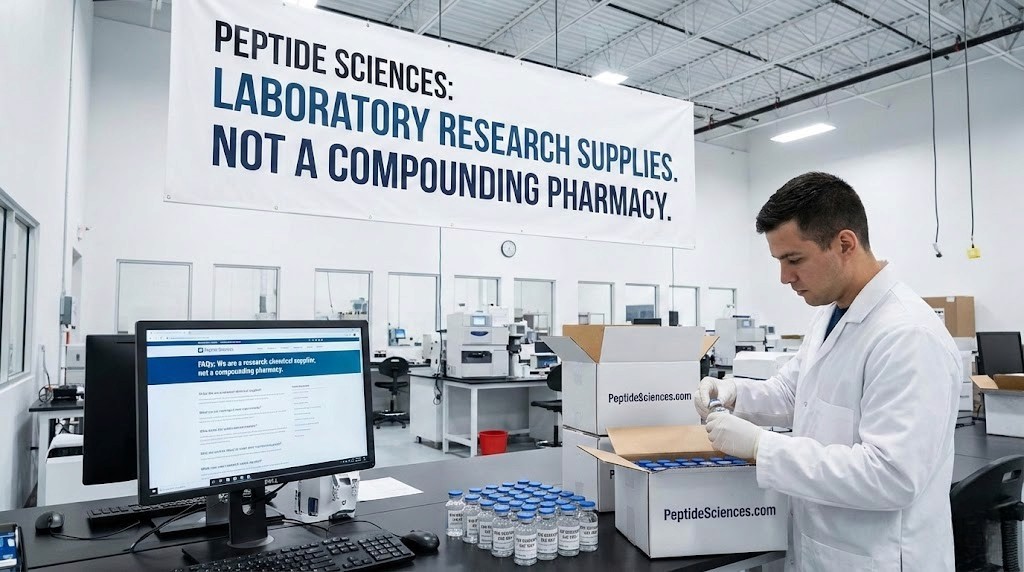
You have been researching peptides for weeks. You found a website called Peptide Sciences. The prices look reasonable and the reviews seem positive. But before you proceed, one question stops you cold. Is Peptide Sciences a compounding pharmacy?
The answer matters more than most people realize.
No. Peptide Sciences is not a compounding pharmacy. It is a research peptide supplier. These two categories could not be more different in terms of regulation, intended use, quality standards, and legal implications. Understanding this distinction is not academic. It affects your safety, your legal standing, and your outcomes.
This guide breaks down everything you need to know about Peptide Sciences, compounding pharmacies, research peptide suppliers, and why the differences between them fundamentally change how you should approach peptide research. Whether you are exploring peptides for the first time or you have years of experience, clarifying these distinctions will help you make informed decisions and avoid costly mistakes.
What is Peptide Sciences?
Peptide Sciences describes itself as a leading provider of research peptides and amino acid derivatives for scientific research and development. The company operates from the United States and ships to researchers domestically and internationally.
Their website states that products are intended for in-vitro laboratory research use only. Not for human use. This disclaimer is not a formality or legal technicality. It defines the entire business model and determines how the company operates within federal regulations.
Peptide Sciences manufactures and distributes peptides using automated and manual peptide synthesizers. They employ both solution and solid-phase peptide synthetic technology. According to their claims, products exceed 99 percent purity. They provide certificates of analysis for each batch and utilize high-performance liquid chromatography and mass spectrometry for testing.
The company has partnered with WHO/GMP and ISO 9001:2015 approved manufacturers. These certifications relate to manufacturing quality but do not change the fundamental classification of their products as research chemicals rather than pharmaceutical preparations.
How Peptide Sciences positions itself
Visit the Peptide Sciences website and you will find a professional layout with detailed peptide information, scientific references, and certificates of analysis. The presentation mirrors what you might expect from a pharmaceutical company. But the business model is fundamentally different.
Research peptide suppliers like Peptide Sciences exist in a specific regulatory space. They sell chemicals intended for laboratory use. The products are not approved for human consumption. The disclaimer stating not for human use is not a suggestion. It is a legal requirement that allows these companies to operate without FDA drug approval.
This positioning creates both advantages and limitations. The advantage is access. Researchers can purchase peptides without prescriptions. The limitation is protection. No regulatory body ensures these products are safe for human use because they are not sold for that purpose.
What is a compounding pharmacy?
A compounding pharmacy operates under an entirely different regulatory framework. These pharmacies create customized medications based on prescriptions from licensed physicians. They function within healthcare systems and answer to pharmacy boards, the FDA, and state regulators.
The Federal Food, Drug, and Cosmetic Act establishes two primary categories for compounding facilities. Section 503A covers traditional compounding pharmacies. Section 503B covers outsourcing facilities that can produce larger batches.
503A compounding pharmacies
Traditional 503A pharmacies create medications for individual patients based on specific prescriptions. A physician evaluates a patient, determines that a commercially available medication does not meet their needs, and writes a prescription for a compounded preparation.
These pharmacies must comply with United States Pharmacopeia standards for compounding both sterile and nonsterile medications. They operate under state pharmacy board oversight. They must use pharmaceutical-grade ingredients, not research-grade chemicals.
The FDA maintains a bulk drug substances list specifying which ingredients 503A pharmacies can legally use for compounding. Category 1 includes substances deemed safe for compounding. Category 2 contains substances under evaluation. Category 3 covers those with insufficient safety data. Only Category 1 substances can be compounded for human use.
This system creates significant limitations on which peptides compounding pharmacies can legally prepare. Many popular peptides, including BPC-157, currently sit in Category 2. This means traditional compounding pharmacies cannot legally compound them for human use.
503B outsourcing facilities
The Drug Quality and Security Act of 2013 created a new category of compounding facilities. These 503B outsourcing facilities can produce medications without patient-specific prescriptions. They can manufacture in larger batches and sell directly to healthcare providers, hospitals, and clinics.
The tradeoff for this expanded capability is stricter oversight. 503B facilities must register with the FDA. They must comply with current Good Manufacturing Practices, the same standards pharmaceutical manufacturers follow. Every batch undergoes testing for potency, sterility, and stability. The FDA inspects these facilities regularly.
503B facilities can only compound from bulk substances that appear on the FDA 503B Bulks List or the Drug Shortages List. The substances available for 503B compounding differ from those allowed for 503A pharmacies.
Why Peptide Sciences is not a compounding pharmacy
The distinction between Peptide Sciences and compounding pharmacies comes down to fundamental business classification, regulatory oversight, and intended product use.
Business classification
Peptide Sciences operates as a research chemical supplier. The company sells raw materials intended for laboratory research. They do not fill prescriptions. They do not operate under pharmacy licenses. They do not employ pharmacists to oversee patient care.
Compounding pharmacies are healthcare entities. They employ licensed pharmacists. They operate under pharmacy board regulation. They fill prescriptions for individual patients. Their products are medications intended for human therapeutic use.
Regulatory oversight
Compounding pharmacies answer to multiple regulatory bodies. State pharmacy boards set licensing requirements and conduct inspections. The FDA establishes which substances can be compounded and under what conditions. USP standards govern preparation procedures. Third-party analytical labs verify potency and sterility.
Research peptide suppliers like Peptide Sciences operate outside this pharmaceutical regulatory framework. The not for human use designation means FDA pharmaceutical regulations do not apply. State pharmacy boards have no jurisdiction over research chemical suppliers. Quality control exists, but it is voluntary rather than mandated.
Product intended use
This is the critical distinction. Compounding pharmacies produce medications for human therapeutic use. Research peptide suppliers produce chemicals for laboratory research. The products may be chemically identical. The legal status and intended application are completely different.
When you purchase from a compounding pharmacy, you receive a medication with dosing instructions, safety information, and a paper trail connecting you to a prescribing physician. When you purchase from a research peptide supplier, you receive a chemical labeled not for human consumption with no medical guidance.
The regulatory landscape for peptide compounding
Understanding the current regulatory environment helps explain why some people turn to research peptide suppliers rather than compounding pharmacies.
The FDA category system
The FDA evaluates bulk drug substances that pharmacies want to compound. The agency places substances into categories based on safety data. Category 1 substances can be compounded. Category 2 substances are under evaluation. Category 3 substances lack sufficient data.
In recent years, the FDA has taken a restrictive approach to peptide compounding. The agency placed several popular peptides in Category 2, effectively preventing compounding pharmacies from legally preparing them.
BPC-157 landed in Category 2 based on FDA concerns about immunogenicity and impurity risks. Ipamorelin and CJC-1295 were removed from Category 2 in September 2024 after nominators withdrew their nominations, but they still cannot be compounded because they never moved to Category 1.
This regulatory situation creates a gap. People interested in these peptides cannot obtain them legally through compounding pharmacies. Some turn to research peptide suppliers despite the not for human use labeling.
Legal challenges to FDA peptide restrictions
The peptide compounding restrictions have generated significant legal pushback. Healthcare providers and compounding pharmacies have challenged the FDA approach on multiple grounds.
Some argue the FDA bypassed required rulemaking procedures when classifying peptides into Category 2 through interim guidance rather than formal regulation. Others contend the restrictions exceed FDA authority under sections 503A and 503B of the Federal Food, Drug, and Cosmetic Act.
The Evexias case highlighted procedural concerns about how the FDA implemented peptide restrictions. Legal experts suggest the FDA peptide crackdown may be on shaky legal ground, though enforcement continues.
This regulatory uncertainty creates confusion for everyone, from researchers to compounding pharmacies to individuals seeking peptide therapy. The landscape continues evolving as legal challenges proceed and the FDA refines its approach.
Quality differences between research peptides and compounded medications
People often assume research peptides are lower quality than compounded medications. The reality is more nuanced. Quality varies significantly across both categories.
Compounding pharmacy quality standards
Compounding pharmacies must use pharmaceutical-grade active ingredients. They must purchase from FDA-registered facilities. They must follow USP standards for preparation. Third-party labs test finished products for potency, sterility, and endotoxins.
503B outsourcing facilities face even stricter requirements. They must comply with current Good Manufacturing Practices, the same standards pharmaceutical manufacturers follow. FDA inspections verify compliance. Every process requires validation.
These requirements create documented quality assurance. Patients receive medications with verified potency and sterility. If problems occur, recall systems exist. Adverse events get tracked and reported.
Research peptide quality considerations
Research peptide suppliers are not required to meet pharmaceutical standards because their products are not sold for human use. Quality assurance is voluntary. Standards vary dramatically between suppliers.
Peptide Sciences claims their products exceed 99 percent purity. They provide certificates of analysis for each batch. They use HPLC and mass spectrometry for testing. They partner with GMP-certified manufacturers.
These claims are encouraging, but verification presents challenges. Third-party testing of research peptides sometimes reveals discrepancies between claimed and actual purity. Some suppliers have been caught selling underdosed or contaminated products.
The research peptide market lacks standardized quality requirements. Some suppliers maintain excellent standards. Others prioritize profit over purity. Without mandatory testing and oversight, buyers must evaluate suppliers carefully.
The quality verification challenge
How do you verify quality when purchasing research peptides? Several approaches help but none provide the certainty of pharmaceutical regulation.
Certificates of analysis document testing results for specific batches. Reputable suppliers provide these documents with every order. However, COAs can be falsified or apply only to initial batches while subsequent production varies.
Third-party testing services analyze peptide samples and verify purity and identity. Organizations like Janoshik and others test samples submitted by customers. Results published on forums help identify reliable suppliers and expose problematic ones.
Community reputation matters in the research peptide space. Forums discuss supplier reliability, product quality, and customer experiences. Long-term positive reputation suggests consistent quality, though it provides no guarantee.
SeekPeptides helps members navigate these quality considerations with comprehensive vendor analysis, community feedback, and educational resources about peptide testing and quality verification.
Legal implications of purchasing research peptides
The legal status of purchasing research peptides creates significant confusion. The situation is neither clearly legal nor clearly illegal in most cases.
Research peptide legality
Buying peptides labeled for research only is not explicitly illegal in most circumstances. The products themselves are not scheduled controlled substances like anabolic steroids or narcotics. Possession is not criminal under federal drug laws.
However, using research peptides on yourself creates legal complications. These products are not FDA-approved for any human indication. The FDA regulates them as unapproved drugs when used therapeutically. Self-administration technically violates FDA regulations regarding unapproved drug use.
Licensed researchers and laboratories can legally purchase research peptides for legitimate scientific studies. Individual buyers using these products personally operate outside clear legal boundaries without typically facing prosecution.
The physician perspective
Healthcare providers face different considerations. A physician cannot legally prescribe research peptides for human use. Doing so risks medical board discipline, DEA attention, and legal liability.
This creates a disconnect. Patients want access to certain peptides. Physicians cannot legally prescribe them if the peptides are not FDA-approved or available through compounding. Some patients turn to research peptide suppliers, creating an unregulated self-treatment situation.
Enforcement realities
While regulations exist, enforcement focuses primarily on suppliers rather than individual buyers. The Department of Justice prosecuted Tailor Made Compounding LLC for distributing unapproved peptides, forcing a $1.79 million forfeiture. Such actions target commercial operations rather than personal use.
This does not mean personal use carries no risk. It means current enforcement priorities focus elsewhere. Regulatory approaches could shift. Personal legal risk, while currently low, exists.
Compounding pharmacy peptides you can actually obtain
Despite restrictions, some peptides remain available through legitimate compounding pharmacies. Understanding what can be legally compounded helps set realistic expectations.
Category 1 peptides
Peptides on the FDA Category 1 list can be compounded by 503A pharmacies. The list is relatively limited but includes some therapeutically relevant options.
NAD+ appears on the Category 1 list. Compounding pharmacies can legally prepare NAD+ formulations for patients with valid prescriptions. This makes NAD+ one of the more accessible compounded peptide options.
Sermorelin also appears on the approved list. This growth hormone releasing hormone analog can be compounded for patients who need growth hormone stimulation. Physicians can legally prescribe it and compounding pharmacies can legally prepare it.
FDA-approved peptide medications
Some peptides have FDA approval as manufactured drugs. These are not compounded but rather produced by pharmaceutical companies under standard drug approval. Compounding pharmacies may prepare these when commercial versions are unavailable or unsuitable.
Semaglutide and tirzepatide have FDA approval for diabetes and weight management. During shortages, compounding pharmacies have prepared these under specific conditions, though recent FDA guidance restricted semaglutide compounding as commercial supply stabilized.
Working with prescribing physicians
Obtaining peptides from compounding pharmacies requires physician involvement. The process typically works as follows.
You consult with a physician experienced in peptide therapy. They evaluate your health status, goals, and appropriateness for peptide treatment. If they determine a compounded peptide is indicated, they write a prescription specifying the peptide, dose, and preparation method.
The prescription goes to a compounding pharmacy. The pharmacy prepares your medication according to the prescription, USP standards, and applicable regulations. You receive a finished product with dosing instructions, storage requirements, and safety information.
This process provides medical oversight, quality assurance, and legal protection. The limitation is access. If the peptide you want is not on the approved list, this pathway does not work.
Finding peptide therapy providers and understanding what physicians can legally prescribe helps navigate this landscape effectively.
Research peptide suppliers: what to know before purchasing
If you decide to purchase from research peptide suppliers like Peptide Sciences despite the not for human use labeling, understanding the market helps you make safer decisions.
Evaluating supplier reputation
Supplier reputation matters enormously in an unregulated market. Established suppliers with years of positive reviews present lower risk than new or poorly reviewed options.
Look for suppliers that provide certificates of analysis with every order. Check if independent testing organizations have verified their products. Review community discussions on peptide forums to understand real customer experiences.
Peptide Sciences has operated for years and maintains generally positive reviews. Customers report consistent product quality and professional service. Some note higher prices compared to alternatives. Third-party testing has largely confirmed their purity claims, though some tests revealed minor discrepancies.
Understanding product labeling
Research peptide suppliers label products for research use only. This labeling has specific implications.
The supplier cannot provide dosing guidance for human use. Asking customer service how to inject a peptide violates the terms under which they operate. Some suppliers have faced legal action for providing such guidance.
Products do not include human dosing instructions, warnings, or contraindications. You receive a chemical, not a medication. Any information about human applications must come from independent research.
Storage and handling considerations
Research peptides require proper storage to maintain stability. Most peptides need refrigeration. Some require freezing. Storage duration affects potency.
Lyophilized peptides in sealed vials remain stable longer than reconstituted solutions. Once you add bacteriostatic water, degradation accelerates. Understanding peptide storage requirements helps maintain product quality.
Research peptide suppliers ship products in insulated packaging with cold packs. Transit time affects what you receive. Ordering during extreme heat requires extra caution.
Reconstitution and preparation
Research peptides typically arrive as lyophilized powder. Preparing them for use requires reconstitution with appropriate diluent.
Bacteriostatic water is the standard diluent for peptides intended for repeated use. The benzyl alcohol preservative inhibits bacterial growth, extending solution stability. Sterile water without preservative requires single-use preparation.
Calculating proper reconstitution volumes requires understanding concentrations. The peptide reconstitution calculator at SeekPeptides simplifies these calculations. Getting concentrations right prevents dosing errors that could affect results or safety.
The critical safety differences
Safety represents perhaps the most important distinction between compounded medications and research peptides. Understanding these differences helps inform your decisions.
Medical oversight
Compounded peptide medications come with physician involvement. A doctor evaluates your health status before prescribing. They consider contraindications, potential interactions, and individual risk factors. If problems occur, you have medical support.
Research peptides come without medical oversight. No physician evaluates whether you should use them. No one checks for contraindications or drug interactions. If adverse effects occur, you manage them independently or seek care without disclosing peptide use.
Product quality assurance
Compounding pharmacies must verify product quality through regulated testing. Third-party labs confirm potency and sterility. If contamination or dosing errors occur, investigation and accountability follow.
Research peptide quality depends on supplier practices. Reputable suppliers maintain quality standards, but verification is voluntary. Contamination or underdosing might go undetected. No regulatory system ensures accountability.
Adverse event reporting
Healthcare products have adverse event reporting systems. If a compounded medication causes harm, reports flow to regulatory agencies. Patterns get identified. Dangerous products get recalled. The system, imperfect as it is, provides collective protection.
Research peptide adverse events generally go unreported. No centralized system tracks problems. If a supplier ships contaminated product, individual buyers may experience harm without triggering any broader response.
Individual versus system-level safety
This distinction between individual and system-level safety matters. A careful individual might successfully use research peptides without problems. But when thousands of people use unregulated products, some will experience adverse events that a regulated system would have prevented or at least documented.
The banning of legal compounding ironically increases risks for some people. Patients desperate for certain peptides turn to unregulated online sources where product quality varies dramatically. Regulatory restrictions intended to protect public health may push some individuals toward higher-risk options.
Making informed decisions about peptide sources
Given the complex landscape, how should you approach peptide sourcing? The answer depends on your priorities, risk tolerance, and specific needs.
When compounding pharmacies make sense
If the peptide you want is available through legitimate compounding, this pathway offers significant advantages. Medical oversight catches problems early. Quality assurance prevents contamination risks. Legal protection eliminates regulatory concerns.
Compounding pharmacies make sense when you want peptides on the approved list, you have access to knowledgeable prescribing physicians, you prioritize safety and legal compliance, and you accept higher costs for these protections.
Peptide therapy costs through legitimate channels typically exceed research peptide prices. The premium reflects regulatory compliance, quality testing, and medical oversight.
When people choose research peptides
Some people choose research peptide suppliers despite the limitations. Understanding their reasoning helps clarify the decision.
Access drives many choices. Peptides in FDA Category 2 cannot be compounded legally. If someone wants BPC-157 for injury recovery, compounding pharmacies cannot provide it. Research peptide suppliers can.
Cost influences decisions. Research peptides typically cost less than compounded medications. For people paying out of pocket, price differences matter.
Some people have positive past experiences with research peptides. They found reliable suppliers, achieved desired outcomes, and saw no reason to change approaches.
None of these factors eliminates the risks of unregulated products. They explain why people make different choices despite those risks.
Risk mitigation if choosing research peptides
If you decide to use research peptides, several practices reduce risk.
Choose established suppliers with verified reputations. Peptide Sciences has years of operation and generally positive reviews. Community feedback helps identify reliable sources.
Request and review certificates of analysis. Verify that COAs match your specific batch. Consider independent testing for expensive purchases.
Start with conservative dosing. Common peptide mistakes include starting at doses too high. Lower initial doses help assess tolerance before increasing.
Maintain proper storage. Temperature control preserves peptide integrity. Poor storage degrades products regardless of initial quality.
Monitor your response. Track effects, side effects, and any unexpected reactions. If problems occur, discontinue use and seek medical attention.
Consider health monitoring. Blood work before and during peptide use helps identify changes. SeekPeptides members access guidance on appropriate monitoring approaches.
Understanding Peptide Sciences specifically
Since the original question asks about Peptide Sciences specifically, deeper analysis of this particular supplier helps inform decisions.
Company background
Peptide Sciences operates from the United States. They describe themselves as providing the highest purity research peptides for scientific research and development. The company has operated for years and maintains significant market presence.
Their manufacturing involves both automated and manual peptide synthesis. They use solid-phase and solution-phase synthetic technologies. Products undergo HPLC and mass spectrometry analysis.
Quality claims and verification
Peptide Sciences claims products exceed 99 percent purity. They provide batch-specific certificates of analysis. They partner with WHO/GMP and ISO 9001:2015 certified manufacturers.
Independent testing has largely supported these claims. Finnrick Analytics conducted lab tests on Peptide Sciences products with generally positive results. Some community-submitted tests have shown similar confirmation of purity and identity.
Occasional discrepancies appear. Some COAs show purity slightly below competing suppliers, like 99.3 percent versus 99.8 percent. Whether such differences matter practically depends on application sensitivity.
Customer experience
Customer reviews for Peptide Sciences are generally positive. Long-term customers report consistent quality, professional packaging, and prompt shipping. Products arrive in appropriate cold packaging.
Criticisms include higher prices compared to alternatives, limited customer service responsiveness, and lack of return policy. Some recent reviews mention concerns about product appearance upon reconstitution, though these reports are scattered among many positive experiences.
Practical considerations
Peptide Sciences serves researchers seeking reliable peptide supplies. Their products are appropriate for laboratory research applications as labeled. The not for human use designation is genuine, not a formality.
Anyone purchasing from Peptide Sciences should understand they are buying research chemicals. The products are not medications. No medical guidance accompanies purchase. Responsibility for appropriate use rests entirely with the buyer.
Alternatives to Peptide Sciences
If Peptide Sciences does not meet your needs, several alternatives exist within both the research peptide and compounding pharmacy categories.
Other research peptide suppliers
The research peptide market includes numerous suppliers with varying quality and reputation.
Some domestic US suppliers maintain similar quality standards to Peptide Sciences. Others offer lower prices with potentially lower quality. International suppliers, particularly from China, offer significant cost savings with variable quality and longer shipping times.
Evaluating alternatives requires the same due diligence as evaluating Peptide Sciences. Check reputation on peptide forums. Request certificates of analysis. Consider independent testing for significant purchases.
Peptide vendor reviews and sourcing guides help navigate the options.
Compounding pharmacy options
For peptides that can be legally compounded, numerous pharmacies provide these services. Quality varies. Finding experienced providers matters.
Look for pharmacies with specific peptide compounding experience. Ask about testing procedures, sterility assurance, and quality certifications. Verify they compound the specific peptide you need using approved bulk substances.
Peptide therapy clinic guides help locate legitimate providers in various regions.
Clinical trial access
Some peptides are available through clinical trials. Participation provides access to experimental treatments under medical supervision with quality-assured products.
Clinical trial access is limited. Eligibility criteria restrict participation. Geographic availability varies. But for certain conditions and peptides, this pathway offers unique advantages.
ClinicalTrials.gov lists active studies. Searching for specific peptides reveals enrollment opportunities in your area.
The future of peptide access
The regulatory landscape for peptides continues evolving. Understanding current trends helps anticipate future access pathways.
FDA regulatory direction
The FDA has moved toward restricting peptide compounding. The Category 2 classifications for popular peptides signal agency concerns about safety data gaps. Enforcement actions against compounding facilities demonstrate willingness to act on these concerns.
However, legal challenges to FDA authority continue. Court decisions could affect agency power to restrict compounding. Congressional interest in peptide access may influence future regulation.
Pharmaceutical development
Some peptides currently available only as research chemicals may eventually gain FDA approval as manufactured drugs. The drug development pathway is expensive and time-consuming, but successful approval would create legal access routes.
Pharmaceutical companies pursue peptide development when commercial potential justifies investment. Weight loss peptides like tirzepatide demonstrate this pathway. Whether therapeutic peptides like BPC-157 attract similar investment remains uncertain.
Regulatory reform possibilities
Some advocate for regulatory changes that would expand access to compounded peptides while maintaining safety standards. Proposed approaches include streamlined approval processes for peptides with established safety records, clearer pathways for compounding pharmacies to demonstrate safety data, and category system reforms that better balance access and protection.
Whether regulatory reform occurs depends on political factors, legal outcomes, and ongoing safety monitoring. The current restrictive trend could continue, stabilize, or reverse depending on these developments.
Practical protocols for common peptide goals
Understanding peptide sourcing becomes more relevant when connected to specific applications. Here are considerations for common peptide research areas.
Injury recovery peptides
People researching peptides for injury recovery often focus on BPC-157 and TB-500. Neither is currently available through legitimate compounding pharmacies.
BPC-157 sits in FDA Category 2. TB-500, while not explicitly categorized, lacks approval for human compounding. Research interest in both peptides remains high, but legal access through healthcare channels does not exist.
Those researching these peptides must currently use research peptide suppliers. Understanding proper dosing protocols, mechanisms, and safety considerations becomes essential without medical guidance.
Growth hormone secretagogues
Peptides that stimulate growth hormone release include ipamorelin, CJC-1295, and various combinations. Sermorelin can be compounded legally. Others face restrictions.
For those seeking growth hormone stimulation through legitimate channels, sermorelin represents the most accessible option. Working with knowledgeable physicians who understand sermorelin protocols creates a legal pathway with medical oversight.
Weight management peptides
Weight management peptides present a unique situation. Semaglutide and tirzepatide have FDA approval as manufactured drugs. During shortages, compounding was possible. As supply stabilizes, compounding restrictions tighten.
The primary access route for these peptides is through FDA-approved medications. Generic versions and compounding may become more accessible as patents expire and supply increases.
Research peptide suppliers do offer semaglutide and tirzepatide analogs. Quality and safety considerations apply. These powerful medications carry significant risks when used without medical supervision.
Anti-aging and longevity peptides
Longevity-focused peptide research involves compounds like epitalon, NAD+ precursors, and various bioregulator peptides.
NAD+ can be compounded legally. This creates a legitimate access route for one of the most researched longevity interventions. Clinics offering NAD+ therapy operate within regulatory frameworks.
Other longevity peptides remain in the research category. Epitalon, SS-31, and similar compounds are available only through research peptide suppliers.
Frequently asked questions
Is Peptide Sciences FDA approved?
No. Peptide Sciences is not FDA approved because FDA approval applies to drugs intended for human use. Peptide Sciences sells research chemicals labeled not for human consumption. These products do not go through FDA drug approval processes. The FDA has no approval role for research chemicals sold for laboratory use.
Can I get a prescription for peptides from Peptide Sciences?
No. Peptide Sciences does not fill prescriptions. They are not a pharmacy. They sell research chemicals to researchers. To obtain prescription peptides, you need to work with a physician who can prescribe and a compounding pharmacy that can prepare FDA-approved or compoundable peptides.
Are research peptides the same quality as compounding pharmacy peptides?
Quality varies in both categories. Reputable research peptide suppliers like Peptide Sciences maintain high purity standards and provide testing documentation. Compounding pharmacies must meet regulatory quality requirements. The key difference is mandatory oversight. Compounding pharmacy quality is verified through required testing and inspections. Research peptide quality depends on voluntary supplier practices.
Why would someone buy from research peptide suppliers instead of compounding pharmacies?
Several reasons drive this choice. Many peptides, including BPC-157, cannot be legally compounded due to FDA restrictions. Research peptides typically cost less than compounded medications. Some people have established relationships with research suppliers and trust their quality. Access and cost are primary factors.
Is it illegal to buy research peptides?
Purchasing research peptides is not explicitly illegal. The products themselves are not scheduled controlled substances. However, using them on yourself technically violates FDA regulations regarding unapproved drug use. Enforcement focuses primarily on suppliers rather than individual buyers. Legal risk exists but prosecution of personal use is rare.
How can I verify research peptide quality?
Several approaches help verify quality. Request certificates of analysis for your specific batch. Compare COA data to expected values for the peptide. Consider independent testing through services like Janoshik. Review supplier reputation on peptide forums. SeekPeptides provides guidance on quality verification for members.
What peptides can compounding pharmacies legally prepare?
Compounding pharmacies can prepare peptides that appear on the FDA Category 1 bulk substances list, have FDA GRAS status, have USP monographs, or have FDA approval. Currently compoundable peptides include NAD+, sermorelin, and a limited list of others. Many popular peptides including BPC-157 are not compoundable due to Category 2 classification.
Should I tell my doctor I am using research peptides?
Medical honesty generally serves your health interests. If you experience adverse effects or need medical care, your doctor needs accurate information to help you. However, some people worry about documentation or judgment. The decision involves weighing health benefits of full disclosure against other concerns. Peptide communities discuss these considerations in detail.
External resources
In case I do not see you, good afternoon, good evening, and good night. May your sources stay verified, your quality stay consistent, and your decisions stay informed.