Dec 22, 2025

Every cell in your body contains hundreds to thousands of tiny power plants called mitochondria, and by the time you're 70, they're operating at roughly half their youthful capacity.
This isn't just an abstract biological fact.
It's the reason you feel more tired than you used to.
It's why recovery takes longer. It's a driving force behind cognitive decline, heart disease, and the gradual loss of muscle mass that comes with age.
Mitochondrial dysfunction sits at the center of aging itself.
SS-31 (also known as Elamipretide) represents a fundamentally different approach to addressing this problem. Unlike antioxidants that circulate throughout the body hoping to neutralize damage wherever they find it, SS-31 concentrates directly inside mitochondria, approximately 5,000-fold, where it stabilizes the very membrane structures that keep these organelles functioning.
The result is a peptide that doesn't just protect against damage but actively restores mitochondrial efficiency. Clinical trials have tested SS-31 in conditions ranging from heart failure to mitochondrial myopathy to age-related macular degeneration, with the FDA granting it accelerated approval in 2025 for Barth syndrome under the brand name Forzinity.
This guide covers what SS-31 is, how it works at the molecular level, the research behind its benefits, and practical information about dosing and safety.
What is SS-31
SS-31 is a synthetic tetrapeptide with the sequence D-Arg-dimethylTyr-Lys-Phe-NH2. It goes by several names in research and clinical contexts:
Elamipretide – The pharmaceutical name used in clinical trials Bendavia – An earlier trademark MTP-131 – A research designation Forzinity – The FDA-approved brand name for Barth syndrome treatment
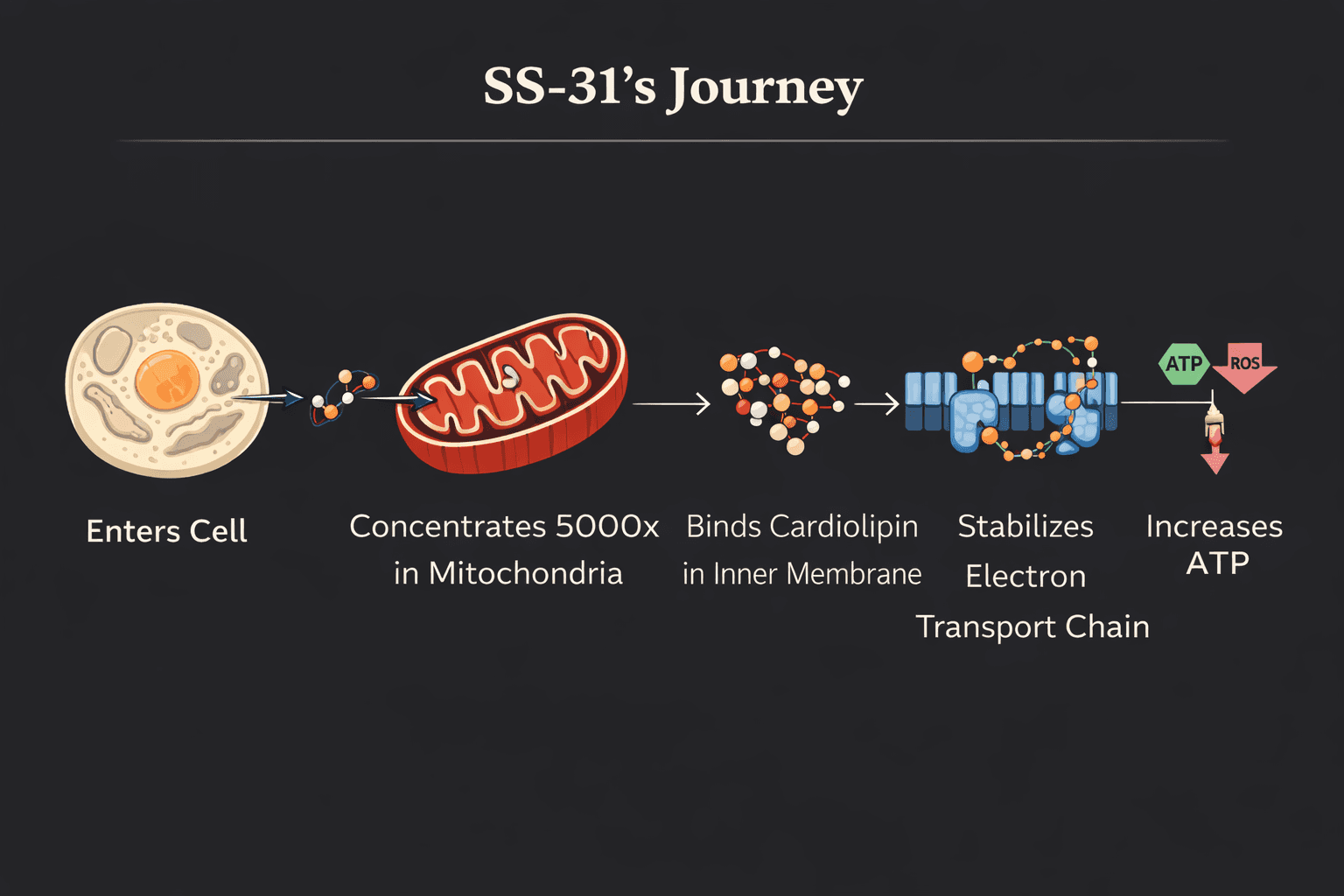
What makes SS-31 unique: Unlike most peptides that work by binding to cell surface receptors, SS-31 is designed to penetrate cell membranes and accumulate specifically in mitochondria. Once there, it binds to cardiolipin—a phospholipid found exclusively in the inner mitochondrial membrane—and stabilizes the structures responsible for energy production.
Development history: SS-31 was developed through the Szeto-Schiller (SS) peptide series, which explored aromatic-cationic peptides capable of targeting mitochondria. The "31" designation indicates the specific sequence found to have optimal mitochondrial targeting and protective properties.
Regulatory status: In 2025, the FDA granted accelerated approval to elamipretide (Forzinity) as the first treatment for Barth syndrome, a rare genetic disorder affecting mitochondrial cardiolipin metabolism. For all other conditions, SS-31 remains investigational and is not approved for general clinical use.
How SS-31 works
Understanding SS-31's mechanism explains why it's effective across so many different conditions—they all share mitochondrial dysfunction as a root cause.
Mitochondrial targeting and accumulation
SS-31's structure gives it remarkable selectivity for mitochondria:
Cationic properties: The positively charged amino acids (arginine and lysine) are attracted to the negative electrical potential across mitochondrial membranes.
Aromatic residues: The dimethyltyrosine and phenylalanine components allow SS-31 to interact with the lipid environment of membranes.
Rapid uptake: Peak plasma levels occur within 15 minutes of administration, with steady state reached in about 30 minutes.
Massive concentration: Studies show SS-31 accumulates approximately 5,000-fold in mitochondria compared to the surrounding cytoplasm. This concentration effect means tiny doses can achieve therapeutic levels exactly where needed.
Tissue distribution: SS-31 reaches highest concentrations in the kidneys, followed by the heart, liver, lungs, and skeletal muscle, all tissues with high energy demands and dense mitochondrial populations.
Cardiolipin stabilization
The core mechanism of SS-31 is its interaction with cardiolipin:
What is cardiolipin: Cardiolipin is a unique phospholipid found exclusively in the inner mitochondrial membrane. It's essential for organizing the protein complexes of the electron transport chain and maintaining the folded cristae structure that maximizes ATP production surface area.
Why cardiolipin matters: When cardiolipin becomes damaged (through oxidation) or depleted (through aging or disease), the electron transport chain becomes disorganized, ATP production drops, and reactive oxygen species (ROS) leak out, causing further damage.
How SS-31 helps: By binding to cardiolipin, SS-31 protects it from oxidative damage, maintains proper membrane structure, and preserves the organization of respiratory complexes.
This creates a virtuous cycle, better organization means more efficient electron transport, which means less ROS production, which means less cardiolipin damage.
Effects on energy production
The downstream effects of cardiolipin stabilization include:
Improved electron transport efficiency: Better organization of respiratory complexes (I, III, and IV) means electrons flow more smoothly through the chain with less "leakage."
Enhanced ATP synthesis: More efficient electron transport drives more protons across the membrane, powering ATP synthase to produce more ATP per oxygen consumed.
Reduced ROS production: When electron transport is inefficient, electrons can escape and react with oxygen to form superoxide and other reactive species. SS-31 reduces this leakage at the source.
Better ADP sensitivity: Research shows SS-31 improves how mitochondria respond to ADP (the signal that more energy is needed), particularly in aged tissues where this sensitivity declines.
Beyond energy: additional mechanisms
SS-31's effects extend beyond simple energy production:
Anti-inflammatory: By reducing ROS production, SS-31 decreases activation of inflammatory pathways that are triggered by oxidative stress.
Anti-apoptotic: SS-31 helps prevent the opening of the mitochondrial permeability transition pore, a key event in programmed cell death.
Improved autophagy: Some research suggests SS-31 supports the cellular cleanup processes that remove damaged mitochondria.
BDNF signaling: In brain tissue, SS-31 has been shown to promote brain-derived neurotrophic factor pathways, supporting neuroplasticity.
SS-31 benefits: what the research shows
The benefits of SS-31 stem from its fundamental role in restoring mitochondrial function. Here's what clinical and preclinical research has demonstrated.
Energy and fatigue
The most direct benefit of improved mitochondrial function is enhanced cellular energy production.
Clinical evidence: In the MMPOWER-2 trial of patients with primary mitochondrial myopathy, SS-31 treatment (40 mg/day) resulted in participants reporting significantly less fatigue compared to placebo. The Primary Mitochondrial Myopathy Symptom Assessment showed improved Total Fatigue scores (p=0.0006).
Preclinical findings: Studies in aged mice show SS-31 rapidly improves mitochondrial ATP production capacity (ATPmax) and the efficiency of ATP synthesis (P/O ratio). These improvements translate to measurable increases in exercise tolerance.
Mechanism: By improving how efficiently mitochondria convert nutrients to ATP, SS-31 addresses fatigue at its cellular source rather than simply masking symptoms.
For those exploring peptides for energy, SS-31 offers a unique mechanism that targets the fundamental machinery of cellular power generation.
Skeletal muscle and exercise tolerance
Muscle tissue is exceptionally dependent on mitochondrial function, making it highly responsive to SS-31.
Age-related muscle decline: In aged mice, 8 weeks of SS-31 treatment reversed age-related decline in maximum mitochondrial ATP production and improved the coupling efficiency of oxidative phosphorylation.
Exercise performance: The same study showed SS-31-treated aged mice had significantly greater treadmill endurance compared to both their pre-treatment baseline and untreated controls. Muscle tissue was more fatigue-resistant and had greater mass.
Fatigue resistance: Isolated muscle from SS-31-treated animals showed improved resistance to fatigue during repeated contractions, indicating better sustained energy supply.
Clinical translation: The improvements seen in mitochondrial myopathy patients suggest these benefits may extend to age-related sarcopenia and general fitness applications, though more research is needed.
Heart function
The heart is among the most mitochondria-dense organs, making it particularly responsive to mitochondrial-targeted therapies.
Heart failure research: Clinical trials have tested SS-31 in patients with heart failure with reduced ejection fraction (HFrEF). In one study, a single 4-hour infusion resulted in significant decreases in left ventricular end-diastolic and end-systolic volume at the highest dose versus placebo.
Cardiac remodeling: Preclinical studies show SS-31 prevents maladaptive cardiac remodeling following heart attack by preserving mitochondrial function in surviving heart muscle.
Stroke volume improvements: In the Barth syndrome trial, patients showed increases in cardiac stroke volume after 36 weeks of treatment, suggesting improved heart muscle function.
Mechanism: By maintaining ATP supply to heart muscle and reducing oxidative stress, SS-31 supports both the mechanical function and the structural integrity of cardiac tissue.
Neuroprotection and cognitive function
Brain tissue has extremely high energy demands and limited tolerance for oxidative stress, making it vulnerable to mitochondrial dysfunction.
Cognitive protection: In animal models of anesthesia-induced cognitive impairment, SS-31 pretreatment protected cognitive function by maintaining mitochondrial complex I activity and ATP production. It also prevented opening of the mitochondrial permeability transition pore, a key event in neuronal death.
Neuroinflammation: Studies show SS-31 improves memory and learning in models of lipopolysaccharide-induced neuroinflammation by reducing oxidative stress and protecting synaptic function.
BDNF promotion: SS-31 has been shown to facilitate brain-derived neurotrophic factor signaling, promoting synaptic plasticity—the foundation of learning and memory.
Alzheimer's research: Preclinical studies suggest SS-31 may reduce markers of neurodegeneration in Alzheimer's disease models, though human data is limited.
Kidney protection
The kidneys have exceptionally high mitochondrial density to power the energy-intensive process of blood filtration.
Distribution: Pharmacokinetic studies show SS-31 achieves its highest tissue concentrations in the kidneys, making renal protection a particularly relevant application.
Ischemia protection: In animal models, SS-31 accelerates ATP recovery and reduces kidney injury following ischemia (reduced blood flow).
Diabetic nephropathy: SS-31 has shown protective effects against diabetic kidney damage in preclinical models by reducing oxidative stress.
Renal artery stenosis: A clinical study in patients with severe atherosclerotic renal artery stenosis showed SS-31 treatment during stenting reduced hypoxic damage and improved renal blood flow at 3-month follow-up.
Vision and eye health
The retina and optic nerve are metabolically demanding tissues vulnerable to mitochondrial dysfunction.
Age-related macular degeneration: Phase 1 clinical trials have tested SS-31 in patients with intermediate AMD. Subcutaneous injection of 40 mg daily for 24 weeks was safe and well-tolerated, with exploratory analyses suggesting potential improvements in low-luminance visual function.
Optic nerve disease: SS-31 received fast-track designation for Leber's Hereditary Optic Neuropathy, a mitochondrial disease affecting the optic nerve.
Glaucoma protection: Preclinical studies suggest SS-31 may protect retinal ganglion cells from glaucoma-related damage.
Anti-aging and longevity
The role of mitochondrial dysfunction in aging makes SS-31 particularly interesting for longevity applications.
Oxidative stress reduction: By reducing ROS production at the source (the electron transport chain), SS-31 addresses one of the primary drivers of cellular aging.
Redox homeostasis: The 8-week mouse study showed SS-31 reversed age-related shifts in cellular redox balance, restoring a more reduced (less oxidized) state across the muscle proteome.
Cellular senescence: By reducing oxidative damage and supporting mitochondrial function, SS-31 may slow the accumulation of senescent cells.
Multiple pathways: SS-31's effects on inflammation, energy production, and cellular protection address multiple hallmarks of aging simultaneously.
For comprehensive anti-aging strategies, SS-31 pairs conceptually with other longevity-focused interventions. See our peptide stacks guide for combination approaches.
SS-31 dosing protocols
Dosing information comes primarily from clinical trials.
SS-31 is administered via subcutaneous injection.
Clinical trial dosing
Barth syndrome (FDA-approved indication):
Dose: 40 mg once daily Route: Subcutaneous injection Duration: Ongoing (chronic treatment)
Mitochondrial myopathy trials:
Dose: 40 mg once daily Route: Subcutaneous Duration: 4-12 weeks in controlled trials, with open-label extensions
Heart failure trials:
Dose: 4 mg or 40 mg once daily Route: Subcutaneous Duration: 28 days in the primary trial
Intravenous protocols (clinical setting):
Dose range: 0.01-0.25 mg/kg/hour over 4 hours Used in: Acute settings like myocardial infarction
Research-derived protocols
For those exploring SS-31 outside of approved indications, protocols derived from clinical research suggest:
Starting dose: 5 mg daily for 1-2 weeks to assess tolerance
Standard target: 10 mg daily by week 3 (commonly used in research settings)
Advanced range: 15-20 mg daily for week 5+ (only for specific conditions under medical oversight)
Frequency: Once daily, subcutaneous injection
Cycle length: 8-12 weeks is typical in clinical trials; limited data exists beyond 12 weeks
Timing: No specific time requirements; consistency is more important than timing
Reconstitution (for lyophilized powder)
For a 15 mg vial:
Add 3 mL bacteriostatic water
Concentration: 5 mg/mL (0.05 mg per unit on U-100 insulin syringe)
Draw 0.2 mL (20 units) for a 10 mg dose
For a 30 mg vial:
Add 3 mL bacteriostatic water
Concentration: 10 mg/mL (0.1 mg per unit)
Draw 0.1 mL (10 units) for a 10 mg dose
For detailed reconstitution instructions, see our how to reconstitute peptides guide.
Administration
Injection site: Subcutaneous injection into abdominal fat, thigh, or upper arm
Rotation: Rotate injection sites to prevent tissue irritation
Technique: Standard subcutaneous injection at 45-90 degree angle
For larger doses (≥15 mg): Consider splitting into two injections at least 2 inches apart
Side effects and safety
SS-31 has demonstrated a favorable safety profile across multiple clinical trials.
Common side effects
Injection site reactions: The most frequently reported side effects in clinical trials:
Erythema (redness): ~57% of patients
Pruritus (itching): ~47% of patients
Pain at injection site: ~20% of patients
Urticaria (hives): ~20% of patients
Irritation: ~10% of patients
Most injection site reactions are mild and resolve within hours to days.
Less common side effects
Systemic effects reported in some trials:
Headache (mild)
Nausea (mild, temporary)
Fatigue (transient)
Dizziness (rare)
Safety data
Clinical trial safety: In trials using doses up to 40 mg daily for up to 12 weeks, SS-31 was well-tolerated with no serious adverse events attributed to the drug.
No systemic toxicity: SS-31 has shown no evidence of systemic toxicity in human studies.
No mitochondrial overload: Despite targeting mitochondria, SS-31 has not shown evidence of causing mitochondrial dysfunction or overload, it stabilizes normal function rather than overstimulating it.
Renal excretion: SS-31 is completely excreted by the kidneys, with 100% of peptides and metabolites detected in urine.
Half-life: Elimination half-life is approximately 2 hours in animal studies, allowing for once-daily dosing.
Considerations and precautions
Limited long-term data: While short-term safety is well-established, data beyond 12-24 weeks is limited. The Barth syndrome approval included longer follow-up, but generalizability to other populations is uncertain.
Not approved for general use: Outside of Barth syndrome, SS-31 remains investigational. Quality, purity, and dosing accuracy are not assured for research-grade products.
Pregnancy and breastfeeding: No safety data exists; avoid use.
Mitochondrial diseases: Individuals with known mitochondrial disorders should only use SS-31 under direct medical supervision.
Kidney function: While SS-31 is eliminated renally, specific dose adjustments for kidney impairment have not been established.
For broader context on peptide safety, see our peptide safety and risks guide.
Clinical trials: successes and limitations
Understanding SS-31's clinical trial history provides important context for its potential and limitations.
Successful trials
Barth syndrome (TAZPOWER trial): This phase 2/3 trial led to FDA approval. While the 12-week controlled portion didn't meet primary endpoints, the 36-week open-label extension showed significant improvements:
6-minute walk test: +95.9 meters (p=0.024)
Symptom assessment scale: -2.1 points (p=0.031)
Increased cardiac stroke volume
Mitochondrial myopathy (MMPOWER-2): Though walking distance improvements didn't reach statistical significance, patient-reported fatigue scores improved significantly:
Total Fatigue score: p=0.0006
Fatigue During Activities: p=0.0018
Trials that didn't meet primary endpoints
Heart failure (PROGRESS-HF): While safe and tolerable, SS-31 didn't show significant improvements in the primary cardiac imaging endpoints in this population.
MMPOWER-3: The phase 3 trial in primary mitochondrial myopathy was terminated because it didn't meet primary endpoints during the double-blind portion.
Interpretation
The mixed results highlight an important reality: mitochondrial dysfunction contributes to many conditions, but SS-31 may be more effective for some than others. The strongest evidence exists for:
Conditions with direct mitochondrial etiology (like Barth syndrome)
Fatigue and muscle symptoms (consistent improvements across trials)
Acute cellular stress situations (ischemia models)
Heart failure and some other conditions may involve additional pathophysiology that limits the benefit from mitochondrial support alone.
SS-31 vs other mitochondrial compounds
Several compounds target mitochondrial function. Here's how SS-31 compares:
Compound | Primary target | Mechanism | Best for |
|---|---|---|---|
SS-31 | Cardiolipin (inner membrane) | Stabilizes membrane structure, improves ETC efficiency | Direct mitochondrial dysfunction, aging |
MOTS-c | AMPK pathway | Metabolic reprogramming, exercise mimetic | Metabolic health, endurance |
Humanin | Multiple | Cytoprotection, anti-apoptotic | Neuroprotection, cell survival |
CoQ10 | Electron carrier | Supports electron transport | General antioxidant, statin users |
NAD+ precursors (NMN/NR) | NAD+ pool | Supports sirtuins and redox balance | Cellular energy, longevity signaling |
Key distinction: SS-31 works by physically stabilizing mitochondrial membrane structure, while most other compounds either serve as cofactors (CoQ10, NAD+) or signal through metabolic pathways (MOTS-c). This makes SS-31 potentially complementary to these other approaches.
Combination considerations
SS-31 + NAD+ precursors: Theoretically complementary, SS-31 optimizes the machinery while NAD+ ensures adequate substrate.
One study (Whitson et al., 2020) examined both in aged hearts and found distinct but overlapping benefits.
SS-31 + CoQ10: May provide redundant antioxidant effects at the ETC level, but CoQ10's role as an electron carrier could complement SS-31's structural effects.
SS-31 + MOTS-c: Different mechanisms suggest potential synergy for combined bioenergetic and metabolic optimization.
Storage and handling
Proper storage maintains SS-31's stability and effectiveness.
Storage requirements
Lyophilized powder (before reconstitution):
Store frozen at -20°C (-4°F) for long-term storage
Protect from light
Keep in original sealed vial
Stable for months when properly frozen
Reconstituted solution:
Refrigerate immediately at 2-8°C (35.6-46.4°F)
Use within 4 weeks for optimal stability
Do not freeze reconstituted solution
Protect from light
Handling
Reconstitute under aseptic conditions
Allow powder to dissolve by gentle swirling, do not shake vigorously
Visually inspect solution for particles or discoloration before use
Prepare aliquots if needed to minimize freeze-thaw cycles
For comprehensive guidance, see our peptide storage guide.
Frequently asked
How quickly does SS-31 work?
SS-31 reaches peak plasma levels within 15 minutes and achieves steady state in mitochondria within about 30 minutes. Some effects on ATP production can be measured acutely. However, clinical benefits like improved exercise tolerance typically develop over weeks of treatment.
Is SS-31 FDA approved?
SS-31 (as Forzinity/elamipretide) received FDA accelerated approval in 2025 specifically for Barth syndrome. It is not approved for any other condition. All other uses remain investigational.
How is SS-31 different from regular antioxidants?
Traditional antioxidants (vitamin C, vitamin E) circulate throughout the body and neutralize ROS wherever they encounter them. SS-31 concentrates 5,000-fold specifically in mitochondria and prevents ROS from being produced in the first place by stabilizing electron transport. This targeted approach is more efficient and addresses the source rather than the symptoms.
Can SS-31 help with chronic fatigue?
The mechanism is sound—if fatigue stems from mitochondrial dysfunction, improving mitochondrial function should help. Clinical trials in mitochondrial myopathy showed significant improvements in fatigue scores. However, chronic fatigue has many potential causes, and SS-31 hasn't been specifically studied for chronic fatigue syndrome.
Does SS-31 build muscle?
SS-31 doesn't directly stimulate muscle growth like anabolic compounds. However, by improving mitochondrial function and reducing age-related muscle decline, it may support muscle preservation and function. Aged mice treated with SS-31 showed greater muscle mass than untreated controls.
How long should I cycle SS-31?
Clinical trials have used 8-12 week protocols. Some researchers suggest cycling 8 weeks on, 4-12 weeks off, though optimal cycling strategies haven't been established. The Barth syndrome approval involves ongoing daily treatment, suggesting long-term use may be appropriate for chronic conditions.
Can SS-31 be taken orally?
Most clinical research uses subcutaneous injection. Early studies suggest oral SS-31 is safe and may have some bioavailability, but efficacy data for oral administration is limited. Injection remains the standard route.
Is SS-31 legal?
SS-31 is approved as a prescription drug (Forzinity) for Barth syndrome. For other uses, it's typically sold as a research chemical. Legality varies by jurisdiction—it's not a controlled substance but also isn't approved for general human use.
What's the difference between SS-31 and Elamipretide?
They're the same compound. SS-31 is the research designation from the Szeto-Schiller peptide series. Elamipretide is the pharmaceutical name used in clinical development. Forzinity is the brand name for the FDA-approved product.
The bottom line on SS-31
SS-31 represents a genuinely novel approach to addressing mitochondrial dysfunction—not just as a theoretical target but as a clinically validated strategy that has resulted in FDA approval for at least one condition.
Key takeaways:
SS-31 works by concentrating in mitochondria and stabilizing cardiolipin, the key structural lipid that organizes the energy-producing machinery
Clinical trials demonstrate improvements in fatigue, muscle function, and some measures of cardiac and renal function
The safety profile is favorable, with injection site reactions being the primary side effect
FDA approval for Barth syndrome validates the mechanism; other applications remain investigational
Typical research protocols use 5-40 mg daily via subcutaneous injection for 8-12 weeks
SS-31 is most relevant for:
Age-related decline in energy and exercise tolerance
Conditions involving mitochondrial dysfunction
Recovery support in metabolically demanding contexts
Longevity and healthspan optimization strategies
Limitations to understand:
Not all clinical trials met their primary endpoints
Long-term safety data is limited
Research-grade products lack quality assurance
Individual response varies based on underlying mitochondrial status
As mitochondrial medicine advances, SS-31 stands as one of the most promising compounds for addressing the cellular energy decline that underlies so much of aging and disease.
Whether it becomes a mainstream therapeutic or remains a specialized tool for specific conditions, its mechanism offers genuine insight into how we might maintain cellular vitality across the lifespan.
Related guides
Best peptide for energy – Energy-boosting peptide options
Peptide stacks guide – How to combine peptides effectively
Peptide safety and risks – Understanding peptide safety
How to reconstitute peptides – Injection preparation guide
In case I don’t see you, good afternoon, good evening, and good night. Take care of yourself.