Mar 20, 2026
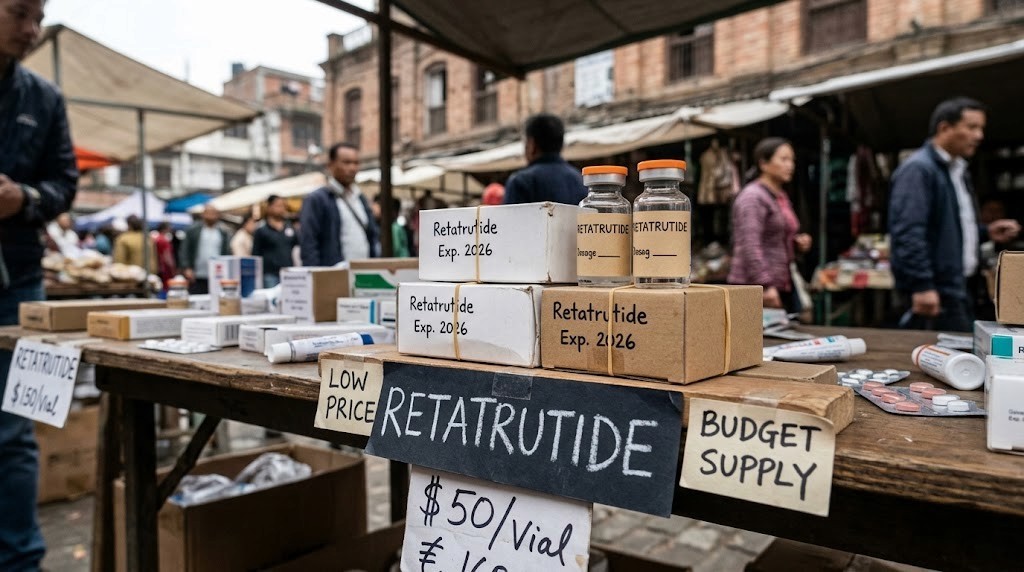
Experienced researchers know something that beginners almost always learn the hard way. The cheapest retatrutide is rarely the most affordable. That sounds contradictory. It is not. Because the vial with the lowest price tag often delivers the least peptide per dollar, the worst purity per milligram, and the most frustrating results per injection. The real savings come from understanding how retatrutide pricing actually works, what drives costs up and down, and where the genuine opportunities for savings exist without gutting the quality that makes the peptide worth purchasing in the first place.
Retatrutide has exploded in popularity since Eli Lilly published Phase 2 trial data showing up to 24.2% body weight reduction over 48 weeks. The Phase 3 TRIUMPH-4 trial pushed that even further, with participants losing an average of 71.2 pounds at the highest dose. Those numbers made retatrutide the most potent weight loss peptide ever studied in clinical trials. And that kind of attention drives demand. Demand drives pricing. Pricing drives the hunt for cheaper options.
This guide breaks down every angle of finding affordable retatrutide. You will learn what drives the cost differences between vendors, how to evaluate whether a low price signals savings or danger, which purchasing strategies actually reduce your per-milligram cost, and how to verify that what arrives in the mail matches what the label claims. Whether you are comparing where to buy retatrutide for the first time or looking to optimize an existing protocol budget, this is the resource that puts real numbers behind every decision.
What retatrutide actually costs right now
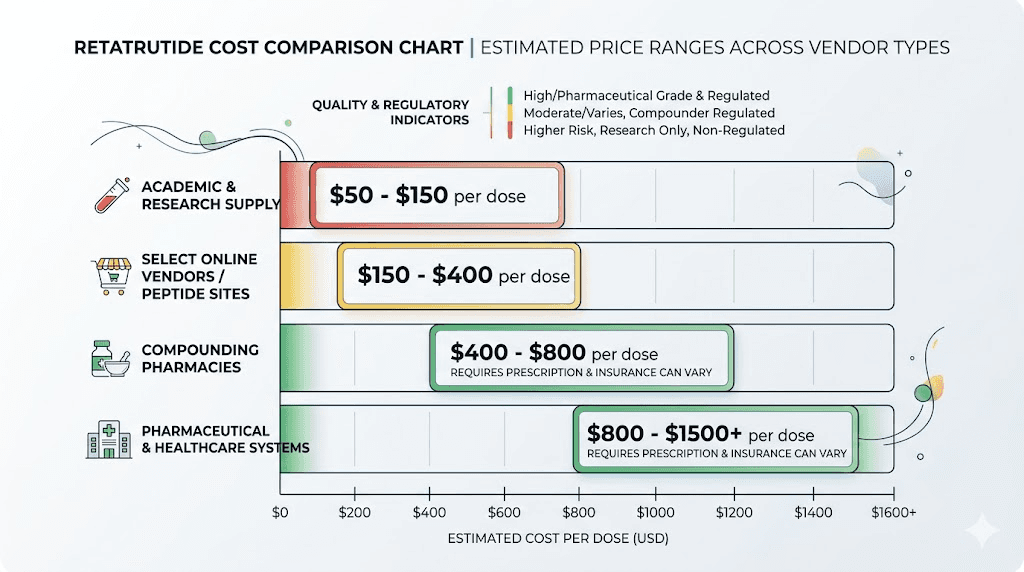
Before hunting for cheap options, you need to understand the baseline. Retatrutide is not yet FDA-approved. That means there is no standardized retail price, no insurance coverage, and no pharmacy benefit manager negotiating rates on your behalf. Every dollar comes out of pocket, which makes price sensitivity completely rational.
The current market breaks into three distinct tiers, each with different pricing structures, quality expectations, and risk profiles. Understanding these tiers is essential before comparing any individual vendor or listing.
Research peptide vendors
Research-grade retatrutide from online peptide vendors typically ranges from $40 to $120 per 5mg vial. A 10mg vial runs between $70 and $200 depending on the supplier, purity verification, and whether independent third-party testing is included. Some vendors offer 20mg and 30mg vials at $150 to $400, which drops the cost per milligram significantly. The retatrutide 20mg vial format has become particularly popular for researchers running longer protocols because the per-milligram savings compound over the full duration.
At clinical trial dosing of 8 to 12mg per week, research peptide costs translate to roughly $150 to $500 per month. That range is wide. The low end represents bulk purchasing from competitive vendors. The high end reflects single-vial purchases from premium suppliers with extensive testing documentation.
Compounded pharmacy retatrutide
Compounded retatrutide from telehealth platforms and compounding pharmacies runs $200 to $650 per month. These come with prescriber oversight, standardized manufacturing under pharmacy regulations, and dosing guidance. A 20mg vial from a compounding pharmacy typically costs $200 to $350, while 30mg vials range from $280 to $420, and 60mg vials can reach $450 to $600.
The premium over research peptide pricing reflects the regulatory infrastructure, prescriber consultations, and standardized compounding processes. For some researchers, that premium buys peace of mind. For others, it represents unnecessary overhead when they already understand proper retatrutide dosing protocols and have the technical knowledge to handle reconstitution independently.
Projected commercial pricing
When Eli Lilly eventually brings retatrutide to market, likely in late 2027 or 2028, analysts project a list price of $1,000 to $1,500 per month based on comparable GLP-1 medications like Mounjaro and Ozempic. That projected price point is exactly why so many researchers are exploring current options while the compound remains accessible at research-grade pricing.
Understanding these tiers matters because "cheap" means completely different things at each level. A $60 per 5mg vial is cheap relative to compounded pharmacy pricing but expensive relative to the lowest research peptide options. Context determines value.
Why some retatrutide costs less than others
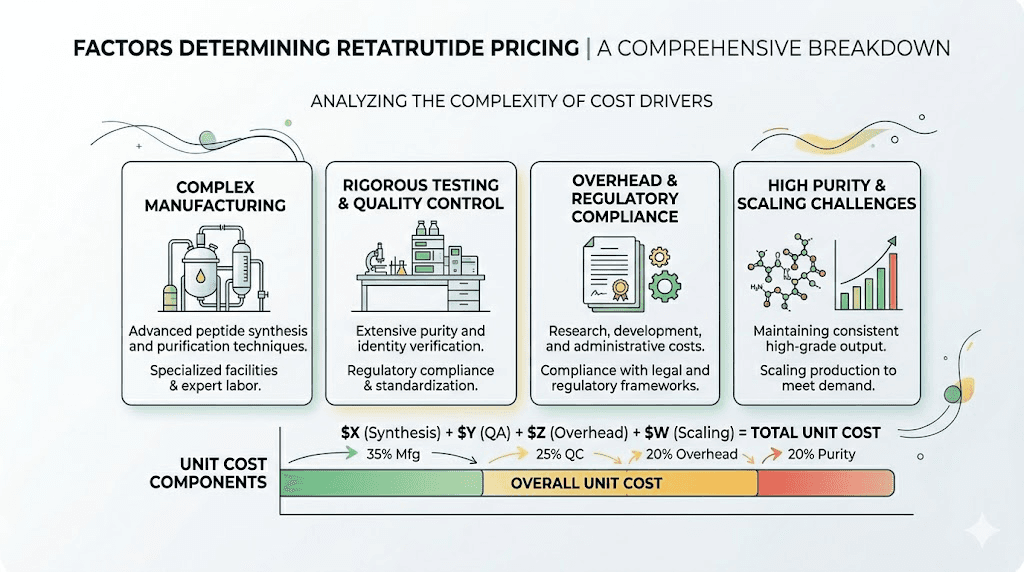
Price differences between vendors are not random. They reflect real differences in manufacturing, testing, overhead, and business strategy. When you understand what creates these gaps, you can make smarter purchasing decisions instead of just chasing the lowest number.
Manufacturing and synthesis costs
Retatrutide is a 39-amino-acid peptide with a complex structure that includes a fatty acid side chain for extended half-life. Synthesizing it correctly requires sophisticated solid-phase peptide synthesis (SPPS) equipment and skilled chemists. The raw material cost for a high-purity batch is significantly higher than simpler peptides like BPC-157 or TB-500, which are shorter and structurally simpler.
Vendors sourcing from established Chinese peptide manufacturers with ISO certification and Good Manufacturing Practice (GMP) compliance pay more per gram than those using smaller, less regulated facilities. That cost difference flows directly to the consumer. A vendor paying $15 per gram for 98% purity retatrutide from a budget manufacturer will price differently than one paying $35 per gram for 99.5% purity from a certified facility.
Purity and testing
High-performance liquid chromatography (HPLC) testing, mass spectrometry verification, and third-party analysis from labs like Janoshik all cost money. A comprehensive Certificate of Analysis (COA) from an independent lab can add $200 to $500 per batch. Vendors who skip independent verification, or rely solely on manufacturer-provided COAs, can price lower because they have eliminated a significant expense.
Testing data from Finnrick Analytics, which analyzed 2,101 retatrutide samples from 138 vendors, found that while purity typically ranges from 98.72% to 99.95%, the actual quantity in vials can diverge by up to 48% from what is advertised. That statistic alone explains why the cheapest option is not always the best value. If a $50 vial labeled as 10mg actually contains 5.2mg, your effective cost per milligram just doubled compared to a $80 vial that delivers the full 10mg.
Business model and overhead
Some vendors operate lean, direct-to-consumer models with minimal overhead. Others maintain customer service teams, educational content, loyalty programs, and returns policies that increase operating costs. Premium vendors also invest in proper cold-chain shipping, tamper-evident packaging, and batch tracking systems. All of these add costs that get passed to the consumer but also add layers of reliability and accountability.
A vendor selling retatrutide at rock-bottom prices might be cutting corners on any combination of these factors. Or they might simply operate more efficiently. The challenge is distinguishing between the two, which is why verification strategies matter so much when shopping for retatrutide online.
Research peptide retatrutide pricing breakdown by vial size
The single biggest factor in getting cheap retatrutide without sacrificing quality is choosing the right vial size. Larger vials almost always offer better per-milligram economics. Here is how the math typically works across the research peptide market.
5mg vials
The entry-level option. Prices range from $40 to $80 per vial, putting the cost per milligram at $8 to $16. These are best for researchers who want to test a vendor before committing to a larger purchase, or for those running low-dose protocols. At the standard retatrutide dose schedule starting at 1mg weekly, a single 5mg vial covers roughly five weeks of the initial titration phase.
The downside is cost efficiency. You pay a premium per milligram for the convenience of a smaller commitment. Over a full 24-week protocol, 5mg vials become the most expensive route by a significant margin.
10mg vials
The most common format. Prices range from $70 to $150, bringing the cost per milligram down to $7 to $15. This is the sweet spot for most individual researchers. A 10mg vial at a maintenance dose of 8mg weekly lasts roughly 1.25 weeks, so you would need approximately 4 vials per month at full dosing.
When calculating how much retatrutide to take, the 10mg vial gives you enough flexibility to adjust dosing without worrying about wasting a large, expensive vial if you need to change course.
20mg vials
This is where pricing gets interesting. A 20mg vial typically costs $120 to $250, putting the per-milligram cost at $6 to $12.50. That represents a 15 to 25% savings compared to 5mg vials from the same vendor. For researchers running the full retatrutide dosage chart for weight loss, the 20mg format covers about 2.5 weeks at the 8mg maintenance dose, reducing the number of reconstitutions and the total number of vials needed.
30mg and larger vials
The best per-milligram economics come from 30mg ($180 to $350) and 60mg ($300 to $550) vials. Cost per milligram drops to $5 to $10 at these sizes. The tradeoff is stability. Once reconstituted, peptide solutions have a limited shelf life even when refrigerated. The retatrutide availability from vendors offering these larger formats has expanded significantly, making them easier to find than even six months ago.
A 30mg vial at 8mg weekly dosing lasts about 3.75 weeks. That means you can use the entire vial within the typical reconstituted stability window of 4 to 6 weeks without waste.
Cost per milligram comparison table
Vial Size | Price Range | Cost Per mg | Monthly Cost (8mg/week) | Best For |
|---|---|---|---|---|
5mg | $40-$80 | $8-$16 | $256-$512 | Testing vendors |
10mg | $70-$150 | $7-$15 | $224-$480 | Individual protocols |
20mg | $120-$250 | $6-$12.50 | $192-$400 | Extended protocols |
30mg | $180-$350 | $6-$11.67 | $192-$373 | Committed researchers |
60mg | $300-$550 | $5-$9.17 | $160-$293 | Maximum savings |
The difference between the cheapest and most expensive approaches can exceed $200 per month over a full protocol. That adds up quickly across a 24 to 48 week research period. Use the peptide cost calculator to model your specific protocol costs based on the vial sizes and dosing schedules you are considering.
Bulk purchasing strategies that actually reduce costs
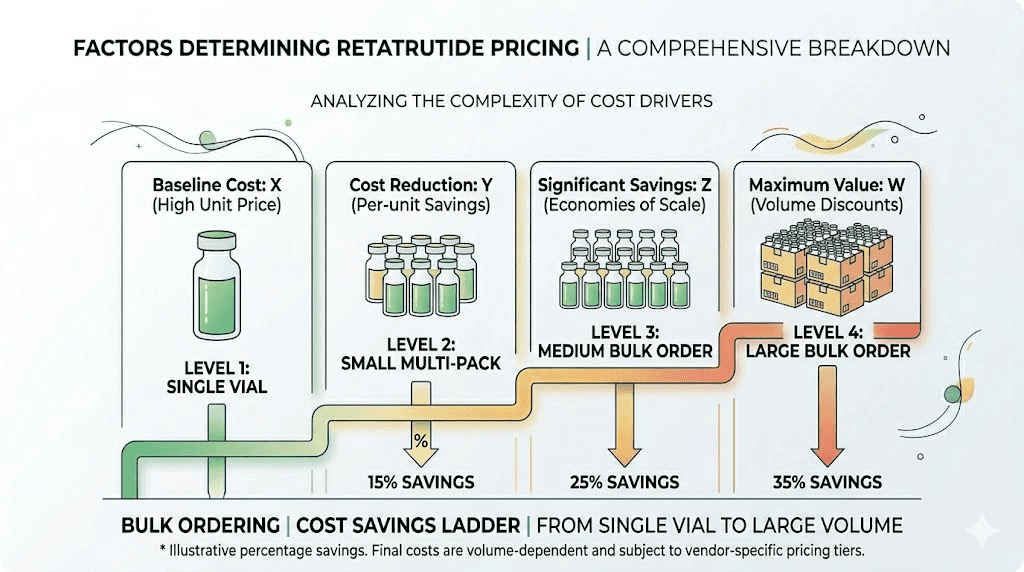
Beyond vial size, there are several legitimate strategies for reducing retatrutide costs. These are not hacks or shortcuts. They are straightforward purchasing approaches that vendors openly support because higher volume means guaranteed revenue for them.
Multi-vial discounts
Most research peptide vendors offer tiered pricing for bulk orders. The standard discount structure looks something like this: 5 to 9 vials gets you 10% off, 10 to 19 vials gets 15 to 20% off, and 20+ vials can unlock 20 to 30% off list price. On a $100 per 10mg vial, buying 10 at once could bring each vial down to $80 to $85. Over a 24-week protocol requiring approximately 19 vials at 8mg per week, that 15% discount saves $285.
The key consideration is storage. Lyophilized (freeze-dried) peptide has excellent shelf life when stored properly, typically 12 to 24 months in a cool, dark environment. That means buying a full protocol supply upfront is practical as long as you have appropriate storage. Understanding the difference between lyophilized vs liquid peptides helps you make the right call on how far in advance to purchase.
Subscription and auto-ship programs
Some vendors offer recurring order programs with 5 to 15% discounts. The commitment is typically month-to-month with cancellation flexibility. This approach works well for researchers on established protocols who know their consumption rate and do not want to manage large upfront purchases. The savings are modest compared to bulk buying, but the convenience and predictability can be worth it.
Coupon codes and seasonal promotions
Research peptide vendors frequently run promotional pricing. Black Friday, New Year, and summer sales commonly offer 15 to 25% discounts. Some vendors provide first-order discounts of 10 to 15%. Stacking a promotional discount with bulk pricing can bring per-milligram costs to their absolute lowest. Follow vendors on social media or subscribe to their newsletters to catch these windows.
Group purchasing
Some research communities organize group buys to access wholesale tier pricing. When five or ten researchers pool an order, they can access pricing that individual buyers never see. This approach requires trust and coordination but can reduce per-vial costs by 20 to 35% compared to individual purchases. For those interested in bulk retatrutide purchasing, group orders represent one of the most effective cost-reduction strategies available.
The real cost of cheap retatrutide: what can go wrong
Here is where the conversation gets serious. Cheap retatrutide exists. Very cheap retatrutide exists. But not all of it is safe, pure, or even actually retatrutide.
Testing data reveals a troubling reality in the budget peptide market. That Finnrick Analytics study found quantity discrepancies of up to 48% in tested retatrutide vials. What does that mean in practical terms? A vial labeled as 10mg might contain as little as 5.2mg of actual peptide. You think you are injecting 4mg. You are actually injecting 2.1mg. Your protocol fails. You blame the peptide. The peptide was never there in the first place.
Underdosed vials
This is the most common problem with cheap retatrutide. It is also the most insidious because you cannot detect it without sending a sample to a lab. Underdosed vials deliver inconsistent results, make it impossible to follow a proper retatrutide dosage chart, and can lead researchers to incorrectly conclude that the peptide does not work for them.
A $50 vial with 5mg of actual peptide inside a 10mg label costs you $10 per real milligram. A $90 vial with 9.8mg of actual peptide costs you $9.18 per real milligram. The "cheap" option is actually 9% more expensive per unit of actual peptide delivered.
Purity concerns
Purity below 98% means the remaining percentage consists of synthesis byproducts, truncated peptide sequences, and potentially harmful impurities. Research-grade peptides should test at 98% or higher via HPLC. Premium vendors consistently deliver 99% or above. Budget vendors sometimes ship product testing at 95 to 97%, which might seem close enough but represents significantly more impurity load per injection.
These impurities can cause injection site reactions, unexpected side effects, and inconsistent pharmacological activity. Researchers who experience unusual injection site reactions or side effects not consistent with published trial data should consider purity as a potential culprit.
Degradation from poor handling
Cheap vendors sometimes cut costs on shipping and storage. Peptides that sit in hot warehouses, ship without ice packs, or arrive in non-insulated packaging can degrade significantly before you ever open the vial. The lyophilized powder might look fine. The potency might be half of what it was when it left the manufacturer. Proper storage and handling matter enormously for peptide quality, just as they do for tirzepatide refrigeration and semaglutide storage.
Outright counterfeits
The worst-case scenario. Some ultra-cheap listings sell vials containing little to no retatrutide at all, substituting cheaper peptides or entirely inactive compounds. This is rare among established vendors but not unheard of from marketplace sellers, overseas direct-ship operations, or vendors with no verifiable testing history.
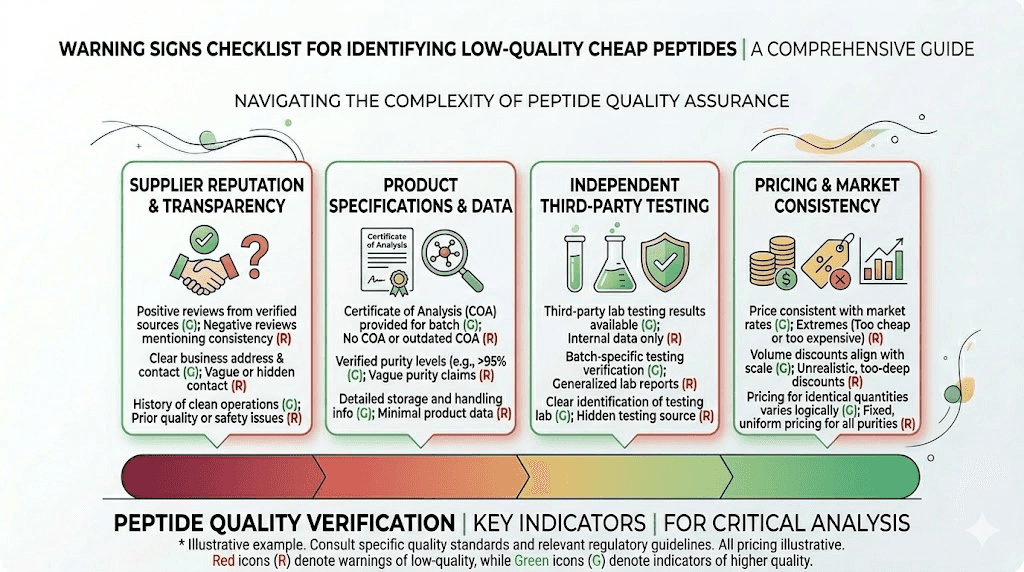
Red flags for suspiciously cheap retatrutide
Not every low price is a red flag. But certain patterns should trigger immediate caution. Here is what experienced researchers look for when evaluating a deal that seems too good.
Pricing more than 40% below market average
If the average 10mg vial sells for $100 to $120 and a vendor offers it at $45, ask why. There might be a legitimate reason, like a clearance sale, excess inventory, or a new vendor building market share. Or there might not be. A 10 to 25% discount from market average is normal competitive pricing. A 40%+ discount warrants investigation.
No Certificate of Analysis available
Every reputable vendor provides batch-specific COAs. Not generic templates. Not manufacturer COAs from six months ago. Current, batch-specific, ideally third-party verified certificates that match the lot number on your vial. If a vendor cannot produce this documentation, the price does not matter because you have no way to verify what you are buying.
No independent third-party testing
Manufacturer-provided COAs are better than nothing but represent a conflict of interest. The manufacturer has every incentive to report favorable results. Independent testing from recognized labs like Janoshik provides an unbiased quality check. Vendors who invest in independent testing are already demonstrating a commitment to quality that correlates with accurate dosing and high purity.
Vague or missing contact information
Legitimate vendors have verifiable business addresses, responsive customer service, and established web presences. Vendors operating through social media DMs, temporary websites, or anonymous email addresses create accountability gaps that make recourse impossible if something goes wrong.
No return or replacement policy
Established vendors stand behind their products. If a vial arrives damaged, the purity does not match the COA, or the product is clearly defective, reputable vendors replace it. Budget vendors without returns policies have no financial incentive to maintain quality standards.
Pressure tactics and urgency
"Limited time offer," "only 3 vials left," "price increases tomorrow." These are sales tactics, not quality indicators. Good peptides sell on reputation, testing data, and consistent quality. They do not need manufactured urgency. When evaluating vendors, apply the same critical thinking you would use when comparing research vs pharmaceutical grade peptides in any context.
How to verify retatrutide quality at any price point
Finding cheap retatrutide is only half the equation. Verifying that cheap retatrutide is actually good retatrutide completes it. Here is a systematic approach to quality verification that works regardless of what you paid.
Step 1: Request and analyze the COA
Every purchase should start with reviewing the Certificate of Analysis. Look for these specific data points: HPLC purity percentage (should be 98%+ minimum, ideally 99%+), mass spectrometry confirmation of molecular weight (retatrutide molecular weight is approximately 4,767 Da), residual solvent analysis, endotoxin testing results, and the date of analysis. The COA should reference a specific batch or lot number that matches the product you receive.
Step 2: Verify third-party testing
If the vendor claims third-party testing, verify the claim. Contact the testing lab directly. Ask if they tested the specific batch number. Some vendors post COAs from testing labs they have never actually used. This is fraud, but it happens. Reputable third-party labs will confirm or deny testing specific batch numbers when asked.
Step 3: Check community reviews and vendor ratings
Peptide research communities on Reddit, specialized forums, and review aggregators provide real-world feedback on vendor quality. Look for reports that mention specific batch testing, side effect profiles consistent with genuine retatrutide (primarily GI effects like nausea at higher doses), and weight loss timelines matching clinical trial data. A vendor with hundreds of positive, detailed reviews represents significantly lower risk than one with no community presence.
Finnrick Analytics and similar testing aggregators also provide vendor ratings based on independent sample testing. For example, some vendors receive A-tier ratings with verified 99%+ purity, while others receive E-tier ratings despite marketing claims. Checking these resources before purchasing can save you from expensive mistakes, similar to how you would research before buying from specific vendors.
Step 4: Physical inspection on arrival
When your order arrives, inspect the packaging. Properly shipped lyophilized peptide should arrive in a sealed vial with an intact flip-top cap, include an ice pack or insulated packaging for temperature control, have a clear label with batch number matching the COA, and show a white or off-white lyophilized cake or powder in the vial. If the powder appears discolored, clumped, or dissolved (suggesting moisture exposure), contact the vendor immediately.
Step 5: Reconstitution behavior
High-purity lyophilized retatrutide should dissolve easily in bacteriostatic water. When you add the solvent slowly down the side of the vial, the peptide should dissolve within 1 to 3 minutes with gentle swirling. Product that resists dissolving, forms visible particles, or produces a cloudy solution may indicate degradation, contamination, or substitution. Proper peptide reconstitution technique also matters for ensuring accurate results from this test.
Step 6: Response assessment
Genuine retatrutide at proper dosing should produce observable effects consistent with its mechanism of action as a triple GLP-1/GIP/glucagon receptor agonist. At initial doses of 1 to 2mg weekly, most researchers report mild appetite suppression within the first week, with effects becoming more pronounced during dose escalation. If you experience zero appetite changes through the first 4 weeks of escalation, the product quality should be questioned.
Retatrutide vs other GLP-1 peptides: cost comparison
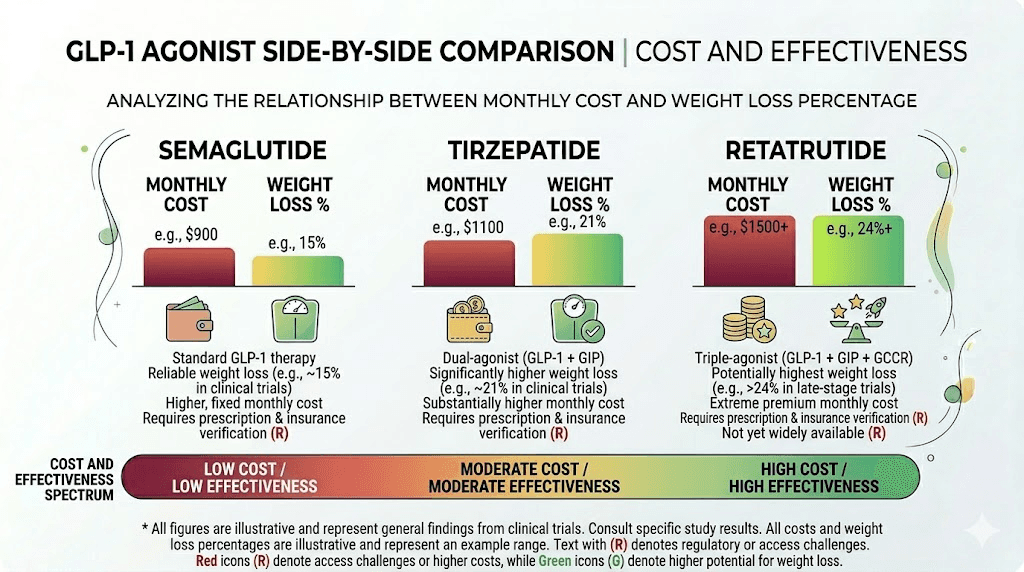
Part of determining whether cheap retatrutide is actually a good deal involves comparing it to alternatives. Each GLP-1 peptide has different efficacy data, different dosing requirements, and different cost structures. The cheapest option per milligram is not necessarily the cheapest option per unit of results.
Retatrutide vs semaglutide
Research-grade semaglutide typically costs $30 to $80 per 5mg vial, making it cheaper per milligram than retatrutide. However, retatrutide vs semaglutide comparisons need to account for efficacy differences. Semaglutide Phase 3 trials showed approximately 15 to 17% weight loss, while retatrutide Phase 2 data showed up to 24.2%. On a cost-per-percentage-point-of-weight-loss basis, retatrutide may actually deliver better value despite a higher per-milligram cost.
Semaglutide dosing typically maxes out at 2.4mg weekly, while retatrutide protocols escalate to 8 to 12mg weekly. The total monthly peptide consumption is higher with retatrutide, which partially offsets its superior per-dose efficacy when calculating total protocol costs.
Retatrutide vs tirzepatide
Tirzepatide, a dual GLP-1/GIP agonist, is often compared directly to retatrutide. Research-grade tirzepatide costs roughly $40 to $100 per 10mg vial, with compounded versions available through telehealth at $200 to $500 monthly. Tirzepatide delivered up to 22.5% weight loss in the SURMOUNT-1 trial, placing it between semaglutide and retatrutide in efficacy. Those comparing semaglutide vs tirzepatide and then adding retatrutide to the comparison should consider the triple agonist mechanism that gives retatrutide its edge.
For researchers already on tirzepatide considering a switch, understanding the transition timeline from tirzepatide to retatrutide helps with budget planning, since there may be an overlap period during the switch.
Cost per percentage point of weight loss
Peptide | Monthly Cost (Research) | Avg Weight Loss | Cost Per % Lost | Mechanism |
|---|---|---|---|---|
Semaglutide | $80-$200 | ~15-17% | $5-$13/% point | GLP-1 only |
Tirzepatide | $120-$300 | ~20-22.5% | $5-$13/% point | GLP-1 + GIP |
Retatrutide | $150-$500 | ~24-28.7% | $5-$17/% point | GLP-1 + GIP + Glucagon |
The cost-per-result metric tells a different story than simple price comparison. Retatrutide is more expensive in absolute terms but can deliver competitive or superior value per unit of outcome. For researchers focused on peptides for fat loss, this efficiency metric matters more than raw price.
Additional comparisons
Some researchers also consider mazdutide vs retatrutide or Ozempic vs retatrutide when evaluating the most cost-effective path to their research goals. Each comparison involves tradeoffs between price, efficacy, side effect profiles, and availability that researchers should evaluate based on their specific protocol requirements and budget constraints.
Ways to reduce your total retatrutide protocol cost
Finding cheap retatrutide is one approach. But reducing the total cost of a retatrutide protocol involves more than just the purchase price. Storage, dosing precision, reconstitution technique, and protocol design all affect how much peptide you actually need and how much you waste.
Proper storage prevents waste
Lyophilized retatrutide stores well at room temperature for short periods but lasts longest when refrigerated at 2 to 8 degrees Celsius. Reconstituted retatrutide should always be refrigerated and used within 4 to 6 weeks. Freezing reconstituted peptide is debated, but multiple freeze-thaw cycles definitely degrade quality.
The practical impact: if poor storage causes a vial to lose 20% potency before you finish it, you are effectively throwing away 20% of what you paid. Proper storage is free. The savings are real. Apply the same discipline you would use for semaglutide storage or tirzepatide refrigeration.
Accurate reconstitution saves peptide
Reconstitution errors waste peptide. Add too much bacteriostatic water and you need more volume per injection, increasing the chance of measurement errors with each draw. Add too little and you risk not fully dissolving the peptide, leaving some stuck to the vial walls.
The peptide reconstitution calculator eliminates guesswork. For a 10mg retatrutide vial, adding 2ml of bacteriostatic water creates a concentration of 5mg per ml. Each 0.1ml (10 units on an insulin syringe) then equals 0.5mg of retatrutide. Clean, simple math reduces errors and waste.
Proper injection technique minimizes loss
Dead space in syringes, air bubbles, and improper needle insertion all waste small amounts of peptide per injection. Over a 24-week protocol with 2 to 3 injections per week, these micro-losses add up. Using low dead-space insulin syringes, priming the needle properly, and injecting at the correct depth and angle ensure maximum delivery per injection. Our guides on how to inject retatrutide and where to inject retatrutide cover proper technique in detail.
Strategic dose titration
The clinical trial protocol starts at 1mg weekly and escalates every 4 weeks through 2mg, 4mg, 8mg, and potentially 12mg. This slow titration is not just for safety. It also reduces total peptide consumption compared to jumping straight to a high dose.
Some researchers find their optimal response at 4 to 8mg weekly rather than the maximum 12mg dose. Staying at the minimum effective dose rather than automatically escalating to the highest saves significant peptide over time. The retatrutide dosage calculator helps model different titration strategies and their total peptide requirements.
Diet and lifestyle optimization
This might seem unrelated to peptide cost, but it is directly connected. Researchers who optimize their nutrition while on GLP-1 peptides tend to see better results at lower doses. Better results at lower doses means less peptide consumed over the full protocol. Protein intake is particularly important, as adequate protein preserves lean mass during weight loss and can enhance the appetite-suppressing effects of GLP-1 agonists. Taking the right supplements alongside GLP-1 peptides can also support the protocol effectiveness.
Vendor evaluation framework for budget retatrutide
Not all cheap retatrutide vendors are created equal. This framework helps you systematically evaluate any vendor offering competitive pricing, so you can separate genuine value from dangerous bargains.
Tier 1: Must-have criteria
These are non-negotiable. If a vendor fails any of these, move on regardless of price.
Batch-specific COA available. Not generic. Not from a different product. A Certificate of Analysis matching the specific batch of retatrutide you are purchasing, showing HPLC purity, mass spec confirmation, and testing date.
Verifiable business presence. A real website with a domain history of at least 6 months. Contact information that actually works. A physical address that can be verified. Social media presence with ongoing engagement.
Proper shipping practices. Cold-chain shipping options for temperature-sensitive peptides. Insulated packaging. Ice packs or gel packs for warm-weather deliveries. Overnight or 2-day shipping options to minimize transit time.
Tier 2: Strong quality indicators
These are not absolute requirements but significantly increase confidence in the purchase.
Third-party testing from recognized labs. Independent verification from Janoshik or similar recognized testing services. This adds cost that the vendor absorbs, which signals commitment to quality. Vendors that invest in independent testing are unlikely to risk their reputation by selling substandard product.
Community reputation. Positive mentions on peptide research forums. Vendor rating from aggregators like Finnrick. Consistent positive feedback over time, not just a burst of suspiciously similar reviews.
Return and replacement policy. A vendor willing to replace defective or damaged products demonstrates accountability. This policy costs them money, which means they have incentive to ship quality product from the start.
Tier 3: Nice-to-have features
These indicate a mature, customer-focused operation but are not essential for product quality.
Loyalty programs and recurring discounts. Indicates a business model built on retention rather than one-time transactions. Vendors that want repeat customers have every incentive to maintain quality.
Educational content. Vendors that provide dosing guides, reconstitution instructions, and storage recommendations demonstrate expertise and investment in their customer base. Platforms like SeekPeptides take this further by providing comprehensive educational resources, protocol tools, and community support for researchers at every level.
Multiple payment options. Credit card processing means the vendor has undergone merchant account verification. This is a weak quality signal but better than vendors who only accept cryptocurrency or wire transfers, which offer no purchase protection.
Sourcing retatrutide internationally
Some of the cheapest retatrutide available comes from international sources, particularly Chinese peptide manufacturers selling direct-to-consumer. This route offers the lowest per-milligram pricing but comes with unique considerations.
Direct from China manufacturers
Chinese peptide synthesis companies offer retatrutide at $3 to $6 per milligram when purchased in larger quantities. Some manufacturers on platforms like Alibaba list 1g (1,000mg) for $2,000 to $5,000, which brings the per-milligram cost down to $2 to $5. Our guide on bulk retatrutide from China covers this route in detail.
The savings are real but so are the risks. Quality control varies wildly between manufacturers. Shipping times run 7 to 21 days with potential customs delays. Communication barriers can make resolving quality issues difficult. And you are typically buying in quantities far larger than an individual protocol requires.
International pharmacy sources
Some researchers explore pharmacy sources in countries with different regulatory frameworks. Mexican pharmacies, Indian pharmaceutical companies, and other international sources sometimes offer compounded or research-grade peptides at lower costs than US domestic vendors. The guide on sourcing peptides like tirzepatide from Mexico provides relevant context for international purchasing considerations.
The tradeoff involves regulatory risk, shipping complications, potential customs seizure, and less recourse if quality issues arise. For researchers outside the US, international sourcing may offer better options than it does for domestic buyers.
Domestic resellers of international product
Many US-based vendors source their raw peptide from Chinese manufacturers, then reconstitute, test, relabel, and sell domestically. This adds cost but also adds a layer of quality verification, faster shipping, easier returns, and domestic legal accountability. When you see a US vendor offering competitive pricing, they are likely sourcing internationally and adding value through testing and service rather than manufacturing domestically.
Understanding the grey market landscape
Since retatrutide is not FDA-approved, all non-clinical-trial access exists in a regulatory grey area. Understanding this landscape helps you make informed decisions about where your money goes and what risks you accept at each price point.
The grey market for peptides operates in a space between fully regulated pharmaceuticals and completely unregulated substances. Research peptides are legally sold for laboratory research purposes only, not for human consumption. This labeling allows vendors to operate without FDA approval while technically complying with federal law.
What this means for pricing: vendors operating in this space face lower regulatory compliance costs than pharmaceutical companies, which is partly why research-grade retatrutide costs a fraction of what the eventual FDA-approved version will cost. But it also means there is no regulatory agency routinely inspecting these vendors, testing their products, or enforcing quality standards. The burden of quality verification falls entirely on the buyer.
This reality makes the verification steps outlined earlier in this guide not optional but essential. When the FDA is not checking quality for you, you need to check it yourself. That means COAs, third-party testing, community reviews, and systematic vendor evaluation become your quality assurance system.
Timing your purchase for maximum savings
Retatrutide pricing is not static. Several factors create pricing fluctuations that strategic buyers can use to their advantage.
New vendor entry discounts
When a new vendor enters the market, they typically offer 15 to 30% introductory discounts to build their customer base and generate reviews. These can be excellent opportunities if you verify quality through the framework outlined above. The risk is that new vendors have limited track records, so smaller initial orders make sense until quality is confirmed.
Post-clinical-trial news cycles
When positive clinical trial results drop, demand surges and some vendors raise prices. Conversely, when the news cycle is quiet, competition drives prices down. The TRIUMPH-4 Phase 3 results showing 28.7% average weight loss likely triggered a demand spike. Buying during quieter periods between major data releases can save 10 to 15%.
Seasonal patterns
January sees increased demand as people pursue New Year health goals. Summer brings another spike as people prepare for the season. Fall and late winter tend to be lower-demand periods with more competitive pricing. Planning purchases during these windows can yield modest savings.
FDA approval timeline
As retatrutide moves closer to FDA approval (projected for 2027 to 2028), the research peptide market will evolve. Some analysts predict research-grade pricing will increase as the FDA approval date approaches, since demand will grow while regulatory scrutiny of the grey market intensifies. Researchers planning longer-term protocols might benefit from purchasing supplies before this anticipated price pressure builds.
Building a complete protocol budget
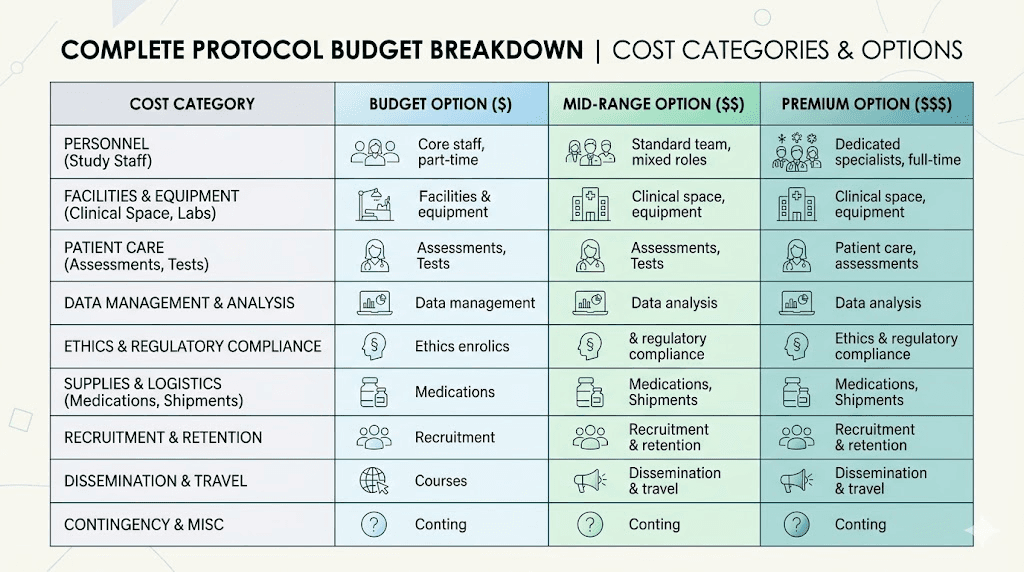
Cheap retatrutide is only one line item in a complete protocol budget. Accounting for all costs upfront prevents surprises and helps you allocate your budget where it matters most.
Peptide cost
For a standard 24-week protocol escalating from 1mg to 8mg weekly, you need approximately 120 to 150mg of total retatrutide depending on your exact titration schedule. At research-grade pricing of $6 to $12 per milligram, that puts the peptide cost between $720 and $1,800 for the full protocol.
Reconstitution supplies
Bacteriostatic water (approximately $5 to $10 per 30ml vial, needing 2 to 4 vials total), alcohol prep pads ($5 to $10 per box of 100), and insulin syringes ($15 to $25 per box of 100). Total supply cost runs $30 to $60 for a full protocol. These are not the place to cut corners. Quality supplies from medical supply vendors cost almost nothing relative to the peptide itself.
Storage equipment
A small dedicated refrigerator or allocated space in an existing unit costs nothing additional for most researchers. Those in warmer climates shipping to hot locations should budget an extra $10 to $20 per order for expedited shipping to minimize heat exposure during transit.
Testing (optional but recommended)
Sending a sample from your first vial to an independent testing lab costs $100 to $200. This feels like an unnecessary expense when you are trying to save money, but think of it as insurance. If the test confirms your vendor is reliable, you have validated your entire supply chain for the cost of a single vial. If it reveals a problem, you have saved yourself from a full protocol on substandard product.
Complete 24-week protocol budget estimate
Item | Budget Option | Mid-Range | Premium |
|---|---|---|---|
Retatrutide (150mg) | $720-$900 | $900-$1,350 | $1,350-$1,800 |
Supplies | $30 | $40 | $60 |
Shipping | $20-$40 | $30-$50 | $50-$80 |
Testing | $0 | $100 | $200 |
Total | $770-$970 | $1,070-$1,540 | $1,660-$2,140 |
Monthly | $128-$162 | $178-$257 | $277-$357 |
The budget option represents bulk purchasing from competitive vendors without independent testing. The mid-range includes quality vendors with some independent verification. The premium tier uses top-rated vendors with comprehensive third-party testing. All three tiers assume proper storage and reconstitution technique to minimize waste.
What experienced researchers actually do
Theory is useful. Practice is better. Here is what researchers with multiple completed protocols actually do to optimize costs without sacrificing quality.
They test before committing
Experienced researchers order a single 5mg or 10mg vial from a new vendor before placing a bulk order. They assess reconstitution behavior, response at known doses, and compare their experience to published data. Only after confirming quality do they place a larger, discounted bulk order. The small premium paid for that initial test vial is insurance against spending hundreds on a bad batch.
They maintain vendor relationships
Long-term customers often receive pricing that new buyers do not see. Vendors value consistent, predictable revenue and reward loyalty with discounts, priority access to new products, and flexible payment arrangements. Building a relationship with a reliable vendor is worth more than constantly chasing the absolute lowest price.
They track effective cost, not sticker price
Smart researchers calculate their cost per milligram of verified peptide, not cost per labeled milligram. A $100 vial that independently tests at 9.8mg costs $10.20 per actual milligram. A $70 vial that tests at 6.5mg costs $10.77 per actual milligram. The "cheap" option is actually more expensive when you account for what you actually received.
They optimize the entire protocol
Rather than just hunting for the cheapest peptide, experienced researchers optimize every variable. Proper storage, precise reconstitution, accurate injection technique, strategic dose titration, and lifestyle optimization all reduce total peptide consumption. The researchers getting the best results at the lowest cost are not just finding cheap peptide. They are using it efficiently. Resources like the complete retatrutide dose guide and the peptide calculator help optimize every aspect of the protocol.
They join communities
Research communities share vendor experiences, pricing intelligence, group buy opportunities, and protocol optimization tips. The collective knowledge of an active community is worth more than any individual discount code. SeekPeptides provides exactly this kind of community infrastructure, connecting researchers with evidence-based protocols, dosing tools, and experienced peers who have navigated these same purchasing decisions.
Common mistakes when buying cheap retatrutide
Knowing what to avoid saves just as much as knowing what to seek. These are the most common mistakes researchers make when trying to minimize costs.
Buying based on price alone
The cheapest vial on the market is cheap for a reason. Sometimes that reason is efficiency. Often that reason is cutting corners on quality. Always investigate the reason before purchasing. A 10-minute review of a vendor COA, testing history, and community reputation can save you hundreds in wasted peptide.
Skipping reconstitution math
Incorrect reconstitution wastes peptide through measurement errors. If you add the wrong amount of bacteriostatic water, every subsequent injection is either overdosed or underdosed. Overdosing wastes peptide faster than necessary. Underdosing extends the vial but delivers subtherapeutic amounts. Use the reconstitution calculator every time. Precision costs nothing and saves everything.
Ignoring storage requirements
Leaving reconstituted peptide at room temperature, exposing it to light, or subjecting it to temperature fluctuations all degrade potency. Every percentage point of degradation is money wasted. A $2 opaque storage box and a dedicated refrigerator shelf protect your entire investment.
Buying from unverified marketplace sellers
Social media marketplaces, messaging apps, and unverified online sellers offer the lowest prices but the highest risk. Without a verifiable business, testing documentation, or return policy, you have zero recourse if the product is fake, underdosed, or contaminated. The savings are not worth the risk.
Not accounting for total protocol cost
Focusing exclusively on per-vial price while ignoring shipping costs, reconstitution supplies, and potential waste creates an incomplete cost picture. A vendor with higher per-vial pricing but free shipping, included supplies, and consistent quality might cost less overall than a cheap vendor with expensive shipping, no supplies, and a 30% chance of receiving underdosed product.
Future of retatrutide pricing
The retatrutide pricing landscape will change significantly over the next 12 to 24 months. Understanding these trends helps you make strategic purchasing decisions now.
FDA approval impact
When Eli Lilly secures FDA approval, the commercial product will likely launch at $1,000 to $1,500 per month. This will be accessible through insurance for qualifying patients but will also create regulatory pressure on the grey market. Compounding pharmacies may face restrictions similar to what happened with compounded semaglutide when Ozempic faced shortage declarations and subsequent regulatory scrutiny.
Increased competition among vendors
As the research peptide market matures, competition among vendors continues to drive prices down while pushing quality standards up. Vendors that survive and thrive will be those delivering consistent quality at competitive prices. This is good for researchers, as market forces gradually improve the value proposition across the board.
Manufacturing improvements
Peptide synthesis technology continues to advance. Improved solid-phase peptide synthesis methods, better purification techniques, and economies of scale as production volumes increase all contribute to gradually declining manufacturing costs. These savings will eventually flow to consumers as vendor margins stabilize.
Regulatory evolution
The FDA has increasingly focused on the peptide grey market, particularly for GLP-1 agonists. Increased enforcement could reduce the number of low-quality vendors, which would potentially increase average prices while simultaneously improving average quality. Staying informed about retatrutide availability developments helps researchers adapt to this evolving landscape.
Making the smart choice for your budget
Cheap retatrutide exists. Safe retatrutide exists. The challenge is finding where those two circles overlap. That intersection is not at the absolute lowest price point, and it is not at the most expensive either.
The smartest approach combines several strategies: buy in larger vial sizes for better per-milligram economics, leverage bulk discounts when your vendor passes quality verification, time purchases during promotional periods, optimize your protocol to minimize waste, and verify quality systematically rather than relying on price as a proxy for anything.
A researcher who buys 20mg vials at a 15% bulk discount from a vendor with verified third-party testing, stores properly, reconstitutes accurately, and titrates to their minimum effective dose will spend significantly less than a researcher who buys the cheapest 5mg vials they can find, stores them carelessly, guesses at reconstitution volumes, and runs through product twice as fast due to underdosing.
The first researcher might spend $150 to $200 per month. The second might spend the same nominal amount but get half the results, effectively doubling their real cost. Price matters. But price in isolation tells you nothing. Cost per verified milligram of high-purity peptide delivered to the injection site is the metric that actually determines value.
For researchers serious about building optimal protocols while managing costs effectively, SeekPeptides provides the tools, education, and community support to make every dollar count. From the peptide cost calculator to comprehensive dosing protocols and reconstitution calculators, having the right resources transforms budget management from guesswork into science.
Frequently asked questions
What is the cheapest way to buy retatrutide?
The cheapest per-milligram approach is purchasing 30mg or 60mg vials in bulk (10+ vials) from a competitive research peptide vendor during a promotional period. This can bring costs down to $4 to $6 per milligram compared to $10 to $16 per milligram for individual 5mg vial purchases. Use the peptide cost calculator to model exact savings for your protocol.
Is cheap retatrutide safe?
Cheap does not automatically mean unsafe, but very low prices warrant extra scrutiny. Always verify quality through batch-specific Certificates of Analysis, third-party testing results, and community reviews. The risks of ultra-cheap retatrutide include underdosed vials, lower purity, and poor handling during shipping. Our complete buying guide covers verification steps in detail.
How much does a full retatrutide protocol cost?
A 24-week protocol at research-grade pricing costs approximately $770 to $2,140 depending on vendor tier, vial size, and whether you include independent testing. Monthly costs range from $128 to $357. Budget-conscious researchers using bulk purchasing strategies and proper storage techniques can stay at the lower end of this range without sacrificing quality.
Should I buy retatrutide from China directly?
Direct purchasing from Chinese manufacturers offers the lowest per-milligram pricing ($2 to $5 per mg in bulk) but comes with significant risks including quality variability, long shipping times, customs complications, and limited recourse for quality issues. Most individual researchers are better served by domestic vendors who source from verified manufacturers and provide independent testing. Our guide on bulk retatrutide from China covers this option in detail.
Is retatrutide cheaper than semaglutide or tirzepatide?
Retatrutide is more expensive per milligram than semaglutide and comparably priced to tirzepatide at research-grade pricing. However, retatrutide delivers superior weight loss results in clinical trials (up to 28.7% vs 15-17% for semaglutide), which means the cost per percentage point of weight loss can be competitive or even favorable.
How do I know if my retatrutide is real?
Genuine retatrutide should dissolve easily in bacteriostatic water during reconstitution, produce observable appetite suppression within the first 1 to 2 weeks of dosing, and come with a batch-specific COA showing HPLC purity above 98% and mass spectrometry confirmation of the correct molecular weight (approximately 4,767 Da). The most definitive verification is sending a sample to an independent testing lab.
When will retatrutide be available by prescription?
Eli Lilly has multiple Phase 3 trials expected to complete through late 2026, with FDA approval projected for 2027 to 2028. When commercially available, the projected retail price is $1,000 to $1,500 per month before insurance. Current retatrutide availability is limited to research peptide vendors and some compounding pharmacy sources.
Can I reduce retatrutide costs by using a lower dose?
Yes. Many researchers find effective results at 4 to 8mg weekly rather than the maximum 12mg studied in trials. Staying at a lower but still effective dose reduces weekly peptide consumption by 33 to 67%, which directly translates to proportional cost savings. The retatrutide dosage calculator helps model different dosing scenarios and their cost implications.
External resources
In case I do not see you, good afternoon, good evening, and good night. May your vials stay potent, your vendors stay honest, and your protocols stay affordable.