Feb 22, 2026
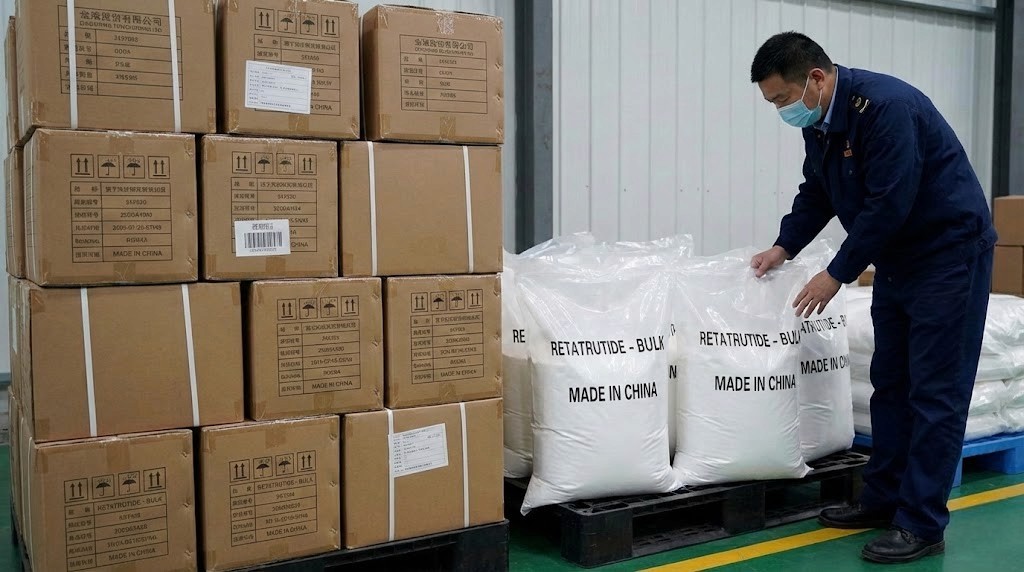
Some researchers order bulk retatrutide from China and receive 99.2% pure peptide at half the price of Western suppliers. Others order from what appears to be the same type of manufacturer and receive a vial of degraded powder that fails every purity test thrown at it. Same country. Same product category. Same search query that brought them to a supplier page. Completely different outcomes. The difference is not luck. It is not random chance or the whims of international shipping. The difference is a systematic vetting process that separates researchers who get legitimate, research-grade retatrutide from those who fund a scam operation and learn an expensive lesson about cutting corners on due diligence.
China produces an estimated 70% of the global peptide raw material supply. That is not a guess. That number reflects the sheer manufacturing infrastructure that Chinese pharmaceutical and chemical companies have built over the past two decades, facilities running solid-phase peptide synthesis at scales that Western labs simply cannot match on price.
For researchers looking to buy retatrutide, this creates a genuine opportunity. Bulk pricing from verified Chinese manufacturers can cut costs by 40-60% compared to domestic vendors. But that same manufacturing density also creates a minefield of counterfeit products, mislabeled vials, and suppliers who vanish after payment clears.
This guide covers everything. Supplier vetting criteria. Purity verification methods. Customs documentation requirements. Cold chain logistics for international shipments. Pricing benchmarks so you know when a deal is real and when it is bait. SeekPeptides built this resource because navigating Chinese peptide sourcing without a framework is how researchers waste thousands of dollars and months of time. Every section draws on documented supplier practices, published analytical standards, and the regulatory landscape that governs peptide imports.
What makes retatrutide the most sought-after research peptide right now
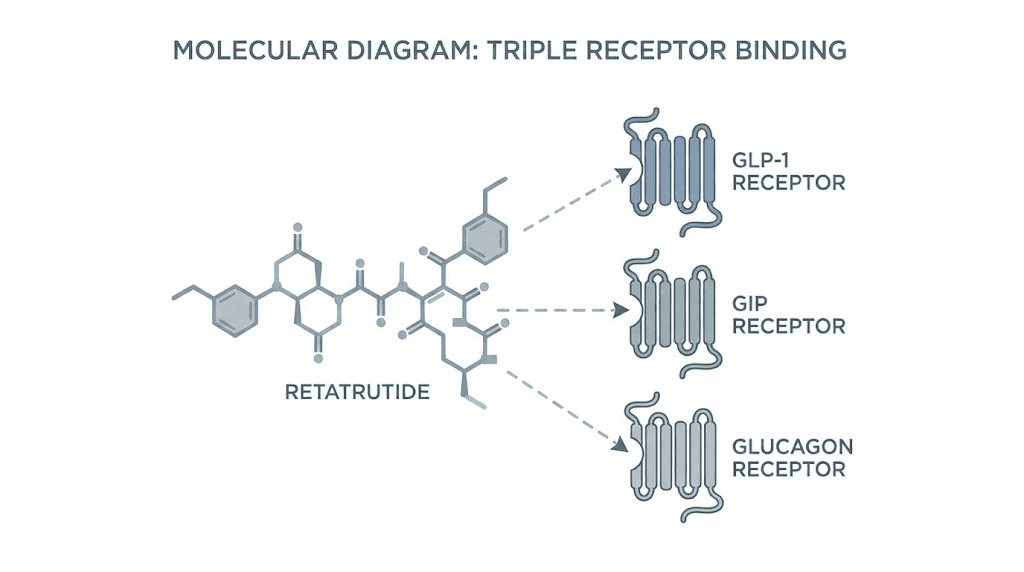
Retatrutide is not just another incremental peptide entering the research landscape. It represents a fundamental shift in how scientists approach metabolic receptor activation. While semaglutide targets a single GLP-1 receptor and tirzepatide activates two receptors, retatrutide simultaneously engages three distinct receptor pathways. GLP-1. GIP. And glucagon. That triple agonism is why researchers across the globe have turned their attention, and their budgets, toward this specific compound.
The clinical data backs up the excitement.
In the Phase 2 trial published in the New England Journal of Medicine, participants receiving the highest dose of retatrutide achieved an average body weight reduction of 24.2% over 48 weeks. That number stunned the metabolic research community. For comparison, semaglutide trials showed roughly 15% weight reduction over similar timeframes, and even tirzepatide topped out around 22% in its best-performing cohort. Retatrutide did not just match these benchmarks. It exceeded them.
The TRIUMPH-4 Phase 3 trial, completed in late 2025, delivered equally striking results. The 12 mg dose produced a mean weight change of negative 23.7%, translating to roughly 60 pounds of weight loss. Participants also experienced a 75.8% reduction in osteoarthritis knee pain scores. More than one in eight patients treated with retatrutide became completely free of knee pain. The cardiovascular markers improved too, with reductions in non-HDL cholesterol and systolic blood pressure that suggest benefits extending well beyond weight management.
This is why bulk demand has exploded.
Researchers running metabolic studies need consistent, high-purity supply in quantities that retail peptide vendors simply do not offer at reasonable prices. A single research protocol might require 50-100mg or more, and at current retail retatrutide pricing, that gets expensive fast. Bulk sourcing from Chinese manufacturers addresses the cost problem directly, provided the quality holds up under analytical scrutiny.
The 39-amino-acid structure of retatrutide makes synthesis challenging. The peptide backbone includes two alpha-amino isobutyric acid residues and one alpha-methyl-L-leucine residue at specific positions that confer stability against DPP-4 cleavage. A C20 fatty acid chain attached via a linker provides the extended half-life of approximately six days. Getting this synthesis right, consistently, at scale, requires sophisticated manufacturing capability. Not every Chinese supplier has it. Understanding which ones do is the entire point of this guide.
Why China dominates the peptide manufacturing landscape
China did not become the center of peptide manufacturing by accident. Three decades of deliberate investment in pharmaceutical chemistry infrastructure created an ecosystem that no other country has replicated at comparable scale or cost efficiency. Understanding why this matters for sourcing retatrutide online requires looking at the structural advantages Chinese manufacturers hold.
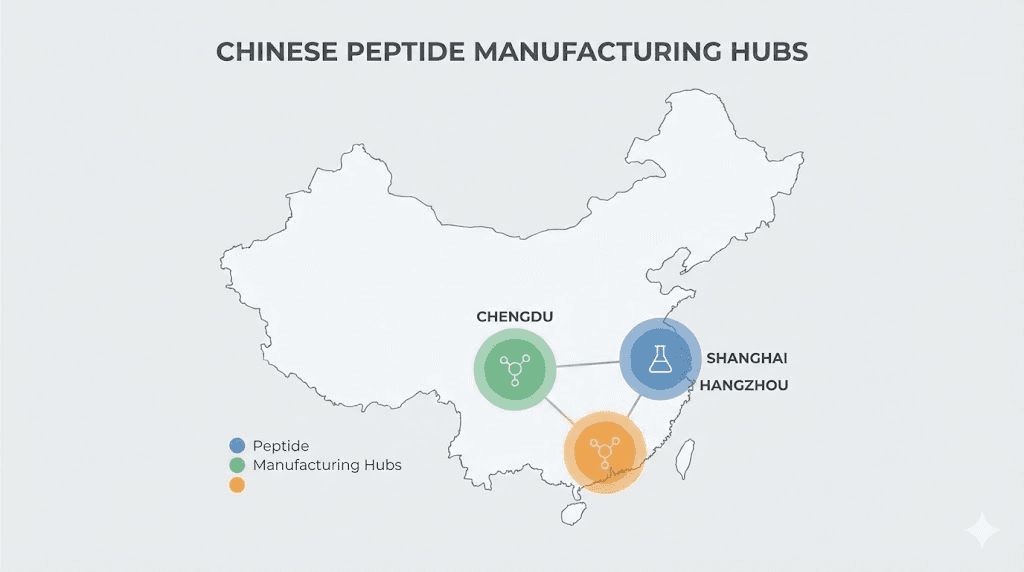
The numbers tell the story. Chinese peptide manufacturers operate over 25 cGMP-compliant production lines in major facilities, with annual API production capacity exceeding 4 tons across the leading companies. Chengdu Shengnuo Biopharm alone, founded in 2004, integrates research and development, production, and sales across peptide APIs, CDMO services, and formulation development. That kind of vertical integration drives costs down dramatically.
Labor costs remain lower than Western equivalents, but that is only part of the equation. The bigger factor is supply chain proximity. The raw amino acids, resins, coupling reagents, and cleavage chemicals needed for solid-phase peptide synthesis are all manufactured domestically in China. A peptide manufacturer in Hangzhou or Chengdu sources these inputs from suppliers within the same industrial zone, sometimes within the same building complex. A Western manufacturer imports many of the same raw materials from, you guessed it, China. Then adds shipping costs, import duties, and handling margins before synthesis even begins.
The result? Chinese bulk peptide pricing runs 40-60% below Western equivalents for the same purity grade.
That pricing gap drives enormous demand from research institutions worldwide. It also attracts bad actors. The low barrier to entry for setting up a peptide trading company in China means that for every legitimate manufacturer with ISO 9001 certification and batch-specific Certificates of Analysis, there exist multiple intermediaries who buy low-grade material, repackage it, and sell it as premium product. These middlemen are the primary source of quality problems that give Chinese peptide sourcing its mixed reputation.
The manufacturing infrastructure advantage
The largest Chinese peptide manufacturers operate facilities ranging from 1,000 square meters to over 50,000 square meters. These are not small labs running manual synthesis. They are industrial-scale operations using automated synthesizers capable of producing multi-kilogram batches with consistent purity profiles. When you evaluate retatrutide availability, these facilities are the source of most global supply.
The certification landscape has matured significantly. Among verified Chinese peptide suppliers, 97 manufacturers hold ISO 9001 certification, 73 maintain ISO 9001:2015 standards, and 39 have achieved GMP certification. These are not meaningless badges. ISO 9001 requires documented quality management systems covering every step from raw material intake through final product release. GMP certification demands even more stringent controls on facility cleanliness, equipment calibration, personnel training, and batch documentation.
But certification alone does not guarantee quality for every individual order. A facility can hold GMP certification for its pharmaceutical product lines while running a separate, less controlled production line for research-grade peptides. This is where due diligence becomes critical, and where most researchers make their first mistake: assuming that a factory-level certification automatically applies to every product that factory sells.
The scale economics of retatrutide synthesis
Synthesizing retatrutide is not cheap regardless of where it happens. The 39-amino-acid chain requires sequential coupling reactions, each with its own yield efficiency. Every amino acid addition that falls below 99% coupling efficiency compounds through the chain, meaning that overall yield for a 39-residue peptide can drop dramatically if any single step underperforms. Scale matters here because larger batch sizes allow manufacturers to optimize each step across more material, spreading fixed costs and improving average yield.
Chinese manufacturers running 100-gram or kilogram-scale batches achieve economies that 5-gram or 10-gram production runs cannot match. This is the fundamental economic reason that bulk retatrutide purchases cost less per gram than small retail quantities, and why the price advantage compounds when sourcing directly from the manufacturing country rather than through Western resellers who add their own margins.
The quality spectrum you will encounter
Not all bulk retatrutide from China is created equal. The quality range spans from pharmaceutical-grade material that would satisfy the most demanding analytical lab to outright counterfeit powder that contains little or no active peptide. Understanding where a given supplier falls on this spectrum, before you send money, determines whether your purchase advances your research or sets it back months.
Here is how the quality tiers typically break down.
Tier 1: Pharmaceutical-grade manufacturers (purity above 99%)
These are the established companies with multi-decade track records, full GMP compliance, and the analytical infrastructure to produce batch-specific documentation that holds up under independent verification. Their retatrutide consistently tests above 99% purity via HPLC, with mass spectrometry confirmation of molecular identity and amino acid analysis validating the complete sequence.
You will pay more per gram from Tier 1 suppliers. But you will also receive material that performs consistently across experiments, stores predictably, and comes with documentation that satisfies institutional review requirements. For researchers running retatrutide dosage protocols that depend on precise concentrations, Tier 1 sourcing is not optional. It is the baseline requirement.
Tier 2: Verified research-grade suppliers (purity 95-99%)
These manufacturers produce peptides specifically for the research market. They hold ISO 9001 certification and provide Certificates of Analysis with each batch, but their quality control may not match the rigor of pharmaceutical-grade facilities. Purity typically falls in the 95-99% range, which is acceptable for many research applications but can introduce variability in sensitive assays.
The key distinction with Tier 2 suppliers is consistency. A given batch might test at 98.5% purity, which is excellent. But the next batch from the same supplier might come in at 95.2%, which could alter experimental outcomes if you are comparing results across batches. Always request batch-specific COAs and consider running reconstitution calculations based on actual measured purity rather than assuming the nominal concentration.
Tier 3: Trading companies and intermediaries (purity unknown)
This is where most quality problems originate. Trading companies do not manufacture peptides. They buy from various sources, sometimes Tier 1 or Tier 2 manufacturers, sometimes from unknown producers, and resell under their own branding. The COA they provide might be genuine, or it might be copied from a legitimate manufacturer and attached to inferior product.
Some warning signs of Tier 3 operators include prices significantly below market rates, generic COAs that do not match specific batch numbers, reluctance to provide video calls showing their facility, and email addresses using free services like Gmail or Outlook rather than corporate domains. If a supplier cannot show you where the peptide was actually synthesized, you are dealing with a middleman. That does not automatically mean the product is bad, but it means you have no way to verify quality at the manufacturing level.
Tier 4: Counterfeit and fraudulent operations
These entities sell products that are mislabeled, contaminated, or contain no active peptide at all. Reports suggest that roughly one in five peptide shipments from unverified Chinese suppliers arrives with documentation that does not match the actual product. Some contain degraded or truncated peptide sequences. Others contain entirely different compounds labeled as retatrutide.
The financial loss from a fraudulent purchase is the least of the problems. Contaminated peptides can introduce unknown variables into research, produce misleading results, and in the worst cases, create safety hazards for anyone handling the material. This is why understanding the difference between research-grade and pharmaceutical-grade peptides matters so much when sourcing internationally.
How to verify retatrutide purity before purchasing
Verification is not something you do after the shipment arrives. The verification process starts before you ever place an order and continues through independent testing of the received material. Skipping any step in this chain creates an opening for quality problems to slip through undetected.
Pre-purchase verification
Before sending money to any supplier, request the following documentation for a recent batch of retatrutide they have produced or sold:
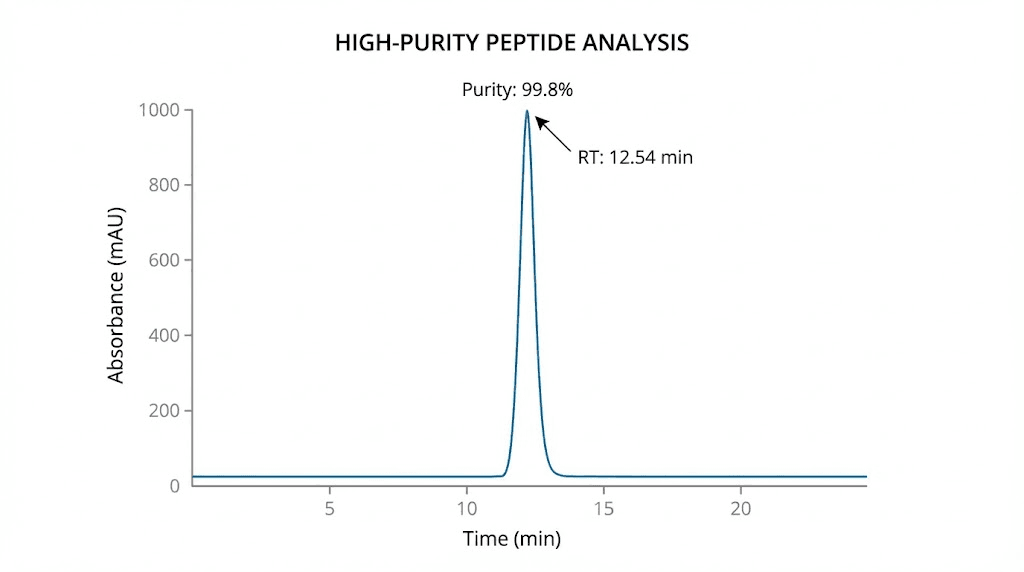
HPLC chromatogram. High-Performance Liquid Chromatography is the gold standard for peptide purity assessment. The chromatogram should show a single dominant peak representing retatrutide, with the peak area constituting at least 98% of the total chromatographic area. Look for the retention time, which should be consistent with known retatrutide standards. Any supplier who cannot provide an HPLC chromatogram for a specific batch is not worth considering.
Mass spectrometry report. While HPLC tells you the purity percentage, mass spectrometry confirms the molecular identity. The observed molecular weight should match the theoretical mass of retatrutide within the instrument accuracy range. A sample can be 99% pure but 99% pure of the wrong compound. Mass spec eliminates that possibility.
Amino acid analysis. For a 39-residue peptide like retatrutide, amino acid analysis provides an additional layer of identity confirmation by verifying the composition ratios of each amino acid in the sequence. This is particularly important for distinguishing retatrutide from truncated or scrambled sequences that might co-elute on HPLC.
Request all three documents for the same batch. If the batch numbers do not match across documents, or if the documents look like they were generated by different laboratories, that is a red flag.
Post-purchase independent testing
Even with solid pre-purchase documentation, independent verification of received material is essential for any bulk order. Third-party analytical testing services specifically designed for peptide researchers can run purity and identity testing on small samples from your received batch.
The cost of independent testing typically runs between 150 and 400 dollars depending on the analytical methods used. For a bulk order worth thousands, this is insurance, not an expense. It either confirms you received what you paid for, or it alerts you to a problem before you commit the material to experiments that would be invalidated by impure reagents.
Several commercial peptide testing services now offer dedicated retatrutide testing packages that include HPLC purity analysis, mass spectrometry identity confirmation, and endotoxin screening. Turnaround times typically range from 5 to 10 business days.
What the numbers mean in practice
Understanding purity percentages requires context. A retatrutide sample testing at 99.2% purity contains approximately 8mg of impurities per gram. Those impurities might include truncated peptide sequences, deletion variants missing one or more amino acids, oxidized forms of the peptide, or residual solvents from the synthesis process.
For most research applications, purity above 98% is considered fully acceptable. The impurities present at that level are unlikely to interfere with receptor binding assays or cellular signaling experiments. Below 95%, the impurity profile becomes more concerning because the proportion of truncated or modified sequences increases, potentially producing confounding signals in sensitive experiments.
When you review a COA, pay attention to more than just the headline purity number. Look at the impurity profile. Are the impurities identified? Are they consistent with normal synthesis byproducts? A well-documented COA from a legitimate manufacturer will list individual impurities above 0.1% with their retention times and estimated quantities. A questionable COA will show only the final purity number with no supporting detail.
Red flags that expose fraudulent or unreliable suppliers
Years of documented buyer experiences have produced a clear pattern of warning signs. Any single red flag might have an innocent explanation. Two or more should end your engagement with that supplier immediately.
Pricing that defies manufacturing economics
Retatrutide synthesis involves 39 sequential coupling steps, specialized non-coded amino acids, a fatty acid conjugation, and purification to remove incomplete sequences. None of this is cheap. When a supplier offers pricing dramatically below the market rate, typically below 300 dollars per gram at bulk quantities, the most likely explanations are diluted product, lower-than-advertised purity, or outright substitution with a cheaper peptide.
Current market pricing for bulk research-grade retatrutide from verified Chinese manufacturers sits in the range of 400-700 dollars per gram for orders of 10 grams or more. Pharmaceutical-grade material commands higher pricing. If someone offers you 200 dollars per gram, the math does not work. Even with Chinese manufacturing efficiencies, the raw material costs alone for a 39-residue peptide with non-standard amino acids approach meaningful fractions of that price point.
Documentation inconsistencies
Compare the batch number on the COA to the batch number printed on the vial or container label. These must match exactly. Compare the stated molecular weight on the mass spec report to the theoretical molecular weight of retatrutide (approximately 4113.58 Da for the free base). Discrepancies beyond the normal instrument accuracy range, usually plus or minus 1-2 Da, indicate either a different compound or a fabricated report.
Look at the COA formatting. Legitimate analytical laboratories use consistent report templates with their accreditation numbers, analyst signatures, and calibration references. Reports that look like they were created in a word processor, with inconsistent fonts, missing accreditation information, or stock photos of laboratory equipment, are almost certainly fabricated.
Communication patterns
Legitimate manufacturers respond to technical questions with technical answers. If you ask about their synthesis approach, coupling reagent choice, or purification method and receive vague marketing language rather than specific technical detail, you are probably not communicating with the actual manufacturer.
Other communication red flags include insistence on payment via Western Union, cryptocurrency, or direct bank transfer with no escrow protection. Legitimate suppliers accept trade assurance platforms, letters of credit, or escrow services because they have nothing to hide and understand that international buyers need payment protection.
Reluctance to schedule a video call showing the facility is another strong signal. A manufacturer proud of their operation will happily walk you through it on camera. Someone operating from a trading office with no manufacturing capability will find reasons to avoid visual confirmation.
Minimum order requirements that make no sense
Legitimate manufacturers set minimum order quantities based on their production economics. For peptide synthesis, minimum batch sizes of 1-5 grams are typical for research-grade material, with 10-gram minimums common for bulk pricing tiers. If a supplier has no minimum order, they are almost certainly a reseller who buys from whoever has stock, regardless of quality consistency.
Conversely, if a supplier demands a 100-gram minimum order with full prepayment and no option for a trial batch, that is equally concerning. Established manufacturers understand that new customers need to validate quality before committing to large orders, and they structure their offerings accordingly.
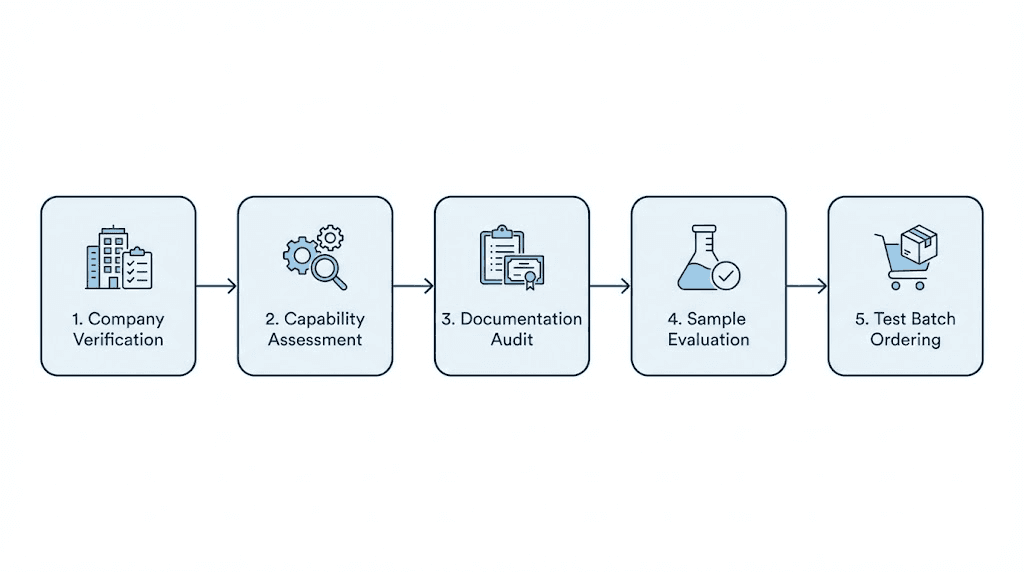
The complete supplier vetting process
This section provides a step-by-step framework for evaluating Chinese retatrutide suppliers. Follow every step in order. Do not skip steps because a supplier seems credible on the surface.
Step 1: Verify the company exists
Search the company name on official Chinese business registries. Check their registration date, registered capital, and business scope. A company registered within the last year with minimal capital claiming to be a major peptide manufacturer is almost certainly a trading front. Look for companies with at least 5 years of registration history and a business scope that explicitly includes pharmaceutical intermediates or peptide synthesis.
Cross-reference the company address with satellite imagery. Does the location show an industrial or manufacturing facility, or an apartment building? This simple check eliminates a surprising number of fraudulent operators.
Step 2: Verify certifications independently
Do not accept a PDF of an ISO certificate at face value. ISO 9001 and GMP certificates have issuing body numbers that can be verified through the certification body database. Contact the listed certification body directly and confirm that the certificate is current, that it covers the company name and address provided, and that its scope includes peptide or pharmaceutical manufacturing.
Step 3: Request a facility video tour
Ask for a live video tour of the production facility. During the tour, look for clean room environments with appropriate gowning, automated peptide synthesizers, HPLC and mass spectrometry equipment, labeled chemical storage areas with safety signage, and a general level of organization consistent with quality manufacturing. A well-run facility will show all of these without hesitation.
Step 4: Order a small test batch
Before committing to a bulk order, purchase the smallest quantity the supplier offers, typically 1-5 grams. Submit this material for independent analytical testing at an accredited third-party laboratory. Compare the independent results to the COA provided by the supplier. If the purity matches within 1-2%, the supplier is likely providing accurate documentation. If the independent test shows significantly lower purity, you have your answer.
Step 5: Negotiate payment terms that protect both parties
For initial orders, propose a 30/70 payment split. Thirty percent upon order confirmation to cover the supplier manufacturing commitment, and seventy percent upon delivery and quality confirmation. Legitimate manufacturers accept this structure for new customer relationships because it demonstrates mutual good faith. Suppliers who demand full prepayment for a first order with no quality assurance mechanism are not worth the risk.
Use trade assurance platforms like Alibaba Trade Assurance where available. These platforms hold payment in escrow until the buyer confirms receipt and satisfaction, providing a neutral dispute resolution mechanism if the product does not match specifications.
Customs, shipping, and import regulations for peptide shipments
Getting a quality product from a verified Chinese manufacturer solves only half the problem. The other half is getting that product through international shipping and customs without delays, seizures, or legal complications. International peptide transport involves regulatory requirements that vary by country and change frequently.
United States import requirements
Importing research peptides into the United States requires clear documentation establishing the material as research-use-only. The shipment must include a commercial invoice specifying the peptide type, quantity, and explicit research-use-only designation. A Certificate of Analysis from the manufacturer accompanies the shipment as proof of identity and purity. Material Safety Data Sheets must be included documenting safe handling procedures. The shipping label must clearly state the contents are not for human consumption.
US Customs and Border Protection has increased scrutiny of peptide imports following FDA guidance changes regarding unapproved drug substances. Shipments that lack proper documentation face holds, additional inspection, and potential seizure. The FDA has issued warning letters to entities marketing peptides for human use and has worked with the DEA in some instances to characterize improperly labeled peptides as misbranded or unapproved drugs.
This does not mean importing research peptides is illegal. It means that documentation must be meticulous. Every document must consistently identify the material as intended for laboratory research, not for human administration. Importers who maintain clean documentation and clear research-use designation navigate customs successfully in the vast majority of cases.
European Union considerations
EU member states apply their own interpretations of the Medicinal Products Directive to peptide imports. In general, peptides classified as active pharmaceutical ingredients require import permits and must enter through licensed pharmaceutical importers. Research-use materials may face different requirements depending on the destination country. The UK has its own separate framework following Brexit, with the MHRA providing guidance on research chemical imports.
Documentation that prevents problems
Proper documentation is the single most effective protection against customs issues. Before your shipment leaves China, verify that every document is present, consistent, and accurate.
The commercial invoice should list the chemical name of the peptide, the CAS number for retatrutide (2381089-83-2), the quantity in precise weight, the total declared value, and a clear statement of research-use intent. The COA should match the batch number on the product label and the batch number on the invoice. The MSDS should reference the correct compound. Inconsistencies between documents trigger additional scrutiny.
Work with a freight forwarder experienced in pharmaceutical or chemical shipments. General freight services often lack familiarity with the specific documentation requirements for peptide imports and may make errors in customs declarations that cause delays. Specialized chemical logistics companies understand the classification codes, labeling requirements, and regulatory frameworks that apply to peptide shipments.
What happens when shipments get held
If a shipment is held at customs, the typical process involves a document review request where customs agents ask for additional information about the contents, intended use, and end user. Having all documentation prepared in advance and readily available shortens this process from weeks to days. Shipments held for documentation deficiencies can usually be released once the correct paperwork is provided. Shipments held because they appear to be marketed for human consumption face a much more difficult path, potentially including permanent seizure.
The key to smooth customs clearance is proactive documentation, not reactive problem-solving. Everything the customs agent needs should be in the shipment package or immediately available upon request. Do not wait for them to ask.
Cold chain logistics and storage requirements for bulk orders
Retatrutide, like most research peptides, is sensitive to temperature, moisture, and light. A bulk order that arrives with perfect purity but suffers degradation during shipping or storage is a waste of money and research time. Understanding the properties of lyophilized peptides and their storage requirements is essential for preserving your investment.
Shipping temperature requirements
Lyophilized retatrutide should ship under temperature-controlled conditions, ideally at 2-8 degrees Celsius for transit times under 5 days, or with dry ice for longer shipments. The lyophilized form provides inherent stability advantages over reconstituted solution, but extended exposure to temperatures above 25 degrees Celsius can initiate degradation even in powder form.
Ask your supplier about their shipping protocol. Do they use insulated packaging with cold packs? For international air freight, do they comply with IATA PI954 requirements for shipments containing dry ice? Is the shipping container rated for the expected transit time and ambient temperature conditions along the route? These are not hypothetical concerns. A shipment from Chengdu to New York in August will encounter ambient temperatures that can degrade unprotected peptide within hours.
Storage upon receipt
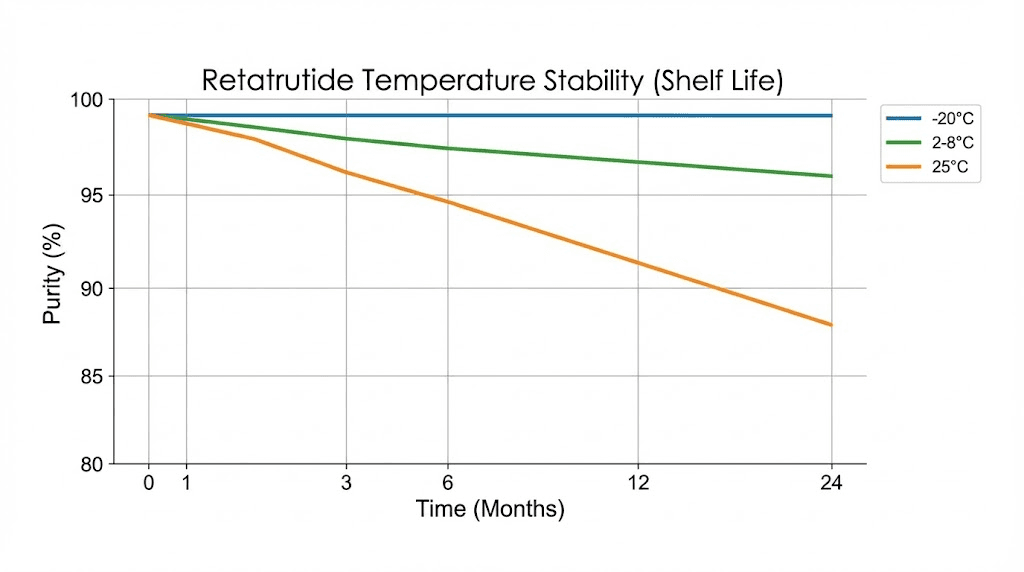
Once your bulk retatrutide arrives, proper storage determines how long it maintains potency. The stability data for lyophilized retatrutide shows clear temperature-dependent shelf life profiles.
At negative 20 degrees Celsius or colder, lyophilized retatrutide remains stable for up to 48 months. That is four years of reliable shelf life if you maintain the temperature consistently. At 2-8 degrees Celsius in a standard laboratory refrigerator, stability drops to 12-24 months. At room temperature around 25 degrees Celsius, significant degradation begins within weeks to months depending on humidity and light exposure.
For bulk orders that you will use over an extended period, the smartest approach is to aliquot the material upon receipt. Divide the bulk quantity into individual-use portions stored in separate sealed vials. This way, you only expose one small portion to a freeze-thaw cycle when you need it, rather than repeatedly warming and cooling the entire stock. Each freeze-thaw cycle stresses the peptide molecular structure and reduces stability.
Store all vials in a desiccator or container with fresh desiccant packs. Lyophilized peptides are hygroscopic, meaning they absorb moisture from the air. Even brief exposure to humid conditions can trigger partial breakdown. Amber vials or secondary containers that block UV light provide additional protection against photodegradation. Understanding these principles applies whether you are storing tirzepatide, semaglutide, or retatrutide. The fundamental peptide chemistry is similar.
Reconstitution and handling of bulk material
When you are ready to use a portion of your bulk retatrutide, proper reconstitution technique determines whether you get the full potency from your investment. Use bacteriostatic water for reconstitution if you plan to use the solution over multiple days. Use sterile water if you plan to use the entire reconstituted vial in a single session.
The peptide reconstitution calculator on SeekPeptides can help you determine exact water volumes based on desired concentration and vial size. For bulk material that you are dividing into smaller portions, calculate your reconstitution volumes based on the actual weighed amount in each aliquot rather than assuming perfect division from the bulk container.
Gentle mixing is critical. Roll the vial between your palms or swirl gently. Never shake vigorously. Peptides can aggregate and denature when subjected to aggressive mechanical disruption. If the lyophilized material does not dissolve completely within 5 minutes of gentle mixing, allow it to sit at room temperature for 15-30 minutes with occasional gentle swirling rather than adding more solvent or shaking harder.
Pricing analysis and what bulk retatrutide actually costs from China
Pricing transparency is one of the most requested pieces of information from researchers considering Chinese sourcing, and one of the hardest to pin down because prices fluctuate with raw material costs, order volume, supplier relationships, and market demand. Here is what the current landscape looks like based on verified supplier quotations.
Current pricing tiers
For orders in the 1-5 gram range, expect to pay between 600 and 900 dollars per gram from verified Tier 1 or Tier 2 Chinese suppliers. This is the trial order range where you are paying a premium for the small batch size but establishing a quality baseline.
For orders in the 5-20 gram range, pricing drops to approximately 400-650 dollars per gram. This is where the bulk discount starts to become meaningful, and where most individual researchers place their first significant order after confirming quality with a smaller trial.
For orders above 20 grams, pricing can fall to 300-500 dollars per gram depending on the supplier relationship, payment terms, and whether you are committing to recurring orders. Institutional buyers with established relationships and predictable ordering patterns often negotiate the best pricing at this tier.
Compare these numbers to Western vendor pricing, where retail retatrutide typically costs 800-1,500 dollars per gram or more in small quantities. The savings from Chinese bulk sourcing become substantial at scale. A 50-gram order at 400 dollars per gram from a verified Chinese supplier versus 1,200 dollars per gram from a Western retailer represents a difference of 40,000 dollars. That is real money that can fund additional research.
Hidden costs to factor in
The per-gram price from the Chinese supplier is not your total cost. Factor in international shipping with cold chain logistics, which typically adds 100-300 dollars per shipment depending on weight and speed. Customs brokerage fees, if you use a specialized freight forwarder, add another 50-200 dollars. Independent analytical testing of received material costs 150-400 dollars per batch. Import duties vary by country but typically range from 0-10% of declared value for research chemicals.
When you add these costs to the base per-gram price, the total landed cost for Chinese bulk retatrutide typically comes to 450-750 dollars per gram at meaningful quantities. That is still significantly below Western retail pricing, but the margin is narrower than the raw supplier quotation suggests. Use the peptide cost calculator to model your total cost including all these factors.
Pricing red flags
Pricing below 250 dollars per gram for any quantity should trigger immediate skepticism. At that price point, the manufacturer cannot cover raw material costs, synthesis labor, analytical testing, and cold chain shipping while maintaining a viable business margin. Something is being cut, and it is almost always quality.
Conversely, a Chinese supplier charging 1,000+ dollars per gram for bulk orders is likely a trading company adding excessive margins to product sourced from a manufacturer who charges a fraction of that. In this case, you might get good product, but you are paying middleman margins that eliminate the cost advantage of Chinese sourcing.
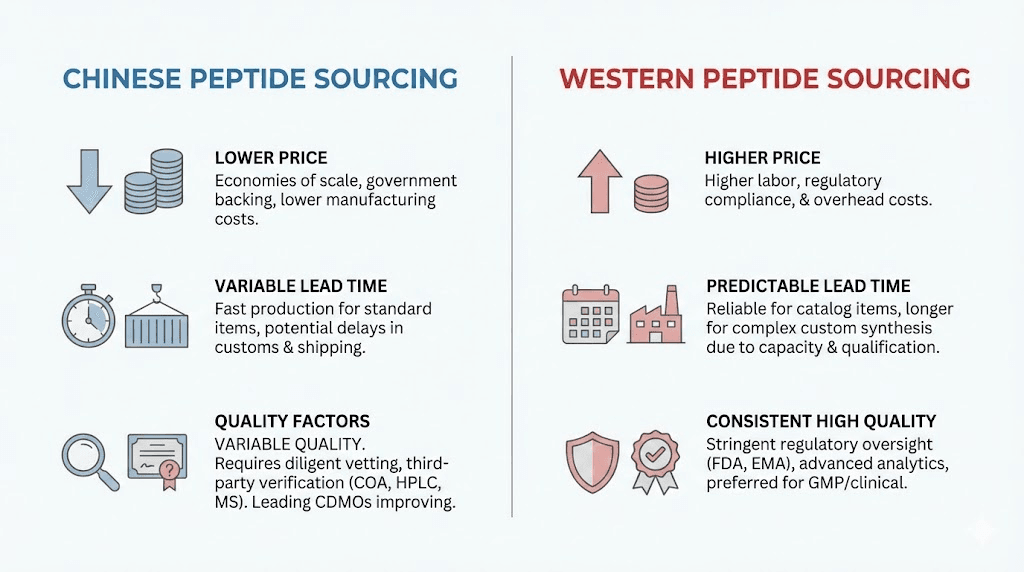
Chinese bulk retatrutide vs Western alternatives
The decision between Chinese and Western sourcing involves more than just price. Each option carries distinct advantages and risks that researchers should weigh against their specific needs, budget constraints, and risk tolerance.
Factor | Chinese bulk suppliers | Western retail vendors |
|---|---|---|
Price per gram (10g order) | 400-650 dollars | 800-1,500 dollars |
Minimum order | 1-10 grams typical | Often 2-5mg vials |
Lead time | 7-21 days including shipping | 2-7 days domestic |
Quality documentation | COA provided, verify independently | COA provided, some offer third-party testing |
Customs risk | Moderate, documentation dependent | None for domestic orders |
Cold chain reliability | Variable, supplier dependent | Generally well controlled |
Recourse if quality fails | Limited without trade assurance | Better, domestic legal framework |
Bulk availability | Grams to kilograms | Usually limited to milligrams |
For researchers who need large quantities, the Western retail model simply does not scale. Buying 50 grams of retatrutide in 5mg vials from a domestic vendor would require 10,000 vials and a budget that most research programs cannot support. Chinese bulk sourcing exists because this market need is real and the Western supply chain does not address it efficiently.
However, researchers with smaller needs, perhaps running a single experiment requiring only a few milligrams, may find that the convenience, speed, and lower risk of domestic sourcing outweigh the cost savings of Chinese bulk procurement. The due diligence process described in this guide takes time and money. For a 50 dollar purchase, that overhead is not justified. For a 5,000 dollar purchase, it is essential.
Western vendors who source from Chinese manufacturers (which many do) essentially perform the vetting process on your behalf and charge a markup for that service. Whether that markup is worth paying depends on your budget, your timeline, and your willingness to manage the sourcing process yourself. Peptide Sciences retatrutide and other established vendors offer this intermediary service for researchers who prefer not to manage international sourcing directly.
Building a reliable long-term relationship with Chinese peptide manufacturers
The initial vetting process is the hardest part. Once you identify a verified, quality-producing Chinese manufacturer, maintaining that relationship becomes increasingly valuable over time. Repeat customers receive better pricing, priority production scheduling, and more responsive technical support.
Communication best practices
Use WeChat for regular communication with Chinese suppliers. While email works for formal documentation, WeChat is the default business communication platform in China, and suppliers respond faster and more personally through it. Establishing a WeChat connection signals that you are a serious, recurring customer rather than a one-time browser.
Be direct about your quality requirements. Chinese business culture respects clarity. If you need purity above 98%, say so explicitly in writing and include it in your purchase agreement. If you require batch-specific COAs with full chromatographic data rather than summary certificates, state that upfront. Most quality problems stem from unclear specifications rather than deliberate fraud.
Negotiating recurring order agreements
After two or three successful orders, discuss a framework agreement for recurring purchases. These agreements typically specify quarterly or monthly order quantities, fixed pricing for an agreed period (usually 6-12 months), quality specifications and testing requirements, payment terms, and dispute resolution procedures. Both sides benefit from predictability. The manufacturer can schedule production efficiently, and you lock in pricing against market fluctuations.
Quality monitoring over time
Even with a trusted supplier, periodic independent testing remains important. Test every third or fourth order at minimum, and every order if you are running experiments where purity consistency is critical. Manufacturers change raw material sources, adjust synthesis parameters, or experience personnel turnover that can affect batch quality. Ongoing monitoring catches these changes before they affect your research.
Tracking retatrutide potency across batches from the same supplier builds a quality history that informs your purchasing decisions and provides evidence of consistent supply for institutional reporting purposes.
Step-by-step bulk purchasing protocol
For researchers ready to proceed, here is the complete purchasing protocol condensed into a practical workflow.
Phase 1: Supplier identification (weeks 1-2)
Search verified sourcing platforms for Chinese retatrutide manufacturers. Shortlist 3-5 candidates based on registration history, certification claims, and initial communication quality. Request COAs and facility information from each candidate. Eliminate any that cannot provide batch-specific analytical documentation or refuse video tours.
Phase 2: Trial order (weeks 2-4)
Place a small trial order (1-5 grams) from your top 1-2 candidates. Use trade assurance or escrow payment. Upon receipt, submit samples for independent third-party testing. Compare independent results to supplier COA. Document everything including shipping time, packaging quality, and documentation accuracy.
Phase 3: Evaluation and selection (week 5)
Compare trial order results across candidates. Evaluate purity match, communication responsiveness, shipping reliability, and documentation quality. Select your primary supplier based on the complete evaluation, not just price.
Phase 4: Bulk order (weeks 5-8)
Negotiate pricing and terms for your full order based on demonstrated quality from the trial batch. Specify exact quality requirements in writing. Agree on payment terms (30/70 split recommended for orders under established relationships). Confirm shipping logistics and cold chain requirements. Place the order and monitor production timeline.
Phase 5: Receipt and validation (weeks 8-10)
Upon arrival, inspect packaging integrity and temperature indicators. Verify documentation completeness and batch number consistency. Submit a sample for independent testing. Once quality is confirmed, release remaining payment if using staged terms. Properly aliquot and store the bulk material following the storage guidelines covered earlier in this guide.
The entire process from initial supplier search to validated bulk material in hand typically takes 8-10 weeks. That timeline decreases significantly for repeat orders with established suppliers, often down to 2-3 weeks from order to delivery.
Frequently asked questions
Is it legal to import bulk retatrutide from China?
Importing research-grade peptides for legitimate laboratory research is legal in most jurisdictions provided proper documentation accompanies the shipment. The material must be clearly labeled as not for human consumption and accompanied by documentation establishing its research-use intent. Specific requirements vary by country. Check with your national regulatory authority and consider consulting a trade compliance specialist for large or recurring orders.
What purity level should I require for bulk retatrutide?
For most research applications, 98% purity via HPLC is the practical minimum for reliable, reproducible results. Purity above 99% is preferable for sensitive assays involving precise dosing protocols or cell-based signaling experiments. Below 95%, the impurity profile becomes concerning enough to potentially affect experimental outcomes. Always request batch-specific documentation rather than accepting generic purity claims.
How do I know if a Chinese supplier is a manufacturer or a trading company?
Manufacturers can provide facility video tours showing synthesis equipment, clean rooms, and analytical laboratories. They answer technical questions about synthesis methodology with specific detail. They have company registrations dating back multiple years with business scopes including pharmaceutical or chemical manufacturing. Trading companies typically cannot show manufacturing facilities, respond to technical questions with marketing language, and may have recent registrations with minimal capital.
What should I do if the received product does not match the COA?
Contact the supplier immediately with your independent testing results. Legitimate manufacturers will investigate and often offer replacement product or a refund. If you used trade assurance or escrow payment, file a dispute through the platform. If the supplier is unresponsive or disputes your testing results without providing a credible counter-analysis, cut the relationship and report the experience to relevant sourcing platform review systems to warn other buyers.
Can I combine Chinese-sourced retatrutide with other research peptides?
The source of a peptide does not affect its compatibility with other compounds. What matters is purity and identity. If your Chinese-sourced retatrutide passes independent testing at the expected purity, it functions identically to the same peptide from any other source. For information on peptide stacking considerations, the same principles apply regardless of where the individual components were manufactured.
How much should I order for my first bulk purchase from China?
Start with a trial order of 1-5 grams from each of your shortlisted suppliers. This gives you enough material to run independent testing while limiting financial exposure. Once you identify a reliable supplier, scale to your research needs. Most researchers find that 10-20 gram orders hit the sweet spot between meaningful bulk pricing and manageable financial commitment. Refer to the retatrutide dosing guide to estimate your total material needs based on your research protocol.
What is the typical shipping time from China to the United States?
Express air freight typically delivers in 7-14 days including customs clearance. Standard shipping takes 14-21 days. Production time adds another 5-10 days for custom synthesis orders. For stock items that the supplier holds in inventory, the shipping timeline starts immediately upon order confirmation. Factor in potential customs holds of 2-5 days for documentation review, especially for first-time importers.
How do tariffs affect the cost of importing peptides from China?
Tariff rates on research chemicals imported from China vary by classification and current trade policy. As of early 2026, peptide imports may be subject to general tariff rates plus any additional duties imposed under trade policy actions. The actual duty amount depends on the HS code classification of the specific product. A customs broker experienced in chemical imports can provide current duty rate information for your specific shipment. Budget 5-15% of declared value for duties as a planning estimate, and factor this into your total cost calculation using a peptide cost calculator.
External resources
For researchers serious about optimizing their peptide sourcing and research protocols, SeekPeptides offers the most comprehensive resource available, with evidence-based guides, proven protocols, and a community of thousands who have navigated these exact questions. Members get access to detailed retatrutide dose schedules, dosage calculators, and expert guidance that takes the guesswork out of peptide research.
In case I do not see you, good afternoon, good evening, and good night. May your suppliers stay verified, your purity stay above 99%, and your shipments stay cold.