Jan 15, 2026
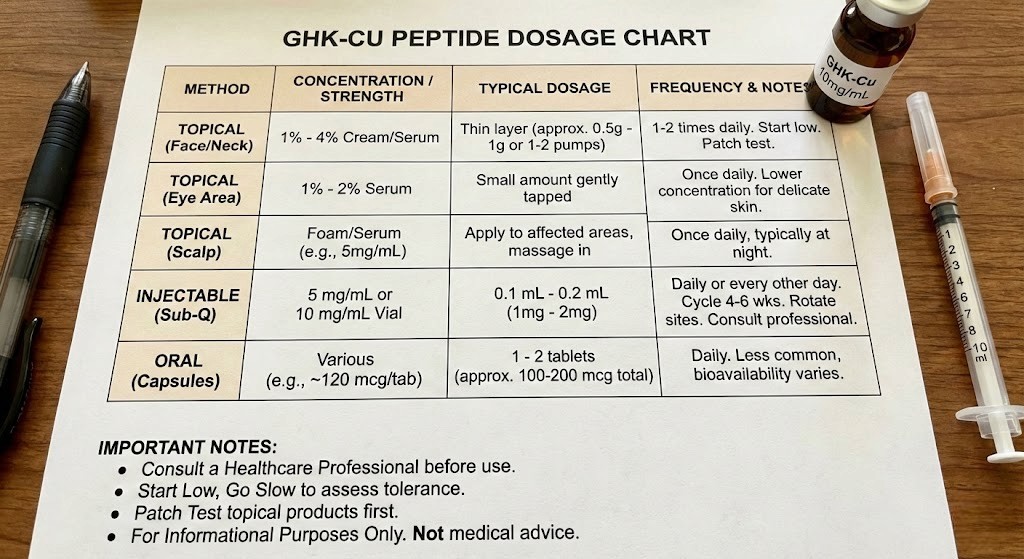
You have searched through fifteen different articles looking for one specific number. Every guide buries the dosage information under paragraphs of background, mechanism explanations, and disclaimers. You need a chart. A table. Something you can reference quickly without scrolling through thousands of words. Here it is.
This guide exists for one purpose. To give you complete GHK-CU dosage reference tables you can bookmark and return to whenever you need specific numbers. Weight-based calculations. Reconstitution math. Topical concentrations. Cycle timing.
Every chart you need for copper peptide protocols organized in one comprehensive resource.
The tables below cover injectable protocols from 1mg to 3mg daily, topical applications from 0.5% to 4% concentration, and reconstitution calculations for both 50mg and 100mg vials.
Each section includes specific numbers for different goals, whether you are targeting skin rejuvenation, hair restoration, wound healing, or general anti-aging benefits. SeekPeptides created this as the definitive chart reference for GHK-CU protocols.
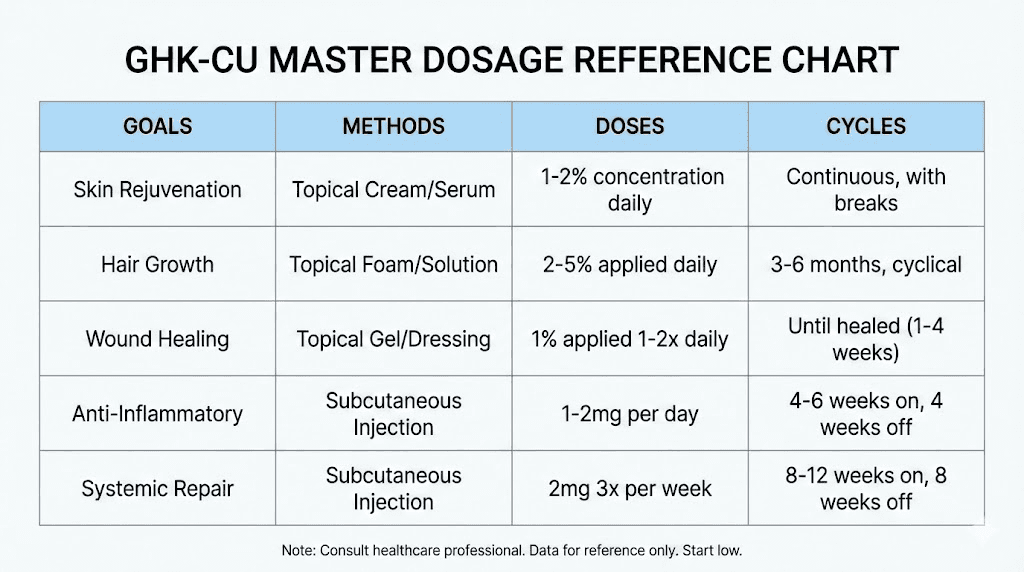
Master GHK-CU Dosage Chart by Goal
Different objectives require different approaches. The chart below provides complete dosage recommendations organized by your primary goal, including administration method, dose range, frequency, and expected cycle duration.
Goal | Method | Dose Range | Frequency | Cycle Length | Notes |
|---|---|---|---|---|---|
Skin Anti-Aging | Injectable | 1-2mg | Daily or 5x/week | 8-12 weeks | Subcutaneous, rotate sites |
Skin Anti-Aging | Topical | 2-4% | 2x daily | Ongoing | Morning and evening |
Hair Restoration | Injectable | 1-2mg | Daily | 16-24 weeks | Extended cycles needed |
Hair Restoration | Topical | 0.5-2% | 1-2x daily | 3-6 months | Scalp application |
Wound Healing | Injectable | 2-3mg | Daily | Until healed | Higher doses, shorter duration |
Wound Healing | Topical | 2-4% | 2-3x daily | Until healed | Direct application |
Joint/Tissue Repair | Injectable | 1.5-2mg | 5x/week | 8-12 weeks | Combine with TB-500 |
General Longevity | Injectable | 1mg | 3x/week | 8 weeks on, 4 off | Maintenance protocol |
Post-Procedure Recovery | Topical | 2-4% | 2x daily | 2-4 weeks | After microneedling, laser |
Eye Area | Topical | 2% | 1x daily | Ongoing | Lower concentration for delicate skin |
This master chart provides your starting point. The dosing calculations below will help you translate these ranges into specific injection volumes based on your vial size and reconstitution method. For detailed injection-specific protocols, the numbers above serve as your baseline reference.
Weight-Based GHK-CU Dosage Calculations
While most GHK-CU protocols use flat dosing rather than weight-based calculations, understanding how body weight affects dosing helps you fine-tune your approach.
Research in animal models shows activity at approximately 0.5mcg/kg, though human protocols typically use standardized doses in the 1-3mg range regardless of body weight.
Flat Dosing Reference Chart
The table below shows standard flat dose recommendations without weight adjustment, which represents how most practitioners approach GHK-CU.
Experience Level | Starting Dose | Working Dose | Maximum Dose | Frequency |
|---|---|---|---|---|
Beginner | 0.5mg | 1mg | 1.5mg | Daily |
Intermediate | 1mg | 1.5mg | 2mg | Daily |
Advanced | 1.5mg | 2mg | 3mg | Daily |
Maintenance | 0.5mg | 1mg | 1.5mg | 3x/week |
Weight-Adjusted Calculation Chart
For those who prefer weight-based calculations, the following chart provides dosing ranges based on body weight using the common mcg/kg approach. These calculations use 15-30mcg/kg as the reference range.
Body Weight (lbs) | Body Weight (kg) | Low Dose (15mcg/kg) | Standard Dose (20mcg/kg) | High Dose (30mcg/kg) |
|---|---|---|---|---|
120 lbs | 54kg | 0.81mg | 1.08mg | 1.62mg |
140 lbs | 64kg | 0.96mg | 1.28mg | 1.92mg |
160 lbs | 73kg | 1.10mg | 1.46mg | 2.19mg |
180 lbs | 82kg | 1.23mg | 1.64mg | 2.46mg |
200 lbs | 91kg | 1.37mg | 1.82mg | 2.73mg |
220 lbs | 100kg | 1.50mg | 2.00mg | 3.00mg |
240 lbs | 109kg | 1.64mg | 2.18mg | 3.27mg |
260 lbs | 118kg | 1.77mg | 2.36mg | 3.54mg |
Most practitioners find that flat dosing works perfectly well for GHK-CU. The weight-adjusted approach matters more for peptides with narrow therapeutic windows or those where body composition significantly affects distribution.
For GHK-CU, research shows effectiveness across a wide range, making precise weight calculations less critical than consistent administration.
50mg Vial Reconstitution Charts
Proper reconstitution determines your dosing accuracy.
The charts below show exactly how much bacteriostatic water to add and how many units to draw for your target dose from a 50mg vial.
Reconstitution Volume Options for 50mg Vial
BAC Water Added | Concentration (mg/mL) | Units per mg | Total Doses at 2mg | Total Doses at 1mg |
|---|---|---|---|---|
1.0mL | 50mg/mL | 2 units | 25 doses | 50 doses |
1.5mL | 33.3mg/mL | 3 units | 25 doses | 50 doses |
2.0mL | 25mg/mL | 4 units | 25 doses | 50 doses |
2.5mL | 20mg/mL | 5 units | 25 doses | 50 doses |
3.0mL | 16.67mg/mL | 6 units | 25 doses | 50 doses |
50mg Vial Injection Volume Chart (2.5mL BAC Water)
Using 2.5mL of bacteriostatic water is the most common approach for 50mg vials. This creates a 20mg/mL concentration where 10 units equals 2mg. The chart below shows exact injection volumes for various doses.
Target Dose | Units to Draw (U-100) | Volume (mL) | Doses per Vial | Days Supply (Daily) |
|---|---|---|---|---|
0.5mg | 2.5 units | 0.025mL | 100 doses | 100 days |
1.0mg | 5 units | 0.05mL | 50 doses | 50 days |
1.5mg | 7.5 units | 0.075mL | 33 doses | 33 days |
2.0mg | 10 units | 0.10mL | 25 doses | 25 days |
2.5mg | 12.5 units | 0.125mL | 20 doses | 20 days |
3.0mg | 15 units | 0.15mL | 16 doses | 16 days |
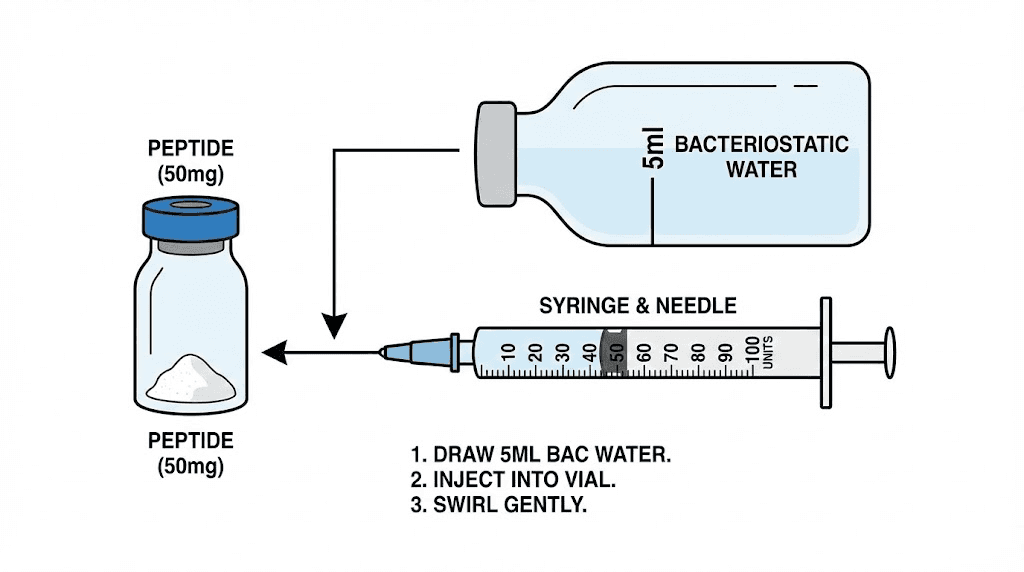
Quick Reference Formula
For any reconstitution calculation, use this formula:
Units to draw = (Desired dose in mg / Total mg in vial) × Total units of BAC water added × 100
Example: For 2mg from a 50mg vial reconstituted with 2.5mL (250 units) BAC water:
(2mg / 50mg) × 250 units = 10 units
This formula works for any vial size and any reconstitution volume, making it essential for accurate peptide dosing.
100mg Vial Reconstitution Charts
Larger vials offer better value but require careful storage consideration since reconstituted peptides should be used within 30 days.
The charts below help you choose the right reconstitution volume for your protocol.
Reconstitution Volume Options for 100mg Vial
BAC Water Added | Concentration (mg/mL) | Units per mg | Total Doses at 2mg | Total Doses at 1mg |
|---|---|---|---|---|
2.0mL | 50mg/mL | 2 units | 50 doses | 100 doses |
2.5mL | 40mg/mL | 2.5 units | 50 doses | 100 doses |
3.0mL | 33.3mg/mL | 3 units | 50 doses | 100 doses |
4.0mL | 25mg/mL | 4 units | 50 doses | 100 doses |
5.0mL | 20mg/mL | 5 units | 50 doses | 100 doses |
100mg Vial Injection Volume Chart (3.0mL BAC Water)
Adding 3.0mL to a 100mg vial creates a 33.3mg/mL concentration.
This is a practical choice that keeps injection volumes small while fitting within standard vial capacity.
Target Dose | Units to Draw (U-100) | Volume (mL) | Doses per Vial | Days Supply (Daily) |
|---|---|---|---|---|
0.5mg | 1.5 units | 0.015mL | 200 doses | 200 days |
1.0mg | 3 units | 0.03mL | 100 doses | 100 days |
1.5mg | 4.5 units | 0.045mL | 66 doses | 66 days |
2.0mg | 6 units | 0.06mL | 50 doses | 50 days |
2.5mg | 7.5 units | 0.075mL | 40 doses | 40 days |
3.0mg | 9 units | 0.09mL | 33 doses | 33 days |
Note that 100mg vials at daily 2mg dosing provide 50 days of product, which exceeds the 30-day reconstituted stability recommendation. Consider splitting the powder into two sterile vials before reconstitution if using lower doses, or choose 50mg vials for protocols requiring less than 2mg daily. SeekPeptides recommends matching vial size to your protocol duration for optimal potency.
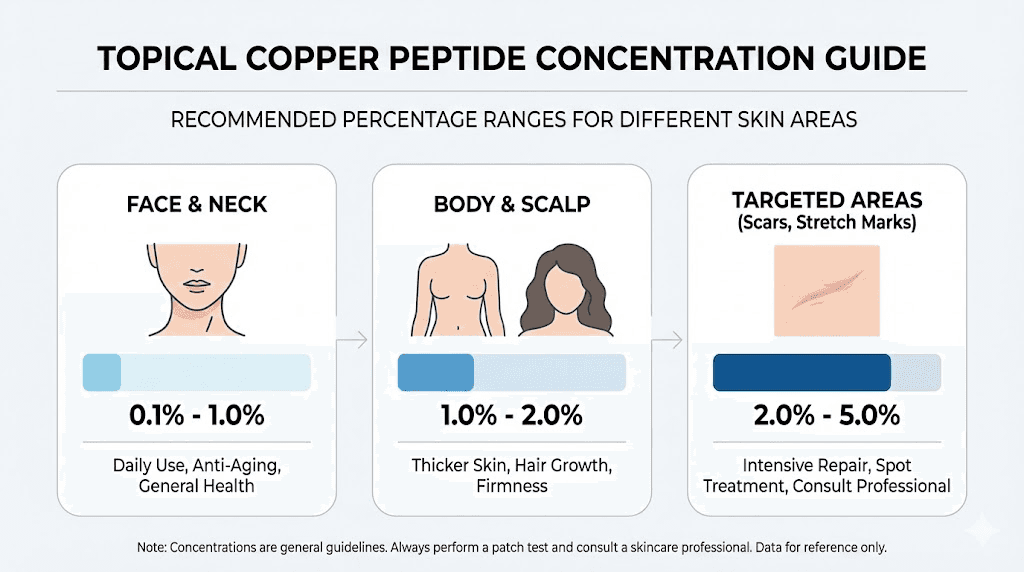
Topical GHK-CU Concentration Guide
Topical copper peptide concentrations vary significantly based on application area and goal. The chart below provides complete guidance on selecting the right concentration for your needs.
Concentration by Application Area
Application Area | Recommended Concentration | Frequency | Rationale |
|---|---|---|---|
Face (general) | 2-4% | 2x daily | Standard effective range |
Neck | 2-4% | 2x daily | Thinner skin, same concentration |
Eye area | 2% | 1x daily | Delicate skin, lower concentration |
Scalp | 0.5-2% | 1-2x daily | Hair follicle targeting |
Hands | 2-4% | 2x daily | Thicker skin tolerates higher % |
Chest/Decolletage | 2-3% | 2x daily | Sun-damaged skin responds well |
Wound sites | 2-4% | 2-3x daily | Active healing support |
Post-procedure | 2-4% | 2x daily | Enhanced recovery |
Concentration Effectiveness Chart
Research supports specific concentration ranges for different skin benefits.
The following chart shows what you can expect at various concentrations based on available clinical evidence and user experiences documented across the peptide research community.
Concentration | Effectiveness for Anti-Aging | Effectiveness for Healing | Risk of Irritation | Cost Efficiency |
|---|---|---|---|---|
0.5% | Low | Moderate | Very Low | High |
1% | Low-Moderate | Good | Low | High |
2% | Good | Good | Low | Good |
3% | Very Good | Very Good | Low-Moderate | Moderate |
4% | Excellent | Excellent | Moderate | Moderate |
5%+ | Excellent | Excellent | Higher | Lower |
The 2-4% range represents the optimal balance between effectiveness and tolerability for most users. Higher concentrations may accelerate results but increase risk of temporary irritation. The general principle with copper peptides is that excessive application can break down tissue faster than regeneration occurs, so more is not always better.
Cycle Length Reference Charts
Cycling GHK-CU helps maintain receptor sensitivity and prevents potential copper accumulation.
The charts below provide cycle recommendations based on your goals and experience level.
Cycle Duration by Goal
Goal | On Cycle | Off Cycle | Total Cycle | Repeat? |
|---|---|---|---|---|
Skin Anti-Aging | 8-12 weeks | 2-4 weeks | 10-16 weeks | Yes, indefinitely |
Hair Restoration | 16-24 weeks | 4-8 weeks | 20-32 weeks | Yes, 2-3 cycles typical |
Acute Wound Healing | Until healed | N/A | 2-6 weeks typical | As needed |
Joint/Tissue Repair | 8-12 weeks | 4 weeks | 12-16 weeks | Yes, 2-3 cycles |
General Longevity | 8 weeks | 4 weeks | 12 weeks | Yes, ongoing |
Post-Surgery Recovery | 4-8 weeks | 4 weeks | 8-12 weeks | Typically one cycle |
Progressive Dosing Schedule
Many researchers prefer a titration approach that starts conservatively and increases over time. This chart shows a standard progressive protocol for a 12-week cycle.
Week | Phase | Dose | Frequency | Purpose |
|---|---|---|---|---|
1-2 | Assessment | 0.5-1mg | 3x/week | Gauge tolerance |
3-4 | Building | 1mg | 5x/week | Establish baseline |
5-8 | Optimization | 1.5mg | 5x/week | Full therapeutic dose |
9-12 | Peak | 2mg | Daily | Maximum effect |
13-16 | Off | 0mg | N/A | Recovery period |
This progressive approach helps identify your optimal dose while minimizing potential side effects. Some users find they respond well to lower doses and never need to reach the peak phase amounts. Others require the full 2mg daily for noticeable results. Starting low and titrating up remains the safest approach.
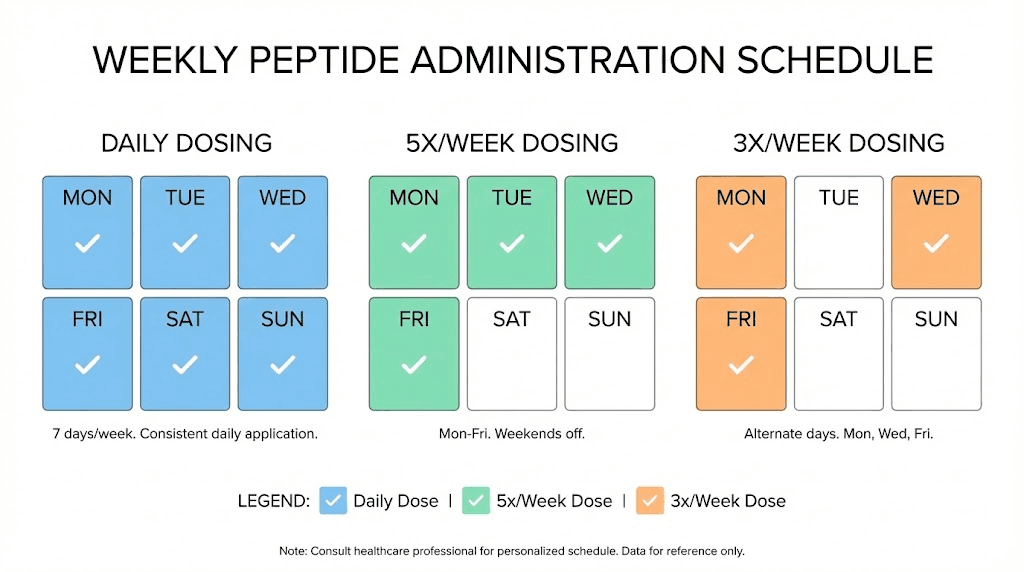
Administration Frequency Charts
How often you administer GHK-CU affects both results and practicality. The charts below compare different frequency protocols and their typical outcomes.
Injectable Frequency Comparison
Frequency | Weekly Total (at 2mg) | Convenience | Effectiveness | Best For |
|---|---|---|---|---|
Daily (7x/week) | 14mg | Low | Excellent | Aggressive protocols, wound healing |
5x/week | 10mg | Moderate | Very Good | Standard therapeutic use |
Every Other Day | 7mg | Good | Good | Maintenance, cost efficiency |
3x/week (M/W/F) | 6mg | Very Good | Good | Long-term maintenance |
2x/week | 4mg | Excellent | Moderate | Minimal maintenance |
Optimal Timing Chart
The timing of your GHK-CU administration can influence results, though the peptide is relatively flexible compared to growth hormone releasing peptides.
Time of Day | Advantages | Disadvantages | Rating |
|---|---|---|---|
Morning (6-8am) | Aligns with natural cortisol rhythm | May need fasting | Good |
Evening (8-10pm) | Aligns with tissue repair during sleep | May forget after long day | Excellent |
Before bed | Maximizes overnight healing | Routine disruption | Very Good |
Split (AM/PM) | Maintains steady levels | Twice daily injections | Good for high doses |
For most users, evening administration provides the best balance of effectiveness and convenience. The body does most tissue repair during sleep, making evening dosing physiologically advantageous. However, consistency matters more than timing. Pick a time that works for your schedule and stick with it.
Stacking Reference Charts
GHK-CU combines well with several other peptides for enhanced results.
The charts below show common stacking combinations and their synergistic benefits.
Popular GHK-CU Stack Combinations
Stack Partner | Combined Benefit | GHK-CU Dose | Partner Dose | Best For |
|---|---|---|---|---|
Enhanced tissue repair | 1-2mg daily | 2.5mg 2x/week | Injury recovery | |
Accelerated healing | 1-2mg daily | 250-500mcg daily | Gut + tissue healing | |
Longevity enhancement | 1mg daily | 5mg daily | Anti-aging | |
Mitochondrial + tissue | 1-2mg daily | 50-100mg daily | Cellular health | |
Anti-inflammatory + repair | 1-2mg daily | 200-400mcg daily | Inflammatory conditions |
The Glow Stack Protocol
One of the most popular combinations is the Glow Stack, which combines GHK-CU with TB-500 for comprehensive skin and tissue benefits.
Week | GHK-CU Dose | TB-500 Dose | Frequency | Phase |
|---|---|---|---|---|
1-2 | 1mg | 2.5mg | 2x/week each | Loading |
3-4 | 1.5mg | 2.5mg | 2x/week each | Building |
5-8 | 2mg | 2mg | 2x/week each | Maintenance |
9-12 | 1mg | 2mg | 1x/week each | Tapering |
When stacking multiple peptides, use the peptide stack calculator to manage total volumes and timing.
Most stacks can be administered in the same injection if using the same delivery method, though some practitioners prefer separating them by several hours.
What Not to Stack
While GHK-CU is generally safe to combine with most peptides, certain combinations require caution or are not recommended.
Avoid Combining With | Reason | Alternative Approach |
|---|---|---|
Excessive copper supplements | Risk of copper toxicity | Reduce supplemental copper |
Zinc at same time | Mineral competition | Separate by 4+ hours |
High-dose Vitamin C topical | May oxidize copper | Use at different times |
Retinoids (initially) | Combined irritation risk | Introduce gradually |
For guidance on combining copper peptides with retinoids, start with alternating days before progressing to same-day use. This approach from SeekPeptides protocols minimizes irritation while maximizing benefits.
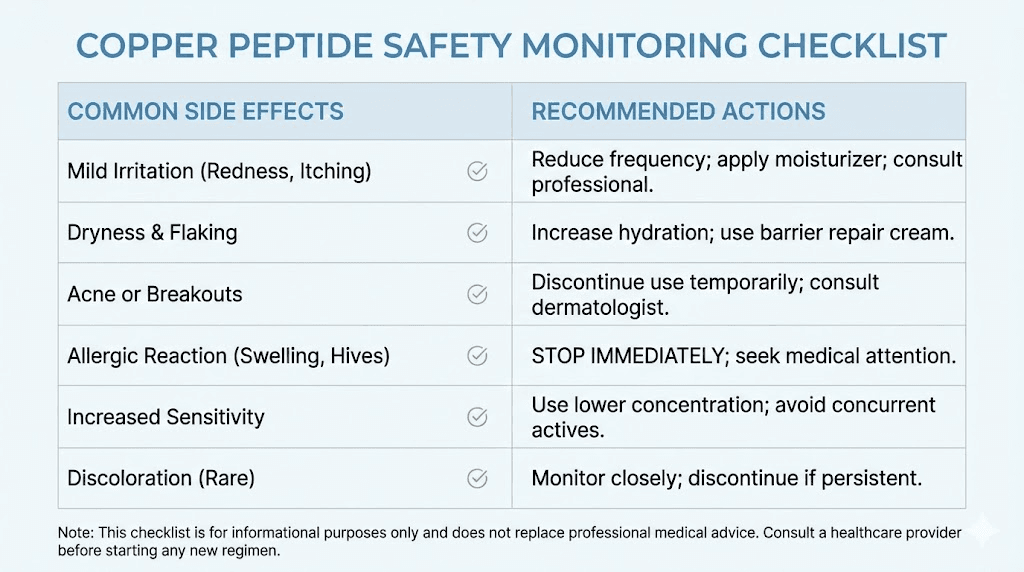
Side Effects Monitoring Chart
GHK-CU has an excellent safety profile, but monitoring for potential effects helps optimize your protocol. The chart below lists what to watch for and when to adjust.
Common Side Effects Reference
Side Effect | Frequency | Severity | Action | Usually Resolves |
|---|---|---|---|---|
Injection site redness | Common | Mild | Rotate sites | 1-2 hours |
Mild headache | Occasional | Mild | Reduce dose | Hours |
Temporary skin flushing | Occasional | Mild | Normal response | 30-60 minutes |
Topical irritation | Uncommon | Mild-Moderate | Reduce concentration | 24-48 hours |
Nausea | Rare | Mild | Take with food | Hours |
Allergic reaction | Very Rare | Variable | Discontinue | Varies |
When to Adjust Protocol
Observation | Possible Cause | Recommended Action |
|---|---|---|
Persistent injection site reactions | Sensitivity, technique | Rotate sites more, check technique |
No results after 4 weeks | Dose too low, poor absorption | Increase dose, verify product quality |
Skin breakouts (topical) | Purging, concentration too high | Reduce frequency or concentration |
Excessive skin sensitivity | Overuse, concentration too high | Take 1 week break, reduce concentration |
Hair shedding increase (temporary) | Normal part of hair cycle reset | Continue protocol, usually resolves week 4-6 |
The vast majority of GHK-CU users experience no significant side effects. Studies note that copper peptides have "a long history of safe use in wound healing and skin care" and are active at very low concentrations. The lethal dose in humans would be approximately 21,000mg for a 70kg person, making the 1-3mg daily doses used in typical protocols extremely safe from a toxicity standpoint.
Results Timeline Chart
Understanding when to expect results helps set realistic expectations and prevents premature protocol abandonment.
The chart below shows typical result timelines for different goals.
Expected Results by Week
Timeframe | Skin Anti-Aging | Hair Restoration | Wound Healing | Tissue Repair |
|---|---|---|---|---|
Week 1-2 | Improved hydration | Scalp sensation changes | Reduced inflammation | Reduced pain/swelling |
Week 3-4 | Subtle texture improvement | Reduced shedding | Visible healing progress | Improved mobility |
Week 5-8 | Fine lines softening | New vellus hairs | Significant closure | Substantial improvement |
Week 9-12 | Visible firmness increase | Thickening visible | Complete healing | Near-complete recovery |
Week 13-16 | Continued improvement | Noticeable density | N/A | Full recovery |
Week 17-24 | Optimal results | Significant regrowth | N/A | N/A |
Quantified Results from Research
Available research provides some quantified expectations for GHK-CU results.
Outcome Measure | Reported Improvement | Timeframe | Source |
|---|---|---|---|
Fine line reduction | 36% | 12 weeks | Clinical study |
Skin clarity | 27% | 12 weeks | Clinical study |
Wound healing rate | 40-60% faster | Compared to controls | Multiple studies |
Hair density | 22% | 24 weeks | Clinical observation |
Hair thickness | 28% | 24 weeks | Clinical observation |
Collagen production | 70%+ | Cell studies | In vitro research |
These numbers come from various research contexts and individual results vary based on age, baseline condition, protocol adherence, and other factors.
The key takeaway is that GHK-CU produces measurable, documented improvements when used consistently at appropriate doses.
Cost Calculation Charts
Understanding the cost per dose helps you budget effectively and compare vial sizes. The charts below calculate typical costs based on common market pricing.
Cost Per Dose Comparison (50mg vs 100mg Vials)
Vial Size | Typical Price Range | Cost at 1mg/dose | Cost at 2mg/dose | Cost per Week (5x) |
|---|---|---|---|---|
50mg | $40-80 | $0.80-1.60 | $1.60-3.20 | $8-16 |
100mg | $70-140 | $0.70-1.40 | $1.40-2.80 | $7-14 |
200mg | $120-240 | $0.60-1.20 | $1.20-2.40 | $6-12 |
Monthly Cost by Protocol
Protocol Type | Monthly Dose | Cost Range (50mg vials) | Cost Range (100mg vials) |
|---|---|---|---|
Maintenance (1mg, 3x/week) | ~12mg | $10-20 | $8-17 |
Standard (1.5mg, 5x/week) | ~30mg | $24-48 | $21-42 |
Aggressive (2mg, daily) | ~60mg | $48-96 | $42-84 |
Maximum (3mg, daily) | ~90mg | $72-144 | $63-126 |
Larger vials offer better value per milligram but require proper storage and may result in waste if not used within the 30-day reconstituted stability window. Match your vial purchase to your protocol duration for optimal cost efficiency.
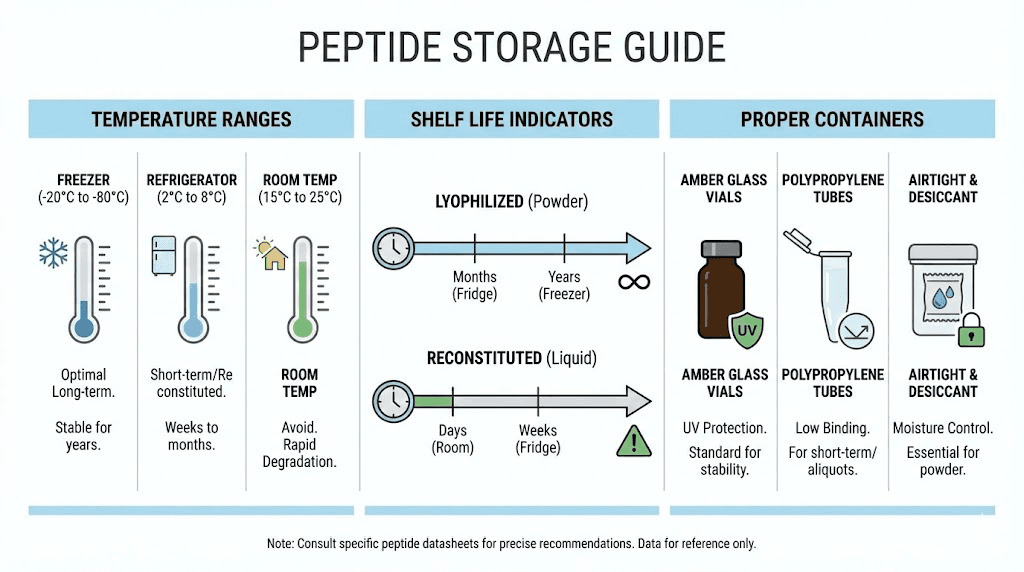
Storage Reference Chart
Proper storage preserves potency and maximizes your investment. This quick reference covers storage requirements for all GHK-CU forms.
Storage Requirements by Form
Form | Temperature | Light | Shelf Life | Container |
|---|---|---|---|---|
Lyophilized powder | -20°C to 4°C (-4°F to 39°F) | Protect from light | 2+ years | Original sealed vial |
Reconstituted solution | 2-8°C (36-46°F) | Protect from light | 30 days | Original vial, refrigerated |
Topical serum/cream | Room temp or refrigerated | Dark container | Per manufacturer | Airless pump preferred |
Frozen solution | -20°C (-4°F) | N/A | 3-6 months | Sterile vials |
Stability Indicators
Indicator | Good | Caution | Discard |
|---|---|---|---|
Color (reconstituted) | Clear with blue tint | Slightly darker blue | Cloudy, brown, or discolored |
Clarity | Completely clear | Minor particles | Cloudy or precipitate |
Odor | None | Slight | Strong or unusual |
Powder appearance | White to off-white | Slightly colored | Brown or dark |
The characteristic blue tint of reconstituted GHK-CU comes from the copper ion. This is normal and expected. However, significant color changes, cloudiness, or particles indicate degradation. When in doubt, discard and reconstitute fresh.
Quick Reference Summary Tables
These condensed tables provide at-a-glance reference for the most commonly needed GHK-CU dosing information.
Injectable Quick Reference
Parameter | Beginner | Standard | Advanced |
|---|---|---|---|
Daily dose | 0.5-1mg | 1-2mg | 2-3mg |
Frequency | 3-5x/week | 5-7x/week | Daily |
Cycle length | 4-6 weeks | 8-12 weeks | 12-16 weeks |
Off period | 2-4 weeks | 2-4 weeks | 4-8 weeks |
50mg vial duration | 50+ days | 25-50 days | 16-25 days |
Topical Quick Reference
Parameter | Conservative | Standard | Aggressive |
|---|---|---|---|
Concentration | 0.5-1% | 2-3% | 4%+ |
Frequency | 1x daily | 2x daily | 2-3x daily |
Best for | Sensitive skin, maintenance | General use | Targeted treatment |
Results timeline | 8-12 weeks | 4-8 weeks | 2-4 weeks |
Reconstitution Quick Reference
Vial Size | Add BAC Water | Concentration | Units for 1mg | Units for 2mg |
|---|---|---|---|---|
50mg | 2.5mL | 20mg/mL | 5 units | 10 units |
100mg | 3.0mL | 33.3mg/mL | 3 units | 6 units |
Bookmark this page for quick access to these reference tables. SeekPeptides members get access to interactive versions of these charts plus personalized protocol builders that adjust recommendations based on your specific goals and body composition.
Comparison with Other Copper Peptide Forms
GHK-CU is not the only copper peptide available.
Understanding how it compares to alternatives helps you make informed decisions about which form suits your needs.
Copper Peptide Comparison Chart
Form | Structure | Bioavailability | Best Administration | Primary Use |
|---|---|---|---|---|
GHK-CU | Tripeptide + copper | High | Injectable, topical | Comprehensive regeneration |
Copper Peptide Serums | Various | Moderate (topical) | Topical only | Skin care |
AHK-CU | Modified tripeptide | Moderate | Topical | Hair specific |
Copper Gluconate | Simple salt | Low | Oral | Copper supplementation |
GHK-CU vs Topical Copper Peptide Serums
Factor | GHK-CU (Injectable) | GHK-CU (Topical) | OTC Copper Serums |
|---|---|---|---|
Penetration depth | Systemic | Dermal layers | Surface/upper dermal |
Concentration control | Precise | Precise | Variable by product |
Effectiveness | Highest | High | Moderate |
Cost | Higher | Moderate | Lower |
Convenience | Lower | High | Highest |
Systemic benefits | Yes | Limited | No |
For localized skin concerns, topical application often suffices. For systemic benefits, tissue repair, or hair restoration, injectable protocols typically produce superior results due to better bioavailability and distribution.
Special Population Considerations
Certain populations may need modified protocols.
The chart below provides guidance for specific situations.
Dosing Adjustments by Population
Population | Starting Dose Adjustment | Special Considerations | Monitoring |
|---|---|---|---|
Over 60 | Start 25-50% lower | May respond more sensitively | Standard |
Under 25 | Generally not recommended | Natural regeneration usually adequate | N/A |
Wilson's Disease | Contraindicated | Copper accumulation disorder | N/A |
Copper Sensitivity | Patch test first | Start topical at 0.5% | Watch for reactions |
Post-Surgery | Standard or higher | Benefits healing significantly | Coordinate with surgeon |
Standard dosing | No gender-specific adjustments | Standard | |
Standard dosing | No gender-specific adjustments | Standard |
For women over 40 interested in anti-aging benefits, GHK-CU represents one of the most evidence-supported peptide options with an excellent safety profile. Perimenopausal and menopausal women often report particular benefit from the skin and tissue support GHK-CU provides.
Combining GHK-CU with Other Treatments
GHK-CU integrates well with many aesthetic and therapeutic treatments. The chart below shows timing considerations for common combinations.
Treatment Combination Timing Chart
Treatment | GHK-CU Timing | Benefit | Notes |
|---|---|---|---|
Microneedling | Apply immediately after | Enhanced penetration, faster healing | Use topical 2-4% |
Chemical Peels | 24-48 hours after | Accelerated recovery | Wait for initial healing |
Laser Treatments | 24-48 hours after | Reduced downtime | Coordinate with provider |
PRP (Platelet Rich Plasma) | Same session or concurrent | Synergistic regeneration | Injectable GHK-CU |
Retinoids | Alternate initially | Anti-aging synergy | Build up gradually |
Vitamin C Serum | Different times of day | Antioxidant + regeneration | AM Vitamin C, PM GHK-CU |
Hyaluronic Acid | Can layer same time | Hydration + repair | GHK-CU first, HA second |
The enhanced penetration achieved after microneedling makes this combination particularly effective for skin rejuvenation goals.
The micro-channels created allow topical GHK-CU to reach deeper dermal layers where it can stimulate collagen production more effectively.
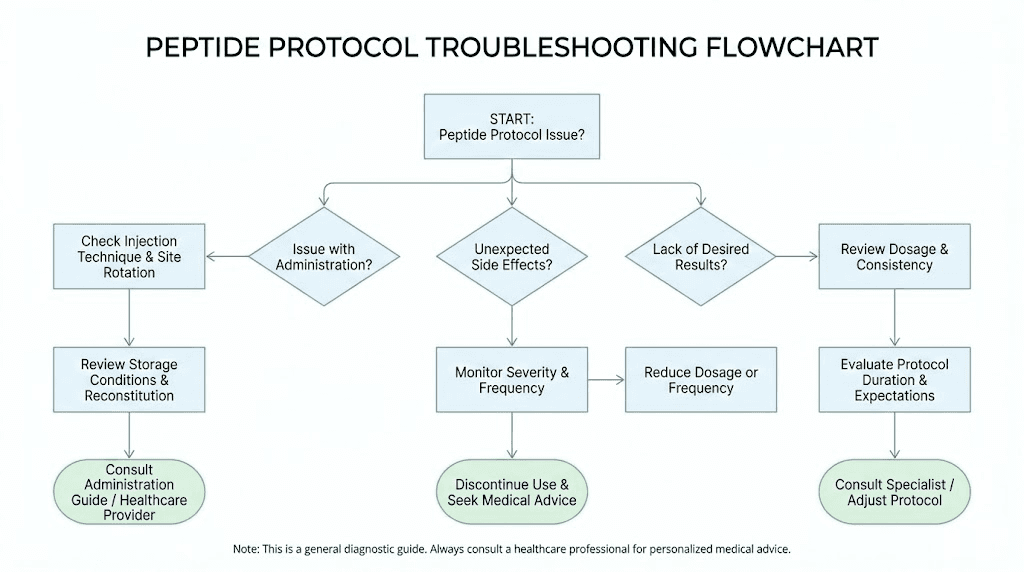
Troubleshooting Reference Chart
When protocols do not work as expected, systematic troubleshooting helps identify the issue. This chart covers common problems and solutions.
Problem-Solution Reference
Problem | Possible Causes | Solutions |
|---|---|---|
No results after 4 weeks | Dose too low, poor product quality, unrealistic expectations | Increase dose, verify vendor, adjust timeline |
Injection site lumps | Too shallow injection, insufficient rotation | Inject deeper subcutaneously, rotate sites |
Skin irritation (topical) | Concentration too high, over-application | Reduce to 1-2%, once daily |
Headaches | Dose too high, dehydration | Reduce dose 25-50%, increase water intake |
Solution cloudy | Contamination, degradation | Discard, reconstitute fresh with proper technique |
Inconsistent results | Irregular dosing, improper storage | Establish consistent schedule, verify storage |
Hair shedding increase | Normal cycle reset (usually temporary) | Continue protocol, typically resolves weeks 4-6 |
For questions about discontinuing or troubleshooting skin reactions, these specific guides provide detailed protocols for addressing common concerns.
Frequently Asked Questions
What is the standard GHK-CU dose for beginners?
Beginners typically start with 0.5-1mg administered subcutaneously 3-5 times per week. This allows assessment of tolerance before increasing to standard therapeutic doses of 1-2mg daily.
How do I calculate units to draw from my syringe?
Use the formula: (Desired dose ÷ Total peptide in vial) × Total BAC water units × 100. For example, for 2mg from a 50mg vial with 2.5mL BAC water: (2÷50) × 250 = 10 units. The reconstitution calculator automates this calculation.
Can I use GHK-CU topically and by injection simultaneously?
Yes, many protocols combine both methods for comprehensive benefits. The injectable form provides systemic effects while topical application targets specific areas directly.
How long until I see results from GHK-CU?
Initial changes like improved skin hydration often appear within 2-4 weeks. More significant results for anti-aging typically require 8-12 weeks, while hair restoration often needs 16-24 weeks of consistent use.
What happens if I miss a dose?
Missing occasional doses does not significantly impact results. Simply continue with your next scheduled dose, do not double up. Consistency over weeks matters more than perfect daily adherence.
Is GHK-CU safe for long-term use?
Current evidence supports excellent safety for long-term use with appropriate cycling. The peptide occurs naturally in the body and has decades of research supporting its safety profile.
What concentration of topical GHK-CU should I use?
Start with 2% for most applications. The eye area benefits from lower 1-2% concentrations, while normal facial skin can use 2-4%. Higher concentrations may increase results but also increase irritation risk.
Can I stack GHK-CU with BPC-157 and TB-500?
Yes, this is a popular combination for comprehensive healing. GHK-CU provides tissue regeneration, BPC-157 supports gut and systemic healing, and TB-500 promotes tissue repair. Use the stack calculator for dosing guidance.
External Resources
In case I don't see you, good afternoon, good evening, and good night. May your charts stay accurate, your calculations stay precise, and your protocols stay effective. Join the best Peptide platform.