Dec 23, 2025

You started using copper peptides for anti-aging. Everyone raves about GHK-Cu - collagen production, skin regeneration, reduced wrinkles. The science looked solid.
Then your skin freaked out.
Maybe it's red and irritated. Or breaking out like you're 15 again. Or weirdly sensitive to everything.
Your skin looks worse than before you started, and you're wondering if you've permanently damaged your face.
Here's the truth: copper peptides didn't ruin your skin. But they revealed problems, triggered reactions, or were used incorrectly in ways that caused damage. The good news is almost all copper peptide skin problems are reversible.
This guide explains exactly why copper peptides cause problems for some people, how to repair the damage if it's already done, and how to use copper peptides properly without wrecking your skin. You'll learn the difference between normal adjustment reactions and actual problems, when to push through versus when to stop, and alternative approaches if copper peptides genuinely don't work for you.
Let's start with understanding what's actually happening when copper peptides "ruin" your skin.
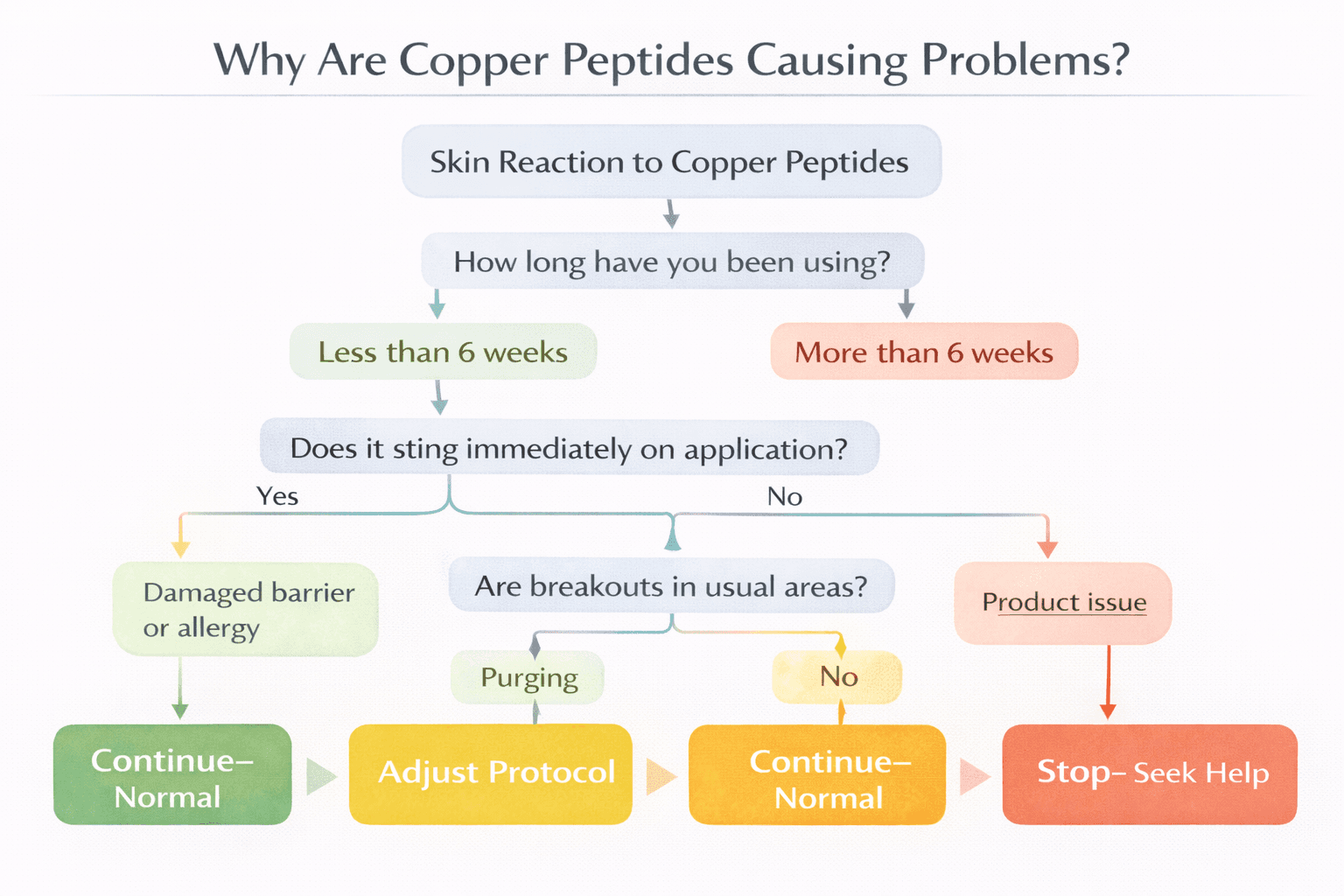
Why copper peptides cause skin problems
Copper peptides are powerful. That's why they work. It's also why they can cause problems when used incorrectly.
Reason 1: Too high concentration too fast
GHK-Cu increases cellular turnover, collagen production, and skin activity. When you jump straight to high concentrations (2-3% or higher), your skin can't handle the sudden increase in cellular activity.
What happens: Irritation, redness, burning sensation, increased sensitivity. Your skin is being told to work overtime when it wasn't ready.
Why it happens: Skin needs time to adapt to increased copper peptide signaling. Starting high overwhelms cellular processes.
The fix: Start with 0.5-1% concentration. Use 2-3 times per week for 2 weeks. Gradually increase frequency and concentration as skin adjusts.
Reason 2: Damaged skin barrier
If your skin barrier was already compromised (from overuse of actives, harsh cleansers, environmental damage), copper peptides penetrate too deeply too quickly, causing inflammation rather than beneficial cellular activity.
What happens: Severe sensitivity, stinging with application, redness that persists for hours, potential breakouts.
Why it happens: Intact skin barrier regulates penetration. Damaged barrier allows copper peptides to flood into deeper layers, triggering inflammatory response.
The fix: Stop all actives. Repair barrier first (2-4 weeks of gentle cleansing and moisturizing only). Reintroduce copper peptides at low concentration once barrier is restored.
Reason 3: Purging (often mistaken for damage)
Copper peptides increase cellular turnover. This pushes existing congestion to the surface faster. You're not breaking out - you're clearing out.
What happens: Increased breakouts in areas where you typically get acne. Breakouts resolve faster than usual (7-10 days vs 2-3 weeks).
Why it happens: Accelerated skin turnover brings trapped sebum, bacteria, and debris to the surface. This is actually the product working.
The fix: Nothing - this is normal. Push through for 4-6 weeks. If breakouts don't resolve or worsen beyond 6 weeks, it's not purging.
Reason 4: Copper sensitivity or allergy
Some people are genuinely sensitive to copper. This is relatively rare but real.
What happens: Immediate reaction upon application - severe stinging, rash, hives, persistent redness. Gets worse with repeated use rather than better.
Why it happens: Your immune system recognizes copper as threat and mounts allergic response.
The fix: Stop using copper peptides. Consider patch testing before trying again. If allergic response is confirmed, copper peptides aren't for you.
Reason 5: Poor formulation or contamination
Not all copper peptide products are created equal. Poor formulations, contaminated products, or expired peptides cause problems.
What happens: Inconsistent reactions - works fine one day, causes irritation the next. Unusual smell or color changes in product.
Why it happens: Copper peptides are unstable and can degrade. They also interact with certain preservatives and ingredients, creating irritating compounds.
The fix: Source quality products from reputable suppliers. Check expiration dates. Store properly (cool, dark place). If product has changed color or smell, discard it.
Reason 6: Combining with incompatible ingredients
Copper peptides don't play well with everything. Combining them with certain actives creates interactions that irritate or damage skin.
What happens: Skin that tolerates copper peptides alone and vitamin C alone breaks out or gets irritated when using both.
Why it happens: Chemical interactions between copper and certain ingredients (particularly vitamin C, high-acid products) reduce effectiveness and increase irritation.
The fix: Use copper peptides separately from incompatible ingredients. Different times of day or alternate days.
Reason 7: Pre-existing skin conditions
Conditions like rosacea, seborrheic dermatitis, or severe acne make skin more reactive to new actives.
What happens: Condition flares dramatically after starting copper peptides.
Why it happens: Already-inflamed skin can't handle additional cellular activity from copper peptides.
The fix: Treat underlying condition first. Consider whether copper peptides are appropriate for your skin condition. Some conditions improve with copper peptides (anti-inflammatory effects), others worsen.
How to repair skin damaged by copper peptides
If you've already experienced problems, here's how to fix it:
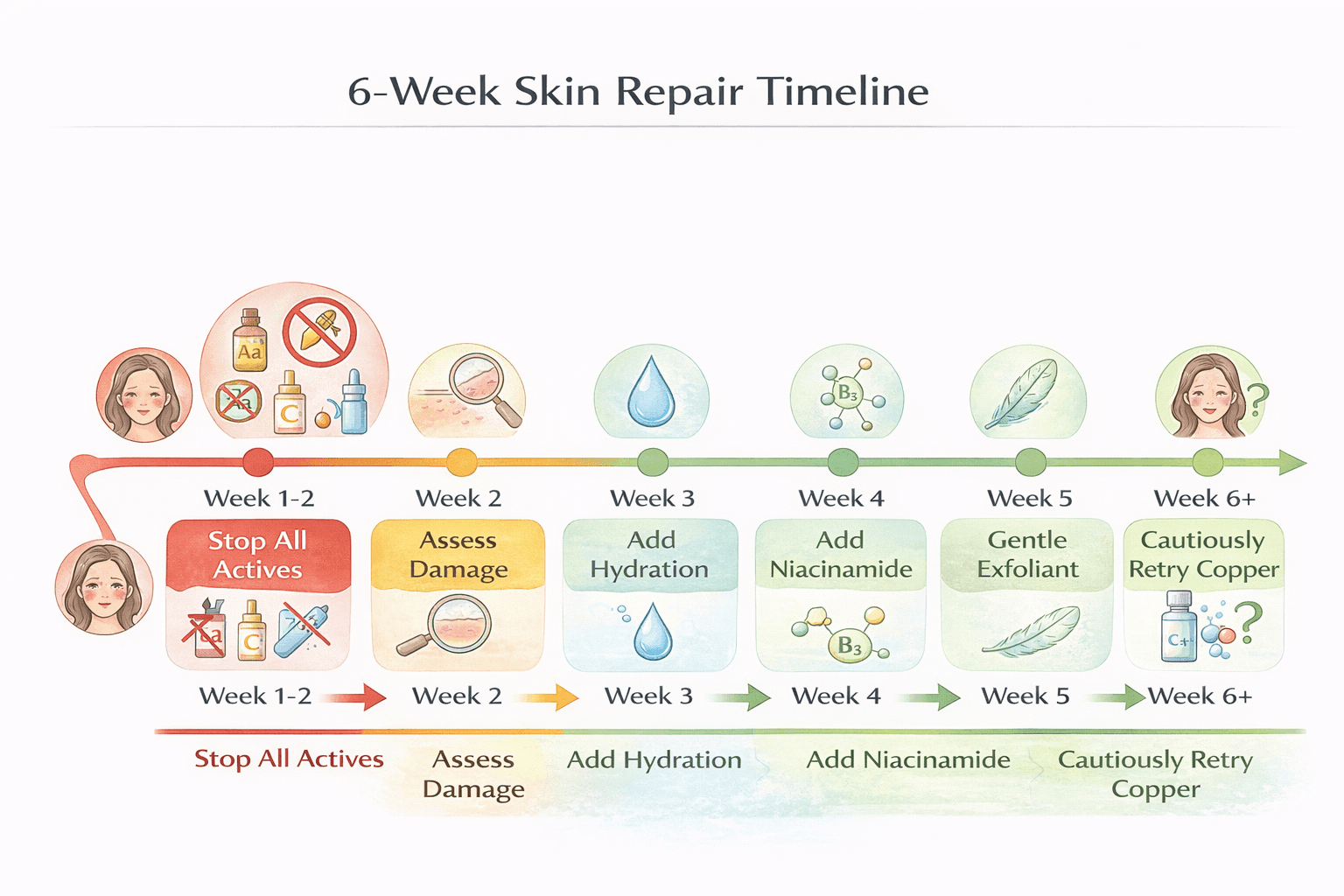
Step 1: Stop all actives immediately (Week 1-2)
When your skin is damaged, continuing to use active ingredients (including copper peptides) makes it worse. Your skin needs a break.
What to do:
Stop copper peptides
Stop retinoids, AHAs, BHAs, vitamin C, and all other actives
Use only gentle, fragrance-free cleanser
Apply simple, barrier-repairing moisturizer
Use mineral sunscreen (zinc oxide or titanium dioxide based)
Products to use:
Cleanser: Cetaphil Gentle Skin Cleanser, La Roche-Posay Toleriane, or similar
Moisturizer: CeraVe Moisturizing Cream, Vanicream, or products with ceramides
Sunscreen: EltaMD UV Physical, Blue Lizard Sensitive
What to avoid:
Hot water (use lukewarm only)
Mechanical exfoliation (scrubs, brushes)
Fragranced products
Essential oils
Any active ingredients
Timeline: Stick with this minimal routine for 2 weeks minimum. Skin should start calming within days, but barrier repair takes time.
Step 2: Assess the damage (Week 2)
After 2 weeks of barrier repair, evaluate where you are:
Signs skin is healing:
Reduced redness
Less sensitivity/stinging
Improved texture
Fewer new breakouts
Signs you need more time:
Persistent redness
Still stinging with gentle products
New breakouts appearing
Skin feels tight and uncomfortable
If not healing after 2 weeks of minimal routine, see a dermatologist. You may have triggered a condition requiring professional treatment.
Step 3: Slowly rebuild routine (Week 3-6)
Once baseline sensitivity is reduced, carefully reintroduce products:
Week 3: Add hydrating serum (hyaluronic acid, ceramides, peptides other than copper)
Week 4: Add niacinamide if desired (reduces inflammation, supports barrier)
Week 5: Consider very gentle chemical exfoliant (mandelic acid once weekly) if skin is fully calm
Week 6+: Only now consider reintroducing copper peptides if you still want to try them
Rules for reintroduction:
Add one product at a time
Wait 5-7 days between new additions
If anything causes reaction, stop and go back to previous step
Take notes on what works and what doesn't
Step 4: Reintroduce copper peptides properly (if desired)
If you want to try copper peptides again after your skin has healed:
Start differently this time:
Use 0.5% concentration or lower
Apply 2x per week only
Start with small area (forearm test first, then small facial area)
Wait 4 weeks before increasing frequency or concentration
Pay attention to skin's response
If problems recur:
Copper peptides may not be right for your skin
Consider alternatives (regular peptides without copper, retinoids, other collagen-boosting actives)
Focus on barrier health and gentle anti-aging approaches
Supplements and support for healing
While healing damaged skin, these can help:
Omega-3 fatty acids: 2-3g daily (reduces inflammation, supports skin barrier)
Zinc: 30mg daily (healing, anti-inflammatory, supports skin health)
Vitamin C: 1,000-2,000mg daily oral (collagen synthesis, healing)
Collagen peptides: 10g daily (provides building blocks for skin repair)
Don't supplement copper while healing from copper peptide damage. You're getting adequate copper from diet.
How to use copper peptides properly (avoiding problems)
If you're starting fresh or trying again, here's the right approach:
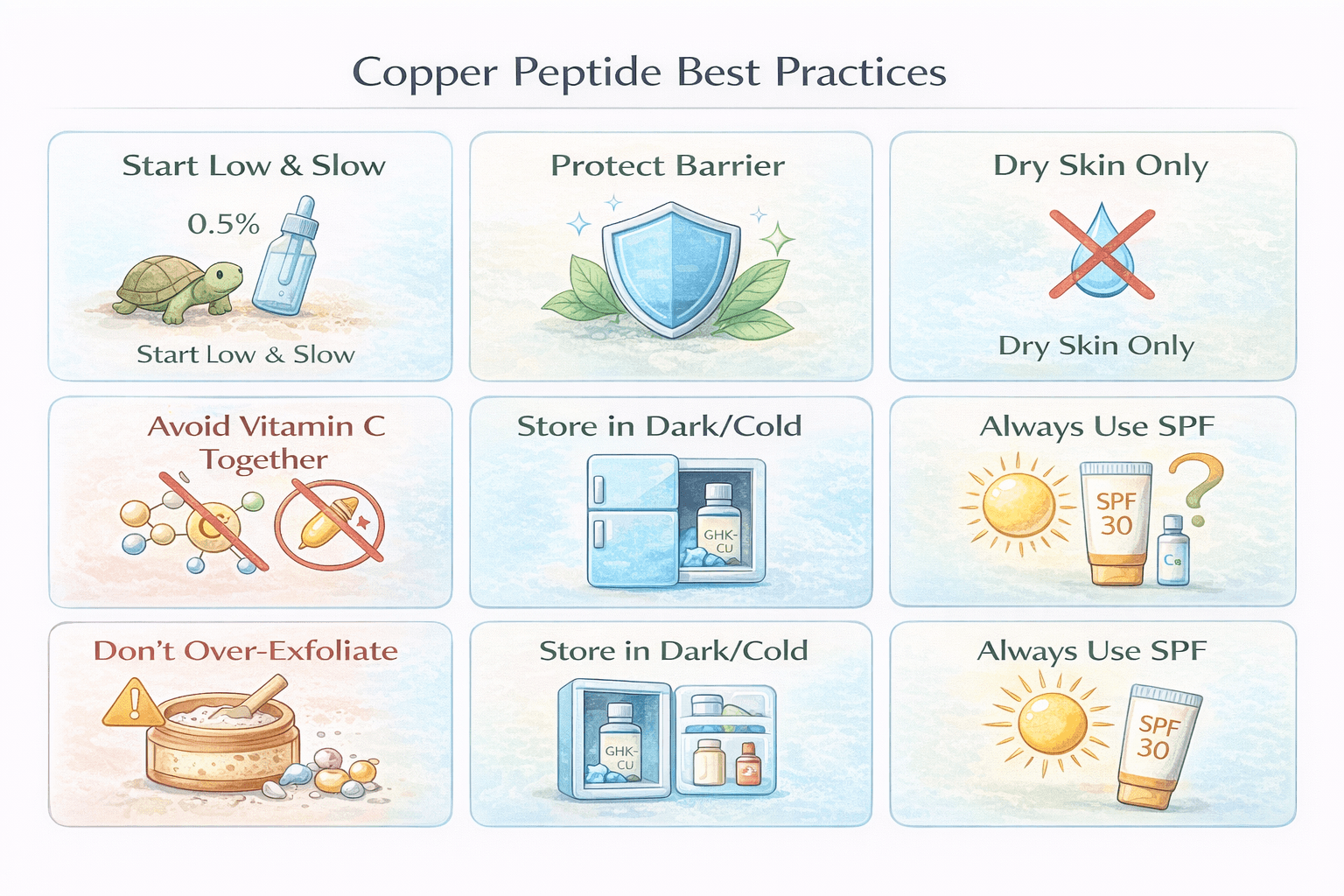
Rule 1: Start low and slow
Beginning protocol:
Week 1-2: 0.5-1% GHK-Cu, 2x per week (Monday, Thursday)
Week 3-4: 0.5-1% GHK-Cu, 3x per week (Monday, Wednesday, Friday)
Week 5-6: 0.5-1% GHK-Cu, every other day
Week 7-8: 0.5-1% GHK-Cu, daily if tolerated
Month 3+: Consider increasing to 1-2% if desired and skin handles it well
Never:
Start with 2-3% concentration
Use daily from day one
Increase concentration and frequency simultaneously
Rule 2: Respect the skin barrier
Your skin barrier is everything. Protect it.
Signs of healthy barrier:
Skin feels comfortable
Minimal sensitivity to products
Consistent texture
Appropriate oil production (not too dry, not too oily)
Signs of compromised barrier:
Stinging with products that normally don't sting
Increased sensitivity
Redness
Flaking or unusual dryness
More reactive to environmental factors
If barrier is compromised:
Stop copper peptides until repaired
Focus on gentle cleansing, moisturizing, protecting
Takes 2-6 weeks to repair depending on severity
Rule 3: Apply to clean, dry skin
Wet skin has temporarily compromised barrier (swelling of stratum corneum). Applying actives to wet skin increases penetration beyond what you want.
Proper application:
Cleanse gently
Pat dry completely
Wait 5 minutes for skin to fully dry
Apply copper peptide serum
Wait 2-3 minutes for absorption
Apply moisturizer if desired
Rule 4: Avoid incompatible combinations
Never combine copper peptides with (same routine):
Vitamin C (especially L-ascorbic acid) - completely destabilizes copper peptides
High-acid products (pH below 4) - reduces effectiveness
Benzoyl peroxide - oxidizes and deactivates peptides
Use cautiously with:
Retinoids - both increase turnover; can be too much at once
AHAs/BHAs - space apart by several hours
Safe combinations:
Hyaluronic acid
Niacinamide (actually synergistic)
Ceramides
Peptides (non-copper)
Timing strategy:
AM: Vitamin C, moisturizer, sunscreen
PM: Copper peptides, moisturizer
Or alternate days: copper peptides Monday/Wednesday/Friday, vitamin C Tuesday/Thursday/Saturday.
Rule 5: Store properly
Copper peptides degrade quickly when exposed to light, air, and heat.
Proper storage:
Opaque bottle or keep in dark place
Airtight packaging
Store in refrigerator if possible (cool temperature extends stability)
Use within 3-6 months of opening
Signs of degradation:
Color change (bluer or greener)
Strange smell
Separation of formula
Reduced effectiveness
If any of these occur, discard product. Using degraded copper peptides causes irritation without benefits.
Rule 6: Don't over-exfoliate
Copper peptides increase cellular turnover. Adding aggressive exfoliation on top creates over-exfoliation.
Maximum exfoliation with copper peptides:
Chemical exfoliant 1-2x per week maximum
Physical exfoliation (gentle only) 1x per week maximum
Many people need zero additional exfoliation when using copper peptides
Signs of over-exfoliation:
Tight, shiny skin
Increased sensitivity
Redness
Peeling or flaking
Breakouts
If over-exfoliated, stop all exfoliation (including copper peptides temporarily) and focus on barrier repair.
Rule 7: Use sunscreen religiously
Copper peptides increase cellular turnover, which means newer, more vulnerable skin cells at surface. These need protection.
Sunscreen rules:
SPF 30 minimum (SPF 50 better)
Reapply every 2 hours if outdoors
Mineral sunscreens (zinc/titanium) often better tolerated with active skincare
Use every day, even if not going outside (UVA penetrates windows)
Skipping sunscreen while using copper peptides means UV damage hits more vulnerable skin, causing increased pigmentation, sensitivity, and premature aging.
Common mistakes that cause copper peptide problems
Even with good intentions, these errors sabotage results:
Mistake 1: Using too much product
More isn't better. A little copper peptide serum goes a long way.
The problem: Slathering on excess product doesn't increase benefits but does increase irritation risk and waste expensive product.
The fix: 2-3 drops for entire face. That's it. Thin layer is sufficient.
Mistake 2: Layering multiple copper peptide products
Using copper peptide serum, copper peptide cream, and copper peptide eye cream all at once.
The problem: You're dramatically increasing copper concentration beyond what skin can handle.
The fix: Pick one copper peptide product. Use it consistently. Don't stack multiple copper peptide products in same routine.
Mistake 3: Not patch testing
Jumping straight to full-face application without testing.
The problem: If you react badly, your entire face is compromised instead of a small test area.
The fix: Patch test on forearm for 24-48 hours first. Then test small facial area (behind ear or small section of jawline) for a week before full face application.
Mistake 4: Continuing when skin screams stop
Pushing through severe reactions thinking "it just needs to adjust."
The problem: Severe reactions indicate real problems, not normal adjustment. Continuing causes genuine damage.
The fix: Know the difference between normal adjustment (mild tingling, slight redness that fades within an hour) and problem reactions (severe stinging, persistent redness, worsening skin). If in doubt, stop and reassess.
Mistake 5: Using on damaged or compromised skin
Starting copper peptides when skin is sunburned, actively breaking out, or already irritated from other treatments.
The problem: Damaged skin can't handle additional active ingredients. You're pouring gasoline on a fire.
The fix: Wait until skin is calm and healthy before introducing copper peptides.
Mistake 6: Expecting instant results
Getting frustrated after one week and increasing concentration or frequency to "speed things up."
The problem: Copper peptides work through cellular processes that take weeks to manifest. Aggressive use doesn't speed results, it causes damage.
The fix: Commit to consistent use for 8-12 weeks before judging effectiveness. Be patient.
Mistake 7: Buying cheap, untested products
Choosing $15 copper peptide serum from Amazon instead of established brand.
The problem: Copper peptides are expensive to formulate properly. Cheap products are often fake, contaminated, or improperly formulated.
The fix: Buy from reputable suppliers. Check for third-party testing if possible. Quality costs more but actually works without wrecking your skin.
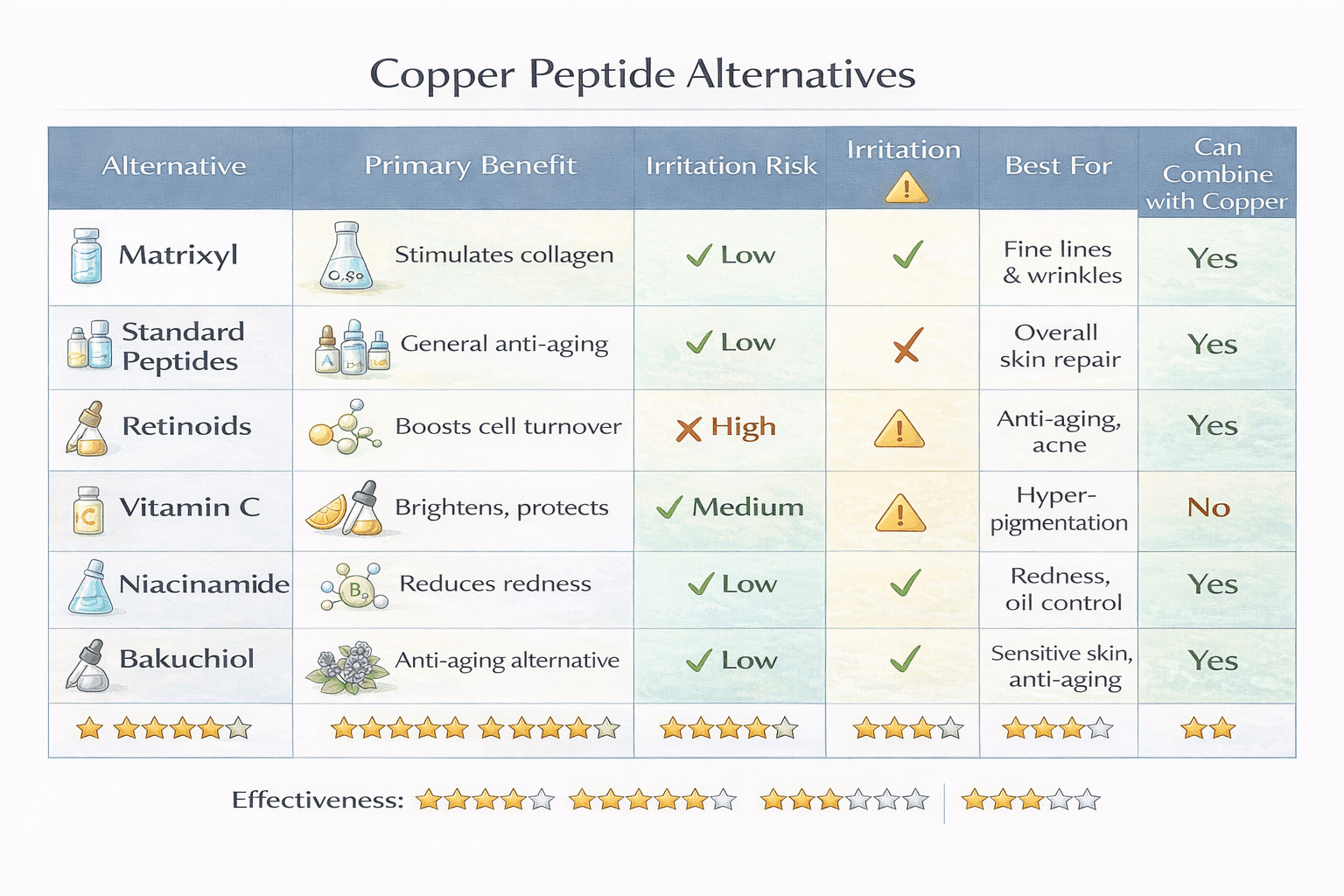
Alternatives if copper peptides don't work for you
If you've tried properly and copper peptides genuinely don't work, other options exist:
Matrixyl (palmitoyl peptides)
Palmitoyl peptides stimulate collagen production without copper.
Benefits:
Excellent collagen-boosting effects
Better tolerated by sensitive skin
No copper sensitivity risk
Can combine with vitamin C
Typical concentration: 3-8% in serums
Who it's for: People who want peptide benefits without copper
Standard peptides (non-copper)
Various peptide combinations (pentapeptides, hexapeptides, etc.) provide anti-aging benefits.
Benefits:
Generally well-tolerated
Multiple peptides target different pathways
Less potential for irritation
Often combined in serums for synergistic effects
Who it's for: Sensitive skin, anyone who reacts to copper peptides
Retinoids (tretinoin, adapalene, retinol)
The gold standard for anti-aging and collagen production.
Benefits:
Proven effectiveness
Increases collagen production
Improves texture, reduces wrinkles
Treats acne as bonus
Considerations:
Requires gradual introduction (similar to copper peptides)
Can cause irritation initially
Requires strict sunscreen use
Prescription-strength options available
Who it's for: People wanting proven anti-aging results, comfortable with adjustment period
Vitamin C (ascorbic acid)
Powerful antioxidant and collagen synthesis support.
Benefits:
Boosts collagen production
Brightens skin
Protects against environmental damage
Well-researched
Considerations:
Can be irritating at high concentrations
Requires proper formulation and pH
Degrades quickly (brown/orange means oxidized and useless)
Who it's for: Anyone wanting antioxidant protection and anti-aging benefits
Niacinamide (Vitamin B3)
Versatile, well-tolerated active with multiple benefits.
Benefits:
Improves barrier function
Reduces inflammation
Helps with pigmentation
Supports collagen production
Generally non-irritating
Typical concentration: 5-10%
Who it's for: Sensitive skin, those wanting gentle but effective anti-aging
Growth factors
EGF (epidermal growth factor) and other growth factors stimulate cellular activity.
Benefits:
Promotes collagen and elastin production
Accelerates healing
Improves texture
Considerations:
Expensive
Limited long-term safety studies
Theoretical concerns about excessive cell proliferation
Who it's for: People wanting advanced anti-aging, willing to invest significantly
Bakuchiol
Natural retinoid alternative with similar effects.
Benefits:
Retinol-like benefits without irritation
Better tolerated by sensitive skin
Can use during day (not photosensitizing)
Gentle but effective
Considerations:
Slower results than tretinoin
Less research than retinoids
More expensive than retinol
Who it's for: Sensitive skin, pregnant/breastfeeding women (seeking retinoid alternative), anyone who doesn't tolerate retinoids
For comprehensive information on copper peptides when they do work, see our GHK-Cu copper peptides guide.
When to see a dermatologist
Some situations require professional help:
Immediate dermatologist visit needed:
Severe allergic reaction:
Hives, extensive rash
Swelling of face, lips, or throat
Difficulty breathing
Severe, spreading redness
This is medical emergency. Go to ER if breathing difficulty.
Signs of infection:
Increasing pain and warmth
Pus or drainage
Fever
Red streaks extending from affected area
Infections can develop in damaged skin. Require prompt treatment.
Severe persistent reactions:
Skin not improving after 2 weeks of stopping all actives
Progressive worsening despite removing triggers
Pain that interferes with daily life
Routine dermatologist visit recommended:
Persistent problems after 4-6 weeks:
Ongoing sensitivity despite gentle routine
Breakouts that won't resolve
Unusual pigmentation changes
Texture changes that concern you
Pre-existing conditions worsening:
Rosacea flare that won't calm
Eczema spreading or worsening
Seborrheic dermatitis not responding to usual treatments
Uncertainty about what's happening:
You're not sure if reaction is normal
Conflicting advice from online sources
Want professional assessment before continuing
General skin health evaluation:
Haven't seen dermatologist in years
Starting serious anti-aging routine
Want baseline assessment and professional product recommendations
Don't wait if you're concerned. Dermatologists can:
Accurately diagnose issues
Prescribe appropriate treatments
Recommend suitable products for your specific skin
Prevent long-term damage from continued problems
Real experiences: When copper peptides actually help
Not everyone has problems.
Many people get excellent results.
Here's what successful use looks like:
Normal adjustment (not damage):
Week 1-2:
Mild tingling upon application (fades within 5 minutes)
Slight warmth
Possible minimal redness (resolves within 30 minutes)
Week 3-4:
Adjustment effects diminish
Skin feels more active, slightly tighter
Minor purging possible (resolves quickly)
Week 6-8:
Skin texture improving
Fine lines looking softer
Healthy glow developing
No persistent irritation
Month 3+:
Visible improvement in collagen/firmness
Reduced wrinkles
Better overall skin health
Routine feels normal, no reactions
What helps ensure success:
Starting properly:
Low concentration (0.5-1%)
Infrequent use initially (2-3x weekly)
Good quality product
Healthy skin barrier before starting
Supporting factors:
Good overall skincare routine
Adequate hydration
Healthy diet
Sun protection
Realistic expectations
Avoiding pitfalls:
Not combining with incompatibles
Not over-using
Proper storage
Patience with timeline
Most people who have success with copper peptides started carefully, used quality products, and gave their skin time to adjust. The dramatic horror stories usually involve one or more serious mistakes.
The role of SeekPeptides in your skincare journey
Whether you're using copper peptides topically or other peptides systematically, SeekPeptides provides the knowledge you need.
Evidence-based information: Our copper peptides guide provides comprehensive information on proper use, benefits, and realistic expectations.
Injectable peptide guidance: If you're using systemic peptides for skin health (or other purposes), our calculators ensure precise dosing. Our peptide reconstitution calculator prevents mixing errors.
Comprehensive protocols: Our guides on various peptides help you understand how they work, when to use them, and how to combine them safely.
AI-powered assistance: Get answers to your specific questions about peptides, managing side effects, optimizing protocols, and troubleshooting issues.
You don't have to figure out peptides through trial and error that damages your skin. Use the knowledge base that helps people use peptides effectively and safely.
Final thoughts
Copper peptides didn't ruin your skin - but mistakes in using them might have caused temporary damage. The good news is that almost all copper peptide skin problems are fixable.
If you're currently experiencing problems, stop all actives, focus on barrier repair, and give your skin 2-4 weeks to heal. Most people see dramatic improvement simply by removing irritants and supporting barrier function.
If you want to try copper peptides again after healing, start low and slow. Use 0.5-1% concentration 2-3 times weekly. Build up gradually over months, not weeks. Store products properly. Avoid incompatible combinations. Be patient.
If copper peptides genuinely don't work for you after proper use, excellent alternatives exist. Matrixyl, retinoids, vitamin C, niacinamide - all provide anti-aging benefits through different mechanisms.
Your skin is resilient. With proper care, it heals. With proper approach, copper peptides can provide real benefits. And if they don't work for you, other options will.
Related resources
Take care of yourself. <3