Jan 3, 2026
Wrinkles develop through cumulative collagen degradation, repetitive muscle contractions creating expression lines, and environmental damage from UV exposure and oxidative stress creating visible aging particularly on forehead, around eyes (crow's feet), between brows (frown lines), and around mouth (smile lines and smoker's lines). Traditional anti-wrinkle approaches including retinoids provide proven effectiveness but carry irritation burden, while invasive options like botulinum toxin injections or fillers deliver dramatic temporary results requiring ongoing maintenance and professional administration.
Peptides offer multi-mechanism wrinkle reduction through collagen synthesis stimulation rebuilding dermal support, muscle contraction modulation reducing expression-related creasing, antioxidant protection preventing ongoing damage, and skin barrier optimization improving overall resilience. The SeekPeptides platform provides comprehensive guidance on peptide protocols for wrinkle reduction across different skin types and severity levels.
This guide examines best wrinkle-fighting peptides, application strategies, realistic timeline expectations, combination approaches with other actives, and honest comparison to alternative treatments helping users select appropriate interventions matching goals and tolerance for gradual improvement characteristic of peptide anti-aging approaches.
Understanding wrinkle formation and peptide intervention mechanisms
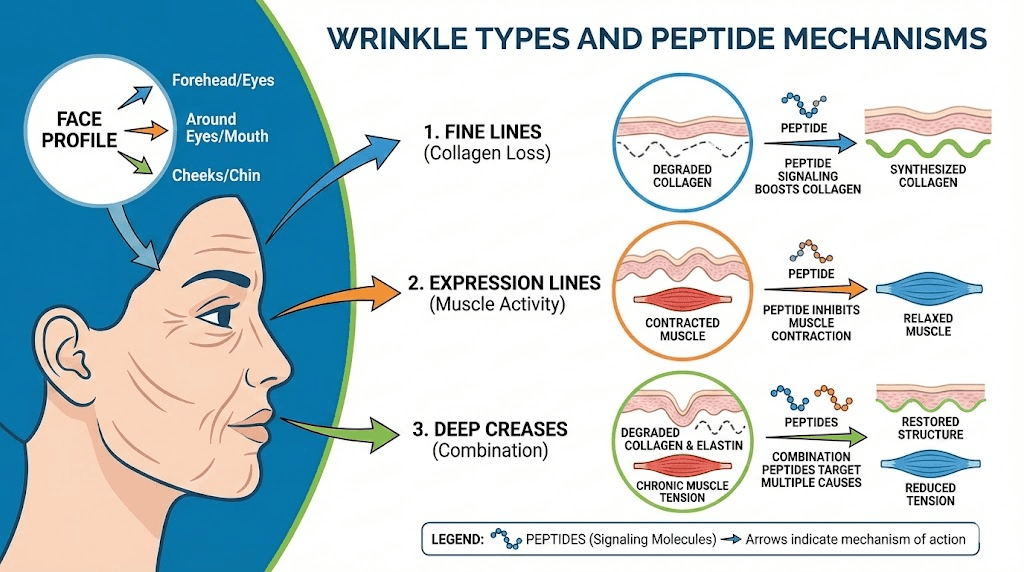
Wrinkles form through multiple interconnected pathways requiring comprehensive intervention addressing collagen deficiency, repetitive muscle activity, photo-damage accumulation, and skin barrier degradation rather than single-mechanism approaches producing limited results. Intrinsic aging drives progressive collagen loss averaging 1% annually after age 30 through reduced fibroblast activity, increased matrix metalloproteinase (MMP) activity degrading existing collagen, and impaired collagen synthesis from age-related cellular decline creating net structural deficiency manifesting as skin thinning and wrinkle formation.
Collagen-stimulating peptides like GHK-Cu address this fundamental cause through fibroblast activation increasing collagen type I and III production, MMP regulation preventing excessive breakdown, and enhanced cross-linking creating stronger dermal matrix supporting smoother skin surface. Research demonstrates peptide-induced collagen synthesis increasing by 70-80% in cultured fibroblasts with clinical studies showing measurable wrinkle depth reduction over 3-6 month treatment periods using therapeutic concentrations.
Expression wrinkles develop from repetitive muscle contractions creating permanent creases in overlying skin through mechanical folding stress, collagen damage at crease points, and progressive deepening as skin loses elasticity with age making temporary expression lines become permanent static wrinkles. Forehead lines, crow's feet, frown lines between brows, and smile lines around mouth exemplify expression-driven wrinkling where muscle activity significantly contributes to visible aging.
Muscle-relaxing peptides like Argireline (acetyl hexapeptide-8) provide topical alternative to botulinum toxin through SNARE complex interference reducing neurotransmitter release and subsequent muscle contraction intensity. While effects prove less dramatic than injectable neurotoxins, topical peptides offer gradual improvement without paralysis, needles, or professional administration requirements making them accessible option for expression wrinkle management as detailed in SeekPeptides peptide guides.
Photo-aging from chronic UV exposure accelerates wrinkle formation through direct collagen and elastin fiber damage, increased MMP production promoting matrix degradation, oxidative stress creating inflammatory cascades, and melanin irregularities creating uneven tone accentuating texture irregularities. Sun-damaged skin shows deeper wrinkles, more prominent texture irregularities, and earlier aging onset compared to protected skin of equivalent chronological age.
Antioxidant peptides and complementary ingredients like vitamin C provide protection against ongoing photo-damage while collagen-promoting peptides work to repair accumulated damage, creating comprehensive approach addressing both prevention and reversal of UV-induced wrinkling when combined with diligent sun protection practices.
Learn about comprehensive peptide mechanisms and anti-aging applications through SeekPeptides educational resources.
Wrinkle Type | Primary Cause | Typical Location | Peptide Mechanism | Effectiveness Level |
|---|---|---|---|---|
Static (Intrinsic Aging) | Collagen loss, skin thinning | Entire face, general | Collagen synthesis stimulation | High - addresses root cause |
Dynamic (Expression) | Repetitive muscle contractions | Forehead, crow's feet, frown lines | Muscle contraction reduction | Moderate - gentler than Botox |
Photo-aging | UV damage, oxidative stress | Sun-exposed areas | Antioxidant protection, repair | Moderate-High with sun protection |
Gravitational | Tissue descent, volume loss | Lower face, jowls, neck | Modest support through firmness | Low-Moderate - often needs fillers |
Best anti-wrinkle peptides and their specific mechanisms
Copper peptides (GHK-Cu) represent gold-standard wrinkle-fighting peptides through multiple synergistic mechanisms including dramatic collagen and elastin synthesis stimulation (70-80% increase in vitro), copper delivery supporting lysyl oxidase enzyme creating stable cross-links, MMP-1 regulation preventing excessive collagen degradation, antioxidant enzyme activation (superoxide dismutase) protecting against free radical damage, and growth factor modulation supporting comprehensive skin remodeling. Clinical studies using 1-2% GHK-Cu concentrations demonstrate 30-50% wrinkle depth reduction over 3-6 months with continued improvement through 12 months of consistent application.
The copper peptide evidence base proves strongest among topical peptides with decades of research, multiple clinical trials, and robust mechanism understanding supporting efficacy claims. Users should ensure adequate concentrations (1-2% for face), proper formulation stability through appropriate storage, and realistic 3-6 month timeline expectations for meaningful visible improvement as detailed in SeekPeptides copper peptide protocols.
Matrixyl peptides (palmitoyl pentapeptide-4, palmitoyl tripeptide-1, and related compounds) function as matrikines - collagen fragment mimics signaling fibroblasts to increase synthesis compensating for perceived deficiency. The mechanism operates through TGF-β pathway stimulation upregulating collagen I, III, and IV production along with fibronectin and glycosaminoglycans supporting comprehensive dermal matrix enhancement. Multiple clinical studies using 3-5% Matrixyl concentrations demonstrate 13-35% wrinkle depth reduction and measurable skin elasticity improvements over 2-4 months with effects attributed to actual structural changes rather than temporary hydration.
Matrixyl variants offer different wrinkle-targeting approaches - Matrixyl 3000 (palmitoyl tripeptide-1 plus palmitoyl tetrapeptide-7) provides dual collagen stimulation and anti-inflammatory effects, Matrixyl Synthe'6 targets 6 major skin constituents including collagen I, III, IV, fibronectin, hyaluronic acid, and laminin 5, while standard Matrixyl focuses primarily on collagen synthesis. Quality formulations from reputable peptide vendors typically combine multiple Matrixyl variants creating comprehensive matrix remodeling effects.
Argireline (acetyl hexapeptide-8) reduces expression wrinkles through SNARE complex interference preventing neurotransmitter vesicle fusion and subsequent acetylcholine release triggering muscle contraction. The mechanism mimics botulinum toxin effects but works topically through skin penetration rather than injection, producing gentler 20-30% wrinkle depth reduction in expression-prone areas (forehead, crow's feet, frown lines) compared to 50-80% reduction from injectable neurotoxins. Clinical studies using 5-10% Argireline show visible improvement within 2-4 weeks with maximum effects at 8-12 weeks, making it fastest-acting wrinkle peptide for expression-related concerns.
Snap-8 peptide (acetyl octapeptide-3) provides enhanced muscle relaxation compared to Argireline through additional amino acids creating stronger SNARE complex binding, producing 30-40% wrinkle reduction in some studies using 5-10% concentrations. The longer peptide chain theoretically delivers superior penetration and activity, though real-world differences between Argireline and Snap-8 prove subtle with both providing meaningful but moderate expression wrinkle improvement without injection requirements.
SYN-AKE (dipeptide diaminobutyroyl benzylamide diacetate) mimics snake venom peptides inhibiting muscle contraction through different pathway than Argireline - blocking nicotinic acetylcholine receptors preventing muscle fiber activation. Studies using 4% SYN-AKE demonstrate 50% wrinkle area reduction in 28 days though evidence quality and independent replication prove limited compared to more established peptides. Users seeking muscle-relaxing peptides might combine multiple types targeting different pathways for additive effect.
Explore comprehensive peptide options and anti-aging protocols through SeekPeptides guides.
Peptide Type | Primary Mechanism | Wrinkle Type | Clinical Evidence | Optimal Concentration | Results Timeline |
|---|---|---|---|---|---|
GHK-Cu (Copper Peptide) | Collagen synthesis, antioxidant | Static, all wrinkles | Strong - extensive research | 1-2% | 3-6 months visible |
Matrixyl (Pal-KTTKS) | Matrikine signaling, matrix synthesis | Static, general aging | Good - multiple studies | 3-5% | 2-4 months visible |
Argireline | SNARE complex, muscle relaxation | Dynamic, expression lines | Moderate - some studies | 5-10% | 2-4 weeks noticeable |
Snap-8 | Enhanced muscle relaxation | Dynamic, expression lines | Limited - fewer studies | 5-10% | 2-4 weeks noticeable |
SYN-AKE | Receptor blocking, muscle inhibition | Dynamic, expression lines | Limited - vendor studies | 4% | 2-4 weeks claimed |
Tripeptide-1 (GHK) | Collagen stimulation | Static wrinkles | Moderate evidence | 2-3% | 3-4 months expected |
Application protocols for maximum wrinkle reduction
Concentration optimization balances effectiveness against irritation risk with peptide dosing proving critical for results. GHK-Cu requires 1-2% for meaningful wrinkle improvement with concentrations below 0.5% producing subtle effects insufficient for moderate to deep wrinkles, Matrixyl demonstrates concentration-dependent effects with 3-5% providing optimal balance between efficacy and cost-effectiveness, while Argireline and Snap-8 need 5-10% for measurable expression wrinkle reduction with lower concentrations showing minimal clinical impact as discussed in peptide concentration guides.
Application frequency determines cumulative peptide exposure influencing treatment effectiveness - twice-daily application (morning and evening) on freshly cleansed skin before moisturizer creates consistent dermal peptide levels supporting continuous collagen synthesis and muscle modulation, while once-daily evening application suits users with sensitive skin or those using higher concentrations minimizing irritation while maintaining treatment benefits through sustained overnight peptide activity during peak skin repair processes following peptide cycling principles.
Skin preparation dramatically affects peptide absorption determining treatment effectiveness - proper cleansing removes surface oils and makeup residue creating absorption barriers, gentle exfoliation 2-3 times weekly (chemical exfoliants like AHA/BHA or physical methods) clears dead cell accumulation exposing fresh epidermis improving penetration, and pH optimization through slightly acidic toners (pH 4.5-5.5) enhances certain peptide stability and absorption while supporting barrier function as detailed in peptide application guides.
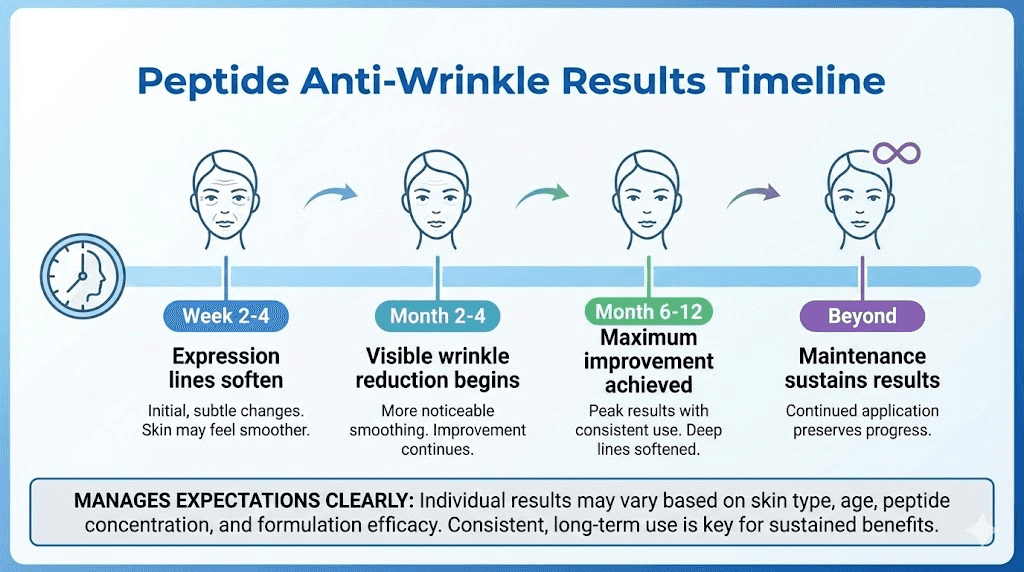
Treatment duration requirements create realistic timeline expectations - initial subtle improvements often appear within 2-4 weeks as muscle-relaxing peptides reduce expression wrinkle depth and surface hydration increases, meaningful structural improvement requires 2-4 months allowing significant collagen synthesis and dermal thickening, while maximum effects typically manifest at 6-12 months of continuous application creating cumulative improvements after which maintenance protocols using reduced frequency or concentration sustain results without indefinite peak-intensity treatment.
Targeted application strategies maximize results in specific wrinkle-prone areas - forehead benefits from muscle-relaxing peptides (Argireline, Snap-8) combined with collagen-stimulating compounds addressing both expression and intrinsic aging components, crow's feet respond excellently to combination approaches given thin delicate skin in this area, frown lines between brows show dramatic response to muscle-relaxing peptides reducing habitual scowling, while nasolabial folds and marionette lines require primarily collagen-boosting peptides with realistic expectations as very deep structural wrinkles may need professional treatments.
Layering sequence with other anti-aging actives ensures optimal penetration and compatibility - morning routine: gentle cleanser, peptide serum on damp skin (wait 60 seconds), vitamin C if used (wait 30 seconds), lightweight moisturizer, SPF 30-50. Evening routine: cleanser, exfoliant 2-3x weekly, peptide serum (wait 60 seconds), retinoid if used (wait 20 minutes to minimize interaction), richer night moisturizer ensuring peptides contact clean skin while supporting ingredients enhance rather than interfere with wrinkle-fighting mechanisms.
Learn optimal protocols and avoid common mistakes through SeekPeptides comprehensive guides.
Expected results and realistic improvement levels
Initial expression wrinkle softening emerges within 2-4 weeks for users applying muscle-relaxing peptides (Argireline, Snap-8, SYN-AKE) as SNARE complex interference reduces contraction intensity creating visible smoothing in forehead lines, crow's feet, and frown lines. This relatively rapid improvement proves encouraging though effects remain partial (20-30% depth reduction) compared to injectable neurotoxins (50-80% reduction), with benefits reversing over 2-3 months if treatment discontinues requiring ongoing application for sustained results following peptide maintenance strategies.
Measurable collagen-related improvement develops around 6-8 weeks as synthesis-stimulating peptides accumulate sufficient new matrix creating detectable dermal thickening and structural enhancement. Changes remain subtle at this stage - perhaps 10-15% reduction in fine line depth, barely perceptible improvement in skin bounce and firmness, minor enhancement in overall texture and radiance - requiring photography comparison for objective assessment as gradual changes prove difficult detecting day-to-day but meaningful when comparing baseline to 2-month images side-by-side documenting peptide progress.
Significant visible wrinkle reduction manifests at 3-6 months representing timeframe where most users and observers notice clear improvement without photo comparison - moderate wrinkles show 25-40% depth reduction, skin texture appears noticeably smoother and more refined, overall skin quality reflects healthier more youthful appearance, and facial contours demonstrate subtle improvement particularly in areas receiving targeted peptide application. The improvement level depends heavily on baseline severity with fine lines potentially achieving near-complete resolution while moderate to deep wrinkles show meaningful but incomplete correction as explored in realistic expectations guides.
Maximum wrinkle improvement plateaus around 6-12 months of continuous high-quality peptide use at optimal concentrations and application consistency, beyond which further improvements prove minimal as collagen synthesis stabilizes at enhanced baseline and dermal remodeling completes within genetic and age-related capacity constraints. Users achieving satisfactory results can transition to maintenance protocols using reduced application frequency (4-5 times weekly instead of daily) or lower concentrations (0.5-1% GHK-Cu instead of 1-2%) sustaining results without indefinite peak-intensity treatment expense.
Age dramatically influences achievable wrinkle improvement with younger users (30s-early 40s) experiencing more dramatic results as fibroblasts retain higher responsiveness to peptide stimulation and baseline damage remains moderate rather than severe. Users in late 40s-50s achieve meaningful improvement obtaining 50-70% of results younger users experience from identical protocols due to reduced cellular activity and more extensive accumulated damage, while very advanced age (60s-70s+) may show modest improvements requiring realistic expectation adjustment focusing on prevention of further deepening rather than dramatic wrinkle erasure as discussed in age-specific peptide guides.
Baseline wrinkle severity determines realistic outcome expectations - fine lines from early aging (crow's feet beginnings, slight forehead lines) may achieve 50-80% improvement potentially appearing nearly resolved, moderate wrinkles (established expression lines, some static wrinkles) typically improve 30-50% creating noticeable but incomplete correction, while deep wrinkles (severe static lines, very deep expression creases) show 15-30% improvement often requiring combination with professional treatments for satisfactory results as peptides alone prove insufficient for dramatic transformation.
Explore realistic timelines and outcome expectations through SeekPeptides resources.
Wrinkle Severity | Visual Description | Peptide-Only Results | Timeline to Maximum | Maintenance Requirements |
|---|---|---|---|---|
Fine Lines (Minimal) | Barely visible, early signs | 50-80% improvement, near-resolution possible | 3-6 months | Reduced frequency sustains |
Moderate Wrinkles | Clearly visible, some depth | 30-50% improvement, noticeable reduction | 6-9 months | Ongoing moderate use needed |
Deep Wrinkles | Very prominent, significant depth | 15-30% improvement, modest softening | 9-12 months | May need professional adjunct |
Severe/Etched | Extremely deep, structural | 10-20% improvement if any | 12+ months | Likely requires professional intervention |
Comparing peptides to alternative anti-wrinkle treatments
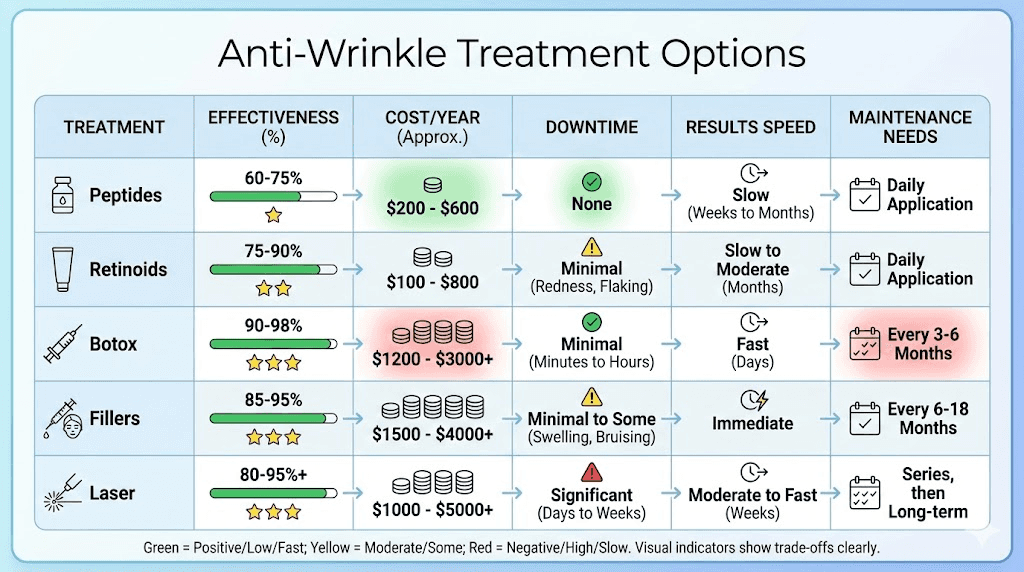
Retinoids (tretinoin prescription, adapalene OTC, retinol cosmetic) represent gold-standard medical anti-wrinkle intervention with decades of research demonstrating robust collagen synthesis stimulation, accelerated cell turnover, improved skin texture and tone, and measurable wrinkle depth reduction through retinoic acid receptor activation controlling gene expression. Tretinoin 0.025-0.1% produces 30-60% wrinkle improvement over 6-12 months with continued enhancement through extended use, proving superior effectiveness to most peptides but carrying higher side effect burden including significant irritation, dryness, photosensitivity, and initial purging period where skin temporarily worsens before improving.
The retinoid vs peptide decision balances proven efficacy against tolerability - retinoids suit users tolerating irritation and navigating 3-6 month adjustment period, offering medical establishment endorsement and insurance coverage possibilities for prescription forms. Peptides suit sensitive skin users, those unable tolerating retinoid side effects, individuals wanting immediate combination with vitamin C and acids retinoids complicate, and users preferring gentle gradual improvement over aggressive intervention requiring adaptation. Optimal approach combines both - retinoid 2-3 nights weekly for proven efficacy plus peptides daily for complementary gentle stimulation creating synergistic wrinkle reduction exceeding either alone.
Botulinum toxin injections (Botox, Dysport, Xeomin) deliver superior expression wrinkle reduction (50-80% improvement) within 3-7 days through complete muscle paralysis preventing contraction and subsequent creasing. Effects last 3-4 months requiring repeated treatments 3-4 times annually for sustained results, creating annual costs of $1200-2400 for typical treatment areas (forehead, crow's feet, frown lines) plus potential complications including asymmetry, drooping, frozen appearance, or bruising though serious adverse events prove rare with experienced injectors as discussed in professional treatment comparisons.
Muscle-relaxing peptides (Argireline, Snap-8) provide gentler alternative producing 20-30% expression wrinkle improvement without paralysis, needles, downtime, or professional visits, at annual costs of $300-600 for quality topical products versus $1200-2400 for injectable neurotoxins. The peptide approach suits users wanting natural gradual improvement, avoiding injectable procedures, accepting modest results, or using topical peptides between professional treatments extending results and reducing injection frequency from 4x to 2-3x annually creating hybrid cost-effective strategy.
Dermal fillers (hyaluronic acid, calcium hydroxylapatite, poly-L-lactic acid) restore volume correcting wrinkles from tissue descent and hollow areas peptides cannot address, particularly nasolabial folds, marionette lines, under-eye hollows, and sunken cheeks creating shadows and texture irregularities. Filler results prove immediately visible lasting 6-24 months depending on product and placement, costing $500-1500 per syringe with typical treatment requiring 1-4 syringes creating $1000-4000 annual maintenance costs for comprehensive facial volume restoration beyond peptide capabilities.
Professional treatments including laser resurfacing, chemical peels, microneedling, and radiofrequency provide intensive wrinkle intervention through controlled injury triggering collagen remodeling - ablative fractional lasers produce dramatic improvement (40-70% wrinkle reduction) with 7-14 day downtime costing $1500-4000 per treatment, while gentler non-ablative options offer 20-40% improvement with minimal downtime at $500-1500 per session. These interventions suit users wanting rapid dramatic results, willing to invest in professional care, and accepting temporary healing periods as adjunct or alternative to gradual peptide protocols.
Learn about treatment combinations and professional options through SeekPeptides comprehensive comparisons.
Product selection and formulation quality factors
Multi-peptide formulations prove superior to single-compound products through addressing wrinkles via multiple mechanisms simultaneously - quality anti-wrinkle serums typically combine 1% GHK-Cu for collagen synthesis, 4% Matrixyl for matrikine signaling, 8% Argireline for expression line reduction, plus supporting ingredients like niacinamide for barrier support and vitamin C for antioxidant protection creating comprehensive wrinkle intervention exceeding single-peptide approaches.
Concentration verification ensures effective therapeutic dosing rather than ineffective trace amounts - products should disclose specific percentages (1-2% GHK-Cu, 3-5% Matrixyl, 5-10% Argireline) rather than vaguely listing peptides in ingredient lists without quantities suggesting marketing-driven formulations with insufficient actives. Users should research reputable peptide vendors known for transparency and therapeutic concentrations including Transcend, Planet Peptides, and specialized medical-grade skincare lines.
Formulation stability determines whether stated peptide concentrations remain active through shelf life - peptides prove notoriously unstable in aqueous solutions with GHK-Cu particularly vulnerable to oxidation reducing copper availability, Matrixyl degrading in inappropriate pH or with light/heat exposure, and Argireline losing potency without proper preservatives. Quality indicators include opaque or UV-protective packaging, airless pump dispensers minimizing oxygen contact, refrigeration recommendations, and relatively short expiration dates (6-12 months) indicating manufacturers prioritize potency over extended shelf life as detailed in peptide storage guides.
pH optimization affects peptide stability and skin compatibility - most peptides function optimally at pH 4.5-5.5 matching skin's natural slightly acidic barrier, with formulations outside this range risking reduced efficacy or increased irritation. Quality products disclose pH ranges allowing users to verify appropriate formulation design, while products without pH information create uncertainty about stability and compatibility requiring cautious trial or selection of brands with established quality reputations.
Brand selection balances cost against quality with luxury brands charging premium prices sometimes delivering inferior formulations to specialized peptide-focused companies prioritizing active concentrations over marketing budgets. Medical-grade brands from dermatologists and plastic surgeons typically deliver therapeutic concentrations with appropriate stability, peptide-specialized companies often provide best value combining high concentrations with reasonable pricing, while mass-market drugstore options rarely contain effective levels despite peptide marketing prominence though exceptions exist requiring careful ingredient list analysis.
Price reality assessment prevents wasted investment in underdosed products - effective multi-peptide anti-wrinkle serums typically cost $60-200 for 30ml (2-3 month supply) representing $25-80 monthly investment, with suspiciously cheap products (<$30 for multi-peptide formulation) likely containing insufficient actives while excessive luxury pricing (>$250 for basic formulation) often reflects branding rather than superior active concentrations. Users should evaluate cost-per-active rather than total price using peptide cost calculators for informed purchasing decisions.
Explore vendor comparisons and quality evaluation through SeekPeptides comprehensive reviews.
Safety considerations and managing side effects
Peptide safety profiles prove excellent with minimal adverse effects reported across thousands of users - peptides represent natural amino acid sequences the body already produces or recognizes as biological signaling molecules rather than foreign synthetic compounds requiring immune response or metabolic adaptation. Most side effects prove mild and transient, resolving with continued use as skin adjusts or immediately upon discontinuation if sensitivity develops, making peptides well-tolerated anti-aging option for diverse user populations.
Common minor reactions include temporary stinging or tingling upon peptide application lasting seconds to minutes particularly with copper peptides or vitamin C combinations, managed through reduced concentration or less frequent application if uncomfortable. Mild dryness or flaking may emerge during first 1-2 weeks as increased cell turnover creates temporary surface changes, addressed through gentle moisturizer application and brief peptide reduction if bothersome. Slight redness or warmth occasionally appears with copper peptides as copper delivery increases localized metabolic activity, typically fading within 30-60 minutes and considered normal response rather than problematic reaction.
True allergic reactions prove rare but possible requiring product discontinuation - contact dermatitis presents as persistent redness, itching, burning, or rash developing over days to weeks of use, improving rapidly with cessation confirming peptide causation. Patch testing proves valuable for users with sensitive skin or multiple product allergies - apply small amount to inner forearm for 48 hours before facial use watching for adverse reactions indicating incompatibility requiring alternative product selection as recommended in peptide safety protocols.
Specific precautions include avoiding copper peptides during pregnancy and breastfeeding due to uncertain copper exposure effects on fetal development and infant exposure through breast milk, though theoretical risk rather than documented harm cases. Users with Wilson's disease (genetic copper metabolism disorder) should avoid copper peptides entirely as impaired excretion could create toxic accumulation. Muscle-relaxing peptides show no significant contraindications but users allergic to botulinum toxin should monitor carefully despite different mechanism.
Interaction considerations prove minimal with peptides demonstrating excellent compatibility with most skincare actives - however, users should avoid combining multiple highly active treatments simultaneously as cumulative irritation risk increases. Introducing peptides to existing retinoid routine requires starting on alternate nights until tolerance confirms, combining peptides with chemical peels should involve 48-72 hour spacing, and using peptides with professional treatments like microneedling or laser should follow practitioner guidance about appropriate timing as detailed in combination protocols.
Learn comprehensive safety protocols and risk management through SeekPeptides safety resources.
How you can use SeekPeptides for comprehensive anti-wrinkle guidance
SeekPeptides provides extensive peptide education for wrinkle reduction and comprehensive anti-aging. Explore copper peptide guides, GHK-Cu dosing, storage protocols, discontinuation effects, skin tightening, and dark circles.
Access anti-aging resources including women over 40, perimenopause, menopause, general women's guides, and safe options.
Learn combination strategies, cycling protocols, stacking approaches, cycle planning, and dosing optimization.
Explore vendor reviews including Amopure, Transcend, Planet, RPO, NextGen, Profound, Elite, Integrity, and Revive.
Access practical calculators including peptide calculator, cost calculator, BPC-157 dosage, reconstitution calculator, and dosage chart.
Learn fundamentals through what are peptides, how they work, safety guide, research overview, getting started, common mistakes, and complete peptide list.
Final thoughts
Peptides for wrinkles provide multi-mechanism anti-aging intervention through collagen synthesis (GHK-Cu, Matrixyl), muscle contraction reduction (Argireline, Snap-8), and antioxidant protection creating comprehensive wrinkle improvement without retinoid irritation or injectable procedures. Results develop gradually over 2-6 months with maximum effects at 6-12 months, requiring patience following realistic timelines.
Fine to moderate wrinkles respond well to peptide protocols achieving 30-60% improvement, while deep wrinkles benefit from combination with professional treatments. The advantage lies in excellent safety, minimal side effects, and ability to combine with other actives creating synergistic effects through comprehensive approaches.
Your anti-wrinkle strategy should match wrinkle type to appropriate peptide compounds, apply at therapeutic concentrations, combine with sun protection and complementary actives, and maintain realistic expectations about gradual improvement through SeekPeptides comprehensive guidance.
Related wrinkle and anti-aging resources
Essential anti-aging guides
In case I don’t see you, good afternoon, good evening, and good night. Take care of yourself. Join SeekPeptides