Dec 26, 2025
Just several peptide categories significantly enhance strength training outcomes through different mechanisms. Growth hormone peptides increase muscle mass and strength over time. IGF-1 LR3 provides rapid muscle growth and strength gains.
Healing peptides like BPC-157 and TB-500 allow you to train harder by accelerating recovery, and each serves specific purposes in a strength protocol.
This guide breaks down exactly which peptides benefit strength training, how each category works, specific protocols for strength versus mass versus recovery, realistic expectations for strength gains, proper dosing and cycling, and how to stack peptides for maximum performance enhancement.
Let's start with understanding how peptides enhance strength training.
How peptides enhance strength training performance
Peptides improve strength through multiple pathways beyond just building muscle. Learn complete peptide fundamentals in our what are peptides guide and how peptides work.
Direct muscle growth and strength
Mechanisms:
Increase protein synthesis in muscle cells
Enhance amino acid uptake
Stimulate satellite cell activation
Promote muscle fiber hypertrophy
Improve nutrient partitioning
Peptides in this category:
IGF-1 LR3 (most anabolic)
Growth hormone secretagogues (CJC-1295, Ipamorelin)
MGF (Mechano Growth Factor)
Result: Bigger, stronger muscles that generate more force.
See our what are peptides used for guide for comprehensive peptide applications.
Enhanced recovery and reduced injury
Mechanisms:
Accelerate tissue repair between training sessions
Reduce inflammation from training damage
Heal micro-tears faster
Support connective tissue (tendons, ligaments)
Allow higher training frequency
Peptides in this category:
BPC-157
TB-500
GHK-Cu
Result: Train harder, more often, with less injury risk. More volume = more strength gains.
Learn complete healing protocols in our best peptides for injury recovery guide, best peptides for joint pain, and best peptides for tendon repair.
Improved neural drive and force production
Mechanisms:
Enhance neuromuscular efficiency
Improve motor unit recruitment
Support nervous system recovery
Optimize muscle fiber activation
Peptides in this category:
Cerebrolysin (neurological support)
Semax (cognitive and neural enhancement)
Result: Better ability to recruit muscle fibers = more force production at same muscle size.
Optimized body composition
Mechanisms:
Reduce body fat while preserving muscle
Improve strength-to-weight ratio
Better leverage and force application
Enhanced muscle definition
Peptides in this category:
Growth hormone peptides (recomposition)
AOD 9604 (fat loss without muscle loss)
Semaglutide/Tirzepatide (weight management)
Result: Leaner body = better relative strength and power output.
See our best peptides for muscle growth guide for comprehensive muscle-building protocols.
Growth hormone peptides for strength training
These are the foundation of most strength enhancement protocols.
CJC-1295 (with or without DAC)
Primary benefits for strength:
Increased lean muscle mass over 3-6 months
Improved recovery between sessions
Better sleep quality (crucial for strength gains)
Enhanced fat loss while building muscle
Modest direct strength increases
Dosing for strength:
CJC-1295 (no DAC): 200-300mcg before bed, 5-7 days per week
CJC-1295 (with DAC): 1-2mg once or twice weekly
Typically stacked with GHRP for synergy
Timeline for strength gains:
Week 1-4: Improved recovery, better sleep
Week 8-12: Noticeable muscle mass increase
Month 4-6: Clear strength improvements (10-15% increase in major lifts)
Best for:
Long-term strength and mass building
Older athletes (35+) with declining GH
Body recomposition while gaining strength
Use our CJC-1295 dosage calculator for precise dosing.
Ipamorelin
Primary benefits for strength:
Growth hormone release without cortisol/prolactin increase
Clean muscle gains
Excellent recovery enhancement
Improved sleep architecture
Synergistic with CJC-1295
Dosing for strength:
200-300mcg before bed, 5-7 days per week
Best results when combined with CJC-1295
Can dose 2-3x daily for maximum effect (pre-workout, post-workout, bedtime)
Timeline for strength gains:
Similar to CJC-1295
Works best in combination protocols
3-6 months for significant strength increase
Best for:
Athletes who want GH benefits without side effects
Stacking with other peptides
Long-term strength development
See our Ipamorelin vs CJC-1295 comparison for detailed analysis.
GHRP-6 and GHRP-2
Primary benefits for strength:
Powerful growth hormone release
Significant muscle mass gains
Increased appetite (helps with bulking)
Strong recovery enhancement
Dosing for strength:
100-300mcg, 2-3 times daily
Best on empty stomach
Powerful when stacked with CJC-1295
Timeline for strength gains:
Faster muscle gains than Ipamorelin
8-16 weeks for significant strength improvements
More aggressive muscle building
Best for:
Bulking phases
Athletes who want aggressive muscle gain
Those who can manage increased appetite
Downsides:
Increases prolactin (monitor for side effects)
Very strong hunger (can be pro or con)
Hexarelin
Primary benefits for strength:
Most powerful GHRP for GH release
Rapid muscle growth
Significant strength gains
Enhanced recovery
Dosing for strength:
100-200mcg, 2-3 times daily
Cycle for 4-8 weeks, then break (desensitization occurs)
Extremely potent
Timeline for strength gains:
Faster than other GHRPs
4-8 weeks for noticeable strength increase
Requires cycling to maintain effectiveness
Best for:
Short-term strength boosts
Experienced peptide users
Aggressive bulking phases
Downsides:
Desensitization with continuous use
Increases cortisol and prolactin more than other GHRPs
Requires breaks
IGF-1 LR3: The most anabolic peptide for strength
IGF-1 LR3 is in a category by itself for muscle and strength building.
How IGF-1 LR3 builds strength
Mechanisms:
Directly stimulates muscle protein synthesis
Activates satellite cells (muscle stem cells)
Promotes hyperplasia (new muscle fiber creation)
Enhances nutrient uptake into muscles
Prevents muscle breakdown
Why it's so powerful:
Works locally in muscles (doesn't need GH conversion)
Longer half-life than natural IGF-1 (24+ hours vs 10 minutes)
More potent than growth hormone peptides
Dosing protocol for strength
Standard dosing:
40-80mcg daily
Split into bilateral injections (both sides of target muscle) for local effect
Or single injection for systemic effect
Cycle length:
4-6 weeks maximum
Followed by equal time off (4-6 weeks)
Not for continuous use
Timing:
Post-workout preferred (muscles are primed for growth)
OR pre-workout for nutrient partitioning during training
Expected strength gains
Realistic expectations:
15-25% strength increase in major lifts over 4-6 weeks
5-10 lbs muscle gain in single cycle
Noticeable size and strength within 2-3 weeks
Why results are dramatic:
Most anabolic peptide available
Directly builds muscle tissue
Works faster than growth hormone peptides
Important considerations
Risks and downsides:
Hypoglycemia risk (carry fast carbs during training)
Organ growth possible with chronic use
Requires cycling (not safe long-term)
Expensive
Best for:
Experienced users only
Specific strength/size goals
Short-term strength peaking
Advanced bodybuilders and powerlifters
Not for beginners: Start with GH peptides first.
Healing and recovery peptides for strength training
These don't build muscle directly but enable harder training.
BPC-157 for connective tissue and recovery
Benefits for strength training:
Prevents and heals tendon/ligament injuries
Reduces joint inflammation from heavy loading
Accelerates recovery between sessions
Allows higher training frequency and volume
Protects against overtraining injuries
Dosing for strength athletes:
250-500mcg twice daily (500mcg-1mg total daily)
Injectable near problem areas or systemically
Can use continuously or cycle
Timeline:
Injury prevention: Ongoing use during heavy training
Acute injury: 4-8 weeks for healing
Recovery enhancement: Noticeable within 1-2 weeks
Best for:
Powerlifters and Olympic weightlifters (heavy joint stress)
Preventing chronic overuse injuries
Returning from injury
High-volume strength training
See our BPC-157 complete guide and BPC-157 dosage calculator.
TB-500 for deep tissue repair
Benefits for strength training:
Heals muscle strains faster
Repairs tendons and ligaments
Improves flexibility and range of motion
Reduces inflammation throughout body
Enhances recovery from intense training
Dosing for strength athletes:
Loading: 5-10mg per week (split into 2-3 injections) for 4-6 weeks
Maintenance: 2-5mg per week
Cycles of 8-16 weeks
Timeline:
Week 2-4: Improved recovery and reduced soreness
Week 4-8: Injuries healing faster
Week 8+: Significant tissue repair and enhanced training capacity
Best for:
Chronic injuries (shoulder, elbow, knee issues)
Improving mobility for better lifting mechanics
Aging athletes (35+)
High-intensity training recovery
See our TB-500 guide, TB-500 dosage calculator, and BPC-157 vs TB-500 comparison.
GHK-Cu (Copper Peptide) for tissue regeneration
Benefits for strength training:
Supports connective tissue health
Reduces exercise-induced inflammation
Enhances tissue repair
May improve vascularity
Dosing for strength athletes:
1-2mg, 3-5 times per week
Injectable for systemic effects
Can combine with BPC-157 and TB-500
Best for:
Comprehensive recovery protocols
Aging athletes
Injury prevention
See our copper peptides guide.
Peptide strength protocol benefits comparison table
Here's how different peptides compare for strength training goals:
Peptide | Strength Gains | Muscle Mass | Recovery | Injury Prevention | Timeline | Difficulty | Best For |
|---|---|---|---|---|---|---|---|
CJC-1295 | Moderate | Good | Excellent | Moderate | 3-6 months | Beginner | Long-term strength building |
Ipamorelin | Moderate | Good | Excellent | Moderate | 3-6 months | Beginner | Clean muscle gains |
GHRP-6 | Good | Excellent | Excellent | Moderate | 2-4 months | Intermediate | Bulking phases |
Hexarelin | Excellent | Excellent | Excellent | Moderate | 4-8 weeks (cycles) | Advanced | Rapid strength gains |
IGF-1 LR3 | Excellent | Excellent | Good | Poor | 4-6 weeks (cycles) | Advanced | Maximum muscle/strength |
BPC-157 | Poor (indirect) | Poor | Excellent | Excellent | 2-4 weeks (recovery) | Beginner | Injury prevention |
TB-500 | Poor (indirect) | Moderate | Excellent | Excellent | 4-8 weeks | Intermediate | Deep tissue repair |
GHK-Cu | Poor (indirect) | Poor | Good | Good | 4-8 weeks | Intermediate | Tissue regeneration |
Key:
Strength gains: Direct impact on force production and lifting capacity
Muscle mass: Ability to build lean muscle tissue
Recovery: Speed of recovery between training sessions
Injury prevention: Protection against training-related injuries
Timeline: How long to see significant benefits
Difficulty: Beginner-friendly vs requires experience
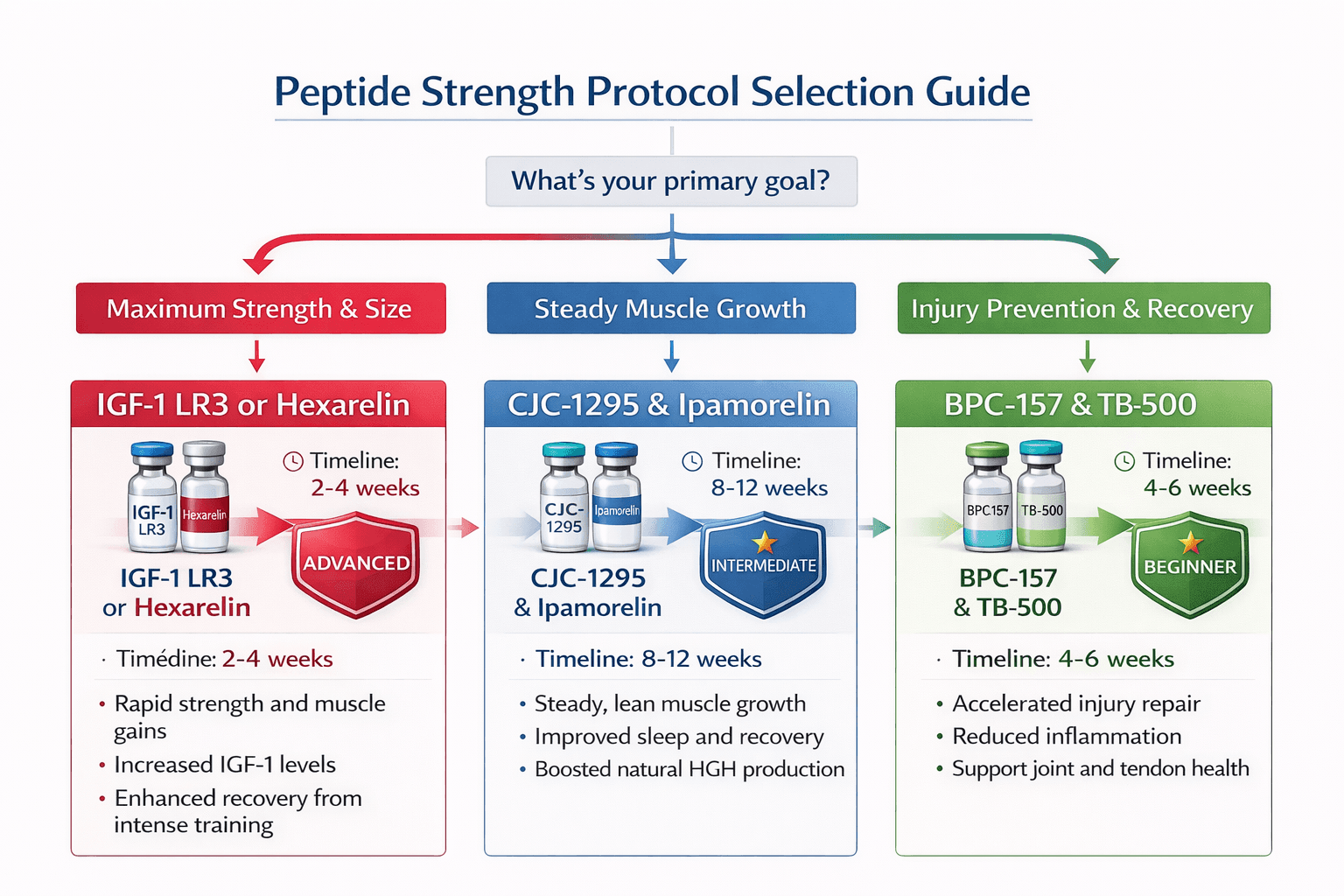
Complete strength training peptide stacks
Combining peptides provides synergistic benefits.
Beginner stack: CJC-1295 + Ipamorelin
Protocol:
CJC-1295 (no DAC): 200mcg before bed
Ipamorelin: 200mcg before bed
Frequency: 5-7 days per week
Duration: 3-6 months minimum
Benefits:
Steady muscle growth
Improved recovery
Better sleep
Minimal side effects
Easy to manage
Expected results:
5-10 lbs muscle gain over 6 months
10-20% strength increase
Enhanced work capacity
Cost: Moderate ($100-200/month)
Intermediate stack: GH peptides + BPC-157
Protocol:
CJC-1295: 200mcg before bed
Ipamorelin: 200mcg before bed
BPC-157: 250-500mcg twice daily
Duration: 3-6 months
Benefits:
Muscle growth from GH peptides
Injury prevention from BPC-157
Can train harder and more frequently
Comprehensive support
Expected results:
8-12 lbs muscle gain
15-25% strength increase
Reduced injury incidence
Faster recovery
Cost: Moderate to high ($150-300/month)
Advanced stack: IGF-1 LR3 + GH peptides + healing peptides
Protocol:
IGF-1 LR3: 40-80mcg daily (4-6 week cycles)
CJC-1295: 200mcg before bed (continuous)
Ipamorelin: 200mcg before bed (continuous)
BPC-157: 500mcg twice daily (continuous)
TB-500: 5-10mg per week loading, then 2-5mg maintenance
Benefits:
Maximum anabolic environment
Rapid muscle and strength gains
Excellent recovery
Injury protection
Expected results:
10-15 lbs muscle gain in 4-6 weeks (IGF-1 cycle)
20-35% strength increase
Dramatic body composition improvement
Cost: High ($300-500+/month)
Experience required: Advanced users only. Requires proper cycling, monitoring, and understanding of all peptides.
Learn complete stacking strategies in our peptide stacks guide, can you cycle different peptides guide, and common peptide mistakes beginners make.
Dosing and cycling for strength protocols
Proper protocols maximize gains and minimize risks.
General principles
Start low:
Begin with minimum effective dose
Assess tolerance for 2-4 weeks
Increase if needed and tolerated
Cycle appropriately:
Growth hormone peptides: Can use 3-6+ months continuously
IGF-1 LR3: Must cycle 4-6 weeks on, 4-6 weeks off
Healing peptides: Can use continuously or cycle based on need
Monitor progress:
Track strength (weights, reps)
Monitor body composition
Watch for side effects
Adjust dosing based on results
Timing relative to training
Pre-workout:
IGF-1 LR3 (nutrient partitioning)
Optional: GHRP-6 (some users prefer)
Post-workout:
IGF-1 LR3 (muscle building)
BPC-157 (recovery)
Before bed:
CJC-1295 + Ipamorelin (GH release during sleep)
Growth happens during sleep
Throughout day:
BPC-157 (twice daily)
TB-500 (based on weekly total)
Learn proper injection technique in our how to inject peptides guide and mixing protocols in our how to reconstitute peptides guide. Use our free peptide reconstitution calculator for exact measurements.
Sample 16-week strength protocol
Weeks 1-16 (base):
CJC-1295: 200mcg nightly
Ipamorelin: 200mcg nightly
BPC-157: 250mcg twice daily
Weeks 1-6 (IGF-1 cycle):
Add IGF-1 LR3: 60mcg post-workout
Weeks 7-12 (off IGF-1):
Continue base protocol only
Weeks 13-16 (optional second IGF-1 cycle):
Add IGF-1 LR3: 60mcg post-workout
Expected outcome:
15-20 lbs muscle gain
25-40% strength increase in major lifts
Minimal injuries
Excellent body composition
Use our peptide cycle planning guide for detailed cycle planning, peptide dosage chart for reference doses, and how to calculate peptide dosages for precision.
Realistic strength gain expectations
Understanding what's actually achievable prevents disappointment and unrealistic goals.
Strength gains by peptide protocol
Beginner protocol (CJC/Ipa only):
3 months: 10-15% strength increase
6 months: 15-25% strength increase
Muscle gain: 5-10 lbs
Intermediate protocol (GH + BPC-157):
3 months: 15-20% strength increase
6 months: 20-30% strength increase
Muscle gain: 8-15 lbs
Advanced protocol (IGF-1 + full stack):
6 weeks (single IGF-1 cycle): 15-20% strength increase
4-6 months (multiple cycles): 30-50% strength increase
Muscle gain: 15-25 lbs
Factors affecting results:
Training quality (progressive overload essential)
Nutrition (caloric surplus for strength gains)
Sleep (7-9 hours nightly)
Training experience (beginners gain faster)
Genetics
Age (older athletes may see bigger relative improvements)
Comparison to natural training
Natural strength gains (optimal training and nutrition):
Beginner: 20-30% strength increase in first year
Intermediate: 10-15% per year
Advanced: 5-10% per year
With peptides:
Accelerated timeline (compress 12 months into 6)
Higher ceiling (surpass natural potential)
Better recovery allows more volume
Peptides don't replace training:
Still need progressive overload
Proper programming essential
Nutrition must support gains
Peptides enhance but don't replace fundamentals
Safety and side effects for strength protocols
Peptides are generally safe but require awareness.
Common side effects by peptide type
Growth hormone peptides:
Water retention (temporary)
Lethargy initially (adapts within weeks)
Carpal tunnel symptoms (rare, high doses)
Insulin resistance (monitor with long-term use)
IGF-1 LR3:
Hypoglycemia (keep fast carbs on hand)
Jaw/facial bone growth (with chronic use)
Organ enlargement (long-term misuse)
Healing peptides:
Minimal side effects
Occasionally: fatigue, headache (rare)
Monitoring and bloodwork
Baseline testing before starting:
IGF-1 levels
Thyroid panel (T3, T4, TSH)
Fasting glucose and insulin
Lipid panel
Liver and kidney function
Follow-up testing:
Every 3-6 months during protocol
Monitor IGF-1 (ensure not excessively elevated)
Check glucose metabolism
Liver/kidney function
Contraindications
Avoid peptides if:
Active cancer (GH/IGF-1 can promote tumor growth)
Diabetic without physician oversight
Significant organ disease
Use caution if:
Family history of cancer
Pre-diabetic
Taking medications that affect blood sugar
See our peptide safety and risks guide for comprehensive safety information.
Nutrition and training optimization with peptides
Peptides enhance results but require proper foundation.
Nutrition for strength with peptides
Caloric surplus required:
Minimum +300-500 calories above maintenance
Higher protein (1.2-1.5g per lb bodyweight)
Adequate carbs (support training and IGF-1 effectiveness)
Healthy fats (hormone production)
Timing:
Pre-workout: Carbs and protein
Post-workout: High protein, moderate carbs (especially with IGF-1)
Throughout day: Regular protein feedings
Hydration:
Increased water needs (GH peptides cause retention)
Minimum 1 gallon daily
More during training
Training programming
Progressive overload essential:
Increase weight, reps, or volume over time
Peptides support this but don't replace it
Track all training metrics
Frequency:
Peptides support higher frequency (better recovery)
Can train each muscle 2-3x weekly instead of 1x
Listen to body despite enhanced recovery
Volume:
Can tolerate higher volume with peptides
Start conservatively, add volume gradually
Recovery peptides allow aggressive training
Sleep and recovery
Sleep critical:
7-9 hours nightly minimum
GH release primarily during deep sleep
Peptides enhance sleep quality
Active recovery:
Light cardio
Mobility work
Massage, sauna
Rest days:
Still necessary despite enhanced recovery
1-2 full rest days weekly
How you can use SeekPeptides for strength protocols
SeekPeptides provides personalized strength and performance protocols tailored to your training goals. Get customized peptide stacks showing exactly which peptides to use for your strength phase, proper dosing schedules, and cycle planning that aligns with your training blocks.
Our AI advisor helps you troubleshoot protocols, adjust doses based on results, and determine when to add or remove specific peptides.
Access complete research on peptide mechanisms for muscle growth and strength, clinical evidence from our peptide research library, and proven protocols from experienced users.
Track your strength progression and body composition changes throughout peptide cycles using our peptide dosing tools and cycle planning resources to optimize your protocols.
Learn how to properly store and handle your peptides with our peptide storage guide and reconstitution guide for best results.
Final thoughts
Peptides offer significant benefits for strength training through multiple pathways.
Growth hormone peptides provide steady muscle and strength gains over months. IGF-1 LR3 delivers rapid, dramatic muscle growth and strength increases in short cycles. Healing peptides prevent injuries and enhance recovery, allowing harder, more frequent training.
The best approach combines growth and healing peptides. CJC-1295 + Ipamorelin provides the foundation for beginners. Advanced users add IGF-1 LR3 for explosive gains. BPC-157 and TB-500 protect against injuries and speed recovery throughout.
Realistic expectations matter. Expect 10-25% strength gains in 3-6 months with beginner protocols, 30-50% with advanced protocols. Results require proper training, nutrition, and recovery - peptides enhance but don't replace fundamentals.
Start conservatively, track progress, adjust based on results. Peptides are powerful tools for strength training when used intelligently.
Your strength gains accelerate with the right peptide protocol. Choose based on your experience level, goals, and commitment.
Frequently Asked Questions About Peptide Strength Protocols
What peptides are best for strength training?
The most effective peptides for strength include BPC-157 for recovery, TB-500 for muscle repair, Ipamorelin for growth hormone release, and CJC-1295 for sustained muscle growth. Many athletes use peptide stacks combining multiple compounds for synergistic effects.
How long does it take to see strength gains from peptides?
Most users report noticeable strength improvements within 4-6 weeks. Peptides for muscle growth like Ipamorelin show faster results (2-3 weeks) while recovery peptides like TB-500 take 4-8 weeks for full benefits.
What's the proper dosage for strength-focused peptide protocols?
Dosages vary by peptide: BPC-157 (250-500mcg daily), TB-500 (2-5mg twice weekly), Ipamorelin (200-300mcg 2-3x daily), CJC-1295 (1-2mg weekly). Always start at lower doses and adjust based on response. Use our peptide dosage calculator for precise measurements.
Can I stack multiple peptides for better strength results?
Yes, peptide stacking is common for strength training. Popular combinations include BPC-157 + TB-500 for recovery, or Ipamorelin + CJC-1295 for growth. See our peptide stacking guide and peptide stack calculator to plan your protocol safely.
Are peptides safer than steroids for building strength?
Generally yes - peptides have fewer side effects than anabolic steroids and work with your body's natural processes. They don't suppress testosterone production or cause organ damage like traditional steroids.
How do I properly reconstitute and store strength peptides?
Use bacteriostatic water for reconstitution - our peptide reconstitution calculator ensures accurate mixing. Store reconstituted peptides in the refrigerator (2-8°C). Reconstituted peptides typically last 2-4 weeks when properly stored.
What are common mistakes to avoid with peptide strength protocols?
Common errors include improper dosing, inconsistent timing, inadequate nutrition, and skipping post-cycle therapy. Many beginners also mix peptides incorrectly or use contaminated water.
Do I need to cycle peptides for strength training?
Yes, most strength protocols benefit from cycling - typically 8-12 weeks on followed by 4-6 weeks off. This prevents receptor desensitization and maintains effectiveness.
Helpful resources for strength peptides
Peptide calculator - Calculate all peptide doses
CJC-1295 dosage calculator - GH peptide dosing
BPC-157 dosage calculator - Recovery peptide dosing
TB-500 dosage calculator - Healing peptide dosing
Related guides worth reading
Best peptides for muscle growth: complete protocols - Muscle building focus
Peptides for athletic performance: optimization - Performance enhancement
BPC-157 complete guide: injury prevention - Recovery support
Take care of yourself. Use SeekPeptides