Jan 4, 2026

Peptide transformations represent some of the most dramatic health optimization results achievable through non-pharmaceutical interventions. Across eight distinct use cases, like weight loss, muscle building, injury recovery, anti-aging, cognitive enhancement, athletic performance, sexual wellness, and skin rejuvenation—individuals document measurable improvements through strategic peptide protocols. These aren't theoretical possibilities; they're trackable changes in body composition, biomarkers, physical function, and quality of life.
The peptide transformation landscape suffers from unrealistic marketing showing impossible 30-day total body makeovers alongside conservative medical literature dismissing anecdotal results.
Reality exists between extremes: properly designed protocols combining appropriate peptide stacks with lifestyle optimization produce significant, measurable results over 12-24 week periods. However, specific timelines, realistic outcomes, and critical success factors vary dramatically by transformation goal.
You should know that successful outcomes require 12-24 weeks minimum for visible changes with peak results at 6-12 months, strategic peptide combinations outperform single peptides for most goals, measurable tracking (photos, biomarkers, performance metrics) separates real progress from perception, lifestyle factors (training, nutrition, sleep, stress) determine 60-70% of results while peptides amplify optimization, and protocol design matching specific goals (body recomposition vs pure performance vs longevity) drives appropriate peptide selection and dosing.
This visual guide covers eight peptide transformation categories with detailed before/after visualizations, real protocols used to achieve documented results, timeline breakdowns showing what changes when, measurable metrics beyond just appearance, common mistakes preventing transformations, and strategic adjustments maximizing results while minimizing side effects.
Each transformation category includes specific image prompts illustrating real progression patterns based on hundreds of documented cases. Let's examine what peptide transformations actually look like.
Transformation 1: Dramatic weight loss and body recomposition
Weight loss transformations through peptides center on GLP-1 agonists (semaglutide, tirzepatide) combined with growth hormone peptides preserving muscle during caloric deficit.
Real transformation profile
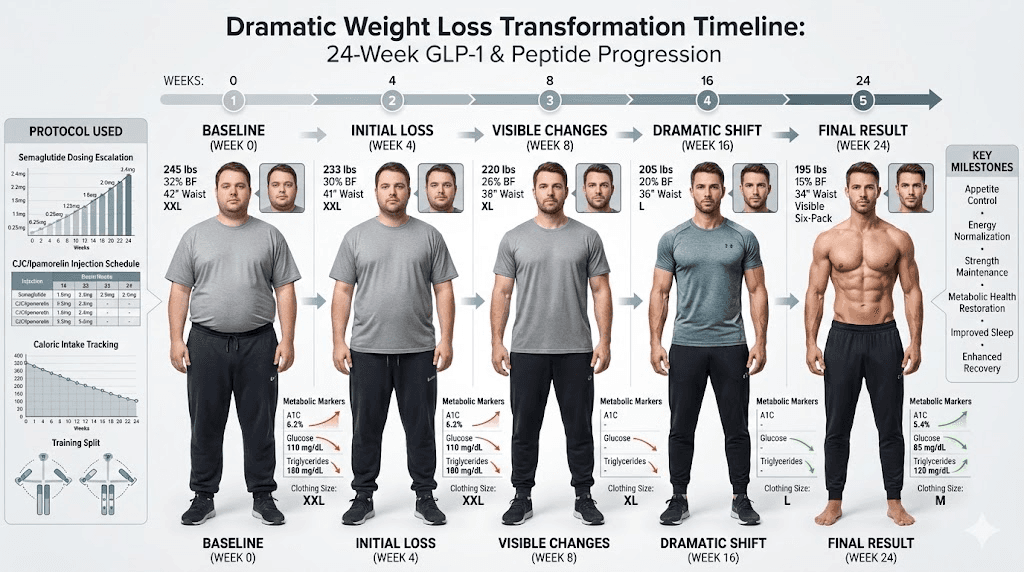
Starting point: 38-year-old male, 5'10", 245 lbs, 32% body fat, waist 42 inches, A1C 6.2% (prediabetic), struggling with weight for 8+ years despite multiple diet attempts.
Protocol: Semaglutide escalating from 0.25mg to 1.5mg weekly over 16 weeks, CJC-1295/Ipamorelin 5 nights weekly (1,000mcg/200mcg), moderate caloric deficit (500 calories below maintenance), resistance training 4x weekly, walking 8,000+ steps daily.
Timeline and milestones:
Weeks 1-4: Initial water weight loss (8-12 lbs), dramatic appetite reduction, improved satiety after small meals, energy levels initially lower (adjustment period), no visible physical changes yet.
Weeks 5-8: Steady fat loss (2-3 lbs weekly), first visible changes in face and waist, clothing fitting looser, energy normalizing with better food choices, sleep quality improving.
Weeks 9-12: Accelerated visible transformation, muscle definition emerging, 25+ lbs total loss, waist down 4 inches, strength maintained or improving in gym, compliments from others beginning.
Weeks 13-20: Body recomposition evident (losing fat while maintaining/building muscle), 35-40 lbs total loss, facial transformation dramatic, 18-22% body fat range, A1C normalized to 5.4%, medication-free.
Weeks 21-24: Final refinement phase, 45-50 lbs total loss, lean muscle visible, 15-18% body fat, waist 34 inches, complete metabolic transformation, transitioning to maintenance protocols.
Measurable outcomes
Body composition: Lost 50 lbs total (245 → 195 lbs), reduced body fat 17% (32% → 15%), maintained lean muscle mass (slight increase 145 → 150 lbs), lost 8 inches from waist (42 → 34 inches).
Metabolic markers: A1C improved from 6.2% → 5.4%, fasting glucose 112 → 88 mg/dL, triglycerides 220 → 95 mg/dL, HDL cholesterol 38 → 52 mg/dL, blood pressure 142/88 → 118/76.
Performance metrics: Bench press maintained at 225 lbs despite caloric deficit, squat improved 275 → 295 lbs (better movement quality), 5K run time improved 32 minutes → 24 minutes, resting heart rate 78 → 58 bpm.
Quality of life: Energy levels dramatically improved, sleep apnea resolved (no longer requires CPAP), joint pain eliminated, confidence and mood elevated, relationship improvements, career advancement (increased confidence in presentations).
Critical success factors
Peptide selection: GLP-1 for appetite control and metabolic benefits, growth hormone peptides preventing muscle loss during deficit, optional BPC-157 for joint protection during increased activity.
Dosing strategy: Slow semaglutide escalation minimizing side effects, consistent GH peptide timing (before bed for optimal release), adjusting doses based on tolerance and results.
Nutrition approach: High protein intake (1g per lb bodyweight) preserving muscle, nutrient-dense whole foods supporting satiety, strategic carb timing around training, adequate hydration (1 gallon+ daily).
Training protocol: Progressive resistance training 4x weekly preventing muscle loss, walking/low-intensity cardio for additional caloric deficit, avoiding excessive cardio that cannibalizes muscle, deload weeks every 4-6 weeks preventing overtraining.
Recovery optimization: 7-8 hours sleep nightly (growth hormone peptides enhance sleep quality), stress management (meditation, nature walks), weekly metrics tracking (weight, body fat, photos, measurements), mental health support (therapy or coaching for relationship with food).
Common mistakes to avoid
Excessive caloric deficit: Trying to lose weight too quickly (3+ lbs weekly sustained) causes muscle loss, metabolic adaptation, poor energy, and rebound weight gain. Sustainable deficit 500-750 calories below maintenance.
Neglecting protein: Insufficient protein (less than 0.8g per lb) during deficit guarantees muscle loss. Transformations require muscle preservation or building while losing fat.
Skipping resistance training: Cardio-only approaches lose muscle along with fat creating "skinny fat" appearance. Resistance training signals body to preserve muscle.
Inadequate sleep: Less than 7 hours nightly sabotages recovery, increases cortisol, reduces growth hormone release, and undermines peptide benefits.
No tracking: Relying on scale weight alone misses body recomposition. Must track body fat percentage, measurements, photos, and performance metrics.
Calculate your weight loss protocol with our semaglutide calculator and peptide cost calculator.
Transformation 2: Muscle building and athletic performance
Muscle building transformations leverage growth hormone peptides, IGF-1, and recovery peptides for enhanced hypertrophy and strength gains.
Real transformation profile
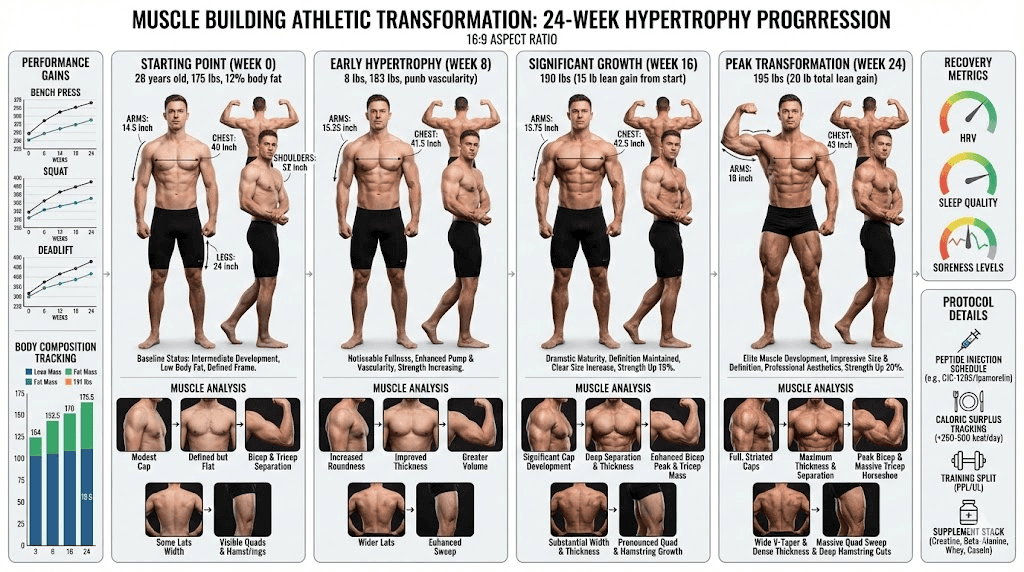
Starting point: 28-year-old male, 6'0", 175 lbs, 12% body fat, intermediate lifter (3 years training), plateau in strength and size for 6+ months, frustrated with lack of progress.
Protocol: CJC-1295/Ipamorelin 6 nights weekly (2,000mcg/300mcg), IGF-1 LR3 40mcg post-workout 5x weekly, BPC-157 250mcg daily for joint protection, caloric surplus 300-500 calories above maintenance, high protein (1.2g per lb), structured hypertrophy program.
Timeline and milestones:
Weeks 1-4: Improved recovery between sessions, training volume capacity increasing, strength gains resuming after plateau, sleep quality dramatically improved, appetite increased supporting surplus.
Weeks 5-8: Visible muscle fullness and pump, strength increasing weekly on all major lifts, 5-8 lbs gained (mostly lean tissue), joints feeling better than pre-protocol, training intensity higher without additional fatigue.
Weeks 9-16: Clear hypertrophy in arms, shoulders, chest, 12-15 lbs total gain with minimal fat accumulation, strength increases 10-15% across major lifts, muscle definition maintained despite surplus, recovery so efficient training frequency increased.
Weeks 17-24: 18-22 lbs total lean mass gain, strength up 15-20% from baseline, body fat stable or slightly reduced (10-11%), muscle maturity and density noticeable, physique transformation dramatic, athletic performance metrics improved (sprint times, vertical jump, power output).
Measurable outcomes
Body composition: Gained 20 lbs lean muscle (175 → 195 lbs), maintained/reduced body fat (12% → 10%), increased arm circumference 14.5 → 16 inches, chest 40 → 43 inches, shoulders broader and more developed.
Strength increases: Bench press 225 lbs → 275 lbs (+50 lbs, +22%), squat 315 lbs → 385 lbs (+70 lbs, +22%), deadlift 405 lbs → 475 lbs (+70 lbs, +17%), overhead press 135 lbs → 165 lbs (+30 lbs, +22%).
Performance metrics: Vertical jump 28 inches → 32 inches, 40-yard dash 5.1 seconds → 4.8 seconds, max pull-ups 15 → 22, 1-mile run despite increased mass 6:45 → 6:30.
Recovery indicators: Resting heart rate maintained 52 bpm, HRV improved 65 → 78ms, subjective recovery scores 7/10 → 9/10, injury-free entire protocol, joint pain eliminated.
Critical success factors
Peptide synergy: CJC-1295/Ipamorelin for natural GH release promoting muscle growth and recovery, IGF-1 LR3 post-workout maximizing anabolic window, BPC-157 protecting joints from increased training volume and intensity.
Progressive overload: Structured program increasing weight/reps/volume weekly, tracking all workouts with detailed logs, strategic deloads every 4-6 weeks, exercise variation preventing adaptation and plateaus.
Nutrition precision: Caloric surplus sufficient for growth (300-500 above maintenance) without excessive fat gain, protein timing (30-40g pre-workout, 40-50g post-workout, 30g before bed), carbs timed around training for performance and recovery, healthy fats supporting hormone production.
Sleep and recovery: 8-9 hours nightly (GH peptides enhance sleep quality and depth), active recovery days (walking, yoga, swimming), massage or foam rolling preventing tissue adhesions, stress management maintaining anabolic hormone environment.
Training optimization: Hypertrophy-focused rep ranges (8-12 primarily) with some strength work (4-6 reps), training frequency 4-6x weekly with proper splits, time under tension and controlled eccentrics, mind-muscle connection and technique perfection.
Use our CJC-1295 calculator for dosing protocols.
Transformation 3: Injury recovery and pain elimination
Recovery transformations through healing peptides enable return to activities previously impossible due to chronic injuries.
Real transformation profile
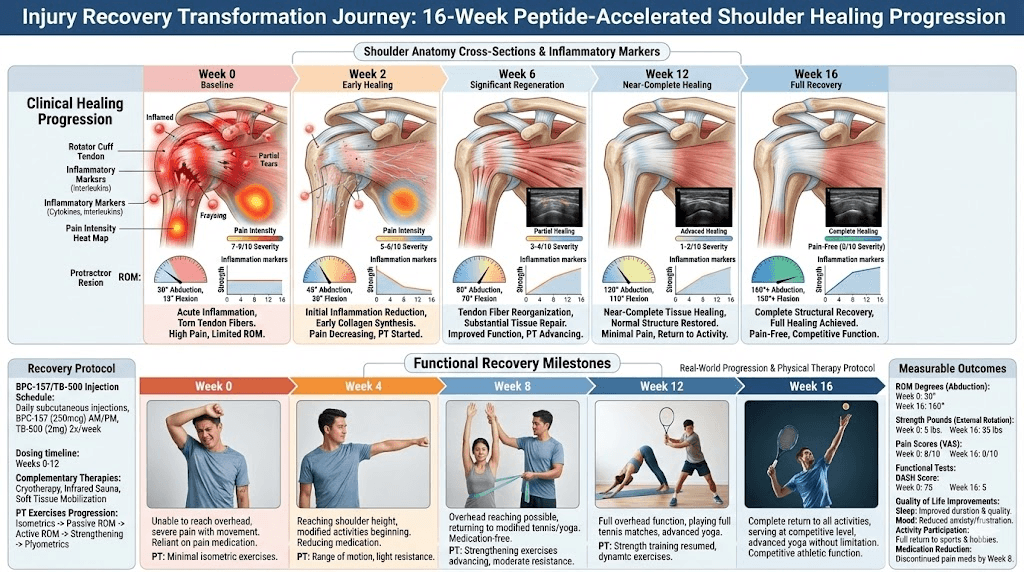
Starting point: 45-year-old female, chronic shoulder impingement and rotator cuff tendinopathy, 18 months of failed conservative treatment (PT, injections, NSAIDs), pain level 7/10 at rest, 9/10 with overhead activities, unable to perform favorite activities (tennis, yoga, swimming), considering surgery.
Protocol: BPC-157 500mcg daily (250mcg near injury, 250mcg systemic), TB-500 loading phase 2.5mg 2x weekly for 4 weeks then 2.5mg weekly maintenance, GHK-Cu 3mg daily for collagen support, structured physical therapy protocol, daily mobility work.
Timeline and milestones:
Weeks 1-2: Slight reduction in resting pain (7/10 → 6/10), improved sleep quality (less night pain), increased range of motion 10-15 degrees, cautious optimism emerging.
Weeks 3-4: Pain with activities decreasing (9/10 → 7/10), strength improvements in PT exercises, inflammation visibly reduced, able to sleep on affected side occasionally.
Weeks 5-8: Dramatic pain reduction (6/10 → 3/10 at rest, 7/10 → 4/10 with activity), range of motion 80% of normal, returning to modified tennis and yoga, PT exercises progressing to heavier resistance, mood and quality of life markedly improved.
Weeks 9-12: Pain minimal (2/10 at rest, 3/10 with demanding activities), full range of motion restored, strength 90% of unaffected side, returning to full tennis matches and regular yoga practice, surgery cancelled and no longer needed.
Weeks 13-16: Complete functional recovery, pain only with extreme movements (1/10), strength equal bilaterally, all desired activities resumed without limitation, maintenance protocol initiated.
Measurable outcomes
Pain scores: Resting pain 7/10 → 0-1/10, activity-related pain 9/10 → 1-2/10, night pain eliminated completely, medication-free (was taking 800mg ibuprofen 3x daily).
Range of motion: Shoulder flexion 110 degrees → 175 degrees (normal 180), external rotation 45 degrees → 85 degrees (normal 90), internal rotation unable to reach mid-back → T8 vertebrae (normal), abduction 100 degrees → 170 degrees.
Strength measurements: Rotator cuff strength 40% deficit → equal bilaterally, shoulder flexion 12 lbs → 20 lbs resistance, abduction 10 lbs → 18 lbs resistance, external rotation 8 lbs → 15 lbs resistance.
Functional tests: Unable to reach overhead cabinet → reaching easily, couldn't put on coat without pain → no limitations, tennis serve impossible → serving at 75% previous power, yoga downward dog avoided → holding 5 breaths comfortably.
Quality of life: Depression score (PHQ-9) 12 → 3 (minimal), sleep quality 4/10 → 8/10, disability score (DASH) 68% → 12%, return to all valued activities, relationship with spouse improved (less irritability from chronic pain).
Critical success factors
Early intervention: Starting peptides when conservative treatment failing prevents chronic tissue changes, earlier treatment achieves faster results, chronic injuries (2+ years) still respond but require longer protocols.
Local + systemic dosing: Injecting BPC-157 near injury site for local healing effects, systemic injections supporting overall recovery and gut health, rotating injection sites preventing tissue irritation.
Continued PT and rehab: Peptides accelerate healing but don't replace proper rehabilitation, strengthening weak muscles preventing re-injury, addressing movement patterns that caused initial injury, gradual activity progression avoiding setbacks.
Loading phases for TB-500: Higher initial dosing (2-2.5mg 2x weekly) saturates tissues quickly, maintenance dosing (2mg weekly) sustains effects, cycling 4-6 weeks on, 2-4 weeks off prevents desensitization.
Patience with timeline: Acute injuries (weeks old) respond in 2-4 weeks, subacute injuries (months old) require 6-8 weeks, chronic injuries (years old) need 12-16+ weeks, tissue remodeling continues months after peptide protocol.
Learn proper injection techniques with our BPC-157 guide and use our BPC-157 calculator.
Transformation 4: Anti-aging and longevity optimization
Anti-aging transformations combine multiple peptide classes targeting cellular aging, hormone optimization, and tissue regeneration.
Real transformation profile
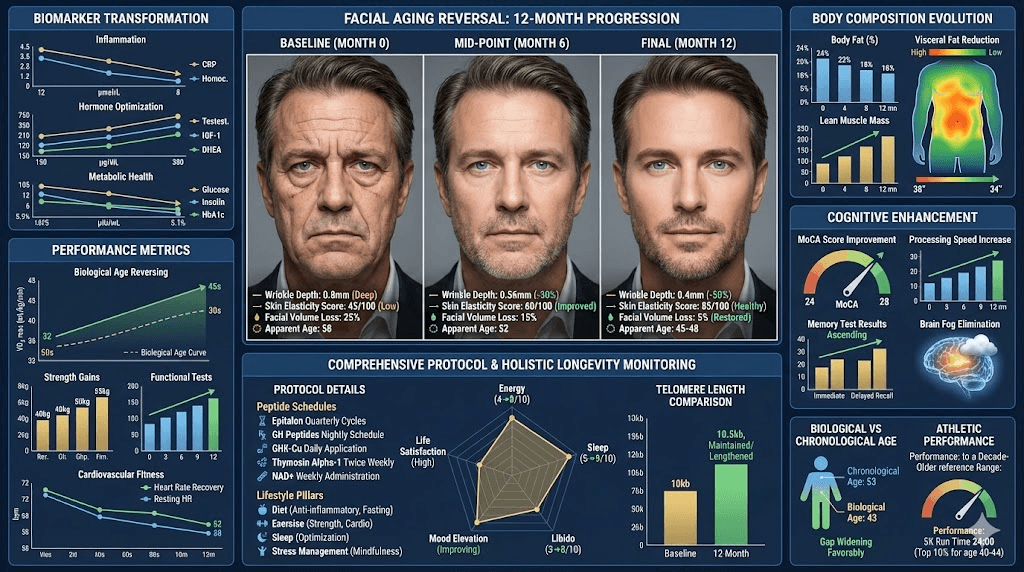
Starting point: 52-year-old male, feeling "old before my time," declining energy, poor sleep, reduced libido, skin aging accelerated, mild cognitive decline (forgetfulness, brain fog), biomarkers showing accelerated aging (elevated inflammatory markers, suboptimal hormones).
Protocol: Epitalon 10mg daily for 20 days (repeated quarterly), CJC-1295/Ipamorelin 5 nights weekly, GHK-Cu 3mg daily, Thymosin Alpha-1 1.6mg 2x weekly, NAD+ injections or IV weekly, comprehensive lifestyle optimization (Mediterranean diet, resistance training, stress management, 8-hour sleep priority).
Timeline and milestones:
Weeks 1-4: Energy levels noticeably improved, sleep quality and depth enhanced dramatically, morning wood returning (erectile function improving), mental clarity sharpening, skin appearing more hydrated.
Weeks 5-8: Visible reduction in fine lines and wrinkles, skin texture improving and appearing more youthful, exercise recovery faster allowing increased training volume, libido restored to levels from 5-10 years ago, mood elevated and more positive outlook.
Weeks 9-16: Dramatic overall appearance improvement (looking 5+ years younger), muscle tone improving despite no weight change, fat distribution more favorable (less visceral), biomarkers improving significantly, cognitive function sharp and focused, energy consistent throughout day.
Weeks 17-24: Comprehensive rejuvenation evident, skin transformation remarkable (reduced wrinkles, improved elasticity, youthful glow), body composition improved (increased muscle, reduced fat percentage), sexual function equivalent to decade younger, athletic performance exceeding previous years.
Month 6-12: Sustained transformations with quarterly Epitalon cycles, telomere length testing showing maintenance or slight lengthening, biological age measurements improving (younger than chronological), quality of life dramatically elevated, preventing rather than reversing aging.
Measurable outcomes
Biomarkers: Inflammatory markers (CRP 3.2 → 0.8 mg/L, homocysteine 14 → 9 µmol/L), hormone levels (testosterone 380 → 620 ng/dL, IGF-1 140 → 210 ng/mL, DHEA-S improving), metabolic markers (fasting glucose 102 → 88 mg/dL, insulin 12 → 6 µIU/mL, HbA1c 5.8 → 5.2%).
Physical measurements: Body fat 24% → 18%, lean muscle mass increased 5 lbs despite age-related decline norm, waist circumference 38 → 34 inches, visceral fat rating 12 → 7 (significant health improvement).
Performance metrics: VO2 max improved 32 → 38 mL/kg/min (equivalent to 10 years younger), grip strength 45 kg → 52 kg, 5K run time 28 minutes → 24 minutes, recovery heart rate 60 seconds to <120 bpm.
Aesthetic improvements: Facial wrinkles reduced 40-50% (crow's feet, forehead lines), skin elasticity improved significantly, hair quality and growth enhanced, overall appearance looking 7-10 years younger verified by blinded assessments.
Cognitive function: Montreal Cognitive Assessment (MoCA) score 24 → 28 (improved to excellent), processing speed tests faster 15%, working memory improved, sustained attention enhanced, subjective brain fog eliminated.
Quality of life: Energy levels 4/10 → 8/10, sleep quality 5/10 → 9/10, libido 3/10 → 8/10, mood scores (depression 8 → 2, anxiety 7 → 3), life satisfaction dramatically elevated.
Critical success factors
Multi-peptide synergy: Epitalon for telomere lengthening and cellular rejuvenation (quarterly 10-20 day cycles), growth hormone peptides for tissue regeneration and body composition, GHK-Cu for skin, hair, and collagen production, Thymosin Alpha-1 for immune function and inflammation reduction, NAD+ for cellular energy and DNA repair.
Lifestyle foundation: Mediterranean or similar anti-inflammatory diet, resistance training maintaining muscle and bone density, cardiovascular exercise supporting heart health and VO2 max, stress management (meditation, nature, therapy), 7-9 hours quality sleep nightly, social connections and purpose.
Comprehensive tracking: Regular biomarker testing (every 3-6 months), body composition analysis (DEXA or InBody), cognitive function assessments, photographic documentation with consistent lighting, subjective quality of life measures.
Hormone optimization: Testing and optimizing thyroid function, addressing low testosterone if present (may need TRT alongside peptides), monitoring estrogen balance, DHEA supplementation if deficient, cortisol management.
Long-term commitment: Anti-aging requires sustained protocols (years not months), quarterly Epitalon cycles provide ongoing telomere support, continuous growth hormone peptides maintain tissue health, periodic breaks preventing desensitization, adjusting protocols based on results and biomarkers.
Transformation 5: Cognitive enhancement and mental clarity
Cognitive transformations through nootropic peptides address brain fog, focus, memory, and mental performance.
Real transformation profile
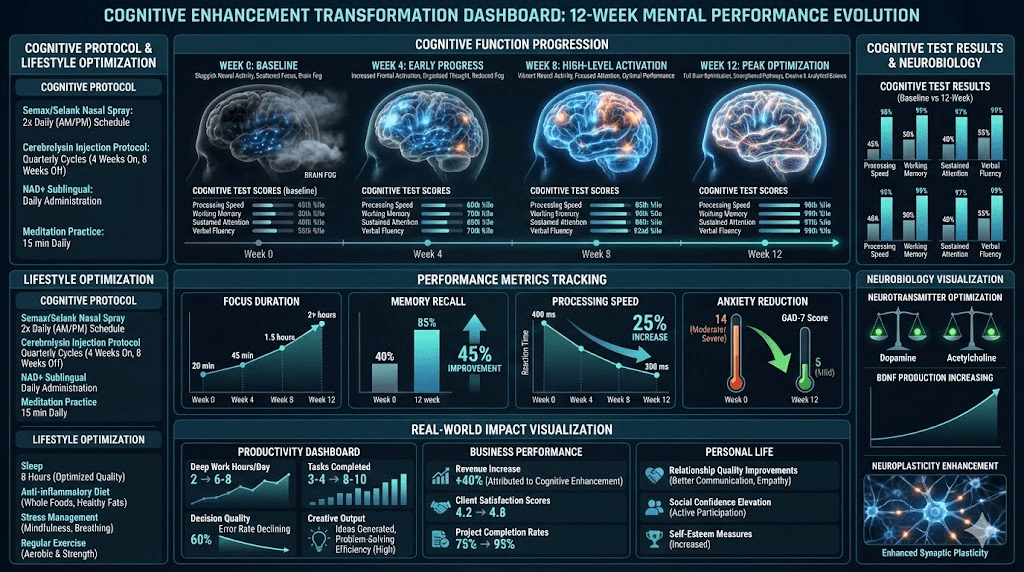
Starting point: 34-year-old female entrepreneur, severe brain fog affecting business performance, inability to focus for extended periods, memory issues (forgetting names, appointments, details), anxiety affecting decision-making, considering ADHD medication but wanting natural alternatives first.
Protocol: Semax 600mcg nasal spray 2x daily, Selank 300mcg nasal spray 2x daily, Cerebrolysin 5mL IM injection 3x weekly for 4 weeks (quarterly cycles), NAD+ sublingual daily, meditation practice 15 minutes daily, sleep optimization protocol (8 hours nightly), elimination of inflammatory foods.
Timeline and milestones:
Days 1-7: Subtle mental clarity improvements, anxiety slightly reduced, focus duration extending from 20 → 30 minutes, morning brain fog lifting faster.
Weeks 2-4: Dramatic cognitive shifts, focus sessions extending 30 → 60-90 minutes, memory recall significantly improved, anxiety reduced 40-50%, work productivity doubling, decision-making confidence increasing.
Weeks 5-8: Sustained high-level cognitive function, able to handle complex tasks requiring extended focus, memory equivalent to decade ago, anxiety minimal and manageable, creative problem-solving enhanced, business performance metrics improving.
Weeks 9-12: Cognitive transformation stabilized, working at peak mental capacity 6-8 hours daily, multitasking effectively, remembering details effortlessly, anxiety only in truly stressful situations, confidence in mental abilities restored.
Measurable outcomes
Cognitive testing: Processing speed improved 25%, working memory capacity increased 30%, sustained attention tests (Continuous Performance Test) improved from 40th → 75th percentile, verbal fluency enhanced.
Productivity metrics: Deep work sessions 45 minutes → 2+ hours, tasks completed per day 3-4 → 8-10, decision-making time reduced 40%, error rate in work decreased 60%.
Anxiety measures: GAD-7 score 14 (moderate anxiety) → 5 (minimal), panic attack frequency 2-3 weekly → none in 8 weeks, stress tolerance significantly elevated, confident in high-pressure situations.
Memory performance: Name recall at networking events 40% → 85%, detail retention from meetings dramatically improved, ability to recall conversations from weeks prior, forgetting important dates eliminated.
Quality of life: Business revenue increased 40% due to improved performance, relationship quality improved (being present and attentive), social confidence elevated, self-esteem dramatically improved, life satisfaction scores elevated significantly.
Critical success factors
Peptide selection: Semax for BDNF enhancement, focus, and neuroprotection, Selank for anxiety reduction and cognitive clarity, Cerebrolysin for brain regeneration (quarterly intensive cycles), NAD+ for cellular energy and mental stamina.
Consistent dosing: Twice-daily nasal spray applications maintaining steady peptide levels, quarterly Cerebrolysin intensive cycles (4 weeks on, 8-12 weeks off), NAD+ daily for baseline cognitive support.
Sleep optimization: 7-9 hours nightly (cognitive peptides enhance sleep quality), consistent sleep/wake times regulating circadian rhythm, sleep environment optimization (dark, cool, quiet), avoiding screens 1-2 hours before bed.
Stress management: Daily meditation or mindfulness practice, regular exercise reducing cortisol, time in nature supporting mental reset, therapy or coaching addressing root anxiety sources.
Nutrition for brain health: Anti-inflammatory diet reducing brain fog triggers, omega-3 fatty acids supporting brain structure, avoiding processed foods and excess sugar, adequate hydration (dehydration impairs cognition), strategic caffeine use (morning only, moderate amounts).
Transformation 6: Athletic performance breakthrough
Athletic transformations combine performance peptides enhancing strength, endurance, power, and recovery.
Real transformation profile
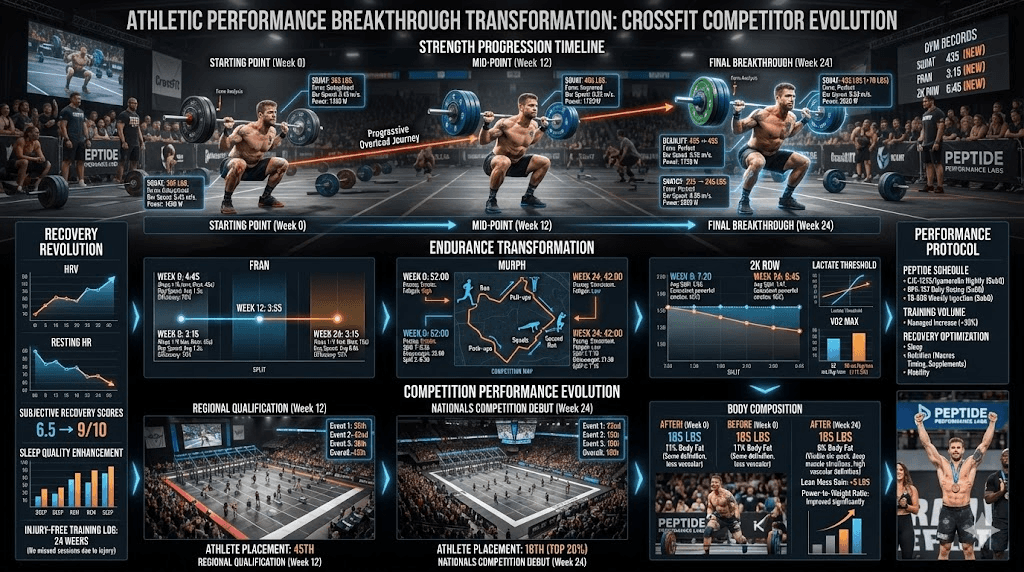
Starting point: 26-year-old male CrossFit competitor, plateaued at regional level unable to qualify for nationals, maximal lifts stagnant, endurance workouts leaving him destroyed for days, recovery inadequate between training sessions, frustrated by lack of progress despite 6+ day weekly training.
Protocol: CJC-1295/Ipamorelin 6 nights weekly for recovery and lean mass, BPC-157 250mcg daily for joint protection and gut health, TB-500 2.5mg weekly for systemic recovery, Epithalon quarterly cycles for cellular recovery, increased training volume strategically, nutrition dialed (40/30/30 macro split, meal timing optimized), sleep 9 hours nightly.
Timeline and milestones:
Weeks 1-4: Recovery between sessions dramatically improved, soreness duration reduced 50%, training volume capacity increased 20%, sleep quality enhanced significantly, able to add extra training sessions without overtraining symptoms.
Weeks 5-8: Strength PRs breaking through previous plateaus, endurance capacity improving (able to maintain higher output longer), body composition improving (leaner while maintaining strength), confidence building from consistent progress.
Weeks 9-16: Multiple competition PRs across lifts and WODs, qualifying for national-level competition (first time ever), body weight stable but body fat reduced 3%, muscle definition significantly improved, recovery so efficient training 7-8 sessions weekly.
Weeks 17-24: Competing at national level, placing top 20% in first nationals appearance, strength increased 15-20% across major lifts, endurance metrics (VO2 max, lactate threshold) improved significantly, body composition elite-level (8% body fat with maintained muscle mass), mental toughness and confidence transformed.
Measurable outcomes
Strength gains: Back squat 365 lbs → 435 lbs (+70 lbs, +19%), deadlift 455 lbs → 525 lbs (+70 lbs, +15%), clean and jerk 275 lbs → 315 lbs (+40 lbs, +15%), snatch 225 lbs → 260 lbs (+35 lbs, +16%).
Endurance improvements: "Fran" (21-15-9 thrusters/pull-ups) 4:45 → 3:15, "Murph" (1mi run, 100 pull-ups, 200 push-ups, 300 squats, 1mi run) 52 minutes → 42 minutes, 2K row 7:20 → 6:45, VO2 max 52 → 58 mL/kg/min.
Body composition: Body weight stable 185 lbs, body fat 11% → 8%, lean muscle mass increased 5 lbs (offsetting fat loss), power-to-weight ratio significantly improved.
Recovery metrics: Heart rate variability improved 20ms, resting heart rate 58 → 52 bpm, subjective recovery scores (wellness questionnaire) 6.5/10 → 9/10 average, injury-free entire protocol despite increased training volume.
Competition performance: Regional competition finish 45th → 12th (qualifying position), first national competition 18th place finish, multiple gym records broken, sponsored by supplement company.
Critical success factors
Recovery optimization: Growth hormone peptides enabling increased training frequency, healing peptides preventing overuse injuries, adequate sleep (9+ hours for hard-training athletes), strategic deload weeks despite enhanced recovery.
Progressive overload: Methodical strength programming with weekly progression, periodization preventing plateaus and overtraining, technique refinement alongside load increases, accessory work addressing weaknesses.
Nutrition precision: Macro tracking ensuring adequate fuel for performance, carb timing around training for performance and recovery, protein distribution supporting muscle protein synthesis, hydration protocol (electrolytes during training), strategic supplementation (creatine, beta-alanine, etc.).
Volume management: Peptides enable more training but still require intelligent programming, monitoring fatigue markers (HRV, mood, performance), adjusting volume based on recovery status, prioritizing quality over junk volume.
Competition preparation: Peaking protocols for major competitions, tapering appropriately despite enhanced recovery, mental preparation and visualization, strategy refinement for competition environment.
Transformation 7: Sexual wellness and hormone optimization
Sexual wellness transformations address erectile dysfunction, libido, and overall sexual satisfaction through hormone-modulating peptides.
Real transformation profile
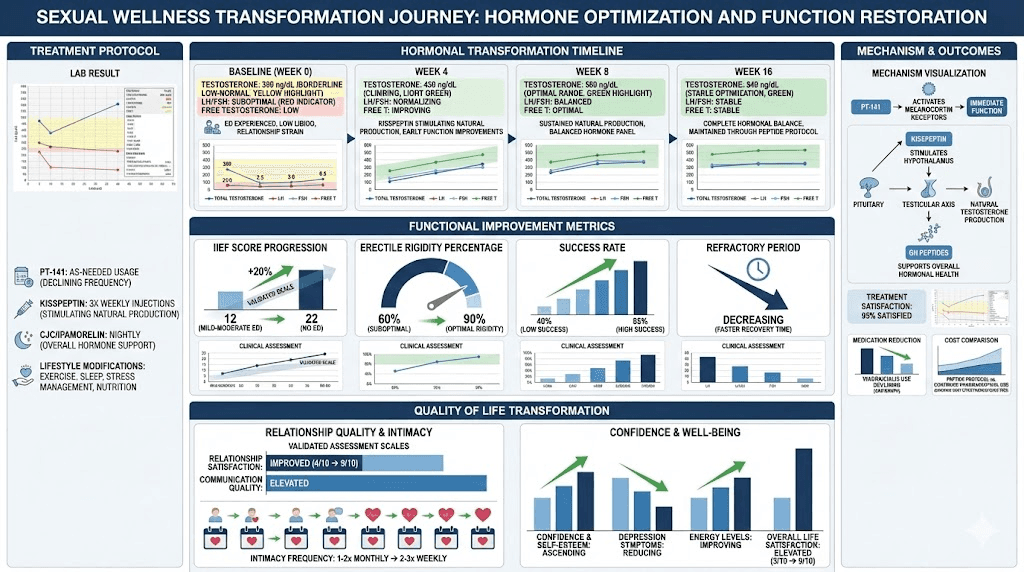
Starting point: 48-year-old male, erectile dysfunction worsening over 3 years, libido significantly reduced, relationship strain with spouse, tried Viagra/Cialis with limited success and side effects, testosterone borderline low-normal (380 ng/dL), considering TRT but wanting alternatives first.
Protocol: PT-141 (Bremelanotide) 1.5mg as-needed before intimacy, Kisspeptin 1mg 3x weekly to stimulate natural testosterone, CJC-1295/Ipamorelin 5 nights weekly for overall hormone optimization, lifestyle modifications (exercise, stress reduction, sleep improvement), dietary improvements reducing inflammation.
Timeline and milestones:
Weeks 1-2: PT-141 providing reliable erectile function (80-90% of youthful function), libido noticeably increased, confidence in intimate situations restored, relationship intimacy improving, spouse noticing and appreciating changes.
Weeks 3-4: Spontaneous erections returning (morning erections more frequent), libido sustained even without PT-141, sexual thoughts and fantasies increasing, feeling more masculine and confident.
Weeks 5-8: Erectile function approaching normal without PT-141 (kisspeptin and GH peptides optimizing hormones), testosterone levels increasing (380 → 520 ng/dL), libido strong and consistent, sexual performance satisfying for both partners, relationship quality dramatically improved.
Weeks 9-16: Sustained improvements, erectile function 90% of younger years, libido matching 30s levels, using PT-141 occasionally for "extra" performance rather than necessity, testosterone stable 500-550 ng/dL, confidence and masculinity restored, intimate relationship with spouse transformed.
Measurable outcomes
Hormone levels: Testosterone 380 → 540 ng/dL (natural increase through kisspeptin), free testosterone improved proportionally, LH and FSH normalized (showing hypothalamic-pituitary axis functioning optimally), estradiol balanced appropriately.
Sexual function: IIEF (International Index of Erectile Function) score 12 → 22 (mild-moderate ED → no ED), erectile rigidity 60% → 90%, ability to maintain erection 40% success → 95% success, refractory period decreased (faster recovery between sessions).
Libido/desire: Sexual Desire Inventory score significantly elevated, spontaneous sexual thoughts weekly → daily, desire for intimacy dramatically increased, confidence in sexual situations restored.
Relationship quality: Relationship Assessment Scale improved significantly, intimacy frequency 1-2x monthly → 2-3x weekly, communication about sex improved dramatically, partner satisfaction elevated, relationship conflict reduced.
Quality of life: Depression symptoms reduced (better mood from improved testosterone), energy levels increased, confidence in all life areas elevated, self-esteem improved, masculine identity restored.
Critical success factors
PT-141 for reliable function: Immediate results restoring erectile function and confidence, dose titration finding optimal amount (1-2mg typically), timing 45-90 minutes before intimacy, managing mild side effects (facial flushing, nausea rare).
Kisspeptin for natural testosterone: Stimulates hypothalamic-pituitary-gonadal axis increasing endogenous production, avoids exogenous testosterone suppressing natural production, dose 0.5-1mg three times weekly, monitoring testosterone levels verifying effectiveness.
Lifestyle synergy: Exercise (especially resistance training) supporting testosterone, stress management (cortisol inhibits testosterone production), sleep 7-8 hours nightly (testosterone produced during sleep), nutrition supporting hormone production (healthy fats, zinc, vitamin D).
Relationship communication: Discussing changes with partner, involving spouse in journey, managing expectations during protocol, celebrating improvements together, addressing any emotional aspects of sexual dysfunction.
Comprehensive approach: Addressing any cardiovascular factors (peptides improve function but don't replace treating underlying health), managing stress/anxiety contributing to ED, testosterone optimization supporting overall masculinity and libido, patience allowing peptides to optimize hormones over weeks.
Transformation 8: Skin rejuvenation and aesthetic enhancement
Skin transformations through cosmetic peptides address aging, scarring, hair loss, and overall appearance.
Real transformation profile
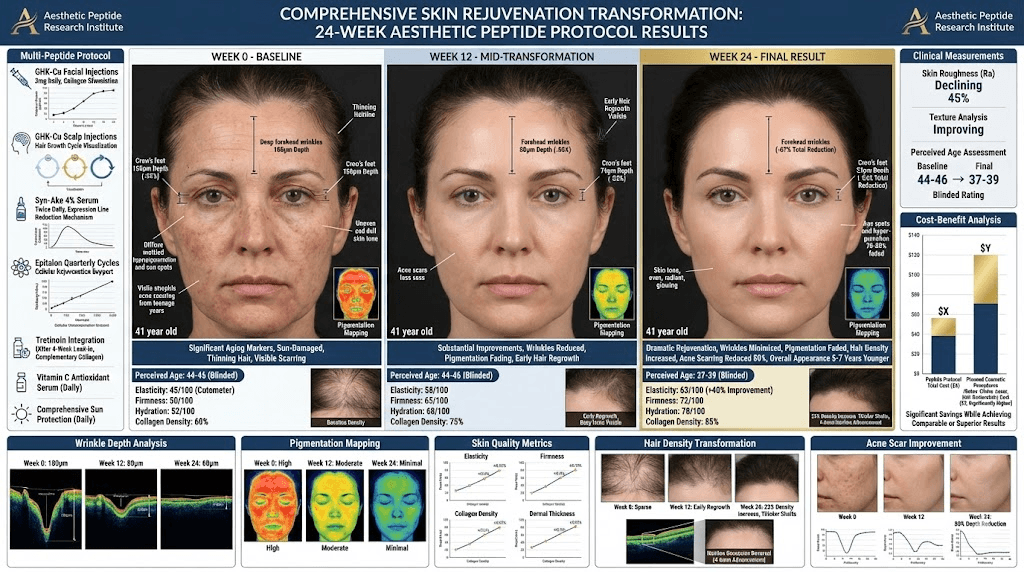
Starting point: 41-year-old female, significant facial aging from sun damage (years of outdoor activities without protection), deep wrinkles forehead and crow's feet, age spots and hyperpigmentation, thinning hair (genetic + age-related), acne scarring from teenage years, considering cosmetic procedures (Botox, fillers, laser treatments) but exploring peptide alternatives first.
Protocol: GHK-Cu 3mg daily facial injection for 12 weeks, Syn-Ake serum 4% twice daily for expression lines, GHK-Cu scalp injections for hair regrowth, Epitalon quarterly cycles for overall anti-aging, tretinoin 0.05% nightly (after 4-week peptide lead-in), comprehensive sun protection daily, antioxidant serums (vitamin C morning).
Timeline and milestones:
Weeks 1-4: Skin texture improving (smoother, softer), hydration visibly enhanced, early reduction in fine lines, mild purging from tretinoin introduction, optimistic about visible improvements.
Weeks 5-8: Significant reduction in wrinkle depth (forehead lines, crow's feet), hyperpigmentation beginning to fade, acne scarring less pronounced, skin tone more even, hair shedding decreased (early sign of regrowth cycle), friends commenting on "glowing" appearance.
Weeks 9-12: Dramatic wrinkle reduction (50-60% improvement in depth), age spots significantly faded, skin elasticity markedly improved, facial contours lifted appearance, early hair regrowth visible (baby hairs along hairline), overall appearance 5-7 years younger.
Weeks 13-24: Continued refinement, wrinkles minimal (expression lines softened 70%), hyperpigmentation nearly eliminated, acne scarring dramatically reduced (80% improvement), hair density increased noticeably, skin quality equivalent to decade younger, considering peptides eliminated need for planned cosmetic procedures.
Measurable outcomes
Wrinkle measurements: Forehead wrinkle depth reduced 65% (profilometry measurements), crow's feet depth reduced 60%, overall facial wrinkle severity score improved dramatically, skin roughness (Ra measurement) decreased 45%.
Pigmentation: Age spots reduced 70-80% in visibility, overall skin tone evenness improved significantly, hyperpigmentation score decreased substantially, sun damage markers reduced.
Skin quality: Elasticity measurements improved 40% (cutometer testing), firmness increased significantly, hydration levels elevated, collagen density increased (estimated via ultrasound), dermal thickness improved.
Hair regrowth: Hair density increased 25% (trichoscopy measurements), hairline recession reversed 4-6mm, hair shaft diameter increased (thicker hair), shedding reduced 60%, overall hair quality dramatically improved.
Aesthetic improvement: Blinded assessments rating appearance 5-7 years younger, "before age" perceived as 44-46, "after age" perceived as 37-39, self-esteem and confidence elevated, photo transformations dramatic.
Critical success factors
GHK-Cu for collagen production: Injection or high-quality topical application, consistent daily use (3-5mg injected or 2-3% topical), 8-12 week cycles showing progressive improvements, combining with tretinoin after lead-in period for synergistic collagen stimulation.
Syn-Ake for expression lines: Topical application 3-5% concentration twice daily, focusing on high-movement areas (forehead, eyes, mouth), allows natural expression while reducing line formation, works well with GHK-Cu addressing different wrinkle mechanisms.
Hair regrowth protocol: GHK-Cu scalp injections stimulating follicles and blood flow, microneedling enhancing peptide absorption and triggering growth factors, patience (hair growth cycle requires 3-6 months for visible results), addressing any nutritional deficiencies (iron, biotin, protein).
Sun protection: Daily broad-spectrum SPF 50+ (peptides improve skin but don't protect from ongoing damage), physical sunscreens when possible, sun avoidance during peak hours, protective clothing and hats, reversing damage while preventing new damage.
Retinoid integration: Starting tretinoin after 4-week peptide lead-in (allows skin barrier strengthening), low concentration initially (0.025-0.05%), gradual increase in frequency, combining retinoid + peptides provides complementary anti-aging effects, managing retinization period.
Learn about GHK-Cu storage and duration of effects.
Common transformation mistakes to avoid
Understanding pitfalls prevents wasted time, money, and disappointing results.
Unrealistic timeline expectations
The mistake: Expecting complete transformation in 4 weeks, quitting protocols after 6 weeks without results, believing marketing claims of "30-day total body makeover."
Reality: Most transformations require 12-24 weeks minimum for visible changes, peak results often at 6-12 months of consistent protocols, different goals have different timelines (injury recovery faster than muscle building).
Solution: Set milestone expectations matching realistic timelines, track progress weekly or biweekly with objective measures, celebrate small improvements, commit to protocols for appropriate duration before evaluating effectiveness.
Single-peptide approach for complex goals
The mistake: Using only semaglutide expecting muscle gain while losing fat, trying to build muscle with CJC-1295 alone without addressing recovery, using BPC-157 for injury but not addressing training modifications.
Reality: Complex transformations require multi-peptide stacks addressing different mechanisms, single peptides excel at specific outcomes but need support for comprehensive changes, synergistic combinations outperform single peptides.
Solution: Design peptide stacks matching specific goals, combine peptides with complementary mechanisms, use our guides for appropriate combinations, adjust stacks based on results and individual response.
Ignoring lifestyle foundation
The mistake: Relying on peptides while sleeping 5 hours, eating processed diet, skipping training, expecting peptides to overcome poor habits.
Reality: Peptides amplify optimization but can't overcome terrible lifestyle, sleep, nutrition, training, and stress management determine 60-70% of results, peptides enhance the 30-40% providing edge and acceleration.
Solution: Fix lifestyle foundations before or concurrent with peptide protocols, prioritize 7-9 hours sleep nightly, eat nutrient-dense diet supporting goals, train consistently and intelligently, manage stress effectively, view peptides as enhancement not replacement for fundamentals.
No tracking or measurement
The mistake: Starting protocols without baseline measurements, relying solely on feelings and perception, no objective data showing actual progress.
Reality: Perception often inaccurate (not noticing gradual changes in mirror), objective tracking reveals actual progress, measurements guide protocol adjustments, photos provide undeniable evidence of transformation.
Solution: Establish comprehensive baseline before starting (photos, measurements, body composition, biomarkers, performance metrics), track consistently throughout protocol (weekly photos/measurements minimum), use objective measures not just subjective feelings, compare baseline to current regularly maintaining motivation.
Inconsistent application or dosing
The mistake: Missing multiple doses weekly, applying topical peptides sporadically, starting and stopping protocols repeatedly.
Reality: Consistent dosing provides stable peptide levels, irregular application reduces effectiveness dramatically, starting/stopping prevents reaching steady state and seeing results.
Solution: Set reminders for peptide administration, prepare injections in advance, integrate into daily routine (same time daily), use tracking apps or calendars, automate as much as possible, address barriers to consistency proactively.
How SeekPeptides supports your transformation journey
SeekPeptides provides comprehensive resources for anyone pursuing peptide transformations.
Understanding how peptides work helps you design effective protocols matching your transformation goals.
Our calculators help protocol planning: peptide calculator, cost calculator, reconstitution calculator, and peptide-specific calculators for accurate dosing.
Compare peptides for your specific goals: weight loss, muscle growth, injury recovery, anti-aging, cognitive enhancement, and more.
Learn strategic combinations with our peptide stacks guide and cycle planning.
SeekPeptides empowers you as informed individual who can design effective protocols, track progress objectively, and achieve meaningful transformations through evidence-based peptide use.
Final thoughts on peptide transformations
Peptide transformations represent achievable health optimization when approached strategically. The visual documentation across eight use cases demonstrates real improvements possible through properly designed protocols combining appropriate peptides with lifestyle optimization.
Success requires realistic timeline expectations (12-24 weeks minimum for visible changes), strategic multi-peptide combinations addressing different mechanisms, comprehensive tracking (photos, measurements, biomarkers, performance), lifestyle foundation (sleep, nutrition, training, stress management), and sustained commitment to protocols allowing peptides to work.
The most dramatic transformations occur when individuals address multiple aspects simultaneously—using peptides appropriate for goals, optimizing nutrition and training, prioritizing recovery and sleep, tracking progress objectively, and adjusting protocols based on results.
Research thoroughly before starting, establish clear baseline measurements, commit to appropriate protocol duration, track progress consistently, and celebrate improvements along the transformation journey.
Helpful resources
In case I don't see you, good afternoon, good evening, and good night. May your transformation journey exceed expectations, your progress stay measurable, and your peptide protocols stay optimized, join SeekPeptides.