Dec 26, 2025
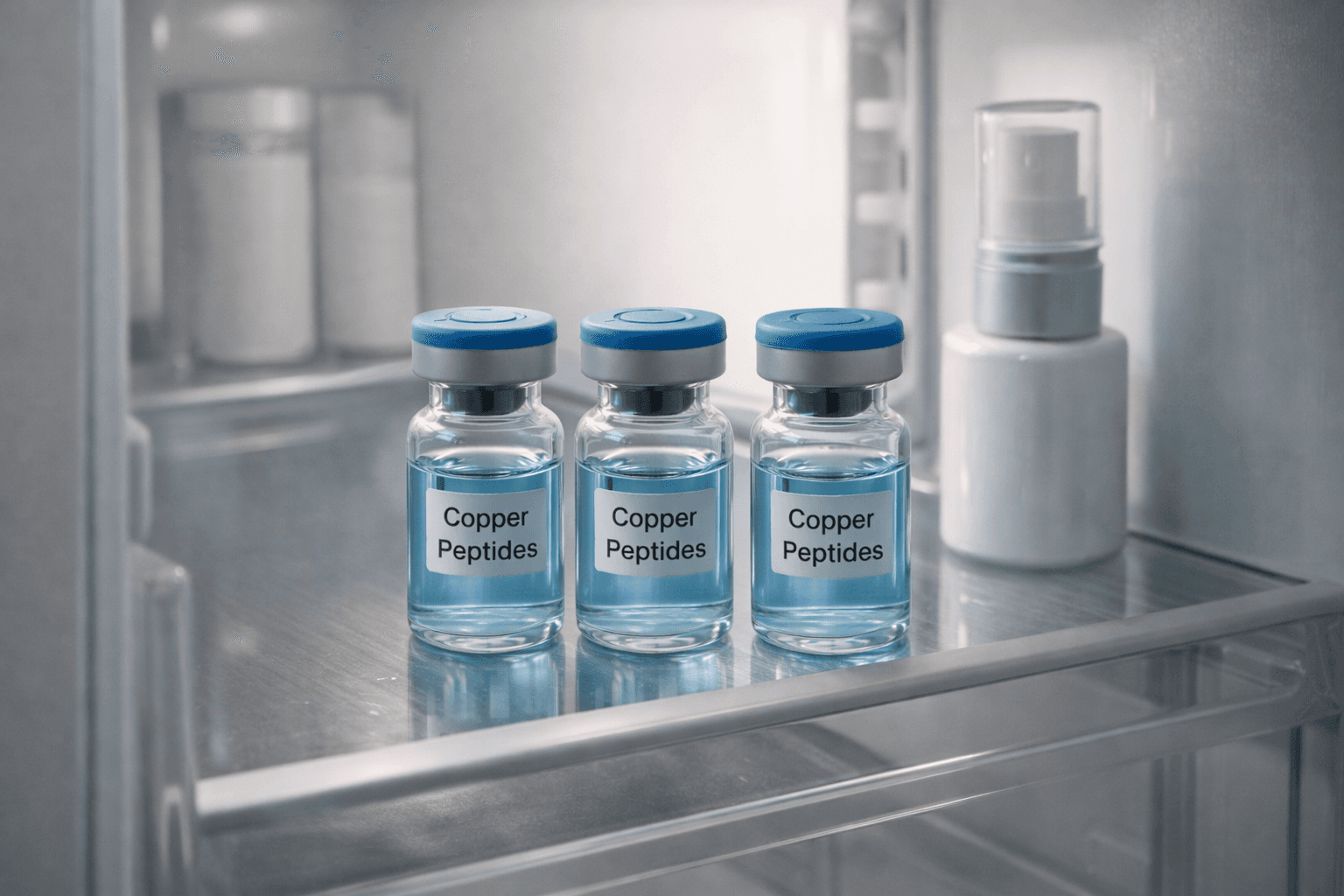
Some sources say copper peptides must be refrigerated at all times, others claim room temperature is fine.
You're worried about wasting money if you store it wrong and the peptides degrade, and you need a clear answer for your specific copper peptide product.
It depends on the form.
Injectable GHK-Cu after reconstitution absolutely requires refrigeration. Topical copper peptide serums usually don't but benefit from it. Raw powder is stable at room temperature but lasts longer refrigerated. The rules differ based on whether your copper peptides are lyophilized powder, reconstituted liquid, or formulated serum.
This guide breaks down exact storage requirements for every form of copper peptide. You'll learn when refrigeration is mandatory, when it's optional but beneficial, how temperature affects potency, proper storage techniques, and how long each form lasts under different conditions.
Let's start with the most critical form - injectable GHK-Cu.
Injectable GHK-Cu storage requirements
Injectable copper peptides have the strictest storage needs.
Before reconstitution (lyophilized powder)
When your injectable GHK-Cu arrives as freeze-dried powder in a sealed vial, storage is straightforward.
Required storage: Cool, dry place protected from light. Refrigeration optional but extends shelf life.
Room temperature storage:
Stable for 6-12 months when sealed
Keep below 25°C (77°F)
Protect from direct sunlight
Store in original packaging or wrap in foil
Refrigerated storage (2-8°C / 36-46°F):
Extends shelf life to 18-24 months
Preferred for long-term storage
Keep in main fridge section (not freezer, not door)
Freezer storage (-20°C / -4°F):
Maximum shelf life: 24-36 months
Only for unopened sealed vials
Thaw completely before reconstituting
Don't repeatedly freeze and thaw
Why lyophilized powder is stable: Freeze-drying removes water, which is necessary for degradation reactions. Without moisture, copper peptides remain stable at room temperature for extended periods.
After reconstitution (mixed with bacteriostatic water)
Once you add bacteriostatic water to your GHK-Cu powder, refrigeration becomes mandatory.
Required storage: Refrigerate at 2-8°C (36-46°F) immediately after mixing.
Shelf life after reconstitution:
Refrigerated: 28-30 days maximum
Room temperature: Degrades within hours to days (do NOT store at room temp)
Why refrigeration is critical: Reconstituted peptides are suspended in water. Copper can catalyze oxidation reactions. Bacterial growth becomes possible despite bacteriostatic water. Temperature control is essential for stability.
Proper refrigerated storage:
Store in main refrigerator section (not freezer)
Keep away from freezer compartment (avoid freezing)
Don't store in door (temperature fluctuates)
Protect from light (keep in box or wrap in foil)
Label with reconstitution date
Signs of degradation:
Cloudiness or particles (should be clear)
Color change (should remain same color as when mixed)
Unusual odor
Loss of effectiveness
If you notice any of these, discard and prepare fresh solution.
See our peptide storage guide for complete reconstitution and storage protocols.
Topical copper peptide serum storage
Commercial topical copper peptide products have different requirements than injectable forms.
Unopened topical copper peptide serums
Most commercial copper peptide serums are formulated with preservatives and stabilizers.
Manufacturer recommendations: Follow label instructions. Most say store in cool, dry place.
Typical storage:
Room temperature (15-25°C / 59-77°F) is usually fine
Away from direct sunlight
Away from heat sources (windowsills, radiators)
Bathroom is often too humid and warm
Refrigeration for unopened serums:
Not required for most products
Can extend shelf life by 3-6 months
Beneficial for products without strong preservatives
Good practice if you stock up
Shelf life unopened:
Room temperature: 12-24 months (check label)
Refrigerated: 18-30 months
Opened topical copper peptide serums
Once opened, exposure to air and potential contamination change storage needs.
Best practice: Refrigerate after opening.
Why refrigeration helps after opening:
Slows oxidation (copper can oxidize)
Prevents bacterial contamination
Maintains potency longer
Extends usable life
Room temperature storage after opening:
Acceptable for 3-6 months if product has strong preservatives
Use quickly if stored at room temp
Watch for signs of degradation
Refrigerated storage after opening:
Extends life to 6-12 months
Better potency retention
Reduced oxidation
Signs your topical copper peptide has degraded:
Color change (darker, more blue/green)
Separation of layers
Change in texture
Reduced effectiveness
Unusual smell
Application tip: If refrigerated, let serum warm to room temperature before applying. Cold serum can be uncomfortable on skin and may absorb less effectively.
DIY copper peptide serums and solutions
If you're making your own topical copper peptide solutions, refrigeration is more important.
Homemade solutions without preservatives:
Must refrigerate immediately
Use within 1-2 weeks maximum
Risk of bacterial contamination is high
Consider adding preservative system
Homemade solutions with preservatives:
Refrigeration recommended
Can last 1-3 months refrigerated
Room temp storage reduces to 2-4 weeks
Raw GHK-Cu powder mixed into existing products:
Follow storage requirements of base product
Generally refrigerate to be safe
Use within original product's timeframe
Learn more about copper peptide formulations in our copper peptides complete guide.
Raw copper peptide powder storage
If you're buying bulk GHK-Cu powder, storage is critical for maintaining quality.
Unopened sealed powder
Raw copper peptide powder is remarkably stable when properly packaged.
Room temperature storage:
Stable 12-24 months in sealed container
Keep below 25°C (77°F)
Low humidity environment essential
Protect from light
Refrigerated storage:
Extends shelf life to 24-36 months
Prevents any moisture absorption
Reduces oxidation risk
Recommended for long-term storage
Freezer storage:
Maximum shelf life: 36-48 months
Best for bulk quantities you won't use soon
Must be in moisture-proof container
Allow to reach room temp before opening (prevents condensation)
Critical factors for raw powder:
Moisture is the enemy (causes clumping and degradation)
Light exposure accelerates degradation
Air exposure leads to oxidation
Temperature stability matters
Opened powder container
Once you open your copper peptide powder, moisture and air exposure become risks.
Best storage after opening:
Refrigerate in airtight container
Use desiccant packet to absorb moisture
Minimize air exposure (don't leave open)
Use clean, dry utensils when measuring
Shelf life after opening:
Refrigerated with desiccant: 12-18 months
Room temperature sealed: 6-12 months
Room temperature frequently opened: 3-6 months
Signs of powder degradation:
Color change (darker, greenish tint)
Clumping (moisture absorption)
Loss of fine powder texture
Reduced effectiveness when used
Preventing degradation:
Store in amber glass jar or opaque container
Add silica gel desiccant packet
Keep refrigerated after opening
Never use wet measuring tools
Seal immediately after measuring
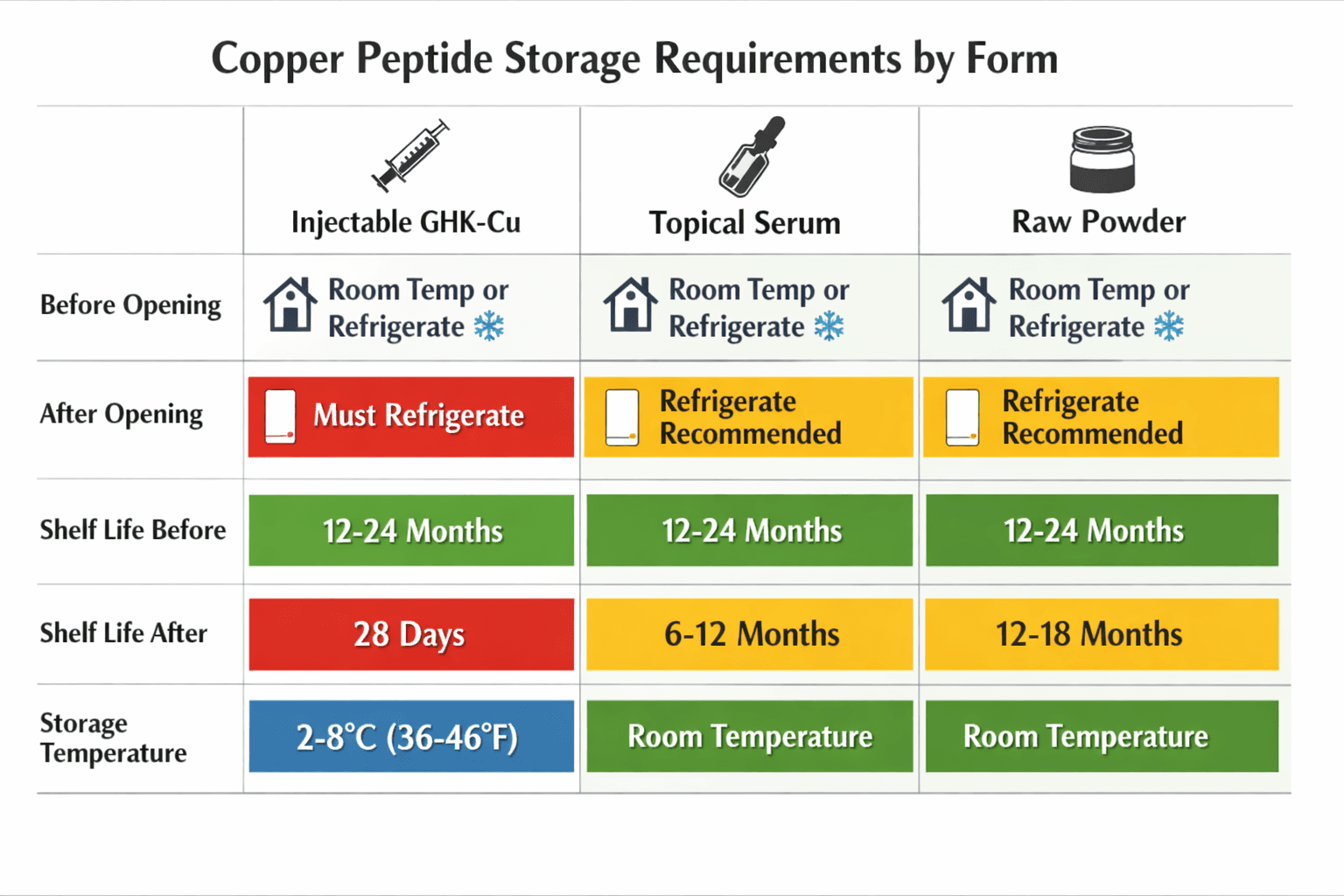
Temperature and copper peptide stability
Understanding how temperature affects copper peptides helps you make informed storage decisions.
Degradation mechanisms
Copper peptides degrade through several temperature-dependent processes.
Oxidation: Copper ions can catalyze oxidation reactions. Higher temperatures accelerate oxidation. This is why GHK-Cu solutions may turn greenish-blue over time at room temperature - the copper is oxidizing.
Peptide bond hydrolysis: The peptide bonds in GHK-Cu can break down over time. Higher temperatures speed up this process. Refrigeration slows hydrolysis dramatically.
Bacterial growth (reconstituted forms): Even with bacteriostatic water, some bacterial growth is possible at room temperature over time. Refrigeration inhibits bacterial proliferation.
Copper complex dissociation: The copper-peptide complex can dissociate at higher temperatures. Once dissociated, you have free copper ions and free peptide fragments - neither as effective as the intact complex.
Temperature impact on shelf life
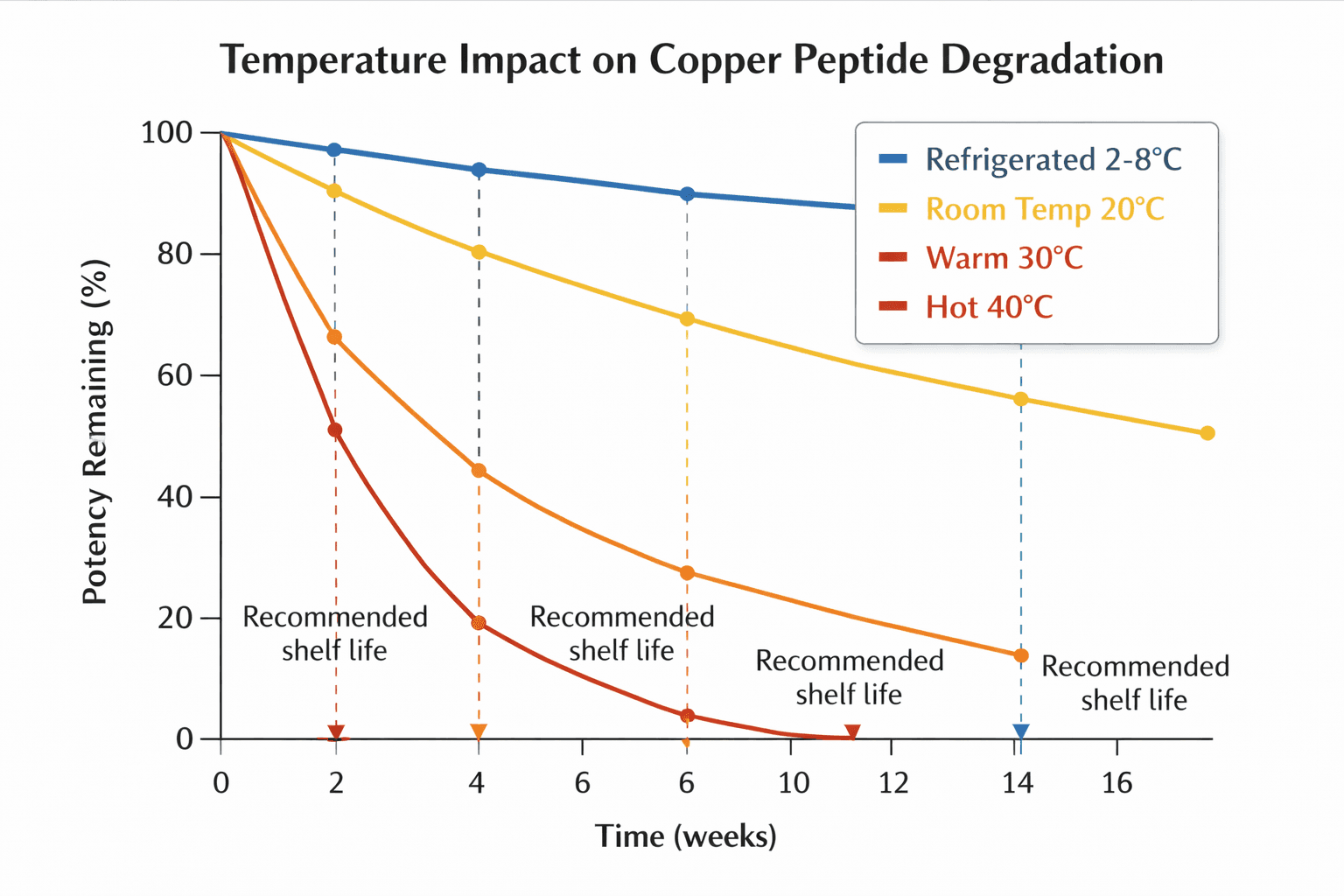
Temperature has a dramatic effect on how long copper peptides remain potent.
Reconstituted injectable GHK-Cu:
2-8°C (refrigerated): 28-30 days stable
15-25°C (room temp): Degrades in 3-7 days
30°C (warm): Degrades in 24-48 hours
Topical serum (opened):
2-8°C (refrigerated): 6-12 months
15-25°C (room temp): 3-6 months
30°C (warm environment): 1-3 months
Raw powder (sealed):
2-8°C (refrigerated): 24-36 months
15-25°C (room temp): 12-24 months
30°C (warm): 6-12 months
Key takeaway: Every 10°C increase in temperature roughly doubles the degradation rate. Refrigeration isn't just "better" - it can extend usable life by 3-10x depending on the form.
Freezing: helpful or harmful?
Freezing copper peptides requires caution.
Lyophilized powder (before reconstitution):
Safe to freeze: Yes
Extends shelf life: Yes, up to 36 months
Must be in moisture-proof container
Thaw completely before opening (prevents condensation)
Reconstituted injectable solution:
Safe to freeze: No, don't freeze
Why avoid: Ice crystals can damage peptide structure
Exception: Some users freeze individual doses in insulin syringes (controversial, potency may decrease)
Topical serums:
Safe to freeze: Generally no
Why avoid: Emulsions can separate, preservatives may not protect when frozen, texture changes upon thawing
Some simple water-based solutions may tolerate freezing
If you must freeze reconstituted peptides:
Use small single-dose aliquots
Thaw slowly in refrigerator (not at room temp or microwave)
Use immediately after thawing
Never refreeze
Accept some potency loss
Storage by copper peptide product type
Different copper peptide products have different optimal storage.
GHK-Cu for injection (research peptides)
Before mixing:
Refrigerate or room temp in original packaging
Refrigeration extends shelf life
Protect from light and moisture
After mixing with bacteriostatic water:
MUST refrigerate at 2-8°C
Use within 28-30 days
Discard if cloudy or discolored
Store in main fridge section, not door
During use:
Store vial in fridge between doses
Can remove briefly for injection (15-20 minutes is fine)
Don't leave out for hours
See our how to reconstitute peptides guide for mixing instructions.
Commercial copper peptide serums (skincare products)
Popular brands (The Ordinary, SkinCeuticals, Drunk Elephant, etc.):
Follow manufacturer instructions (usually room temp)
Refrigeration after opening extends life
Keep away from heat and light
Bathroom storage often too warm and humid
High-concentration copper peptide serums:
More sensitive to degradation
Refrigeration strongly recommended
Watch for color changes (indicates oxidation)
Low-concentration products:
More stable (less copper to oxidize)
Room temp usually fine
Refrigeration still beneficial
Copper peptide + hyaluronic acid combinations
Many products combine copper peptides with hyaluronic acid.
Storage considerations:
Hyaluronic acid is stable at room temp
Copper peptide is the limiting factor
Store based on copper peptide requirements
Refrigeration benefits the copper peptide component
Copper peptide + retinol combinations
Some advanced formulations combine copper peptides with retinol.
Storage is critical:
Retinol degrades with light and heat
Copper peptides also degrade with heat
MUST refrigerate after opening
MUST protect from light (opaque container)
Shelf life shorter than single-ingredient products
Traveling with copper peptides
Travel creates storage challenges. Here's how to maintain potency on the go.
Short trips (1-3 days)
Injectable GHK-Cu (reconstituted):
Use insulated cooler bag with ice pack
Keep in hotel mini-fridge
Can survive 24 hours without refrigeration if kept cool (not ideal but won't completely degrade)
Topical serums:
Room temperature travel is fine for short trips
Keep out of direct sunlight
Don't leave in hot car
Longer trips (1+ weeks)
Injectable GHK-Cu:
Bring unreconstituted powder if possible (doesn't need refrigeration)
Reconstitute at destination if you have bacteriostatic water
Or use insulated travel case with gel ice packs, replace ice daily
Hotel mini-fridge for storage
Topical products:
Room temp is acceptable
Refrigerate at destination if available
Consider bringing smaller decanted amount rather than full bottle
Air travel considerations
TSA regulations:
Liquids under 100ml (3.4oz) allowed in carry-on
Larger amounts must go in checked luggage
Ice packs allowed in carry-on if frozen solid
Best practices:
Carry injectable peptides in original packaging with labels
Bring prescription or documentation if asked
Use insulated bag with ice packs for injectable forms
Topical serums don't need special handling
Hot climate travel
If traveling to hot destinations:
Refrigerate immediately upon arrival
Don't leave products in car or luggage in sun
Consider using products quickly rather than extended trip
Topical serums more forgiving than injectables
Common storage mistakes that ruin copper peptides
Avoid these errors to maintain potency.
Mistake 1: Storing in bathroom
Bathrooms have high humidity and temperature fluctuations from showers.
Why it's bad:
Humidity accelerates degradation
Temperature swings stress the product
Moisture can contaminate products
Better storage:
Bedroom drawer (cool, dry, dark)
Refrigerator (best)
Climate-controlled closet
Mistake 2: Leaving reconstituted injectable at room temp
This is the most common and costly mistake.
What happens:
Rapid degradation within days
Complete loss of potency within 1-2 weeks
Wasted money and ineffective treatment
Solution:
Refrigerate immediately after reconstitution
Never leave out longer than 30 minutes
Set reminders to put back in fridge after injecting
Mistake 3: Freezing reconstituted peptides
Some users freeze individual doses thinking it extends life.
The problem:
Ice crystal formation can damage peptide structure
Potency loss
Unproven benefit vs proven risk
Better approach:
Mix smaller batches more frequently
Use within 28-30 days while refrigerated
Mistake 4: Storing in fridge door
The fridge door experiences the most temperature fluctuation.
Why it matters:
Temperature swings accelerate degradation
Door is warmest part of fridge
Frequent opening and closing
Best practice:
Store in main fridge section
Middle or back of shelf (stable temperature)
Away from freezer section
Mistake 5: Not protecting from light
Light exposure degrades copper peptides.
The issue:
Clear containers in bright rooms
Products stored near windows
No protective packaging
Solutions:
Keep in original packaging
Use amber glass bottles if decanting
Store in dark drawer or wrap in foil
Refrigerator provides darkness
Mistake 6: Using contaminated measuring tools
For raw powder, contamination ruins batches.
Common errors:
Using wet scoops
Not cleaning measuring tools
Touching powder with fingers
Leaving container open
Proper technique:
Clean, dry measuring tools only
Minimal air exposure
Seal immediately after measuring
Store with desiccant packet
How to tell if your copper peptides have degraded
Recognition prevents using ineffective products.
Visual signs of degradation
Injectable GHK-Cu changes:
Clear to cloudy (bacterial growth or precipitation)
Color change (bluish, greenish tint from copper oxidation)
Particles floating in solution
Separation or settling
Topical serum changes:
Darker color (oxidation)
Layer separation
Texture changes (thicker or thinner)
Crystallization
Powder changes:
Color darkening
Clumping (moisture absorption)
Greenish or bluish tint
Loss of fine powder consistency
Smell and texture changes
Off odors:
Metallic smell intensifying (some metallic odor is normal for copper peptides)
Sour or rancid smell (bacterial contamination or lipid oxidation in serums)
Any unusual smell different from when first opened
Texture issues:
Serum becoming grainy
Unusual thickness or thinning
Sticky residue
Separation that doesn't re-mix
Effectiveness loss
Signs of reduced potency:
Reduced healing speed (injectable)
Less visible skin improvement (topical)
Need to use more product for same effect
Complete lack of expected results
When in doubt: Discard and get fresh product. Using degraded copper peptides wastes time and provides false hope.
Storage recommendations summary table
Here's a quick reference for all copper peptide storage needs:
Product Type | Before Opening | After Opening | Must Refrigerate? | Shelf Life (Refrigerated) | Shelf Life (Room Temp) |
|---|---|---|---|---|---|
Injectable GHK-Cu (powder) | Room temp or fridge | N/A | No (optional) | 18-24 months | 6-12 months |
Injectable GHK-Cu (reconstituted) | N/A | Immediately | YES | 28-30 days | <7 days (NOT recommended) |
Topical serum (commercial) | Room temp | After opening | Recommended | 6-12 months | 3-6 months |
Raw GHK-Cu powder | Room temp or fridge | After opening | Recommended | 12-18 months | 6-12 months |
DIY solutions (no preservatives) | N/A | Immediately | YES | 1-2 weeks | NOT safe |
DIY solutions (with preservatives) | N/A | After making | YES | 1-3 months | 2-4 weeks |
Key:
YES = Mandatory refrigeration
Recommended = Not required but significantly extends shelf life
Optional = Minor benefit
NOT safe/recommended = Will degrade rapidly or grow bacteria
How you can use SeekPeptides for copper peptide protocols
Getting the most from copper peptides requires more than proper storage - you need personalized protocols, accurate dosing, and expert guidance. SeekPeptides provides everything you need to use copper peptides effectively and safely.
Personalized copper peptide protocols: Whether you're using GHK-Cu for healing injuries, regrowing hair, improving skin quality, or systemic anti-aging, SeekPeptides creates customized protocols based on your specific goals. Get exact dosages, injection schedules (for injectable forms), application instructions (for topical), timing, and duration designed for your body and objectives. No more guessing if you should use GHK-Cu topically or injectable, or whether to combine it with BPC-157 for injury healing.
24/7 AI peptide advisor for copper peptide questions: Wondering if your GHK-Cu serum that's been in the bathroom for 3 months is still good? Need to know if injectable GHK-Cu can be mixed with TB-500 in the same syringe? Curious about optimal application timing for topical copper peptides with retinol? Get instant expert answers trained on copper peptide science. Ask about storage troubleshooting, reconstitution, dosing adjustments, stacking with other peptides, or interpreting results - anytime you need help.
Complete research library for GHK-Cu evidence: Access comprehensive guides on GHK-Cu mechanisms, collagen synthesis pathways, clinical studies for wound healing and anti-aging, and proven protocols. Understand exactly how copper peptides work, why proper storage matters for maintaining the copper-peptide complex, and what the science says about topical vs injectable applications. Every protocol is built on peer-reviewed research you can review yourself.
Storage and handling guidance: Get specific instructions for storing your exact copper peptide products. Learn reconstitution techniques that maximize shelf life, proper refrigeration methods, travel storage solutions, and how to identify degradation. Know exactly how long your reconstituted GHK-Cu will last and when it's time to mix a fresh batch.
Dosage calculators for precision: Our peptide calculator and reconstitution calculator ensure you're mixing and dosing GHK-Cu accurately. Know exactly how much bacteriostatic water to add to your 50mg vial, how to measure your doses, and how long your supply will last when properly stored.
Progress tracking to optimize results: Monitor your skin improvements, wound healing progress, or hair regrowth results. Track your GHK-Cu doses, application timing, and outcomes. The system helps you identify what's working and suggests adjustments - whether that means increasing frequency, combining with other peptides, or switching from topical to injectable for better results.
Combination protocols: Learn how to safely stack GHK-Cu with BPC-157 for accelerated healing, with minoxidil for hair growth, or with other anti-aging peptides like Epithalon. Get specific dosing for each component and timing strategies to maximize synergy while maintaining proper storage for all compounds.
SeekPeptides takes the guesswork out of copper peptide use. Instead of wondering if you're storing your GHK-Cu correctly or using effective doses, you get a personalized protocol with expert AI support whenever you need it. Stop wasting money on degraded products or ineffective application methods - know exactly how to store, dose, and use copper peptides for maximum results.
Final thoughts
Should copper peptides be refrigerated? The answer depends on what form you have.
Injectable GHK-Cu after reconstitution must be refrigerated - no exceptions. Topical serums benefit from refrigeration after opening but can survive at room temperature for shorter periods. Raw powder is stable at room temperature when sealed but lasts significantly longer refrigerated.
The key is understanding that temperature dramatically affects copper peptide stability. Every 10°C temperature increase roughly doubles degradation speed. Refrigeration isn't just "better" - it can extend usable life by 3-10x.
Store your lyophilized powder in a cool, dry place or refrigerate for extended shelf life. Refrigerate immediately after reconstituting injectable GHK-Cu and use within 28-30 days. Keep topical serums away from heat and light, refrigerate after opening when possible. Protect raw powder from moisture and light, refrigerate after opening.
Proper storage preserves your investment and ensures you get the healing, anti-aging, and regenerative benefits copper peptides provide. Don't let poor storage waste your money and compromise your results.
Your copper peptides work when stored correctly. Follow these guidelines and maximize their potency.
Helpful resources for copper peptide use
Peptide storage guide: maintain potency - Complete storage for all peptides
How to reconstitute peptides: step-by-step - Mix GHK-Cu correctly
Peptide reconstitution calculator - Calculate exact water amounts
Peptide calculator - Dose GHK-Cu accurately
Related guides worth reading
Copper peptides complete guide: GHK-Cu benefits - Everything about GHK-Cu
Glow peptides: skin anti-aging protocols - Topical copper peptide use
In case I don’t see you, good afternoon, good evening, and good night. Take care of yourself. Use SeekPeptides