Dec 26, 2025
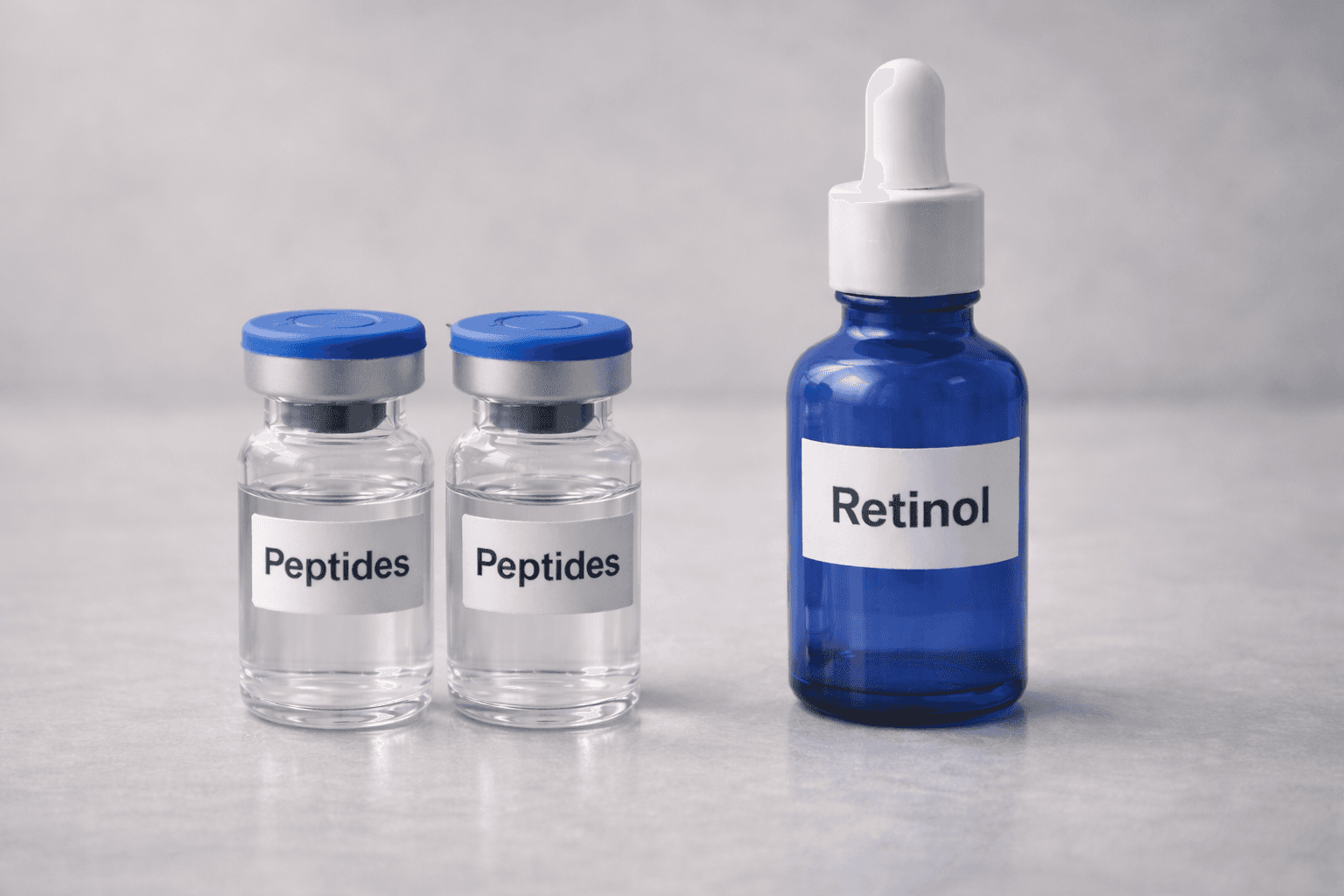
Some dermatologists say peptides and retinol work synergistically, but in the same time others warn about irritation or reduced effectiveness.
You've read that pH differences might deactivate one or both.
Also, you don't want to waste money on expensive products that interfere with each other, or worse, damage your skin.
Here's what you need to know: yes, you can use peptides and retinol together, and they often work synergistically for better anti-aging results than either alone. However, the order of application matters, some peptide types pair better than others with retinol, and your skin's tolerance determines whether you apply them together or separately.
This guide breaks down exactly which peptides work with retinol, how to layer them properly, whether to use them in the same routine or alternate, what results to expect, and how to avoid irritation. By the end, you'll know precisely how to combine peptides and retinol for maximum anti-aging benefits.
Let's start with understanding why this combination works.
How retinol works for anti-aging
Retinol (vitamin A derivative) is one of the most researched anti-aging ingredients.
Retinol mechanisms:
Increases cell turnover (sheds dead skin cells faster)
Stimulates collagen production in dermis
Reduces breakdown of existing collagen
Unclogs pores and reduces acne
Fades hyperpigmentation and sun damage
Thickens epidermis over time
Timeline for results:
4-6 weeks: Smoother texture, reduced breakouts
8-12 weeks: Visible reduction in fine lines
6-12 months: Significant improvement in wrinkles, firmness, tone
Trade-off: Retinol can cause irritation, dryness, redness, and peeling, especially when starting or using high concentrations.
How peptides work for anti-aging
Peptides are short chains of amino acids that signal skin cells to perform specific functions.
Peptide mechanisms:
Signal fibroblasts to produce more collagen (signal peptides)
Inhibit muscle contractions that cause expression lines (neurotransmitter peptides like Argireline)
Deliver copper to enhance healing and collagen synthesis (carrier peptides like GHK-Cu)
Protect against oxidative damage and inflammation (antioxidant peptides)
Timeline for results:
4-8 weeks: Improved hydration and texture
8-12 weeks: Noticeable firmness improvement
3-6 months: Visible reduction in wrinkles and fine lines
Advantage: Peptides rarely cause irritation. Well-tolerated by sensitive skin.
Why combining them is powerful
Synergistic benefits:
Retinol increases cell turnover, creating fresh receptive cells for peptide signals
Peptides support collagen production that retinol stimulates
Peptides soothe and repair while retinol exfoliates (balances irritation)
Retinol addresses surface texture; peptides improve deeper structure
Different pathways = additive effects
Clinical perspective: Dermatologists often recommend combining retinol with peptides for comprehensive anti-aging because they work through different mechanisms without interfering.
Which peptides work best with retinol
Not all peptides are created equal for pairing with retinol.
Copper peptides (GHK-Cu) and retinol
Compatibility: Excellent, with caveats about timing.
Why they work together:
Copper peptides enhance wound healing and skin regeneration
Support retinol's collagen-boosting effects
Anti-inflammatory properties counter retinol irritation
Both stimulate collagen from different pathways
Important consideration: Some research suggests using copper peptides and retinol at different times (AM vs PM) for optimal results, though many formulations combine them successfully.
Application strategy:
Morning: Copper peptide serum
Evening: Retinol
OR use combined formulations designed to work together
See our copper peptides complete guide for GHK-Cu details.
Matrixyl (Palmitoyl Tripeptide-1 and Palmitoyl Tetrapeptide-7)
Compatibility: Excellent. One of the best peptides to pair with retinol.
Why they work together:
Matrixyl stimulates collagen and elastin production
Complements retinol's collagen-boosting without irritation
Repairs skin barrier that retinol may compromise
Well-studied combination in clinical settings
Application strategy:
Can use in same routine (layer peptide first, then retinol)
Or alternate (peptides AM, retinol PM)
Popular products with Matrixyl: The Ordinary Matrixyl 10% + HA, The INKEY List Collagen Peptide Serum
Argireline (Acetyl Hexapeptide-8)
Compatibility: Good, but better applied separately.
Why they work together:
Argireline reduces expression lines (Botox-like effect)
Retinol addresses overall skin texture and collagen
Different mechanisms = complementary results
Application strategy:
Morning: Argireline serum (targets expression lines during day)
Evening: Retinol
Don't mix in same application (pH differences may reduce effectiveness)
Syn-Coll (Palmitoyl Tripeptide-5)
Compatibility: Excellent.
Why they work together:
Stimulates Type I, III, and IV collagen
Enhances retinol's anti-aging effects
Minimal irritation risk
Supports skin barrier function
Application strategy:
Layer together in same routine (peptide first)
OR separate AM/PM
Signal peptides vs neurotransmitter peptides with retinol
Signal peptides (like Matrixyl, Syn-Coll):
Best compatibility with retinol
Work synergistically
Can apply together or separately
Neurotransmitter peptides (like Argireline, Leuphasyl):
Good compatibility but better separated
Different pH requirements may interfere
Apply separately (AM vs PM) for best results
Peptides to avoid combining with retinol
AHA/BHA peptide combinations:
Products that combine peptides with acids (glycolic, salicylic)
Adding retinol on top = potential over-exfoliation
Use peptide+acid products separately from retinol nights
High-dose vitamin C + peptides + retinol:
All three together may be too much for sensitive skin
Vitamin C (L-ascorbic acid) can destabilize retinol
Better to separate: Vitamin C AM, Peptides + Retinol PM
See our glow peptides guide for complete skincare peptide protocols.
How to layer peptides and retinol in your routine
Application order matters for maximum effectiveness.
The basic layering rule
Thinnest to thickest consistency:
Cleanser
Toner (if using)
Thinnest serum (usually peptide serum)
Retinol (if in serum form)
Moisturizer
Occlusive (if needed)
Why this order: Thinner products penetrate better when applied first. Thicker products can block absorption of what's applied after.
Specific application sequences
Sequence 1: Peptides first, then retinol (same routine)
Cleanse face
Apply peptide serum to damp skin
Wait 1-2 minutes for absorption
Apply retinol
Wait 1-2 minutes
Apply moisturizer
Best for: Most peptides (Matrixyl, Syn-Coll, general collagen peptides)
Sequence 2: Retinol first, then peptides (less common)
This is rarely recommended because retinol benefits from being closer to skin, and peptides are often in hydrating serums that work well after retinol.
Sequence 3: Sandwich method (for sensitive skin)
Cleanse
Light layer of moisturizer
Apply retinol
Apply peptide serum
Final layer of moisturizer
Best for: Reducing retinol irritation while still getting benefits
Wait time between layers
1-2 minutes between products is ideal:
Allows first product to absorb
Prevents pilling or mixing on skin surface
Maximizes penetration of each ingredient
Don't wait too long:
5+ minutes unnecessary
Skin dries out between applications
Makes subsequent products harder to spread
Morning vs evening application
Evening routine (most common approach):
Evening: Peptide serum + Retinol + Moisturizer
Why: Retinol degrades with sun exposure; evening maximizes effectiveness
Peptides can amplify retinol's overnight repair
Separate AM/PM (alternative approach):
Morning: Peptide serum + Vitamin C + SPF
Evening: Retinol + Moisturizer
Why: Spreads actives across day; reduces evening product layering
Which is better: Personal preference. Both work. Evening application together is more convenient; separate timing may reduce any theoretical interference.
Potential issues and how to avoid them
Combining potent actives requires awareness of possible problems.
Irritation and sensitivity
Retinol alone can cause:
Redness
Peeling
Dryness
Burning sensation
Increased sensitivity
Adding peptides usually helps:
Most peptides are soothing
Support skin barrier repair
Reduce inflammation
When irritation occurs despite peptides:
Reduce retinol frequency (every other night instead of nightly)
Use lower retinol concentration (0.25% or 0.5% instead of 1%)
Apply peptides in morning, retinol at night (not together)
Add more moisturizer
Take retinol break for few days
pH incompatibility concerns
The pH issue:
Retinol works best at pH 5.5-6
Some peptides work best at different pH ranges
Mixing products with very different pH can reduce effectiveness
In practice:
Modern formulations account for this
Short contact time between layers minimizes pH issues
Many successful products combine peptides + retinol in same formulation
Solution: Don't worry excessively about pH. If both products are from reputable brands, they're formulated to work in skincare routine contexts.
Product pilling
Pilling happens when:
Too many products layered
Not enough wait time between layers
Silicone-heavy products mixed with water-based
Rubbing products instead of patting
Prevention:
Apply thin layers
Pat products in gently (don't rub vigorously)
Wait 1-2 minutes between layers
Use fewer products overall
Over-exfoliation
Risk when combining:
Retinol + AHA/BHA peptide products = too much exfoliation
Daily use of potent retinol + exfoliating toners
Signs of over-exfoliation:
Raw, sensitive skin
Increased breakouts
Redness that doesn't subside
Burning sensation
Skin feels tight and irritated
Prevention:
Don't use chemical exfoliants (AHA/BHA) on retinol nights
Start retinol 2-3x weekly, not nightly
Skip retinol if skin feels sensitive
Best peptide + retinol product combinations
Some products pair particularly well together.
Peptide serums that work with retinol
The Ordinary "Buffet" + Retinol:
"Buffet" contains multiple peptides (Matrixyl 3000, Matrixyl synthe'6, ARGIRELOX, etc.)
Layer before The Ordinary Retinol 0.5% or 1% in Squalane
Affordable, effective combination
The INKEY List Collagen Peptide Serum + Retinol:
Collagen peptides support skin structure
Pair with The INKEY List Retinol (0.2%, 0.5%, or 1%)
Budget-friendly option
Paula's Choice Peptide Booster + Clinical 1% Retinol:
Peptide booster has multiple signal peptides
Clinical retinol is well-formulated
Premium but effective
Drunk Elephant Protini Polypeptide Cream + A-Passioni Retinol:
Protini has signal peptides, growth factors
A-Passioni is vegan retinol
Luxury option, expensive but well-loved
All-in-one products (peptides + retinol combined)
SkinCeuticals A.G.E. Interrupter Advanced:
Contains peptides + ProxylaneTM
Can pair with separate retinol at night
Dr. Dennis Gross Ferulic + Retinol Triple Correction Eye Serum:
Combines peptides, retinol, ferulic acid
Specifically for eye area
Note on combined products: Many brands now formulate peptides + retinol together because they know dermatologists recommend pairing them. These eliminate timing concerns.
Building a complete routine
Sample evening routine:
Cleanser: CeraVe Hydrating Cleanser
Peptide serum: The Ordinary "Buffet"
Retinol: The Ordinary Retinol 0.5% in Squalane
Moisturizer: CeraVe Moisturizing Cream
Occlusive (optional): Vaseline or Aquaphor on dry areas
Sample separate AM/PM routine:
Morning: Cleanser → Peptide serum → Vitamin C → Moisturizer → SPF
Evening: Cleanser → Retinol → Moisturizer
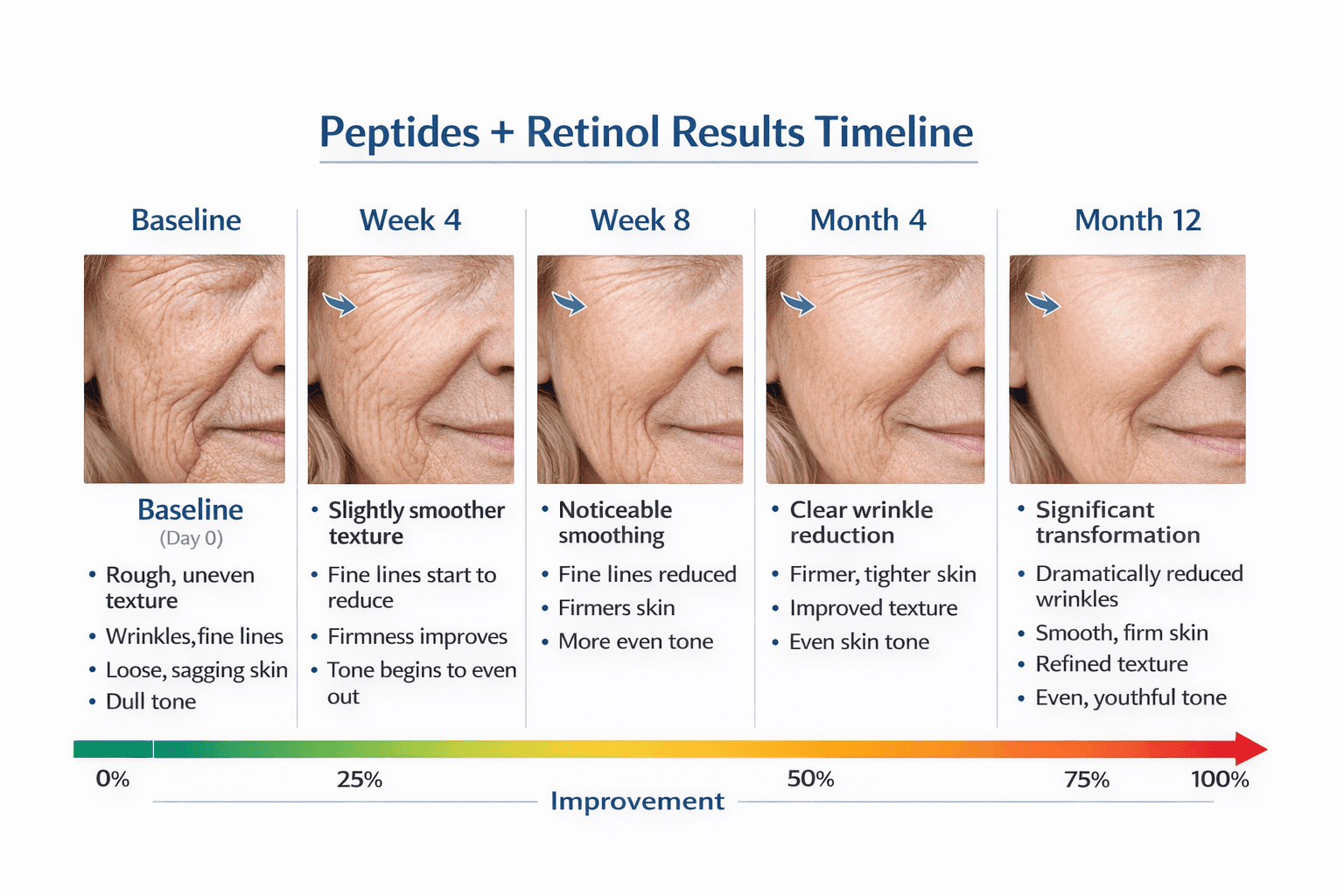
Timeline and results: what to expect
Combining peptides with retinol accelerates results compared to retinol alone.
Week 1-2: Adjustment period
What happens:
Skin adapts to retinol (may see some peeling, redness)
Peptides begin signaling collagen production
Texture may worsen before improving (retinol purge)
What to do:
Stick with routine unless severe irritation
Reduce retinol frequency if needed
Increase moisturizer
Week 4-6: Initial improvements
What you'll notice:
Smoother skin texture
Reduced breakouts (if acne-prone)
More even tone
Skin feels firmer
Less irritation as skin adjusts
Peptide + retinol advantage: Smoother, more hydrated texture than retinol alone. Peptides support barrier function while retinol works.
Week 8-12: Visible anti-aging results
Clear improvements:
Fine lines diminishing
Improved skin elasticity
Reduction in expression lines (if using neurotransmitter peptides)
More radiant complexion
Pore refinement
Combination benefit: Better results than retinol or peptides alone. Synergistic collagen production from both pathways.
Month 4-6: Significant transformation
Dramatic changes:
Noticeably fewer wrinkles
Firmer skin
Improved skin thickness
More youthful appearance overall
Sun damage fading
Why combination wins: Retinol provides surface renewal and deep collagen stimulation. Peptides enhance that collagen production and repair barrier damage from retinol. Result: Faster, more comprehensive anti-aging.
Month 6-12: Long-term benefits
Continued improvement:
Ongoing collagen remodeling
Sustained wrinkle reduction
Maintained firmness
Healthier skin barrier
Preventive anti-aging
Continue routine for lasting results, because skin improvement plateaus around 12 months, but maintenance prevents regression.
Special considerations for different skin types
Your skin type influences how to combine these ingredients.
Sensitive skin
Challenges:
Retinol causes more irritation
Even gentle peptides may sting on compromised barrier
Strategy:
Start with low-dose retinol (0.25% or 0.3%)
Use soothing peptides (Matrixyl, copper peptides)
Apply retinol 2-3x weekly initially
Use sandwich method (moisturizer → retinol → peptides → moisturizer)
Consider separate AM/PM application
Dry skin
Challenges:
Retinol increases dryness
Needs extra hydration
Strategy:
Use hydrating peptide serums with hyaluronic acid
Apply retinol over damp skin
Heavy moisturizer after peptides + retinol
Consider retinol in emollient base (like squalane)
Oily/acne-prone skin
Advantages:
Tolerates retinol well (less dryness)
Retinol helps with breakouts
Strategy:
Can use higher retinol concentrations (0.5-1%)
Lighter peptide serums (water-based, not oil-heavy)
Oil-free moisturizer
Can apply peptides + retinol nightly once acclimated
Mature skin (50+)
Needs:
More aggressive anti-aging
May have thinner, more fragile skin
Strategy:
Build up to potent retinol (0.5-1%) gradually
Use multiple peptide types (signal + copper + neurotransmitter)
Apply peptides AM and PM
Retinol PM only
Rich, nourishing moisturizers
Injectable peptides vs topical peptides with retinol
Beyond topical skincare, some people use injectable peptides for anti-aging.
Injectable GHK-Cu with topical retinol
Can you combine? Yes. Injectable copper peptides work systemically while topical retinol works on skin surface.
Benefits of combining:
Injectable GHK-Cu promotes collagen throughout body, including skin
Topical retinol addresses surface texture and wrinkles
Complementary mechanisms
Faster, more dramatic skin improvements
Protocol:
Injectable GHK-Cu: 1-2mg, 3-5x weekly subcutaneous
Topical retinol: Nightly (or as tolerated)
Topical peptide serum: Optional additional layer
See our copper peptides guide for injectable GHK-Cu protocols.
Other anti-aging injectable peptides
Epithalon:
Longevity peptide
Doesn't directly target skin but supports overall anti-aging
Can use with topical retinol routine
BPC-157:
Primarily for healing, not skin-specific
Won't interfere with topical retinol
TB-500:
Tissue repair and regeneration
May improve skin healing alongside retinol exfoliation
Bottom line: Injectable peptides for systemic anti-aging don't interfere with topical retinol. Combining may enhance overall anti-aging results.
Learn more in our best peptides for anti-aging guide.
Common mistakes when using peptides with retinol
Avoid these errors to maximize results and minimize problems.
Mistake 1: Starting both at once
The problem:
Hard to identify source of irritation
Overwhelming for skin
Higher risk of adverse reaction
Better approach:
Establish retinol routine first (2-3 months)
Add peptides after skin adjusts
OR start peptides first, add retinol later
Mistake 2: Using too many actives
The problem:
Peptides + Retinol + Vitamin C + AHA + BHA = over-exfoliation
More isn't better
Skin barrier damage
Better approach:
Evening: Peptides + Retinol
Morning: Peptides (or Vitamin C) + SPF
Chemical exfoliants 1-2x weekly on non-retinol nights
Mistake 3: Expecting overnight results
The problem:
Unrealistic expectations lead to giving up too soon
Anti-aging takes months
Reality:
Minimum 8 weeks for visible improvements
Best results at 4-6 months
Patience required
Mistake 4: Skipping SPF
The problem:
Retinol increases sun sensitivity
UV damage undoes all anti-aging efforts
Hyperpigmentation risk
Non-negotiable rule:
Daily SPF 30+ every morning
Reapply if sun exposure
Mineral or chemical sunscreen (your choice)
Mistake 5: Using expired products
The problem:
Retinol degrades quickly (especially if exposed to light/air)
Peptides lose effectiveness over time
Wasting money on ineffective products
Best practices:
Store retinol in dark, cool place
Use within 3-6 months of opening
Check expiration dates
Discard if color/smell changes
How you can use SeekPeptides for optimizing peptide and retinol protocols
While topical peptides and retinol provide excellent anti-aging benefits, maximizing skin rejuvenation often requires personalized protocols and knowing when advanced options provide superior results. SeekPeptides helps you optimize both topical and injectable approaches.
Personalized skin anti-aging protocols: SeekPeptides creates custom protocols based on your skin goals, age, and current routine. Know exactly which topical peptides pair best with your retinol concentration, whether you should apply them together or separately, and optimal timing for each product.
Get guidance on whether adding injectable peptides like GHK-Cu would accelerate your results beyond what topical products alone can achieve.
Complete research library for anti-aging science: Access comprehensive guides on collagen synthesis pathways, retinol mechanisms, peptide signaling, and skin aging biology.
Understand exactly how signal peptides stimulate fibroblasts, why retinol increases cell turnover, and what clinical studies show about combining them. Learn when injectable peptides provide advantages over topical application for specific anti-aging goals.
Advanced peptide options beyond basic topical: While topical peptides and retinol provide foundational anti-aging, SeekPeptides shows you when injectable therapeutic peptides offer faster, more dramatic results.
Learn about injectable GHK-Cu for systemic skin regeneration (more powerful than topical), Epithalon for longevity and cellular anti-aging, and growth hormone peptides that enhance overall skin quality from the inside out.
Optimal product layering and timing: Get specific guidance on applying your peptide serums, retinol, moisturizers, and other actives in the correct order for maximum penetration and effectiveness.
Know precise wait times between layers, whether morning or evening application works better for your schedule, and how to troubleshoot pilling or irritation.
Progress tracking for visible results: Monitor your wrinkle depth, skin firmness, texture improvements, and overall anti-aging progress over time.
Track which products and protocols work best for your skin.
The system helps you identify what's delivering results and suggests adjustments - whether that means increasing retinol concentration, adding different peptide types, or upgrading to injectable peptides for enhanced benefits.
Cost-benefit analysis for anti-aging investments: Understand the real value of expensive topical peptide serums versus more affordable options, whether high-dose retinol prescription (tretinoin) makes sense for your goals, and when investing in injectable peptides provides dramatically better results per dollar spent than endless topical products.
Combination protocols for maximum rejuvenation: Learn how to safely stack topical peptides, retinol, vitamin C, and injectable peptides like GHK-Cu for comprehensive anti-aging.
Get specific dosing for each component, timing strategies to prevent interactions, and protocols that maximize synergy while maintaining skin health.
eekPeptides takes you beyond basic topical skincare. Just stop wasting money on products that may conflict, know precisely how to optimize peptides and retinol for your specific skin goals.
Final thoughts
Can you use peptides and retinol together? Absolutely yes, and you should.
Peptides and retinol work through complementary mechanisms for enhanced anti-aging results. Retinol increases cell turnover and stimulates collagen from one pathway.
Peptides signal collagen production through different pathways and help repair the barrier damage retinol can cause. Together, they provide faster, more comprehensive wrinkle reduction and skin firming than either alone.
A
pply thinnest products first - typically peptide serum, then retinol, then moisturizer.
Wait 1-2 minutes between layers. Most people apply both in evening routine, though separating to morning peptides and evening retinol works too.
Start slowly if new to retinol. Build tolerance over weeks.
Add peptides for enhanced results and barrier support. Choose signal peptides like Matrixyl for best synergy with retinol.
Expect visible results by 8-12 weeks, with continued improvement through 6-12 months. The combination delivers better anti-aging outcomes than either ingredient alone.
Your peptide + retinol routine is one of the most effective science-backed approaches to fighting skin aging. Layer correctly, be patient, and watch your skin transform.
Helpful resources for peptide skincare
Glow peptides: complete skincare guide - Comprehensive peptide skincare
Copper peptides (GHK-Cu): complete guide - Injectable and topical GHK-Cu
Copper peptides ruined my skin: troubleshooting - Avoid mistakes
Should copper peptides be refrigerated - Storage guide
Related guides worth reading
Best peptides for anti-aging - Complete anti-aging protocols
Peptides for hair growth - Peptides for hair
Getting started with peptides: beginner roadmap - New to peptides?
What are peptides used for: complete guide - Peptide overview
In case I don’t see you, good afternoon, good evening, and good night.