Jan 3, 2026
Skin sagging from collagen loss, elastin breakdown, and dermal thinning creates visible laxity around the jawline, neck, and under-eyes where gravity accelerates aging appearance. Traditional solutions like facelifts provide dramatic results at significant cost and recovery, while professional treatments like radiofrequency require ongoing maintenance without addressing underlying collagen deficiency.
Peptides target root causes through collagen synthesis stimulation and dermal remodeling rather than temporary tightening that reverses when treatment stops. Consistent use over months creates structural improvements that may persist after treatment, contrasting with purely cosmetic interventions requiring indefinite continuation.
This guide examines best tightening peptides, protocols, realistic timelines, and comparison to alternatives helping users select appropriate interventions.
Understanding skin laxity and tightening mechanisms
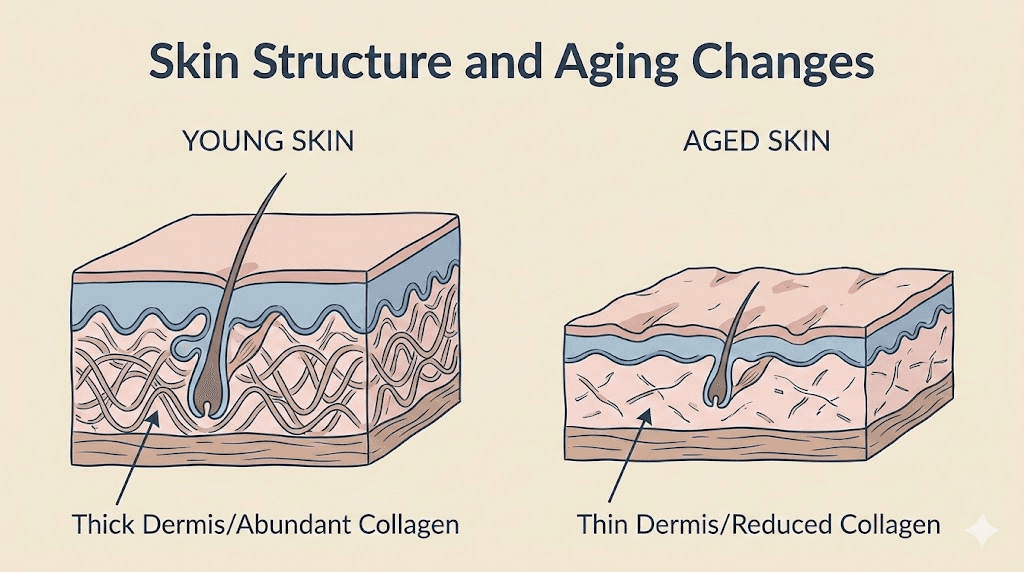
Skin laxity develops through multiple interconnected pathways creating visible sagging requiring comprehensive intervention addressing collagen quantity, elastin functionality, dermal thickness, and structural architecture rather than single-factor approaches producing limited temporary improvements. The collagen degradation process accelerates with age as synthesis rates decline while breakdown continues or accelerates through matrix metalloproteinase (MMP) activity, creating net collagen loss averaging 1% annually after age 30 compounding into substantial structural deficiency by ages 50-60 where skin contains 30-40% less collagen than youthful baselines.
Elastin fiber deterioration proves equally critical for skin tightness as these protein networks provide recoil capacity allowing skin returning to original position after stretching from facial expressions or movement. Unlike collagen which continuously turns over enabling replacement, elastin production essentially ceases after adolescence meaning elastin damage from UV exposure, oxidative stress, or enzymatic breakdown accumulates irreversibly creating permanent laxity contribution.
Peptide interventions cannot restore damaged elastin fibers but may slow further degradation through antioxidant effects and potentially stimulate limited new elastin synthesis in some formulations.
Dermal thickness reduction compounds laxity problems as thinning skin loses structural integrity making existing collagen and elastin networks less effective at maintaining firmness. The dermis thins approximately 6% per decade after age 40 through reduced fibroblast activity, decreased glycosaminoglycan production, and altered extracellular matrix organization. Peptides targeting dermal thickening through fibroblast stimulation and matrix component synthesis address this dimension complementing collagen-focused interventions for comprehensive structural improvement.
Gravitational effects on aging skin create distinct sagging patterns varying by facial region based on structural support and soft tissue attachment.
The jawline develops jowling as cheek fat pads descend and platysma muscle bands become prominent, the neck shows horizontal lines and vertical banding from platysma laxity, under-eye areas demonstrate hollowing and loose skin from orbital fat redistribution, and cheeks flatten as malar fat pads migrate inferiorly. Understanding regional variation guides targeted peptide application strategies maximizing tightening effects where most visible and concerning.
Learn about how peptides work for anti-aging applications.
Skin Laxity Factor | Mechanism | Age-Related Change | Peptide Intervention Approach | Reversibility Potential |
|---|---|---|---|---|
Collagen Degradation | Net loss 1%/year after 30 | 30-40% deficit by 50s-60s | Synthesis stimulation via GHK-Cu, Matrixyl | High - continuous turnover allows replacement |
Elastin Breakdown | Limited production after teens | Cumulative irreversible damage | Antioxidant protection, limited synthesis | Low - damage permanent, prevention key |
Dermal Thinning | Reduced fibroblast activity | 6% per decade after 40 | Fibroblast stimulation, GAG production | Moderate - can increase thickness somewhat |
Structural Disorganization | Matrix architecture degradation | Progressive with time/damage | Matrix remodeling peptides | Moderate - can improve organization |
Fat Redistribution | Compartment descent | Gravity-accelerated migration | Not peptide-addressable | Low - requires volumizing fillers |
Best peptides for skin tightening and their mechanisms
Copper peptides, particularly GHK-Cu (glycyl-L-histidyl-L-lysine-copper), represent the most extensively researched tightening peptides with mechanisms including collagen synthesis stimulation through fibroblast activation, matrix metalloproteinase regulation preventing excessive collagen breakdown, antioxidant enzyme activation providing free radical protection, and wound healing acceleration supporting dermal remodeling. Research demonstrates GHK-Cu increases collagen synthesis by 70-80% in cultured fibroblasts with clinical studies showing measurable skin thickness increases and wrinkle reduction over 3-6 month treatment periods using 1-2% concentrations.
The copper delivery mechanism proves critical as this trace mineral serves as essential cofactor for lysyl oxidase catalyzing collagen and elastin cross-linking creating structural stability, and superoxide dismutase providing antioxidant protection against elastin-damaging free radicals. Topical copper peptide formulations deliver copper directly to dermal fibroblasts bypassing absorption limitations affecting oral copper supplementation, creating localized high concentrations stimulating collagen production and supporting existing fiber network integrity through enhanced cross-linking and oxidative damage prevention.
Matrixyl peptides (palmitoyl pentapeptide-4 and related compounds) function as matrikines - fragments mimicking collagen breakdown products that signal fibroblasts to increase synthesis compensating for perceived deficiency. The mechanism operates through specific cell surface receptors triggering intracellular signaling cascades upregulating collagen I, III, and IV production along with fibronectin and glycosaminoglycans supporting comprehensive dermal matrix enhancement. Clinical studies using 3-5% Matrixyl concentrations demonstrate 13-25% wrinkle depth reduction and measurable skin elasticity improvements over 2-4 months with effects attributed to actual structural changes rather than temporary hydration or plumping.
Argireline (acetyl hexapeptide-8) provides tightening effects through different mechanism targeting muscle contraction reduction similar to botulinum toxin but working topically through SNARE complex interference preventing neurotransmitter release. While not directly stimulating collagen synthesis, Argireline reduces expression-related dynamic wrinkles allowing existing collagen networks supporting smoother tighter appearance and potentially preventing new collagen damage from repetitive folding. The tightening effect proves most apparent in expression-prone areas like forehead, crow's feet, and between brows where muscle activity significantly contributes to visible laxity.
See copper peptides GHK-Cu guide for comprehensive copper peptide information.
Peptide Type | Primary Mechanism | Collagen Effect | Elastin Effect | Clinical Evidence | Optimal Concentration | Tightening Timeline |
|---|---|---|---|---|---|---|
GHK-Cu (Copper Peptide) | Copper delivery, fibroblast activation | +70-80% synthesis | Cross-link enhancement | Strong - multiple RCTs | 1-2% | 2-4 months visible |
Matrixyl (Pal-KTTKS) | Matrikine signaling | +30-50% synthesis | Indirect support | Good - clinical studies | 3-5% | 2-3 months visible |
Argireline (Ac-Hex-8) | Muscle relaxation | Indirect (reduced folding) | No direct effect | Moderate - some studies | 5-10% | 2-4 weeks temporary |
SYN-Coll | TGF-β stimulation | +35% synthesis | Limited | Limited - in vitro mainly | 2-4% | 3-4 months expected |
Tripeptide-1 | Collagen fragment mimic | Moderate stimulation | Minimal | Limited studies | 2-3% | 2-3 months expected |
Peptide combinations prove more effective than single compounds for comprehensive tightening addressing multiple mechanisms simultaneously. A typical high-performance serum might combine 1% GHK-Cu for direct collagen stimulation and copper delivery, 4% Matrixyl for matrikine signaling and matrix enhancement, 8% Argireline for expression line reduction and immediate smoothing, plus supporting ingredients like vitamin C for collagen hydroxylation and hyaluronic acid for hydration and plumping. The multi-mechanism approach targets structural improvement, muscle activity reduction, and immediate cosmetic enhancement creating noticeable results faster than single-peptide protocols while building cumulative long-term tightening.
Injectable peptide options exist for users comfortable with self-administration seeking systemic or highly localized tightening effects. BPC-157 shows some skin repair and collagen support effects though primarily researched for injury healing rather than cosmetic tightening, TB-500 provides tissue repair and regeneration benefits potentially supporting skin structure, and growth hormone secretagogues like Ipamorelin may indirectly enhance skin quality through systemic effects though evidence for specific tightening benefits remains limited compared to targeted topical formulations.
Application protocols and optimization strategies
Peptide concentration significantly impacts tightening effectiveness with higher concentrations generally producing stronger effects up to absorption and stability limits creating optimal dosage windows. GHK-Cu proves effective at 0.5-1% for maintenance and prevention but requires 1-2% for meaningful tightening effects in moderate to advanced laxity, with concentrations above 2% showing diminishing returns and potential irritation risks.
Matrixyl demonstrates concentration-dependent effects with 3-5% providing optimal balance between efficacy and cost-effectiveness, while lower concentrations around 1-2% may produce subtle improvements insufficient for noticeable tightening in significant laxity cases.
Application frequency balances maximizing peptide exposure against allowing adequate skin recovery and avoiding product waste through excess application. Most peptide serums benefit from twice-daily application (morning and evening) on freshly cleansed skin before moisturizer, creating consistent dermal peptide levels supporting continuous fibroblast stimulation and collagen synthesis.
Some users achieve comparable results with once-daily evening application when using higher concentrations or combined formulations, reducing product consumption and simplifying routines while maintaining treatment effectiveness through sustained peptide activity during overnight skin repair processes.
Skin preparation dramatically affects peptide absorption determining treatment effectiveness regardless of product quality or concentration. Proper cleansing removes surface oils, makeup residue, and dead cell buildup creating absorption barriers, gentle exfoliation 2-3 times weekly clears accumulated dead cells exposing fresh epidermis improving peptide penetration, and pH optimization through slightly acidic toners (pH 4.5-5.5) enhances certain peptide stability and absorption while supporting skin barrier function. Users should apply peptides on damp not wet skin after cleansing, allowing 30-60 seconds absorption before layering additional products avoiding dilution or interference.
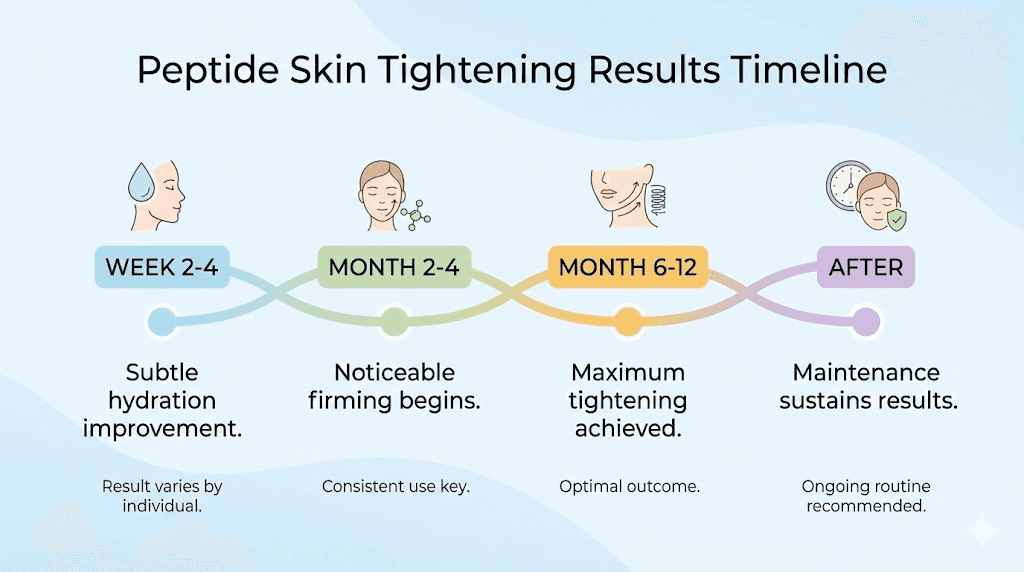
Treatment duration requirements create realistic timeline expectations distinguishing peptides from quick-fix interventions promising immediate dramatic results. Initial subtle improvements often appear within 2-4 weeks as existing collagen networks reorganize and surface hydration increases, but meaningful structural tightening requires 2-4 months of consistent use allowing significant new collagen synthesis and dermal thickening. Maximum effects typically manifest at 6-12 months of continuous application creating cumulative improvements, after which maintenance protocols using reduced frequency or concentration can sustain results without requiring indefinite peak-intensity treatment.
Protocol Factor | Suboptimal Approach | Optimal Approach | Impact on Results |
|---|---|---|---|
Concentration | <0.5% (too low for tightening) | 1-2% GHK-Cu, 3-5% Matrixyl | High - insufficient vs effective levels |
Frequency | Sporadic, inconsistent | Twice daily or consistent once daily | High - consistency critical |
Skin Prep | Apply over makeup, unwashed | Cleanse, light exfoliation, pH optimize | Moderate - affects absorption |
Application Amount | Too little (insufficient coverage) | Adequate coverage (2-3 drops face/neck) | Moderate - need sufficient peptide |
Layering Order | Random, over heavy creams | After cleansing, before moisturizer | Moderate - affects penetration |
Treatment Duration | 2-4 weeks then quit | 3-6+ months consistent | Very High - structural changes take time |
Regional targeting strategies maximize tightening where most visible and concerning rather than uniform whole-face application depleting products faster without proportional benefit.
The lower face and jawline benefit from concentrated peptide application as this area shows prominent jowling and sagging creating aged appearance, the neck requires dedicated treatment as skin here proves particularly thin and prone to horizontal lines and vertical banding, under-eye areas respond well to gentle peptide formulations though require careful selection avoiding irritation in this sensitive region, and forehead/between brows show excellent response when combining collagen-stimulating peptides with Argireline targeting both structural and muscle-activity components.
Complementary interventions enhance peptide tightening effects through synergistic mechanisms addressing laxity from multiple angles.
Retinoids (tretinoin, adapalene, retinol) provide complementary collagen stimulation through different pathways than peptides while accelerating cell turnover exposing fresh cells to peptide treatment, vitamin C serums support collagen hydroxylation creating stable triple-helix structures from peptide-stimulated synthesis, hyaluronic acid provides immediate hydration and plumping while supporting glycosaminoglycan production peptides stimulate, and sun protection prevents ongoing collagen and elastin damage that would undermine tightening progress.
The layering sequence determines product effectiveness with general rule of thinnest to thickest consistency allowing proper absorption.
Optimal morning routine: gentle cleanser, peptide serum on damp skin (wait 60 seconds), vitamin C serum if used (wait 30 seconds), lightweight moisturizer with SPF 30-50. Evening routine: cleanser, exfoliant 2-3x weekly, peptide serum on damp skin (wait 60 seconds), retinoid if used (wait 20 minutes), heavier moisturizer. This sequence ensures peptides contact clean skin without occlusion while supporting ingredients enhance rather than interfere with tightening mechanisms.
See can you use peptides and retinol together for combination protocols.
Expected results and realistic timeline
Initial hydration and plumping effects appear within days to 2 weeks as peptide formulations typically include moisturizing ingredients and peptides themselves possess some immediate hydrating properties creating temporary improvement in skin appearance and texture.
This early response proves encouraging but shouldn't be mistaken for actual tightening. The visual enhancement stems from water retention and surface smoothing rather than structural collagen changes requiring substantially longer development.
Users should appreciate this cosmetic improvement while maintaining realistic expectations about timeline for genuine tightening effects.
Measurable firming begins emerging around 6-8 weeks of consistent application as new collagen synthesis starts accumulating in sufficient quantity creating detectable dermal thickening and structure improvement.
Changes remain subtle at this stage, perhaps slight reduction in fine lines, barely perceptible improvement in skin bounce when pressed, or minor enhancement in jawline definition when examined closely in consistent lighting.
Photography comparison proves valuable for detecting these gradual changes invisible day-to-day but meaningful when comparing baseline to 2-month images side-by-side.
Significant visible tightening manifests at 3-4 months representing the timeframe where most users and observers notice clear improvement without side-by-side photo comparison.
Moderate fine lines show 20-40% depth reduction, skin texture appears smoother and more refined, facial contours demonstrate subtle lift particularly around jawline and cheeks, and overall skin quality reflects healthier more youthful appearance.
The improvement level depends heavily on severity of initial laxity - mild cases may achieve near-complete resolution while severe sagging shows meaningful but incomplete correction requiring additional interventions.
Maximum tightening effects plateau around 6-12 months of continuous high-quality peptide use at optimal concentrations and application consistency. Beyond this point further improvements prove minimal as collagen synthesis stabilizes at enhanced baseline and dermal remodeling completes within genetic and age-related capacity constraints.
Users achieving satisfactory results at this stage can transition to maintenance protocols using reduced application frequency (once daily or even 3-5 times weekly) or lower concentrations sustaining results without indefinite peak-intensity treatment expense and commitment.
Timeline | Physical Changes | Visible Results | User Experience | Recommended Action |
|---|---|---|---|---|
Days 1-14 | Hydration, surface smoothing | Subtle immediate improvement | "Skin feels nicer" | Continue, don't expect tightening yet |
Weeks 2-8 | Early collagen synthesis begins | Barely perceptible firming | "Maybe slightly better?" | Take comparison photos |
Months 2-4 | Measurable dermal thickening | Clear improvement to user | "Definitely working!" | Maintain consistency |
Months 4-6 | Significant structural changes | Obvious to others | "People notice!" | Continue toward peak |
Months 6-12 | Maximum achievable tightening | Plateau at best outcome | "As good as it gets" | Consider maintenance protocol |
Beyond 12 Months | Maintenance of improvements | Sustained results | "Keeping results" | Reduce frequency/concentration |
Age significantly influences achievable tightening magnitude with younger users (30s-40s) showing more dramatic improvements as their fibroblasts retain higher responsiveness to stimulation and baseline collagen production remains moderate rather than severely diminished.
Users in their 50s-60s experience meaningful improvements but often achieve 50-70% of the tightening younger users obtain from identical protocols due to reduced fibroblast activity and more extensive baseline damage. Very advanced aging (70s+) may show disappointing results from topical peptides alone, potentially requiring combination with professional treatments or realistic expectation adjustment focusing on prevention of further decline rather than dramatic reversal.
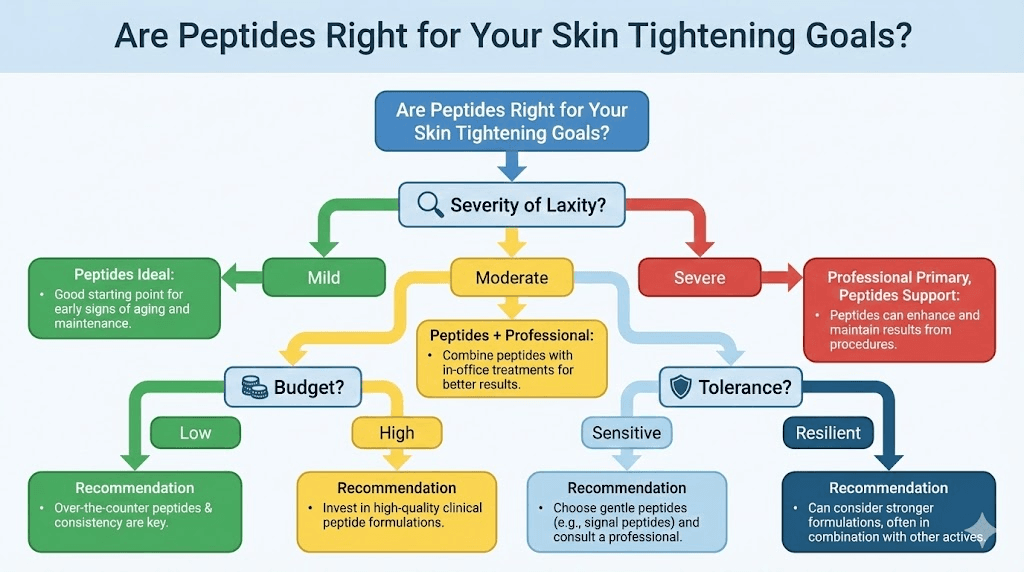
Baseline laxity severity determines realistic outcome expectations with mild to moderate laxity showing best response to peptide-only protocols potentially achieving near-complete resolution, while severe sagging typically requires peptides as adjunct to professional interventions (radiofrequency, ultrasound, thread lifts) rather than standalone solution.
Users should honestly assess their starting point. If significant jowling, substantial neck banding, or pronounced under-eye bags exist, peptides may meaningfully improve these issues without fully resolving them, creating decision point about whether partial improvement suffices or whether investing in professional treatments proves more cost-effective than extended peptide use producing incomplete results.
Comparing peptides to alternative skin tightening treatments
Topical retinoids represent gold-standard medical tightening intervention with tretinoin (prescription) and adapalene (OTC) demonstrating robust clinical evidence for collagen synthesis stimulation, dermal thickening, and wrinkle reduction through retinoic acid receptor activation controlling gene expression. Retinoids typically produce visible tightening within 3-6 months comparable to peptide timelines but carry higher side effect burden including irritation, dryness, photosensitivity, and initial purging period where skin temporarily worsens before improving.
The peptide advantage lies in better tolerability allowing higher concentration use and immediate combination with other actives without cumulative irritation.
The retinoid vs peptide decision balances efficacy evidence against side effect tolerance. Retinoids prove superior for users tolerating irritation and willing to navigate adjustment period, offering decades of research backing and medical establishment endorsement. Peptides suit sensitive skin users, those unable tolerating retinoid side effects, users wanting immediate combination with vitamin C and other acids retinoids complicate, and individuals preferring gentle gradual improvement over aggressive intervention requiring adaptation. Optimal approach for many users combines both - retinoid 2-3 nights weekly for proven efficacy plus peptides daily for complementary gentle stimulation creating synergistic tightening exceeding either alone.
Professional radiofrequency and ultrasound treatments deliver energy to dermal layers creating controlled thermal injury triggering collagen remodeling and new synthesis through wound healing response.
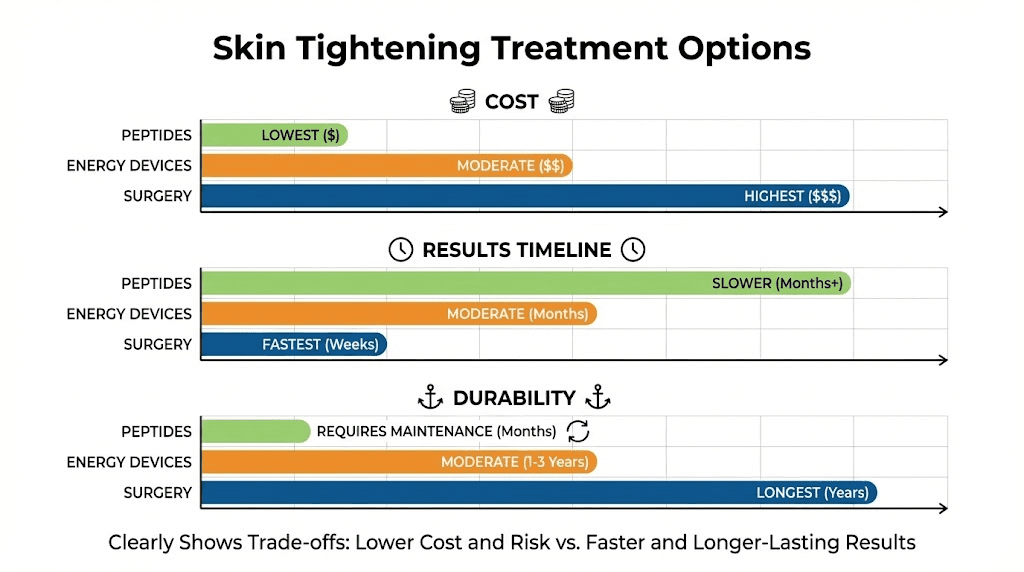
These interventions produce faster visible results than topical peptides with noticeable tightening emerging 4-8 weeks post-treatment and continuing to improve over 3-6 months as collagen remodeling progresses. The trade-offs include substantial per-session costs ($500-3000 depending on treatment area and technology), temporary side effects like swelling and redness lasting days to week, requirement for multiple sessions (typically 3-6 spaced 4-6 weeks apart), and results lasting 1-2 years before requiring retreatment.
Treatment Type | Mechanism | Evidence Quality | Cost (Annual) | Side Effects | Results Timeline | Durability |
|---|---|---|---|---|---|---|
Peptides (topical) | Collagen stimulation, various | Moderate - some clinical data | $200-600 products | Minimal - well-tolerated | 3-6 months visible | Requires maintenance |
Retinoids (topical) | Gene expression, collagen synthesis | Strong - extensive research | $50-200 Rx/OTC | Moderate - irritation common | 3-6 months visible | Requires continuous use |
RF/Ultrasound (professional) | Thermal collagen remodeling | Strong - clinical studies | $1500-6000 (3-6 sessions) | Moderate - swelling, redness | 1-3 months visible | 1-2 years then retreatment |
Laser Resurfacing | Ablative/non-ablative remodeling | Strong - well-established | $2000-5000 per treatment | High - downtime, healing | 2-4 weeks visible | 1-3 years variable |
Thread Lifts | Physical lift + collagen stimulation | Moderate - newer technique | $1500-4500 per treatment | Moderate - bruising, dimpling | Immediate then improves | 1-2 years then resorption |
Surgical Facelift | Tissue repositioning, excess removal | Strong - long track record | $7000-15000 one-time | High - surgery, recovery | Immediate dramatic | 7-15 years then re-aging |
Microneedling enhances peptide effectiveness dramatically through creating thousands of microchannels allowing direct dermal peptide delivery bypassing epidermal absorption barriers.
Professional microneedling combined with peptide serum application achieves results comparable to or exceeding standalone professional treatments at lower cost. Typical protocol involves 4-6 sessions spaced 4-6 weeks apart with immediate post-needling peptide application plus continued daily topical use between sessions. Home microneedling devices (0.25-0.5mm depth) provide gentler enhancement for users comfortable with self-treatment, though professional depth (1.0-2.5mm) produces superior tightening through stronger collagen induction response.
The combination approach proves optimal for many users seeking maximum tightening without surgery - professional radiofrequency or ultrasound treatment initiating rapid collagen remodeling, followed by consistent peptide application supporting ongoing synthesis and maintaining results, with retinoid 2-3x weekly providing additional stimulus through complementary pathway.
This multi-modal strategy costs less than repeated professional-only treatments while producing superior outcomes to topical-only protocols, creating practical middle ground between conservative peptide approach and aggressive professional intervention.
Product selection and quality considerations
Peptide concentration represents critical quality factor with many products listing peptides prominently but containing ineffective trace amounts creating impressive ingredient labels without therapeutic dosing.
Users should verify actual percentages - GHK-Cu requires 1-2% for tightening (not the 0.01% in many "copper peptide" products), Matrixyl needs 3-5% (not the 1% in budget formulations), and Argireline should reach 5-10% (not the 2% common in mass-market options). Products rarely list exact percentages requiring research into reputable brands known for therapeutic dosing or purchasing from specialized peptide suppliers providing concentration transparency.
Formulation stability determines whether stated peptide concentrations remain active through product shelf life rather than degrading into ineffective fragments.
Peptides prove notoriously unstable in aqueous solutions with GHK-Cu particularly vulnerable to oxidation reducing copper availability, Matrixyl degrading in inappropriate pH ranges or with exposure to light and heat, and Argireline losing potency in formulations lacking proper preservatives and stabilizers.
Quality indicators include opaque or UV-protective packaging preventing light degradation, airless pump dispensers minimizing oxygen exposure, refrigeration recommendations suggesting fresh active formulation, and relatively short expiration dates (6-12 months) indicating manufacturers prioritize potency over extended shelf life.
Brand reputation and manufacturing standards vary enormously across peptide skincare landscape with luxury brands charging premium prices for formulations sometimes inferior to specialized peptide companies focusing exclusively on active ingredient quality and concentration.
Independent testing and user reviews provide more reliable quality assessment than marketing claims or price points.
Established medical-grade brands from plastic surgeons and dermatologists typically deliver therapeutic concentrations with appropriate stability, specialized peptide-focused companies often provide best value combining high concentrations with reasonable pricing, while mass-market drugstore options rarely contain effective levels despite peptide marketing prominence.
Quality Factor | Red Flags | Good Signs | Why It Matters |
|---|---|---|---|
Concentration | Peptides listed but % absent | Specific percentages disclosed (1-2% GHK-Cu, 3-5% Matrixyl) | Ineffective trace amounts vs therapeutic dosing |
Packaging | Clear bottles, jar packaging | Opaque/UV bottles, airless pumps | Light/air exposure degrades peptides rapidly |
Formulation pH | Not disclosed, wide range | pH 4.5-5.5 for most peptides | Wrong pH reduces stability and activity |
Expiration Date | 2-3+ years from manufacture | 6-12 months, refrigeration recommended | Fresher = more active peptides |
Ingredient Order | Peptides near end of list | Peptides in first 5-7 ingredients | Higher list position = higher concentration |
Price Reality | Suspiciously cheap for listed peptides | Reasonable for therapeutic concentrations | Quality peptides cost $40-150+ per ounce |
Brand Focus | Generic beauty brand with peptides added | Peptide-specialized company or medical-grade | Specialized brands prioritize active potency |
Storage practices dramatically affect product longevity and peptide activity with improper handling degrading even high-quality formulations into ineffective solutions. Users should store peptide products in cool dark locations (ideally refrigerator for maximum longevity), keep containers tightly sealed minimizing air exposure between uses, avoid contaminating product with dirty fingers or applicators, use products within 6 months of opening regardless of stated expiration, and discard formulations showing color changes, separation, or unusual odor indicating peptide degradation or bacterial contamination.
See should copper peptides be refrigerated for storage guidance.
DIY peptide formulation allows cost-conscious users purchasing raw peptide powders and creating custom serums at desired concentrations, potentially saving 50-80% compared to branded products while ensuring fresh potent formulations. This approach requires careful attention to sterile technique, proper pH adjustment, appropriate preservative selection, and accurate concentration calculation to avoid under or over-dosing. Users comfortable with DIY should source pharmaceutical-grade peptides from reputable suppliers, use distilled or sterile water, add appropriate preservatives (phenoxyethanol, optiphen), adjust pH to 4.5-5.5 range, and prepare small batches used within 2-4 weeks ensuring maximum freshness.
Safety considerations and potential side effects
Topical peptide safety profiles prove excellent with minimal adverse effects reported across thousands of users and multiple clinical studies examining various peptide formulations. The well-tolerated nature stems from peptides representing natural amino acid sequences the body already produces or recognizes as biological signaling molecules rather than foreign synthetic compounds requiring immune system response or metabolic adaptation. Most side effects when occurring prove mild and transient, resolving with continued use as skin adjusts or immediately upon discontinuation if sensitivity develops.
Common minor reactions include temporary stinging or tingling upon application lasting seconds to minutes, particularly with higher concentrations or sensitive skin types not requiring intervention unless persistent or severe.
Mild dryness or flaking may emerge during first 1-2 weeks as increased cell turnover from collagen stimulation creates temporary surface changes similar to retinoid adjustment, managed through gentle moisturizer application and brief peptide reduction if uncomfortable. Slight redness or warmth occasionally appears with copper peptides as copper delivery increases localized metabolic activity, typically fading within 30-60 minutes and considered normal response rather than problematic reaction.
True allergic reactions prove rare but possible requiring discontinuation and potentially medical evaluation if severe.
Contact dermatitis presents as persistent redness, itching, burning, or rash developing over days to weeks of use, improving rapidly with cessation confirming peptide causation rather than unrelated skin condition coincidentally emerging during treatment period. Patch testing proves valuable for users with sensitive skin or multiple product allergies - apply small amount of peptide product to inner forearm for 48 hours before facial use, watching for adverse reactions indicating incompatibility requiring alternative product selection.
Side Effect | Frequency | Severity | Management | When to Discontinue |
|---|---|---|---|---|
Temporary stinging/tingling | Common 20-30% | Mild - seconds to minutes | None needed unless persistent | If painful or doesn't resolve |
Mild dryness/flaking | Occasional 10-15% | Mild - cosmetic nuisance | Increase moisturizer, reduce peptide freq | If severe or doesn't improve |
Slight redness | Occasional 10-20% | Mild - fades 30-60 min | Monitor, reduce concentration if bothers | If persists >2 hours or worsens |
Contact dermatitis | Rare 1-3% | Moderate - persistent irritation | Discontinue product | Immediately if confirmed |
Allergic reaction | Very rare <1% | Moderate to severe | Seek medical care if severe | Immediately, try different peptide |
Specific peptide precautions include copper peptide avoidance during pregnancy and breastfeeding due to uncertain effects of enhanced copper delivery on fetal development and infant exposure through breast milk, though theoretical risk rather than documented harm cases. Users with Wilson's disease (genetic copper metabolism disorder) should avoid copper peptides entirely as impaired copper excretion could create toxic accumulation with repeated topical application. Argireline shows no significant contraindications but users allergic to botulinum toxin should exercise caution despite different mechanism, monitoring carefully for any unusual reactions suggesting cross-sensitivity.
Interaction considerations prove minimal with peptides demonstrating excellent compatibility with most skincare actives. However, users should avoid combining multiple highly active treatments simultaneously as cumulative irritation risk increases - introducing peptides to existing retinoid routine requires starting peptides on alternate nights until tolerance confirms, combining peptides with chemical peels should involve 48-72 hour spacing preventing excessive irritation from cumulative exfoliation, and using peptides with professional treatments like microneedling or laser should follow practitioner guidance about appropriate timing avoiding interference with healing or excessive stimulation.
Maintenance strategies and long-term planning
Achieving tightening through 6-12 months intensive peptide application represents first phase requiring transition to maintenance protocols sustaining results without indefinite peak-intensity treatment expense and commitment.
Maintenance frequency reduction proves viable for most users with options including daily application at lower concentrations (0.5-1% GHK-Cu instead of 1-2%), maintaining higher concentrations but reducing frequency to 5-6 days weekly instead of daily, or alternating between peptide types providing different stimulation patterns preventing adaptation while reducing cost.
Experimentation determines optimal individual balance between result maintenance and resource conservation.
Periodic intensive cycles refresh results when gradual decline emerges during maintenance phase - users might implement 2-3 month intensive protocols (daily high-concentration application) twice annually with lower-intensity maintenance between cycles, creating cost-effective rhythm sustaining results while accommodating budget fluctuations and lifestyle changes. The cycling approach mirrors how some users successfully manage retinoid therapy, suggesting peptides follow similar patterns where continuous maximum stimulation proves unnecessary once initial structural improvements establish.
Lifestyle optimization supports long-term tightening maintenance through addressing factors undermining peptide effects.
Sun protection proves absolutely critical as UV exposure degrades collagen and elastin faster than peptides stimulate synthesis - daily SPF 30-50 application, sun avoidance during peak hours, and protective clothing prevent treatment sabotage. Adequate protein intake (0.8-1.0g per kg bodyweight minimum) provides amino acid building blocks for collagen synthesis peptides stimulate, while deficient diets limit results regardless of perfect topical application. Sleep optimization enables overnight skin repair processes supporting peptide-induced improvements, and stress management reduces cortisol levels that accelerate collagen breakdown.
Realistic aging expectations prevent disappointment as peptides slow visible aging without completely halting time's effects. Users in their 40s maintaining excellent peptide protocols plus lifestyle optimization may appear 5-10 years younger than chronological age and significantly better than without intervention, but continued aging still occurs gradually. The realistic goal involves maintaining current appearance or experiencing very slow decline rather than expecting indefinite improvement - someone achieving excellent tightening at age 45 through peptides should expect sustaining that appearance into early 50s rather than continuing to look progressively younger.
How you can use SeekPeptides for anti-aging guidance
SeekPeptides provides comprehensive peptide guides for anti-aging applications. Learn about copper peptides GHK-Cu, best peptides for anti-aging, peptides for women over 40, if you stop GHK-Cu what happens.
Access complementary skincare guides - can you use peptides and retinol together, should copper peptides be refrigerated, copper peptides ruined my skin, hyaluronic acid peptide.
Explore related peptides - BPC-157, TB-500, Epitalon benefits.
Learn fundamentals - what are peptides, how peptides work, peptide safety, getting started.
Use planning tools - peptide calculator, cost calculator.
Final thoughts
Peptides for skin tightening work gradually through collagen synthesis and dermal remodeling, with copper peptides (GHK-Cu) and Matrixyl showing strongest evidence at therapeutic concentrations (1-2% GHK-Cu, 3-5% Matrixyl). Visible results emerge over 3-6 months with maximum effects at 6-12 months, requiring patience and consistency unlike quick-fix alternatives.
Age and baseline laxity determine outcomes - mild to moderate cases in 30s-40s may achieve near-complete resolution while severe sagging or advanced age typically requires peptides as adjunct to professional treatments. The advantage lies in excellent safety, minimal side effects, and lower cost than ongoing professional interventions, though results develop slower and may prove insufficient as standalone solution for severe cases.
Your anti-aging strategy should match severity - copper peptides excel for mild to moderate laxity with patience for gradual improvement, while severe sagging benefits from professional treatment foundation with peptides supporting maintenance.
Related skin tightening resources
Essential anti-aging guides
In case I don’t see you, good afternoon, good evening, and good night. Take care of yourself. Join SeekPeptides