Dec 16, 2025
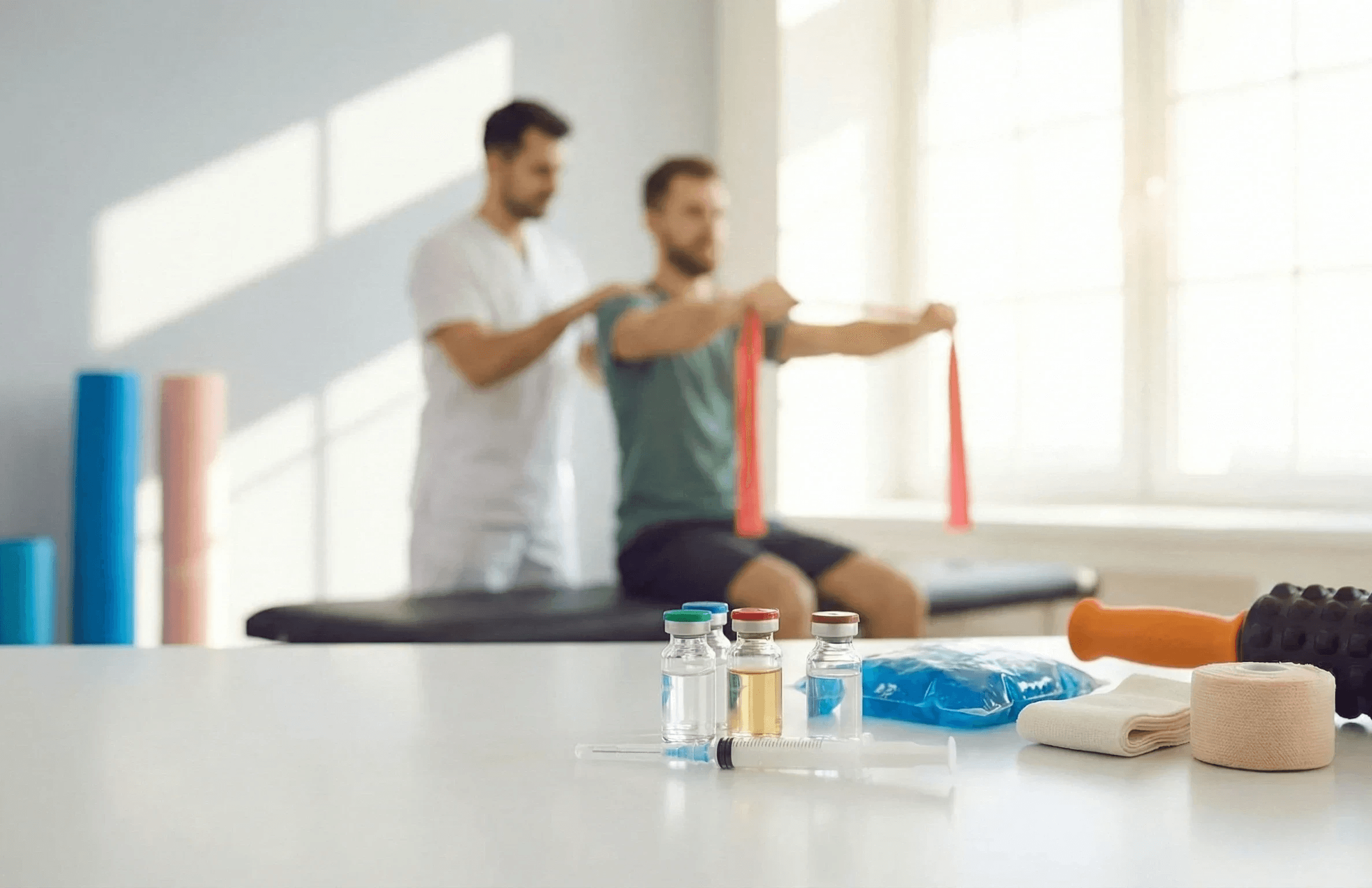
Different peptides heal injuries through different mechanisms.
Some work locally, others work systemically, some are fast, others take time but produce better long-term results.
The main categories:
Local healing peptides (BPC-157) - Work at the injury site. Fast pain relief. Direct tissue repair.
Systemic healing peptides (TB-500) - Circulate throughout the body. Find damaged tissue. Promote rebuilding.
Recovery enhancing peptides (Ipamorelin, CJC-1295) - Increase growth hormone. Better overall recovery capacity.
Collagen synthesis peptides (GHK-Cu) - Promote collagen production. Strengthen connective tissue.
Let's break down each type and show you which injuries they heal best.
BPC-157: the local healing powerhouse
BPC-157 (Body Protection Compound 157) is the most popular healing peptide. It works fast and targets specific injuries.
How it works:
Increases blood flow to injured area
Promotes angiogenesis (new blood vessel formation)
Accelerates fibroblast activity (tissue repair cells)
Reduces inflammation at injury site
Protects gut lining (bonus effect)
What it heals best:
Tendon injuries (Achilles, patellar, rotator cuff)
Ligament damage (ACL, MCL, ankle sprains)
Muscle tears and strains
Joint inflammation
Gut issues (ulcers, leaky gut, IBS)
Timeline for results:
Days 1-7: Noticeable pain reduction
Days 8-14: Improved range of motion
Weeks 3-4: Significant healing progress
Weeks 6-8: Near complete recovery for minor injuries
The protocol:
Dose: 250-500mcg per injection
Frequency: Twice daily (morning and evening)
Location: As close to injury as safely possible
Duration: 4-8 weeks depending on injury severity
Realistic expectations: BPC-157 accelerates healing but doesn't work miracles. A 6-week injury might heal in 3-4 weeks. A 12-week injury might heal in 6-8 weeks.
Use our BPC-157 dosage calculator to determine your exact dose based on body weight and injury type.
TB-500: the systemic healer
TB-500 (Thymosin Beta-4) is a larger peptide that circulates through your bloodstream and finds damaged tissue throughout your body.
How it works:
Promotes cell migration to injury sites
Increases new blood vessel formation (angiogenesis)
Reduces scar tissue and fibrosis
Decreases inflammation systemically
Improves tissue flexibility
What it heals best:
Chronic overuse injuries
Multiple injury sites simultaneously
Muscle strains and tears
Tendon issues (especially chronic)
Post-surgical recovery
Timeline for results:
Week 1-2: Minimal noticeable change (loading phase)
Week 3-4: Reduced inflammation, improved mobility
Week 5-8: Clear healing progress
Week 9-12: Significant improvement in chronic injuries
The protocol:
Loading phase: 2.5-5mg twice weekly for 4-6 weeks
Maintenance phase: 2-3mg once weekly for 4-8 weeks
Location: Anywhere subcutaneous (it circulates systemically)
Duration: 8-16 weeks total
Realistic expectations: TB-500 is slower than BPC-157 initially but produces better long-term tissue quality. It's rebuilding tissue architecture, not just patching the injury.
Use our TB-500 dosage calculator for complete loading and maintenance protocols.
BPC-157 vs TB-500: which for your injury?
Let's get specific about when to use each.
Use BPC-157 when:
Single, localized injury:
Torn rotator cuff
Patellar tendonitis
Sprained ankle
Tennis elbow
Specific muscle strain
Acute injury (recent):
Happened within last 2-4 weeks
Sharp, focused pain
Clear injury event
Need fast pain relief:
Competition or event coming up
Need to get back to training quickly
Immediate function matters
Gut issues alongside injury:
Taking NSAIDs regularly
Have digestive problems
IBS or ulcers
Use TB-500 when:
Multiple injury sites:
Several nagging problems
Chronic overuse pattern
Multiple joints affected
Chronic injury (old):
Lingering for months or years
Won't heal with rest alone
Scar tissue present
Post-surgical recovery:
After any orthopedic surgery
ACL reconstruction
Rotator cuff repair
Meniscus surgery
Systemic inflammation:
Widespread joint pain
Inflammatory conditions
Athletic overtraining syndrome
Stack both when:
Severe injury:
Major tendon or ligament tear
Surgery required or just completed
Injury significantly limits function
Stubborn chronic injury:
Not responding to single peptides
Multiple failed treatments
Want maximum healing
The stacking protocol:
Morning: BPC-157 250-500mcg near injury
Evening: BPC-157 250-500mcg near injury
Monday/Thursday: TB-500 2.5-5mg anywhere
Duration: 8-12 weeks
Use our peptide stack calculator to plan combined protocols with proper timing and costs.
Growth hormone peptides for recovery
GH peptides don't heal specific injuries, but they improve your overall recovery capacity.
Ipamorelin + CJC-1295
This stack increases growth hormone, which accelerates all tissue repair processes.
How it helps injury recovery:
Enhances collagen synthesis
Improves overall tissue regeneration
Reduces recovery time between rehab sessions
Supports systemic healing
Best combined with: BPC-157 or TB-500 for synergistic healing
The protocol:
Ipamorelin: 200mcg twice daily
CJC-1295: 200mcg twice weekly
Duration: 8-12 weeks
Best for: Athletes needing full-body recovery support
This stack makes sense if you're injured AND trying to maintain training in uninjured areas.
GHK-Cu: the collagen specialist
GHK-Cu (Copper Peptide) specifically promotes collagen production and tissue remodeling.
How it works:
Stimulates collagen and elastin production
Increases tissue remodeling enzymes
Improves blood vessel growth
Reduces inflammation and oxidative damage
What it heals best:
Connective tissue injuries
Skin wounds and surgical incisions
Aging-related tissue degradation
Chronic tendon issues
The protocol:
Dose: 200mcg per injection
Frequency: Once daily
Duration: 8-16 weeks
Best for: People over 40 with connective tissue issues
GHK-Cu is slower than BPC-157 but excellent for improving tissue quality long-term.
Injury-specific protocols
Let's get practical with specific injuries.
Tendon injuries (Achilles, patellar, rotator cuff)
Best peptides: BPC-157 + TB-500 stack
Protocol:
BPC-157: 250mcg twice daily, injected near tendon
TB-500: 5mg twice weekly during loading (4 weeks)
TB-500: 2.5mg once weekly maintenance (8 weeks)
Duration: 12 weeks total
Expected timeline:
Week 2-3: Pain reduction
Week 4-6: Improved function
Week 8-10: Return to light activity
Week 12: Full return to training
Critical notes:
Don't rush return to activity
Continue peptides through entire rehab
Gradually load the tendon
Maintain protocol even when feeling better
Ligament sprains (ankle, knee)
Best peptide: BPC-157
Protocol:
BPC-157: 500mcg twice daily
Inject around injured ligament
Duration: 6-8 weeks
Add TB-500 if severe sprain or multiple ligaments
Expected timeline:
Week 1-2: Reduced swelling and pain
Week 3-4: Improved stability
Week 5-6: Return to normal walking/light activity
Week 7-8: Full recovery for grade 1-2 sprains
Muscle tears and strains
Best peptides: BPC-157 (acute) or TB-500 (chronic)
Acute protocol (recent injury):
BPC-157: 500mcg twice daily
Inject near tear if accessible
Duration: 4-6 weeks
Chronic protocol (old injury):
TB-500: 5mg twice weekly loading (4 weeks)
TB-500: 2.5mg weekly maintenance (4 weeks)
Duration: 8 weeks total
Expected timeline:
Minor tear: 3-4 weeks to full recovery
Moderate tear: 6-8 weeks to full recovery
Severe tear: 10-12 weeks + possible surgery
Post-surgical recovery
Best peptide: TB-500
Protocol:
Start 1-2 weeks post-surgery (after incision closure)
TB-500: 5mg twice weekly for 6 weeks
TB-500: 2.5mg weekly for 4 weeks
Consider adding BPC-157 if surgical site pain persists
Expected benefits:
Faster tissue healing
Reduced scar tissue formation
Better range of motion recovery
Quicker return to function
Chronic overuse injuries
Best peptides: TB-500 + GHK-Cu
Protocol:
TB-500: 2.5mg twice weekly for 8 weeks
GHK-Cu: 200mcg daily for 12 weeks
BPC-157: Add if specific area flares up
This approach:
Addresses underlying tissue quality
Reduces systemic inflammation
Rebuilds damaged connective tissue
Long-term solution, not quick fix
Combining peptides with physical therapy
Peptides accelerate healing, but proper rehab is still essential.
During acute injury (week 1-2):
Let peptides reduce inflammation
Gentle range of motion work only
Ice and compression as needed
Don't push through pain
During healing phase (week 3-6):
Progressive loading with peptide support
Physical therapy exercises as prescribed
Peptides enable more aggressive rehab
Increased training volume tolerated
During return to activity (week 7-12):
Continue peptides through full return
Gradually increase intensity
Monitor for pain or setbacks
Don't stop peptides early
Common mistakes:
Stopping peptides when pain subsides (tissue not fully healed)
Pushing too hard too soon (peptides accelerate healing, not magic)
Not doing rehab exercises (peptides + PT = optimal results)
Expecting peptides to compensate for poor recovery habits
Injection technique for injury healing
Location matters with healing peptides.
For BPC-157 (local injection):
Inject as close to injury as safely possible
Within 1-2 inches is ideal
Subcutaneous (into fat layer)
Multiple injection sites around injury for large areas
Example locations:
Shoulder injury: Inject into deltoid area
Elbow tendonitis: Around elbow joint
Knee issues: Around knee
Achilles: Near tendon (not directly into tendon)
For TB-500 (systemic):
Inject anywhere subcutaneous
Abdomen, thigh, arm all work equally
It circulates and finds damaged tissue
Rotate sites to prevent tissue irritation
Safety notes:
Never inject directly into tendon or ligament
Avoid injecting into acutely inflamed areas
Use sterile technique always
Rotate sites even when targeting one area
Our peptide reconstitution calculator provides complete injection volume calculations and IU conversions for insulin syringes.
Side effects and safety
Healing peptides are generally very well-tolerated.
BPC-157 side effects (rare):
Temporary fatigue (first 3-5 days)
Mild headaches
Injection site redness
Increased appetite
Most users experience zero side effects.
TB-500 side effects (rare):
Temporary tiredness after injection
Mild lethargy for 24 hours
Head rush or warmth sensation
Slight injection site irritation
Again, most users tolerate perfectly.
When to stop and reassess:
Injury gets worse, not better
New pain develops
Injection sites show signs of infection
No improvement after 4-6 weeks
Who shouldn't use healing peptides:
Active cancer diagnosis
Pregnant or breastfeeding
Recent retinal surgery (BPC-157 promotes angiogenesis)
Allergy to any components
Cost analysis: budgeting for healing
Injury protocols vary in cost based on severity.
Minor injury (4-6 week BPC-157 protocol):
BPC-157: 250mcg twice daily
Total needed: ~21,000mcg (21mg)
Vials: 4-5 vials of 5mg
Cost: $140-200
Moderate injury (8 week BPC-157 protocol):
BPC-157: 500mcg twice daily
Total needed: ~56,000mcg (56mg)
Vials: 11-12 vials of 5mg
Cost: $385-480
Severe injury (12 week BPC-157 + TB-500 stack):
BPC-157: $480 (as above)
TB-500 loading: 40mg over 4 weeks = ~$180
TB-500 maintenance: 20mg over 8 weeks = ~$90
Total: $750-900
Supplies (one-time):
Bacteriostatic water: $15
Insulin syringes: $20
Alcohol pads: $10
Total: $45
Budget $150-900 depending on injury severity and protocol length.
You can use our free peptide cost calculator for exact calculations based on your specific injury protocol.
Real recovery timelines
Be realistic about healing speeds.
Minor injuries (grade 1 sprains, small muscle strains):
Natural healing: 4-6 weeks
With BPC-157: 2-3 weeks
Improvement: 50% faster
Moderate injuries (grade 2 sprains, partial tears):
Natural healing: 8-12 weeks
With BPC-157: 5-8 weeks
With BPC/TB stack: 4-6 weeks
Improvement: 30-50% faster
Severe injuries (grade 3 sprains, major tears):
Natural healing: 12-24 weeks
With peptide stack: 8-16 weeks
Improvement: 25-40% faster
Still requires full rehab protocol
Chronic injuries (months/years old):
Natural healing: May never fully heal
With TB-500: Noticeable improvement in 8-12 weeks
Improvement: Enables healing that wasn't happening
Peptides accelerate healing but don't eliminate the need for time and proper rehab.
Preventing re-injury
Healing the injury is step one. Keeping it healed is step two.
During recovery:
Continue peptides full protocol (don't stop early)
Follow PT exercises religiously
Address movement patterns that caused injury
Strengthen surrounding muscles
After recovery:
Consider low-dose maintenance (BPC-157 250mcg daily for 2-4 weeks)
Continue rehab exercises indefinitely
Warm up properly before activity
Address biomechanical issues
For chronic injury-prone people:
Short peptide protocol (4 weeks) at season start
BPC-157 or TB-500 as preventative
Maintains tissue quality
Reduces overuse injury risk
Stacking with other recovery methods
Peptides work best as part of complete recovery strategy.
Combine peptides with:
Physical therapy (essential, not optional)
Proper rest and sleep (7-9 hours)
Anti-inflammatory diet (reduce processed foods)
Adequate protein intake (1g per pound body weight)
Ice/heat therapy as appropriate
Massage or soft tissue work
Avoid combining with:
NSAIDs (may interfere with healing)
Heavy alcohol consumption (impairs recovery)
Continued aggravating activities (obvious but people do it)
Supplements that synergize:
Collagen peptides (oral, for connective tissue)
Vitamin C (collagen synthesis)
Omega-3 fatty acids (anti-inflammatory)
Magnesium (tissue repair)
When peptides aren't enough
Some injuries need more than peptides.
You need surgery if:
Complete tendon or ligament rupture
Large muscle tear (>50%)
Bone fracture
Joint instability despite peptide treatment
No improvement after 12 weeks of peptide protocol
Peptides post-surgery:
Wait 1-2 weeks for incision to close
Start TB-500 protocol
Accelerates surgical site healing
Reduces scar tissue
Faster return to function
Red flags to stop and see doctor:
Severe pain that's getting worse
Numbness or tingling
Joint instability or giving out
Visible deformity
Loss of function
Peptides are powerful healing tools, but they're not a substitute for proper medical evaluation of serious injuries.
For most injuries, start with BPC-157. It works fast, targets the injury, and has minimal side effects.
If the injury is chronic or not responding after 3-4 weeks, add TB-500 for systemic support.
For severe injuries or post-surgery, use both from the start.
Realistic expectations:
30-50% faster healing with proper protocol
Better tissue quality long-term
Reduced re-injury risk
Enables more aggressive rehab
Calculate your injury protocol:
BPC-157 dosage calculator - injury-specific dosing
TB-500 dosage calculator - loading and maintenance
Peptide stack calculator - combine safely
Peptide cost calculator - budget accurately
Get your protocol right. Stay consistent. Let the peptides work.
Your injury will heal. Faster and better than it would naturally.
In case I don’t see you, good afternoon, good evening, and good night.