Jan 16, 2026
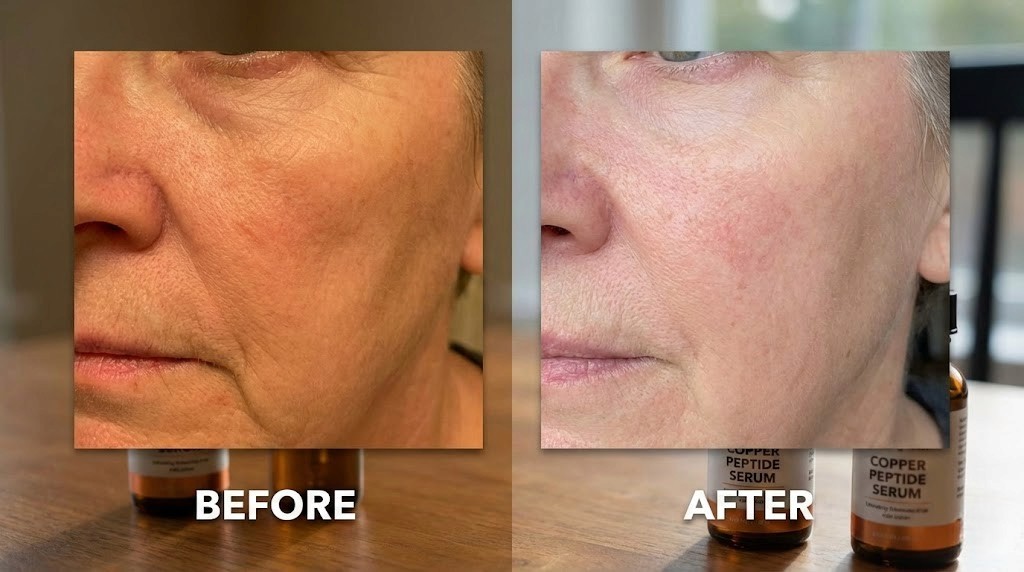
You've seen the photos. The transformation shots. The "week 1 versus week 12" comparisons that seem almost too good to be true. Copper peptides promising to turn back the clock, restore collagen, firm sagging skin, even regrow thinning hair. But here's the question nobody answers directly: what can you actually expect?
Because the truth is more nuanced than marketing photos suggest.
Some researchers see dramatic improvements. Others notice subtle changes that compound over months. A few experience initial worsening before things improve. And a small percentage don't respond at all. The difference often comes down to understanding realistic timelines, proper protocols, and how to accurately assess your own progress.
This guide provides the complete picture of copper peptide results based on clinical research, documented user experiences, and practical guidance for tracking your own transformation. Whether you're considering GHK-CU for wrinkle reduction, skin firmness, or hair regrowth, you'll know exactly what to expect and when to expect it. SeekPeptides members consistently report that understanding these timelines transforms frustration into patience and patience into results.
What Clinical Research Shows About Copper Peptide Results
Before diving into timelines, let's establish what the science actually demonstrates. Clinical studies provide measurable data points that ground expectations in reality rather than marketing claims.
The 12-Week Facial Aging Study
One of the most comprehensive studies examined 71 women with mild to advanced photoaging who applied GHK-Cu facial cream twice daily for 12 weeks. The results were measured objectively using clinical assessment tools rather than subjective opinions.
Researchers documented improved skin laxity, meaning less sagging. They measured increased clarity and overall appearance. Fine lines reduced measurably. Coarse wrinkles showed decreased depth. Mottled pigmentation faded. Skin density increased. Thickness improved.
These weren't vague claims. They were measurements. The study demonstrated that copper peptides produce real, quantifiable changes in skin structure and appearance over a three-month period.
Understanding how peptides work at the cellular level helps contextualize these findings.
The Collagen Production Comparison
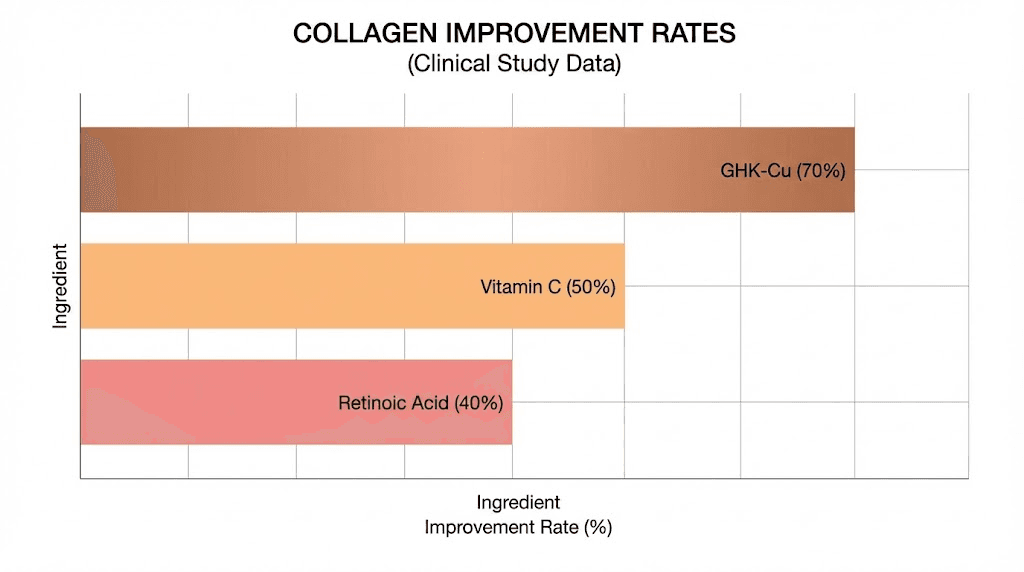
Another critical study compared GHK-Cu to two gold-standard anti-aging ingredients: vitamin C and retinoic acid. Women applied each treatment to thigh skin for 12 weeks while researchers measured collagen production through biopsy samples.
The results surprised many dermatologists. GHK-Cu improved collagen production in 70% of women treated. Vitamin C improved collagen in 50%. Retinoic acid improved collagen in 40%.
Copper peptides outperformed both vitamin C and prescription-strength retinoid for stimulating new collagen synthesis. This doesn't mean they're universally "better," since each compound works through different mechanisms and offers different benefits. But it establishes that copper peptide treatments produce measurable structural improvements in skin tissue.
The Wrinkle Depth Study
A study using GHK-Cu encapsulated in nano-lipid carriers measured wrinkle reduction against Matrixyl 3000, another popular peptide. After 8 weeks of twice-daily application, researchers used imaging technology to quantify changes.
GHK-Cu reduced wrinkle volume by 31.6% compared to Matrixyl 3000. Against control serum, GHK-Cu reduced wrinkle volume by 55.8% and wrinkle depth by 32.8%.
These percentages represent measurable physical changes. A 32.8% reduction in wrinkle depth is visible. It's the difference between lines that catch light and shadow versus smoother transitions across facial contours.
The peptide results guide provides additional context for interpreting transformation data.
Skin Firmness and Elasticity Data
Clinical measurements using cutometer analysis, a device that measures skin's mechanical properties, revealed a 70% increase in skin elasticity after 12 weeks of GHK-Cu application. Separate studies measured 20-30% improvement in skin firmness over the same timeframe.
What does this mean practically? Skin that bounces back faster when pressed. Less visible sagging around the jawline and cheeks. A tighter, more lifted appearance that develops gradually over months.
These improvements don't happen overnight. They build through consistent application as new collagen and elastin fibers form, mature, and cross-link into functional tissue.
The Complete Timeline: What to Expect Week by Week
Now let's translate clinical data into practical expectations. This timeline synthesizes research findings with documented user experiences across topical and injectable protocols.
Week 1-2: Initial Changes
The first two weeks establish your baseline response. Don't expect visible transformation yet. Do expect early signals that the peptide is active.
Most users notice improved hydration within the first week. Skin feels more supple, plumper, better able to retain moisture. This isn't the peptide directly hydrating skin; it's the peptide signaling cells to improve their water-binding capacity through increased glycosaminoglycan synthesis.
Some users experience reduced redness or irritation, reflecting GHK-Cu's anti-inflammatory properties. If you had background inflammation, calmer skin becomes apparent early.
Smoother texture often emerges by week two as increased cell turnover clears accumulated dead cells. The skin surface feels more refined under fingertips.
A minority of users experience temporary purging during this period. If you're prone to congestion, accelerated cell turnover can bring dormant breakouts to the surface. This typically peaks around weeks two through four and resolves by week six to eight. The GHK-CU skin troubleshooting guide addresses purging in detail.
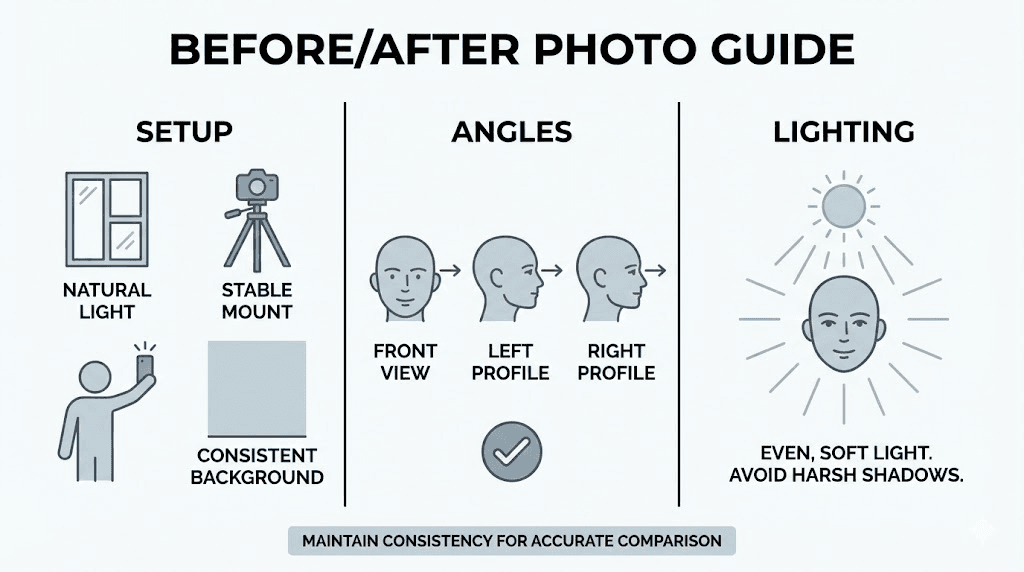
Document your starting point during this phase. Take photos in consistent lighting from consistent angles. Note your current concerns. You'll need this baseline for accurate comparison later.
Week 3-4: Transition Phase
Weeks three and four represent a transition. Some users see early improvements solidifying. Others experience the peak of any adjustment reactions.
Hydration benefits continue building. Skin that initially felt plumper now maintains that quality consistently rather than fluctuating day to day.
Fine lines, particularly around the eyes and mouth, may begin softening. This is subtle at this stage, more "maybe I see something" than definitive improvement. Don't expect dramatic wrinkle reduction yet.
If purging occurred, it should be peaking now. This is often the most discouraging phase. Skin might look worse than baseline while underlying transformation happens beneath the surface. Understanding why copper peptides can initially worsen skin helps maintain perspective.
Texture improvements become more consistent. The refined feeling from week two becomes your new normal rather than an occasional observation.
Using the peptide calculator ensures you're maintaining proper dosing through this critical phase.
Week 5-8: Visible Improvement Begins
This is when transformation becomes visible. Clinical studies show measurable changes appearing in this window, and user experiences align with the research.
Wrinkles begin noticeably softening. Fine lines that were visible at week one show reduced depth. You might notice this most in expressions, when you smile or squint, those lines don't crease as deeply.
Skin elasticity improves perceptibly. When you press your cheek, it bounces back faster. The slightly droopy appearance that comes with age starts reversing.
Overall skin quality shows marked improvement. People who know you might comment that you look rested, refreshed, or somehow different without being able to identify exactly what changed. This is the cumulative effect of better hydration, reduced fine lines, improved texture, and increased firmness combining into overall enhanced appearance.
If purging occurred, it should be resolving now. Breakouts decrease, inflammation calms, and the underlying improved skin starts showing through.
This is an excellent time for your first comparison photos. Place week one images next to week six or eight images. The difference should be visible even if it wasn't obvious day to day.
Understanding peptide timelines helps maintain realistic expectations through this phase.
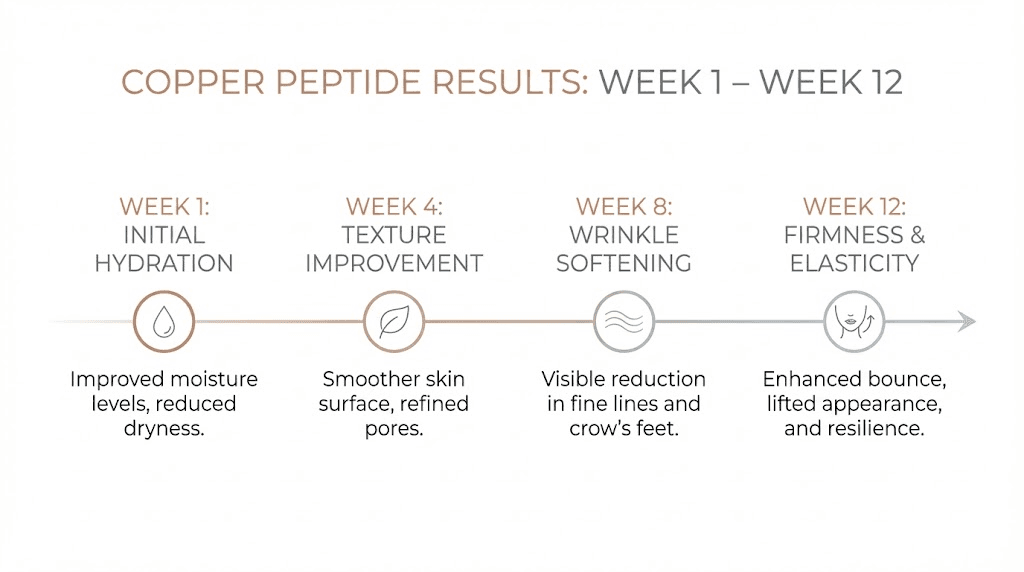
Week 9-12: Optimal Results Emerge
Clinical studies consistently use 12 weeks as their endpoint because this is when optimal results become measurable. Your experience should mirror the research.
Collagen production reaches meaningful levels. The new collagen fibers that started forming at weeks four through six have now matured and cross-linked. They're functional structural proteins actually supporting your skin from within.
Wrinkle reduction becomes significant. That 32.8% average reduction in wrinkle depth translates to visible improvement. Lines that were clearly visible at week one now appear softer, shallower, less prominent.
Firmness improvements peak. The 20-30% improvement in skin firmness measured in studies becomes apparent as reduced jowling, lifted cheeks, tighter jawline, diminished nasolabial folds.
Skin density and thickness increase. Skin that felt thin and fragile now feels more substantial, more resilient, more youthful in its physical properties.
Hyperpigmentation and sun damage show improvement. Mottled pigmentation fades as newer, more evenly pigmented cells replace older damaged ones. Age spots may lighten though likely won't disappear completely.
This is your major assessment point. Compare week 12 photos to week one photos. The transformation should be clearly visible. If you're not seeing expected results, the common peptide mistakes guide helps identify potential issues.
Month 4-6: Continued Improvement
Copper peptide benefits don't stop at 12 weeks. Continued use produces continued improvement, though the rate of change slows as you approach your optimal potential.
Deeper wrinkles continue improving. While fine lines respond quickly, deeper creases take longer to remodel. By month six, even established wrinkles show meaningful reduction.
Structural changes consolidate. The collagen and elastin networks become denser and more organized. Your skin's underlying architecture improves beyond surface-level changes.
Scars and hyperpigmentation continue fading. Post-inflammatory marks from old breakouts or injuries gradually blend with surrounding tissue. This process takes months to complete.
Overall appearance reaches near-optimal levels. While improvement continues beyond six months, the most dramatic transformation typically completes within this window.
The peptide cycling guide discusses whether to continue indefinitely or cycle usage.
Before and After Results by Specific Goal
Different people use copper peptides for different purposes. Let's examine expected results for each major goal.
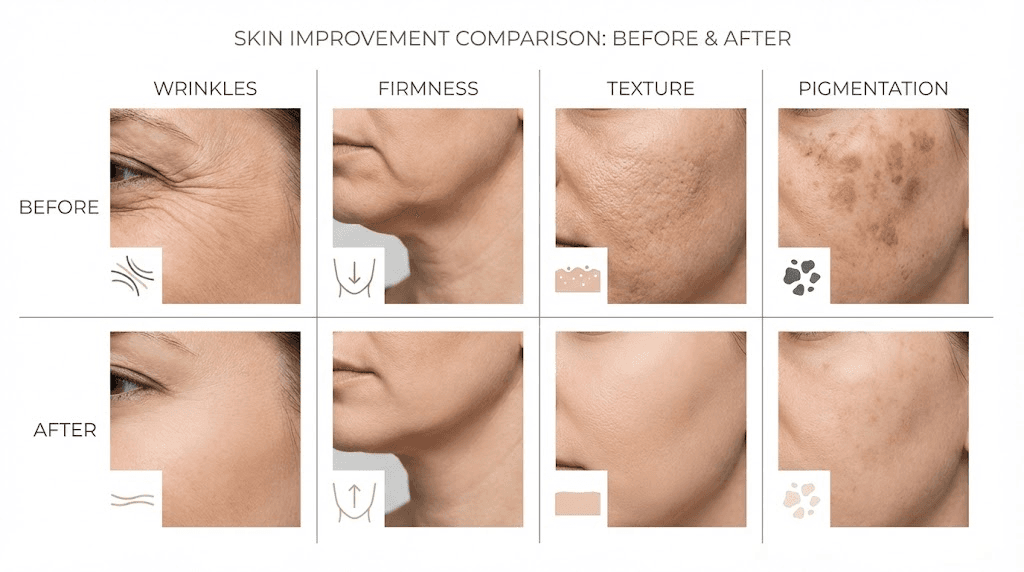
Anti-Aging and Wrinkle Reduction
If your primary goal is reducing visible signs of aging, here's what the before and after journey typically looks like.
Before: Fine lines around eyes and mouth. Forehead creases. Deeper nasolabial folds. Loss of overall facial definition. Skin that looks "tired" even when well-rested.
After (12 weeks): Softened crow's feet with reduced depth and visibility. Smoother forehead with less prominent expression lines. Nasolabial folds appear shallower. Improved facial contours. A refreshed, more youthful appearance that looks natural rather than artificial.
Clinical data suggests 20-30% improvement in firmness and 32% reduction in wrinkle depth as typical outcomes. This is significant and visible but not dramatic transformation. You'll look like a better version of yourself, not a different person.
For comprehensive anti-aging peptide strategies, multiple approaches often work synergistically.
Skin Firmness and Elasticity
If sagging and loss of elasticity concern you most, track these specific changes.
Before: Jowls forming along jawline. Cheeks that don't hold their position. Skin that tents when pinched rather than snapping back. Overall droopy appearance.
After (12 weeks): More defined jawline with reduced jowling. Lifted cheek contours. Skin that rebounds quickly from pinching. Tighter, more lifted appearance throughout the face.
The 70% improvement in elasticity measured via cutometer represents substantial functional change. Skin literally becomes more elastic, more able to return to position after movement or expression.
The skin tightening peptide guide explores additional firming strategies.
Skin Texture and Quality
For those focused on overall skin quality rather than specific concerns, copper peptides offer broad improvement.
Before: Rough or uneven texture. Enlarged pores. Dull, lackluster appearance. Skin that doesn't reflect light evenly. Variable day-to-day quality.
After (12 weeks): Smoother, more refined texture. Pores appear minimized though not eliminated. Healthy glow and improved luminosity. Skin that reflects light evenly. Consistent quality day after day.
These changes reflect improved cell turnover, enhanced hydration capacity, reduced inflammation, and increased density. The "glow-from-within" appearance users describe comes from healthier skin structure, not surface effects.
Understanding glow peptide protocols helps maximize radiance benefits.
Hyperpigmentation and Sun Damage
If discoloration is your primary concern, expect gradual improvement over extended timeframes.
Before: Age spots and sun spots. Uneven skin tone. Post-inflammatory hyperpigmentation from old breakouts. Mottled appearance from cumulative UV damage.
After (12+ weeks): Faded spots with reduced intensity. More even overall tone. Old marks blending with surrounding skin. Improved clarity and reduced mottling.
Pigmentation changes take longer than wrinkle or firmness improvements because they require complete cell turnover in affected areas. Expect three to six months for significant improvement, with continued fading over a year or more.
Copper peptides aren't a standalone hyperpigmentation treatment but work well combined with other approaches. The best copper peptide serum guide discusses formulations that may include additional brightening ingredients.
Hair Growth and Scalp Health
Copper peptides increasingly interest those dealing with thinning hair. The timeline differs significantly from skin applications.
Before: Thinning hair with visible scalp. Receding hairline or crown thinning. Increased daily shedding. Fine, wispy hair texture. Unhealthy scalp with inflammation or flaking.
After 4-8 weeks: Reduced daily shedding. Healthier scalp appearance. Early signs of improved hair texture.
After 3-6 months: Visible new growth appearing, particularly along hairline or in thinning areas. Existing hair appearing thicker. Improved overall density becoming noticeable.
After 9-12 months: Full cosmetic benefits visible. Meaningful improvement in coverage. Thicker, healthier appearing hair throughout.
Hair results take substantially longer than skin results because hair growth cycles span months. The anagen (growth) phase alone lasts two to seven years. Copper peptides work by extending this phase and encouraging dormant follicles to enter it, processes that unfold slowly.
The hair loss peptide guide provides comprehensive protocols. For those also exploring related compounds, hair growth peptides covers multiple options.
Factors That Influence Your Results
Not everyone achieves identical outcomes. Understanding the variables that influence results helps set accurate personal expectations.
Age and Baseline Condition
Your starting point significantly affects what's achievable. Someone with mild photoaging and early fine lines will see different results than someone with advanced sun damage and deep wrinkles.
Younger skin typically responds faster but shows less dramatic improvement because less damage exists to repair. Older skin may take longer to respond but often shows more dramatic before-and-after contrast.
Interestingly, GHK-Cu levels naturally decline with age. Blood levels drop from approximately 200 ng/mL at age 20 to 80 ng/mL by age 60. This correlates with reduced regenerative capacity. Supplementing copper peptides essentially restores something your body has progressively lost, which may explain why older individuals sometimes report particularly meaningful improvements.
The peptides for women over 40 guide addresses age-specific considerations.
Consistency and Protocol Adherence
Perhaps the most significant variable is consistency. Clinical studies showing impressive results involved twice-daily application for 12 continuous weeks. Sporadic use produces sporadic results.
Proper protocol includes correct concentration or dosage, appropriate application frequency, adequate duration before expecting results, and proper peptide storage to maintain potency.
Users who apply inconsistently, use degraded product, or abandon protocols before the eight to twelve week assessment point often report disappointing results. Those who follow protocols precisely typically match clinical expectations.
For injectable users, the GHK-CU dosage chart ensures accurate dosing. The reconstitution calculator helps with preparation.
Product Quality and Concentration
Not all copper peptide products perform equally. Quality varies significantly across sources and formulations.
Concentration matters. Products range from 0.5% to 10% GHK-Cu. Higher isn't always better, as excessive concentration can cause irritation without additional benefit. Clinical studies typically used moderate concentrations in the 1-4% range.
Formulation stability matters. GHK-Cu can degrade, particularly when exposed to incompatible ingredients, heat, or light. Degraded peptide provides reduced benefits while potentially causing irritation from released copper ions.
Source quality matters. Improperly synthesized peptide may contain impurities or incorrect molecular structure. The peptide vendor guide helps identify reliable sources.
If your results lag expectations despite consistent use, product quality deserves investigation.
Supporting Factors
Copper peptides don't work in isolation. Your overall skin health and systemic factors influence outcomes.
Nutritional status matters. Collagen synthesis requires amino acids (protein), vitamin C, and various minerals including zinc. Deficiencies limit what copper peptides can accomplish regardless of perfect topical protocol.
Sleep quality matters. Tissue repair accelerates during sleep when growth hormone peaks. Poor sleep undermines regenerative processes.
Sun exposure matters. Ongoing UV damage can outpace repair. Copper peptides can't out-heal daily destruction. Consistent sun protection amplifies results.
Skincare routine matters. Certain combinations enhance copper peptide effectiveness while others interfere. Avoid simultaneous application with vitamin C (L-ascorbic acid), which destabilizes the copper-peptide bond. The copper peptide skincare routine guide provides compatible protocols.
Individual Biological Response
Finally, individual variation exists. Some people respond exceptionally well to copper peptides while others show minimal change despite perfect protocols.
This reflects genetic differences in copper metabolism, enzyme expression, receptor sensitivity, and cellular responsiveness. It's not failure or doing something wrong. It's simply biological individuality.
If copper peptides don't produce expected results after proper trial, alternative peptides or approaches may suit your biochemistry better. The complete peptide list provides options for various goals.
How to Document Your Own Before and After
Accurate documentation transforms subjective impressions into objective assessment. Here's how to track your results properly.
Taking Effective Comparison Photos
Photos are your most valuable documentation tool, but only if taken consistently. Poor photo technique leads to misleading comparisons that either overstate or understate actual changes.
Use identical lighting for every photo session. Natural daylight from a window works well, but ensure it's the same window, same time of day, same weather conditions when possible. Indoor lighting should use the same fixtures at the same intensity.
Maintain consistent angles. Straight-on, 45-degree left, 45-degree right, and profile views capture different aspects of facial structure. Mark your standing position or use a phone mount to ensure identical positioning.
Remove variables. No makeup, same cleansing routine, same time relative to product application. Facial expression should be neutral and consistent.
Document at regular intervals. Week one baseline, then monthly at minimum. Weekly photos provide more granular tracking but require more effort.
Store images with clear date stamps in a dedicated folder for easy comparison.
Tracking Subjective Changes
Some changes don't photograph well but matter significantly. Create a simple journal tracking daily observations.
Rate hydration on a 1-10 scale each morning before skincare. Note texture observations: rough, smooth, refined. Record any unusual events: breakouts, irritation, exceptional good-skin days.
Weekly, assess firmness by pressing your cheek and observing rebound. Note how quickly skin returns to position. Rate overall appearance subjectively from 1-10.
Monthly, review your entries looking for trends. Upward trends in ratings indicate improvement even if photos don't capture it clearly.
Using Objective Measurements
For the most rigorous tracking, consider objective measurement tools.
Skin moisture meters provide numerical hydration readings. Use the same device, same facial location, same time relative to cleansing for comparable data.
Elasticity can be roughly assessed using the pinch test. Pinch cheek skin, release, and count seconds until fully returned. Track this measurement weekly.
Some dermatology apps offer wrinkle analysis using phone cameras. While not as precise as clinical equipment, they can detect changes over time when used consistently.
Setting Assessment Checkpoints
Structure your tracking around meaningful timepoints rather than daily scrutiny.
Week 4 checkpoint: First meaningful assessment. Compare photos and journal entries to baseline. You should see hydration improvement and texture refinement. Don't expect wrinkle or firmness changes yet.
Week 8 checkpoint: Mid-protocol assessment. Fine lines should show early softening. Elasticity improvements may be perceptible. If still seeing negative effects from initial purging, reassess protocol.
Week 12 checkpoint: Primary outcome assessment. This is your main comparison point matching clinical study endpoints. Evaluate all dimensions: wrinkles, firmness, texture, tone, overall appearance. Compare week 12 photos to week one photos side by side.
Month 6 checkpoint: Extended assessment for those continuing beyond initial protocol. Evaluate whether continued use produces continued improvement or whether you've reached plateau.
Managing Expectations Realistically
Realistic expectations prevent both premature abandonment and disappointment. Let's calibrate what copper peptides can and cannot accomplish.
What Copper Peptides Can Do
Based on clinical evidence and documented experiences, copper peptides reliably produce several outcomes for most users.
Improve skin hydration and moisture retention significantly within weeks. Refine skin texture and smooth rough areas. Reduce fine lines and soften moderate wrinkles by measurable percentages. Increase skin firmness and elasticity. Improve overall skin quality and appearance. Fade hyperpigmentation and uneven tone over extended use. Support healthy wound healing. Potentially stimulate hair growth with extended use.
These benefits are genuine and supported by research. They represent meaningful improvement in skin health and appearance.
What Copper Peptides Cannot Do
Equally important is understanding limitations. Copper peptides cannot completely eliminate deep wrinkles, though they can soften them. They cannot replace lost volume that creates hollow cheeks or under-eye troughs. They cannot provide results equivalent to surgical procedures or injectable treatments like Botox or fillers.
Copper peptides cannot override ongoing damage from poor lifestyle factors like smoking, excessive sun exposure, or inadequate nutrition. They cannot transform skin overnight or in a few days. They cannot work for everyone identically due to individual biological variation.
The peptides versus Botox comparison clarifies what each approach accomplishes.
The Realistic Outcome
What should you realistically expect after 12 weeks of proper copper peptide use?
Looking like a better version of yourself. Not a different person. Not miraculously younger. But visibly improved. Refreshed. Healthier. More vibrant.
The typical user might look three to five years younger in subjective assessment. Fine lines that were visible become subtle. Skin that looked tired appears rested. Texture that was rough feels smooth. Tone that was uneven appears clearer.
These improvements are meaningful. They're noticeable. They affect how you perceive yourself and how others perceive you. But they're not dramatic transformation. They're progressive enhancement.
SeekPeptides members access detailed protocols optimized for specific goals, helping maximize achievable results within realistic bounds.
Comparing Copper Peptide Results to Alternatives
How do copper peptide before and after results compare to other approaches? Context helps with treatment decisions.
Versus Retinoids
Retinoids (retinol, tretinoin, adapalene) remain dermatology's gold standard for anti-aging. How do copper peptides compare?
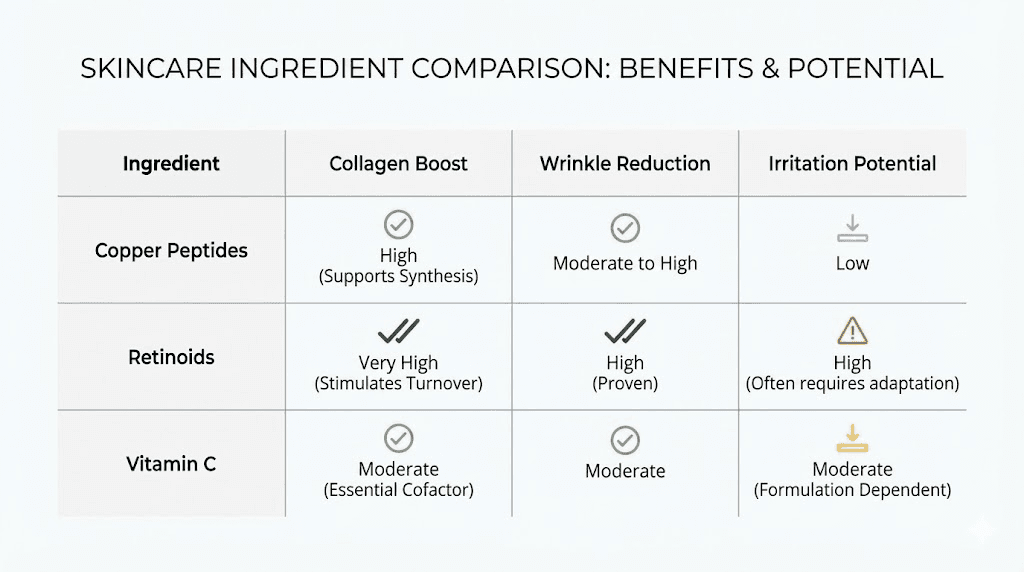
Retinoids typically show faster visible results for texture and acne. They're more effective for deep wrinkles when used at prescription strength. However, they cause more irritation, redness, peeling, and photosensitivity. They're unsuitable during pregnancy.
Copper peptides work more gently with minimal irritation for most users. They outperformed retinoic acid for collagen stimulation in at least one study. They're better tolerated by sensitive skin. They work through entirely different mechanisms, making combination potentially synergistic.
Many researchers use both: peptides and retinol together at different times of day to leverage both mechanisms.
Versus Vitamin C
Vitamin C serums are popular for brightening and antioxidant protection. The comparison with copper peptides is nuanced.
Vitamin C excels at brightening, reducing hyperpigmentation, and providing antioxidant defense against environmental damage. It supports collagen synthesis as a necessary cofactor.
Copper peptides demonstrated higher collagen stimulation rates than vitamin C in direct comparison studies. They provide additional benefits vitamin C doesn't offer, including elastin synthesis and wound healing acceleration. However, they shouldn't be applied simultaneously since L-ascorbic acid destabilizes copper peptides.
Using both in a routine, vitamin C in the morning and copper peptides in the evening, provides complementary benefits.
Versus Other Peptides
The peptide category is broad. How do copper peptides specifically compare to alternatives?
Matrixyl peptides (palmitoyl tripeptides) stimulate collagen through different mechanisms. Studies showed GHK-Cu outperforming Matrixyl 3000 for wrinkle reduction, though both are effective. They can potentially be used together for enhanced results.
Snap-8 and Syn-Ake work like topical Botox alternatives, relaxing expression muscles. They address different aspects of aging than copper peptides, which work on skin structure rather than muscle activity. Combining approaches addresses multiple aging mechanisms.
BPC-157 and TB-500 excel at healing and tissue repair but don't specifically target skin aging the way GHK-Cu does. They're complementary rather than competitive.
The peptide stacking guide explores effective combinations.
Versus Professional Treatments
How do at-home copper peptide results compare to professional dermatological treatments?
Professional treatments like laser resurfacing, chemical peels, microneedling, and injectables generally produce faster and more dramatic results. A single Fraxel laser treatment might accomplish what takes copper peptides months to achieve.
However, professional treatments cost significantly more, require downtime, carry procedural risks, and need periodic maintenance. Copper peptides offer gradual improvement with daily application, no downtime, minimal risk, and continuous benefit with ongoing use.
Many people combine approaches: professional treatments for major correction followed by peptide maintenance to preserve results. Others prefer peptide-only approaches to avoid invasive procedures.
Neither is objectively "better." The right choice depends on your goals, timeline, budget, and risk tolerance.
Maximizing Your Before and After Improvement
Want to optimize your copper peptide results? These strategies help maximize what you achieve.
Protocol Optimization
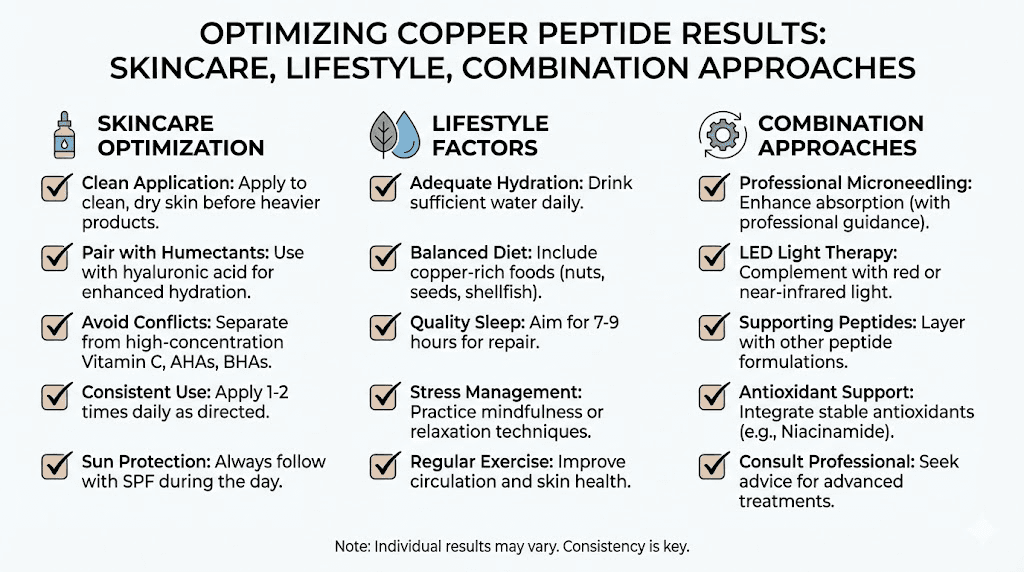
Start with proper fundamentals. Use an effective concentration, typically 1-4% for topical products. Apply consistently, twice daily for most protocols. Continue for minimum 12 weeks before final assessment.
Ensure product quality. Source from reputable suppliers with third-party testing. Store properly to maintain stability. Check expiration dates and discard degraded product.
For injectables, follow dosing protocols precisely. Use bacteriostatic water for proper reconstitution. Maintain appropriate storage to preserve potency.
Supportive Skincare
Build a routine that amplifies copper peptide benefits rather than undermining them.
Cleanse gently. Harsh cleansers strip protective oils and compromise barrier function. Use pH-balanced, non-foaming cleansers.
Layer hydrating serums. Hyaluronic acid before or after copper peptides enhances moisture retention.
Moisturize effectively. Barrier-supporting moisturizers with ceramides, cholesterol, and fatty acids protect the skin while peptides work.
Protect religiously. Sunscreen every morning prevents ongoing damage that peptides would otherwise need to repair. SPF 30 minimum, applied adequately.
Separate incompatible actives. Apply vitamin C in the morning, copper peptides in the evening. Space AHAs and BHAs from peptide application.
The complete skincare routine guide provides detailed protocols.
Lifestyle Factors
Support your peptide protocol with lifestyle optimization.
Prioritize sleep. Seven to nine hours allows maximum tissue repair. Growth hormone peaks during deep sleep, synergizing with peptide regeneration signals.
Manage stress. Cortisol accelerates aging and impairs healing. Chronic stress undermines even perfect skincare protocols.
Optimize nutrition. Adequate protein provides amino acids for collagen synthesis. Vitamin C supports collagen cross-linking. Zinc balances copper and supports skin health. Collagen supplementation may provide additional building blocks.
Stay hydrated. Dehydrated tissue shows more pronounced aging signs and impaired repair capacity.
Avoid smoking. Nothing accelerates skin aging faster than smoking. Quitting produces visible improvement independent of any other intervention.
Combination Strategies
Consider combining copper peptides with complementary approaches for enhanced results.
Microneedling with copper peptides amplifies both treatments. Microneedling creates channels enhancing peptide penetration while triggering wound healing that peptides support. Many clinics offer this combination.
LED light therapy, particularly red light at 630-660nm, supports collagen synthesis through different mechanisms than peptides. Using both addresses multiple pathways.
Other peptides can stack effectively. KPV adds anti-inflammatory benefits. Epitalon supports cellular longevity. BPC-157 and TB-500 enhance tissue repair. The peptide stack calculator helps plan combinations.
Frequently Asked Questions
How long until I see results from copper peptides?
Initial hydration and texture improvements typically appear within one to two weeks. Fine line softening becomes noticeable around weeks five through eight. Optimal results for firmness, wrinkle depth, and overall appearance emerge at twelve weeks of consistent use. Peptide timelines vary by individual, but twelve weeks represents the standard assessment period matching clinical study endpoints.
Will copper peptides work for deep wrinkles?
Copper peptides can soften deep wrinkles but typically won't eliminate them completely. Studies show approximately 32% reduction in wrinkle depth, which is visible and meaningful but not complete reversal. Deep structural wrinkles may benefit from combination approaches including professional treatments. For moderate wrinkle concerns, copper peptides alone often produce satisfying improvement.
Can I use copper peptides if I have sensitive skin?
Most people with sensitive skin tolerate copper peptides well. They're generally less irritating than retinoids or strong acids. However, some individuals experience reactions. Start with lower concentrations (1-2%) and every-other-day application. Patch test on your inner forearm before facial use. If irritation occurs, the troubleshooting guide provides adjustment strategies.
How do injectable copper peptide results compare to topical?
Injectable GHK-CU provides systemic exposure that may benefit skin through internal mechanisms beyond what topical application achieves. Some researchers report faster or more pronounced results with injections. However, topical application delivers peptide directly to target tissue. Many advanced users combine both methods for comprehensive coverage.
Do I need to use copper peptides forever to maintain results?
Results are maintained only with ongoing use. Discontinuing copper peptides leads to gradual return toward baseline as the skin's natural aging processes continue. However, this regression is gradual rather than immediate. What happens when you stop depends on your baseline and how long you've used the peptide. Many users transition to maintenance protocols with reduced frequency after initial improvement.
Can copper peptides help with hair loss?
Evidence supports GHK-Cu for hair by extending the growth phase and potentially reactivating dormant follicles. Results take longer than skin applications, typically three to six months for visible improvement and nine to twelve months for full benefits. Copper peptides work best on thinning areas where follicles remain present but inactive. They cannot revive completely destroyed follicles. The hair loss guide provides comprehensive protocols.
How do I know if copper peptides are working?
Track progress through consistent photos taken in identical conditions, subjective journal entries rating skin quality, and objective measurements like pinch-test rebound time. Compare assessments at four, eight, and twelve weeks to baseline. Improvement often occurs gradually enough that daily observation misses it, but comparison photos reveal clear change. If you see no improvement by twelve weeks despite consistent use, the troubleshooting guide helps identify potential issues.
For researchers serious about tracking and optimizing their copper peptide results, SeekPeptides offers the most comprehensive resource available, with evidence-based protocols, detailed timelines, and a community of thousands documenting their own before and after journeys.
Understanding what's realistically achievable, and exactly how to get there, transforms the gap between expectations and outcomes.