Jan 4, 2026
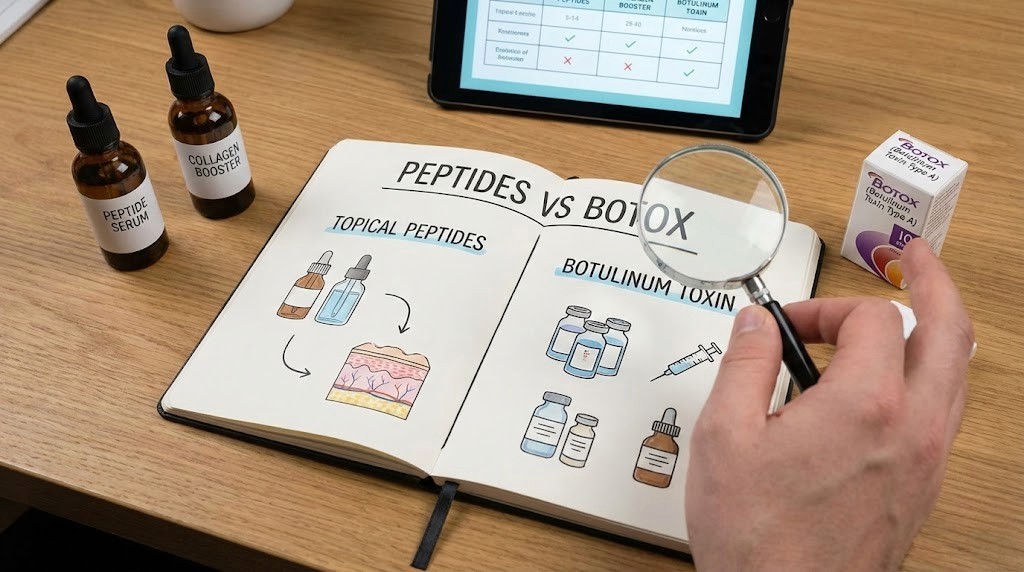
The choice between peptides and Botox for wrinkle reduction represents fundamental trade-off between gradual natural improvement versus dramatic rapid results, with each approach offering distinct advantages and limitations across effectiveness, safety, convenience, cost, and aesthetic philosophy. Botox (botulinum toxin) delivers proven 50-80% expression wrinkle reduction within days through complete muscle paralysis, requiring quarterly professional injections costing $300-600 per treatment area creating $1200-2400 annual expense with potential complications including asymmetry, frozen appearance, or drooping when poorly administered.
Peptide alternatives like Argireline, Snap-8, and copper peptides provide gentler 20-40% wrinkle improvement through topical application avoiding needles and paralysis, requiring daily home use costing $300-600 annually with excellent safety profiles but slower results timelines.
The SeekPeptides platform provides comprehensive guidance on peptide anti-aging protocols helping users optimize topical approaches or determine when Botox proves more appropriate.
This guide examines peptides versus Botox through mechanism comparison, effectiveness assessment, safety evaluation, cost analysis, convenience factors, aesthetic outcome differences, and evidence-based recommendations helping users select appropriate interventions matching priorities, budgets, and tolerance for trade-offs inherent in each approach.
Mechanism comparison: how peptides and Botox work differently
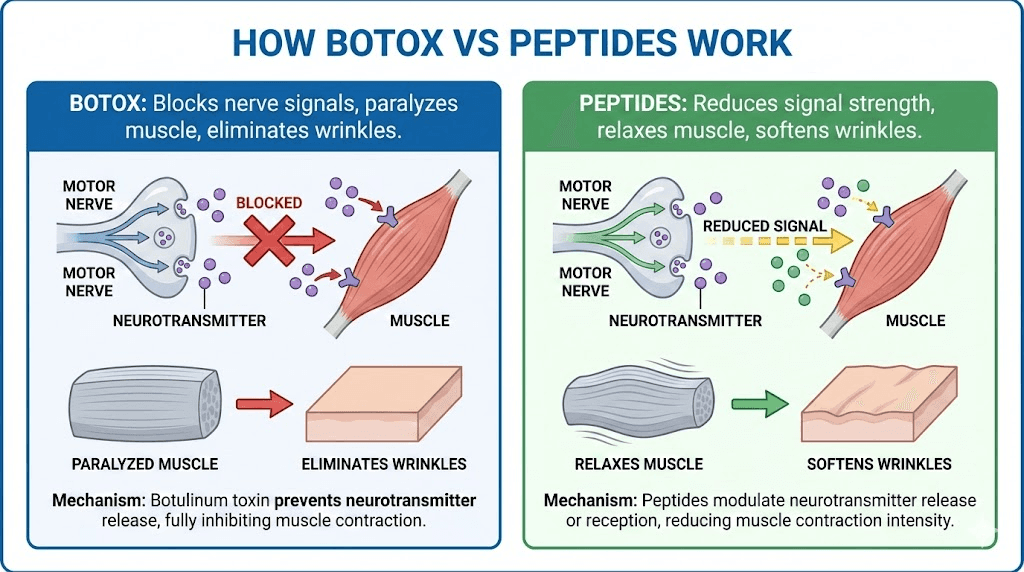
Botox (botulinum toxin type A) functions through irreversible acetylcholine blockade at neuromuscular junction preventing nerve signals from reaching muscle fibers, creating temporary paralysis lasting 3-4 months until new nerve terminals form bypassing blocked connections. The mechanism proves highly effective for expression wrinkles driven by repetitive muscle contractions - forehead lines from frontalis muscle activity, crow's feet from orbicularis oculi contractions, and frown lines from corrugator and procerus muscles creating habitual scowling patterns diminish dramatically when underlying muscle activity ceases through neurotoxin intervention as established through decades of clinical use.
The peptide approach operates through gentler mechanisms avoiding complete paralysis - Argireline (acetyl hexapeptide-8) interferes with SNARE complex proteins preventing neurotransmitter vesicle fusion reducing acetylcholine release by approximately 30%, Snap-8 (acetyl octapeptide-3) provides enhanced SNARE complex binding through additional amino acids creating slightly stronger effect, while SYN-AKE mimics snake venom peptides blocking nicotinic acetylcholine receptors preventing muscle fiber activation through different pathway. These mechanisms produce partial muscle relaxation maintaining natural expression while reducing contraction intensity creating wrinkles, fundamentally differing from Botox's complete paralysis approach.
Collagen-stimulating peptides like GHK-Cu and Matrixyl address wrinkles through structural improvement rather than muscle effects - increasing dermal collagen synthesis by 70-80% in vitro studies, promoting organized matrix formation rather than disorganized scar-like deposition, enhancing skin thickness obscuring fine lines, and improving overall skin quality creating fresher appearance even without direct wrinkle targeting. This mechanism proves complementary to muscle-relaxing approaches whether Botox or peptide-based, allowing combination strategies addressing wrinkles through multiple pathways following comprehensive anti-aging protocols.
The mechanism difference creates distinct outcome characteristics - Botox eliminates expression wrinkles wherever injected through complete prevention of muscle contraction creating dramatic smoothness but also limiting natural facial animation, while peptides reduce wrinkle depth while preserving expression allowing natural emotional communication without dramatic wrinkle elimination. Users must decide whether they prioritize maximum wrinkle reduction accepting expression limitation, or prefer natural appearance with moderate wrinkle improvement through peptide alternatives.
Learn about peptide mechanisms and anti-aging applications through SeekPeptides educational resources.
Factor | Botox | Muscle-Relaxing Peptides | Collagen-Stimulating Peptides |
|---|---|---|---|
Mechanism | Complete acetylcholine blockade | Partial SNARE complex interference | Collagen synthesis stimulation |
Muscle Effect | Total paralysis 3-4 months | 30% contraction reduction | No direct muscle effect |
Wrinkle Reduction | 50-80% elimination | 20-40% depth reduction | 20-30% improvement via thickness |
Expression Impact | Significant limitation/frozen | Maintains natural movement | No expression effect |
Onset | 3-7 days | 2-4 weeks | 2-4 months |
Duration | 3-4 months then reverses | Requires continuous use | Requires continuous use |
Reversibility | Self-limiting as wears off | Immediate upon stopping | Gradual decline over months |
Effectiveness comparison: results magnitude and timeline
Botox delivers superior wrinkle reduction magnitude with clinical studies and decades of real-world use demonstrating 50-80% depth reduction in expression lines including forehead wrinkles, crow's feet, and frown lines between brows when properly administered by experienced injectors. The effectiveness proves most dramatic for dynamic wrinkles appearing only during facial expressions - users notice complete smoothness when making expressions that previously created prominent lines, while static wrinkles present at rest show partial improvement averaging 30-50% reduction as underlying muscle relaxation allows overlying skin recovering some smoothness though established creases may persist requiring additional interventions.
Muscle-relaxing peptides produce modest 20-40% wrinkle depth reduction based on limited clinical studies and extensive anecdotal reports, proving most effective for mild to moderate expression lines while showing minimal impact on deep established wrinkles requiring more intensive intervention. The gentler effect preserves natural facial animation allowing emotional expression without dramatic smoothness Botox creates - users describe softened lines appearing less prominent without complete elimination, maintaining authentic appearance valued by those uncomfortable with frozen aesthetic or seeking natural aging approach through gradual peptide improvement.
Collagen-stimulating peptides like GHK-Cu and Matrixyl address wrinkles through skin thickening and quality improvement producing 20-35% fine line reduction over 3-6 months, proving most effective for static wrinkles from collagen loss rather than expression-driven lines better addressed through muscle-targeting approaches. The mechanism creates cumulative improvement benefiting overall facial appearance beyond specific wrinkle targeting - users notice improved texture, enhanced firmness, better light reflection creating fresher look even where individual wrinkles remain visible following comprehensive skin improvement rather than isolated wrinkle elimination.
Results timeline differs dramatically between approaches creating important decision factor - Botox produces visible smoothing within 3-7 days reaching maximum effect at 2 weeks, allowing users assessing results and deciding whether retreatment proves worthwhile within short timeframe. Muscle-relaxing peptides show initial subtle improvement around 2-4 weeks with gradual enhancement continuing through 8-12 weeks before plateauing, requiring patience and consistent application before evaluating effectiveness. Collagen-building peptides demand longest timeline at 2-4 months for noticeable improvement and 6-12 months for maximum effects, suiting users willing investing in gradual structural enhancement over quick fixes.
Age and baseline wrinkle severity significantly influence comparative effectiveness - younger users (30s-early 40s) with mild expression lines may achieve satisfactory results from peptides alone avoiding Botox entirely, while users in 40s-50s with moderate wrinkles often find peptide-only protocols producing insufficient improvement leading to Botox consideration. Very advanced age (60s+) or severe wrinkling typically requires Botox or professional treatments for meaningful results, though peptides provide valuable support maintaining results between Botox treatments or addressing areas unsuitable for neurotoxin injection.
Explore realistic effectiveness expectations and outcome comparisons through SeekPeptides resources.
Effectiveness Factor | Botox | Muscle-Relaxing Peptides | Collagen Peptides |
|---|---|---|---|
Wrinkle Reduction % | 50-80% dramatic | 20-40% moderate | 20-35% modest |
Best For | Moderate-severe expression lines | Mild-moderate lines, prevention | Static lines, overall quality |
Age Suitability | All ages, proven severe cases | Best under 45, mild concerns | All ages, complementary |
Results Timeline | 3-7 days visible | 2-4 weeks initial, 8-12 weeks max | 2-4 months visible, 6-12 max |
Deep Wrinkle Effect | Good - 30-50% static improvement | Poor - minimal deep wrinkle impact | Moderate - fills via thickness |
Fine Line Effect | Excellent if expression-related | Good - softens fine lines | Good - improves via collagen |
Safety and side effect comparison
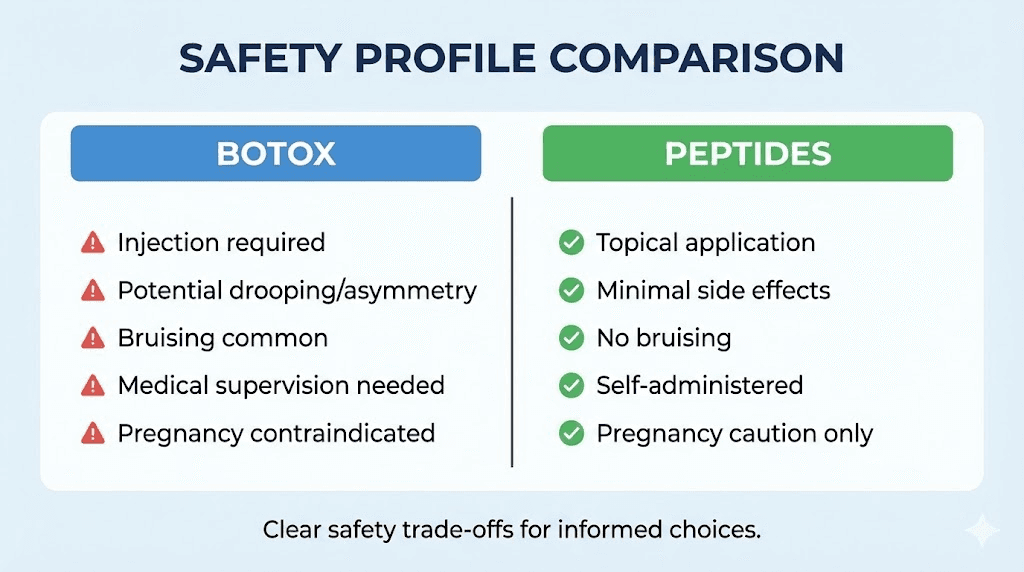
Botox safety profile proves excellent when administered by qualified experienced injectors with serious complications remaining rare (<1% occurrence) though minor side effects occur commonly including injection site bruising (10-20% of treatments), temporary headache (15% of users typically resolving within 24-48 hours), mild flu-like symptoms (5-10% reporting fatigue or malaise), and localized discomfort at injection sites lasting hours to days. The most concerning complications involve muscle weakness beyond intended areas creating eyelid drooping (ptosis, 1-3% incidence), eyebrow asymmetry from uneven muscle relaxation, or frozen appearance from excessive dosing or poor injection technique, though these typically resolve as Botox wears off over 2-4 months requiring patience and potentially corrective procedures.
Rare serious Botox complications include allergic reactions manifesting as rash, itching, or breathing difficulties requiring immediate medical attention, systemic botulism symptoms from toxin spread beyond injection site (extremely rare with cosmetic doses), and vision problems from periocular injections affecting eye muscles. The safety distinction between peptides and Botox stems partly from administration route - injections carry inherent infection risk, bleeding potential, and nerve/vessel damage possibilities versus topical application avoiding these concerns entirely through non-invasive delivery.
Topical peptide safety proves exceptional with side effects limited to mild transient reactions - muscle-relaxing peptides occasionally cause temporary stinging or tingling upon application (5-10% of users), slight redness fading within 30 minutes (occasional), or mild dryness during initial use requiring moisturizer support. Copper peptides show similar excellent tolerance with temporary warmth or tingling from copper delivery (common but benign), occasional initial dryness from increased cell turnover, and very rare allergic contact dermatitis requiring product discontinuation following patch testing protocols.
True allergic reactions to topical peptides prove extremely rare (<1%) presenting as persistent redness, itching, rash, or swelling requiring discontinuation but avoiding serious systemic consequences possible with injectable Botox allergic responses. The non-invasive nature eliminates infection risk, bruising, injection pain, and needle-related complications making peptides dramatically safer from complication perspective though offering reduced effectiveness compared to Botox creating fundamental safety-efficacy trade-off.
Long-term safety considerations favor peptides with decades of topical use showing no concerning patterns, while Botox long-term effects remain incompletely understood with questions about muscle atrophy from chronic paralysis, antibody formation reducing effectiveness requiring dose escalation, and potential spreading effects from repeated treatments though definitive evidence proving harm remains limited. Conservative users uncomfortable with uncertainty might prefer peptide approaches with established long-term safety versus accepting Botox unknowns for superior short-term effectiveness.
Pregnancy and breastfeeding contraindications apply strictly to Botox with no human safety data justifying absolute avoidance during these periods, while topical peptides show minimal systemic absorption creating theoretical safety though conservative approach suggests avoiding copper peptides during pregnancy due to copper exposure concerns. Muscle-relaxing peptides likely prove safe given minimal absorption but definitive pregnancy studies remain absent requiring personal risk assessment.
Learn comprehensive peptide safety protocols and risk management through SeekPeptides safety resources.
Cost and value analysis
Botox pricing varies by geographic location, injector expertise, and treatment area with typical costs at $10-20 per unit and average treatment requiring 20-60 units depending on areas treated - forehead lines need 10-30 units ($100-600), crow's feet require 12-24 units per side ($240-480 bilateral), frown lines between brows use 20-40 units ($200-800), creating per-session costs of $300-600 for single area or $800-1500 for comprehensive three-area treatment. Treatment frequency at 3-4 month intervals creates annual costs of $1200-2400 for single-area maintenance or $3200-6000 for multi-area treatments representing substantial ongoing expense requiring budget commitment.
Peptide costs prove dramatically lower with quality muscle-relaxing peptide serums containing 5-10% Argireline or Snap-8 costing $40-80 for 30ml (2-3 month supply) creating $160-320 annual expense, while copper peptide formulations with 1-2% GHK-Cu cost $50-120 for similar supply generating $200-480 yearly investment. Combined multi-peptide protocols using both muscle-relaxing and collagen-stimulating peptides total $300-600 annually, representing 75-85% cost savings versus equivalent Botox treatments though delivering inferior wrinkle reduction magnitude creating cost-effectiveness question depending on result prioritization.
The value proposition depends critically on individual priorities and wrinkle severity - users with mild expression lines accepting 30-40% improvement find peptides offering excellent value delivering meaningful results at fraction of Botox cost, while those with moderate to severe wrinkles seeking maximum reduction often conclude Botox's superior effectiveness justifies higher expense despite 4-6x cost premium. Age considerations affect value perception with younger users (30s) often finding preventive peptide use adequate delaying Botox need for years, while older users (50s+) with established wrinkles frequently determine Botox proves only intervention delivering satisfactory results making higher cost necessary rather than optional.
Hidden costs affect total expense comparison - Botox requires quarterly professional visits consuming time and transportation expense, potential touch-up treatments if initial results prove inadequate or asymmetric, and makeup or skincare products concealing bruising during recovery period. Peptide protocols involve opportunity cost of daily application time (5-10 minutes), complementary skincare products maximizing results (vitamin C, retinoids, SPF), and extended timeline before assessing effectiveness requiring patience and consistent investment.
Cost-benefit optimization strategies include using peptides as primary intervention with occasional Botox for specific stubborn areas, alternating between Botox and peptide-only periods extending injection intervals from 3-4 months to 5-6 months through peptide support between treatments, or beginning with peptides for preventive maintenance transitioning to Botox only when peptide-only protocols prove insufficient creating age-appropriate escalation strategy matching intervention intensity to actual need.
Calculate personal peptide protocol costs and plan budget through SeekPeptides planning tools.
Cost Factor | Botox | Peptides | Savings/Difference |
|---|---|---|---|
Per Treatment | $300-600 (single area) | $40-80 (2-3 month supply) | 85-90% peptide savings |
Annual Cost (Single Area) | $1200-2400 (4 treatments) | $160-320 (year supply) | $1040-2080 saved |
Annual Cost (Multi-Area) | $3200-6000 (3 areas) | $300-600 (combined protocols) | $2900-5400 saved |
5-Year Investment | $6000-12,000 | $800-1600 | $5200-10,400 saved |
Hidden Costs | Time, travel, touch-ups, bruise coverage | Daily routine time, complementary products | Variable by individual |
Convenience and lifestyle factors
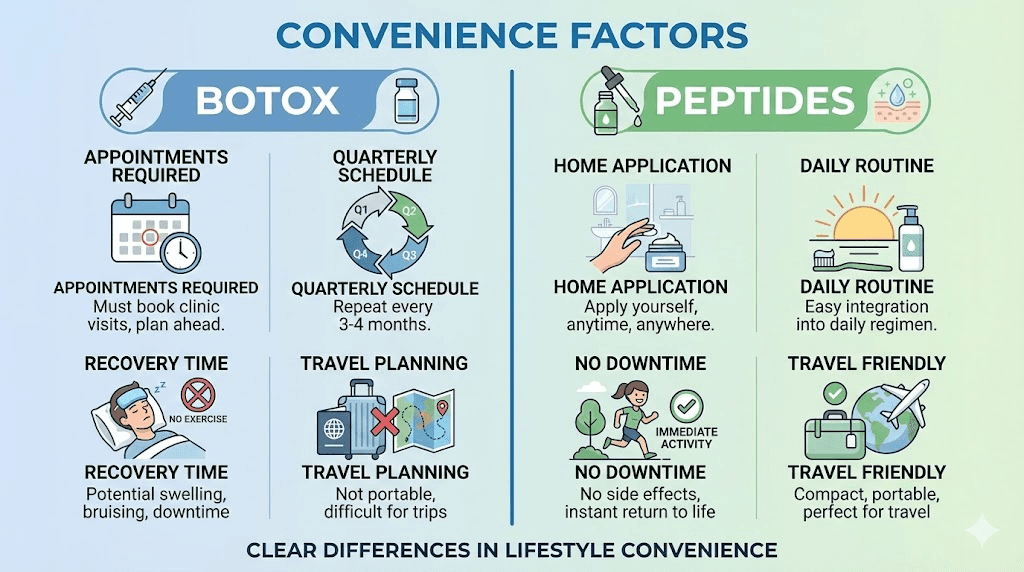
Botox administration requires professional medical visits typically lasting 15-30 minutes for consultation and injection, necessitating scheduling appointments during business hours creating work disruption or personal time sacrifice, traveling to medical office or medical spa with associated transportation time and expense, and coordinating treatments around social events avoiding visible bruising or swelling during important occasions. The quarterly treatment schedule (3-4 month intervals) creates ongoing commitment requiring calendar management and budget planning, while results prove time-sensitive - waiting too long between treatments allows complete wrinkle return requiring rebuilding smoothness rather than maintaining established results following professional treatment protocols.
Peptide convenience centers on home application flexibility - users apply products during normal morning and evening skincare routines (5-10 minutes total daily), adjusting timing around personal schedules without appointment constraints, traveling easily with products in carry-on luggage, and modifying protocols during busy periods without losing all progress as gradual peptide discontinuation shows gentler regression than Botox's abrupt reversal. The daily requirement creates different commitment type - Botox demands quarterly intensive intervention while peptides require consistent small daily actions, suiting different personality types and lifestyle patterns.
Recovery and downtime considerations favor peptides dramatically - topical application causes zero visible side effects allowing immediate return to all activities including exercise, social events, and work without appearance concerns, while Botox commonly creates injection site bruising visible for 3-7 days requiring concealer makeup or social activity avoidance. Botox patients should avoid lying down for 4 hours post-treatment, strenuous exercise for 24 hours, and facial massage/manipulation for several days preventing toxin migration, while peptide users face zero activity restrictions following application beyond normal absorption time.
Travel compatibility differs significantly - peptide products travel easily in carry-on bags (ensure containers under 100ml for TSA), continue daily during travel maintaining treatment consistency, and adapt to varying schedules without disrupting results. Botox users must plan treatments around travel avoiding injections immediately before trips when bruising or swelling might occur, potentially requiring finding qualified injectors at destination for urgent touch-ups, and facing treatment interruption if extended travel prevents quarterly appointments creating complete wrinkle return requiring rebuilding smoothness.
Lifestyle flexibility proves important for many users - peptides accommodate changing circumstances including pregnancy requiring treatment cessation, financial fluctuations allowing protocol modification rather than complete discontinuation, and evolving aesthetic preferences permitting gradual treatment reduction without dramatic appearance changes. Botox creates more rigid commitment requiring quarterly treatments for maintenance with complete wrinkle return if stopping, though self-limiting nature means discontinuation remains option without permanent consequences beyond returning to pre-treatment baseline.
Social considerations affect treatment choice - Botox carries stigma in some social circles associated with vanity, artificial appearance, or excessive intervention creating reluctance to disclose treatments, while peptides frame more easily as "good skincare" rather than medical intervention avoiding judgment from conservative family or professional environments. However, some users appreciate Botox's dramatic visible results creating compliments and confidence versus peptide's subtle improvement sometimes going unnoticed though avoiding "work done" appearance criticism.
Explore lifestyle-compatible protocols and flexible strategies through SeekPeptides planning guides.
Aesthetic outcome and appearance philosophy
Botox aesthetic creates smooth immobile appearance in treated areas - forehead becomes completely flat when raising eyebrows, crow's feet disappear entirely when smiling, frown lines vanish when concentrating - producing dramatic wrinkle elimination but also limiting facial animation essential for natural emotional expression. The frozen or surprised appearance resulting from excessive forehead paralysis, inability to frown creating perpetual pleasant expression regardless of actual emotion, and overall "done" look signaling obvious intervention represent aesthetic concerns for users prioritizing natural appearance over maximum wrinkle reduction following different anti-aging philosophies.
Skilled Botox administration minimizes frozen appearance through conservative dosing preserving some movement, strategic placement targeting specific wrinkle-causing muscles while sparing others maintaining expression, and artistic judgment balancing smoothness against animation creating natural-looking results without obvious treatment signs. However, individual anatomy variation, muscle strength differences, and personal preference regarding acceptable movement create challenge even for experienced injectors, with some users inevitably experiencing more paralysis than desired requiring patience as treatment wears off over 3-4 months before adjusting subsequent doses.
Peptide aesthetic preserves complete facial mobility and natural expression while softening wrinkle prominence - forehead lines remain visible but less pronounced when raising eyebrows, smile lines appear gentler without disappearing, and frown capability persists preventing frozen appearance concerns.
The gradual improvement creates natural aging trajectory rather than dramatic before-after transformation, allowing users aging gracefully without obvious intervention or sudden appearance changes alerting others to treatment following subtle enhancement philosophy valued by those uncomfortable with dramatic anti-aging interventions.
The natural vs dramatic preference reflects fundamental aesthetic philosophy differences - some users embrace modern anti-aging technology delivering maximum results regardless of natural appearance considerations, while others prioritize authenticity accepting visible aging signs rather than pursuing wrinkle elimination through invasive intervention. Peptides serve middle ground allowing modest improvement without dramatic transformation, suiting users wanting "better version of myself" rather than "completely different appearance" following gradual enhancement principles.
Professional and social context affects aesthetic appropriateness - some careers benefit from energetic youthful appearance Botox creates making investment worthwhile despite higher cost, while others value mature distinguished appearance or work in environments where obvious cosmetic intervention faces criticism making peptide's subtlety preferable. Personal relationship dynamics play role with partners potentially having strong preferences regarding natural aging versus intervention, requiring communication and mutual comfort with chosen approach.
Age-appropriate considerations influence aesthetic decisions - users in 30s often find preventive peptide use age-appropriate avoiding premature intensive intervention, while 40s-50s face decision point whether maintaining youthful appearance justifies Botox investment or accepting natural aging with peptide support proves more authentic. Very advanced age (60s-70s+) creates different calculation where dramatic Botox smoothing may appear incongruous with overall aged appearance versus comprehensive peptide skincare improving overall quality without isolated wrinkle elimination.
Combination strategies and optimal use cases
The hybrid approach using both Botox and peptides proves increasingly popular among knowledgeable users optimizing cost-effectiveness and aesthetic outcomes - Botox targets specific stubborn expression areas (frown lines, forehead, crow's feet) creating dramatic smoothness where most valued, while peptides provide comprehensive facial support improving overall skin quality, addressing static wrinkles Botox doesn't affect, and potentially extending Botox duration reducing annual treatment frequency from 4x to 3x through peptide maintenance between injections.
Treatment sequencing affects combination effectiveness - some users begin peptides first assessing response before considering Botox, adding injections only for areas proving peptide-resistant after 3-6 month trial, while others start Botox for immediate results then incorporate peptides reducing future Botox needs through preventive maintenance. The age-escalation strategy proves particularly sensible - peptides throughout 30s-early 40s for prevention, adding strategic Botox mid-40s for specific concerns, and comprehensive combination approach 50s+ maintaining results as aging accelerates.
Optimal use cases for Botox-only approach include severe expression wrinkles unresponsive to topical interventions, users prioritizing maximum results over cost/naturalness, very deep frown lines creating angry appearance affecting professional interactions, specific aesthetic goals (completely smooth forehead) requiring paralysis, and users comfortable with injections, quarterly commitment, and higher expense accepting trade-offs for superior effectiveness as detailed in professional treatment guides.
Peptide-only protocols suit users with mild wrinkles responding well to gentle intervention, needle-phobic individuals avoiding injections, budget-conscious users prioritizing cost savings, those valuing natural appearance over maximum smoothness, preventive users in 30s-early 40s delaying intensive treatment, and anyone philosophically opposed to neurotoxin injection or muscle paralysis accepting modest results for excellent safety and convenience following gradual anti-aging approaches.
The decision framework considers multiple factors simultaneously - wrinkle severity (mild suggests peptides, severe suggests Botox), budget constraints (limited favors peptides, flexible allows Botox), lifestyle compatibility (busy schedules favor peptides, flexible timing allows Botox), aesthetic philosophy (natural appearance favors peptides, dramatic results favor Botox), age and prevention focus (younger favors peptides, established wrinkles favor Botox), and risk tolerance (conservative favors peptides, accepting side effects allows Botox) creating personalized recommendation rather than universal best choice.
Explore combination protocols and strategic planning through SeekPeptides comprehensive guides.
How you can use SeekPeptides for anti-wrinkle guidance
SeekPeptides provides extensive peptide education for wrinkle reduction and comprehensive anti-aging. Explore peptides for wrinkles guide, Snap-8 peptide, copper peptides GHK-Cu, skin tightening, dark circles, and scars.
Access anti-aging resources including women over 40, perimenopause, menopause, best peptides for women, and safe options.
Learn combination strategies, stacking protocols, cycling approaches, cycle planning, and dosing optimization.
Explore vendor reviews including Amopure, Transcend, Planet, RPO, NextGen, Profound, Elite, Integrity, and Revive.
Access practical tools including peptide calculator, cost calculator, dosage chart, and complete peptide list.
Learn fundamentals through what are peptides, how they work, safety guide, research overview, getting started, and common mistakes.
Final thoughts
Peptides versus Botox represents fundamental trade-off between natural gradual improvement (20-40% wrinkle reduction, excellent safety, home convenience, $300-600 annually) and dramatic rapid results (50-80% wrinkle reduction, injection requirements, professional administration, $1200-2400+ annually). Peptides suit mild wrinkles, budget constraints, natural appearance priorities, and preventive users, while Botox addresses severe expression lines, users accepting higher costs and injection commitment for maximum smoothness.
The optimal approach often combines both - Botox for stubborn specific areas plus comprehensive peptide protocols supporting overall skin quality, extending injection intervals, and maintaining results between treatments. Age-escalation strategies beginning with peptides in 30s-40s, adding strategic Botox mid-40s, and comprehensive combination 50s+ create sustainable long-term anti-aging approach.
Your wrinkle treatment decision should match severity to intervention intensity, align with aesthetic philosophy and lifestyle, consider budget sustainability, and acknowledge that both approaches offer valid benefits through SeekPeptides comprehensive guidance helping optimize either path or thoughtful combination strategy.
Related anti-wrinkle and comparison resources
Essential peptide education
In case I don’t see you, good afternoon, good evening, and good night. Take care of yourself. Join SeekPeptides