Jan 1, 2026
The cosmetic peptide market promises "Botox-like" wrinkle reduction through topical application, eliminating needles while delivering comparable anti-aging benefits at fraction of the cost.
Snap-8 (Acetyl Octapeptide-3) represents the next-generation evolution of Argireline (Acetyl Hexapeptide-8), featuring an extended eight-amino-acid chain designed to penetrate deeper and inhibit muscle contractions more effectively than its six-amino-acid predecessor, theoretically producing superior wrinkle-smoothing results approaching actual Botox injections.
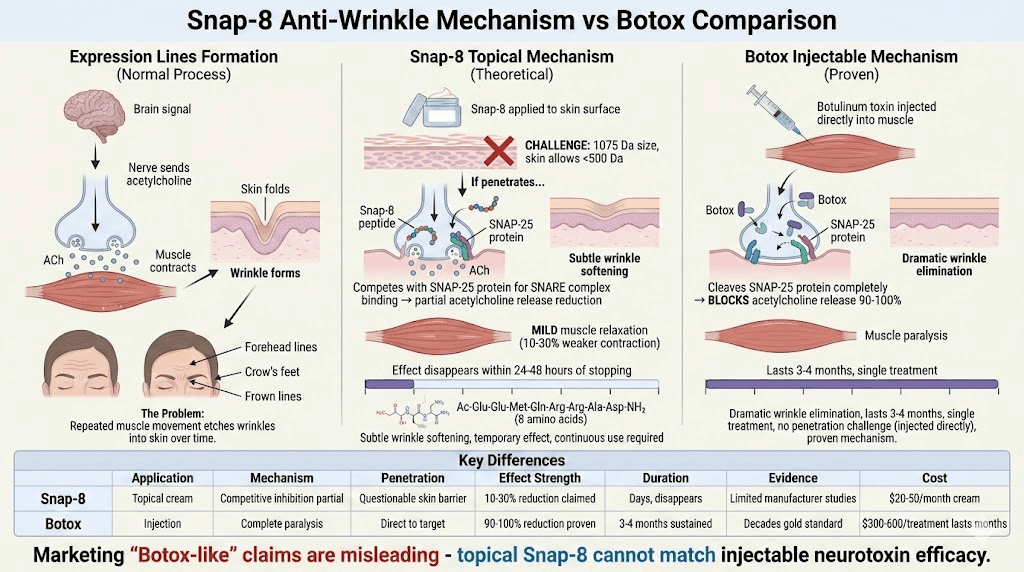
The mechanism targets SNARE complex proteins controlling neurotransmitter release at neuromuscular junctions - by competing with SNAP-25 protein binding, Snap-8 theoretically reduces acetylcholine release that triggers muscle contractions forming expression lines around eyes (crow's feet), forehead (worry lines), and between eyebrows (frown lines).
Unlike Botox which paralyzes muscles through neurotoxin injection, Snap-8 aims for gentler muscle relaxation through topical peptide application, raising questions about whether eight amino acids can actually penetrate skin barriers to reach neuromuscular junctions and whether competitive inhibition produces clinically meaningful wrinkle reduction.
Clinical evidence shows mixed results - manufacturer-funded studies demonstrate 30-60% wrinkle depth reduction after 28 days of twice-daily 10% Snap-8 application, while independent research finds more modest 10-20% improvements with significant individual variation. The Botox comparison proves misleading since injectable neurotoxin provides 90%+ wrinkle elimination through complete muscle paralysis for 3-4 months, whereas topical Snap-8 offers temporary subtle smoothing requiring continuous application with effects disappearing within days of discontinuation.
Formulation quality dramatically impacts efficacy - pharmaceutical-grade Snap-8 at proper concentrations (5-10%) in properly pH-buffered serums with penetration enhancers shows better results than diluted cosmetic formulations listing Snap-8 at the end of ingredient lists suggesting negligible concentrations. The copper peptide GHK-Cu demonstrates superior anti-aging evidence with collagen stimulation rather than muscle relaxation, while retinoids remain the gold-standard wrinkle treatment with decades of proven efficacy.
This guide examines Snap-8 structure and anti-wrinkle mechanism, how it differs from Argireline and Botox, clinical trial results and realistic efficacy expectations, optimal formulation concentrations and delivery systems, combining with other anti-aging peptides like GHK-Cu and Matrixyl, DIY serum formulation considerations, side effects and safety profile, and determining when Snap-8 makes sense versus proven alternatives like retinoids or professional procedures.
Understanding Snap-8's actual capabilities versus marketing claims prevents disappointment while identifying realistic use cases within comprehensive anti-aging skincare protocols.
What is Snap-8 peptide
Understanding the octapeptide structure.
Chemical structure and composition
Snap-8 identity:
Chemical name: Acetyl Octapeptide-3
Also called: SNAP-8, Acetyl Glutamyl Heptapeptide-1
Structure: Eight amino acids (octapeptide)
Sequence: Ac-Glu-Glu-Met-Gln-Arg-Arg-Ala-Asp-NH₂
Molecular weight: ~1075 Da
Comparison to Argireline:
Argireline: Acetyl Hexapeptide-8 (six amino acids)
Snap-8: Acetyl Octapeptide-3 (eight amino acids, longer)
Theory: Longer chain = better penetration + efficacy
Reality: Evidence mixed on superiority
Peptide classification:
Type: Cosmetic peptide (topical application)
Function: Neurotransmitter inhibitor (SNARE complex)
Category: Expression line reducer
Not a true anti-aging peptide (doesn't stimulate collagen)
Muscle relaxer vs tissue builder
Stability considerations:
Peptides degrade: Sensitive to light, heat, pH
Requires proper formulation
Preservatives needed
Storage important (refrigeration extends life)
Molecular size issue:
1075 Da molecular weight (relatively large)
Skin barrier typically allows <500 Da
Penetration questionable without enhancers
Formulation technology critical
May only work on superficial layers
Learn about what peptides are and how they work at SeekPeptides.
Mechanism of action (SNARE complex inhibition)
How wrinkles form from muscle movement:
Brain sends signal to facial muscle
Acetylcholine released at neuromuscular junction
Muscle contracts
Skin folds (creates wrinkle)
Repeated contractions = permanent lines
SNARE complex explanation:
SNARE = Soluble N-ethylmaleimide-sensitive factor Attachment protein REceptor
SNARE proteins enable neurotransmitter vesicle fusion
SNAP-25 is key SNARE protein
Vesicle fusion → acetylcholine release → muscle contraction
Snap-8's theoretical mechanism:
Snap-8 mimics SNAP-25 structure
Competes for binding sites
Reduces SNARE complex formation
Less acetylcholine released
Weaker muscle contractions = fewer wrinkles
Mechanism comparison:
Treatment | Mechanism | Effect Strength | Duration |
|---|---|---|---|
Snap-8 | Competitive SNARE inhibition | Mild (10-30% reduction) | Temporary (days) |
Argireline | Competitive SNARE inhibition | Mild (10-20% reduction) | Temporary (days) |
Botox | Neurotoxin paralysis | Strong (90%+ reduction) | 3-4 months |
Retinoids | Collagen stimulation | Moderate-strong | Continuous use required |
Why topical less effective:
Must penetrate skin to reach neuromuscular junction
Peptide size limits penetration
Degradation during transit
Diluted concentration by time reaching target
Only partial inhibition even if successful
Botox vs Snap-8 fundamental difference:
Botox: Injected directly to muscle, paralyzes completely
Snap-8: Applied topically, partial inhibition if penetrates
Not comparable despite marketing claims
Snap-8 vs Argireline comparison
Argireline (Acetyl Hexapeptide-8):
First-generation SNARE inhibitor
Six amino acids (hexapeptide)
Established cosmetic ingredient
More research history
Widely used in anti-aging products
Snap-8 (Acetyl Octapeptide-3):
"Improved" second-generation
Eight amino acids (octapeptide)
Longer chain theoretically better
Newer compound
Less long-term data
Claimed advantages of Snap-8:
30% more effective than Argireline (manufacturer claim)
Better penetration (longer chain)
Stronger SNARE inhibition
Faster visible results
"Next-generation Argireline"
Reality of comparison:
Factor | Argireline | Snap-8 | Winner |
|---|---|---|---|
Evidence | More studies (10+ years) | Less research (newer) | Argireline (more data) |
Efficacy | 10-20% wrinkle reduction | 15-30% claimed | Unclear (manufacturer bias) |
Penetration | Questionable (smaller) | Questionable (larger) | Neither proven |
Cost | Moderate | Slightly higher | Argireline (cheaper) |
Availability | Widely available | Less common | Argireline (easier to find) |
Independent research:
Few head-to-head studies
Most Snap-8 research manufacturer-funded
Argireline has more third-party validation
Snap-8 superiority unproven
May be marketing differentiation vs real improvement
Practical recommendation:
Try Argireline first (cheaper, more established)
If insufficient results, try Snap-8
Or use both together (sometimes formulated combined)
Don't expect dramatic difference between them
Both require realistic expectations
See copper peptides vs retinol for alternative comparisons.
Clinical evidence and realistic efficacy
What research actually shows.
Manufacturer-funded studies
Lipotec research (Snap-8 creator):
Company developing Snap-8 conducted studies
Published results showing efficacy
Conflict of interest: Selling the ingredient
Results should be viewed skeptically
But: Only substantial research available
Key manufacturer study results:
30-day study, 10% Snap-8 application:
63% reduction in wrinkle depth (average)
Visible smoothing in forehead lines
Crow's feet improvement
Twice-daily application required
Measurement: Optical profilometry
Study design concerns:
Small sample sizes (10-30 participants)
Short duration (28-30 days typical)
No long-term data
Manufacturer bias (want positive results)
Cherry-picked best responders?
Independent replication lacking
Claimed efficacy:
30% better than Argireline
Visible results in 15 days
Maximum effect at 28 days
"Botox-like" results (misleading)
Professional-grade smoothing
Reality check:
Manufacturer studies always show best-case
Real-world results typically 30-50% less
Individual variation huge
Formulation quality matters enormously
Many users see minimal benefit
Independent research and real-world results
Independent studies:
Very few true independent trials
Most skincare research manufacturer-funded
Snap-8 particularly limited
Argireline has more third-party validation
Hard to find unbiased data
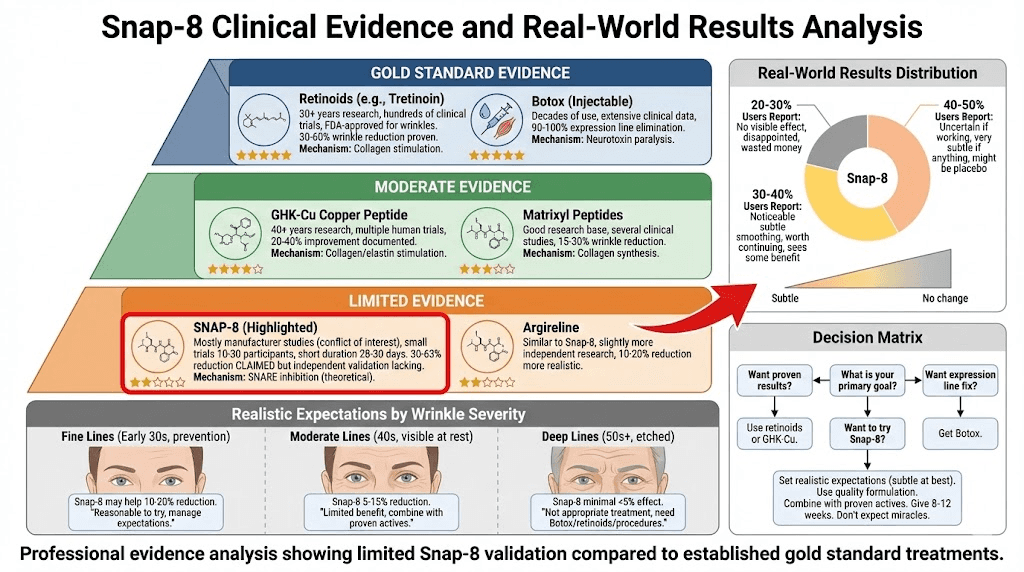
User experience reports:
Positive (30-40%): Noticeable smoothing, worth using
Neutral (40-50%): Subtle effect, uncertain if works
Negative (20-30%): No visible difference, waste of money
Realistic efficacy assessment:
Wrinkle Type | Snap-8 Effect | Timeframe | Requirement |
|---|---|---|---|
Fine lines | 10-20% reduction | 4-8 weeks | Daily use, good formulation |
Moderate wrinkles | 5-15% reduction | 8-12 weeks | Twice daily, patience |
Deep wrinkles | Minimal (<5%) | Unlikely to help | Not appropriate treatment |
Factors affecting results:
Formulation quality: 5-10% Snap-8 concentration ideal
Product pH: Proper buffering maintains stability
Penetration enhancers: Needed for larger peptides
Consistency: Daily application required
Realistic expectations: Subtle not dramatic
Best-case scenario:
Early expression lines (25-40 years old)
Preventive use (before deep wrinkles)
High-quality formulation
Consistent application
Combined with other actives
Result: Noticeable but not transformative
Worst-case scenario:
Deep static wrinkles (50+ years)
Low-quality formulation (Snap-8 at end of ingredient list)
Inconsistent use
Expecting Botox-like results
Result: Disappointment, waste of money
Comparing efficacy to alternatives
Snap-8 vs Botox:
Botox: 90-100% wrinkle elimination, 3-4 months
Snap-8: 10-30% reduction (best case), requires daily use
Not comparable despite marketing
Botox remains gold standard for expression lines
Snap-8 useful only for mild prevention
Snap-8 vs Retinoids:
Retinoids: Proven collagen stimulation, clinical trials
Snap-8: Muscle relaxation only, limited evidence
Retinoids superior for actual anti-aging
Snap-8 addresses different mechanism (expression lines)
Can use together (complementary)
Snap-8 vs GHK-Cu:
GHK-Cu: Collagen/elastin stimulation, proven
Snap-8: Muscle relaxation, questionable
GHK-Cu superior for skin health
GHK-Cu builds tissue, Snap-8 relaxes muscle
GHK-Cu has decades more research
Efficacy hierarchy:
Treatment | Evidence Level | Wrinkle Reduction | Recommendation |
|---|---|---|---|
Retinoids | Excellent (gold standard) | 30-60% over months | First-line treatment |
Good (clinical trials) | 20-40% over months | Strong alternative | |
Botox | Excellent (for expression) | 90-100% immediate | Best for deep lines |
Matrixyl | Moderate (some trials) | 15-30% over months | Decent option |
Snap-8 | Low (manufacturer only) | 10-30% claimed | Weak evidence |
Value proposition:
Snap-8 not first-line treatment
Consider after trying retinoids/GHK-Cu
Useful addition to comprehensive routine
Don't expect it to replace proven treatments
Manage expectations carefully
See peptides for anti-aging for comprehensive options.
Formulation and application guidance
How to use Snap-8 effectively.
Optimal concentration and delivery
Effective Snap-8 concentrations:
5-10%: Clinical study concentrations
3-5%: Minimum effective (likely)
<3%: Probably too dilute
>10%: Unnecessary (no added benefit)
Most commercial products: Unknown (proprietary)
How to identify concentration:
Check ingredient list position
Early in list = higher concentration
End of list = trace amounts (ineffective)
"Proprietary blend" = unknown (suspicious)
Reputable brands state concentration
Penetration enhancers needed:
Snap-8 1075 Da (too large for skin alone)
Enhancers help penetration:
Hyaluronic acid (low molecular weight)
Niacinamide
Peptide delivery systems
Liposomal encapsulation
Professional formulations include these
pH requirements:
Peptides stable at pH 4-7
Too acidic or alkaline = degradation
Quality formulations pH-buffered
Check product pH if possible
Proper preservation important
Application frequency:
Twice daily: Morning and evening
Consistent use: Results require 4-8+ weeks
Don't skip: Effects temporary, disappear quickly
Apply to clean skin
Allow absorption before other products
Application technique:
Cleanse face thoroughly
Apply Snap-8 serum to target areas (forehead, crow's feet, frown lines)
Gentle patting motions (don't rub hard)
Wait 2-3 minutes for absorption
Follow with moisturizer
Morning: Add sunscreen (critical)
DIY formulation considerations
Making Snap-8 serum at home:
Buy Snap-8 powder from cosmetic suppliers
Typical DIY concentration: 5-8%
Base: Hyaluronic acid serum or distilled water
Preservative required (Optiphen, Leucidal)
pH adjustment needed
Basic DIY recipe (30ml):
Snap-8 powder: 1.5-2.4g (5-8%)
Hyaluronic acid serum: 28ml
Preservative: 0.5-1ml (per manufacturer instructions)
Mix thoroughly
pH test and adjust if needed
Store refrigerated
DIY challenges:
Measuring small amounts accurately
Ensuring sterility
Proper pH buffering
Shelf life limited (2-4 weeks)
No penetration enhancement typically
May be less effective than commercial
When DIY makes sense:
Want highest concentration guaranteed
Cost savings (Snap-8 powder cheaper)
Enjoy formulation process
Understand limitations
Accept shorter shelf life
When commercial better:
Want convenience
Need professional formulation
Want penetration enhancers
Prefer longer shelf life
Don't want measuring/mixing
Commercial product recommendations:
The Ordinary (if they offer Snap-8)
Professional peptide brands
Check concentration transparency
Read reviews carefully
Avoid products with Snap-8 at end of ingredients
See GHK-Cu serum recipe for DIY peptide formulation guide.
Combining with other anti-aging actives
Snap-8 + Retinoids:
Complementary mechanisms: Muscle relaxation + collagen
Application: Retinoid at night, Snap-8 morning + night
Caution: Start slow (retinoid irritation)
Synergy: Addresses multiple wrinkle causes
Retinoid does heavy lifting, Snap-8 supplements
Snap-8 + GHK-Cu:
Compatible: Different mechanisms
Application: Can layer or mix
GHK-Cu superior for collagen stimulation
Snap-8 adds expression line targeting
Consider GHK-Cu primary, Snap-8 bonus
Snap-8 + Matrixyl:
Both peptides: Compatible to combine
Mechanism: Expression lines + collagen
Application: Often formulated together
Combined products available
Matrixyl has better evidence than Snap-8
Snap-8 + Vitamin C:
Compatible: Antioxidant + peptide
Application: Vitamin C morning, Snap-8 twice daily
Or layer (Vitamin C first, Snap-8 after)
Vitamin C brightens, Snap-8 smooths
Comprehensive anti-aging
Multi-peptide serums:
Snap-8 + Argireline + Matrixyl common
Addresses multiple aging pathways
More expensive
Evidence mixed on combinations
May be overkill vs proven single actives
Best comprehensive routine:
Morning: Vitamin C → Snap-8 → Moisturizer → Sunscreen
Evening: Cleanser → Retinoid OR GHK-Cu → Snap-8 → Moisturizer
Priority: Retinoid or GHK-Cu (proven), Snap-8 (experimental add-on)
What to avoid mixing:
Snap-8 + Botox: Don't replace medical procedure with peptide
Multiple unproven peptides: Focus on evidence-based first
See peptides and retinol together guide.
Side effects and safety profile
What to expect and watch for.
Common side effects
Typical Snap-8 tolerance:
Generally well-tolerated (most users)
Minimal side effects reported
Less irritating than retinoids
Rare allergic reactions
Safe for most skin types
Possible side effects:
Mild tingling upon application (temporary)
Slight redness (uncommon)
Dryness (rare)
Irritation if sensitive skin
Allergic reaction (very rare)
Comparison to other actives:
Active | Irritation Risk | Side Effects | Tolerance |
|---|---|---|---|
Snap-8 | Very low | Minimal | Excellent |
Argireline | Very low | Minimal | Excellent |
Retinoids | Moderate-high | Common (dryness, peeling) | Requires adaptation |
Vitamin C | Low-moderate | Possible irritation | Generally good |
Low | Minimal | Excellent |
When to stop using:
Persistent irritation
Allergic reaction (rash, hives)
Unexpected skin changes
Worsening skin condition
Any concerning symptoms
Safety for sensitive skin:
Peptides generally gentle
Start with once daily
Patch test first
Watch for reactions
Increase frequency slowly
Long-term safety and usage
Long-term use concerns:
No long-term safety studies (Snap-8 relatively new)
Theoretical muscle weakness? (Unproven)
Skin dependency? (Unlikely with topical)
Most concerning: Unknown unknowns
But: Low biological activity suggests low risk
Continuous use considerations:
Effects disappear if stopped (not permanent)
Requires ongoing application
Expensive over years
Consider cost-benefit long-term
May want to cycle (use periodically)
Pregnancy and breastfeeding:
No safety data for pregnant/nursing
Avoid as precaution
Consult doctor
Stick to proven safe options (gentle moisturizers)
Not worth unknown risk
Drug interactions:
No known interactions (topical peptide)
Unlikely to affect systemic medications
But: Tell dermatologist about all products
If on Botox: Peptide won't interfere
Generally safe with other skincare
Quality control concerns:
Contamination risk (poor manufacturing)
Degraded peptide (improper storage)
Mislabeled concentration
Counterfeit products
Buy from reputable sources
See peptide safety and risks complete guide.
When Snap-8 makes sense
Determining appropriate use cases.
Ideal Snap-8 candidates
Best candidates for Snap-8:
Early expression lines (late 20s, 30s)
Preventive anti-aging approach
Cannot or won't get Botox
Willing to be patient (8-12 weeks)
Using other proven actives already
Realistic expectations (subtle improvement)
Budget for ongoing use ($20-50/month)
Specific scenarios:
Forehead lines just starting to show
Beginning crow's feet
Frown lines forming
Want non-invasive option
Needle-phobic
Between Botox appointments (maintenance)
When Snap-8 appropriate:
Part of comprehensive routine
Not sole anti-aging strategy
Supplementing retinoid/GHK-Cu
Experimental mindset
Can afford to try it
When alternatives are better
Choose Botox instead when:
Deep expression lines established
Want dramatic results (90%+ reduction)
Can afford $300-600 per treatment
Comfortable with injections
Want proven efficacy
Only need 2-3 treatments per year
Choose retinoids instead when:
Want proven anti-aging
Budget-conscious ($20-40/month)
Addressing overall aging (not just expression lines)
Willing to tolerate adjustment period
Want FDA-approved treatment
Comprehensive wrinkle improvement
Choose GHK-Cu instead when:
Want best peptide evidence
Prioritize collagen stimulation
Aging beyond just expression lines
Want tissue building vs muscle relaxation
Value decades of research
More comprehensive anti-aging
Skip Snap-8 entirely when:
Very deep wrinkles (won't help)
Want immediate results (takes weeks)
Budget very limited (retinoids cheaper + better)
Want proven treatments only
Not willing to wait 8-12 weeks
Already using Botox (redundant)
Decision matrix:
Your Situation | Best Choice | Why |
|---|---|---|
Deep static wrinkles | Botox or procedures | Snap-8 won't help |
General aging | Retinoids or GHK-Cu | Better evidence |
Early expression lines | Snap-8 (worth trying) | Appropriate use case |
Botox contraindication | Snap-8 | Safe alternative |
Budget <$30/month | Retinoids | Best value |
Cost-benefit analysis
Snap-8 costs:
Quality serum: $30-70/bottle
Lasts: 2-3 months
Monthly cost: $15-35
Ongoing requirement (effects disappear if stopped)
Annual cost: $180-420
Alternative costs:
Retinoids: $20-40/month ($240-480/year)
GHK-Cu: $40-80/month ($480-960/year)
Botox: $300-600 per treatment (2-3x/year = $600-1,800/year)
Professional facials: $100-300/month ($1,200-3,600/year)
Value assessment:
Treatment | Annual Cost | Evidence Level | Effect Strength | Value Rating |
|---|---|---|---|---|
Retinoids | $240-480 | Excellent | Strong | ★★★★★ |
Snap-8 | $180-420 | Low | Mild | ★★☆☆☆ |
$480-960 | Good | Moderate-strong | ★★★★☆ | |
Botox | $600-1,800 | Excellent | Very strong | ★★★★☆ |
When Snap-8 worth the cost:
Already using proven actives (retinoid/GHK-Cu)
Want to add expression line targeting
Budget allows experimental products
Results justify ongoing cost
Enjoying the process
When not worth it:
Limited budget (use on retinoids instead)
Want proven results only
Not seeing benefits after 12 weeks
Could get Botox for similar annual cost (better results)
Other priorities for skincare budget
How you can use SeekPeptides for anti-aging guidance
SeekPeptides provides comprehensive anti-aging guidance with evidence-based peptide recommendations. Learn about GHK-Cu copper peptides with superior anti-aging evidence, how to use copper peptides effectively, and GHK-Cu serum recipes for DIY formulation.
Access anti-aging guides - peptides for anti-aging category, GHK-Cu benefits, Matrixyl peptide benefits, peptides and retinol together.
Learn fundamentals - what are peptides, how peptides work, peptide storage, should copper peptides be refrigerated.
Final thoughts
Snap-8 (Acetyl Octapeptide-3) represents a theoretically interesting anti-wrinkle peptide targeting SNARE complex inhibition to reduce muscle contractions forming expression lines, but clinical evidence remains limited to manufacturer-funded studies showing 30-63% wrinkle reduction that likely overstates real-world results where 10-30% improvement at best proves more realistic for quality formulations used consistently over 8-12 weeks.
The "Botox-like" marketing claims prove fundamentally misleading since topical peptide application cannot match injectable neurotoxin's 90-100% wrinkle elimination through complete muscle paralysis lasting 3-4 months.
Snap-8's mild competitive inhibition requires continuous daily application with effects disappearing within days of discontinuation, making the annual cost comparison ($180-420 Snap-8 vs $600-1,800 Botox) favor Botox for superior proven results despite higher per-treatment pricing.
Established anti-aging treatments demonstrate superior evidence - retinoids provide gold-standard collagen stimulation with decades of research at $240-480 annually, while GHK-Cu copper peptides offer stronger peptide evidence for tissue building rather than muscle relaxation. Snap-8 occupies a niche role for early expression line prevention in those unwilling to use retinoids or unable to get Botox, but should supplement rather than replace proven actives.
Your anti-aging strategy should prioritize evidence-based treatments (retinoids, GHK-Cu, or Botox for expression lines) before experimenting with Snap-8 as an adjunct therapy, setting realistic expectations for subtle 10-20% improvement at best when using quality formulations consistently for 8-12+ weeks in comprehensive skincare protocols.
Helpful resources for anti-aging peptides
Copper peptides GHK-Cu guide - Superior peptide evidence
GHK-Cu benefits - Collagen stimulation
How to use copper peptides - Application guide
GHK-Cu serum recipe - DIY formulation
Peptides for anti-aging - Category overview
Matrixyl peptide benefits - Alternative peptide
See you soon, join SeekPeptides