Jan 16, 2026
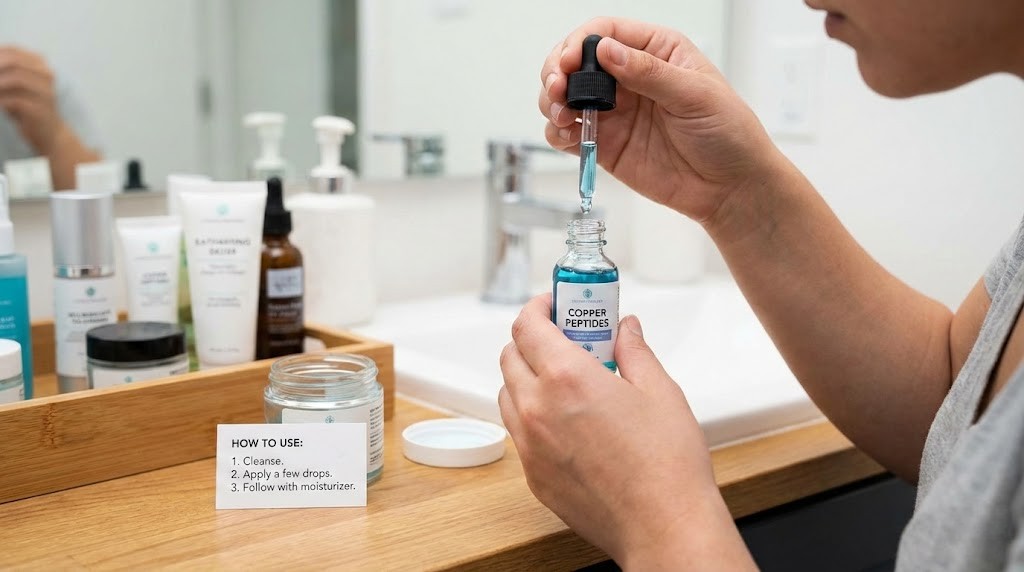
You bought the copper peptide serum. It arrived in its dark glass bottle, promising younger skin, thicker hair, faster healing. You're ready to start. But then the questions hit.
When do you apply it? Before or after moisturizer? Morning or night? Can you use it with your retinol? What about vitamin C? How much is enough? How much is too much?
These aren't trivial details. Using copper peptides incorrectly doesn't just waste product. It can reduce effectiveness, cause irritation, or create interactions that harm rather than help your skin. The difference between mediocre results and transformative results often comes down to application technique.
This guide covers everything about using copper peptides correctly. From basic application steps to advanced layering strategies. From topical serums to injectable protocols. From your first week to long-term maintenance. By the end, you'll know exactly how to incorporate these powerful peptides into your routine for maximum benefit.
The fundamentals of copper peptide application
Before diving into specific routines, understand the principles that guide all copper peptide use. These fundamentals apply whether you're using a serum, cream, or other format.
Clean skin absorbs better
Always apply copper peptides to freshly cleansed skin. Dirt, oil, makeup, and product residue create barriers that prevent peptides from penetrating effectively. The cleaner your skin, the more product actually reaches the cells where it works.
Use a gentle cleanser that doesn't strip your skin. Harsh cleansers can damage the skin barrier, making it more sensitive to active ingredients. A compromised barrier also reduces absorption efficiency, the opposite of what you want.
Slightly damp skin enhances absorption
Many practitioners recommend applying copper peptide products to slightly damp skin rather than completely dry skin. The moisture helps the product spread evenly and may enhance penetration. Don't apply to dripping wet skin. Pat dry with a towel until skin feels just barely damp, then apply immediately.
Thin to thick layering order
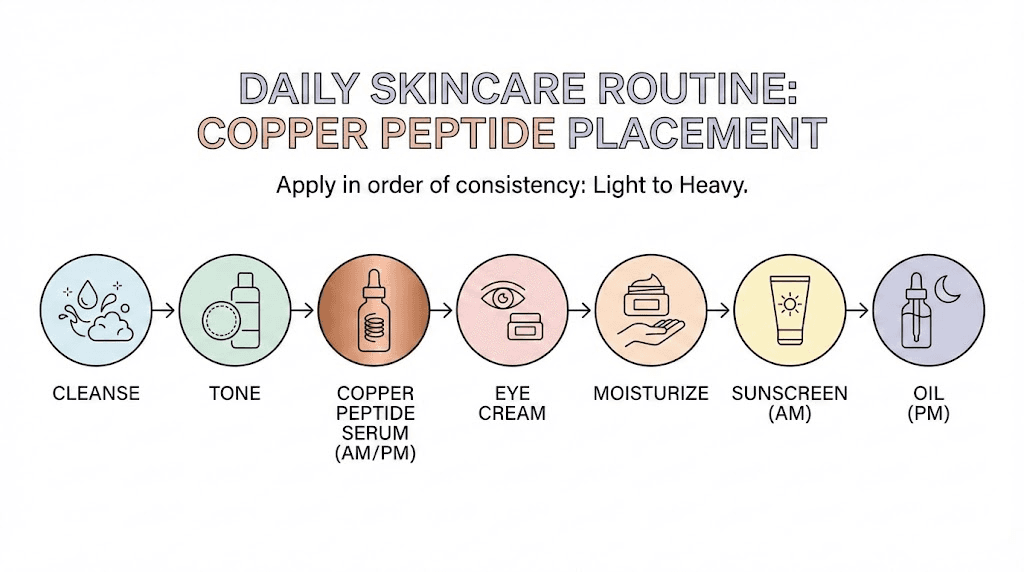
Skincare products should be applied from thinnest consistency to thickest. This ensures each layer can penetrate properly without being blocked by heavier products. Copper peptide serums are typically water-based and lightweight, so they go on early in your routine, after cleansing but before moisturizers and oils.
If you apply a thick cream first, it creates a barrier that blocks your serum from reaching deeper skin layers. The peptides sit on the surface rather than penetrating where they can signal cells to regenerate.
Less is more
Copper peptide products are concentrated. You don't need much to cover your face. A few drops of serum, spread evenly, provides adequate coverage. Using more doesn't improve results and may increase irritation risk while wasting product.
Start with the minimum effective amount. You can always add more if needed, but you can't undo over-application once it's on your skin.
Step-by-step morning routine with copper peptides
Morning application focuses on protection and preparation for the day ahead. Here's the optimal sequence for incorporating copper peptides into your AM routine.
Step 1: Cleanse
Start with a gentle cleanser to remove overnight oil production and any residue from evening products. If your skin doesn't feel dirty in the morning, a simple water rinse may suffice. The goal is a clean slate without over-stripping.
Step 2: Tone (optional)
If you use a toner, apply it after cleansing. Choose a hydrating, alcohol-free formula rather than astringent toners that can dry skin. The toner prepares your skin to receive subsequent products.
Step 3: Apply copper peptide serum
Dispense a few drops of copper peptide serum onto your fingertips. Dot across your face, covering forehead, cheeks, nose, and chin. Gently press and pat the serum into your skin using upward motions. Don't rub vigorously.
Allow the serum to absorb for one to two minutes before proceeding to the next step. You should feel your skin becoming slightly tacky as the serum absorbs. If it remains wet and slippery, you may have applied too much.
Step 4: Apply hydrating serum (optional)
If you use hyaluronic acid or other hydrating serums, apply them now. These complement copper peptides well and don't interfere with their function.
The added hydration actually supports copper peptide efficacy by maintaining a healthy skin barrier.
Step 5: Apply moisturizer
Follow with your regular moisturizer. This seals in the serums below and provides additional hydration. Choose a moisturizer appropriate for your skin type, whether that's a light gel for oily skin or a richer cream for dry skin.
Step 6: Apply sunscreen
Finish your morning routine with broad-spectrum SPF 30 or higher. Sunscreen is essential regardless of what other products you use. UV damage accelerates aging and can counteract the regenerative benefits of copper peptides.
Wait two to three minutes after applying sunscreen before makeup application to allow it to set properly.
Step-by-step evening routine with copper peptides
Evening is when your skin shifts into repair mode. Copper peptides work particularly well at night because they support the natural regeneration processes that occur during sleep.
Step 1: Remove makeup (if applicable)
Use an oil cleanser, micellar water, or dedicated makeup remover to dissolve makeup and sunscreen. This first cleanse removes the bulk of surface debris.
Step 2: Cleanse
Follow with your regular cleanser to ensure skin is thoroughly clean. Double cleansing in the evening is particularly important if you wore makeup or sunscreen during the day. Any residue left behind will impair copper peptide absorption.
Step 3: Tone (optional)
Apply toner if part of your routine. Evening is a good time for slightly more active toners if you use them, though avoid strong acids immediately before copper peptides.
Step 4: Apply copper peptide serum
Same technique as morning. A few drops, dotted across the face, pressed gently into skin. The evening application is arguably more important than morning because it supports overnight repair processes.
If you're using copper peptides only once daily, evening is the time to prioritize. The extended contact time during sleep, without sunscreen or makeup over it, allows maximum absorption and activity.
Step 5: Apply treatment products (carefully)
If you use other treatment products like retinol, this is where they'd go. However, be cautious about layering multiple actives with copper peptides. More on ingredient interactions below.
Step 6: Apply eye cream (optional)
If you use a separate eye cream, apply it now. Some copper peptide serums are gentle enough for the eye area, but check product instructions. The under-eye skin is thinner and more sensitive than the rest of your face.
Step 7: Apply moisturizer or night cream
Finish with a moisturizer suitable for overnight wear. Evening moisturizers can be richer than daytime ones since you don't need to worry about makeup application or greasiness under sunscreen.
Step 8: Apply facial oil (optional)
If you use facial oils, they go last due to their occlusive nature. Oils create a barrier that locks in everything beneath them. Applying oil before copper peptides would block absorption.
Frequency: how often to use copper peptides
Application frequency significantly impacts both results and tolerance. Finding your optimal frequency prevents irritation while maximizing benefits.
For beginners
Start slowly. Apply copper peptides every other day, or even every third day, for the first two weeks. This allows your skin to adjust to the new active ingredient without overwhelming it.
Monitor your skin during this introduction period. Mild tingling immediately after application is normal. Persistent redness, burning, or breakouts suggest you're using too much too soon.
After two weeks with no problems, increase to daily application. After another two weeks of daily use, you can try twice daily (morning and evening) if desired.
For experienced users
Once your skin has adapted, most people do well with daily or twice-daily application. There's no strict requirement for twice daily. Many users see excellent results with evening-only use, which simplifies morning routines.
The optimal frequency is the one that gives you good results without irritation. Some skins thrive with twice-daily copper peptides. Others do better with once daily or even every other day long-term. Pay attention to your skin's feedback.
Signs you're using too frequently
Overuse manifests as persistent redness that doesn't fade between applications. Increased sensitivity to products that previously didn't bother you.
Skin feeling tight, dry, or uncomfortable despite adequate moisturizing. Breakouts or irritation that doesn't match normal purging patterns.
If you experience these symptoms, reduce frequency immediately. Drop back to every other day until symptoms resolve, then gradually increase again if desired.
Cycling considerations
Some practitioners recommend periodic breaks from copper peptides to maintain receptor sensitivity. The theory is that continuous stimulation may lead to diminished response over time.
A common cycling approach is eight weeks on, two weeks off. During the off period, you can use other beneficial ingredients that you might have been avoiding due to copper peptide interactions. There's limited research on whether cycling is truly necessary, but it's unlikely to harm and may help maintain long-term efficacy.
Timing: morning versus night
Both morning and evening application work. The choice depends on your routine, other products you use, and personal preference.
Why evening is often preferred
Copper peptides support skin repair and regeneration. These processes naturally accelerate at night during sleep. Applying copper peptides before bed aligns product activity with your body's biological rhythms.
Evening application also avoids potential interactions with daytime products. If you use vitamin C in the morning, which many people do for its antioxidant protection, keeping copper peptides in the evening prevents any compatibility issues.
The extended contact time during sleep, without interference from sunscreen, makeup, or environmental factors, may enhance absorption and effectiveness.
When morning works better
If your evening routine already includes strong actives like prescription retinoids, adding copper peptides may be too much.
In this case, morning application makes sense.
Some people simply prefer applying active products in the morning when they have more time and attention.
A consistent morning routine that you actually follow beats an ideal evening routine that you skip.
Twice daily application
For maximum benefit, you can use copper peptides both morning and evening. This doubles your exposure to the active ingredient. However, it also doubles the potential for irritation and requires managing ingredient interactions at both times of day.
Twice daily is most appropriate for experienced users whose skin tolerates the ingredient well and who aren't using other strong actives. Beginners should stick to once daily until they understand how their skin responds.
Ingredient interactions: what to use and avoid
Not all skincare ingredients play well with copper peptides. Understanding interactions helps you build an effective routine without causing problems.
Ingredients to avoid combining directly
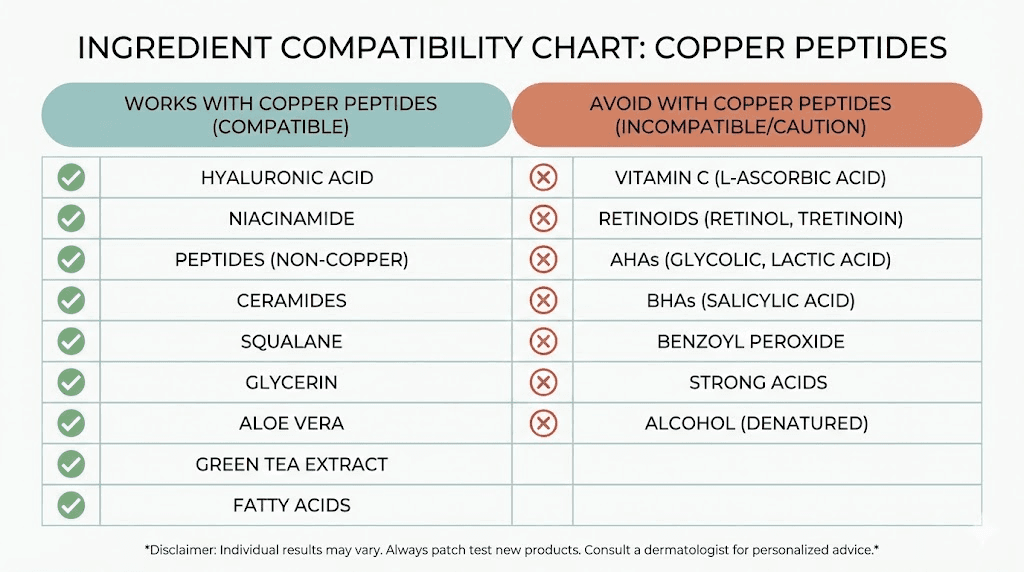
Vitamin C (L-ascorbic acid): The copper peptide and vitamin C interaction is well-documented. Copper can oxidize vitamin C, reducing its effectiveness. Simultaneously, low-pH vitamin C environments can destabilize copper peptides. Use these at different times of day or on alternate days.
Strong acids (AHAs/BHAs): Glycolic acid, salicylic acid, lactic acid, and other exfoliating acids work best at low pH levels that can compromise copper peptide stability. Additionally, combining exfoliation with copper peptides increases irritation risk. Separate these by using acids in the morning and copper peptides at night, or on alternate days.
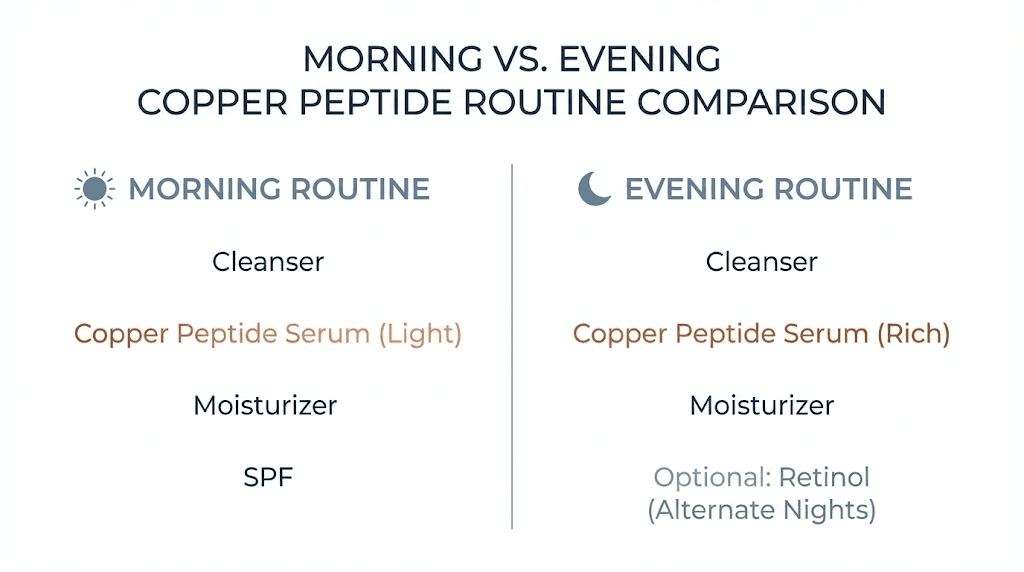
Retinoids: Both copper peptides and retinoids are active ingredients that affect cell turnover. Using them together may be too aggressive for many skin types. If you want to use both, apply them on alternate nights or use copper peptides in the morning and retinol at night.
Ingredients that work well together
Hyaluronic acid: This hydrating ingredient complements copper peptides beautifully. It doesn't interfere with peptide function and helps maintain the healthy hydration levels that support copper peptide efficacy.
Niacinamide: This B vitamin supports barrier health and reduces redness, potentially offsetting any irritation from copper peptides. The two work synergistically for overall skin improvement.
Ceramides: Barrier-supporting ingredients like ceramides protect skin while allowing copper peptides to work. They're especially helpful during the introduction period when skin may be more sensitive.
Squalane and gentle oils: Non-comedogenic oils can follow copper peptide application to lock in the treatment and provide additional hydration without interference.
Timing strategies for incompatible ingredients
If you want to use copper peptides alongside potentially incompatible ingredients, separate them by time.
Option one: Use copper peptides in the evening, vitamin C and acids in the morning. This separation allows each ingredient to work without interference.
Option two: Alternate days. Use copper peptides Monday, Wednesday, Friday. Use retinol Tuesday, Thursday, Saturday. Sunday can be a rest day for your skin.
Option three: Alternate weeks. Use copper peptides for one week, then switch to another active for the following week. This approach works for people who find even alternate-day application too irritating.
Application for specific concerns
While the basic application principles remain the same, you can optimize your approach for specific skin concerns.
For anti-aging and wrinkles
Copper peptides for wrinkles work best with consistent, long-term use. Apply to areas of concern, including forehead lines, crow's feet, and nasolabial folds. Don't neglect the neck, which often shows aging signs before the face.
For anti-aging purposes, evening application may be most effective since it aligns with overnight repair cycles. Pair with a firming moisturizer to support collagen production.
For acne scars
Copper peptides help fade acne scars by promoting tissue remodeling and collagen synthesis. Apply directly to scarred areas, not just as an all-over treatment. The wound-healing properties target damaged tissue specifically.
Be patient. Scar improvement takes months, not weeks. Consistency matters more than intensity.
Twice-daily targeted application may accelerate results, but once daily still works given enough time.
For hair growth
Copper peptides for hair require different application than facial skincare. Apply directly to the scalp rather than hair strands. Use your fingertips to massage the product into thinning areas, which also stimulates blood flow.
Scalp application works best on clean, slightly damp scalp after washing. You can use copper peptides daily on the scalp since this skin is less sensitive than facial skin for most people.
Results typically take three to six months to become visible.
For wound healing
Copper peptides support wound healing through their regenerative signaling. For minor cuts, scrapes, or post-procedure healing, apply a thin layer of copper peptide product directly to the healing area once or twice daily.
Do not apply to open, bleeding wounds. Wait until initial wound closure has occurred. Copper peptides support the remodeling and maturation phases of healing rather than the initial clotting phase.
Using copper peptides with microneedling
Combining copper peptides with microneedling enhances penetration and results, but requires specific technique.
Why this combination works
Microneedling creates tiny channels in the skin that dramatically improve product absorption. Studies suggest up to three-fold increases in penetration. When you apply copper peptides immediately after microneedling, much more active ingredient reaches deeper skin layers where dermal cells reside.
Additionally, microneedling triggers wound healing responses. Copper peptides amplify these responses, creating synergistic benefits beyond either treatment alone.
Application protocol
After microneedling, apply copper peptide serum immediately while channels remain open. The absorption window lasts roughly 30 minutes to an hour after needling.
Use a sterile, high-quality product. Microneedling bypasses the skin's normal protective barrier, so anything you apply enters more directly. Contaminated or low-quality products pose greater risk in this context.
Do not microneedle and apply copper peptides on the same area more than once weekly. The skin needs recovery time between sessions. Over-needling combined with active ingredients can cause excessive irritation and barrier damage.
Post-microneedling care
After applying copper peptides post-microneedling, keep your routine minimal for 24 hours. Avoid other active ingredients. Use gentle, hydrating products only. Stay out of direct sun and avoid swimming or excessive sweating.
Expect some redness and sensitivity for 24-48 hours post-procedure. This is normal. Severe pain, excessive swelling, or signs of infection are not normal and warrant medical attention.
Injectable copper peptide protocols
For those using injectable GHK-Cu, application differs significantly from topical products.
Reconstitution
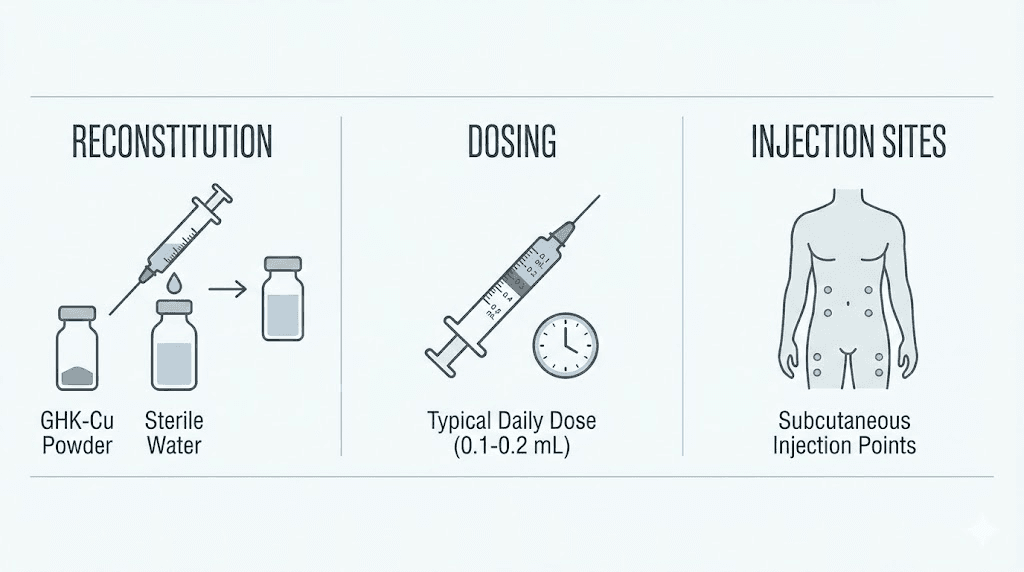
Reconstituting copper peptides requires bacteriostatic water and sterile technique. The peptide reconstitution calculator helps determine the correct water volume for your desired concentration.
Add bacteriostatic water slowly, directing the stream against the vial wall rather than directly onto the peptide powder. Swirl gently to mix. Never shake, as this can damage the peptide structure. Reconstituted GHK-Cu should be stored in the refrigerator and used within a few weeks.
Injection technique
Injectable peptides like GHK-Cu are typically administered subcutaneously. Common injection sites include the abdominal area and thigh. Rotate injection sites to prevent tissue damage from repeated use of the same location.
Clean the injection site with an alcohol swab. Pinch the skin to create a fold. Insert the needle at a 45-degree angle. Inject slowly. Remove the needle and apply gentle pressure if needed.
The complete injection guide provides detailed instructions for proper subcutaneous technique.
Dosing protocols
Standard GHK-Cu dosing typically ranges from 1-2mg daily for general protocols. Some protocols suggest 2-5mg administered several times weekly for more intensive applications.
Beginners should start at the lower end of dosing ranges and increase gradually based on tolerance and response. Injectable protocols often run for four to six weeks followed by a rest period to maintain receptor sensitivity.
Consult the dosage chart for specific protocols based on your goals, whether that's anti-aging, hair growth, or wound healing.
Building your copper peptide routine from scratch
If you're starting fresh with copper peptides, here's how to build an effective routine step by step.
Week one: introduction
Start with a simple routine. Cleanse, apply copper peptide serum, moisturize. Do this in the evening only, every other day. No other active ingredients.
This minimal approach lets you assess how your skin responds to copper peptides specifically without confusion from other variables. Watch for irritation, but also note any positive changes like improved hydration or skin feel.
Week two: establish consistency
If week one went well, increase to daily evening application. Maintain the simple routine. Continue monitoring your skin.
Some people experience purging during this period.
Refer to the purging guide to distinguish between normal adjustment and genuine problems.
Weeks three and four: expand if desired
After two weeks of successful daily use, you can experiment with twice-daily application if desired. You can also begin reintroducing other products you may have paused.
Add back products one at a time, waiting a few days between each addition. This way, if problems occur, you can identify the cause.
Month two and beyond: optimize
By now you should understand how your skin responds to copper peptides. Optimize your routine based on what you've learned.
Maybe you discover evening-only works best for you. Maybe you can tolerate copper peptides with your other actives. Maybe you prefer a higher or lower concentration product.
This is the time to fine-tune based on personal experience.
Sample beginner routine
Morning: Gentle cleanser, hydrating serum, moisturizer, sunscreen
Evening: Gentle cleanser, copper peptide serum (wait 2 minutes), moisturizer
This basic routine provides a foundation. As you become comfortable with copper peptides, you can add complexity based on your skin's needs and tolerance.
Common application mistakes and how to avoid them
Even experienced skincare users make errors with copper peptides. Avoiding these common mistakes improves your results.
Mistake: applying to dirty skin
Applying copper peptides over sunscreen, makeup, or uncleansed skin wastes product. The peptides can't penetrate through layers of debris. Always cleanse thoroughly before application.
Mistake: using too much product
More isn't better. A thin, even layer absorbs better than a thick glob that sits on the surface. Excess product can also increase irritation risk without improving results.
Mistake: combining incompatible ingredients
Layering copper peptides with vitamin C or strong acids in the same routine reduces efficacy and may cause irritation. Separate incompatible ingredients by time.
Mistake: expecting instant results
Copper peptides work through biological processes that take time. Visible improvements typically emerge after four to eight weeks of consistent use.
Some benefits, like scar reduction, may take months.
Mistake: giving up during purging
Some users experience temporary breakouts when starting copper peptides. Mistaking this for a bad reaction, they quit before seeing benefits.
Learn to distinguish purging from genuine adverse reactions.
Mistake: inconsistent use
Using copper peptides sporadically produces sporadic results. The signaling that drives regeneration needs consistent reinforcement. Daily use, or whatever frequency you've determined works for your skin, should be maintained long-term.
Mistake: improper storage
Copper peptide storage matters. Most products should be kept in cool, dark conditions. Heat and light can degrade the active ingredients. Check product instructions and follow storage recommendations.
Tracking your results
Documenting your copper peptide journey helps you evaluate effectiveness and optimize your approach.
Take consistent photos
Photograph your skin at regular intervals, weekly or bi-weekly. Use the same lighting, angle, and distance each time. Your bathroom mirror with overhead lighting works if you're consistent.
Day-to-day changes are too subtle to notice. Comparing photos from week one to week eight reveals changes you'd otherwise miss.
Keep a skin diary
Note what products you use, when you apply them, and any observations about your skin. Record irritation, breakouts, improvements, and anything else relevant.
This documentation helps identify patterns. Maybe you notice your skin does better when you skip copper peptides the day after using acids. Maybe a particular product combination consistently causes problems. Data helps you make informed adjustments.
Set realistic timeline expectations
Expect improved hydration and skin feel within the first two weeks. Initial texture improvements often appear by week four to eight. Wrinkle reduction and significant before-and-after differences typically require three to six months of consistent use.
Understanding these timelines prevents premature disappointment. Copper peptides work through biological regeneration, not surface-level cosmetic effects. Real change takes time.
What SeekPeptides members learn
Building an effective copper peptide routine involves many variables. Product selection, concentration, timing, frequency, ingredient interactions, and individual skin responses all influence outcomes.
SeekPeptides members access detailed protocols tailored to specific goals and skin types. Whether you're optimizing topical application or exploring injectable protocols, the community provides experience-based insights that generic guides can't offer. When questions arise about unusual reactions or optimization strategies, knowledgeable members share what's worked for them.
Frequently asked questions
Should I apply copper peptides to wet or dry skin?
Slightly damp skin, not dripping wet, helps copper peptide products spread evenly and may enhance absorption. Pat dry after cleansing until skin feels barely moist, then apply immediately.
Can I use copper peptides around my eyes?
Many copper peptide serums are gentle enough for the eye area, but check product instructions. The under-eye skin is thinner and more sensitive. If the product isn't formulated for eye use, avoid this area or use a dedicated eye product.
How long should I wait between applying copper peptides and moisturizer?
Wait one to two minutes for the serum to absorb before applying moisturizer. Your skin should feel slightly tacky, not wet. If the serum is still liquid on your skin, wait longer.
Can I wear makeup over copper peptides?
Yes. Allow copper peptides and subsequent products to fully absorb before applying makeup. This typically means waiting two to three minutes after your final skincare step. Makeup won't interfere with copper peptide efficacy once the product has absorbed.
Do I need to use copper peptides forever?
Benefits persist with continued use. If you stop, you'll gradually lose the improvements as skin returns to its baseline state. This isn't dependency. It's simply how regenerative ingredients work. Maintenance use preserves results.
Can I use copper peptides on my body?
Yes. Copper peptides benefit skin anywhere on the body. The neck, chest, and hands often show aging signs and respond well to treatment. Body application follows the same principles as facial application.
What if I miss a day?
Missing occasional applications won't significantly impact results. Simply resume your normal routine. Don't double up to compensate, as this can cause irritation without additional benefit.
External resources
For researchers serious about optimizing their copper peptide protocols, SeekPeptides offers comprehensive guidance, personalized recommendations, and community support from thousands who've navigated these exact questions.
In case I don't see you, good afternoon, good evening, and good night.