Dec 26, 2025
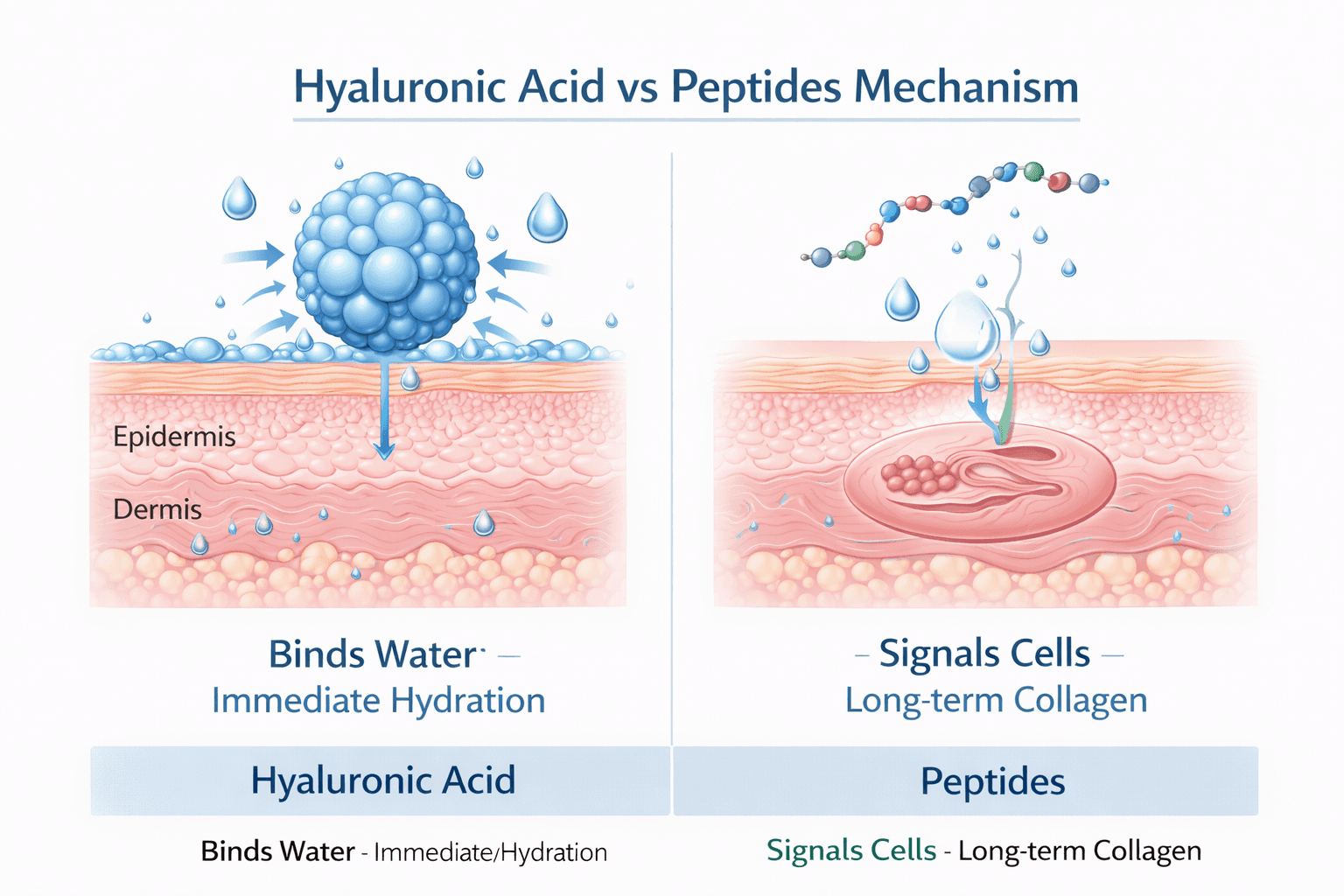
hyaluronic acid and peptides are complementary but work through completely different mechanisms. Hyaluronic acid is a moisture-binding molecule that hydrates skin and creates a plumping effect.
Peptides are signaling molecules that stimulate collagen production and improve skin structure.
Combining them provides both immediate hydration and long-term anti-aging benefits.
The best products use both strategically for maximum results.
This guide breaks down exactly what hyaluronic acid is versus peptides, how they work differently but complement each other, which peptide types pair best with HA, application order and timing, what results to expect, and whether combined products work better than separate ingredients.
Let's start by clarifying what hyaluronic acid actually is.
What is hyaluronic acid and how does it work
Hyaluronic acid (HA) is a naturally occurring molecule in your skin that holds moisture.
Hyaluronic acid basics
What HA is:
Glycosaminoglycan (sugar molecule)
Naturally present in skin, joints, eyes
Can hold up to 1000x its weight in water
Production decreases with age
Not actually an acid:
Name is misleading
pH neutral
Won't exfoliate or irritate like AHAs (glycolic, lactic acid)
Molecular weight matters:
High molecular weight HA: Sits on skin surface, provides immediate hydration
Low molecular weight HA: Penetrates deeper, hydrates dermis
Best products contain multiple molecular weights
How HA works for skin
Primary mechanism:
Binds water molecules from air and deeper skin layers
Creates moisture reservoir in skin
Plumps skin from increased water content
Benefits:
Immediate hydration
Plumps fine lines temporarily
Improves skin texture and smoothness
Supports skin barrier function
Creates dewy, hydrated appearance
Timeline:
Immediate: Hydration and plumping (within hours)
Short-term: Improved texture (1-2 weeks)
Long-term: Better skin barrier function (4+ weeks)
What HA does NOT do:
Doesn't stimulate collagen production
Doesn't change skin structure permanently
Doesn't address wrinkles at their source (collagen loss)
See our glow peptides guide for comprehensive skin anti-aging strategies.
What are peptides and how do they differ from HA
Peptides are completely different from hyaluronic acid in structure and function.
Peptide basics
What peptides are:
Short chains of amino acids (protein building blocks)
Signal molecules that tell skin cells what to do
Various types with different functions
Common skin peptides:
Signal peptides: Stimulate collagen production (Matrixyl, Syn-Coll)
Carrier peptides: Deliver copper for healing (GHK-Cu)
Neurotransmitter peptides: Reduce expression lines (Argireline)
Enzyme-inhibitor peptides: Slow collagen breakdown
Learn about different peptide types in our what are peptides guide and complete peptide list.
How peptides work for skin
Primary mechanisms:
Send signals to fibroblasts to make more collagen
Stimulate elastin production
Enhance skin repair processes
Reduce inflammation
Improve skin structure at cellular level
Benefits:
Increased collagen production
Improved skin firmness
Reduction in fine lines and wrinkles (long-term)
Enhanced skin thickness
Better overall skin quality
Timeline:
No immediate visible effects
4-8 weeks: Texture improvements
8-12 weeks: Visible firmness, reduced fine lines
3-6 months: Significant anti-aging results
What peptides do that HA doesn't:
Actually stimulate collagen synthesis
Change skin structure permanently
Address aging at cellular level
See our copper peptides guide for one of the most powerful skin peptides.
Key differences: hyaluronic acid vs peptides
Understanding these differences explains why combining them works.
Factor | Hyaluronic Acid | Peptides |
|---|---|---|
Type of molecule | Sugar molecule (glycosaminoglycan) | Amino acid chains (proteins) |
Primary function | Hydration and moisture binding | Cell signaling and collagen stimulation |
Mechanism | Physical (holds water) | Biochemical (sends signals) |
Speed of results | Immediate (hours) | Delayed (weeks to months) |
Duration of effect | Temporary (while applied) | Cumulative (builds over time) |
Depth of action | Surface to mid-dermis | Cellular level (fibroblasts) |
Collagen production | No | Yes |
Hydration | Yes (primary benefit) | No (not hydrating) |
Best for | Immediate plumping, hydration | Long-term anti-aging, wrinkle reduction |
Compatibility | Works with everything | Works with most ingredients |
Why combining hyaluronic acid and peptides works
These ingredients are complementary, not redundant.
Synergistic benefits
HA provides the foundation:
Hydrated skin absorbs peptides better
Moisture supports cellular function
Plumped skin makes peptides more effective
Peptides provide the transformation:
Stimulate collagen for structural improvement
Create lasting changes while HA hydrates
Address aging causes, not just symptoms
Together they deliver:
Immediate hydration + long-term anti-aging
Surface smoothness + deep structural improvement
Fast visible results + cumulative benefits
Different timelines complement each other
Day 1-7:
HA: Immediate hydration and plumping visible
Peptides: Beginning to signal cells (not visible yet)
User sees fast results (HA) while peptides work invisibly
Week 2-8:
HA: Continued hydration
Peptides: Texture improvements start becoming visible
Combined effect: Hydrated, smoother skin
Month 3-6:
HA: Maintains hydration and plumpness
Peptides: Significant collagen production, visible wrinkle reduction
Combined effect: Comprehensively improved skin
No interference or conflict
HA and peptides don't interfere:
Different molecular structures
Different penetration depths
Different mechanisms of action
Can be layered without reducing effectiveness
Actually enhance each other:
Hydrated skin = better peptide absorption
Peptide-improved skin = better HA retention
Both support skin barrier function
Best peptide types to combine with hyaluronic acid
Not all peptides are created equal for HA pairing.
Matrixyl (Palmitoyl peptides) + HA
Why this combination is excellent:
Matrixyl stimulates collagen Types I, III, and IV
HA provides hydration matrix for collagen development
Both improve skin elasticity through different pathways
Well-studied combination in clinical settings
Best for:
Overall anti-aging
Fine lines and wrinkles
Skin firmness and texture
Product examples:
The Ordinary Matrixyl 10% + HA
The INKEY List Collagen Peptide Serum (contains both)
Copper peptides (GHK-Cu) + HA
Why this works:
GHK-Cu stimulates collagen and promotes healing
HA soothes and hydrates while copper peptides work
Copper peptides can be slightly irritating; HA counteracts
Complementary anti-aging mechanisms
Best for:
Skin regeneration
Post-procedure healing
Mature skin needing both hydration and renewal
Important note: Some research suggests separating copper peptides from certain ingredients (like vitamin C), but HA poses no conflict.
See our copper peptides complete guide and copper peptides ruined my skin troubleshooting.
Argireline (Acetyl Hexapeptide-8) + HA
Why this combination works:
Argireline reduces expression lines (Botox-like effect)
HA plumps the same lines from different angle
Immediate (HA) + delayed (Argireline) results
Both safe and gentle
Best for:
Expression lines (forehead, crow's feet)
Dynamic wrinkles
People who want non-invasive wrinkle reduction
Syn-Coll (Palmitoyl Tripeptide-5) + HA
Why this pairing is effective:
Syn-Coll boosts collagen production
HA provides hydration for optimal collagen synthesis
Both improve skin elasticity
Minimal irritation risk
Best for:
Skin firmness
Sagging skin
Overall collagen support
Multi-peptide formulations with HA
Products containing multiple peptides + HA:
The Ordinary "Buffet" (4+ peptides + HA)
Formulyst Anti-Aging Night Cream
Timeless Skin Care Matrixyl 3000 + HA
Advantage:
Multiple peptide types target different aging pathways
HA provides hydration foundation
Comprehensive anti-aging in one product
See our glow peptides complete guide for advanced skincare peptide protocols.
How to layer hyaluronic acid and peptides
Application order and timing matter for maximum effectiveness.
Basic layering principle
Thinnest to thickest consistency:
Cleanser
Toner (if using)
Thinnest serum (usually HA serum if very watery)
Peptide serum
Moisturizer
Occlusive/oil (if needed)
Why this order:
Thin products penetrate better when applied to bare skin
Thicker products can block absorption of what comes after
HA on damp skin works best (draws water in)
Specific application sequences
Sequence 1: HA first, then peptides (most common)
Cleanse
Apply HA serum to damp skin (within 60 seconds of cleansing)
Wait 30-60 seconds for HA to absorb
Apply peptide serum
Wait 30-60 seconds
Apply moisturizer
Why HA first:
Hydrated skin absorbs peptides better
HA on damp skin maximizes hydration
Creates optimal environment for peptide penetration
Sequence 2: Peptides first, then HA (less common)
Some formulations recommend peptides on bare skin, then HA.
Cleanse
Apply peptide serum to slightly damp skin
Wait 1-2 minutes
Apply HA serum
Moisturizer
When to use this order:
If peptide product specifically recommends applying to bare skin
Peptide serum is very light/watery
Personal preference/experimentation
Sequence 3: Combined products (easiest)
Many products contain both HA and peptides together.
Cleanse
Apply combined HA + peptide serum
Moisturizer
Advantage:
Simplified routine
Formulated to work together optimally
No guessing about order
Wait time between layers
30-60 seconds between products is ideal:
Allows first product to absorb
Prevents pilling (products balling up on skin)
Maximizes penetration
Don't wait too long:
More than 5 minutes unnecessary
Skin dries out between applications
Next product harder to spread
Morning vs evening application
Morning routine:
HA serum (hydration for day)
Peptide serum
Moisturizer with SPF
Sunscreen (if moisturizer doesn't have adequate SPF)
Evening routine:
HA serum
Peptide serum
Richer moisturizer
Optional: Retinol (compatible with HA and most peptides)
Can use both AM and PM:
HA and peptides are gentle enough for twice-daily use
Consistency improves results
More frequent application = better outcomes
See our can you use peptides and retinol together guide for adding retinol to this routine.
Combined HA + peptide products vs separate serums
Should you buy one product or two?
Advantages of combined products
Convenience:
Fewer steps in routine
Less time spent
Easier to stay consistent
Formulated together:
pH optimized for both ingredients
Concentrations balanced
Tested as complete formulation
Cost-effective (sometimes):
One bottle instead of two
May be cheaper overall
Popular combined products:
The Ordinary Matrixyl 10% + HA (Matrixyl peptides + HA)
The INKEY List Collagen Peptide Serum
CeraVe Skin Renewing Night Cream (peptides + HA + ceramides)
Advantages of separate serums
Customization:
Choose exact peptide type you want
Select HA molecular weight and concentration
Adjust amounts of each independently
Higher concentrations:
Dedicated HA serum often has more HA
Dedicated peptide serum often has higher peptide %
May be more effective than combined product
Flexibility:
Use different amounts morning vs evening
Skip one if needed
Easier to introduce one at a time (identify sensitivities)
Popular separate approach:
HA serum: The Ordinary Hyaluronic Acid 2% + B5, CeraVe Hydrating Hyaluronic Acid Serum
Peptide serum: The Ordinary "Buffet," Paula's Choice Peptide Booster
Which approach is better?
Combined products best for:
Simple routines
Beginners to skincare actives
Budget constraints
Minimal product preferences
Separate serums best for:
Advanced skincare users
Those who want maximum concentrations
People with specific peptide preferences
Customized routines
Bottom line: Both work. Combined products are convenient and effective. Separate serums offer more control and potentially higher concentrations. Choose based on your priorities.
Expected results timeline
What to expect when using HA + peptides together.
Week 1-2: Immediate hydration, early changes
What you'll notice:
Immediate: Skin feels more hydrated (HA effect)
Day 1-3: Plumper, dewier appearance
Week 1-2: Smoother texture, fine lines less visible (HA plumping)
Peptides: Working invisibly (no visible results yet)
What's happening:
HA binding water to skin
Peptides beginning to signal fibroblasts
Skin barrier improving
Week 3-6: Texture improvements appear
Visible changes:
Continued hydration (HA)
Skin texture noticeably smoother (peptides starting to work)
Minor improvement in fine lines
Overall skin quality better
What's happening:
Peptides stimulating collagen production
New collagen beginning to form
HA maintaining hydration foundation
Week 8-12: Clear anti-aging results
Significant improvements:
Fine lines visibly reduced
Skin firmer to touch
Better elasticity
More even tone and texture
Plumpness from both HA hydration and increased collagen
What's happening:
Substantial collagen synthesis from peptides
HA continuing to hydrate and plump
Synergistic effects becoming obvious
Month 4-6: Maximum benefits
Dramatic changes:
Noticeable reduction in wrinkles
Significantly firmer skin
Improved skin thickness
Youthful, hydrated appearance
Long-term structural improvements
What's happening:
Cumulative collagen building
Skin structure improved
Benefits plateau around 6 months (continue for maintenance)
Long-term use (6+ months)
Maintenance phase:
Continued use maintains results
Prevents further aging
Skin stays hydrated and firm
Results regress if stopped
Key insight: HA provides immediate gratification while peptides work. Together, you see fast results that improve over time.
Special considerations for different skin types
Your skin type influences how to use HA and peptides.
Dry skin
Advantages:
Benefits most from HA (intense hydration)
Peptides support barrier function
Strategy:
Use higher concentration HA (2-3%)
Multiple molecular weights for deep hydration
Layer peptides over HA
Rich moisturizer on top
Consider HA + ceramide + peptide combinations
Best products:
CeraVe Skin Renewing Night Cream (HA + peptides + ceramides)
La Roche-Posay Hyalu B5 Serum
Oily/acne-prone skin
Advantages:
HA provides hydration without oil
Peptides don't clog pores
Strategy:
Lightweight HA serum (gel or water-based)
Water-based peptide serums
Oil-free moisturizer
Avoid heavy creams with HA + peptides
Best products:
The Ordinary Hyaluronic Acid 2% + B5 (very lightweight)
The Ordinary "Buffet" (water-based peptides)
Sensitive skin
Advantages:
HA soothes and hydrates
Most peptides are gentle
Strategy:
Fragrance-free products only
Start with lower concentrations
Patch test before full face application
Introduce one ingredient at a time
Best products:
CeraVe Hydrating Hyaluronic Acid Serum (gentle, fragrance-free)
The INKEY List Collagen Peptide Serum
Mature skin (50+)
Needs:
Maximum hydration (HA)
Aggressive collagen stimulation (peptides)
Strategy:
High concentration HA (2-3%)
Multiple peptide types (signal + copper + neurotransmitter)
Rich moisturizers
Twice-daily application
Best products:
The Ordinary "Buffet" + Matrixyl (multi-peptide approach)
Paula's Choice Peptide Booster (higher concentration)
Injectable hyaluronic acid vs topical HA with peptides
Beyond topical skincare, some people use injectable HA fillers.
Dermal fillers (injectable HA)
What they are:
HA gel injected into skin
Provides volume and structure
Lasts 6-18 months depending on product and location
Common brands:
Juvederm, Restylane, Belotero
Benefits:
Dramatic, immediate results
Fills deep wrinkles and lost volume
Shapes facial contours
Limitations:
Expensive ($500-1,500+ per treatment)
Temporary (need repeat injections)
Risk of complications (bruising, lumps, rarely vascular occlusion)
Topical HA + peptides vs injectable HA
Different purposes:
Topical: Hydration, surface plumping, prevention
Injectable: Volume replacement, deep wrinkle filling, contouring
Can use both:
Injectable HA for structure and volume
Topical HA + peptides for skin quality and maintenance
Complementary approaches
Peptides may extend filler results:
Improved skin quality around fillers
Better collagen support
Potentially longer-lasting filler results
Injectable peptides for skin
Some people use injectable peptides for more dramatic anti-aging.
GHK-Cu injectable:
Systemic collagen stimulation
Skin improves throughout body
More powerful than topical
BPC-157:
Healing and tissue repair
May improve skin quality systemically
Primarily used for injuries, not skin-specific
See our copper peptides guide for injectable GHK-Cu protocols and our BPC-157 guide.
Common mistakes when using HA and peptides
Avoid these errors for best results.
Mistake 1: Applying HA to completely dry skin
The problem:
HA pulls moisture from environment or deeper skin layers
On dry skin in low humidity, HA can actually dehydrate
Defeats the purpose
Better approach:
Apply HA to damp skin (within 60 seconds of cleansing)
Use humectant toner first
Apply in bathroom right after shower (high humidity)
Seal with moisturizer to prevent water evaporation
Mistake 2: Using too much product
The problem:
More isn't better
Excess product sits on surface, doesn't absorb
Pilling and wasted product
Right amount:
HA serum: 2-3 drops (pea-sized)
Peptide serum: 2-4 drops
Enough to cover face, not dripping
Mistake 3: Expecting peptide results in one week
The problem:
Unrealistic timeline
Giving up too soon
Peptides take 8-12 weeks minimum
Reality:
HA: Immediate hydration
Peptides: 2-3 months for visible anti-aging
Patience required
Mistake 4: Skipping moisturizer
The problem:
HA and peptides need to be sealed in
Water evaporates without occlusive layer
Reduced effectiveness
Always:
Follow with moisturizer
Cream or lotion based on skin type
Creates barrier to lock in actives
Mistake 5: Not using SPF
The problem:
UV damage undoes all anti-aging efforts
Wrinkles, pigmentation, collagen breakdown
Wasting time and money on products
Non-negotiable:
SPF 30+ every morning
Reapply if sun exposure
HA and peptides can't overcome UV damage
How you can use SeekPeptides for optimizing skin protocols
SeekPeptides helps you build personalized skincare protocols and shows when advanced injectable peptides provide better anti-aging results than topical products alone.
Get customized guidance on combining topical HA and peptides, or learn when injectable options like GHK-Cu deliver superior skin rejuvenation.
Access our complete research library on collagen synthesis, peptide mechanisms, and clinical studies.
Use the AI advisor to ask about layering products, choosing between different peptide types, or determining if injectable peptides would work better for your specific skin goals. Track your progress over time and get protocol adjustments for maximum anti-aging results.
Final thoughts
Hyaluronic acid and peptides work beautifully together for comprehensive skin anti-aging. HA provides immediate hydration and plumping while peptides stimulate long-term collagen production and structural improvement.
Apply HA first to damp skin for maximum hydration, then layer peptides for collagen stimulation. Use both morning and evening for best results. Combined products work well for convenience; separate serums offer more customization and potentially higher concentrations.
Expect immediate hydration from HA and progressive anti-aging results from peptides over 8-12 weeks. The combination delivers both fast visible improvements and long-term skin transformation.
Your routine doesn't have to be complicated. HA serum + peptide serum + moisturizer + SPF provides comprehensive anti-aging with just a few products.
The best anti-aging skincare combines immediate benefits with long-term structural improvements. HA and peptides together deliver exactly that.
Helpful resources for skin peptides
Glow peptides: complete skincare guide - Comprehensive peptide skincare
Copper peptides complete guide - GHK-Cu benefits
Can you use peptides and retinol together - Add retinol
Related guides worth reading
Copper peptides ruined my skin: troubleshooting - Avoid mistakes
What are peptides: complete overview - Peptide basics
Complete peptide list - All peptide types