Jan 16, 2026
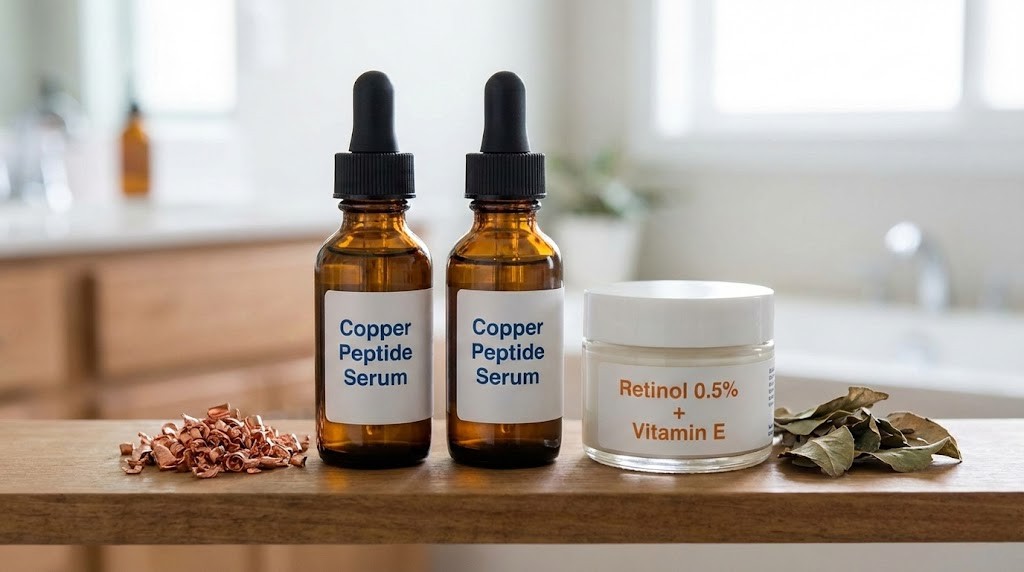
Some skincare combinations cancel each other out. Others create irritation so severe you abandon both products within a week. But copper peptides and retinol? They might be the most misunderstood pairing in modern dermatology, because used correctly, they don't compete. They complement.
The confusion is understandable.
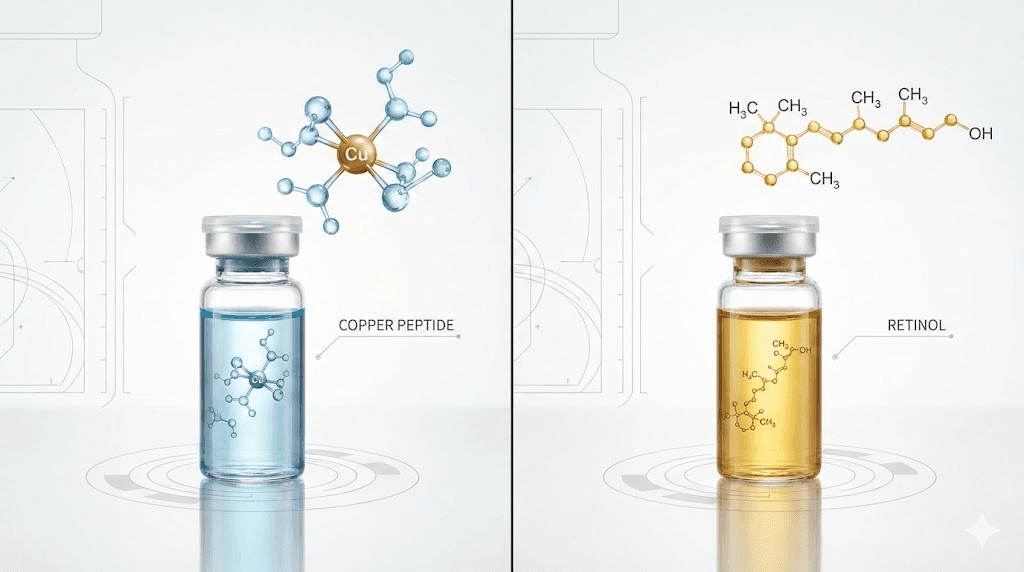
Both ingredients accelerate cell turnover. Both stimulate collagen. Both transform skin when used consistently over weeks and months. So why would you use two ingredients that do similar things? The answer lies in mechanism. Retinol works through retinoic acid receptors, fundamentally changing how skin cells behave at the genetic level. Copper peptides work through entirely different pathways, supporting the structural proteins and enzymes that actually build and repair tissue.
Think of it this way. Retinol is the architect redesigning the building plans. Copper peptides are the construction crew with better tools and materials. You need both for renovation. One without the other leaves the job incomplete.
This guide covers everything you need to know about combining these two powerhouse ingredients. We'll examine the science, the protocols, the potential pitfalls, and the strategies that SeekPeptides members use to maximize results while minimizing irritation. Whether you're new to both ingredients or looking to optimize an existing routine, you'll find evidence-based guidance for making this combination work.
Understanding How Each Ingredient Works
Before combining any active ingredients, you need to understand their individual mechanisms. This knowledge prevents mistakes and helps you troubleshoot when things don't go as planned.
How Retinol Transforms Skin
Retinol belongs to the retinoid family, derivatives of vitamin A that have been studied for decades. When you apply retinol to skin, it converts through enzymatic processes into retinoic acid, the active form that produces visible changes.
Retinoic acid binds to specific cellular receptors called RARs and RXRs. This binding triggers a cascade of genetic changes. Cell turnover accelerates dramatically. Skin that normally renews every 28 to 40 days starts cycling faster, pushing new cells to the surface while shedding old ones more efficiently.
The collagen effects are equally significant. Retinol increases production of Type I and Type III collagen while simultaneously reducing the enzymes that break collagen down. Over months of consistent use, this results in measurably firmer, thicker skin with reduced fine lines.
But retinol comes with a price.
The adjustment period, sometimes called retinization, includes dryness, flaking, redness, and increased sensitivity. Some users experience purging as accelerated turnover brings existing congestion to the surface. These effects typically peak within the first two to four weeks and diminish with continued use, but they can be intense enough to make people quit before seeing results.
Understanding how peptides and retinol interact helps you navigate this adjustment period more successfully.
How Copper Peptides Support Skin
GHK-Cu, the most researched copper peptide, works through fundamentally different mechanisms than retinol. Discovered in 1973, this tripeptide consists of glycine, histidine, and lysine bound to a copper ion.
Copper peptides don't directly trigger genetic changes the way retinol does. Instead, they support the enzymatic processes that build and maintain skin structure. Lysyl oxidase, the enzyme that cross-links collagen and elastin fibers, requires copper as a cofactor. Without adequate copper, even newly synthesized collagen can't form proper bonds.
The peptide mechanism also includes signaling functions. GHK-Cu attracts immune cells to areas needing repair. It stimulates fibroblast activity. It promotes blood vessel formation that delivers nutrients to healing tissue. These actions explain why copper peptides accelerate wound healing so effectively.
Research comparing GHK-Cu to retinoic acid found something remarkable. In a study measuring collagen production from skin biopsies, GHK-Cu increased collagen synthesis in 70% of women treated, compared to 50% with vitamin C and only 40% with retinoic acid. The copper peptide outperformed the gold standard.
Yet copper peptides achieve this with significantly less irritation. Most users experience no adjustment period whatsoever. No flaking, no redness, no purging. The gentle nature of copper peptides makes them accessible to sensitive skin types who can't tolerate retinol at all.
The copper peptide concentration guide helps you choose appropriate strength for your skin.
Why They Work Better Together
Here's where the combination becomes interesting. Retinol tells your skin to produce more collagen. Copper peptides provide the enzymatic support to actually build that collagen properly. Retinol accelerates cell turnover. Copper peptides support the healing of any irritation that turnover might cause.
The synergy runs deeper than simple complementarity.
Retinol can temporarily compromise the skin barrier during the adjustment period. Copper peptides strengthen barrier function through increased glycosaminoglycan synthesis. Using both means you get the transformative power of retinol with some protection against its harsher effects.
Studies also suggest that copper peptides may help reduce the inflammation retinol triggers. GHK-Cu inhibits NFkB, a master regulator of inflammatory response.
While retinol activates certain inflammatory pathways as part of its mechanism, copper peptides may moderate that response, making the combination more tolerable than retinol alone.
This doesn't mean you can use them carelessly. Both ingredients accelerate cell turnover to some degree, and using them improperly can overwhelm your skin's capacity to adapt. But with thoughtful protocols, the combination delivers results neither ingredient achieves alone.
The Three Proven Combination Strategies
How you combine copper peptides and retinol matters more than whether you combine them. Three strategies have emerged as effective, each suited to different skin types, schedules, and tolerance levels.
Strategy One: Temporal Separation
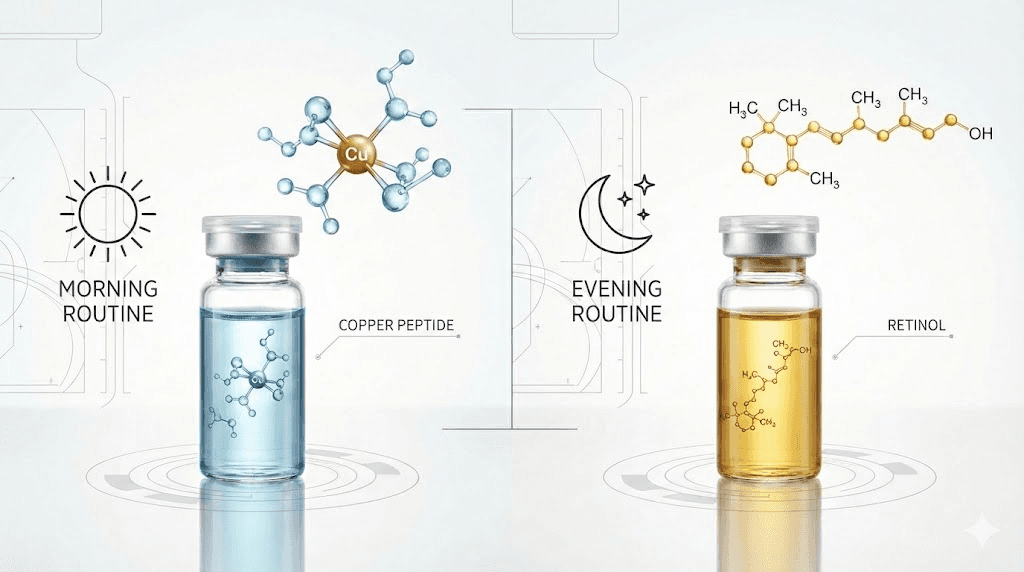
The simplest and safest approach separates the ingredients by time of day. Apply copper peptides in the morning. Apply retinol in the evening. This ensures the ingredients never interact directly on your skin.
Morning copper peptide application makes sense for several reasons. The peptide's wound-healing properties support skin through daily environmental stress. You're not layering it under heavy sunscreen and makeup, which could affect absorption. And you reserve evening, when skin enters repair mode, for retinol's more intensive work.
Evening retinol application aligns with your skin's natural circadian rhythm. Cell turnover peaks at night. Growth hormone release during sleep supports the regenerative processes retinol triggers. You also avoid sun exposure while the retinol is active, reducing photosensitivity concerns.
A typical temporally separated routine looks like this.
Morning: Cleanse, apply copper peptide serum, wait for absorption, apply hydrating serum if desired, moisturize, apply sunscreen SPF 30 or higher.
Evening: Double cleanse to remove sunscreen and daily accumulation, apply retinol to dry skin, wait 15 to 20 minutes for absorption, apply barrier-supporting moisturizer.
This strategy works well for everyone from beginners to experienced users. It eliminates any possibility of ingredient interaction while delivering full benefits of both compounds.
Strategy Two: Alternating Nights
Some users prefer dedicating each evening to one ingredient or the other. Night one: copper peptides. Night two: retinol. Repeat.
This approach gives each ingredient uninterrupted time to work without any competition for receptors or penetration pathways. It's particularly useful during the retinol adjustment period, when every-other-night application reduces cumulative irritation while maintaining the adaptation stimulus.
The Ordinary specifically recommends this approach, noting that both copper peptides and retinoids support skin's natural exfoliating mechanism. Using them on the same night, even sequentially, may increase sensitivity in some individuals. Alternating eliminates that concern entirely.
An alternating routine might look like this.
Copper Peptide Nights (Monday, Wednesday, Friday, Sunday): Double cleanse, apply copper peptide serum, wait for absorption, apply moisturizer.
Retinol Nights (Tuesday, Thursday, Saturday): Double cleanse, apply retinol to dry skin, wait 15 to 20 minutes, apply barrier moisturizer.
You can adjust the ratio based on your tolerance and goals. During initial retinol introduction, you might do two copper peptide nights for every one retinol night. As your skin adapts, you can balance to even alternation or even weight toward more retinol nights if your skin tolerates it well.
The peptide cycling guide provides additional scheduling strategies.
Strategy Three: Same Evening, Sequential Application
For experienced users with robust skin barriers, applying both ingredients in the same evening routine can maximize results. However, this approach requires careful sequencing and adequate wait times.
Apply copper peptides first. The peptide has a relatively neutral pH and absorbs well into skin. Wait 15 to 20 minutes for complete absorption. Then apply retinol. The wait time ensures the copper peptide has penetrated before the retinol arrives, preventing any surface-level interaction.
Some practitioners recommend the reverse order, applying retinol first, then following with copper peptides to soothe any irritation. Both sequences have advocates. The peptide-first approach ensures the copper peptide reaches its targets without competition. The retinol-first approach uses the copper peptide as a calming follow-up.
If trying same-evening application, start with the peptide-first approach and assess your skin's response over two weeks. If you experience increased irritation compared to using retinol alone, either extend the wait time between applications or switch to temporal separation or alternating nights.
Same-evening application is not recommended for retinol beginners, those with sensitive or reactive skin, anyone currently experiencing retinol irritation, or those using high-concentration or prescription-strength retinoids.
The common peptide mistakes guide helps avoid errors when combining active ingredients.
Starting a Combined Protocol Safely
The biggest mistake people make with copper peptides and retinol is rushing. They want results immediately, so they introduce both ingredients at full strength on day one. This almost guarantees irritation, often severe enough to abandon the routine entirely.
If You're New to Both Ingredients
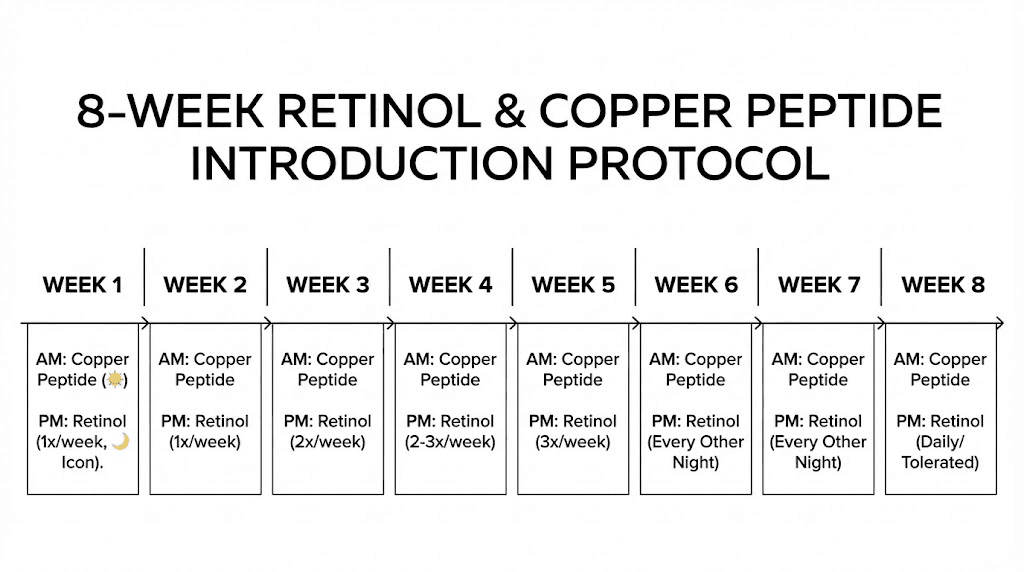
Introduce one ingredient at a time. Start with copper peptides since they cause virtually no adjustment period. Use them daily for two weeks, morning or evening, to establish a baseline and ensure you tolerate them well.
After two weeks of successful copper peptide use, introduce retinol on its own schedule. Begin with a low concentration, 0.25% to 0.5% retinol, applied once or twice weekly. Use the retinol sandwich technique if you have sensitive skin: moisturizer, then retinol, then moisturizer again.
Week one through two: Retinol once weekly. Week three through four: Retinol twice weekly. Week five through six: Retinol three times weekly. Week seven through eight: Retinol every other night. Week nine onward: Nightly if tolerated.
Throughout this introduction, continue your copper peptide use on non-retinol nights or mornings. The copper peptide supports your skin's ability to handle the increasing retinol exposure.
This slow introduction takes eight weeks or more. That feels agonizingly slow when you're eager for results. But it establishes tolerance that allows consistent long-term use, which is where real transformation happens. Rushing leads to barrier damage that sets you back months.
If You Already Use Retinol
Adding copper peptides to an established retinol routine is straightforward since copper peptides rarely cause problems. You can introduce them immediately, either in the morning with temporal separation or on alternating nights.
Start with a moderate concentration, 1% to 2% GHK-Cu for topicals. Use daily for one week. If no irritation develops, you've successfully integrated both ingredients. Most retinol users find that copper peptides actually improve their retinol tolerance, reducing dryness and flaking.
If you notice increased sensitivity when adding copper peptides, reduce your retinol frequency temporarily while your skin adjusts to the new ingredient. Return to your previous retinol schedule once the copper peptide is well established.
If You Already Use Copper Peptides
Adding retinol requires more caution. Even though copper peptides may help moderate retinol irritation, you're still introducing a potent active ingredient that triggers significant skin changes.
Follow the slow retinol introduction protocol above. The fact that you're already using copper peptides may allow slightly faster progression, but listen to your skin. Any signs of excessive irritation, persistent redness, burning, or painful sensitivity, mean you're moving too fast.
Consider whether your copper peptide concentration is appropriate for combination use. Very high concentrations of copper peptides, above 4% to 5%, combined with retinol may overwhelm skin's adaptive capacity. You might temporarily reduce copper peptide concentration while introducing retinol, then return to higher concentrations once retinol tolerance is established.
Managing the Retinol Adjustment Period
Even with copper peptide support, retinol adjustment can challenge your patience and your skin. Understanding what to expect and how to respond keeps you on track toward long-term results.
What Normal Adjustment Looks Like
Retinization typically begins within the first one to two weeks of starting retinol. Symptoms include dryness that feels different from normal dehydration, flaking or peeling especially around the nose and chin, mild redness that comes and goes, increased sensitivity to other products, and temporary worsening of texture.
These symptoms peak around weeks two through four and gradually diminish with continued use. By week eight to twelve, most people have adapted completely and can use retinol nightly without any discomfort.
The key word is gradual. Both the appearance and the resolution of symptoms should be gradual. Sudden severe reactions suggest something beyond normal adjustment.
How Copper Peptides Help During Adjustment
Copper peptides provide several benefits during retinol adjustment. Their wound-healing properties accelerate recovery from the micro-damage retinol causes. Their barrier-supporting effects reduce water loss from compromised skin. Their anti-inflammatory action may moderate the redness and irritation retinol triggers.
Some users report that copper peptides noticeably shorten their retinol adjustment period. Instead of eight weeks of gradual improvement, they experience reduced symptoms within four to six weeks. This isn't universal, but it's common enough to suggest real synergy.
For maximum support during adjustment, use copper peptides consistently. Don't skip applications because your skin feels irritated. The copper peptide isn't causing the irritation; it's helping resolve it. Maintaining consistent copper peptide use while carefully managing retinol frequency produces the best outcomes.
The Retinol Sandwich and Buffering Techniques
If retinol irritation becomes uncomfortable, buffering techniques reduce intensity without eliminating effectiveness.
The retinol sandwich involves applying moisturizer, then retinol, then moisturizer again. The moisturizer layers create a physical buffer that slows retinol penetration. You still get retinol benefits, but at reduced intensity. Research presented at the American Academy of Dermatology confirmed that this technique preserves most retinol bioactivity while meaningfully reducing irritation.
An open sandwich uses moisturizer only before or only after retinol. This provides less buffering than the full sandwich but more than applying retinol to bare skin. It's a middle ground for those who want some protection without significantly diluting the retinol.
Mixing retinol with moisturizer directly in your palm is another option, though this dilutes the product most significantly. It can be useful for very sensitive skin during initial introduction but should eventually give way to direct application as tolerance builds.
The peptide safety guide covers additional protective strategies when using active ingredients.
When to Pause Versus Push Through
Some irritation is normal and necessary for retinol adaptation. Other irritation signals a problem requiring intervention. Distinguishing between them prevents both unnecessary abandonment and actual skin damage.
Push through mild dryness and flaking that responds to moisturizer, temporary redness that subsides within hours, slight sensitivity that doesn't prevent normal routine, and minor texture changes in typical problem areas.
Pause if you experience burning or stinging that doesn't resolve, redness that persists for days rather than hours, cracking or bleeding especially around nose and mouth, spreading irritation to areas not treated with retinol, or symptoms that worsen rather than stabilize over weeks.
Pausing means stopping retinol entirely for one to two weeks while maintaining gentle, hydrating skincare. Copper peptides can continue during this pause and may actually accelerate recovery. Once skin returns to normal, resume retinol at lower frequency than before, building back up more gradually.
The troubleshooting guide for copper peptides addresses when reactions require protocol changes.
Optimizing Your Combined Routine
Once you've established tolerance to both ingredients, optimization becomes possible. Small adjustments can meaningfully improve results without increasing irritation.
Concentration Considerations
Copper peptide concentrations in topical products typically range from 0.5% to 10%. For combination use with retinol, 1% to 4% provides substantial benefits without overwhelming skin. Higher concentrations can be explored once the combination routine is well established, but start moderate.
Retinol concentrations range from 0.025% to 1% in over-the-counter products, with prescription retinoids like tretinoin delivering even stronger effects. For combination use, moderate concentrations of 0.3% to 0.5% retinol provide excellent results without excessive irritation. You can progress to higher concentrations over months of consistent use.
The GHK-Cu dosage chart and peptide calculator help determine appropriate concentrations.
Supporting Ingredients
Building a routine around copper peptides and retinol involves selecting complementary ingredients that enhance results without creating conflicts.
Hyaluronic acid pairs beautifully with both ingredients. It provides hydration without interfering with either compound's activity. Apply it before copper peptides or after retinol for additional moisture support.
Niacinamide strengthens barrier function, reduces inflammation, and helps regulate oil production. It works well with both copper peptides and retinol. Some sources suggest separating niacinamide from retinol by several minutes, but most modern formulations allow layering without issues.
Ceramides support the skin barrier that retinol can temporarily compromise. Including ceramide-rich moisturizer in your routine provides structural support for the lipid barrier. This is especially valuable during retinol adjustment.
Sunscreen is non-negotiable when using retinol. The ingredient increases photosensitivity, making sun protection essential. Apply SPF 30 or higher every morning, reapplying if you'll have significant sun exposure. Copper peptides don't increase sun sensitivity, but the retinol in your evening routine requires daytime protection.
Ingredients to Avoid or Separate
Certain ingredient combinations create problems when copper peptides and retinol are already in your routine.
L-ascorbic acid (pure vitamin C) destabilizes copper peptides. The acidic pH disrupts the copper-peptide bond, potentially releasing free copper ions while deactivating both ingredients. If using vitamin C, apply it in the morning and copper peptides in the evening, or use vitamin C derivatives like ascorbyl glucoside that operate at more neutral pH.
Alpha hydroxy acids and beta hydroxy acids add additional exfoliation on top of retinol's cell turnover acceleration. During initial retinol adjustment, minimize or eliminate these acids. Once adapted to retinol, you can cautiously reintroduce acids on non-retinol nights.
Benzoyl peroxide can oxidize retinol, reducing its effectiveness. If using benzoyl peroxide for acne, apply it in the morning and retinol in the evening, or use them on alternating days.
Strong physical exfoliants, scrubs with abrasive particles, can damage skin already sensitized by retinol. Avoid manual exfoliation while using retinol. Your skin is already shedding cells faster; it doesn't need mechanical help.
Seasonal Adjustments
Your combination routine may need seasonal modifications. Environmental conditions affect both ingredient tolerance and skin needs.
Winter brings lower humidity and harsher conditions. Skin barrier function can suffer. You might reduce retinol frequency slightly, increase moisturizer richness, and emphasize the barrier-supporting aspects of copper peptides. Consider adding occlusive layers like facial oils or sleeping masks to prevent overnight moisture loss.
Summer brings increased sun exposure and humidity. Retinol photosensitivity becomes more relevant. Ensure rigorous sunscreen application. You might shift copper peptide application from morning to evening to avoid any potential sun interaction, though copper peptides themselves don't increase photosensitivity. Lighter moisturizers prevent the heavy, sticky feeling in humid weather.
Transitional seasons require adjustment periods. Don't make drastic routine changes overnight. Gradually shift your product textures and frequencies as conditions change.
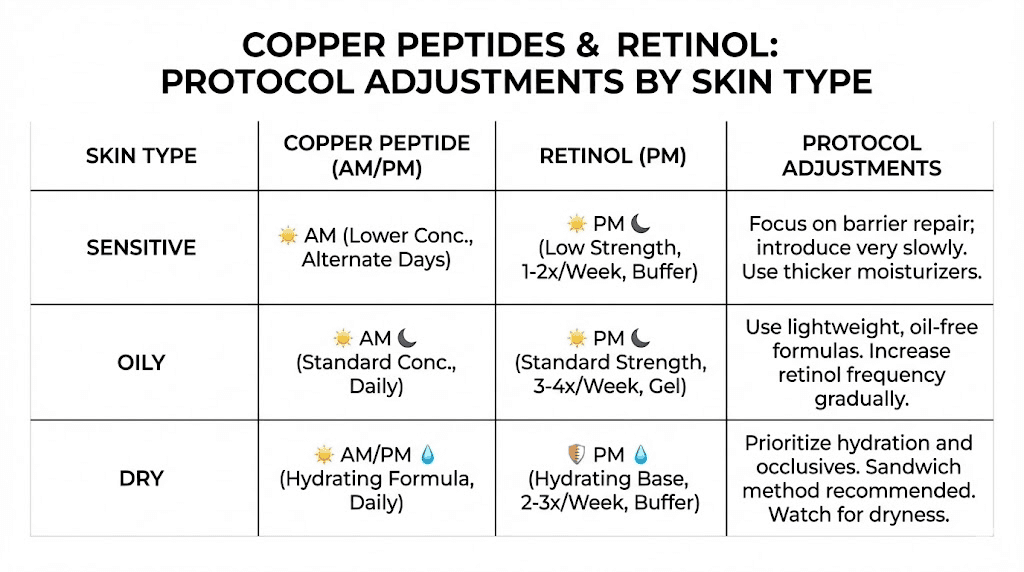
Protocol Adjustments for Different Skin Types
Generic advice only goes so far. Your skin type determines how you should implement the copper peptide and retinol combination.
Sensitive and Reactive Skin
If your skin routinely reacts to new products, proceed with extra caution. Sensitive skin types benefit most from temporal separation, using copper peptides in the morning and retinol in the evening with no overlap whatsoever.
Start retinol at the lowest available concentration, 0.25% or less. Use the full retinol sandwich technique, moisturizer before and after. Begin with once-weekly application and extend to twice weekly only after four weeks with no adverse reaction.
Copper peptide concentration should stay moderate, 1% to 2%. Higher concentrations might provide more benefits in theory, but sensitive skin may not tolerate the combination of high-concentration copper peptide and any retinol.
Consider formulations specifically designed for sensitive skin. Encapsulated retinol releases more slowly, reducing irritation. Time-release copper peptide formulations provide sustained delivery without peak-concentration irritation.
The copper peptide troubleshooting guide addresses sensitivity concerns specific to copper peptides.
Oily and Acne-Prone Skin
Oily skin often tolerates retinol better than other skin types since the natural sebum provides some barrier protection. You may progress through the introduction protocol faster, reaching nightly application within six weeks rather than eight.
However, oily skin can be prone to congestion, making the purging phase more dramatic. As retinol accelerates cell turnover, existing clogged pores surface rapidly. This is normal, but it can be discouraging. Copper peptides may help reduce inflammation associated with these purge breakouts.
Choose lightweight, non-comedogenic formulations of both ingredients. Heavy copper peptide creams might clog already-congestion-prone pores. Gel or serum formats absorb cleanly without contributing to oiliness.
If acne is a significant concern, retinol's pore-clearing and anti-inflammatory effects often improve breakouts substantially over three to six months. The peptides and acne guide provides additional context.
Dry and Mature Skin
Dry skin types face the greatest challenge with retinol. The ingredient's drying effects compound already-compromised hydration. Mature skin, with reduced sebum production and thinner structure, falls into this category.
Prioritize barrier support at every step. Use rich, ceramide-containing moisturizers. Apply hydrating toners or essences before active ingredients. Consider facial oils as a final step to lock in moisture.
The retinol sandwich technique is practically mandatory for dry skin. Some dermatologists recommend starting with open sandwich, moisturizer only under retinol, progressing to bare-skin application only after full adaptation.
Copper peptides particularly benefit mature skin. The collagen and elastin support addresses the structural loss that defines skin aging. The wound-healing properties help skin that doesn't recover as quickly as it once did. Consistent copper peptide use may be more transformative for mature skin than for younger skin that still has robust natural regeneration.
Peptides for mature skin and anti-aging peptide strategies provide age-specific guidance.
Combination Skin
Combination skin presents unique challenges because different areas have different needs. Your oily T-zone tolerates retinol well while your dry cheeks react with flaking and irritation.
Consider zone-specific application.
Apply retinol to the oilier, more tolerant T-zone more frequently than to the drier areas. Some users apply retinol to their entire face only twice weekly while adding additional T-zone-only applications on intervening nights.
Copper peptides can be applied uniformly since they rarely cause irritation regardless of skin type. The balanced application provides consistent benefits across all zones.
Moisturizer strategy may also vary by zone. Lighter hydration for the T-zone, richer formulas for cheeks and eye area. This prevents both excess oiliness and uncomfortable dryness.
Injectable Copper Peptides With Topical Retinol
The combination discussion extends beyond topical products. Many researchers use injectable GHK-Cu for systemic benefits. Can this be combined with topical retinol?
How Injectable GHK-Cu Differs
Injectable copper peptides provide systemic rather than purely local effects. The peptide circulates through the bloodstream, reaching all tissues rather than only the application site. This offers broader anti-aging benefits including effects on hair, internal tissues, and overall skin health from within.
The systemic delivery also means injectable GHK-Cu doesn't interact with topical products in the same way topical copper peptides might. There's no surface-level mixing, no pH interaction, no competition for penetration pathways.
The peptide injection guide covers administration protocols. The reconstitution guide ensures proper preparation.
Combining Injectable and Topical Protocols
Using injectable GHK-Cu while also using topical retinol presents no direct compatibility concerns. The ingredients work through entirely different routes. Many researchers report excellent results from this combination, with injectable copper peptides supporting skin health systemically while retinol provides targeted surface transformation.
You might even add topical copper peptides to this stack, giving you systemic copper peptide support plus localized copper peptide application plus retinol's transformative power. This triple approach addresses skin aging from multiple angles simultaneously.
However, monitor your total copper exposure. Injectable GHK-Cu plus topical copper peptides plus any dietary copper supplementation could theoretically provide more copper than your body can optimally utilize. Signs of copper excess include persistent inflammation, paradoxical skin worsening, and metallic taste. If you notice these symptoms, reduce copper peptide exposure from one or more sources.
The copper peptide dosing guide helps calculate appropriate total exposure.
Protocol Considerations
If using injectable GHK-Cu with topical retinol, continue following all retinol best practices. The injectable peptide doesn't reduce retinol's irritation potential or eliminate the need for slow introduction and barrier support.
Some researchers report that systemic GHK-Cu improves their skin's overall resilience, potentially making retinol adjustment easier. This makes theoretical sense given the peptide's wound-healing and anti-inflammatory properties. But don't assume you can skip the gradual introduction protocol. Start retinol slowly regardless of what other treatments you're using.
The peptide stacking guide covers combination protocols for multiple compounds.
Measuring Results From Your Combined Routine
How do you know if the combination is working? Without objective measurement, it's easy to either miss gradual improvement or imagine changes that haven't occurred.
Timeline Expectations
Results from both copper peptides and retinol develop over months, not days or weeks.
Setting appropriate timeline expectations prevents premature disappointment.
Week 1 through 4: Initial adjustment period. Retinol may cause temporary worsening. Copper peptide effects are subtle. Focus on tolerance rather than visible results.
Month 2 through 3: Adjustment resolves. Skin begins showing early improvements, better hydration, smoother texture, reduced minor breakouts. Fine lines may begin softening.
Month 4 through 6: Meaningful visible improvement. Wrinkle reduction becomes apparent. Firmness increases. Skin quality and radiance improve noticeably. Comparison photos show clear differences from baseline.
Month 7 through 12: Continued improvement at slower rate. Deeper wrinkles continue softening. Structural changes in skin density and thickness become measurable. Results approach optimal levels for your protocol.
The peptide timeline guide and copper peptide results guide provide detailed expectations.
Documentation Strategies
Take consistent photos to track progress objectively. Use the same lighting, same angle, same time of day, same distance from camera. Morning photos before skincare eliminate product-related variations.
Front view, 45-degree angles, and profile views capture different aspects of skin change. Fine lines around eyes and mouth, cheek firmness, jawline definition, and forehead texture all change at different rates.
Compare photos monthly rather than weekly. Weekly changes are too subtle to detect visually. Monthly comparisons reveal meaningful progress that daily observation misses.
Beyond photos, track subjective observations. How does your skin feel? How does it respond to products? How long do breakouts last? How does it look in different lighting? These qualitative assessments provide information photos can't capture.
Adjusting Based on Results
At month three and month six, honestly assess your results. Compare photos. Review your subjective notes. Ask: Is this combination working for me?
If results meet or exceed expectations, continue your protocol. You might cautiously explore higher concentrations of either ingredient to push further improvement, but don't fix what isn't broken.
If results disappoint, troubleshoot systematically. Is your retinol concentration adequate? Some people need prescription-strength retinoids for meaningful change. Is your copper peptide concentration sufficient? Have you been consistent enough? Sporadic use produces sporadic results. Are other factors, diet, sleep, sun exposure, undermining your skincare?
If troubleshooting doesn't reveal obvious issues, consider whether this combination suits your skin. Not everyone responds equally to every ingredient. Some people see dramatic results from copper peptides; others barely notice them. Some adapt to retinol easily; others remain sensitive indefinitely. Individual variation is real.
SeekPeptides members access detailed protocols and troubleshooting support for optimizing their peptide routines.
Common Mistakes and How to Avoid Them
Learning from others' errors accelerates your own success. These mistakes appear repeatedly among those trying to combine copper peptides and retinol.
Mistake One: Introducing Both Simultaneously
Eager beginners often start copper peptides and retinol at the same time, figuring they'll save time and see results faster. This approach makes it impossible to identify which ingredient causes any reaction and typically produces more irritation than sequential introduction.
The fix: Always introduce one ingredient at a time. Establish tolerance to the first before adding the second. This takes longer but produces more successful long-term outcomes.
Mistake Two: Ignoring the Adjustment Period
When retinol irritation appears, some users double down, thinking their skin just needs to "get used to it" through exposure. Others panic and abandon retinol entirely. Both responses are wrong.
The fix: Adjust frequency rather than abandoning or forcing.
If irritation exceeds comfortable levels, reduce retinol to every third night instead of quitting. Build back up once skin stabilizes. Patience during adjustment produces better results than either extreme.
Mistake Three: Combining With Too Many Other Actives
Copper peptides plus retinol is already a potent combination. Adding vitamin C serums, AHA toners, BHA treatments, and other actives creates an overwhelming load that even resilient skin struggles to handle.
The fix: During initial combination use, simplify your routine to copper peptides, retinol, and supportive basics only.
Once well-adapted, you can cautiously add other ingredients one at a time, with weeks between additions to assess tolerance.
Mistake Four: Neglecting Sun Protection
Retinol increases photosensitivity. Users who skip sunscreen, even on cloudy days, undermine their results and risk increased sun damage. All that collagen stimulation means nothing if UV exposure destroys it.
The fix: Sunscreen every single morning, no exceptions. SPF 30 minimum. Reapply if outdoors for extended periods. Treat this as non-negotiable as the retinol itself.
Mistake Five: Using Degraded Products
Both copper peptides and retinol degrade over time, especially when exposed to light, heat, or air. Using degraded products provides reduced benefits while potentially causing irritation from breakdown products.
The fix: Store products properly in cool, dark locations. Check expiration dates. Discard any product that changes color or consistency. The peptide storage guide covers optimal preservation methods.
Mistake Six: Expecting Overnight Transformation
Marketing images showing dramatic before-and-after transformations set unrealistic expectations. Real results from copper peptides and retinol develop over months of consistent use, not days or weeks.
The fix: Set your expectations appropriately. Commit to at least six months of consistent use before final assessment. Take regular photos to track gradual change that daily observation misses. Trust the process rather than seeking instant gratification.
Frequently Asked Questions
Can I use copper peptides and retinol together every night?
Yes, but with caveats. Your skin must be fully adapted to retinol before attempting same-night use. Apply copper peptides first, wait 15 to 20 minutes for absorption, then apply retinol. If you experience increased irritation compared to retinol alone, separate them by time of day or use on alternating nights instead. Peptide and retinol combination protocols provide detailed guidance.
Should I apply copper peptides before or after retinol?
Either sequence can work. Applying copper peptides first allows them to absorb without competition, then retinol follows. Applying retinol first allows it to penetrate unimpeded, then copper peptides provide calming follow-up. The peptides-first approach is more common, but experiment to find what works for your skin. What matters most is the waiting period between applications, minimum 15 minutes.
Will copper peptides help reduce retinol irritation?
Likely yes. Copper peptides' wound-healing and anti-inflammatory properties may help moderate retinol irritation for many users. Some report shortened adjustment periods when using both ingredients versus retinol alone. However, copper peptides don't eliminate retinol irritation entirely. Follow proper introduction protocols regardless of copper peptide use.
How long before I see results from this combination?
Expect initial adjustment during weeks one through four. Early improvements in texture and hydration may appear by month two. Meaningful visible changes in fine lines and firmness typically emerge around month three to four. Optimal results develop over six to twelve months of consistent use. The peptide results timeline provides detailed expectations.
Can I use vitamin C with copper peptides and retinol?
Yes, but not simultaneously with copper peptides. L-ascorbic acid destabilizes copper peptides when applied together. Use vitamin C in the morning separated from copper peptides by hours, or use vitamin C derivatives that operate at neutral pH. Retinol and vitamin C can be used in the same routine with appropriate wait times. The safest approach: vitamin C morning, copper peptides and retinol evening.
What if I'm already using prescription tretinoin?
Prescription retinoids like tretinoin are more potent than over-the-counter retinol. The combination principles remain the same, but proceed with extra caution. Ensure you're fully adapted to tretinoin before adding copper peptides. Use temporal separation initially. Monitor carefully for increased irritation. The common mistakes guide addresses prescription retinoid considerations.
Is this combination safe during pregnancy or breastfeeding?
Retinoids are contraindicated during pregnancy due to potential teratogenic effects. Oral retinoids carry clear risks, and while topical retinol poses lower risk, most dermatologists recommend avoiding it entirely during pregnancy and breastfeeding. Copper peptides have less established safety data for pregnancy. Consult a healthcare provider before using either ingredient while pregnant or nursing. The peptide safety guide covers contraindications.
Can I use this combination with injectable copper peptides?
Yes. Injectable GHK-Cu works systemically and doesn't interact directly with topical retinol. Many researchers successfully combine injectable copper peptides with topical retinol routines. Monitor total copper exposure if also using topical copper peptides. The injectable approach may support overall skin health while retinol provides targeted surface transformation.
External Resources
For additional scientific background on copper peptides and retinol:
Regenerative and Protective Actions of the GHK-Cu Peptide in the Light of the New Gene Data - PMC review of GHK-Cu mechanisms and effects
GHK Peptide as a Natural Modulator of Multiple Cellular Pathways in Skin Regeneration - PMC study on copper peptide skin benefits
A Comprehensive Review of Strategies to Reduce Retinoid-Induced Skin Irritation - PMC review of retinol tolerance strategies
For researchers serious about optimizing their anti-aging protocols, SeekPeptides provides the most comprehensive resource available, with evidence-based protocols, detailed combination strategies, and a community of thousands who've successfully integrated copper peptides and retinol into transformative skincare routines.
Understanding exactly how to use these powerful ingredients together, without the guesswork or trial-and-error frustration, accelerates your results.
In case I don't see you, good afternoon, good evening, and good night.