Jan 4, 2026
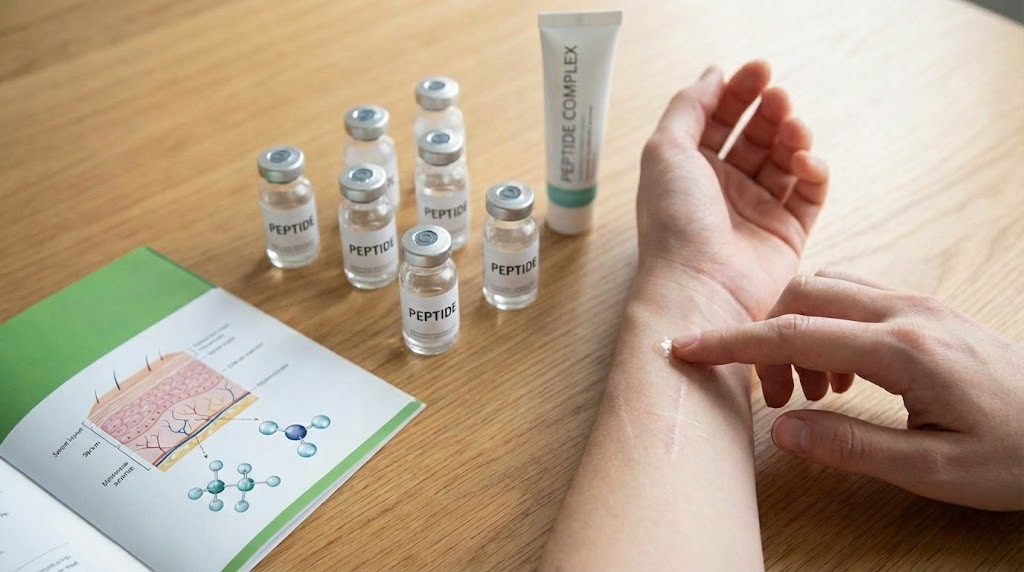
Scars form through dysregulated wound healing creating excess collagen deposition (hypertrophic and keloid scars), insufficient collagen production (atrophic scars like acne scarring), or disorganized tissue remodeling (surgical scars with irregular texture and pigmentation). Traditional scar treatments including silicone sheets, steroid injections, and laser resurfacing provide varying effectiveness depending on scar type, age, and severity, while invasive options like surgical revision carry additional risks and recovery requirements.
Peptides offer targeted intervention addressing scar formation and maturation through collagen remodeling promoting organized matrix structure, growth factor modulation supporting healthy tissue regeneration, inflammation reduction preventing excessive scarring, and melanin regulation normalizing pigmentation in hyperpigmented or hypopigmented scars. The SeekPeptides platform provides comprehensive guidance on peptide healing protocols for optimal scar improvement outcomes.
This guide examines best scar-treating peptides, application protocols for different scar types, realistic improvement expectations, combination strategies with conventional treatments, and evidence-based assessment helping users determine whether peptide therapy offers meaningful scar reduction for their specific concerns.
Understanding scar formation and peptide intervention mechanisms
Scars develop through three overlapping phases - inflammatory (days 0-5), proliferative (days 5-21), and remodeling (months to years) - with peptide interventions targeting specific dysfunction points creating pathological scarring. Normal wound healing produces organized collagen type III initially transitioning to stronger collagen type I in parallel bundles creating minimal visible scarring, while pathological healing shows disorganized collagen deposition, excessive inflammation, or inadequate tissue formation creating visible textural and pigmentation abnormalities.
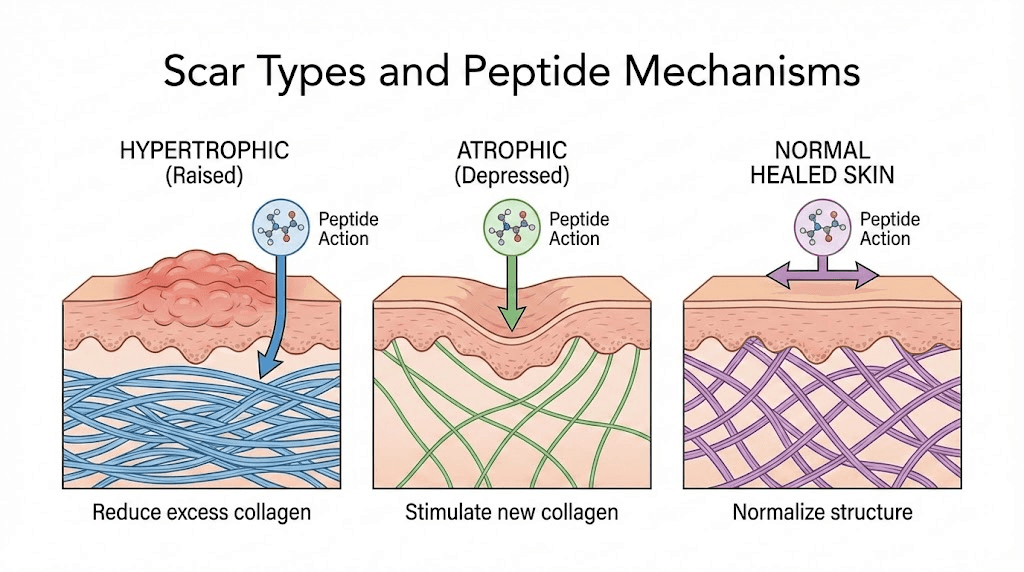
Hypertrophic scars result from excessive collagen production remaining confined to original wound boundaries, creating raised firm scars with red-purple coloration from increased vascularity and ongoing inflammation. Collagen-remodeling peptides address this through MMP (matrix metalloproteinase) regulation degrading excess disorganized collagen while supporting organized replacement, anti-inflammatory effects reducing ongoing tissue stimulation, and growth factor modulation normalizing fibroblast activity preventing continued overgrowth following principles detailed in SeekPeptides healing guides.
Keloid scars represent more severe overgrowth extending beyond original wound boundaries through genetic predisposition and dysregulated TGF-β signaling creating continuous collagen production.
These prove most challenging treating with peptides alone often requiring combination with medical interventions including steroid injections, pressure therapy, or laser treatment, though peptide adjuncts may reduce recurrence following professional treatments by supporting normal healing patterns.
Atrophic scars from insufficient collagen formation create depressed areas particularly common with acne where inflammatory damage destroys dermal tissue faster than repair processes replace it. Ice pick, rolling, and boxcar acne scars represent different atrophic patterns requiring collagen-stimulating peptides promoting new tissue synthesis filling depressions, though severe atrophic scarring typically needs professional interventions like subcision, microneedling with radiofrequency, or TCA CROSS for meaningful improvement beyond topical capacity.
Surgical scars vary widely based on wound closure technique, healing complications, and individual scarring tendency - optimal surgical scars appear as thin white lines barely perceptible, while problematic scars show raised texture, irregular pigmentation, contracture limiting movement, or widened appearance from tension or infection during healing. Peptide protocols beginning early post-surgery support optimal healing trajectory reducing pathological scarring risk, while mature surgical scars benefit from remodeling peptides improving appearance even years post-injury.
Learn about peptide healing mechanisms and injury recovery applications through SeekPeptides educational resources.
Scar Type | Formation Mechanism | Visual Characteristics | Peptide Approach | Treatment Difficulty |
|---|---|---|---|---|
Hypertrophic | Excessive collagen, confined to wound | Raised, firm, red-purple | Collagen remodeling, anti-inflammatory | Moderate - good peptide response |
Keloid | Overgrowth beyond wound boundaries | Very raised, spreading, genetic | Adjunct to medical treatment | High - peptides insufficient alone |
Atrophic (Acne) | Insufficient collagen formation | Depressed, ice pick/rolling/boxcar | Collagen stimulation | Moderate-High - often needs professional |
Surgical | Variable based on healing quality | Thin to wide, texture varies | Early intervention optimal | Low-Moderate - responds well if early |
Burn | Severe tissue damage, contracture | Thick, tight, discolored | Supportive, limited efficacy alone | High - requires medical management |
Best peptides for scar treatment and their specific mechanisms
BPC-157 (Body Protection Compound) represents the most extensively researched healing peptide for wound repair and scar prevention through multiple mechanisms including angiogenesis promoting blood vessel formation delivering nutrients and oxygen to healing tissue, growth factor upregulation (VEGF, TGF-β, EGF) supporting organized collagen synthesis, anti-inflammatory effects reducing excessive scarring triggers, and collagen modulation favoring organized type I deposition over disorganized type III accumulation. Research demonstrates BPC-157 improving wound healing quality with reduced scar formation in animal studies, though human clinical trials remain limited requiring realistic expectations about evidence quality.
BPC-157 administration for scar treatment uses subcutaneous injection near affected area or systemic dosing at 250-500mcg daily during active healing phase (first 2-4 weeks post-injury) supporting optimal initial repair, with some protocols continuing 2-3 months for mature scar remodeling though diminishing returns likely beyond acute healing window. Users should understand BPC-157 legal status and source from reputable peptide vendors ensuring quality and purity following SeekPeptides vendor reviews.
TB-500 (Thymosin Beta-4) provides complementary healing support through different pathways including cell migration promotion allowing fibroblasts, keratinocytes, and endothelial cells reaching wound site efficiently, actin regulation supporting cellular movement and tissue organization, inflammation modulation preventing excessive scarring response, and stem cell differentiation encouraging proper tissue type formation. TB-500 research demonstrates accelerated wound closure and improved healing quality, with typical dosing at 2-5mg twice weekly during active healing or 2-4mg weekly for mature scar remodeling.
The BPC-157 and TB-500 combination proves popular for comprehensive injury healing protocols through synergistic mechanisms - BPC-157 focusing on angiogenesis and collagen organization while TB-500 enhances cell migration and tissue remodeling, creating superior outcomes than either alone particularly for significant scarring concerns or surgical recovery as detailed in peptide stacking guides.
GHK-Cu (Copper Peptide) addresses scar appearance through collagen remodeling stimulating organized matrix replacement of disorganized scar tissue, MMP regulation degrading excess collagen in hypertrophic scars while supporting new organized synthesis, wound healing acceleration when applied early post-injury, anti-inflammatory effects reducing pathological scarring triggers, and skin regeneration promoting normal tissue characteristics including pigmentation normalization. GHK-Cu concentrations of 1-2% applied topically twice daily show clinical improvements in scar texture, color, and overall appearance over 3-6 months with continued enhancement through extended use.
Matrixyl peptides (palmitoyl pentapeptide-4 and related) support scar improvement through matrikine signaling encouraging organized collagen synthesis, fibronectin and elastin production improving tissue quality, and glycosaminoglycan synthesis supporting dermal hydration and structure. While not specifically designed for scars, Matrixyl's proven anti-aging efficacy translates to scar remodeling applications at 3-5% concentrations applied topically to affected areas, particularly effective for mature scars where ongoing gentle stimulation gradually improves appearance through cumulative structural changes.
Explore comprehensive healing peptides and injury recovery protocols through SeekPeptides guides.
Peptide | Administration | Primary Mechanism | Scar Type | Optimal Timing | Evidence Quality |
|---|---|---|---|---|---|
BPC-157 | Injectable, 250-500mcg daily | Angiogenesis, growth factors | All types, prevention | Acute healing 0-4 weeks | Moderate - animal studies |
TB-500 | Injectable, 2-5mg 2x/week | Cell migration, actin regulation | All types, remodeling | Acute healing 0-6 weeks | Moderate - limited human data |
GHK-Cu | Topical 1-2%, twice daily | Collagen remodeling, MMP regulation | Hypertrophic, surgical, pigmented | Mature scars, prevention | Good - clinical studies |
Matrixyl | Topical 3-5%, twice daily | Matrikine signaling, matrix synthesis | Mature scars, atrophic | Mature scars 3+ months | Moderate - anti-aging studies |
BPC-157 + TB-500 | Injectable combination | Synergistic healing mechanisms | Significant scarring | Acute through remodeling | Moderate - anecdotal reports |
Application protocols optimized for different scar types
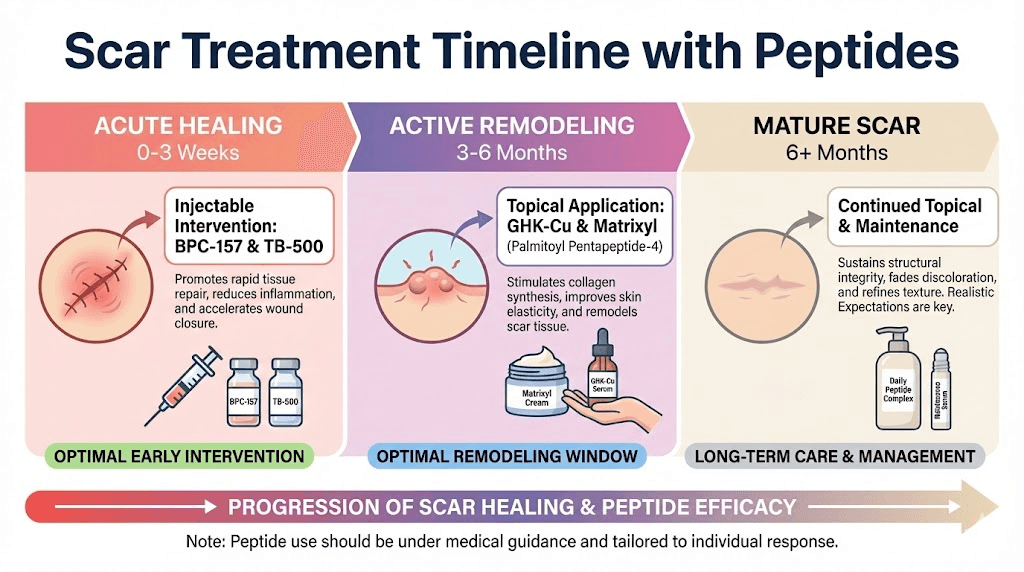
Early intervention during active healing (days 0-21 post-injury) provides maximum scarring prevention through supporting optimal wound closure and initial tissue organization - BPC-157 at 250-500mcg daily injected subcutaneously near wound site or systemically combined with TB-500 at 2-5mg twice weekly creates comprehensive healing support, while topical GHK-Cu 1-2% applied twice daily to closed incisions (not open wounds) provides additional collagen organization benefits as detailed in wound healing protocols.
Post-surgical scar protocols should begin once incisions fully closed (typically 7-14 days post-surgery) to avoid infection risk from topical applications to compromised skin barrier - injectable peptides can start earlier under medical supervision if appropriate, while topical copper peptides and Matrixyl should wait for complete epithelialization. Continue intensive peptide treatment through initial 3-6 months of scar maturation when remodeling proves most active and intervention impact maximizes.
Mature scar treatment (3+ months to years post-injury) requires realistic expectations as established scars prove less responsive than actively remodeling tissue, though meaningful improvement remains possible through sustained intervention - topical GHK-Cu 1-2% and Matrixyl 3-5% applied twice daily for 6-12 months create gradual texture improvement and pigmentation normalization in many users, while injectable peptides show diminishing returns for very mature scars better addressed through professional treatments as explored in peptide therapy clinics.
Acne scar protocols combine collagen-stimulating peptides with professional interventions for optimal results - topical GHK-Cu and Matrixyl provide baseline collagen support applied consistently between professional treatments, while in-office microneedling with peptide serums enhances penetration and collagen induction response. Home microneedling (0.25-0.5mm depth) combined with peptide application offers gentle enhancement though professional depth (1.0-2.5mm) produces superior atrophic scar filling through stronger tissue remodeling stimulus.
Hypertrophic scar management uses anti-inflammatory peptides and collagen-remodeling compounds reducing excess tissue - topical GHK-Cu twice daily helps normalize collagen organization and reduce inflammation, combined with silicone sheeting or gel providing occlusion and hydration supporting scar flattening. Injectable BPC-157 around scar edges may reduce inflammation and promote remodeling though evidence remains limited requiring experimental mindset and realistic expectations following peptide safety protocols.
Application technique for topical peptides affects results - apply to freshly cleansed scar area on slightly damp skin improving absorption, use gentle massage in circular motions 30-60 seconds enhancing penetration, allow complete absorption (60-90 seconds) before applying other products, and follow with appropriate moisturizer and SPF protection preventing pigmentation worsening from UV exposure as detailed in peptide application guides.
Learn optimal protocols and timing strategies through SeekPeptides comprehensive resources.
Expected results and realistic improvement timelines
Early intervention results during active healing (first 2-4 weeks) prove difficult quantifying as peptides support normal healing trajectory rather than producing dramatic visible changes - users notice potentially faster wound closure, reduced inflammation and redness, less pain and discomfort during healing, and subjectively "better" healing quality though objectively comparing to non-treated healing proves impossible without bilateral injuries treated differently. The prevention value emerges months later when scars mature showing superior appearance suggesting early peptide intervention improved healing trajectory.
Initial mature scar improvement emerges around 6-12 weeks of consistent topical peptide application as collagen remodeling begins creating structural changes - slight softening of raised scars, subtle texture improvement in depressed scars, beginning pigmentation normalization in hyperpigmented areas, and overall appearance marginally improved though changes remain subtle requiring photography comparison for objective assessment. Users should maintain realistic expectations during this early phase recognizing scar improvement requires extended timelines measured in months not weeks following peptide treatment principles.
Meaningful scar improvement manifests at 3-6 months representing timeframe where most users notice clear enhancement - raised hypertrophic scars show 20-40% height reduction becoming flatter and softer, texture irregularities improve with smoother surface quality, pigmentation differences diminish by 30-50% in responsive cases, and overall scar visibility decreases creating more cosmetically acceptable appearance. The improvement magnitude depends heavily on scar characteristics with newer scars (3-12 months old) responding better than very mature scars (years old), and moderate severity showing superior results compared to severe scarring often requiring professional intervention beyond topical peptide capacity.
Maximum scar improvement plateaus around 6-12 months of consistent peptide treatment as remodeling capacity reaches individual limits - users achieving satisfactory results can reduce application frequency to 4-5 times weekly for maintenance preventing regression while avoiding indefinite intensive treatment expense. Some users report continued gradual improvement through 12-24 months suggesting very slow ongoing remodeling, though dramatic changes beyond 12-month mark prove rare with most meaningful improvement occurring in first 6-9 months following peptide timelines.
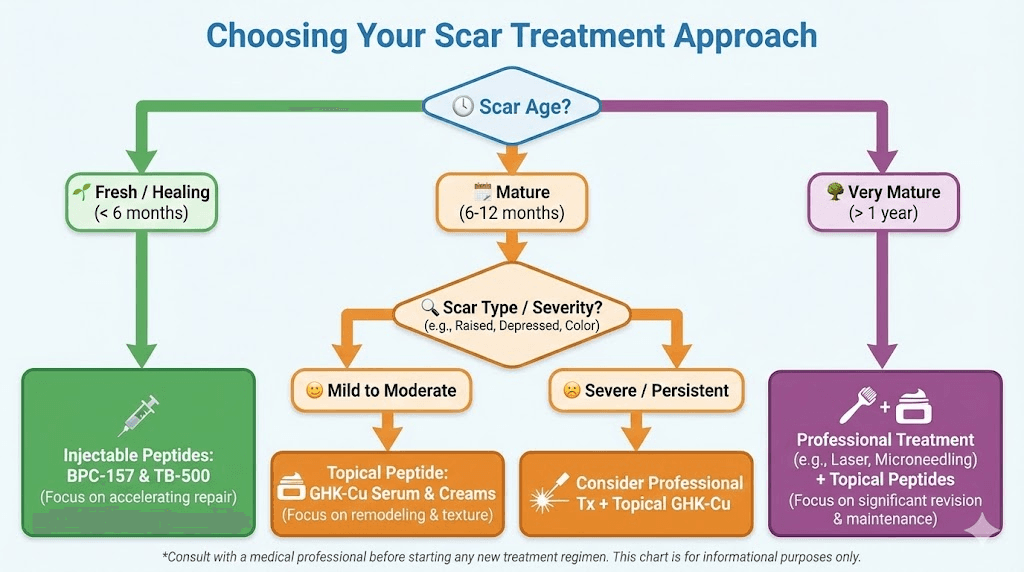
Scar age significantly influences achievable improvement - fresh scars (under 6 months) show most dramatic response as active remodeling processes amplify peptide effects, maturing scars (6-24 months) demonstrate moderate improvement as remodeling slows but remains active, while very mature scars (2+ years) may show only subtle enhancement requiring extended treatment (12+ months) for noticeable results often insufficient justifying ongoing peptide investment versus accepting scar appearance or pursuing professional treatments.
Individual healing tendency creates substantial outcome variation - users with normal scarring tendency show good peptide response achieving 40-60% scar improvement, those with mild hypertrophic tendency experience 30-50% enhancement, while strong keloid formers prove challenging with peptides alone often requiring medical intervention as primary treatment with peptides providing supportive role reducing recurrence risk following professional treatments.
Explore realistic timelines and outcome expectations through SeekPeptides resources.
Timeline Phase | Visible Changes | Scar Response | User Experience | Recommended Action |
|---|---|---|---|---|
Weeks 0-6 | Minimal visible change | Cellular-level activity beginning | "Not seeing much yet" | Continue, take baseline photos |
Weeks 6-12 | Subtle improvements | Early remodeling effects | "Maybe slightly better?" | Monthly comparison photos |
Months 3-6 | Clear enhancement | Active remodeling peak | "Definitely improving!" | Maintain consistency |
Months 6-12 | Plateau at maximum | Remodeling slowing | "This is as good as it gets" | Consider maintenance protocol |
Beyond 12 Months | Minimal further change | Stable mature scar | "Maintaining results" | Reduce frequency if satisfied |
Combining peptides with conventional scar treatments
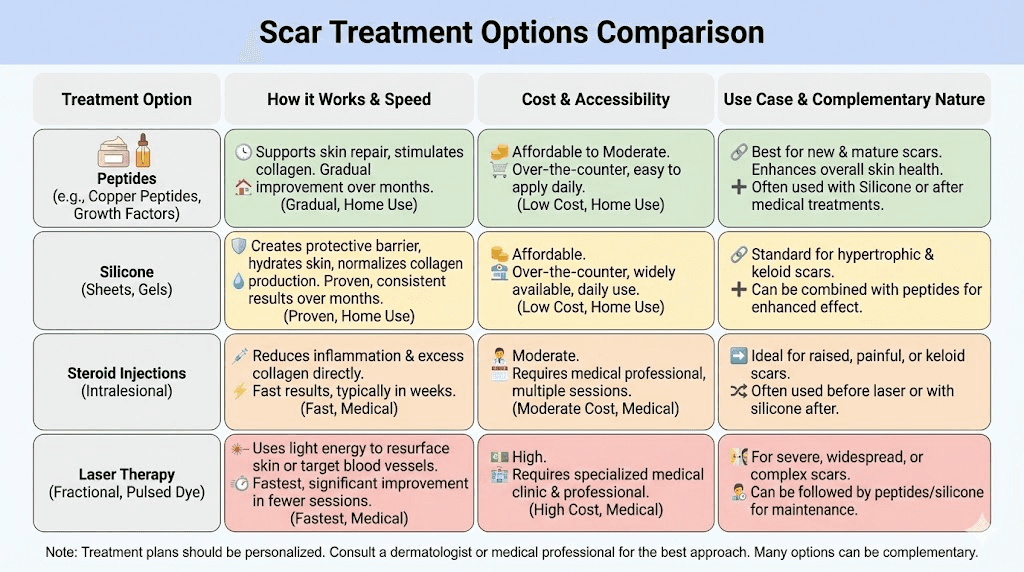
Silicone sheeting or gel represents gold-standard topical scar treatment with robust evidence demonstrating 30-50% improvement in hypertrophic scar height, texture, and color through occlusion creating optimal hydration for collagen remodeling, pressure effects reducing blood flow and collagen synthesis, and barrier protection preventing trauma and irritation. Combining silicone with peptides proves highly effective - apply GHK-Cu serum twice daily allowing complete absorption (60-90 seconds), then cover with silicone sheet worn 12-24 hours daily or apply silicone gel creating synergistic approach addressing scar through multiple mechanisms.
Pressure therapy using compression garments reduces hypertrophic scarring particularly from burns or large wounds through decreasing tissue oxygenation slowing fibroblast activity, mechanical pressure limiting collagen deposition, and microvasculature compression reducing inflammation. Peptide application fits well into pressure therapy routines - apply peptides during garment removal periods (typically few hours daily for skin hygiene), allowing absorption before resuming compression creating comprehensive protocol addressing scars through chemical (peptides) and physical (pressure) modalities as detailed in combination strategies.
Steroid injections (triamcinolone) provide medical intervention for problematic hypertrophic or keloid scars through anti-inflammatory effects reducing fibroblast activity, collagen synthesis inhibition preventing overgrowth, and vascular effects reducing scar blood supply. Peptides serve as adjunct preventing recurrence following steroid treatment - begin topical GHK-Cu after injection-related inflammation resolves (typically 1-2 weeks), continuing long-term to support normal healing and reduce recurrence risk through promoting organized collagen rather than excessive disorganized deposition.
Laser treatments including pulsed dye laser (PDL) for redness, fractional CO2 for texture, and Q-switched lasers for pigmentation provide professional scar intervention through targeted tissue destruction stimulating remodeling, vascular effects reducing redness, and pigment fragmentation normalizing color. Post-laser peptide protocols support optimal healing - begin BPC-157 and TB-500 immediately post-treatment supporting tissue repair, add topical copper peptides once epithelialization complete (typically 3-7 days), creating comprehensive approach maximizing professional treatment results while reducing complication risk.
Microneedling creates controlled micro-injuries stimulating collagen production particularly effective for atrophic scars when combined with peptide delivery - professional treatments (1.0-2.5mm depth) with immediate peptide serum application enhance penetration and healing response, while home microneedling (0.25-0.5mm) with peptides provides gentle ongoing stimulation between professional sessions. Typical protocol involves professional treatments every 4-6 weeks for 3-6 sessions with daily topical peptide application between sessions following combination protocols.
Surgical scar revision removes problematic scars replacing with new incisions closed with meticulous technique - peptide protocols optimize new scar healing preventing recurrence of initial problem. Begin BPC-157 250-500mcg daily plus TB-500 2-5mg twice weekly immediately post-surgery continuing through first 4-6 weeks, add topical GHK-Cu once incisions closed, and maintain topical peptides 6-12 months supporting optimal maturation creating superior outcomes versus revision surgery alone.
Learn about combination approaches and professional integration through SeekPeptides guides.
Product selection and sourcing for scar treatment
Injectable BPC-157 and TB-500 require sourcing from reputable peptide vendors providing third-party testing verification ensuring purity and identity - quality vendors like Amopure (budget option), Transcend, Planet Peptides, and others reviewed on SeekPeptides offer Janoshik COAs and batch tracking. Users should verify peptide legality in their jurisdiction as research peptides occupy regulatory gray area requiring personal responsibility and informed decision-making.
Reconstitution requirements for lyophilized injectable peptides demand sterile technique - use bacteriostatic water for multi-dose vials, follow proper reconstitution calculations ensuring accurate dosing, and employ sterile handling preventing contamination as detailed in injection guides. Storage protocols prove critical - lyophilized powder stored frozen or refrigerated maintains potency for months to years, while reconstituted peptides refrigerated last 2-4 weeks before degradation reduces effectiveness.
Topical copper peptide products for scar treatment require adequate concentrations (1-2% GHK-Cu) rather than cosmetic products containing trace amounts - specialized peptide skincare brands or medical-grade lines typically deliver therapeutic dosing, while mass-market products often contain insufficient actives despite marketing prominence. Users should verify ingredient lists showing GHK-Cu or copper peptides in first 5-7 ingredients suggesting adequate concentration, though specific percentages disclosure provides best verification as discussed in product quality guides.
Formulation stability affects copper peptide effectiveness - look for opaque or UV-protective packaging preventing light degradation, airless pumps minimizing oxygen exposure, appropriate pH ranges (4.5-5.5), and refrigeration recommendations indicating manufacturer prioritizes potency. Short expiration dates (6-12 months) suggest fresh formulations while extended shelf life (2+ years) raises stability questions for active peptide content.
Cost considerations for scar treatment vary by approach - topical copper peptide serums cost $40-120 for 30ml (2-3 month supply) creating $15-50 monthly expense, while injectable BPC-157 and TB-500 cost $80-200 for 4-6 week treatment course. Compare to professional treatments costing $500-3000 per session requiring multiple treatments making peptide protocols cost-effective option especially for prevention or mild to moderate scarring as detailed in cost analysis guides.
Explore vendor reviews and sourcing guidance through SeekPeptides comprehensive comparisons.
Safety considerations and precautions for scar treatment
Injectable peptide safety requires proper technique and sterile practice - use clean injection protocols with alcohol swabs for skin and vial tops, rotate injection sites preventing tissue damage, follow appropriate needle disposal in sharps container, and monitor injection sites for signs of infection (increasing redness, warmth, pus, fever) requiring immediate medical attention. BPC-157 and TB-500 show excellent safety profiles in research and anecdotal use though human clinical trial data remains limited requiring informed consent to uncertainty.
Topical peptide application safety proves excellent with minimal adverse effects - copper peptides may cause temporary stinging or mild redness fading within 30-60 minutes, while true allergic reactions prove rare manifesting as persistent irritation requiring discontinuation. Patch testing on small scar area for 48 hours before full application prevents unnecessary complications allowing early detection of sensitivity as recommended in safety protocols.
Timing considerations affect safety and effectiveness - avoid applying topical peptides to open wounds risking infection and impaired healing, wait for complete wound closure and epithelialization (typically 7-14 days post-injury), ensure no active infection exists before beginning treatment, and coordinate with healthcare providers for post-surgical applications ensuring appropriate timing relative to suture removal and healing progress. Injectable peptides can begin earlier under medical supervision though most users start after initial wound closure for safety.
Pregnancy and breastfeeding precautions apply to scar treatment peptides - avoid injectable BPC-157 and TB-500 during pregnancy/nursing due to insufficient safety data, exercise caution with topical copper peptides though systemic absorption remains minimal, and consult healthcare providers about scar treatment timing potentially postponing intensive protocols until after pregnancy/nursing completion. Scar treatment proves non-urgent allowing conservative approach prioritizing maternal and fetal safety.
Medical supervision recommendations include informing treating physicians about peptide use particularly around surgical procedures, coordinating peptide protocols with professional scar treatments, monitoring for unexpected reactions or complications, and maintaining realistic expectations about peptide limitations for severe scarring requiring medical intervention. Peptides complement rather than replace appropriate medical care for significant scarring concerns.
Learn comprehensive safety protocols and risk management through SeekPeptides safety resources.
How you can use SeekPeptides for comprehensive scar treatment guidance
SeekPeptides provides extensive healing peptide education for scar treatment and injury recovery. Explore BPC-157 complete guide, how to take BPC-157, BPC-157 banned status, TB-500 benefits, TB-500 full guide, and BPC-157 vs TB-500 comparison.
Access copper peptide resources including GHK-Cu dosing, storage protocols, discontinuation effects, skin tightening, wrinkles, and dark circles.
Learn injury recovery protocols, joint pain treatment, tendon repair, and general healing applications.
Explore vendor comparisons including Amopure, Transcend, Planet, RPO, NextGen, Profound, Elite, Integrity, and Revive.
Access practical tools including peptide calculator, BPC-157 dosage calculator, cost calculator, reconstitution calculator, and dosage chart.
Learn administration techniques, reconstitution methods, storage requirements, bacteriostatic water use, and injectable peptide list.
Understand fundamentals through what are peptides, how they work, safety guide, research overview, getting started, common mistakes, and complete peptide list.
Final thoughts
Peptides for scars provide targeted intervention through BPC-157 and TB-500 promoting optimal healing during acute phase, copper peptides supporting collagen remodeling in mature scars, and comprehensive protocols addressing different scar types through appropriate mechanisms. Results develop gradually over 3-6 months for mature scars with maximum effects at 6-12 months, requiring patience following realistic timelines.
Fresh scars and mild to moderate established scars respond well to peptide-only protocols while severe scarring benefits from combination with professional treatments. The advantage lies in excellent safety, home application convenience, and cost-effectiveness compared to repeated professional interventions through comprehensive healing approaches.
Your scar treatment strategy should match scar type and age to appropriate peptide compounds, begin early post-injury when possible, combine with conventional treatments like silicone, and maintain realistic expectations about gradual improvement through SeekPeptides comprehensive guidance.
Related scar and healing resources
Essential healing and injection guides
In case I don’t see you, good afternoon, good evening, and good night. Take care of yourself. Join SeekPeptides