Dec 27, 2025
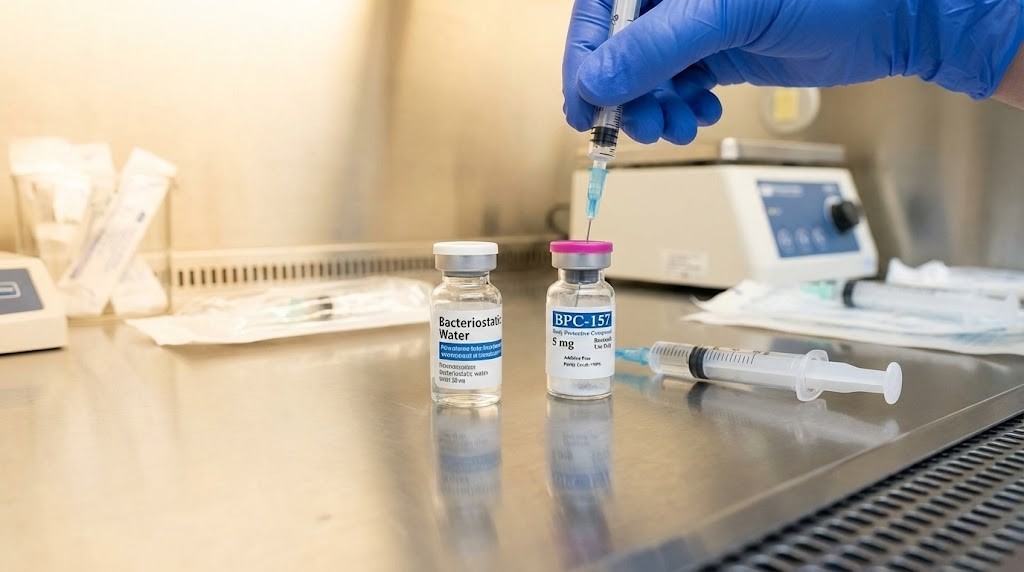
You know that BPC-157 comes in two main forms - injectable (lyophilized powder requiring reconstitution) and oral (capsules or stable oral formula).
Injectable is most common and effective for injuries, requiring you to mix the powder with bacteriostatic water and inject subcutaneously or intramuscularly.
Oral works well for gut-specific issues.
Dosing is typically 250-500mcg twice daily for injectable, or 500-1,000mcg daily for oral. The method you choose depends on what you're treating.
This guide breaks down exactly how to take BPC-157 step-by-step, reconstitution instructions with visual guides, injection technique for both subcutaneous and intramuscular, oral administration methods, dosing protocols by condition, timing for optimal results, and troubleshooting common problems.
Let's start with understanding which form of BPC-157 to use.
Injectable vs oral BPC-157: Which to choose
Your administration method depends on what you're treating.
Injectable BPC-157 (lyophilized powder)
Best for:
Muscle, tendon, ligament injuries
Joint pain and inflammation
Systemic healing
Skin wounds and tissue damage
Fastest, most direct results
How it comes:
Freeze-dried white powder in sealed vial
Typical sizes: 2mg, 5mg, 10mg per vial
Requires reconstitution with bacteriostatic water
Must refrigerate after mixing
Advantages:
Higher bioavailability (more gets into bloodstream)
Can inject near injury site for localized healing
Works for all BPC-157 uses
Faster results typically
Disadvantages:
Requires needles and injection
More intimidating for beginners
Needs reconstitution knowledge
Must store refrigerated after mixing
See our BPC-157 complete guide and BPC-157 benefits for background.
Oral BPC-157 (capsules or stable oral form)
Best for:
Gut healing (IBS, leaky gut, ulcers, Crohn's)
Digestive issues
Beginners afraid of needles
Convenience
How it comes:
Capsules containing BPC-157 powder
Oral stable BPC-157 Arginate or Acetate
Pre-measured doses
No mixing required
Advantages:
No needles required
Easy to use
Works directly on gut lining
Convenient for travel
Disadvantages:
Lower bioavailability than injectable
Less effective for injuries/systemic healing
More expensive per dose typically
Slower results
Important note: Standard BPC-157 has poor oral bioavailability. Look for "oral stable" BPC-157 Arginate or BPC-157 Acetate for better oral absorption.
Combination approach
For comprehensive healing:
Injectable BPC-157 for systemic/injury healing
Oral BPC-157 for gut healing
Both can be used together
Maximize benefits from both pathways
See our injectable vs oral peptides comparison.
How to reconstitute BPC-157 (injectable powder)
Step-by-step guide to mixing your BPC-157 powder.
What you need
Required supplies:
BPC-157 lyophilized powder vial
Bacteriostatic water (NOT sterile water for long-term use)
Syringes with needles (3ml syringe recommended)
Alcohol wipes
Clean workspace
Where to get supplies:
Bacteriostatic water: Research chemical vendors, some pharmacies
Syringes: Amazon, pharmacy (insulin syringes work)
Alcohol wipes: Any pharmacy or store
Don't use:
Sterile water (for single-use only, no preservative)
Tap water (not sterile)
Saline (can degrade peptides)
Learn about water in our bacteriostatic water for peptides and water to mix with peptides guides.
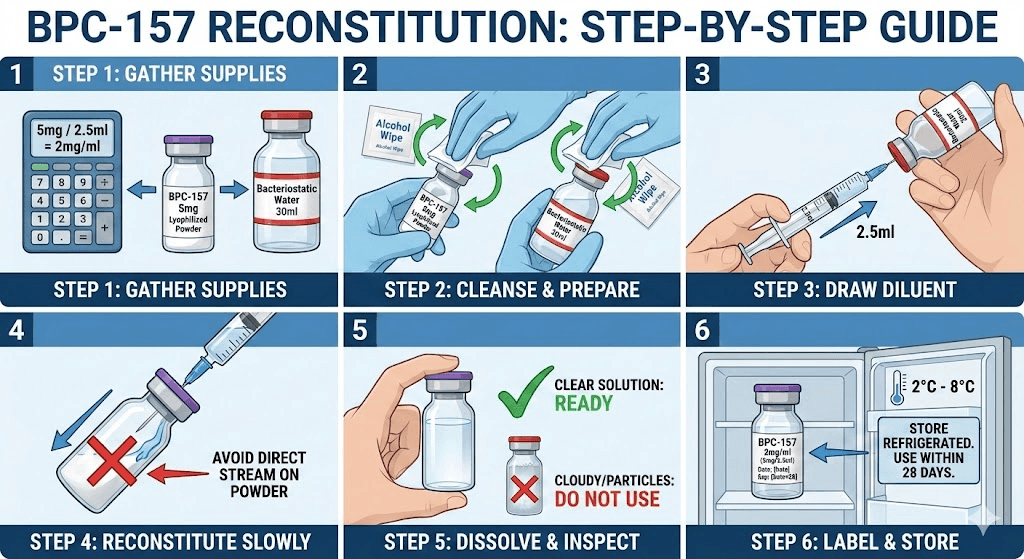
Step-by-step reconstitution
Step 1: Calculate water amount
Use our peptide reconstitution calculator or free peptide reconstitution calculator.
Common reconstitutions:
5mg BPC-157 + 2.5ml bacteriostatic water = 2mg/ml (200mcg per 0.1ml)
5mg BPC-157 + 5ml bacteriostatic water = 1mg/ml (100mcg per 0.1ml)
10mg BPC-157 + 5ml bacteriostatic water = 2mg/ml (200mcg per 0.1ml)
Easy math: 5mg + 2.5ml water means each 0.1ml (10 units on insulin syringe) = 200mcg. For 250mcg dose, draw 0.125ml (12.5 units). For 500mcg dose, draw 0.25ml (25 units).
Step 2: Clean and prepare
Wash hands thoroughly
Clean workspace
Remove caps from BPC-157 vial and bacteriostatic water
Wipe both vial tops with alcohol swabs
Step 3: Draw bacteriostatic water
Insert needle into bacteriostatic water vial
Draw calculated amount (e.g., 2.5ml for 5mg vial)
Remove air bubbles by tapping syringe
Step 4: Add water to BPC-157 vial
Insert needle into BPC-157 vial
SLOWLY inject water down the side of vial (not directly onto powder)
Don't shake - let it dissolve naturally or swirl gently
Takes 1-5 minutes to fully dissolve
Step 5: Inspect solution
Should be clear (no cloudiness)
No particles or floating material
Completely dissolved
If cloudy, don't use (contaminated or degraded)
Step 6: Label and store
Write reconstitution date on vial
Store in refrigerator (2-8°C / 36-46°F)
Use within 28-30 days
See complete reconstitution guide in our how to reconstitute peptides and how long reconstituted peptides last in fridge.
How to inject BPC-157 subcutaneously
Most common injection method for BPC-157.
What subcutaneous (SubQ) injection means
Subcutaneous = under the skin, into fat layer:
Not into muscle (that's intramuscular)
Not into vein (that's intravenous)
Into fatty tissue between skin and muscle
Slower absorption than IM, but adequate for BPC-157
Why SubQ for BPC-157:
Easy to self-administer
Less painful than IM
Works well for systemic healing
Can inject near injury sites
Injection sites for SubQ
Best locations:
Abdomen (2 inches away from belly button)
Thighs (front and outer sides)
Upper arms (back of arm, need help or flexibility)
Love handles/flanks
Near injury:
Can inject within 2-3 inches of injury
Example: Shoulder injury = inject into shoulder area fat
Knee injury = inject into thigh near knee
Local injection may speed healing to that area
Rotate sites:
Don't inject same spot repeatedly
Prevents tissue damage and scar tissue
Rotate between abdomen, thighs, arms
Different spot each injection
SubQ injection step-by-step
Step 1: Gather supplies
Reconstituted BPC-157 (refrigerated)
Insulin syringe (29-31 gauge, 1/2 inch needle)
Alcohol wipes
Sharps container for disposal
Step 2: Prepare dose
Remove BPC-157 from fridge
Wipe vial top with alcohol
Draw calculated dose (e.g., 25 units = 250mcg if using 2mg/ml concentration)
Remove air bubbles
Recap needle
Step 3: Prepare injection site
Choose injection area
Clean with alcohol wipe
Let dry (30 seconds)
Step 4: Inject
Pinch skin to create fold (makes it easier)
Insert needle at 45-90 degree angle into pinched skin
Insert fully (it's a short needle)
Slowly inject (take 3-5 seconds)
Remove needle quickly
Step 5: After injection
Apply gentle pressure with alcohol wipe if bleeding (rare)
Don't massage injection site
Return BPC-157 vial to refrigerator immediately
Dispose of needle in sharps container
Pain level: Minimal. Most people barely feel it with small insulin needles.
See our complete how to inject peptides guide for detailed technique with photos.
How to inject BPC-157 intramuscularly (IM)
Alternative method for some situations.
When to use IM injection
Intramuscular is better when:
Treating deep muscle injuries
Want faster absorption
Prefer muscle over fat injection
Targeting specific muscle groups
Most people use SubQ:
SubQ is easier and works well
IM not necessary for most BPC-157 uses
IM more painful typically
IM injection sites
Best muscles:
Glutes (butt, upper outer quadrant)
Thighs (vastus lateralis - outer mid-thigh)
Deltoids (shoulder muscle - advanced)
Site selection:
Choose muscle near injury if targeting specific area
Rotate between muscles
Requires longer needle than SubQ
IM injection technique
Different from SubQ:
Longer needle (1-1.5 inch)
90-degree angle (straight in)
Into muscle, not just under skin
Inject slowly
May feel more discomfort
Not necessary for most BPC-157 users: SubQ works great. Only use IM if you have specific reason or preference.
How to take BPC-157 orally
For those who prefer no injections or have gut-specific issues.
Oral BPC-157 capsules
Standard oral capsules:
Contains BPC-157 powder
Take on empty stomach
Lower bioavailability (only small amount absorbed)
Works directly on stomach/gut lining as it passes through
Dosing:
500-1,000mcg daily (higher than injectable due to poor absorption)
Split into 1-2 doses
Take 30 minutes before meals
Best for:
Stomach ulcers
IBS and digestive issues
Leaky gut
Esophageal issues
Oral stable BPC-157 (Arginate or Acetate)
Better oral absorption:
BPC-157 Arginate or BPC-157 Acetate
Modified to resist stomach acid breakdown
Higher bioavailability than standard oral
More expensive
Dosing:
250-500mcg daily (similar to injectable)
Can work systemically when absorbed
Still best for gut issues
How to take:
Empty stomach preferred
30 minutes before food
With water
Don't take with acidic beverages
Sublingual administration (under tongue)
Some users try sublingual:
Hold under tongue for 60-90 seconds
May improve absorption vs swallowing
No definitive evidence it's better
Worth trying if you have capsules
How to do it:
Open capsule
Pour powder under tongue
Hold as long as possible
Swallow saliva after 60-90 seconds
BPC-157 dosing protocols by condition
How much to take depends on what you're treating.
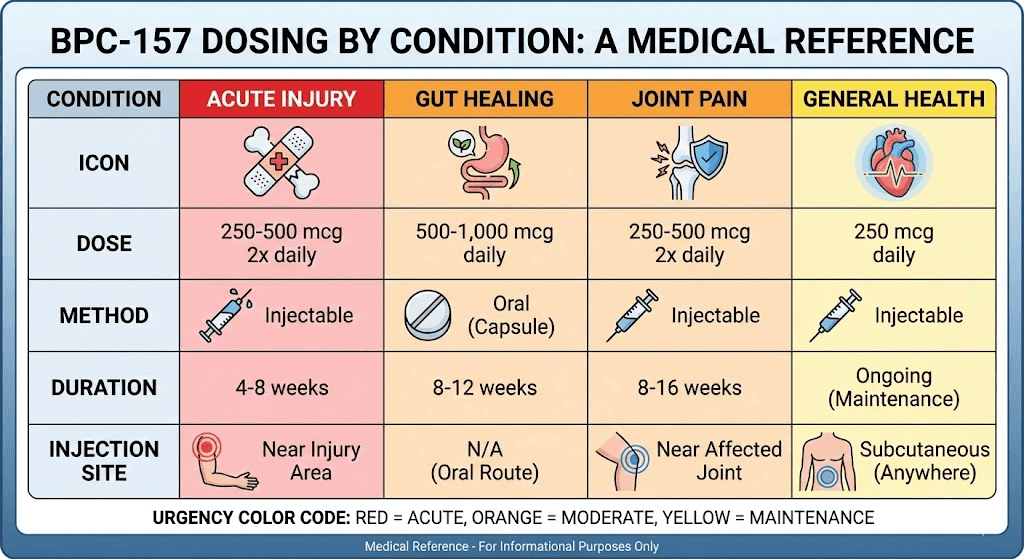
For injury healing (muscles, tendons, ligaments)
Standard protocol:
Dose: 250-500mcg twice daily (500mcg-1mg total daily)
Method: Injectable SubQ near injury site
Duration: 4-8 weeks minimum
Timing: Morning and evening
Severe injuries:
Dose: 500mcg twice daily (1mg total daily)
Method: Injectable SubQ
Duration: 8-12 weeks
Can extend if needed
Mild injuries:
Dose: 250mcg twice daily (500mcg total)
Method: Injectable SubQ
Duration: 4-6 weeks
Use our BPC-157 dosage calculator and BPC-157 5mg dosing guide.
For gut healing (IBS, leaky gut, ulcers)
Oral protocol (preferred for gut):
Dose: 500-1,000mcg daily
Method: Oral capsules on empty stomach
Duration: 8-12 weeks minimum
Timing: 30 minutes before breakfast
Injectable protocol (alternative):
Dose: 250-500mcg twice daily
Method: Injectable SubQ (abdomen area)
Duration: 8-12 weeks
Works systemically and reaches gut
Severe gut issues:
Consider both oral AND injectable
Oral: 500mcg morning
Injectable: 250mcg twice daily
Comprehensive approach
For joint pain and arthritis
Standard protocol:
Dose: 250-500mcg twice daily
Method: Injectable SubQ near affected joint
Duration: 8-16 weeks
Long-term use acceptable
Multiple joints:
Systemic dosing (not near specific joint)
500mcg twice daily
Abdomen or thigh injections
Reaches all joints systemically
For general health and longevity
Maintenance protocol:
Dose: 250mcg daily
Method: Injectable SubQ or oral
Duration: Ongoing (can use long-term)
Timing: Morning or evening
Cycling:
Can use continuously or cycle
Example: 12 weeks on, 4 weeks off
Not required (BPC-157 safe long-term)
See best peptides for injury recovery and best peptides for joint pain.
Timing: When to take BPC-157
Optimal timing maximizes results.
Time of day
Twice-daily dosing (most common):
Morning: 30-60 minutes before breakfast
Evening: 30-60 minutes before dinner OR before bed
Consistent timing each day helps
Once-daily dosing:
Morning preferred (on empty stomach)
Or before bed for healing during sleep
Choose what fits your schedule
Does timing matter much?
Not critically, but empty stomach slightly better for absorption
Consistency matters more than perfect timing
Don't stress about exact times
Before or after meals
Empty stomach is better:
30 minutes before meals ideal
Or 2+ hours after meals
Peptides absorb better without food competing
Can take with food if necessary:
Still works, just slightly less absorption
Better to take with food than skip dose
Consistency > perfect timing
Before or after workouts
For injuries:
Some inject right before training injured area
Or immediately after workout
May accelerate healing of training-induced micro-damage
No strong evidence for specific timing:
Total daily dose matters most
Twice daily (morning/evening) works great
Don't overthink pre/post workout timing
How long before seeing results
Timeline varies by condition:
Gut healing: 1-2 weeks for initial improvements
Acute injuries: 2-4 weeks for noticeable healing
Chronic injuries: 4-8 weeks
Joint pain: 4-6 weeks
Skin wounds: 1-2 weeks
Be patient:
BPC-157 works but not overnight
Minimum 4-week trial recommended
Some benefits accumulate over months
Don't stop too early
Learn about timelines in our how long do peptides take to work guide.
Proper storage and handling
Maintaining BPC-157 quality ensures effectiveness.
Before reconstitution
Lyophilized powder storage:
Room temperature: Fine for months
Refrigerator (2-8°C): Extends shelf life to 12-24 months
Freezer (-20°C): Maximum shelf life (24-36 months)
Keep in original packaging, protect from light
Don't:
Leave in hot car
Expose to direct sunlight
Open vial until ready to reconstitute
Get moisture inside vial
After reconstitution
Critical: Refrigerate immediately:
Store at 2-8°C (36-46°F)
Main fridge section, not door (too much temperature fluctuation)
Use within 28-30 days maximum
Discard if cloudy or discolored
Daily use:
Remove from fridge briefly to draw dose
Return to fridge immediately
Don't leave out for hours
Each removal should be <5 minutes
Never freeze reconstituted BPC-157:
Ice crystals damage peptide structure
Potency loss
Keep liquid refrigerated, not frozen
See our peptide storage guide and how long reconstituted peptides last in fridge.
Travel and portability
Short trips (1-3 days):
Bring reconstituted vial in insulated cooler with ice pack
Or bring unreconstituted powder + bacteriostatic water, mix at destination
Oral capsules easiest for travel
Longer trips:
Unreconstituted powder doesn't need refrigeration
Bring bacteriostatic water and supplies to mix
Or use oral form for convenience
Air travel:
Carry-on: Allowed with ice pack
Checked: Can include with documentation
Bring prescription or research documentation if asked
Safety and side effects
BPC-157 is very safe but awareness prevents issues.
Common (minor) side effects
What some users experience:
Fatigue (first few days)
Headache (rare)
Dizziness (very rare)
Nausea (uncommon, usually with oral)
These are mild and temporary:
Usually resolve within days
Reduce dose if bothersome
Rarely cause discontinuation
Serious side effects (extremely rare)
No serious adverse events widely documented:
Decades of research use
Millions of doses given
Excellent safety record
Theoretical concerns:
Tumor growth promotion (no evidence in humans, avoid if active cancer)
Unknown very long-term effects (>5 years continuous use)
When to stop and consult physician:
Severe or persistent side effects
Allergic reaction (rash, difficulty breathing)
Unexpected symptoms
Contraindications
Avoid BPC-157 if:
Pregnant or breastfeeding (no safety data)
Active cancer (theoretical tumor growth concern)
Severe allergic reaction to previous dose
Use caution if:
Taking blood thinners (BPC-157 may affect coagulation)
Scheduled for surgery (stop 1-2 weeks before)
Significant health conditions (consult physician)
See our peptide safety and risks guide.
Combining BPC-157 with other peptides
BPC-157 stacks well with complementary peptides.
BPC-157 + TB-500
Most popular stack:
BPC-157: 250-500mcg twice daily
TB-500: 5-10mg per week (loading), then 2-5mg weekly
Synergistic tissue healing
Works through different pathways
Why combine:
BPC-157: Local healing, gut, blood vessels
TB-500: Deep tissue, inflammation, flexibility
Together = comprehensive healing
See our BPC-157 vs TB-500 comparison and TB-500 complete guide.
BPC-157 + GHK-Cu
For regeneration and anti-aging:
BPC-157: 250-500mcg twice daily
GHK-Cu: 1-2mg, 3-5x weekly
Tissue regeneration focus
Benefits:
BPC-157: Healing and repair
GHK-Cu: Collagen synthesis, copper delivery
Great for skin, connective tissue
See our copper peptides GHK-Cu guide.
BPC-157 + Growth hormone peptides
For muscle building and recovery:
BPC-157: 250mcg twice daily
CJC-1295 + Ipamorelin: 200mcg each before bed
Recovery + muscle growth
Not necessary for healing alone:
Add GH peptides for muscle building goals
BPC-157 alone sufficient for injury healing
Learn stacking in our peptide stacks guide and can you cycle different peptides.
Troubleshooting common problems
Solutions to issues that arise.
BPC-157 won't dissolve completely
Problem: Powder doesn't fully dissolve after adding water.
Solutions:
Swirl gently (don't shake vigorously)
Let sit 5-10 minutes
Roll between palms gently
If still won't dissolve, may be old or degraded (contact vendor)
Prevention:
Add water slowly down side of vial
Use room temperature bacteriostatic water
Don't inject directly onto powder pellet
Injection site reactions
Problem: Redness, swelling, or bump at injection site.
Solutions:
Rotate injection sites more frequently
Use new needle every time
Clean site thoroughly with alcohol
Let alcohol dry before injecting
If persistent, reduce dose or switch to oral
Usually harmless:
Minor reactions common
Should resolve within hours to days
Not dangerous unless signs of infection (warmth, spreading redness, fever)
No results after 4 weeks
Problem: Not seeing expected healing or improvements.
Solutions:
Verify product quality (request COA from vendor)
Increase dose (try 500mcg twice daily if using 250mcg)
Extend duration (some injuries take 8-12 weeks)
Check storage (refrigerated properly?)
Consider switching vendors
Realistic expectations:
Some conditions take months
BPC-157 enhances healing but isn't magic
Combine with rest, PT, proper nutrition
Forgot to refrigerate overnight
Problem: Left reconstituted BPC-157 out of fridge.
Solutions:
If <12 hours: Probably still okay, use quickly
If 12-24 hours: Potency likely reduced, use if necessary
If >24 hours: Discard and mix fresh
Don't risk using degraded peptides
How you can use SeekPeptides for BPC-157 protocols
SeekPeptides provides complete BPC-157 guidance from sourcing to administration. Get step-by-step protocols for reconstitution, injection technique, and dosing specific to your condition. Our AI advisor answers questions about administration methods, troubleshooting injection issues, and optimizing your protocol.
Access our calculators - BPC-157 dosage calculator, peptide reconstitution calculator, peptide calculator - for precise dosing and mixing. Learn proper technique through our guides on injection methods, storage, and reconstitution.
Final thoughts
How do you take BPC-157? Most commonly, you reconstitute the lyophilized powder with bacteriostatic water and inject it subcutaneously twice daily at 250-500mcg per dose.
For gut issues, oral capsules work well at 500-1,000mcg daily on an empty stomach.
The process isn't complicated once you understand the basics. Mix powder with water slowly, store in refrigerator, draw your dose with insulin syringe, inject into fatty tissue, and repeat twice daily. Results appear within weeks for most conditions.
Injectable BPC-157 works for all uses - injuries, gut, joints, systemic healing. Oral works best for digestive issues.
Choose based on your primary goal and comfort with injections.
Proper reconstitution, sterile technique, and refrigerated storage ensure your BPC-157 remains effective. Calculate doses precisely, rotate injection sites, and be patient with results.
BPC-157 is one of the easiest peptides to self-administer. Small needles, minimal pain, forgiving dosing, and excellent safety profile make it accessible for beginners.
Your healing starts with proper administration.
Follow these guidelines and you'll be taking BPC-157 correctly from day one.
Helpful resources for BPC-157
BPC-157 dosage calculator - Calculate precise doses
Peptide reconstitution calculator - Mix correctly
Peptide calculator - Dose any peptide
Free peptide reconstitution calculator - Alternative calculator
Peptide cost calculator - Budget your protocol