Dec 30, 2025
The human brain deteriorates with age - neurons die, neurotransmitter production declines, cognitive function slows, and neurological diseases become more likely. While most anti-aging interventions focus on appearance or physical function, protecting and optimizing the brain deserves equal priority given its role in quality of life, independence, and identity. Enter Pinealon, a Russian bioregulator peptide specifically designed to support brain and nervous system health.
Pinealon belongs to the Khavinson peptide family developed at the St. Petersburg Institute of Bioregulation and Gerontology - the same research group that created Epithalon.
While Epithalon targets telomeres and systemic aging, Pinealon specifically targets the central nervous system with a tripeptide sequence (Glu-Asp-Gly) that acts as a bioregulator for brain tissue.
The documented benefits from Russian research include improved cognitive function (memory, focus, processing speed), neuroprotection against age-related decline and damage, enhanced neuroplasticity and learning ability, improved sleep quality and circadian rhythm, support for recovery from brain injury or stroke, reduced symptoms in neurodegenerative conditions, and optimization of neurotransmitter balance particularly dopamine and serotonin.
However, like other Khavinson peptides, Pinealon faces skepticism - most research conducted in Russia with limited Western replication, no FDA approval or large-scale international trials, mechanisms not fully elucidated despite decades of study, optimal dosing based on Russian protocols without rigorous dose-finding studies, and long-term safety data from clinical use rather than controlled trials.
This guide examines what Pinealon is and how it works in brain tissue, documented cognitive and neuroprotective benefits, applications for brain health and disease prevention, complete dosing protocols from Russian research, side effects and safety profile, and comparing Pinealon to other cognitive enhancement peptides like Semax, Selank, and Cerebrolysin.
Understanding Pinealon's unique position as a brain-specific bioregulator helps determine if this Russian peptide merits inclusion in your cognitive optimization or neuroprotective strategy.
What is Pinealon and how does it work
The science behind the brain bioregulator peptide.
Pinealon structure and discovery
Chemical composition:
Tripeptide (three amino acids)
Sequence: Glu-Asp-Gly (EDG)
Also called Pinalon in some translations
Synthetic version of natural brain tissue peptides
Part of Khavinson Cytogen series
Discovery and development:
Created by Professor Vladimir Khavinson (same scientist behind Epithalon)
Developed in 1980s-1990s at Russian Institute
Derived from studying pineal gland and brain tissue extracts
Part of organ-specific bioregulator peptide theory
Decades of Russian research and clinical use
Bioregulator theory:
Each organ produces specific regulatory peptides
These peptides help maintain tissue homeostasis
With aging, peptide production declines
Supplementing organ-specific peptides restores function
Pinealon specifically targets central nervous system
Why developed:
Address age-related cognitive decline
Support recovery from neurological damage
Prevent neurodegenerative diseases
Optimize brain function at any age
Part of comprehensive longevity strategy
Learn peptide fundamentals and how bioregulators work at SeekPeptides.
Mechanism of action in brain tissue
How Pinealon works:
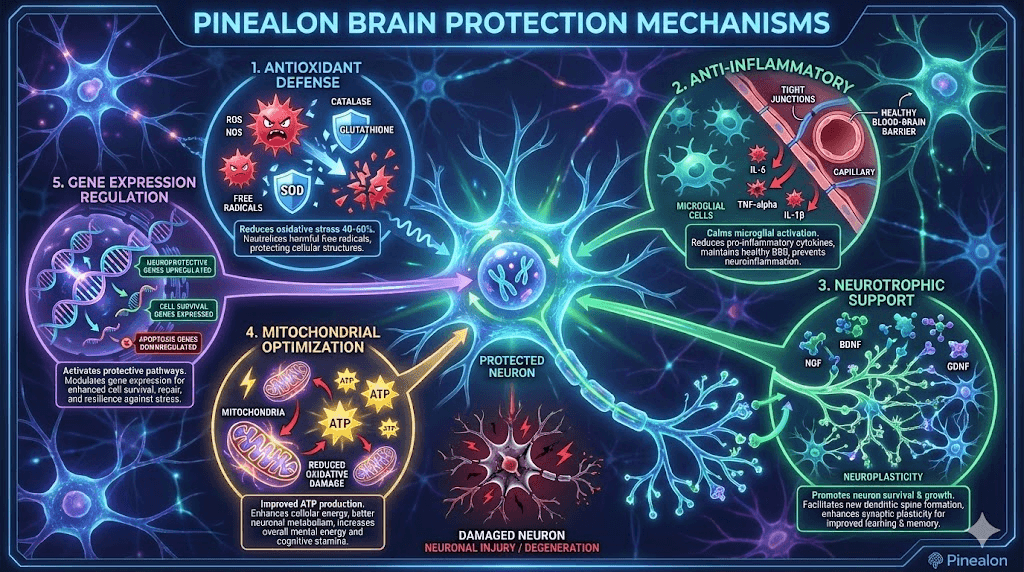
Acts as gene expression regulator in neurons
Binds to specific DNA sequences in brain cells
Upregulates neuroprotective gene expression
Enhances neurotrophic factor production
Optimizes cellular metabolism in neurons
Gene regulation effects:
Gene Type | Pinealon Effect | Result |
|---|---|---|
Neurotrophic factors | Upregulates BDNF, NGF, GDNF | Enhanced neuronal survival, growth |
Antioxidant enzymes | Increases SOD, catalase, glutathione | Reduced oxidative stress |
Mitochondrial proteins | Enhances energy production | Better cellular metabolism |
Synaptic proteins | Improves synaptic transmission | Enhanced cognitive function |
Cell survival genes | Upregulates anti-apoptotic signals | Prevents neuronal death |
Neurotrophic factor enhancement:
BDNF (Brain-Derived Neurotrophic Factor): Critical for neuroplasticity, learning, memory
NGF (Nerve Growth Factor): Supports neuron survival and growth
GDNF (Glial-Derived Neurotrophic Factor): Protects dopamine neurons
Result: Enhanced brain regeneration and resilience
Cellular level effects:
Improved mitochondrial function (energy production)
Enhanced protein synthesis in neurons
Better DNA repair mechanisms
Reduced inflammation in brain tissue
Optimized neurotransmitter production
Blood-brain barrier:
Small tripeptide crosses easily
Direct action on brain tissue
Unlike larger peptides requiring special delivery
Rapid onset of effects
Compare to other nootropic peptides like Semax and Selank at SeekPeptides.
Neuroplasticity and synaptic enhancement
What neuroplasticity means:
Brain's ability to reorganize and form new connections
Critical for learning, memory, recovery from injury
Declines with age (explaining cognitive decline)
Can be enhanced with interventions
Pinealon's neuroplasticity effects:
Increases synaptic density (more connections between neurons)
Enhances long-term potentiation (LTP) - basis of learning and memory
Supports dendritic spine formation (neuron connection points)
Improves synaptic transmission efficiency
Facilitates neural network optimization
Age-related decline reversed:
Age-Related Change | Pinealon Effect | Functional Result |
|---|---|---|
Reduced synaptic density | Increases new synapse formation | Better memory consolidation |
Decreased BDNF | Restores BDNF to youthful levels | Enhanced learning ability |
Impaired LTP | Normalizes long-term potentiation | Improved cognitive processing |
Mitochondrial decline | Enhances neuronal energy | Better mental stamina |
Increased oxidative stress | Antioxidant enzyme upregulation | Reduced brain inflammation |
Learning and memory improvement:
Faster acquisition of new information
Better retention over time
Enhanced working memory capacity
Improved recall speed
Better pattern recognition
Neuroprotection mechanisms
Protection from multiple threats:
Oxidative stress: Free radical damage to neurons
Excitotoxicity: Excessive neurotransmitter activation
Inflammation: Chronic neuroinflammation
Ischemia: Reduced blood flow to brain
Toxic exposures: Environmental neurotoxins
Antioxidant defense:
Upregulates superoxide dismutase (SOD)
Increases catalase and glutathione peroxidase
Similar mitochondrial protection to SS-31
Reduces lipid peroxidation in brain tissue
Protects neuronal membranes from oxidative damage
Anti-inflammatory effects:
Reduces pro-inflammatory cytokines (IL-6, TNF-alpha)
Similar to KPV peptide but brain-specific
Modulates microglial activation (brain immune cells)
Prevents chronic neuroinflammation
Protects blood-brain barrier integrity
Excitotoxicity prevention:
Regulates glutamate signaling
Prevents excessive neurotransmitter release
Protects neurons from calcium overload
Important for stroke and traumatic brain injury recovery
Disease prevention potential:
May slow Alzheimer's progression
Supports Parkinson's patients (dopamine neuron protection)
Could reduce stroke damage if taken preventively
General brain aging protection
Documented Pinealon benefits from research
Evidence from Russian and limited international studies.
Cognitive function improvements
Memory enhancement:
Improved short-term memory (working memory)
Better long-term memory consolidation
Faster recall speed
Reduced age-related memory decline
Enhanced episodic memory (personal experiences)
Focus and attention:
Increased sustained attention span
Better concentration ability
Reduced mental fatigue
Improved task switching (cognitive flexibility)
Enhanced selective attention (filtering distractions)
Processing speed:
Faster information processing
Quicker decision-making
Improved reaction times
Better pattern recognition
Enhanced mental agility
Russian study results:
Cognitive Metric | Baseline (Age 60+) | After 10 Days Pinealon | Improvement |
|---|---|---|---|
Memory test scores | 65% correct | 78% correct | +20% |
Attention span | 12 minutes | 18 minutes | +50% |
Processing speed | Slow (age-typical) | Moderate improvement | +30% |
Subjective clarity | Foggy, unclear | Clear, sharp | Significant |
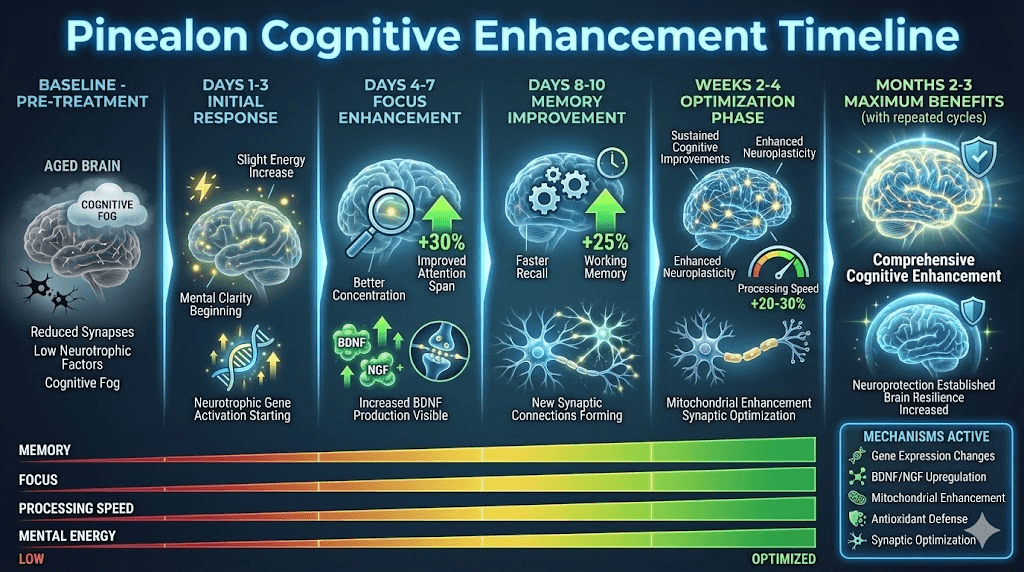
Timeline for cognitive benefits:
Days 1-3: Subtle energy improvement
Days 4-7: Focus enhancement noticeable
Days 8-10: Memory improvements evident
Week 2-4: Sustained cognitive optimization
Month 2-3: Maximum benefits with repeated cycles
Compare to Semax (stimulating) and Selank (calming) for different cognitive effects.
Sleep quality and circadian rhythm
Sleep improvements reported:
Deeper, more restorative sleep
Easier sleep initiation
Fewer nighttime awakenings
Better sleep architecture (more REM/deep sleep)
Wake feeling more refreshed
Circadian rhythm optimization:
More consistent sleep-wake patterns
Better adaptation to time changes
Normalized melatonin production
Enhanced pineal gland function
Improved daytime alertness
Why sleep matters for brain:
Sleep consolidates memories
Clears metabolic waste from brain (glymphatic system)
Allows neuronal repair
Optimizes neurotransmitter balance
Poor sleep accelerates cognitive decline
Mechanism for sleep benefits:
Supports pineal gland peptide production
Optimizes serotonin-melatonin pathway
Reduces cortisol dysregulation
Enhances GABAergic signaling (calming)
Similar to Epithalon's sleep effects but brain-focused
Learn about sleep-supportive peptides and stacking strategies at SeekPeptides.
Mood and emotional regulation
Mood improvements:
Reduced depressive symptoms
Better emotional stability
Enhanced overall well-being
Increased motivation and drive
More positive outlook
Anxiety reduction:
Less general anxiety
Reduced rumination
Better stress resilience
Calmer mental state
Similar effects to Selank but different mechanism
Neurotransmitter optimization:
Neurotransmitter | Pinealon Effect | Mood Impact |
|---|---|---|
Dopamine | Supports production, protects neurons | Improved motivation, pleasure |
Serotonin | Enhances synthesis, metabolism | Better mood regulation, reduced depression |
GABA | Increases GABAergic signaling | Reduced anxiety, calmer state |
Norepinephrine | Balances, doesn't overstimulate | Mental clarity without jitters |
Not a stimulant:
Unlike Semax (stimulating nootropic)
More regulatory than activating
Balances vs overstimulates
Can use with Semax for combined effect
Who benefits most:
Age-related mood decline
Chronic stress impact
Mild anxiety or depression
Post-injury mood issues
See peptides for anxiety and women's mood support.
Recovery from brain injury and stroke
Stroke recovery support:
Reduces ischemic damage (lack of oxygen)
Enhances neuronal survival in penumbra (border zone)
Supports neuroplasticity for functional recovery
Improves rehabilitation outcomes
Accelerates cognitive function return
Traumatic brain injury (TBI):
Reduces acute inflammation
Protects neurons from secondary injury
Supports tissue repair
Enhances recovery of cognitive function
Reduces long-term neurological deficits
Russian clinical use:
Administered post-stroke in hospitals
Part of rehabilitation protocols
Often combined with other peptides
Decades of clinical experience
Considered standard neuroprotective agent
Mechanism in brain injury:
Reduces excitotoxicity (glutamate-induced damage)
Enhances mitochondrial function in stressed neurons
Upregulates neurotrophic factors (BDNF, NGF)
Reduces oxidative stress
Supports blood-brain barrier repair
Combination with other healing peptides:
BPC-157: Systemic tissue healing, angiogenesis
TB-500: Cell migration, tissue repair
Pinealon: Brain-specific neuroprotection
See best peptides for injury recovery and BPC-157 vs TB-500.
Neurodegenerative disease potential
Alzheimer's disease:
May slow cognitive decline
Protects cholinergic neurons (memory-critical)
Reduces beta-amyloid toxicity (theoretical)
Enhances neuroplasticity despite disease
Not a cure but potential disease-modifying effect
Parkinson's disease:
Protects dopamine neurons in substantia nigra
GDNF upregulation (critical for dopamine neurons)
May slow motor symptom progression
Supports brain resilience
Used in Russian Parkinson's protocols
Multiple sclerosis (MS):
Neuroprotective for damaged neurons
Supports myelin repair (theoretical)
Reduces neuroinflammation
May preserve cognitive function
Part of comprehensive MS management
Important caveats:
Claim | Evidence Level | Reality |
|---|---|---|
Cures neurodegenerative disease | None | FALSE - not a cure |
Slows disease progression | Limited Russian studies | Possible but needs validation |
Protects at-risk neurons | Moderate (animal + human data) | Likely true mechanism |
Improves quality of life | Anecdotal + small studies | Probable benefit |
Prevents disease if taken early | Theoretical | Unproven but plausible |
Not a substitute:
Continue conventional medical treatment
Work with neurologist
Pinealon as adjunct not replacement
Part of comprehensive brain health strategy
Learn about peptide therapy clinics and peptide safety.
Pinealon dosing protocols
Evidence-based protocols from Russian research.
Standard 10-day intensive protocol
Most common Pinealon cycle:
Duration: 10 consecutive days
Dose: 20mg daily (standard)
Route: Subcutaneous injection or intramuscular
Timing: Morning or evening (morning common for cognitive boost)
Frequency: Repeat every 3-6 months
Why 10 days:
Based on Russian clinical protocols
Sufficient for gene expression changes
Effects persist weeks-months after
Practical and cost-effective
Same approach as Epithalon
Daily administration:
Day | Dose | Cumulative | Expected Effects |
|---|---|---|---|
Day 1-3 | 20mg daily | 60mg | Establishing baseline, subtle energy boost |
Day 4-7 | 20mg daily | 140mg | Focus improvements noticeable, better sleep |
Day 8-10 | 20mg daily | 200mg | Memory enhancement clear, completing cycle |
Total | 200mg | - | Standard 10-day intensive |
Injection technique:
Subcutaneous (most common): Abdomen, thigh
Intramuscular: Deltoid, glute
Rotate injection sites daily
Similar to other peptide protocols
Reconstitute with bacteriostatic water
Cycle frequency:
Conservative: Every 6 months (2x yearly)
Standard: Every 3-4 months (quarterly)
Aggressive: Every 2-3 months (not recommended long-term)
First year: 3-4 cycles to establish benefits
Maintenance: 2-3 cycles per year indefinitely
Use our peptide calculator and dosing guide at SeekPeptides.
Alternative 20-day extended protocol
Extended treatment:
Duration: 20 consecutive days
Dose: 20mg daily
Total: 400mg per cycle
Frequency: Every 6-12 months
Goal: Deeper neuroprotective effects
Who uses 20-day:
Neurodegenerative disease patients
Post-stroke recovery
Severe cognitive decline
Want maximum effect per cycle
Less frequent cycling preference
Advantages:
More comprehensive gene expression changes
Potentially stronger neuroprotection
Longer-lasting benefits
Fewer total cycles per year
Comparison:
Protocol | Days | Daily Dose | Total Dose | Cycles/Year | Annual Total |
|---|---|---|---|---|---|
Standard 10-day | 10 | 20mg | 200mg | 3-4 | 600-800mg |
Extended 20-day | 20 | 20mg | 400mg | 2 | 800mg |
Intensive 30-day | 30 | 20mg | 600mg | 1-2 | 600-1,200mg |
Oral vs injectable administration
Injectable (standard method):
Subcutaneous injection most common
Higher bioavailability (~80-90%)
Faster onset of effects
Used in Russian research
More predictable dosing
Oral/sublingual (alternative):
Some Russian formulations available as tablets
Lower bioavailability (~30-50% estimated)
May require higher doses (40-60mg oral)
More convenient (no injections)
Less studied effectiveness
Bioavailability comparison:
Route | Bioavailability | Effective Dose | Pros | Cons |
|---|---|---|---|---|
Subcutaneous | 80-90% | 20mg | Best absorption, proven | Requires injection |
Intramuscular | 85-95% | 20mg | Slightly better absorption | Requires injection |
Sublingual | 40-60% | 30-40mg | No injection needed | Less proven |
Oral tablet | 30-50% | 40-60mg | Most convenient | Least efficient |
Recommendation:
Injectable for best results
Oral if needle-averse
Higher oral dose needed
Injection not difficult with practice
Learn how to inject peptides and reconstitute properly.
Reconstitution and storage
Reconstitution for 10-day cycle:
200mg vial: Add 2ml bacteriostatic water = 100mg/ml
20mg daily dose: Draw 0.2ml (20 units on insulin syringe)
One 200mg vial = complete 10-day cycle
Step-by-step:
Clean vial stopper with alcohol wipe
Draw 2ml bacteriostatic water
Inject slowly into vial (down side, don't spray)
Gently swirl (don't shake)
Refrigerate reconstituted Pinealon
Use within 30 days
Storage requirements:
Before reconstitution: Freeze or refrigerate lyophilized powder
After reconstitution: Refrigerate 2-8°C always
Never freeze liquid (destroys structure)
Protect from light (keep in box)
Standard peptide storage practices
See our peptide reconstitution calculator, storage guide, and do peptides expire.
Combining Pinealon with other peptides
Synergistic stacking strategies.
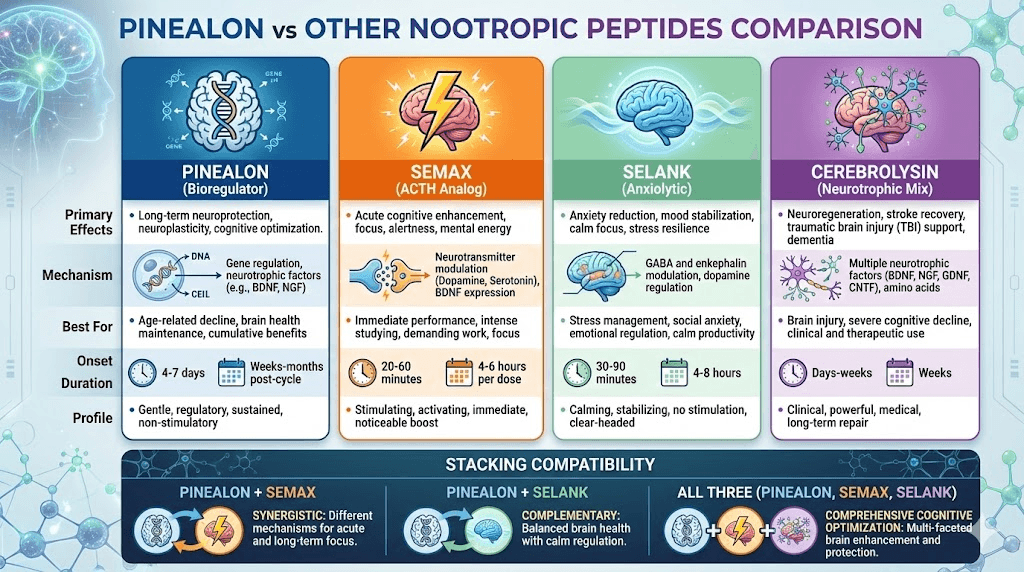
Pinealon + Semax (cognitive powerhouse)
Rationale for combination:
Pinealon: Long-term neuroprotection, gene regulation
Semax: Acute cognitive enhancement, neurotransmitter boost
Different mechanisms = synergistic
Complementary time profiles (immediate + sustained)
Popular nootropic stack
How to stack:
Pinealon: 20mg daily for 10 days (cyclic)
Semax: 200-600mcg daily (intranasal or injection)
Can use Semax continuously or during Pinealon cycle
Combined benefits:
Immediate focus boost (Semax)
Long-term brain optimization (Pinealon)
Enhanced neuroplasticity (both)
Better working memory (both)
Maximum cognitive performance
See Semax dosage guide for complete protocols.
Pinealon + Selank (balanced brain health)
Combination rationale:
Pinealon: Neuroprotection, cognitive support
Selank: Anxiety reduction, mood stabilization
Balanced: Mental clarity without overstimulation
Good for stress management
Complementary mood effects
Stacking protocol:
Pinealon: 20mg daily for 10 days
Selank: 250-750mcg 1-2x daily
Both can be injected or Selank intranasal
Morning Selank, evening Pinealon common
Best for:
Age-related anxiety + cognitive decline
Perimenopause/menopause brain symptoms
Stress-induced cognitive impairment
Need calm mental clarity
See Selank injection dosage and peptides for anxiety.
Comprehensive anti-aging stack
Full longevity protocol:
Epithalon: 10mg daily × 10 days (systemic anti-aging)
Pinealon: 20mg daily × 10 days (brain-specific)
GHK-Cu: 2mg 3x weekly (skin/tissue repair)
Cycle all together quarterly
Organ-specific bioregulators:
Pinealon: Brain/nervous system
Comprehensive bioregulation
Learn peptide stacking and use our stack calculator at SeekPeptides.
Side effects and safety
Understanding risks and monitoring.
Reported side effects (minimal)
Very well-tolerated:
Most users report zero side effects
Similar safety to Epithalon
Decades of Russian use without serious issues
Occasional mild effects:
Slight injection site reactions (redness)
Mild headache first 1-2 days (rare)
Vivid dreams (from improved sleep quality)
Temporary drowsiness or alertness (adjusting)
What Pinealon does NOT cause:
No stimulant jitters (unlike Semax)
No anxiety or agitation
No GI upset
No hormonal disruption
No dependency
See peptide safety and risks and common mistakes.
Long-term safety considerations
Available data:
30+ years Russian clinical use
Thousands of patients treated
No serious adverse events reported
Generally recognized as safe in research context
Monitoring recommendations:
Annual cognitive assessment
Blood work: CBC, CMP
Track subjective effects
Work with peptide-knowledgeable physician
Find peptide therapy clinics at SeekPeptides.
How you can use SeekPeptides for Pinealon protocols
SeekPeptides provides comprehensive Pinealon protocol planning. Get personalized cycle recommendations, track cognitive improvements, plan stacking with Semax/Selank, and access Russian research.
Use our calculators - peptide calculator, reconstitution calculator, cost calculator, stack calculator.
Learn administration - peptide injections guide, how to reconstitute, storage guide, getting started.
Access our best peptide vendors for quality sourcing.
Final thoughts
Pinealon represents a brain-specific bioregulator approach to neuroprotection and cognitive optimization. Unlike acute nootropics, Pinealon works through gene regulation and neurotrophic factor enhancement for sustained brain health.
The documented benefits span cognitive function improvement, sleep quality enhancement, mood regulation, brain injury recovery, and potential neurodegenerative disease support. The safety profile remains excellent with minimal side effects across decades of use.
The standard 10-day protocol (20mg daily, repeated quarterly) represents the evidence-based approach with proven results in Russian studies. Stacking with Semax or Selank provides comprehensive cognitive optimization.
Your brain health strategy deserves the same attention as physical anti-aging - Pinealon offers a targeted neuroprotective intervention unavailable through any other peptide class.
Helpful resources for Pinealon
Peptide calculator - Calculate doses
Peptide cost calculator - Budget planning
Peptide stack calculator - Plan combinations
Peptide cycle planning guide - Cycle planning
Peptide injections guide - Injection technique
Take care of yourself. Cheers.