Dec 31, 2025
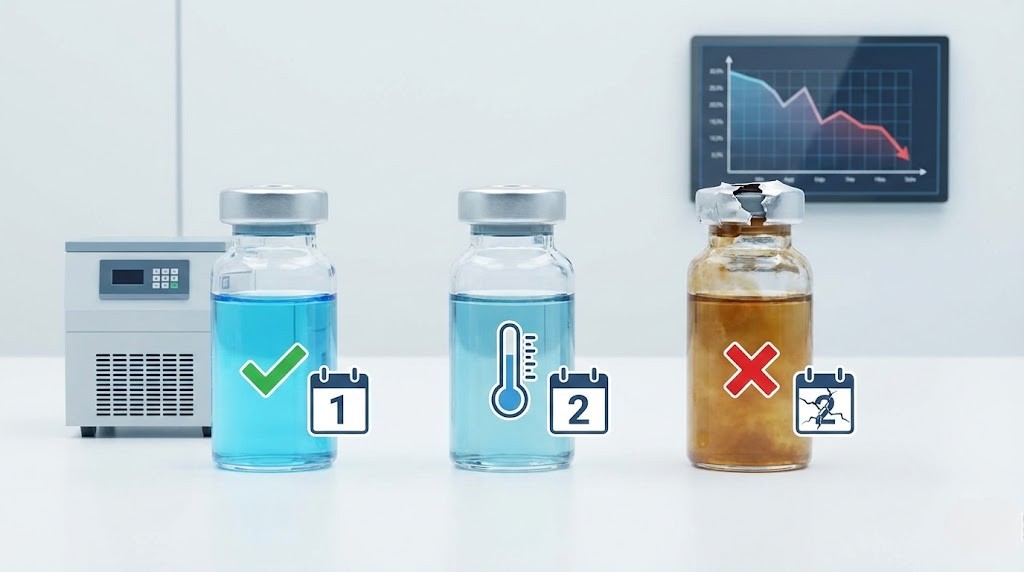
Peptide degradation represents a primary concern for users investing $50-200 in GHK-Cu copper peptide products, where improper storage or expired formulations deliver zero anti-aging benefits despite appearing unchanged. Understanding GHK-Cu's shelf life across different forms - lyophilized powder before reconstitution, reconstituted injectable solution, pre-made serums, and homemade DIY formulations - prevents wasted money on degraded product while maximizing the peptide's proven collagen-stimulating effects.
The fundamental storage principle recognizes that peptides degrade through oxidation, hydrolysis, and bacterial contamination, with copper ions in GHK-Cu creating additional oxidation concerns beyond standard peptides.
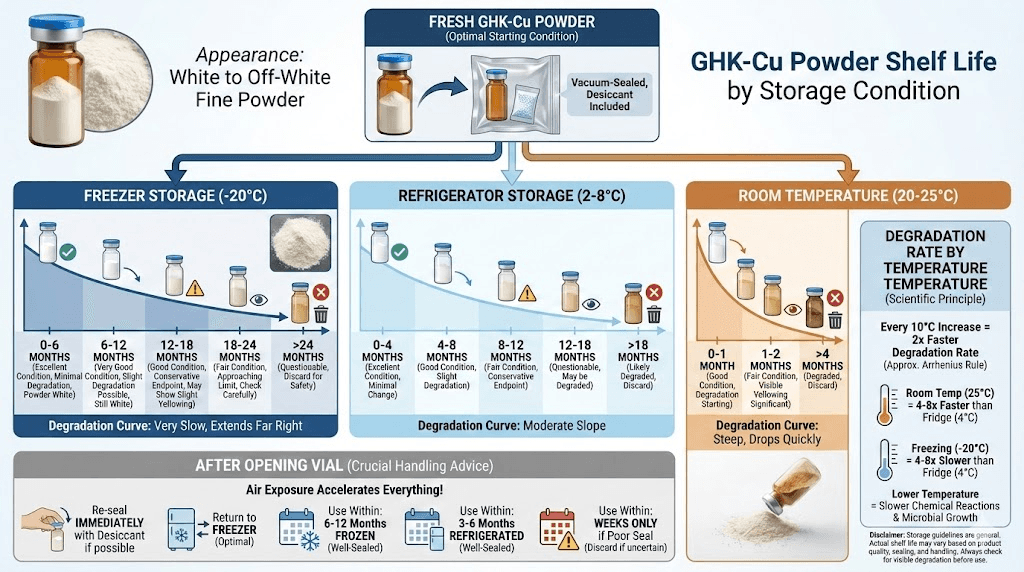
Temperature proves most critical - every 10°C increase doubles degradation rate, meaning room temperature storage (25°C) degrades peptides 4-8x faster than refrigeration (2-8°C) and dramatically faster than freezing (-20°C or below).
GHK-Cu powder (lyophilized) maintains potency 12-24 months frozen, 6-12 months refrigerated, or just 2-3 months at room temperature, with vacuum-sealed containers and desiccant packets extending these timelines. Once reconstituted with bacteriostatic water, the solution remains viable 28-30 days refrigerated maximum, with sterile water reducing this to merely 5-7 days due to rapid bacterial growth without preservatives.
Commercial GHK-Cu serums typically claim 6-12 month shelf life unopened when properly formulated with preservatives and appropriate pH, dropping to 3-6 months after opening due to air exposure and contamination introduction.
DIY serums made without professional preservative systems last just 1-2 weeks refrigerated, requiring small-batch preparation and frequent replacement.
This guide examines GHK-Cu powder storage requirements and shelf life by condition, reconstituted solution expiration timelines and bacterial growth concerns, commercial serum shelf life and preservative systems, DIY serum formulation storage challenges, signs of GHK-Cu degradation and potency loss, temperature effects on degradation rates, and optimal storage strategies to maximize investment.
Understanding GHK-Cu's limited shelf life prevents applying ineffective degraded peptide while optimizing storage conditions preserves the proven anti-aging benefits you paid for.
GHK-Cu powder shelf life
Before reconstitution storage timelines.
Unopened lyophilized powder storage
Lyophilized (freeze-dried) GHK-Cu powder:
Most stable form
Water removed = minimal degradation
Longest shelf life achievable
How vendors ship
Typical: 50mg or 100mg vials
Storage conditions and shelf life:
Storage Condition | Temperature | Shelf Life | Degradation Rate |
|---|---|---|---|
Freezer | -20°C or below | 18-24 months | Very slow |
Refrigerator | 2-8°C | 12-18 months | Slow |
Room temp | 20-25°C | 2-4 months | Moderate-fast |
Hot environment | >30°C | Weeks only | Very fast |
Why freezer optimal:
Lowest degradation rate
Extends shelf life 2-4x
Minimal oxidation
Best for long-term storage
Industry standard
Refrigerator acceptable:
Convenient daily access
Still good shelf life (12-18 months)
Fine for near-term use (<1 year)
Most vendors recommend this minimum
Protect from light
Room temperature risks:
Rapid degradation (2-4 months only)
Oxidation accelerates
Copper oxidation concern
Lost potency quickly
Never ship/store this way long-term
Factors affecting powder shelf life:
Packaging: Vacuum-sealed best, nitrogen-flushed good
Desiccant: Silica gel packets absorb moisture
Light exposure: Amber/opaque vials protect
Oxygen contact: Sealed vials critical
Manufacturing quality: Purity affects stability
Manufacturer claims:
Most vendors claim "2 years frozen"
Conservative estimate safer (12-18 months)
Beyond this, potency uncertain
Test reports rarely extend that far
When in doubt, freeze immediately
Learn about peptide storage and expiration at SeekPeptides.
After opening powder vial
Once opened (vial accessed):
Exposure to air and moisture
Degradation accelerates
Still powder form but compromised
Oxygen contact begins degradation
Reconstitute soon or reseal well
Shelf life after opening:
Reseal Quality | Storage | Shelf Life After Opening |
|---|---|---|
Re-sealed well | Freezer | 6-12 months |
Re-sealed well | Refrigerator | 3-6 months |
Poor seal | Freezer | 1-3 months |
Poor seal | Refrigerator | Weeks only |
How to reseal opened vials:
Replace rubber stopper immediately
Parafilm wrap around top (optional)
Return to freezer promptly
Minimize air exposure time
Use desiccant if available
Best practice:
Reconstitute immediately after opening
Don't open powder vial unless ready to use
Plan ahead for timing
Avoid partial vial use (hard to reseal)
Better to buy smaller vials (50mg) vs opening large (100mg)
Oxidation concerns:
GHK-Cu contains copper ions
Copper accelerates oxidation
Air exposure = rapid degradation
Color change possible (blue/green tint)
Once opened, use within months not years
Signs of powder degradation
Visual inspection:
Fresh powder: White to off-white, fine powder
Possible degradation: Color change (yellowing, blue-green tint)
Definite degradation: Clumping, caking, discoloration
Moisture exposure: Clumpy, sticky, not free-flowing
Copper oxidation indicators:
Blue-green tint: Copper oxidized (degraded)
Color intensifying: Progressive degradation
Fresh GHK-Cu should be white/cream
Copper visible = compromised
When to discard powder:
Significant color change (blue/green)
Clumping or caking
Moisture visible
Beyond 24 months frozen
Beyond 18 months refrigerated
Stored at room temp >4 months
Any foul odor (rare but indicator)
Testing potency (impossible at home):
No home test for GHK-Cu potency
Must trust storage conditions
Vendor testing (if available)
Err on side of caution
When uncertain, discard and replace
Reconstituted GHK-Cu solution shelf life
After adding bacteriostatic water.
Standard reconstituted solution timeline
Once reconstituted with bacteriostatic water:
Maximum shelf life: 28-30 days refrigerated
Never freeze reconstituted solution (destroys peptide)
Clock starts immediately upon mixing
Must be refrigerated (2-8°C) always
No room temperature storage
Why 28-30 day limit:
Bacteriostatic water contains 0.9% benzyl alcohol
Preservative prevents bacterial growth ~30 days
Peptide degradation also factors
Conservative safe window
Standard for all reconstituted peptides
Day-by-day degradation:
Days Since Reconstitution | Peptide Integrity | Safety | Recommendation |
|---|---|---|---|
0-14 days | Excellent (95-100%) | Safe | Optimal use window |
15-21 days | Good (90-95%) | Safe | Still effective |
22-28 days | Fair (85-90%) | Safe | End of safe window |
29-35 days | Questionable (80%?) | Risky | Discard after day 30 |
>35 days | Degraded (<80%) | Unsafe | Never use |
Temperature absolutely critical:
Must refrigerate 2-8°C
Never leave at room temp (even hours degrade)
Don't freeze (ice crystals damage peptide structure)
Back of fridge (most stable temperature)
Not in door (temperature fluctuates)
Why freezing reconstituted solution fails:
Ice crystals form in solution
Crystals physically damage peptide bonds
Copper-peptide complex disrupted
Thawing doesn't restore structure
Completely ineffective after freeze-thaw
Common mistake:
Thinking "frozen = longer shelf life"
TRUE for powder, FALSE for liquid
Reconstituted = refrigerate only
Critical distinction
See how long reconstituted peptides last guide.
Sterile water vs bacteriostatic water
Sterile water (no preservative):
Maximum shelf life: 5-7 days refrigerated
Rapid bacterial growth risk
No preservative to prevent contamination
Very short window
Not recommended for GHK-Cu
Bacteriostatic water (0.9% benzyl alcohol):
Maximum shelf life: 28-30 days refrigerated
Preservative inhibits bacterial growth
Standard for peptide reconstitution
Much safer
Always use this
Comparison:
Water Type | Shelf Life | Bacterial Risk | Cost | Recommendation |
|---|---|---|---|---|
Sterile water | 5-7 days | High (no preservative) | $5-10 | Don't use |
28-30 days | Low (preserved) | $10-20 | Always use |
Why always use bacteriostatic:
4x longer shelf life (30 days vs 7 days)
Much safer (bacterial inhibition)
Multiple access points safer (each needle insertion)
Worth the small extra cost
Standard in peptide therapy
Sterile water only appropriate when:
Single-use vial (reconstitute, use all immediately)
Injecting full dose same day
No storage needed
Even then, bacteriostatic better
Bacterial contamination signs:
Cloudiness (fresh GHK-Cu clear)
Particles or floaters
Color change
Foul smell (rare but obvious)
Discard immediately if suspected
Storage requirements for reconstituted GHK-Cu
Mandatory refrigeration:
Temperature: 2-8°C (36-46°F)
Back of main fridge compartment
Not in door (temperature varies)
Not in freezer (damages peptide)
Constant cold critical
Protecting from light:
Light degrades peptides
Store in original amber/opaque vial
Or put in box/drawer in fridge
Minimize light exposure
UV light especially harmful
Minimizing contamination:
Clean vial stopper with alcohol before each access
Use sterile technique
Don't touch needle or stopper
Single-use syringes only
Never reuse needles
Label clearly:
Write reconstitution date on vial
Note concentration (e.g., "2mg/ml")
Calculate discard date (day 30)
Avoid confusion with other peptides
Optimal practices:
Practice | Purpose | Impact |
|---|---|---|
Refrigerate 2-8°C | Slow degradation | 10x slower vs room temp |
Protect from light | Prevent photodegradation | Extends potency |
Use bacteriostatic water | Prevent bacterial growth | 4x longer safe window |
Sterile technique | Avoid contamination | Safety and effectiveness |
Label with date | Track freshness | Prevents using expired |
Planning reconstitution volume:
Only reconstitute what you'll use in 30 days
Example: 2mg daily dose × 30 days = 60mg needed
Reconstitute 50-60mg vial, not 100mg
Smaller vials better than larger
Avoid waste from expiration
Commercial GHK-Cu serum shelf life
Pre-made skincare formulations.
Unopened commercial serum storage
Commercial GHK-Cu serums:
Pre-formulated for topical use
Contains GHK-Cu + preservatives + base
Professionally formulated
Sealed/vacuum-packed
Longer shelf life than DIY
Typical unopened shelf life:
12-18 months (room temperature, unopened)
18-24 months (refrigerated, unopened)
Check expiration date on product
"Best by" date conservative estimate
Preservative system dependent
Storage for unopened serum:
Cool, dark place acceptable
Refrigeration extends life
Avoid extreme heat (>30°C)
Protect from sunlight
Original packaging best
Factors affecting commercial serum stability:
Factor | Impact on Shelf Life |
|---|---|
Preservative system | Major (determines bacterial safety) |
pH buffering | Moderate (maintains optimal pH 5-6) |
Antioxidants | Moderate (prevents peptide oxidation) |
Packaging | Moderate (airless pump best, jar worst) |
GHK-Cu concentration | Minor (higher = more degradation risk) |
Professional formulations advantages:
Preservatives prevent bacterial growth
pH optimized for peptide stability
Antioxidants included (Vitamin E, etc.)
Tested stability timelines
Quality control
Commercial brands (examples):
The Ordinary "Buffet" + Copper Peptides (12 months unopened)
Various professional brands (12-24 months unopened)
Check specific product for date
Reputable brands more reliable
Learn about how to use copper peptides effectively.
After opening commercial serum
Once opened (seal broken):
Air exposure begins
Bacterial contamination possible
Oxidation accelerates
Shorter shelf life
Track opening date
Shelf life after opening:
Packaging Type | Shelf Life After Opening | Storage |
|---|---|---|
Airless pump | 6-12 months | Room temp or refrigerated |
Dropper bottle | 3-6 months | Refrigerate recommended |
Jar (open top) | 1-3 months | Refrigerate required |
Why packaging matters:
Airless pump: Minimal air contact, longest life
Dropper: Some air exposure, moderate life
Jar: Maximum air exposure, shortest life
Finger contamination risk (jar)
Best practices after opening:
Refrigerate after opening (extends life)
Close tightly after each use
Don't contaminate (no fingers in product)
Use within 6 months ideally
Note opening date on bottle
Signs commercial serum degraded:
Color change (darkening, blue-green tint)
Smell change (rancid or off odor)
Texture change (separation, clumping)
Reduced efficacy (no longer works)
Irritation (preservatives depleted, bacteria)
When to discard:
Past expiration date + 3-6 months opened
Any signs of degradation above
Unusual smell or color
Product separated and won't remix
Skin irritation develops
Commercial vs DIY serum stability
Commercial serum advantages:
Professional preservative systems
pH buffered correctly
Antioxidants included
Tested stability (12-24 months unopened)
Quality assurance
DIY serum challenges:
No professional preservatives (or inadequate)
pH optimization difficult
Limited antioxidant protection
Short shelf life (1-2 weeks refrigerated)
Bacterial contamination risk
Comparison:
Aspect | Commercial Serum | DIY Serum |
|---|---|---|
Unopened shelf life | 12-24 months | N/A (make fresh) |
After opening/making | 6-12 months (airless) | 1-2 weeks max |
Storage required | Room temp ok, fridge better | Must refrigerate |
Preservative system | Professional, tested | None or basic |
Safety | High (if quality brand) | Moderate risk |
Cost | Higher upfront ($30-80) | Lower batch cost ($5-15) |
When DIY acceptable:
Make small batches (1-2 weeks supply)
Use immediately
Refrigerate always
Accept short shelf life
Understand contamination risk
When commercial better:
Want convenience
Need longer shelf life
Travel frequently
Don't want frequent preparation
Value safety/stability
See DIY GHK-Cu serum recipe for home formulation.
How you can use SeekPeptides for GHK-Cu optimization
SeekPeptides provides comprehensive GHK-Cu copper peptide guidance beyond storage. Learn about GHK-Cu benefits for anti-aging, how to use copper peptides effectively, 50mg dosing, and DIY serum recipes.
Access storage guides - peptide storage complete, do peptides expire, reconstituted peptide shelf life, should copper peptides be refrigerated.
Learn fundamentals - how to reconstitute peptides, bacteriostatic water guide, what are peptides.
Find best peptide vendors for quality GHK-Cu sourcing with proper storage and testing.
Final thoughts
GHK-Cu shelf life varies dramatically by form and storage conditions - lyophilized powder maintains 18-24 months frozen or 12-18 months refrigerated but degrades in just 2-4 months at room temperature, while reconstituted solution lasts merely 28-30 days refrigerated with bacteriostatic water and should never be frozen as ice crystals destroy peptide structure.
Temperature proves the dominant factor affecting degradation rates - every 10°C increase doubles degradation speed, making refrigeration at 2-8°C essential for all reconstituted solutions and beneficial for extending powder shelf life beyond basic 12-18 month refrigerated baseline. Freezing powder at -20°C provides optimal long-term storage approaching 24 months, but freezing liquid reconstituted GHK-Cu destroys the peptide through ice crystal damage.
Commercial serums offer 12-24 months unopened shelf life with professional preservative systems and 6-12 months post-opening depending on packaging (airless pump best), while DIY serums last only 1-2 weeks refrigerated without professional preservatives. The 28-30 day limit for reconstituted solutions represents bacterial growth concerns from bacteriostatic water preservative depletion as much as peptide degradation.
Your GHK-Cu storage strategy should freeze powder immediately upon receipt for long-term preservation, reconstitute only quantities usable within 30 days, refrigerate all liquid forms constantly at 2-8°C, protect from light exposure, label with dates clearly, and discard any solution showing cloudiness, particles, color change, or past 30-day expiration regardless of appearance.
Helpful resources for GHK-Cu
Copper peptides GHK-Cu guide - Complete overview
GHK-Cu benefits - Benefits complete
How to use copper peptides - Usage guide
GHK-Cu 50mg dosage - Dosing guide
GHK-Cu serum recipe - DIY formulation
Should copper peptides be refrigerated - Storage basics