Dec 26, 2025
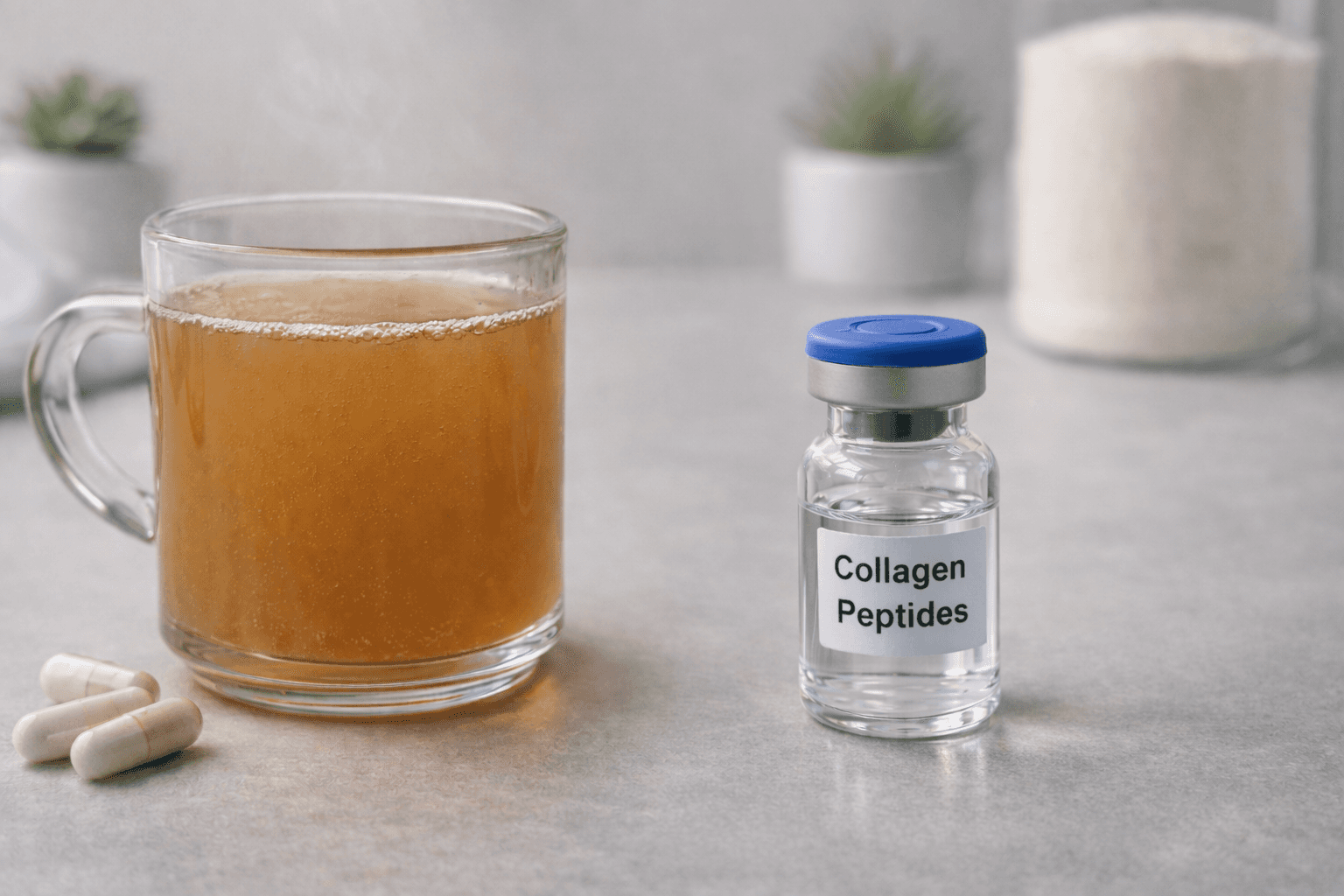
Bone broth enthusiasts claim it's a superfood with unmatched healing properties, and at the same time you've seen collagen peptide advocates present research showing superior bioavailability and absorption.
Some say bone broth provides minerals and nutrients that collagen powders lack, others argue collagen peptides deliver more actual collagen per serving without the hassle of making broth.
Here's the reality: both provide collagen and both work, but in different ways for different purposes.
Bone broth offers a complete nutritional package with minerals, gelatin, and other compounds.
Collagen peptides provide concentrated, highly bioavailable collagen protein optimized for absorption.
Your choice depends on your primary goals, lifestyle, and whether you value convenience or whole-food nutrition.
This guide breaks down exactly how bone broth and collagen peptides differ, which works better for specific goals like gut healing versus joint pain versus skin anti-aging, what the research shows about effectiveness, cost and convenience comparisons, and when to use one versus the other or combine both.
Let's start by understanding what each actually is.
What is bone broth and how does it provide collagen
Bone broth is liquid made by simmering animal bones and connective tissue in water for extended periods.
How bone broth is made
Traditional bone broth involves slow extraction of nutrients from bones.
Basic process:
Animal bones (beef, chicken, pork, fish) with connective tissue attached
Simmered in water for 12-48 hours
Often includes vegetables, herbs, and apple cider vinegar (helps extract minerals)
Slow cooking breaks down collagen into gelatin
Results in nutrient-rich liquid that gels when cooled
What gets extracted during cooking:
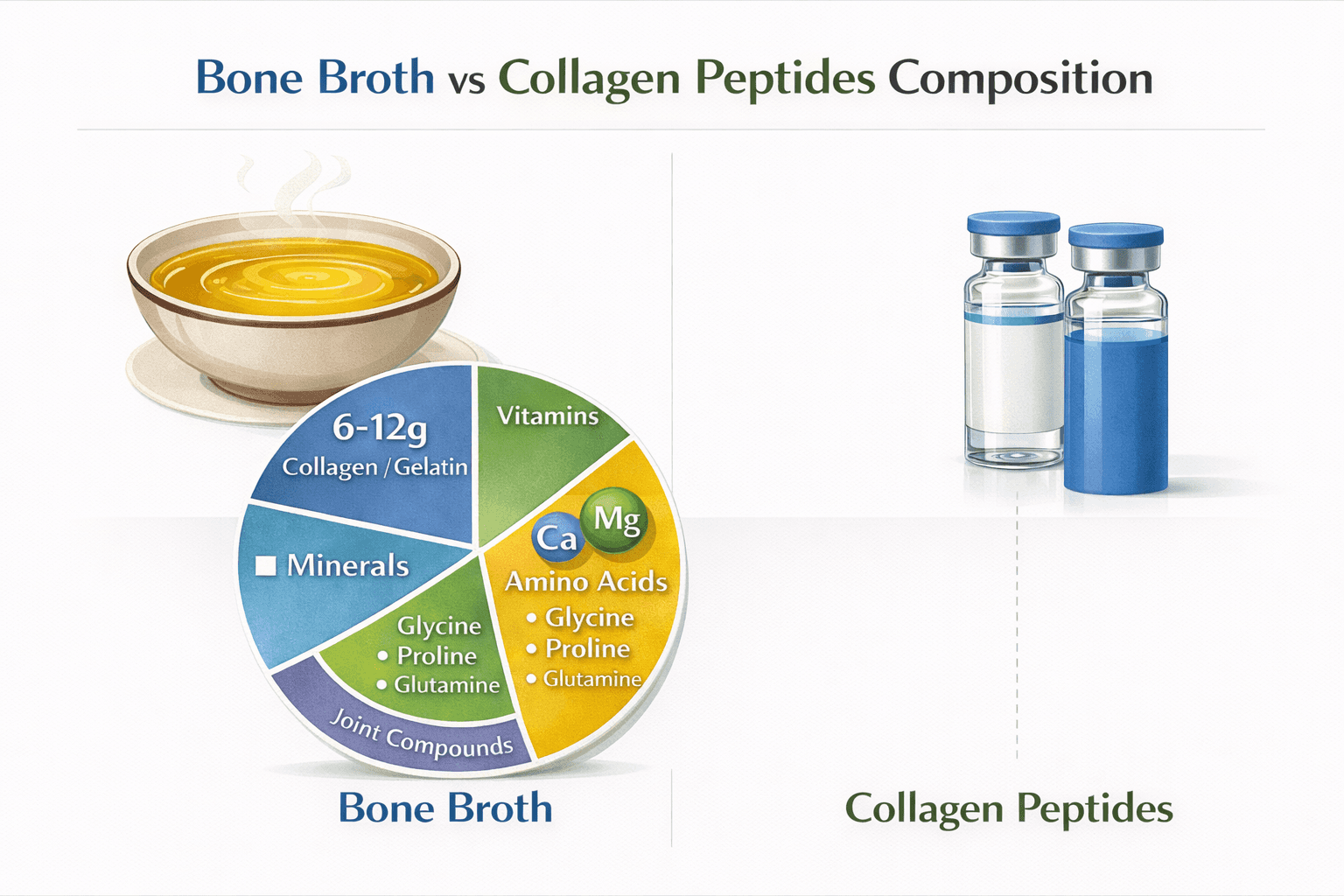
Collagen from bones and connective tissue breaks down into gelatin
Minerals (calcium, magnesium, phosphorus, potassium)
Amino acids (glycine, proline, glutamine)
Trace minerals (zinc, iron, manganese, selenium)
Glucosamine and chondroitin from cartilage
Hyaluronic acid from joints
Collagen content in bone broth
Bone broth's collagen content varies dramatically based on preparation.
Typical collagen per cup (8oz) of bone broth:
Homemade (good quality): 6-12g collagen/gelatin
Store-bought liquid: 2-8g collagen/gelatin
Powdered bone broth products: 8-10g collagen (varies by brand)
Factors affecting collagen content:
Bone types used (joints and knuckles = more collagen)
Cooking time (longer = more extraction)
Bone-to-water ratio
Quality of bones (grass-fed, pasture-raised = better)
Form of collagen in bone broth: Gelatin. Collagen breaks down into gelatin during the long cooking process. Gelatin is partially hydrolyzed collagen - broken into smaller pieces but not fully broken down into individual peptides.
Additional nutrients in bone broth beyond collagen
Bone broth provides more than just collagen.
Minerals: Calcium, magnesium, phosphorus, and trace minerals extracted from bones. Amounts vary widely depending on cooking time and bone quality, but a cup can provide 5-15% of daily needs for key minerals.
Amino acids: Particularly high in glycine (anti-inflammatory, supports detoxification), proline (collagen building block), and glutamine (gut healing).
Joint-supporting compounds: Glucosamine and chondroitin naturally present in cartilage. Hyaluronic acid from joint tissue.
Fat-soluble vitamins: If made with marrow bones, provides vitamins A and K2.
Electrolytes: Sodium, potassium, and other electrolytes if salt is added.
What are collagen peptides and how do they work
Collagen peptides are a processed, bioavailable form of collagen protein.
How collagen peptides are made
Collagen peptides undergo enzymatic hydrolysis to break down into small, easily absorbed fragments.
Manufacturing process:
Start with animal collagen source (bovine hide, bones, or fish skin/scales)
Extract raw collagen
Enzymatic hydrolysis breaks collagen into small peptides (typically 2-20 amino acids long)
Dry into powder form
Result: Very small collagen fragments (peptides) that dissolve easily in liquid and are rapidly absorbed in the digestive system.
Types of collagen peptides:
Bovine collagen peptides (from cows): Primarily Type I and Type III collagen
Marine collagen peptides (from fish): Primarily Type I collagen
Chicken collagen peptides (less common): Type II collagen
Multi-collagen blends: Combination of sources for Types I, II, III, V, X
Collagen content in peptide supplements
Collagen peptides are concentrated, standardized collagen.
Typical serving:
10-20g collagen peptides per scoop
100% pure collagen protein (no other nutrients)
Standardized amount every time
Collagen types: Most products specify which collagen types they contain. Type I and III are most common for skin, hair, nails, bones. Type II for joints and cartilage.
Bioavailability advantage: Peptides are pre-digested. Your body doesn't have to break them down much before absorption. They enter bloodstream faster and in more intact form than gelatin from bone broth.
What's NOT in collagen peptides
Pure collagen peptides lack the additional nutrients found in bone broth.
Missing components:
Minerals (no calcium, magnesium, etc.)
Vitamins
Glucosamine and chondroitin (unless added separately)
Hyaluronic acid (unless added)
Fat and fat-soluble vitamins
Trade-off: You get concentrated, highly bioavailable collagen but miss the whole-food nutritional package of bone broth.
Effectiveness comparison: bone broth vs collagen peptides
Which actually works better for specific health goals?
For gut healing and digestive health
Bone broth advantages:
Contains L-glutamine (primary fuel for intestinal cells)
Gelatin soothes and coats gut lining
Minerals support gut barrier function
Easy to digest, gentle on compromised digestion
Warm liquid is soothing
Collagen peptides advantages:
Higher concentration of collagen per serving
Specific peptides stimulate collagen synthesis in gut lining
Can add to any beverage without heating
Research findings: Both show benefits for gut health. Gelatin from bone broth has traditional use for leaky gut and IBS. Collagen peptides have clinical research showing improvements in gut barrier function and reduction in inflammation.
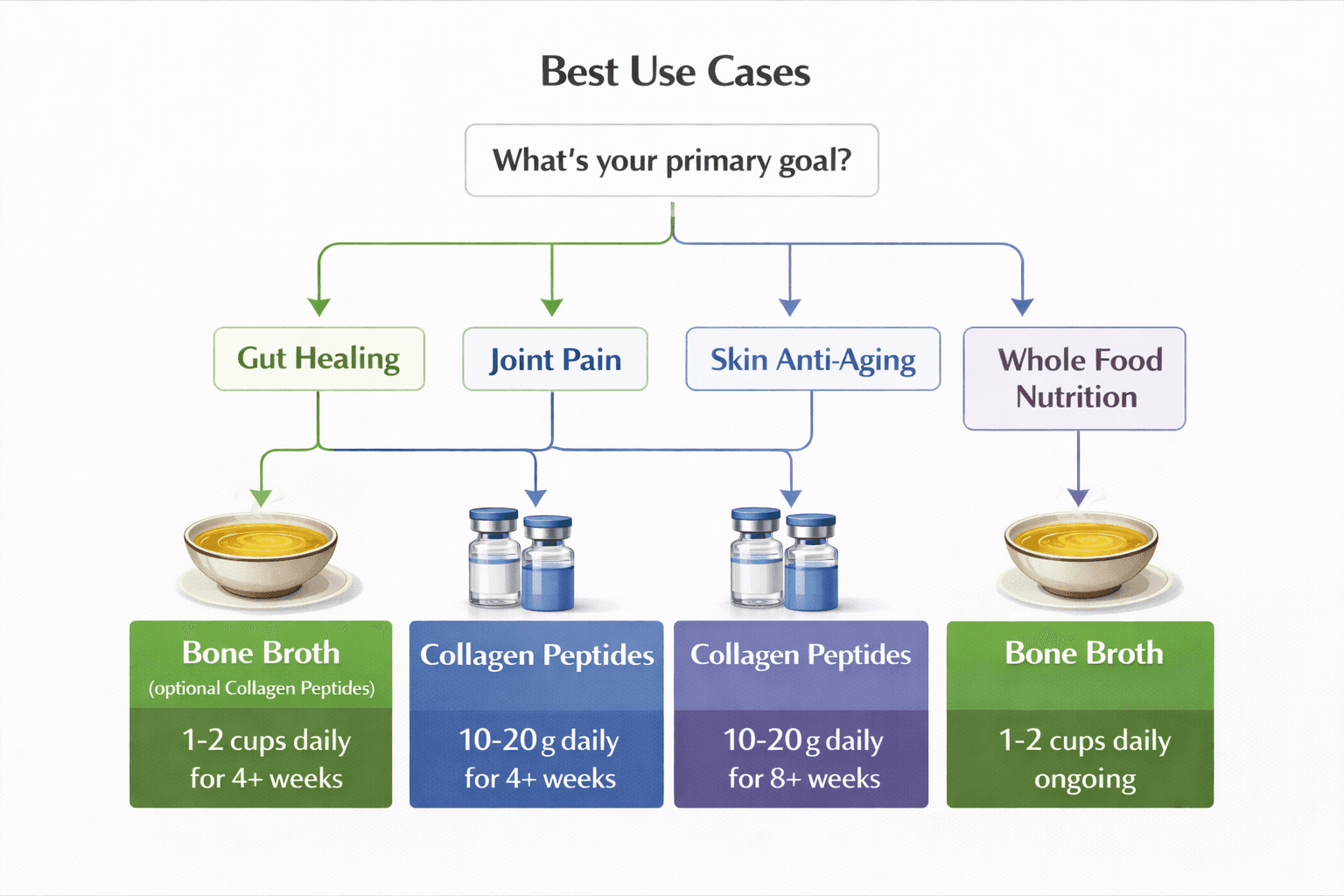
Winner for gut healing: Bone broth slightly edges out for acute gut issues due to glutamine content and soothing gelatin. But collagen peptides work well for maintenance and can be more convenient.
Best approach: Combine both. Use bone broth for immediate gut soothing, add collagen peptides for additional collagen support.
See our peptides for gut health guide for advanced gut healing peptides like BPC-157 and KPV.
For joint pain and cartilage support
Bone broth advantages:
Contains glucosamine and chondroitin naturally
Provides hyaluronic acid
Type II collagen if made from chicken bones
Minerals support bone density
Collagen peptides advantages:
Higher collagen concentration (10-20g vs 6-12g)
Better bioavailability (absorbed more efficiently)
Can choose Type II collagen specifically for joints
Consistent dosing
Research findings: Multiple studies show collagen peptides reduce joint pain and improve mobility. Bone broth has traditional use but less clinical research. Studies using collagen supplements show 40-50% reduction in joint pain after 3-6 months.
Winner for joint pain: Collagen peptides, especially Type II collagen peptides or multi-collagen blends. Higher concentration and better absorption translate to better results.
Dosing for joint support: 10-15g collagen peptides daily, or 2-3 cups bone broth daily (though hard to get equivalent collagen from broth alone).
Learn more in our best peptides for joint pain guide.
For skin anti-aging and appearance
Bone broth advantages:
Provides vitamin A (if made with marrow)
Minerals support skin structure
Hyaluronic acid for hydration
Gelatin may improve skin elasticity
Collagen peptides advantages:
Specific peptides stimulate fibroblast activity (collagen production in skin)
Higher bioavailability means more reaches skin
Clinical studies show improvements in skin elasticity, hydration, wrinkles
Consistent dosing easier
Research findings: Multiple randomized controlled trials show collagen peptides improve skin elasticity, reduce wrinkles, and increase skin hydration after 8-12 weeks at 5-10g daily. Bone broth lacks this level of clinical evidence for skin benefits.
Winner for skin: Collagen peptides clearly superior. The research specifically on skin uses collagen peptide supplements, not bone broth.
Effective dosing for skin: 5-10g collagen peptides daily (lower end than joint support).
See our glow peptides guide for advanced skin peptides.
For muscle recovery and building
Bone broth advantages:
Provides electrolytes for hydration
Contains minerals for muscle contraction
Glycine may reduce exercise-induced oxidative stress
Gelatin supports connective tissue in muscles
Collagen peptides advantages:
Higher protein content per serving
Absorbed quickly post-workout
Specific peptides stimulate muscle protein synthesis
Can add to protein shakes easily
Research findings: Studies show collagen peptides combined with resistance training increase muscle mass and strength, especially in older adults. Bone broth has less research for muscle building specifically.
Winner for recovery: Collagen peptides for targeted muscle recovery. Bone broth works well as part of whole-diet approach but doesn't deliver concentrated collagen protein like peptides.
Note: Neither replaces complete protein (whey, casein, meat). Collagen is incomplete protein lacking tryptophan. Use alongside complete proteins for muscle building.
Learn more in our best peptides for muscle growth guide.
For hair and nail growth
Bone broth advantages:
Minerals (zinc, iron, biotin) support hair and nail health
Whole-food source with cofactors
Collagen peptides advantages:
Higher proline and glycine (collagen building blocks)
Better absorption
Clinical studies show improvements in nail growth and reduced brittleness
Research findings: Studies on collagen peptides show increased nail growth rate and reduced nail breakage. Less research on bone broth specifically for hair/nails.
Winner: Collagen peptides for targeted hair/nail benefits, though bone broth's minerals provide supporting nutrients.
See our peptides for hair growth guide for advanced options.
Comparison table: bone broth vs collagen peptides
Factor | Bone Broth | Collagen Peptides | Winner |
|---|---|---|---|
Collagen per serving | 6-12g (varies widely) | 10-20g (standardized) | Peptides |
Bioavailability | Moderate (gelatin) | High (pre-digested peptides) | Peptides |
Additional nutrients | Minerals, vitamins, amino acids, joint compounds | None (pure collagen) | Bone Broth |
Gut healing | Excellent (gelatin + glutamine) | Very good (collagen) | Bone Broth (slight edge) |
Joint support | Good (natural glucosamine/chondroitin) | Excellent (high concentration + absorption) | Peptides |
Skin anti-aging | Moderate (some benefits) | Excellent (clinical evidence) | Peptides |
Muscle recovery | Moderate (incomplete protein) | Good (but incomplete protein) | Peptides |
Hair/nail growth | Good (minerals support) | Excellent (direct collagen supply) | Peptides |
Convenience | Low (hours to make, or expensive to buy) | High (mix in anything instantly) | Peptides |
Cost per serving | $2-5 (store-bought) or $1-2 (homemade) | $1-2 per serving | Tie |
Taste | Savory, requires seasoning | Neutral (flavorless) | Peptides (versatility) |
Whole food nutrition | Yes | No | Bone Broth |
Clinical research | Limited | Extensive | Peptides |
Overall winner: Depends on goals. Collagen peptides win for targeted benefits (joints, skin, convenience). Bone broth wins for whole-food nutrition and gut soothing.
Cost comparison: homemade vs store-bought options
Price matters when using daily.
Bone broth costs
Homemade bone broth:
Bones: $5-15 (can often get free or cheap from butcher)
Vegetables and seasonings: $3-5
Yields: 8-12 cups
Cost per cup: $0.50-$2.00
Time investment: 2-3 hours active (12-48 hours total simmering)
Store-bought liquid bone broth:
Pacific Foods, Kettle & Fire, Bonafide: $6-12 per quart (4 cups)
Cost per cup: $1.50-$3.00
Convenience: Ready to heat and drink
Powdered bone broth products:
Ancient Nutrition, Left Coast Performance: $30-50 for 15-20 servings
Cost per serving: $2-3
Convenience: Mix with hot water instantly
Collagen peptide costs
Budget brands:
Vital Proteins, Sports Research, NeoCell: $25-35 for 20-30 servings
Cost per serving (10-20g): $1.00-$1.50
Premium brands:
Further Food, Ancient Nutrition Multi-Collagen: $40-60 for 20-30 servings
Cost per serving: $1.50-$2.50
Marine collagen (typically pricier):
Cost per serving: $2.00-$3.50
Cost-effectiveness analysis
For equivalent 10g collagen daily:
Homemade bone broth: $1-2 per day (1-2 cups) + time
Store-bought bone broth: $3-6 per day (2-4 cups needed)
Collagen peptides: $1-2 per day
Winner for budget: Homemade bone broth or collagen peptides tie. Store-bought broth is most expensive.
Winner for value (convenience + cost + effectiveness): Collagen peptides. Better absorption means you need less, no time investment, consistent dosing.
Convenience and lifestyle fit
Practicality matters for daily use.
Preparation and consumption
Bone broth:
Homemade: 12-48 hours simmering, requires planning
Store-bought: Heat and drink
Best consumed: As savory beverage, soup base, cooking liquid
Storage: Refrigerate 5-7 days or freeze
Collagen peptides:
Mix into any beverage (hot or cold)
Dissolves completely (no texture)
Add to coffee, smoothies, water, oatmeal
Storage: Shelf-stable powder
Winner: Collagen peptides for convenience. Zero prep time, versatile use.
Taste and palatability
Bone broth:
Savory, meaty flavor
Requires seasoning for most people
Some find it delicious, others struggle with taste
Best consumed warm/hot
Collagen peptides:
Virtually flavorless
No taste impact on beverages or food
Can hide in anything
Temperature doesn't matter
Winner: Collagen peptides for versatility and ease of consumption.
Travel and portability
Bone broth:
Liquid form = bulky and heavy
Requires refrigeration after opening
Powdered bone broth works for travel but limited availability
Collagen peptides:
Light powder in resealable container
Single-serve packets available
No refrigeration needed
Easy to travel with
Winner: Collagen peptides significantly more portable.
When to choose bone broth over collagen peptides
Despite peptides' advantages, bone broth has specific use cases where it excels.
Choose bone broth when:
You want whole-food nutrition: Bone broth provides a complete package of minerals, amino acids, and compounds beyond just collagen. If you value getting nutrients from food rather than isolated supplements, bone broth aligns with that philosophy.
You have acute gut issues: The gelatin in bone broth coats and soothes an inflamed gut lining. The warmth is comforting. The glutamine helps heal intestinal cells.
For active gut flares, leaky gut, or IBS, bone broth may provide faster symptomatic relief than peptides alone.
You enjoy cooking and food prep: Making bone broth can be satisfying. You control ingredients. You get a versatile cooking base.
If you already batch-cook and meal prep, homemade bone broth fits naturally.
You want a savory beverage: Some people genuinely enjoy sipping warm bone broth, especially in colder months. It's satisfying in a way that collagen-enhanced coffee isn't.
You need electrolyte replacement: Bone broth naturally contains sodium and potassium. Useful for athletes, after illness, or on low-carb diets where electrolyte needs increase.
You're on a budget and have time: Homemade bone broth from cheap or free bones costs less than premium collagen peptides.
When to choose collagen peptides over bone broth
Collagen peptides are often the better choice for specific goals.
Choose collagen peptides when:
You have specific therapeutic goals: If you want measurable improvements in joint pain, skin elasticity, or hair growth, collagen peptides have the clinical research backing. Targeted benefits require targeted supplementation.
You want convenience: Mixing a scoop into coffee takes 10 seconds. Making bone broth takes hours. For most people, convenience determines consistency, and consistency determines results.
You need higher collagen doses: Getting 15-20g collagen from bone broth means drinking 3-4 cups daily. Collagen peptides deliver that in one scoop.
You want neutral taste: Adding collagen to smoothies, oatmeal, or water without changing flavor is only possible with peptides.
You travel frequently: Powder travels easily. Liquid broth doesn't.
You want consistent, measurable dosing: Every scoop of collagen peptides has the same amount. Bone broth varies wildly.
You prefer backed-by-research options: Clinical trials use collagen peptide supplements, not bone broth.
Combining bone broth and collagen peptides for maximum benefits
You don't have to choose one or the other.
The best-of-both-worlds approach
Daily protocol combining both:
Morning: Add 10g collagen peptides to coffee or smoothie
Lunch or dinner: 1 cup bone broth as soup or cooking liquid
Total collagen: 15-20g (10g from peptides + 5-10g from broth)
Bonus: Get minerals, glutamine, and other nutrients from broth
Why this works:
Collagen peptides provide concentrated, bioavailable collagen for skin, joints, hair
Bone broth adds whole-food nutrition, gut-healing compounds, minerals
Covers all bases without excessive cost
Variety prevents boredom
Targeted combination strategies
For gut healing:
Morning: Collagen peptides in water (gentle on stomach)
Between meals: Warm bone broth (soothes and heals)
Consider adding: BPC-157 for advanced gut healing
For joint pain:
Post-workout: Collagen peptides in protein shake
Dinner: Bone broth-based soup with joint-friendly ingredients
Consider adding: Glucosamine/chondroitin supplement or joint-healing peptides
For skin anti-aging:
Daily: 10g collagen peptides (consistent for skin benefits)
2-3x weekly: Bone broth for mineral support
Consider adding: GHK-Cu peptides topically or glow peptides
Making bone broth at home: best practices for maximum collagen
If you choose bone broth, optimize it for collagen content.
Select the right bones:
Joints, knuckles, feet, necks (highest collagen)
Mix bones and meaty bones for flavor
Grass-fed, pasture-raised when possible
Add acid:
2 tablespoons apple cider vinegar or lemon juice
Helps extract minerals and collagen from bones
Simmer time:
Chicken: 12-24 hours
Beef/pork: 24-48 hours
Longer = more collagen extraction
Test collagen content:
Good bone broth gels when refrigerated (gelatin content)
If it doesn't gel, collagen content is low
Boost collagen:
Add chicken feet (extremely high collagen)
Use pressure cooker (Instant Pot) to extract more in less time
Don't dilute too much (use less water for concentration)
Choosing collagen peptide supplements: quality factors
If you choose peptides, get quality products.
Source matters:
Grass-fed bovine for Type I and III collagen
Wild-caught marine for Type I (smaller molecules, may absorb better)
Chicken for Type II (if targeting joints specifically)
Look for:
Third-party testing (no heavy metals, contaminants)
Hydrolyzed collagen peptides (not just "collagen")
No unnecessary additives or fillers
Clear sourcing information
Avoid:
Products with added sugars (unless specific formulation)
Vague sourcing ("bovine collagen" without quality details)
Unrealistic claims
Popular quality brands:
Vital Proteins (widely available, good quality)
Sports Research (budget-friendly, quality)
Further Food (premium, clean)
Ancient Nutrition (multi-collagen blends)
How you can use SeekPeptides for optimizing collagen and healing protocols
Whether you're using bone broth, collagen peptides, or both, maximizing benefits requires more than just consumption - you need personalized protocols and expert guidance. SeekPeptides provides everything you need to optimize collagen intake and healing.
Personalized collagen and healing protocols: SeekPeptides creates custom protocols based on your specific goals.
No matter if you're targeting gut healing, joint pain, skin anti-aging, or overall recovery, get exact recommendations for collagen peptide dosing, timing, and whether to combine with bone broth or advanced healing peptides like BPC-157 or GHK-Cu.
Know precisely how much collagen you need daily and whether peptide supplements will accelerate your results beyond what bone broth alone provides.
24/7 AI peptide advisor for collagen questions: Wondering if you should add collagen peptides if you're already drinking bone broth? Need to know if marine collagen works better than bovine for your skin goals? Curious about combining collagen with healing peptides like TB-500 for joint recovery? Get instant expert answers trained on collagen science and peptide therapy. Ask about optimal timing, stacking with other supplements, or whether your bone broth is providing enough collagen - anytime you need help.
Complete research library for collagen and healing: Access comprehensive guides on collagen synthesis, gut healing mechanisms, joint cartilage repair, and skin anti-aging pathways. Understand exactly how collagen works in your body, why hydrolyzed peptides absorb better than gelatin, and what the science says about effective dosing. See clinical studies on collagen peptides for specific conditions and learn when advanced peptides like BPC-157 for gut healing or GHK-Cu for skin might provide superior results.
Advanced peptide options beyond basic collagen: While bone broth and collagen peptides provide foundational support, SeekPeptides shows you when therapeutic peptides offer faster, more dramatic results. Learn about BPC-157 for gut healing (far more powerful than gelatin), TB-500 for joint recovery, GHK-Cu for skin regeneration, and other specialized peptides that work synergistically with collagen intake.
Combination protocols for maximum results: Get specific guidance on stacking bone broth, collagen peptides, and therapeutic peptides. Learn optimal dosing for each component, timing strategies (when to take collagen vs when to inject healing peptides), and how to maximize synergy. Know whether to focus on food-based collagen or whether adding targeted peptides will accelerate your healing and recovery.
Progress tracking and optimization: Monitor your joint pain levels, gut health improvements, skin quality changes, or recovery speed. Track your collagen intake from all sources and peptide protocols.
The system helps you identify what's working and suggests adjustments - whether that means increasing collagen peptide doses, adding therapeutic peptides, or optimizing timing for better results.
Cost-benefit analysis: Understand the real value of different approaches. SeekPeptides helps you calculate whether expensive bone broth subscriptions make sense versus budget collagen peptides, or when investing in therapeutic peptides provides dramatically better results per dollar spent than endless cups of bone broth.
SeekPeptides takes you beyond the basic bone broth vs collagen peptides question.
Instead of guessing about optimal collagen intake or wondering if there are better options, you get personalized protocols showing exactly what to take, how much, and when to add advanced healing peptides for superior results. Stop wasting money on conflicting advice - know precisely how to optimize collagen intake and healing for your specific goals.
Final thoughts
Collagen peptides win for targeted therapeutic benefits.
Higher concentration, better bioavailability, extensive clinical research, and unmatched convenience make them superior for joint pain, skin anti-aging, and consistent collagen supplementation. If you want measurable results in specific areas, collagen peptides deliver.
Bone broth wins for whole-food nutrition and gut healing.
The gelatin soothes inflammatory gut conditions.
The minerals, amino acids, and joint compounds provide a complete nutritional package.
The warm, savory liquid offers comfort that powder in coffee doesn't.
If you value traditional whole foods and enjoy cooking, bone broth fits naturally.
The best approach for many people combines both.
Use collagen peptides as your daily foundation for concentrated, bioavailable collagen. Add bone broth 2-4 times weekly for minerals, variety, and additional gut-healing benefits.
This covers all bases without excessive cost or effort.
Cost and convenience favor collagen peptides. Clinical evidence favors collagen peptides. Whole-food philosophy favors bone broth. Your lifestyle, budget, and primary goals determine the right choice.
Both work. Both provide collagen. Choose based on what you'll actually use consistently, because consistency determines results far more than which option is theoretically superior.
Your collagen source matters less than using it daily. Make your choice and stick with it.
Helpful resources for collagen and healing
Peptide calculator - Calculate peptide doses if adding therapeutic peptides
BPC-157 dosage calculator - For advanced gut healing
Peptide cost calculator - Budget collagen and peptide protocols
Peptide reconstitution calculator - Mix healing peptides accurately
Related guides worth reading
Best peptides for joint pain: complete protocols - Advanced joint healing beyond collagen
BPC-157 complete guide: gut healing - Superior gut healing peptide
Glow peptides: skin anti-aging - Advanced skin peptides beyond collagen
Take care of yourself.