Jan 1, 2026
Peptides emerged as an alternative performance enhancement category promising muscle growth, strength gains, recovery acceleration, and power output improvements through targeted biological pathways - growth hormone secretion, IGF-1 elevation, muscle protein synthesis stimulation, and injury healing - while maintaining better safety profiles than traditional performance-enhancing drugs.
"Power peptides" encompasses compounds targeting explosive strength, maximal force production, and rapid power output rather than general muscle building or endurance enhancement.
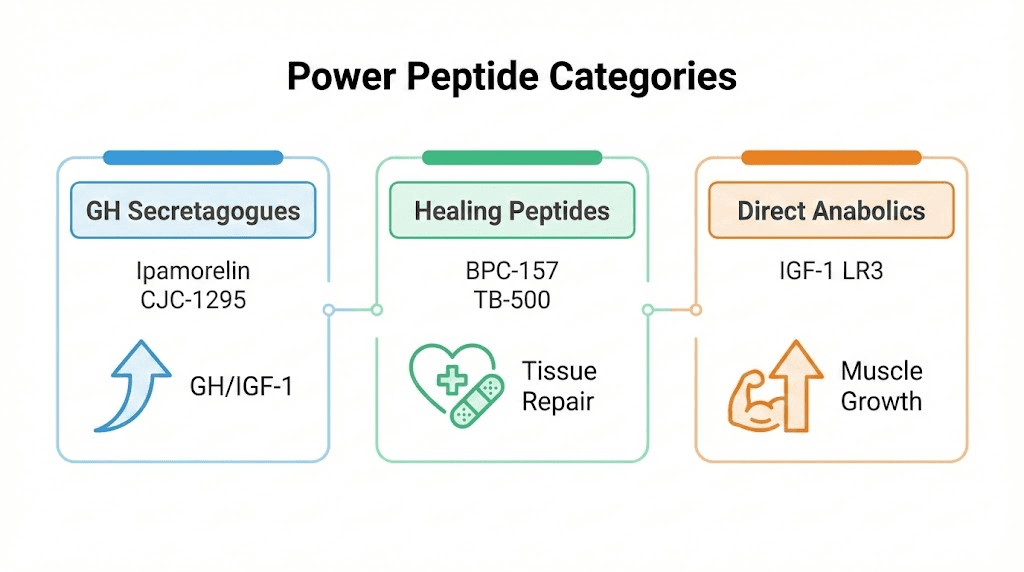
Key peptides in this category include growth hormone secretagogues (Ipamorelin, CJC-1295) elevating GH and IGF-1 for strength gains, healing peptides (BPC-157, TB-500) enabling heavier training through accelerated recovery, and direct muscle-building compounds (IGF-1 variants) stimulating hypertrophy and force capacity.
The performance enhancement evidence varies dramatically across peptides - growth hormone secretagogues demonstrate 20-40% GH elevation with correlating strength increases in clinical trials, healing peptides show injury recovery acceleration enabling more frequent heavy training, while direct anabolic peptides like IGF-1 LR3 carry limited human research but extensive anecdotal reports of significant muscle and strength gains. The legal and ethical implications prove complex since most peptides remain legal for personal research use but banned by athletic organizations (WADA, NCAA, professional sports) through blanket prohibitions on growth hormone releasing compounds.
Power-focused athletes face different optimization goals than bodybuilders - powerlifters and strength athletes prioritize maximal single-rep force production over muscle size aesthetics, requiring peptide protocols emphasizing neural adaptations, connective tissue strengthening, and recovery from extremely heavy loads rather than purely hypertrophic responses.
This specialization influences peptide selection, dosing strategies, and stacking combinations distinguishing power protocols from general muscle growth peptides approaches.
This guide examines what constitutes "power peptides" versus general performance enhancement, best peptides for strength and power output (GH secretagogues, healing peptides, direct anabolics), optimal dosing protocols for power athletes, strategic peptide stacking for maximal strength gains, combining peptides with strength training programming, managing recovery and injury prevention, legal and ethical considerations for competitive athletes, realistic results expectations and timelines, and comparing peptides to traditional performance-enhancing drugs.
Understanding power peptide applications helps strength athletes make informed decisions about performance enhancement while managing health risks and competitive eligibility.
Defining power peptides vs general performance
Understanding the category.
What makes a peptide "power-focused"
Power vs other performance goals:
Power: Maximal force production, explosive strength
Endurance: Sustained output, aerobic capacity
Hypertrophy: Muscle size for aesthetics
Recovery: Injury healing, training frequency
Power peptides: Optimize strength and force specifically
Key characteristics:
Enhance neural drive (muscle recruitment)
Increase contractile force capacity
Strengthen connective tissue (tendons, ligaments)
Accelerate recovery from heavy loads
Support maximal strength training
Power athlete requirements:
Powerlifters: Maximal squat/bench/deadlift
Olympic lifters: Explosive clean/snatch/jerk
Strongman: Max load carries and lifts
Throwers: Explosive power output
Sprinters: Maximal force generation
Different from bodybuilding:
Bodybuilders: Muscle size primary (aesthetics)
Power athletes: Strength primary (performance)
Overlap exists (strength needs muscle)
But priorities differ
Peptide selection adjusts accordingly
Primary mechanisms for power enhancement
Growth hormone and IGF-1 pathway:
GH/IGF-1 increase muscle protein synthesis
Enhance muscle fiber recruitment
Strengthen connective tissue
Improve recovery capacity
Peptides: Ipamorelin, CJC-1295, IGF-1 variants
Connective tissue strengthening:
Tendons and ligaments must handle force
Collagen synthesis critical
Injury prevention essential
Heavy loads stress connective tissue
Recovery acceleration:
Power training extremely demanding
CNS fatigue significant
Muscle damage from heavy loads
Faster recovery = more training
Peptides: Healing peptides, GH secretagogues
Muscle protein synthesis:
Muscle size correlates with force capacity
More muscle = more strength potential
Hypertrophy supports power
Direct anabolic effects
Peptides: IGF-1 LR3, GH peptides
Learn about how peptides work at SeekPeptides.
Power peptides vs steroids comparison
Anabolic steroids mechanism:
Androgen receptor activation
Direct muscle protein synthesis
Significant strength gains (30-50%+)
Rapid results (weeks)
Severe side effects and health risks
Power peptides mechanism:
Indirect (GH/IGF-1 pathway)
Moderate strength gains (10-30%)
Slower results (months)
Better safety profile
Legal for personal use (mostly)
Effectiveness comparison:
Factor | Steroids | Power Peptides |
|---|---|---|
Strength gains | 30-50%+ | 10-30% |
Speed of results | 4-8 weeks | 8-16 weeks |
Side effects | Severe (many) | Moderate (fewer) |
Health risks | High | Lower |
Legal status | Illegal without RX | Legal research use |
Sports bans | Banned | Also banned |
Why athletes choose peptides:
Better safety profile
Legal for personal use
Fewer side effects
Natural GH/IGF-1 pathway
Can combine with training safely
When steroids more effective:
Maximum strength priority (competition)
Accept health risks
Short-term goals (meet prep)
Experienced PED users
Medical supervision available
Peptides vs steroids decision:
Peptides: Health-conscious, long-term approach
Steroids: Maximum gains, accept risks
Many athletes use both (advanced)
Peptides safer starting point
See peptides vs steroids guide
Best peptides for strength and power
Top compounds for power athletes.
Growth hormone secretagogues
Class: GH secretagogue (GHRP-2 analog)
Mechanism: Stimulates GH release from pituitary
Strength benefits: 10-20% gains over 12-16 weeks
Dosing: 200-300mcg 2-3x daily
Best for: Consistent GH elevation, recovery
Ipamorelin advantages:
Selective GH release (minimal cortisol/prolactin)
Well-tolerated (few side effects)
Established research
Can use long-term
Stacks well with CJC-1295
Class: GHRH analog (growth hormone releasing hormone)
Mechanism: Amplifies natural GH pulses
With DAC: Long-acting (week-long half-life)
Without DAC: Shorter-acting (pairs with Ipamorelin)
Dosing: 2mg per week (with DAC) or 100mcg 2-3x daily (without)
CJC-1295 advantages:
Synergizes with Ipamorelin
Sustained GH elevation
Minimal dosing (with DAC)
Strong strength gains
Good safety profile
Ipamorelin + CJC-1295 stack:
Most popular GH secretagogue combination
Complementary mechanisms (GHRP + GHRH)
Greater GH release than either alone
20-30% strength gains possible
MK-677 (Ibutamoren):
Class: Oral GH secretagogue
Mechanism: Ghrelin mimetic (GH release)
Dosing: 10-25mg daily (oral)
Advantage: No injections required
Disadvantage: Increased appetite, water retention
GH secretagogue benefits for power:
Increased muscle protein synthesis
Enhanced recovery capacity
Connective tissue strengthening
Fat loss (improved body comp)
Better sleep (recovery)
Healing and recovery peptides
Full name: Body Protection Compound-157
Mechanism: Angiogenesis, growth factor modulation
Power athlete benefit: Tendon/ligament healing
Dosing: 250-500mcg 1-2x daily
Duration: 4-8 weeks cycles
BPC-157 for power athletes:
Heals connective tissue injuries
Prevents injuries from heavy loads
Reduces inflammation
Enables more frequent max effort training
Critical for powerlifters/strongman
Full name: Thymosin Beta-4
Mechanism: Actin regulation, cell migration
Power benefit: Muscle and tendon repair
Dosing: 5-10mg per week
Duration: 4-8 weeks loading, then maintenance
TB-500 advantages:
Broader tissue repair than BPC-157
Reduces inflammation systemically
Improves flexibility and mobility
Accelerates recovery from training
Stacks well with BPC-157
BPC-157 + TB-500 stack:
Complementary healing mechanisms
Enhanced injury prevention
Faster recovery from heavy training
Enables training through minor injuries
Popular among strength athletes
Healing peptides importance:
Power training extremely stressful
Injuries sideline gains
Prevention better than treatment
Enables consistent heavy training
Worth the investment
See BPC-157 vs TB-500 comparison.
Direct anabolic peptides
IGF-1 LR3 (Long R3 IGF-1):
Class: Synthetic IGF-1 analog
Mechanism: Direct muscle protein synthesis
Strength gains: 15-30% (anecdotal)
Dosing: 40-80mcg daily
Duration: 4-6 weeks maximum
IGF-1 LR3 advantages:
Direct anabolic effects
Localized muscle growth possible
Significant strength increases
Works without GH elevation
Rapid results (weeks)
IGF-1 LR3 disadvantages:
Limited human research
Expensive ($200-400/month)
Potential organ growth concerns
Hypoglycemia risk
More aggressive than GH peptides
IGF-1 DES:
Shorter-acting IGF-1 variant
Localized injection effects
50mcg pre-workout
Even more aggressive
Very limited research
When to use direct anabolics:
Experienced peptide users only
Plateaued on GH secretagogues
Short competition prep (6-8 weeks)
Accept higher risk
Can afford cost
When to avoid:
Beginners (start with GH secretagogues)
Long-term health priority
Budget-conscious
Want safest options
Sufficient gains from GH peptides
Dosing protocols for power athletes
Optimal power peptide protocols.
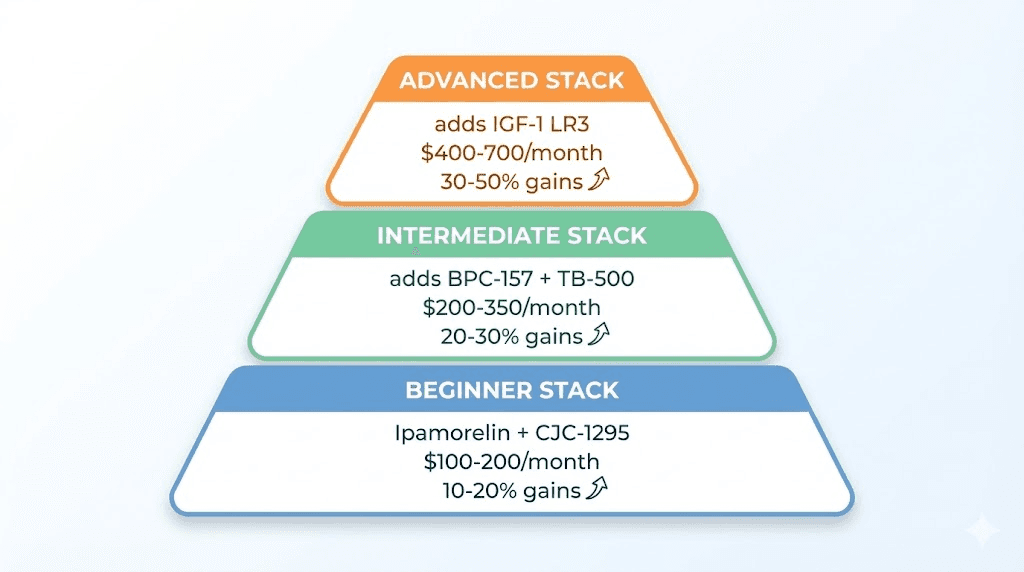
Beginner power peptide stack
Starting stack (conservative):
Ipamorelin: 200mcg 2x daily (morning, pre-bed)
CJC-1295 (no DAC): 100mcg 2x daily (with Ipamorelin)
Duration: 12-16 weeks minimum
Cost: $100-200/month
Why start here:
Well-researched peptides
Excellent safety profile
Proven strength gains (10-20%)
Manageable cost
Good risk-benefit ratio
Dosing schedule example:
Morning (fasted): Ipamorelin 200mcg + CJC 100mcg
Pre-bed: Ipamorelin 200mcg + CJC 100mcg
Injections: Subcutaneous, rotate sites
Consistency: Daily dosing critical
Expected results (12-16 weeks):
Strength gains: 10-20% on main lifts
Recovery: Noticeably faster
Body comp: Improved (fat loss)
Injuries: Reduced frequency
Sleep: Better quality
When to progress:
After 3-4 months on beginner stack
Gains plateauing
Want more aggressive approach
Comfortable with injections
Budget allows expansion
Intermediate power stack
Intermediate stack (aggressive):
Ipamorelin: 300mcg 3x daily
CJC-1295 (with DAC): 2mg once weekly
BPC-157: 250-500mcg daily
TB-500: 5mg weekly (4-8 weeks)
Cost: $200-350/month
Stack rationale:
Maximized GH/IGF-1 elevation
Added healing/recovery support
Injury prevention priority
Enables heavier training loads
More aggressive strength gains
Dosing schedule:
Morning: Ipamorelin 300mcg
Pre-workout: Ipamorelin 300mcg + BPC-157 250mcg
Pre-bed: Ipamorelin 300mcg + BPC-157 250mcg
Weekly: CJC-1295 DAC 2mg, TB-500 5mg
Duration: 16-24 weeks
Expected results:
Strength gains: 20-30% over 16 weeks
Recovery: Significantly enhanced
Injury prevention: Excellent
Training frequency: Can increase
Body composition: Dramatic improvement
Advanced power stack (competitive)
Advanced stack (maximum gains):
Ipamorelin: 300mcg 3x daily
CJC-1295 (with DAC): 2mg weekly
BPC-157: 500mcg 2x daily
TB-500: 10mg weekly
IGF-1 LR3: 40-60mcg daily (4-6 week cycles)
Cost: $400-700/month
Warning - advanced only:
Experienced users only
Competitive athletes
Accept higher risks
Medical monitoring recommended
Very expensive
Competition prep protocol:
12-16 weeks out: Full stack
8 weeks out: Add IGF-1 LR3
4 weeks out: Continue or taper
Post-competition: PCT and recovery
Off-season: Maintenance doses
Results expectations:
Strength gains: 30-50%+ possible
Recovery: Maximum
Injury risk: Lowest (with healing peptides)
Competition readiness: Optimal
But: Expensive and aggressive
Use peptide calculator for dosing.
Training integration and timing
Maximizing peptide effectiveness.
Pre-workout peptide timing
Pre-workout dosing strategy:
GH secretagogues: 30-60 minutes pre-workout
BPC-157: 30 minutes pre-workout
Goal: Elevate GH/IGF-1 during training
Benefit: Enhanced anabolic response
Why pre-workout timing works:
GH peaks during training window
IGF-1 elevation during muscle damage
Anabolic signaling maximized
Recovery processes initiated
Synergizes with training stimulus
Pre-workout timing example:
60 minutes before: Ipamorelin 300mcg + CJC 100mcg
30 minutes before: BPC-157 250mcg
During workout: Peak GH/IGF-1
Post-workout: Anabolic window enhanced
Better results than random timing
Post-workout and recovery timing
Post-workout recovery:
Natural GH pulse occurs post-training
Don't dose immediately post-workout (interferes)
Wait 2-3 hours minimum
Evening dose works well
Supports overnight recovery
Evening/pre-bed dosing:
Best timing: 30-60 minutes before bed
Ipamorelin + CJC: Before sleep
Rationale: Natural GH pulse during sleep
Amplifies: Natural overnight GH release
Result: Maximum recovery and growth
Sleep quality importance:
GH secretagogues improve sleep
Deeper sleep = more recovery
Essential for power athletes
Track sleep quality
Aim for 8-9 hours nightly
Training frequency and volume adjustments
With peptides vs without:
Without peptides: May need more rest days
With peptides: Can increase frequency
Recovery: Faster with healing peptides
Volume: Can increase training volume
Intensity: Heavy loads more often
Training frequency recommendations:
Training Style | Without Peptides | With Power Peptides |
|---|---|---|
Powerlifting | 3-4x weekly | 4-6x weekly possible |
Olympic lifting | 4-5x weekly | 5-7x weekly possible |
Strongman | 3-4x weekly | 4-5x weekly possible |
Progressive overload:
Peptides enable faster strength gains
Progress loads more aggressively
But: Don't overtrain
Listen to body
Healing peptides protect but aren't magic
Deload weeks:
Still needed even with peptides
Every 4-6 weeks reduce volume
Allow supercompensation
Prevent burnout
Critical for long-term gains
See best peptides for injury recovery for training integration.
Legal and competitive considerations
Understanding restrictions and risks.
WADA and sports organization bans
Banned substances:
All GH secretagogues (WADA prohibited)
IGF-1 and analogs (banned)
Most performance peptides (banned)
BPC-157 specifically banned
TB-500 also banned
Athletic organizations that test:
WADA (Olympics, international)
NCAA (college sports)
NFL, NBA, MLB, etc. (professional)
USAPL, IPF (tested powerlifting)
USADA (Olympic sports)
Untested federations:
Many powerlifting federations untested
Bodybuilding (most federations)
Strongman (varies)
Local/amateur competitions (often no testing)
But: Always check specific federation rules
Testing detection:
GH secretagogues: Detectable days-weeks
IGF-1: Detectable (elevated levels)
BPC-157: Specific tests exist
TB-500: Detectable
Detection windows vary
Consequences of positive test:
Competition ban (2-4+ years)
Record disqualification
Loss of titles/medals
Reputation damage
Legal issues possible (depending on sport/country)
Legal status for personal use
United States:
Peptides legal for research use
Not FDA-approved for human use
"For research only" classification
Personal possession legal
Not scheduled controlled substances
Other countries:
Varies significantly
Some countries ban all peptides
Others similar to US (research legal)
Check local laws
Importation restrictions vary
Legal risks:
Low for personal use (US)
Higher if selling/distributing
Competitive athletes risk bans
Always "for research" labeling
Consult lawyer if concerned
See are peptides legal complete guide.
Ethical considerations
Fair competition:
Using banned substances = cheating
Even if not caught
Ethical implications
Personal values matter
Consider competition integrity
Health vs performance:
Peptides safer than steroids
But still carry risks
Long-term effects unknown (some)
Medical monitoring recommended
Health should be priority
Career considerations:
Professional athletes: High risk
Competitive amateurs: Moderate risk
Recreational lifters: Personal choice
Consider testing status
Future goals matter
When peptides appropriate:
Untested competitions
Personal training (non-competitive)
Health optimization focus
Recovery from injury
Age-related decline
When to avoid:
Tested competitions (obvious)
Professional sports career
Against personal ethics
Health concerns present
Legal uncertainty
How you can use SeekPeptides for power optimization
SeekPeptides provides comprehensive peptide guidance for athletic performance. Learn about Ipamorelin benefits, best peptides for muscle growth, and peptide stacks for performance.
Access performance guides - BPC-157 complete guide, TB-500 benefits, best peptides for injury recovery, Ipamorelin vs CJC-1295.
Use our calculators - peptide calculator, peptide cost calculator, CJC-1295 calculator.
Learn fundamentals - what are peptides, how peptides work, peptide injections guide, are peptides legal.
Final thoughts
Power peptides targeting strength and explosive force production center on growth hormone secretagogues (Ipamorelin + CJC-1295) for 10-30% strength gains through GH/IGF-1 pathway elevation, healing peptides (BPC-157 + TB-500) enabling heavier training through injury prevention and recovery acceleration, and direct anabolics (IGF-1 LR3) for aggressive 15-30% strength increases in experienced users accepting higher risks.
Beginner protocols using Ipamorelin 200mcg + CJC-1295 100mcg twice daily for 12-16 weeks provide excellent strength gains at $100-200 monthly with minimal side effects and proven safety, while intermediate stacks adding BPC-157 and TB-500 enable 20-30% strength increases through enhanced recovery and injury prevention at $200-350 monthly.
Advanced competitive protocols incorporating IGF-1 LR3 reach $400-700 monthly with 30-50% strength potential but require experience and medical monitoring.
The legal and ethical landscape proves complex - all performance peptides face WADA bans and athletic organization prohibitions making them inappropriate for tested competitive athletes despite legal status for personal research use in most jurisdictions. Untested powerlifting federations, recreational strength training, and injury recovery represent appropriate use cases where peptides provide significant performance benefits with better safety profiles than traditional steroids.
Your power peptide strategy should match experience level and competitive status - beginners should start with GH secretagogue combinations for proven gains with excellent safety, competitive tested athletes should avoid entirely due to bans, untested competitors can leverage full stacks for maximum performance, and recreational lifters should prioritize healing peptides enabling consistent heavy training over aggressive anabolics.
Helpful resources for power peptides
Ipamorelin benefits - GH secretagogue guide
Best peptides for muscle growth - Muscle building
BPC-157 complete guide - Healing peptide
TB-500 benefits - Recovery peptide
Peptide stacks guide - Stacking strategies
Ipamorelin vs CJC-1295 - Comparison
Related guides worth reading
Are peptides legal - Legal guide
Is BPC-157 banned - Competition status