Dec 23, 2025
You want to build muscle faster, recover better, push your performance beyond natural limits.
You've heard about steroids, and you've also heard about peptides.
Both promise enhanced results, but you're not clear on the difference.
Are peptides just "safer steroids"? Are they less effective?
What are you actually getting with each?
Here's the reality: peptides and steroids are completely different classes of compounds that work through entirely different mechanisms. They share some outcomes (increased muscle, better recovery) but the path to get there, the side effects, and the long-term implications are vastly different.
This isn't a guide to encourage steroid use. It's an honest comparison so you can make informed decisions about your body and your goals. You'll learn how each works, what results to expect, the risks involved, and which might be appropriate for your situation.
Let's start with understanding what each actually is.
What are steroids vs what are peptides?
Anabolic steroids
Anabolic-androgenic steroids (AAS) are synthetic derivatives of testosterone. They're hormones - specifically, modified versions of the primary male sex hormone.
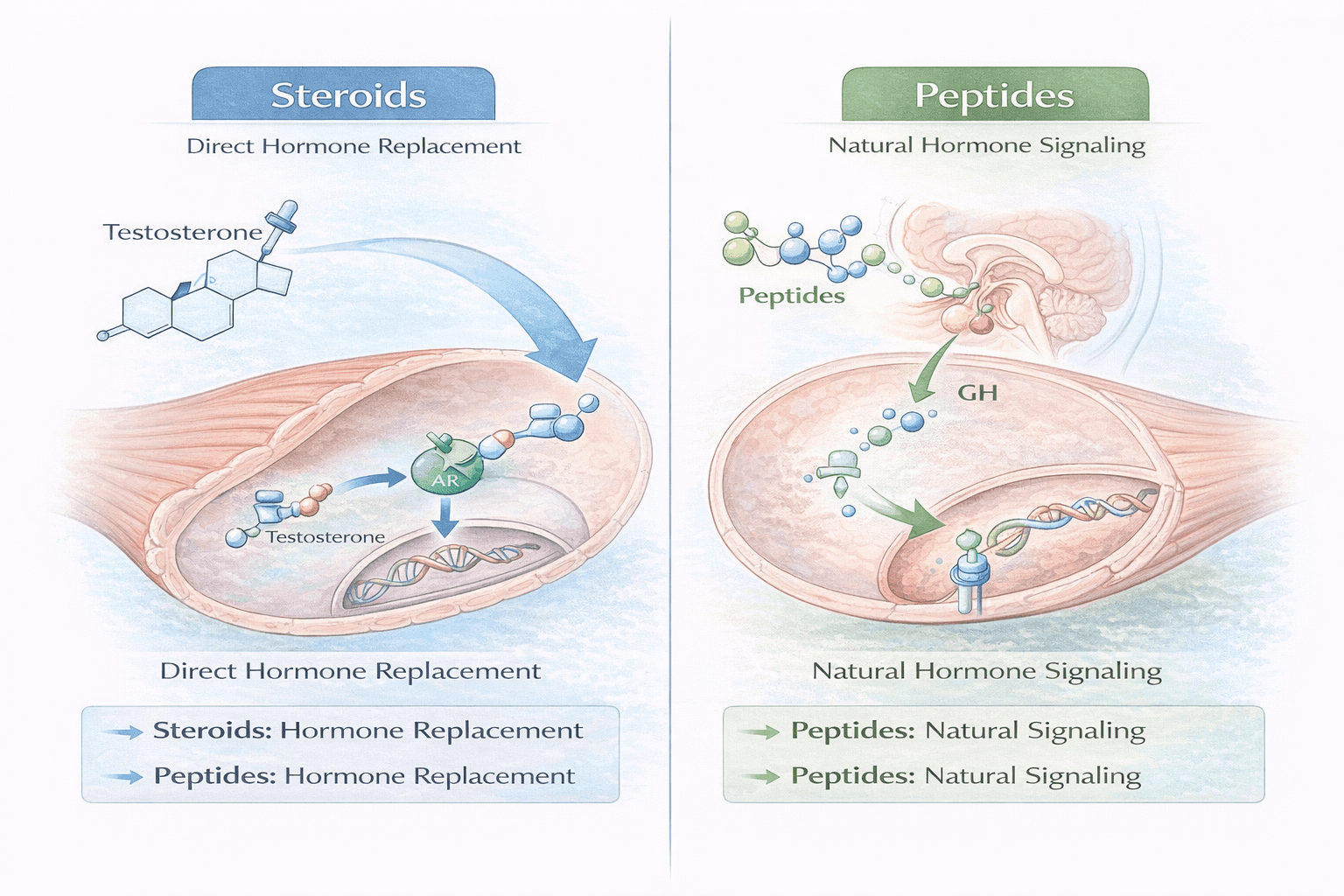
How they work: Steroids bind directly to androgen receptors in muscle tissue. This binding activates genes that increase protein synthesis, nitrogen retention, and muscle growth. You're flooding your body with synthetic hormones that tell your muscles to grow.
Common examples:
Testosterone (various esters: enanthate, cypionate, propionate)
Nandrolone (Deca-Durabolin)
Trenbolone
Dianabol (methandrostenolone)
Anavar (oxandrolone)
Winstrol (stanozolol)
Key characteristic: Steroids are actual hormones. They replace or supplement your natural testosterone and other hormones.
Peptides
Peptides are short chains of amino acids - the same building blocks that make up proteins in your body. They're signaling molecules that tell your body to produce or release its own hormones.
How they work: Peptides don't directly build muscle. Instead, they signal your pituitary gland to release more growth hormone, or they signal specific tissues to perform certain functions. You're optimizing your body's natural hormone production rather than replacing it with synthetic hormones.
Common examples for muscle/performance:
CJC-1295 (growth hormone releasing hormone analog)
Ipamorelin (growth hormone secretagogue)
BPC-157 (healing and recovery)
TB-500 (tissue repair and growth)
IGF-1 LR3 (insulin-like growth factor)
GHRP-6, GHRP-2 (growth hormone releasing peptides)
Key characteristic: Peptides are signaling molecules. They work with your body's systems rather than replacing them.
The fundamental difference
Steroids: Exogenous hormones that replace/supplement your natural production
Peptides: Signaling molecules that enhance your natural hormone production and cellular processes
This distinction matters enormously for side effects, safety, and long-term health implications.
Muscle building: effectiveness comparison
Let's be honest about what each delivers for muscle growth.
Steroids for muscle building
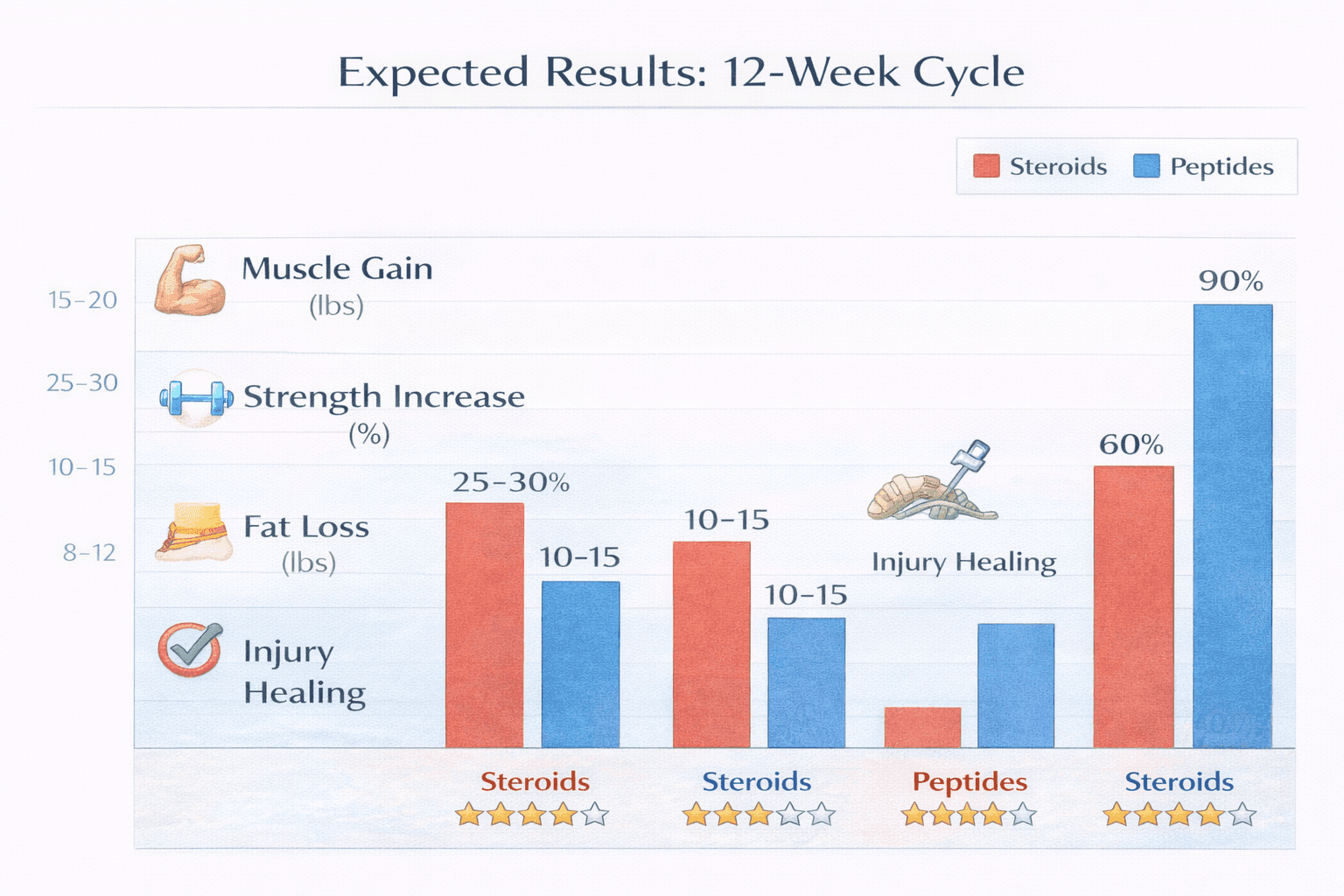
Effectiveness: Extremely powerful. Steroids are the most effective muscle-building compounds available. Nothing else comes close for pure muscle mass gains.
Typical results (testosterone cycle, 500mg/week for 12 weeks):
10-20 pounds lean muscle gain
Significant strength increases (20-30% on major lifts)
Rapid visual changes (4-6 weeks)
Water retention adds additional weight (5-10 pounds)
Why so effective:
Direct androgen receptor activation
Dramatically increased protein synthesis
Enhanced nitrogen retention
Suppressed cortisol (catabolic hormone)
Increased red blood cell production (better endurance)
Compounds ranked by muscle-building power:
Trenbolone (most powerful, harshest sides)
Testosterone (dose-dependent, versatile)
Nandrolone/Deca (solid gains, joint benefits)
Dianabol (fast gains, harsh on liver)
Anavar (mild gains, relatively safe)
The catch: Gains are only partially permanent. When you stop steroids, your testosterone drops (sometimes below baseline), and you lose some of the size. PCT (post-cycle therapy) helps but doesn't preserve everything.
Peptides for muscle building
Effectiveness: Moderate. Peptides work but they're nowhere near as powerful as steroids for pure muscle gain.
Typical results (CJC-1295/Ipamorelin stack, 3-6 months):
5-10 pounds lean muscle gain
Moderate strength increases (10-15% on major lifts)
Gradual changes (8-12 weeks to notice)
No water retention (purely lean tissue)
Improved recovery and injury healing as bonus
Why less dramatic:
Working within natural hormone ranges
Indirect mechanism (signaling, not direct action)
Results depend on your body's response
Slower accumulation of effects
Compounds ranked by muscle-building power:
IGF-1 LR3 (most anabolic, closest to steroid effects)
CJC-1295/Ipamorelin combo (solid GH boost)
GHRP-6 (GH release plus hunger stimulation)
Hexarelin (powerful but tachyphylaxis develops)
BPC-157/TB-500 (indirect muscle benefits via recovery)
The benefit: Gains are more permanent. You're optimizing natural processes, so when you stop, you don't crash. Muscle built with peptides is yours to keep.
Head-to-head comparison
For pure muscle gain:
Steroids: 10/10
Peptides: 6/10
For permanent, keepable gains:
Steroids: 5/10 (lose some when stopping)
Peptides: 8/10 (mostly permanent)
For overall body composition (muscle + fat loss):
Steroids: 9/10 (build muscle, some burn fat)
Peptides: 7/10 (modest muscle, good fat loss)
For feeling "natural":
Steroids: 2/10 (you feel superhuman, but artificial)
Peptides: 7/10 (enhanced but within natural range)
If your singular goal is maximum muscle mass as fast as possible, steroids win. If you want solid results with better long-term health and sustainability, peptides are the answer.
Recovery and healing comparison
Both classes offer recovery benefits, but through different mechanisms.
Steroids for recovery
How they help:
Increased red blood cell production (better oxygen delivery)
Reduced muscle damage during training
Enhanced protein synthesis (faster rebuilding)
Anti-inflammatory effects (cortisol suppression)
Better nutrient partitioning
Typical recovery improvements:
Train same muscle groups more frequently (every 48 hours vs every 72+ hours)
Less soreness post-workout
Faster return to baseline strength
Can handle higher training volume
Best steroids for recovery:
Nandrolone/Deca (famous for joint relief)
Testosterone (general recovery boost)
Anavar (less suppressive, good for cutting)
Equipoise (increased red blood cells)
Limitations:
Doesn't heal actual injuries (may mask pain and encourage training through damage)
Tendon strength doesn't keep up with muscle strength (injury risk)
Joint relief is temporary (problems return after stopping)
Peptides for recovery
How they help:
Tissue repair and regeneration (actual healing)
Reduced inflammation at injury sites
Collagen synthesis (tendon/ligament healing)
Angiogenesis (new blood vessel formation)
Stem cell activation and migration
Typical recovery improvements:
Faster healing from injuries (sometimes dramatically faster)
Better sleep (GH release during sleep cycles)
Reduced chronic inflammation
Improved joint health
Better muscle recovery between sessions
Best peptides for recovery:
BPC-157 (exceptional healing properties)
TB-500 (tissue repair, reduced inflammation)
CJC-1295/Ipamorelin (GH-mediated recovery)
GHK-Cu (tissue regeneration)
Advantage over steroids:
Actually heals injuries, doesn't just mask them
Improves tendon/ligament strength (not just muscle)
Long-term joint health benefits
Can be used during injury recovery specifically
Head-to-head for recovery
For day-to-day training recovery:
Steroids: 9/10 (very powerful)
Peptides: 7/10 (solid improvement)
For actual injury healing:
Steroids: 4/10 (minimal true healing)
Peptides: 9/10 (exceptional for healing)
For joint health:
Steroids: 5/10 (some help, can worsen over time)
Peptides: 8/10 (genuine joint healing and protection)
For long-term sustainability:
Steroids: 3/10 (creates dependencies)
Peptides: 9/10 (builds resilient tissue)
If you're dealing with actual injuries, peptides (especially BPC-157 and TB-500) are far superior. For maximizing training frequency and volume, steroids are more powerful.
For detailed protocols, see our BPC-157 guide and TB-500 guide.
Side effects and health risks
This is where the comparison gets serious. Side effects differ dramatically.
Steroid side effects
Steroids are powerful hormones. They affect every system in your body.
Common side effects (affect 30-70% of users):
Testosterone suppression/shutdown:
Your natural testosterone production stops
Testicles shrink (reduced function)
Fertility problems (sometimes permanent)
Requires post-cycle therapy (PCT) to recover
Some users never fully recover natural production
Cardiovascular issues:
Increased blood pressure (often significantly)
Altered cholesterol (lower HDL, higher LDL)
Left ventricular hypertrophy (enlarged heart)
Increased heart attack and stroke risk
Risk accumulates with each cycle
Liver stress (oral steroids):
Elevated liver enzymes
Potential liver damage with prolonged use
Some orals are extremely hepatotoxic
Hormonal side effects:
Gynecomastia (male breast tissue growth)
Acne (often severe on back/chest)
Hair loss (if genetically predisposed)
Oily skin
Mood changes, aggression, anxiety
Other common issues:
Sleep disruption
Increased appetite (some compounds)
Bloating and water retention
Increased body temperature
Night sweats
Less common but serious:
Psychological effects:
Mood swings and irritability ("roid rage" is real for some)
Depression during cycle or post-cycle
Anxiety and paranoia
Body dysmorphia worsening
Dependency issues
Organ damage:
Kidney stress (especially with high doses)
Prostate enlargement
Potential cardiovascular remodeling (permanent)
Metabolic issues:
Insulin resistance (some compounds)
Diabetes risk increase
Thyroid disruption
The dose-response problem: Higher doses = better results BUT exponentially worse side effects. Diminishing returns are brutal.
Peptide side effects
Peptides are generally well-tolerated, especially compared to steroids.
Common side effects (affect 10-30% of users):
Growth hormone-related peptides (CJC-1295, Ipamorelin, etc.):
Water retention (mild, temporary)
Joint pain (usually temporary adaptation)
Carpal tunnel-like symptoms (rare)
Numbness/tingling in extremities (rare)
Increased hunger (GHRP-6, GHRP-2)
Lethargy initially (body adjusting)
Healing peptides (BPC-157, TB-500):
Headaches (occasional, mild)
Nausea (rare)
Dizziness (rare)
Increased body hair growth (TB-500)
Injection-related:
Site reactions (redness, minor pain)
Bruising (improper technique)
Infection risk (if sterility not maintained)
Rare but possible:
Blood sugar changes (monitor if diabetic)
Prolactin increase (with some GH peptides)
Tachyphylaxis (reduced effectiveness over time with some peptides)
What's notably absent:
No testosterone suppression
No cardiovascular remodeling
No liver stress
No hormonal disaster
No PCT required
No infertility issues
Long-term safety:
Growth hormone peptides mimic natural pulses (safer than exogenous GH)
Healing peptides have excellent long-term safety profiles
No evidence of organ damage with proper use
Can be used for extended periods
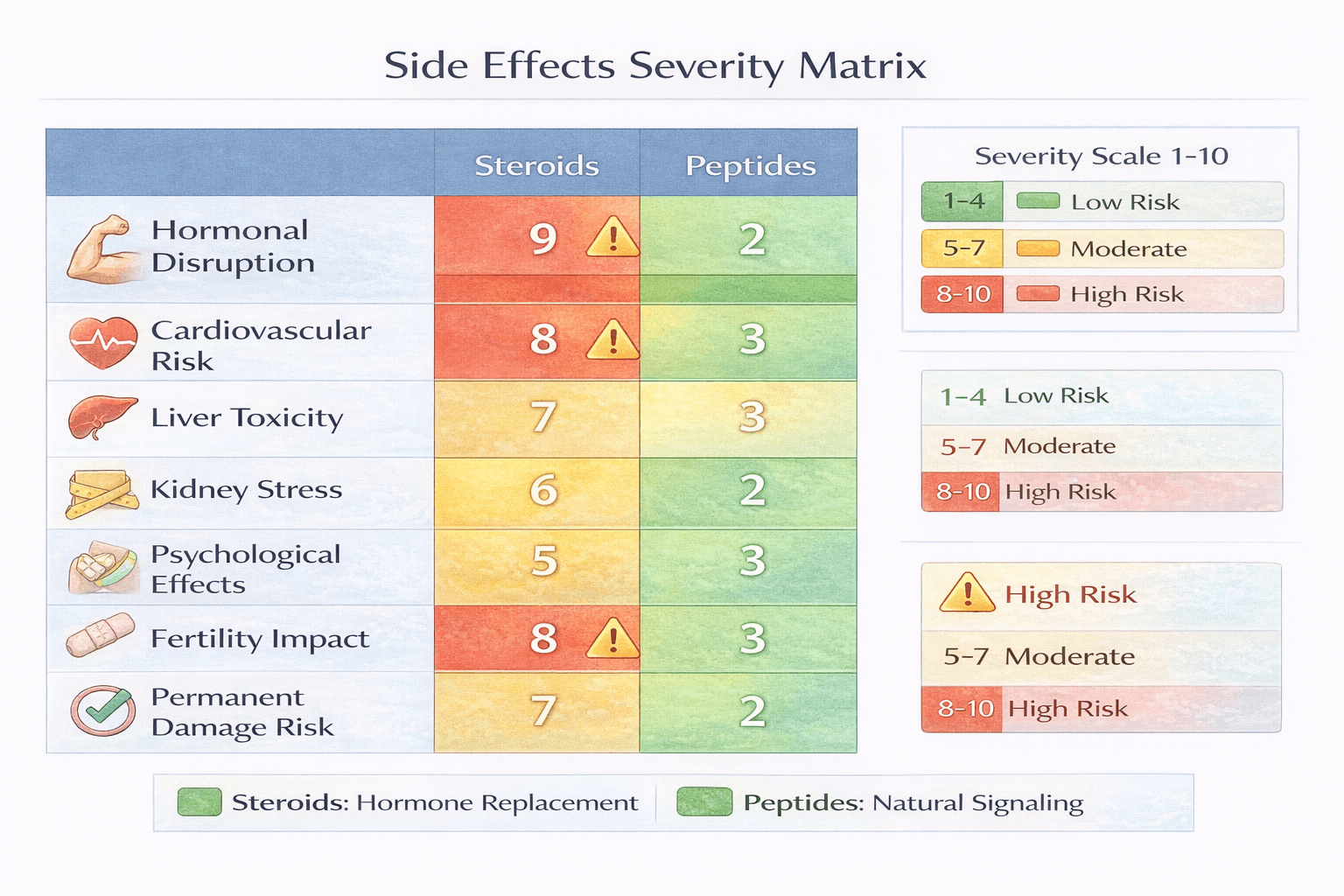
Head-to-head safety comparison
Hormonal disruption:
Steroids: 10/10 severity (guaranteed shutdown)
Peptides: 1/10 severity (minimal hormonal impact)
Cardiovascular risk:
Steroids: 8/10 severity (significant risk increase)
Peptides: 2/10 severity (minimal concerns)
Liver toxicity:
Steroids: 7/10 severity (oral steroids especially)
Peptides: 0/10 severity (no liver impact)
Reversibility of side effects:
Steroids: 5/10 (some permanent damage possible)
Peptides: 9/10 (almost everything reverses)
Need for ancillary drugs:
Steroids: Extensive (AI, SERM, hCG, PCT drugs, BP meds)
Peptides: Minimal (maybe vitamin B6 for prolactin if needed)
The safety profile of peptides is vastly superior. This doesn't mean peptides are risk-free, but the risks are orders of magnitude lower.
For comprehensive safety information, see our peptide safety guide.
Legality and accessibility
Where you can get these compounds matters.
Steroid legality
Legal status: Anabolic steroids are controlled substances in most countries.
United States:
Schedule III controlled substances
Illegal to possess without prescription
Illegal to distribute
Prescriptions only for specific medical conditions
Not prescribed for muscle building/athletic performance
Penalties for possession (US):
First offense: Up to 1 year prison, minimum $1,000 fine
Second offense: Up to 2 years prison, minimum $2,500 fine
Distribution: Much harsher (up to 5 years, $250,000 fine)
Other countries:
UK: Class C drugs (illegal to supply, legal to possess for personal use)
Canada: Schedule IV (illegal without prescription)
Australia: Schedule 4 (prescription only)
Mexico: Legal over-the-counter (but smuggling back to US illegal)
How people acquire them:
Underground labs (UGLs) - quality varies wildly
Black market from gyms/dealers - risky, often fake
Online sources - legal risk, customs seizure risk
Medical tourism - travel to countries with lax laws
Prescription for legitimate medical need (TRT for low T)
Quality concerns:
No regulation of underground products
Underdosed or fake products common
Contamination risks
Heavy metal contamination reports
Completely wrong compounds sometimes
Peptide legality
Legal status: Gray area in most countries.
United States:
Not controlled substances
Legal to possess for "research purposes"
Technically illegal for human consumption
Legal to sell "for research only"
Not FDA-approved for performance enhancement
Reality:
Research peptide companies sell openly online
Payment processors accept transactions
Customers rarely prosecuted for personal use
Gray market more than black market
Other countries:
Similar gray area status in most Western nations
Generally less restricted than steroids
Some peptides prescription-only in some countries
How people acquire them:
Research peptide companies online (most common)
Peptide clinics (some offer legitimate prescriptions)
Compound pharmacies (prescription required)
International suppliers (customs risk)
Quality concerns:
Legitimate research suppliers provide testing (CoAs)
Quality varies by supplier
Third-party testing available
Generally better quality control than steroid UGLs
Still need to vet suppliers carefully
Head-to-head accessibility
Legal risk:
Steroids: High (controlled substances)
Peptides: Low-moderate (gray area)
Ease of acquisition:
Steroids: Difficult legally, risky illegally
Peptides: Relatively easy from research suppliers
Quality assurance:
Steroids: Poor (no oversight of UGLs)
Peptides: Better (third-party testing available)
Cost:
Steroids: Moderate ($200-500/cycle for test)
Peptides: Moderate-high ($150-400/month for GH peptides)
Peptides occupy a more accessible legal space and generally offer better quality assurance through legitimate research suppliers.
For vendor evaluation guidance, see our best peptide vendors guide.
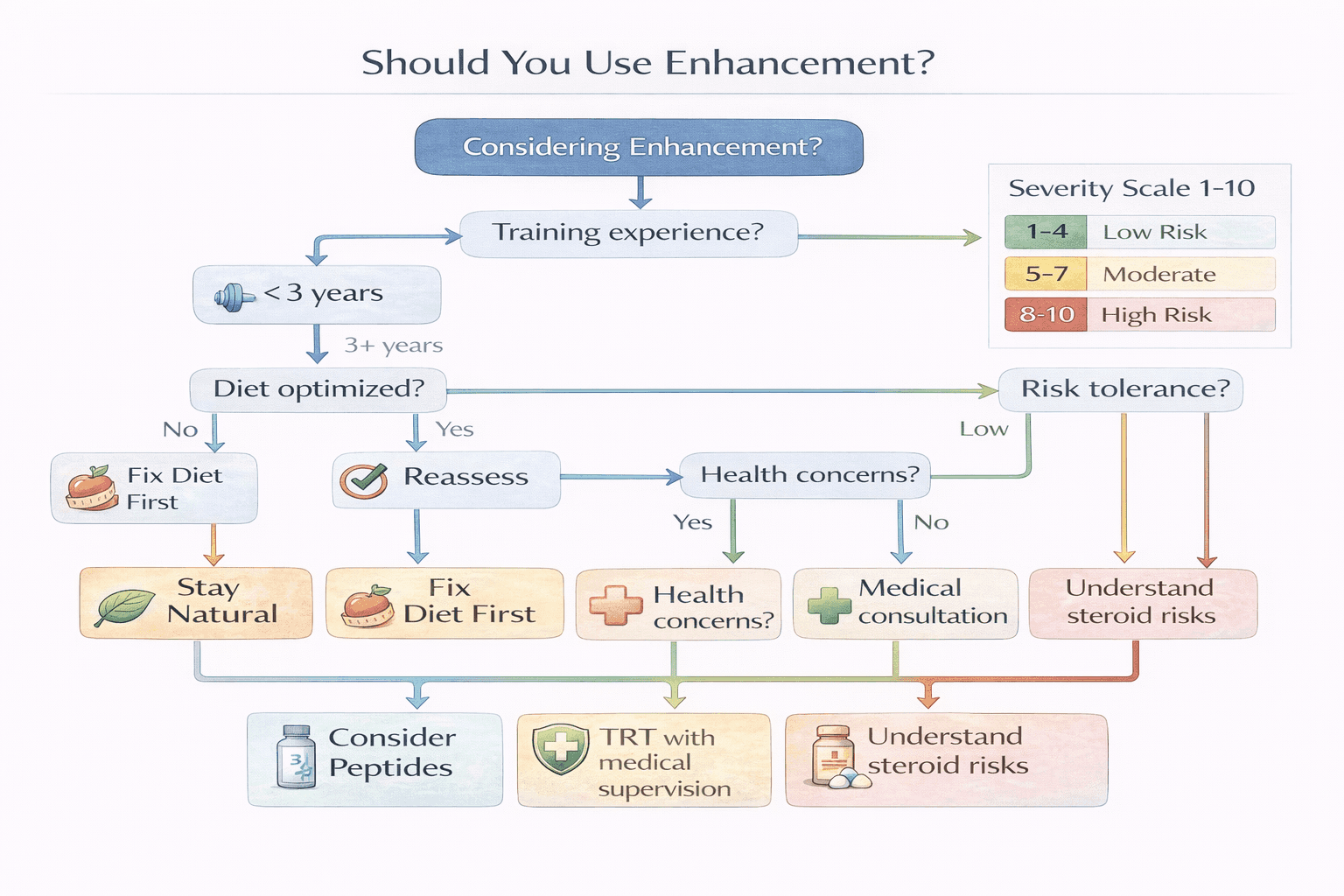
Who should use which (or neither)
Not everyone should use either. Here's honest guidance:
Consider steroids if:
You might be a candidate for steroids if ALL of the following apply:
You're 25+ years old (brain/endocrine system fully developed)
You've trained naturally for 5+ years (exhausted natural potential)
Your diet and training are already optimized
You understand and accept the health risks
You have access to bloodwork and medical monitoring
You're willing to commit to proper ancillary drugs and PCT
You have realistic goals (not trying to look like Mr. Olympia)
You're not in drug-tested competitions
You've thoroughly researched and understand what you're doing
Even then, consider:
Therapeutic testosterone replacement (TRT) under doctor supervision
Rather than blasting high doses for cycles
This maintains stable levels with medical oversight
Better long-term health outcomes than cycling
Consider peptides if:
You might be a candidate for peptides if:
You want enhanced recovery and performance
You're dealing with injuries that won't heal
You want modest muscle gains without health risks
You've optimized training and diet but want an edge
You're 21+ years old (generally safe for adults)
You're willing to commit to consistent use (months, not weeks)
You understand results are moderate, not dramatic
You want sustainable, long-term enhancement
You compete in drug-tested sports (many peptides aren't tested for)
Peptides make sense for:
Athletes wanting legal recovery enhancement
People with chronic injuries
Natural bodybuilders wanting an edge
Aging individuals optimizing health
Anyone wanting conservative, safer enhancement
Consider neither if:
You should not use either if:
You're under 21 (let your endocrine system mature)
You haven't optimized natural training and diet
You have pre-existing health conditions (heart, liver, kidney issues)
You can't afford proper bloodwork and monitoring
You're using to compensate for poor training/diet
You have body dysmorphia or unhealthy fitness obsessions
You're in early stages of training (first 2-3 years)
You have addictive tendencies (dependency risk)
The natural path is viable:
Most people never exhaust natural potential
Natural training produces lasting, sustainable results
No health risks or legal concerns
Cheaper and simpler long-term
Better overall health outcomes
Many people jump to enhancement too early. If you're making consistent natural progress, stay natural longer. Enhancement should be a calculated decision after years of optimized natural training, not a shortcut.
Stacking peptides with steroids (advanced)
Some people use both together. This is advanced and requires serious knowledge.
Why people stack them
Different mechanisms, complementary benefits:
Steroids: Direct anabolic effects
Peptides: Enhanced recovery, healing, natural GH optimization
Common combinations:
Testosterone + BPC-157 + TB-500 (muscle growth + injury protection)
Nandrolone + CJC-1295/Ipamorelin (mass + recovery)
Cutting cycle + GH peptides (preserve muscle, enhance fat loss)
Potential benefits:
Better injury prevention during heavy steroid cycles
Enhanced recovery between brutal training sessions
Mitigate some negative steroid effects
More complete enhancement
The risks multiply
Complexity increases:
More compounds = more variables
Harder to troubleshoot issues
More expensive
More injections
Health monitoring becomes crucial:
Comprehensive bloodwork mandatory
More parameters to track
Multiple organ systems affected
Professional medical oversight strongly recommended
Not for beginners:
Need extensive experience with each class independently
Requires deep understanding of endocrinology
Easy to cause problems without proper knowledge
Safer alternatives to stacking
If considering steroids + peptides:
TRT doses of testosterone + peptides (more sustainable than blasting)
Peptides-only protocols first (assess if sufficient for your goals)
Work with sports medicine doctor or endocrinologist
For protocol planning guidance, see our peptide cycle planning guide and peptide stacks guide.
The role of SeekPeptides in your enhancement journey
Whether you're exploring peptides or trying to understand your options, SeekPeptides provides the knowledge and tools you need.
Accurate dosing: Our peptide calculator and compound-specific calculators ensure precise dosing for peptide protocols.
Reconstitution guidance: Our peptide reconstitution calculator prevents mixing errors with injectable peptides.
Protocol planning: Our cycle planning guide helps you map out comprehensive peptide protocols, track progress, and adjust based on results.
Evidence-based information: Our guides on specific peptides (BPC-157, TB-500, CJC-1295, etc.) provide mechanisms, realistic expectations, and practical protocols based on research and real-world results.
AI-powered assistance: Get answers to your specific questions about peptides, managing side effects, optimizing protocols, and making informed decisions.
You don't have to navigate enhancement blind. Use the resources that help people make informed, safe decisions about their bodies.
Final thoughts
Peptides and steroids aren't the same thing.
They're different tools with different risk-benefit profiles.
Steroids are more powerful for pure muscle building.
No question, but they come with significant health risks, legal concerns, and long-term complications. They're hormones that override your natural systems.
Peptides are more moderate for muscle building but excel at recovery, healing, and optimization. They work with your body rather than replacing its systems. Side effects are minimal, legal risk is lower, and long-term health impact is far better.
For most people, peptides offer the better path - significant benefits without catastrophic risks. For elite athletes or bodybuilders who've exhausted natural potential and understand the trade-offs, steroids might make sense under proper medical supervision.
The best approach? Optimize your natural training and diet first. Exhaust your natural potential. Then, if you still want enhancement, start with peptides. They provide real benefits with manageable risks.
Enhancement isn't necessary for great results. But if you choose it, choose intelligently. Understand what you're using, why you're using it, and what the long-term implications are.
Your health is more valuable than any physique goal.
Related resources
In case I don’t see you, good afternoon, good evening, and good night. Take care of yourself.