Dec 15, 2025
Peptides have moved from the underground world of elite athletics into the forefront of modern health optimization, promising to accelerate injury healing, strip away visceral fat, and "reset" biological clocks.
However, the landscape is filled with confusing acronyms and conflicting advice.
In this guide, we break down exactly what these compounds are, the specific biological mechanisms behind how they work, the precise protocols often discussed in clinical settings, and, most importantly, the serious risks that are rarely talked about.
The fundamentals
What is a peptide?
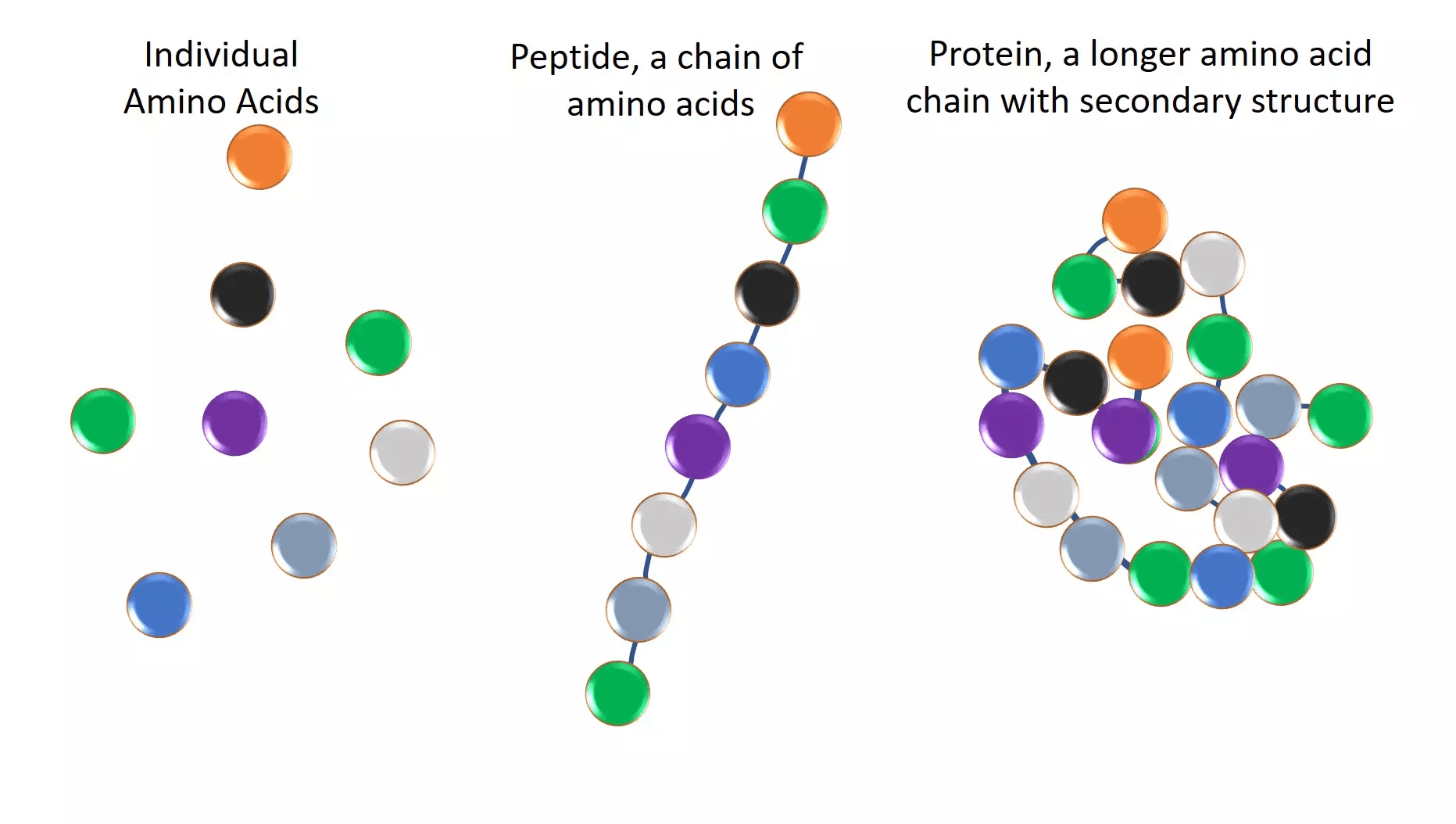
To understand peptides, you have to understand proteins. While a standard protein is a massive, complex 3D structure, a peptide is simply a short chain of amino acids, specifically between 2 and 50 amino acids in length.
You can visualize a peptide like "beads on a string."
The beads are the amino acids, and the specific order of those beads determines the "code" or function of the peptide. When that string gets longer (usually over 50-100 amino acids), it becomes a full protein.
How they work: The "parking spot" mechanism
Peptides function as signaling molecules, traveling through the bloodstream until they find a specific receptor on the surface of a cell.
Think of this receptor as a "parking spot."
Once the peptide "parks" in that spot, it doesn't just sit there, but triggers a cascade of events inside the cell, essentially a "bucket brigade" of biological signals that tells the cell to perform a specific task, such as burning fat, repairing tissue, or releasing a hormone.
The "pleiotropic" rule
This is the single most important concept to grasp before using peptides. Peptides are pleiotropic, meaning they act on many different tissues simultaneously.
Rarely does a peptide do just one thing.
A compound used to heal a tendon might also interact with receptors in your brain, your gut, or your heart. Side effects are not "bugs" in the system, but are features of how these widespread signaling networks function.
The critical safety warning
Before discussing specific compounds, we must address the "dirty secret" of the industry: Lipopolysaccharides (LPS).
There is a massive difference between pharmaceutical-grade peptides and the "research chemicals" sold online.
Pharma-grade: These are synthesized in sterile environments and "scrubbed" of contaminants.
Underground/Research grade: These are often contaminated with LPS, a bacterial by-product from the manufacturing process.
LPS is an immunotoxin. When you inject a peptide contaminated with LPS, your body mounts an immediate immune response.
While a single dose might not be fatal, chronic exposure to LPS can lead to systemic inflammation and immune dysfunction. If you are going to use peptides, the only safe route is through a prescription and a regulated compounding pharmacy to ensure the removal of LPS.
Peptides for soft tissue repair
This is the most popular category, used for healing tears, strains, and chronic injuries in tendons, ligaments, and muscles.
1. BPC-157 (Body protection compound)
The mechanism: Derived from a protective compound naturally found in gastric juices, BPC-157 is a powerhouse for healing. Its primary mechanism is angiogenesis, the formation of new blood vessels.
It upregulates an enzyme called eNOS (Endothelial Nitric Oxide Synthase).
This stimulates VEGF (Vascular Endothelial Growth Factor).
The result: New capillaries grow into the injured tissue, delivering the blood flow and nutrients necessary for repair. It also increases fibroblast migration to rebuild tissue structure.
The protocol:
Dosage: Standard therapeutic doses range from 300 to 500 micrograms (mcg).
Frequency: Typically administered daily or every other day.
Location: While the systemic effect is strong, many protocols favor injecting subcutaneously near the site of the injury (local administration) to concentrate the angiogenic factors.
There is a tumor risk: because BPC-157 promotes blood flow via VEGF, it is indiscriminate.
If you have an active tumor or pre-cancerous cells, BPC-157 may accelerate that tumor’s growth by feeding it a blood supply. This is a critical contraindication for anyone with a history of cancer.
2. Thymosin beta-4 (TB-500)
The mechanism: Naturally produced by the thymus gland (which shrinks as we age), this peptide explains why children heal so quickly and without scarring.
While BPC-157 builds the blood vessels, TB-500 builds the scaffolding.
It sequesters actin (a cell-building protein) and promotes cell migration to the wound site.
The "repair stack": It is common practice to use these two in conjunction.
BPC-157 provides the fuel lines (blood), and TB-500 provides the labor (structural repair).
Peptides for metabolism and growth (HGH)
Many individuals seek the fat-burning and muscle-sparing benefits of Human Growth Hormone (HGH) without the risks of injecting HGH directly (which can shut down natural production). The solution is secretagogues, peptides that signal the pituitary gland to release your own growth hormone.
General rule: These must be taken on an empty stomach (at least 90 minutes after food) because insulin blunts the release of Growth Hormone.
Category A: The signals (GHRH analogs)
These peptides mimic the brain's "go" signal to the pituitary.
Sermorelin: FDA-approved for short stature. It is known to significantly increase deep sleep (Stage 3/4), which is physically restorative. However, some users report a decrease in REM sleep (dreaming/cognitive restoration) as a trade-off.
Tesamorelin: The most potent peptide in this class. It is FDA-approved specifically to reduce visceral fat (the dangerous fat around organs) in HIV patients. It is the gold standard for body composition changes in this category.
CJC-1295: A long-acting analog often modified to last for days. Caution is advised: Clinical trials linked this specific long-acting compound to cardiovascular issues. Given the safer profiles of Sermorelin and Tesamorelin, CJC-1295 is often considered an unnecessary risk.
Category B: The amplifiers (ghrelin mimetics)
These peptides interact with the "hunger" pathways (Ghrelin) to trigger a massive pulse of Growth Hormone.
Ipamorelin: Considered the "cleanest" option. It stimulates GH release without significantly spiking cortisol (stress hormone) or prolactin. It works by inhibiting somatostatin (the hormone that puts the "brakes" on GH).
Hexarelin: The strongest option available. It creates the largest pulse of GH but comes with high risks: it spikes cortisol and prolactin and can cause receptor desensitization (burning out the pituitary’s ability to respond).
MK-677: An oral formulation (no injection needed). While effective, it mimics ghrelin so closely that it causes ravenous, uncontrollable hunger. It is also prone to causing anxiety and significant water retention.
Peptides for longevity
Epitalon (Epithalon)
This synthetic peptide is based on a compound produced by the pineal gland (epithalamin).
The theory: as we age, the pineal gland calcifies, and production of melatonin and epithalamin drops.
The benefit: animal research suggests Epitalon can re-synchronize circadian rhythms and potentially lengthen telomeres, the protective caps on DNA strands that shorten with age.
The protocol: It is rarely taken continuously. Standard protocols involve "cycling" it (e.g., a two-week course every 6 to 12 months) to "reset" the biological clock.
Peptides for vitality and libido
This category leverages the melanocortin system, which evolutionarily links sunlight exposure to reproduction. (Think: Summer = Sun = MSH release = High Libido).
Melanotan & PT-141
These interact with melanocyte receptors to increase skin pigmentation and sexual arousal.
Melanotan I: Primarily increases tanning; does not cross the blood-brain barrier effectively.
Melanotan II: Crosses the blood-brain barrier. Causes profound tanning and significant increases in libido. Side effects: Severe nausea and appetite suppression are very common.
PT-141 (Vyleesi): A derivative of Melanotan II that focuses purely on the libido effect. It is FDA-approved for hypoactive sexual desire disorder in women. It works centrally in the brain to increase the desire for intimacy, rather than just blood flow.
Kisspeptin
Known as the "master regulator," Kisspeptin sits upstream of all sex hormones.
The cascade: Hypothalamus releases Kisspeptin -> Triggers GnRH -> Triggers LH/FSH -> Triggers Testes/Ovaries to make Testosterone/Estrogen.
Use case: It is used to "restart" natural hormone production (for example, after anabolic steroid use) or to treat hypothalamic amenorrhea. It offers a way to boost testosterone and estrogen while maintaining fertility, unlike direct hormone replacement therapy (TRT).
The risk/reward calculation
Peptide therapeutics offer surgical precision for biological optimization, but they are not without risk.
The core safety checklist:
Cancer history: Avoid angiogenic peptides (BPC-157) and GH secretagogues if you have any history of tumors. You do not want to fuel cell growth indiscriminately.
Dosage: More is not better. High doses of GH peptides can lead to insulin resistance and carpal tunnel syndrome (nerve compression from fluid retention).
Cycling: The body seeks homeostasis. Taking these compounds indefinitely can lead to receptor downregulation (burning out the system).
Medical supervision: Due to the complexity of hormonal cascades and the danger of LPS contamination in black-market products, these protocols should only be undertaken with a physician’s oversight.
In case I don’t see you, good afternoon, good evening, and good night. Take care of yourself.