Dec 27, 2025
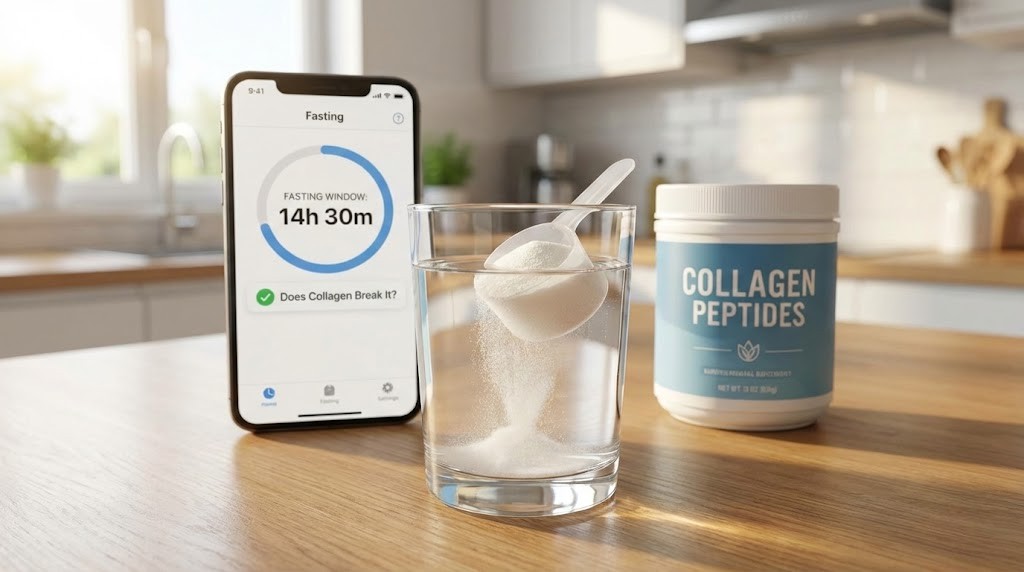
Some sources say any calories break a fast. Others claim collagen won't impact autophagy. Some fasting experts say protein is the worst thing to consume while fasting, while wellness influencers drink collagen coffee every morning claiming it's "fasting-friendly."
You need clear, science-based answers about whether collagen peptides break your fast.
Yes, collagen peptides technically break a fast because they contain calories (35-40 per serving) and protein, which triggers an insulin response and stops autophagy.
However, for intermittent fasting focused on weight loss and metabolic benefits (not strict autophagy), small amounts of collagen (10g or less) have minimal impact. The answer depends on your fasting goal - autophagy and longevity require strict water-only fasting, while metabolic benefits tolerate small amounts of collagen.
This guide breaks down exactly how collagen affects different types of fasts, whether collagen stops autophagy, insulin response from collagen peptides, when you can take collagen without breaking your fast, alternative fasting-safe peptides, and protocols for combining fasting with peptide supplementation.
Let's start with understanding what "breaking a fast" actually means.
What does it mean to "break a fast"
Breaking a fast isn't black and white - it depends on your fasting goals.
Different types of fasting have different rules
Water-only fasting (strictest):
Zero calories allowed
Only water, black coffee (unsweetened), tea (unsweetened)
Maintains deepest autophagy
Most strict definition of fasting
Intermittent fasting for weight loss:
<50 calories often considered acceptable
Small insulin response tolerated
Focus on calorie restriction and eating window
More flexible
Intermittent fasting for autophagy:
Near-zero calories required
Protein especially problematic (mTOR activation)
More strict than weight loss IF
Similar rules to water fasting
Fasting mimicking diet:
Small amounts of specific nutrients allowed
Designed to keep fasting benefits while eating
Very low protein, moderate fat, minimal carbs
Learn about peptides in general in our what are peptides guide and how peptides work.
Why different fasting goals have different rules
For weight loss and metabolic health:
Primary mechanism: Calorie restriction and insulin control
Small amounts of nutrients (<50 cal) have minimal impact
Focus on eating window vs fasting window
Collagen might be acceptable in small amounts
For autophagy and longevity:
Primary mechanism: Cellular cleanup and protein recycling
Protein intake stops autophagy (activates mTOR)
Need deep fasting state
Collagen definitely breaks this type of fast
For gut rest and digestive healing:
Primary mechanism: Giving digestive system a break
Any food, including collagen, activates digestion
Collagen breaks this fast
What happens when you consume collagen
Biological response to collagen peptides:
Insulin spike (protein triggers insulin release)
mTOR activation (cell growth pathway turns on)
Autophagy stops (cell cleanup halts)
Digestion activated
Fasting state interrupted
How significant is this response:
Depends on amount (10g vs 20g makes difference)
Depends on individual insulin sensitivity
Depends on what else is consumed with it
Depends on how long you've been fasting
Does collagen peptides break a fast?
Let's break this down by fasting type.
For water-only fasting: YES, collagen breaks your fast
Why:
Contains 35-40 calories per serving (10g)
Contains protein (amino acids)
Triggers insulin response
Activates mTOR (stops autophagy)
Stimulates digestion
The science:
Any caloric intake breaks a true water fast
Protein is particularly problematic for autophagy
Even small amounts stop the deep fasting state
Verdict: If you're doing a strict water fast, do not consume collagen during fasting hours.
For intermittent fasting (weight loss focus): MAYBE, depends on amount
Small amounts (10g or less) may be acceptable:
~35-40 calories (minimal)
Doesn't significantly impact fat burning
Insulin spike is small and temporary
Many practitioners consider this "fasting-friendly"
Larger amounts (20g+) likely break your fast:
70-80+ calories
More significant insulin response
Greater impact on fasting benefits
Practical reality:
Purists say anything breaks the fast
Flexible approach: <50 calories acceptable
Individual results vary
Verdict: For weight loss-focused IF, small amounts of collagen (10g or less) probably won't ruin your results, but it's not technically fasting.
For autophagy-focused fasting: YES, collagen definitely breaks your fast
Why autophagy is sensitive to protein:
Protein (amino acids) activates mTOR pathway
mTOR activation stops autophagy
This is biological, not negotiable
Even small amounts of protein impact autophagy
The specific issue with collagen:
Rich in glycine, proline, hydroxyproline
These amino acids signal "nutrients available"
Body stops cellular cleanup (autophagy)
Switches to growth/building mode (mTOR)
Research findings:
Studies show protein intake stops autophagy rapidly
Even 10g protein can activate mTOR
Takes hours to re-enter deep autophagy after eating
Verdict: If your primary goal is autophagy (anti-aging, longevity, cellular health), do not consume collagen during fasting. It defeats the purpose.
See our peptides for anti-aging for longevity strategies.
How collagen affects insulin and autophagy
Understanding the mechanisms clarifies why collagen impacts fasting.
Insulin response from collagen peptides
What happens:
Collagen peptides are protein
Protein consumption triggers insulin release
Insulin signals "fed state" to body
Fat burning slows or stops temporarily
How significant is the insulin spike:
Smaller than carbohydrates
Smaller than whey protein
But still present and measurable
Enough to impact fasting benefits
Individual variation:
Insulin-sensitive people: Bigger impact
Insulin-resistant people: May have larger spike
Metabolically healthy: Faster return to fasting state
mTOR activation and autophagy
What is mTOR:
Mechanistic target of rapamycin
Master growth regulator in cells
Activated by: Protein, insulin, nutrients
Inhibited by: Fasting, calorie restriction
Why mTOR matters for fasting:
mTOR ON = growth, building, no autophagy
mTOR OFF = repair, cleanup, autophagy active
Fasting benefits come from mTOR being OFF
How collagen activates mTOR:
Amino acids (especially leucine) activate mTOR
Collagen contains amino acids
mTOR turns on within minutes of consuming protein
Autophagy stops
How long does mTOR stay activated:
2-4 hours after protein intake
Depends on amount consumed
Delays return to deep fasting state
Timeline: How fast does collagen break autophagy
Consumption to mTOR activation:
15-30 minutes: Amino acids absorbed
30-60 minutes: mTOR activated
1-2 hours: Autophagy significantly reduced
2-4 hours: mTOR gradually decreasing
Return to autophagy:
4-6 hours: Fasting state returning
12-16 hours: Deep autophagy resumes
Essentially restarts your fasting clock
Collagen peptides vs other proteins during fasting
How collagen compares to other protein sources.
Collagen vs whey protein
Whey protein:
Higher in leucine (more mTOR activation)
Causes bigger insulin spike
More problematic for fasting
Verdict: WORSE than collagen for fasting
Collagen:
Lower in leucine
Smaller insulin response than whey
Still breaks fast, but less dramatically
Verdict: Better than whey, but still breaks fast
Collagen vs BCAAs (branched-chain amino acids)
BCAAs:
Pure amino acids (leucine, isoleucine, valine)
Strongly activate mTOR
Market as "fasting-friendly" (misleading)
Verdict: Break fast significantly
Collagen:
Contains many amino acids, not just BCAAs
Similar mTOR activation
Both break autophagy-focused fasts
Verdict: Equally problematic for strict fasting
Collagen vs bone broth
Bone broth:
Contains collagen/gelatin naturally
Also has some minerals and fat
~40-50 calories per cup
Similar impact to collagen powder
Collagen peptides:
Concentrated collagen protein
35-40 calories per serving
Essentially same as bone broth collagen
Verdict: Bone broth and collagen peptides have similar fasting impact.
See our bone broth vs collagen peptides comparison.
When to take collagen if you're fasting
Strategic timing preserves both fasting and collagen benefits.
Best times to take collagen while intermittent fasting
Option 1: During eating window (safest)
Take collagen when you break your fast
No conflict with fasting goals
All benefits of collagen, no impact on fasting
Best approach for autophagy-focused fasters
Option 2: End of fasting window (flexible IF)
Take collagen 30-60 minutes before eating window
"Softens" the transition back to fed state
Acceptable if weight loss is primary goal
Not ideal for autophagy
Option 3: With first meal
Add collagen to morning coffee/smoothie when breaking fast
Enhances satiety
Supports protein intake
No fasting conflict
Timing collagen for maximum benefits
For skin, hair, nails:
Consistency matters more than timing
Can take anytime during eating window
Daily use most important
For gut healing:
Take collagen with meals
Supports gut lining throughout eating window
Consider morning and evening doses
For joint health:
Take before or after workouts (during eating window)
Supports connective tissue repair
Pre-bed dose may help overnight repair
16:8 intermittent fasting example
Fasting window: 8 PM - 12 PM (16 hours)
Do NOT take collagen during this time
Stick to water, black coffee, tea
Eating window: 12 PM - 8 PM (8 hours)
12 PM: Break fast with meal, include collagen
3 PM: Optional collagen if desired
7 PM: Dinner, can include collagen
Result: Get collagen benefits without breaking fast.
Fasting-safe peptides (non-collagen options)
Some peptides don't break fasts because they're not consumed orally.
Injectable peptides don't break fasts
Why injectable peptides are fasting-safe:
Not consumed orally
No calories ingested
No digestive process
Minimal to no insulin response
Autophagy typically maintained
Examples of fasting-safe injectable peptides:
BPC-157 (injury healing)
TB-500 (tissue repair)
CJC-1295 + Ipamorelin (energy, recovery)
Semax (cognitive function)
Epithalon (longevity)
Using these while fasting:
Can inject during fasting window
Doesn't break metabolic fast
Doesn't stop autophagy (for most)
Allows fasting + peptide benefits simultaneously
See our BPC-157 guide, TB-500 guide, how to take BPC-157, and is BPC-157 banned.
Growth hormone peptides and fasting synergy
CJC-1295 + Ipamorelin during fasting:
Actually complement fasting
Fasting increases GH naturally
These peptides further enhance GH
Synergistic benefits for fat loss and autophagy
Protocol:
Inject during fasting window (morning or pre-workout)
Doesn't break fast
Enhances fasting benefits
Optimal for body composition
Use our CJC-1295 dosage calculator and see Ipamorelin benefits.
BPC-157 for gut healing while fasting
Why this combination works:
Fasting gives gut a rest
BPC-157 heals gut lining
Injectable BPC-157 doesn't interrupt fast
Powerful combo for gut issues
Protocol:
Fast 16-18 hours daily
Inject BPC-157 during fasting window
Get both gut rest AND healing
Strategies for combining collagen and fasting
How to get benefits of both without compromising either.
Strategy 1: Strict fasting, collagen during eating window
Best for: Autophagy, longevity, serious fasters
Protocol:
Fast 16-20 hours daily (water only)
Break fast with meal containing collagen
Take additional collagen later in eating window if desired
No collagen during fasting hours
Benefits:
Maximum autophagy during fast
Full collagen benefits during eating
No compromise on either goal
Example schedule (18:6 fast):
6 PM - 12 PM: Water fast (no collagen)
12 PM: Break fast with collagen in smoothie/coffee
3 PM: Optional second collagen dose
6 PM: Dinner with collagen-rich foods or supplement
Strategy 2: Flexible IF with small collagen dose
Best for: Weight loss, metabolic health, less strict fasters
Protocol:
Fast 14-16 hours
Small collagen dose (10g) at end of fast
Considered "dirty fasting" but works for weight loss
Full autophagy not achieved but metabolic benefits maintained
Benefits:
Consistent collagen intake
Still get most IF benefits
More sustainable long-term
Better compliance
Example schedule (16:8 fast):
8 PM - 11:30 AM: Water fast
11:30 AM: 10g collagen in coffee
12 PM: First meal
8 PM: Eating window closes
Strategy 3: Alternate day approach
Best for: Balance between strict fasting and collagen benefits
Protocol:
Strict water fasting days: No collagen
Regular eating days: Normal collagen intake
Alternating pattern
Example:
Monday, Wednesday, Friday: 24-hour water fasts (no collagen)
Tuesday, Thursday, Saturday, Sunday: Normal eating with collagen
Benefits:
Deep autophagy on fasting days
Consistent collagen on eating days
Best of both worlds
Strategy 4: Use injectable peptides instead
Best for: Those wanting peptide benefits without breaking fast
Protocol:
Continue strict fasting (16-20 hours daily)
Use injectable peptides for health goals:
BPC-157 for gut and tissue healing
TB-500 for injury recovery
CJC + Ipamorelin for energy and body composition
GHK-Cu for anti-aging
Save oral collagen for eating window if desired
Benefits:
Maintain strict fast
Get powerful peptide benefits
Can address same goals as collagen (healing, recovery)
No insulin spike or mTOR activation
See our peptide stacks guide for combining peptides.
Common myths about collagen and fasting
Clearing up misconceptions.
Myth 1: "Collagen doesn't break a fast because it has minimal calories"
Truth: Any calories technically break a fast. The question is whether it breaks YOUR specific fasting goal. For weight loss, small amounts might be acceptable. For autophagy, any protein breaks the fast regardless of calories.
Myth 2: "Collagen is different from other proteins and doesn't affect insulin"
Truth: Collagen is protein. Protein triggers insulin. Collagen has a smaller insulin response than whey, but it still exists. Don't believe marketing claims that collagen is magically "fasting-friendly."
Myth 3: "BCAAs and collagen keep you in a fasted state"
Truth: Both BCAAs and collagen activate mTOR and stop autophagy. The supplement industry markets these as "fasting-friendly" to sell products, but science says otherwise. They break autophagy-focused fasts.
Myth 4: "Adding collagen to coffee doesn't break a fast"
Truth: Putting collagen in your morning coffee absolutely breaks your fast. It's become popular in wellness circles, but it's not fasting. It's a protein coffee. If weight loss is your only goal and you're okay with "dirty fasting," that's your choice, but don't pretend it's true fasting.
Myth 5: "You need collagen for autophagy"
Truth: You don't need to consume collagen during fasting. Autophagy actually recycles damaged proteins in your body, including collagen. Your body can make its own collagen from amino acids. Take collagen during eating window if you want, but it's not necessary during fasting.
Fasting types and collagen compatibility
Complete breakdown by fasting style.
Fasting Type | Can You Take Collagen? | When to Take It | Why/Why Not |
|---|---|---|---|
Water-only fast | NO | During eating periods only | Breaks fast completely, stops autophagy |
Intermittent fasting (weight loss) | MAYBE | End of fast or eating window | Small amounts (<10g) minimally impact fat loss |
Intermittent fasting (autophagy) | NO | Eating window only | Activates mTOR, stops cellular cleanup |
16:8 IF | MAYBE | 30 min before eating window | Flexible fasters may accept this |
18:6 IF | NO (strict) / MAYBE (flexible) | During 6-hour eating window | Depends on goals |
OMAD (one meal a day) | NO during fast | With your one meal | Take with meal or skip entirely |
5:2 diet | NO on fasting days | On regular eating days | 500-600 cal limit on fast days, collagen uses too much |
Alternate day fasting | NO on fasting days | On eating days | Clear separation |
Extended fasting (24+ hours) | NO | After breaking fast | Deep autophagy requires zero protein |
Fasting mimicking diet | MAYBE small amount | Within FMD meal plan | FMD allows minimal protein |
Key takeaway: The stricter your fast and the more you care about autophagy, the less compatible collagen becomes.
Scientific perspective on fasting and protein intake
What research says about protein during fasting.
Studies on autophagy and protein
Key research findings:
Protein (amino acids) directly inhibit autophagy
mTOR activation stops autophagic flux
Even small amounts of protein impact cellular cleanup
Leucine is particularly problematic for autophagy
Application to collagen:
Collagen contains amino acids
Will activate mTOR pathway
Stops autophagy activation
Takes hours to return to fasted state
Insulin response research
Studies show:
All protein causes insulin secretion
Magnitude varies by protein type
Collagen causes less insulin response than whey
But response is still measurable and significant
Practical implications
For serious fasters:
Follow the science: protein breaks autophagy fasts
Save collagen for eating windows
Don't believe marketing over biology
For flexible approach:
Small amounts (<10g) minimally impact weight loss
Won't achieve maximum autophagy
Acceptable tradeoff for some people
How you can use SeekPeptides for fasting protocols
SeekPeptides helps you optimize fasting protocols with injectable peptides that don't break your fast. Get personalized guidance on using BPC-157, TB-500, or growth hormone peptides during fasting windows to enhance your results without stopping autophagy.
Learn which peptides are fasting-safe and which must be taken during eating windows.
Our AI advisor provides answers about combining specific peptides with different fasting styles, optimal timing for peptide administration around fasting, and how to maximize both fasting and peptide benefits.
Access our research library covering fasting science, autophagy mechanisms, and peptide protocols. Use our calculators - peptide calculator, BPC-157 dosage calculator, peptide cost calculator - to plan your fasting-compatible peptide protocols.
Final thoughts
Does collagen peptides break a fast? Yes, technically it does. Collagen contains calories and protein, triggers insulin release, and activates mTOR, which stops autophagy. For strict water fasting or autophagy-focused fasting, collagen absolutely breaks your fast.
For intermittent fasting focused primarily on weight loss and metabolic benefits, small amounts of collagen (10g or less) have minimal practical impact, though it's still not true fasting. Whether you choose to include it depends on how strict you want to be versus how much you value the collagen benefits.
The best approach for most people: take collagen during your eating window. This gives you full autophagy benefits during fasting and complete collagen benefits when eating. No compromise, maximum benefit from both.
If you want peptide benefits during fasting hours, use injectable peptides like BPC-157, TB-500, or CJC-1295 + Ipamorelin.
These don't break your fast and can actually enhance fasting benefits for fat loss, healing, and longevity.
Your fasting goals determine your rules. Autophagy and longevity require strict adherence - no collagen during fasting. Weight loss and metabolic health tolerate more flexibility - small amounts of collagen may be acceptable. Choose based on your priorities.
The path to optimal health combines fasting and supplementation strategically, not randomly. Take collagen when it won't compromise your fast, or use fasting-safe injectable peptides for comprehensive benefits without breaking your fasted state.
Helpful resources for fasting and peptides
Peptide calculator - Calculate doses
BPC-157 dosage calculator - BPC-157 dosing
TB-500 dosage calculator - TB-500 dosing
CJC-1295 dosage calculator - GH peptide dosing
Peptide cost calculator - Budget protocols